Category Archives: Travel

The plain of Acco: Acco, Aczib, Ladder of Tyre

The coastal cities of Acco and Aczib (Achzib) were allotted to the tribe of Asher in the days of Joshua (Joshua 19:24-31). According to this text the territory reached from (Mount) Carmel on the south to Great Sidon on the north. Israel was not able to control all of the territory

Geographers describe the coastal portion of Asher as the plain of Acco.

Asher did not drive out the inhabitants of Acco, or the inhabitants of Sidon, or of Ahlab, or of Achzib, or of Helbah, or of Aphik, or of Rehob. (Judges 1:31 NAU)

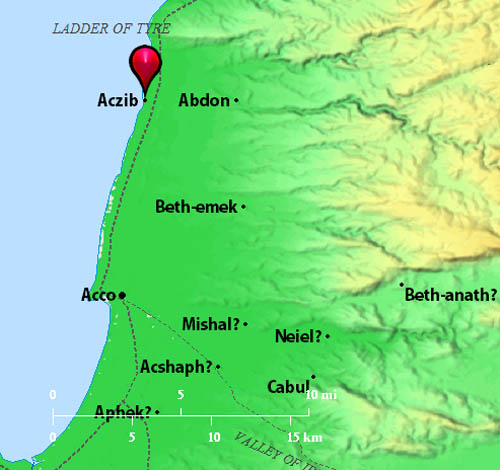
The map below, intended to show the location of Aczib, shows the coastal area from Mount Carmel (where Haifa is located) to the Ladder of Tyre. The Ladder of Tyre is a natural formation that has served as a border between Israel and Lebanon during many historical periods. Within this territory you see Acco and Aczib.

Aczib, plain of Acco in Asher. BibleMapper.org.

Map showing Plain of Acco in tribe of Asher. BibleMapper.org.

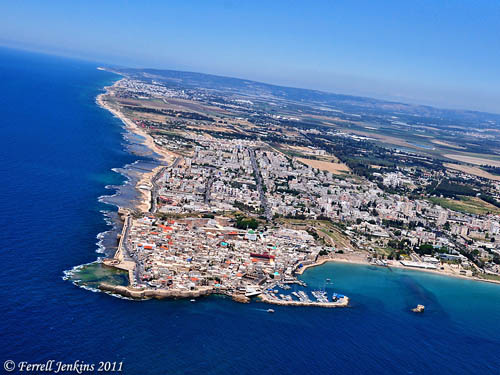
In the aerial photo below you will see the view north from Acco, including the Crusader city, to the ladder of Tyre. The total distance is about 20 miles.

Aerial view north from Acco to the Ladder of Tyre. Photo by Ferrell Jenkins.

Aerial view north from Acco to the Ladder of Tyre. Photo by Ferrell Jenkins.

In New Testament times the city of Acco was know as Ptolemais. The only biblical reference to the city is in the account of Paul’s return from his third journey. From Tyre to Ptolemais is a distance of about 45 miles. Paul and his companions stayed stayed seven days at Tyre, but only one day at Ptolemais.

When we had finished the voyage from Tyre, we arrived at Ptolemais, and after greeting the brethren, we stayed with them for a day. On the next day we left and came to Caesarea, and entering the house of Philip the evangelist, who was one of the seven, we stayed with him. (Acts 21:7-8 NAU)

In a subsequent post we plan to show you the Plain of Acco between Mount Carmel (Haifa) and Acco.

Monday meandering — August 1

My upgrade to BibleWorks 9 arrived about a week ago. I am enjoying getting acquainted with some of the new features and resources. For information see here.

Bible Works 9

Mark Hoffman has given a sort of pre-review at his Biblical Studies and Technology Tools website here. Hoffman was a beta tester for the new version.

Hoffman also talks about Logos for Android here. As a user of Logos (Libronix) I was delighted to see this beta app for the Android. I am enjoying access to many of the Logos books and have downloaded a couple of significant volumes.

Carl Rasmussen, author of Zondervan’s Atlas of the Bible, recently visited a well preserved portion of the Caesarea aqueduct. But it is not the portion of the aqueduct that most tourists see immediately north of Caesarea. This portion is about 3 miles north-northwest of Caesarea. Nice photos included on his HolyLandsPhoto blog here.

Carl also reports that a new paved road now goes directly to Yodfat (Jotapata). This is an improvement over the hour long walk to the site. See here. He visited Qumran, caves 1 and 11. See here.

Since I wrote the two paragraphs above there is a new post about the Middle Bronze I Age tombs (2200-2000 B.C.) located about 16 miles northeast of Jerusalem at Dhahr Mirzbaneh (east of Ein Samiya). Click here.

These three posts by Prof. Rasmussen include photos with a link to additional photos at his Holy Land Photos site.

The Center for the Study of New Testament Manuscripts (CSNTM) announces that they have added Free Audio and Video at iTunes U.

The Center for the Study of New Testament Manuscripts (CSNTM) has always been committed to helping others understand the reliability of our New Testaments, the history of translations, the study of the text, and significant figures who have made this possible.

Beginning today, CSNTM is making a series of videos concerning New Testament manuscripts, textual criticism, history of the New Testament, and expert commentary on key verses available as a free download on iTunes U.

Featured in the videos are interviews and footage shot around the world of important people involved in the work of the Center. Dr. Daniel B. Wallace will also be featured as he explains important aspects in the study of the text of the New Testament.

CSNTM homepage is here. The direct link to the series on Biblical Criticism at iTunes U is here. Inexpensive way to get a great education. Daniel Wallace does a superb job with these presentations. Take some time to listen and study.

Dr. Wallace will debate Bart D. Ehrman at SMU in Dallas Saturday October 1 on the subject Can We Trust the Text of the New Testament? There is a charge for admission, but perhaps this material will be available later on audio/video. Info here.

Tomb of Philip found at Hierapolis?

Italian professor Francesco D’Andria announced the discovery of the tomb of the Apostle Philip at Hierapolis. See more, with a photo, here.

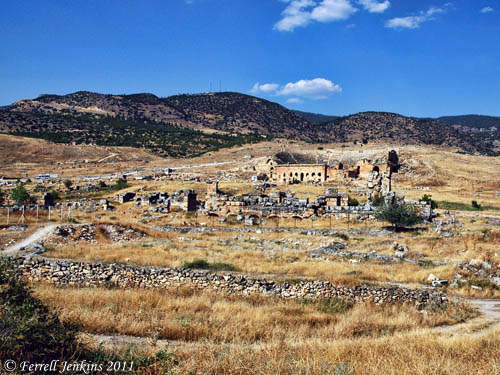
The structure at Hierapolis known as the Martyrium of Philip dates to the 5th century A.D. It is located in the distance above the theater.

Hierapolis. The Martyrium of Philip is in the distance beyond the theater. Photo by Ferrell Jenkins.

The Martyrium of Philip is in the distance beyond the theater. Photo by F. Jenkins.

Early tradition associates Philip with the city, but scholars differ over whether it was Philip the apostle (Matthew 10:3) or Philip the evangelist (Acts 21:8). The brief reports of the discovery by Prof. D’Andria does not provide enough information for us to be able to draw a conclusion. The question of which Philip is addressed by Mark Wilson in Biblical Turkey and Fant and Reddish in A Guide to Biblical Sites in Greece and Turkey. I will leave it for the moment.

This new discovery will more likely reflect the 5th century Byzantine tradition about Philip.

Hierapolis is mentioned only once in the New Testament, as one of the cities of the Lycus River Valley.

For I bear him witness that he has worked hard for you and for those in Laodicea and in Hierapolis. (Colossians 4:13 ESV)

Hierapolis is also known as the home of Papias (about A.D. 60 to 130) who was a disciple of the apostle John and a companion of Polycarp. Fragments of his writings about the apostles survive in Irenaeus and Eusebius.

We have commented on Hierapolis several times over the years. See here. Use the Search box to locate the other posts if you have additional interest in the city.

HT: Doy Moyer

Monday meandering

The Macmillan Dictionary defines meander this way:

  • a river or road that meanders follows a path with a lot of turns and curves
  • to move slowly without a particular direction or purpose in mind
  • to talk or write for a long time, changing subjects or ideas, so that people become bored or confused

We all use the word meander, but do we know its origin? The Webster’s Revised Unabridged Dictionary of 1913 explains the origin:

a river in Phrygia, proverbial for its many windings

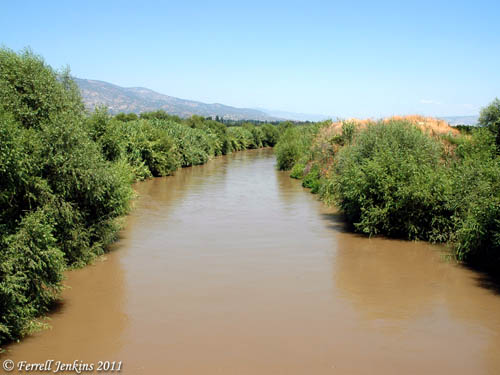
The Meander River, now in Turkey, begins northeast of the Lycus River Valley and flows southwesterly past Miletus into the Aegean Sea. The Lycus River begins southeast of the valley that bears its name and flows northwesterly past Colossae, Laodicea, and Hierapolis (Col. 4:13) until it flows into the Meander.

It would take a good aerial photo to show how the river meanders, but you can get an idea here that there are only short stretches visible at any one time before the rivers makes a turn.

Meander River near Aphrodisias, Turkey. Photo by Ferrell Jenkins.

Meander River near Aphrodisias, Turkey. Photo by Ferrell Jenkins.

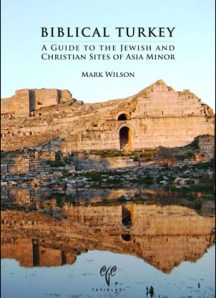
Mark Wilson, in his outstanding Biblical Turkey: A Guide to Jewish and Christian Sites of Asia Minor, comments on Phrygia.

In Acts 2:10 Jews from Phrygia are mentioned Mark Wilson, Biblical Turkey, coveramong those gathered in Jerusalem for the day of Pentecost. …

During the Roman period western Phrygia was in the province of Asia, eastern Phrygia was in the province of Galatia. Paul passed through both Galatic and Asian Phyrgia on his way to Troas on his second journey (Acts 16:6) and to Ephesus on his third journey (Acts 18:23). During Paul’s time in Ephesus churches were established in the Phrygian cities of Laodicea, Hierapolis, and Colossae (Colossians 1:2; 4:13,16). (page 188)

Thanks for meandering through Bible lands with me. We will use the river as our new header for a while.

Excavations at Shechem

Dutch and Palestinian archaeologists are working at Tel Balata, the site of biblical Shechem, under the auspices of the Palestinian Department of Antiquities. The Associated Press report in Ha’aretz provides a brief summary of archaeological work at the site over the past century. Fox News reports on the excavation here.

We wrote about a visit to Shechem, with a summary of the biblical history of the site, here.

Other significant posts are listed for your convenience.

  • The Temple of Baal-Berith at Shechem here.
  • The Entrance to the Temple of Baal-Berith here.
  • The Sacred Standing Stone at Shechem here.

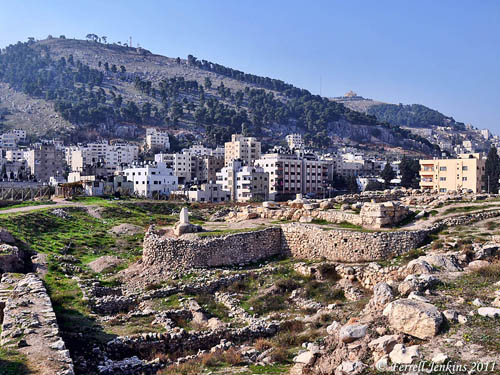
The photo below was made in December, 2009. The site of Shechem is in the foreground. Mount Gerizim is in the distance. Notice how the apartment buildings are crowded around the archaeological park. The site was in fairly good condition at the time, but there were no signs marking the ruins.

View of Mount Gerizim from Shechem. Photo by Ferrell Jenkins.

View of Mount Gerizim from Shechem. Photo by Ferrell Jenkins in 2009.

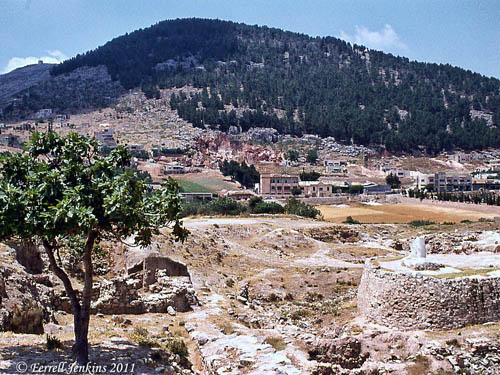
Below is a photo I made in 1973. Notice that there are more trees on Mount Gerizim, and fewer buildings around Tel Balata.

View of Mount Gerizim from Shechem. Photo by Ferrell Jenkins in 1973.

View of Mount Gerizim from Shechem. Photo by Ferrell Jenkins in 1973.

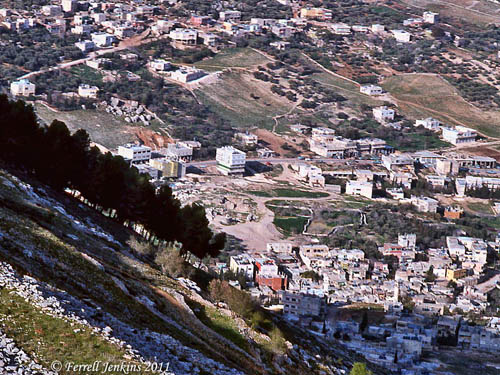
This next photo was made from atop Mount Gerizim in 1982. Ancient Shechem is located near the center of the photo below the line of trees. The location of Jacob’s Well is just out of the photo on the right.

A view of Shechem from Mount Gerizim in 1982. Photo by Ferrell Jenkins.

A view of Shechem from Mount Gerizim in 1982. Photo by Ferrell Jenkins.

Shechem has never been a very popular stop for tourists. Many will stop to see Jacob’s well without knowing that this important biblical site is just blocks away. We are delighted to know that archaeological work is going on in the West Bank Palestinian territory.

HT: Joseph Lauer, Brooks Cochran.

Unique golden bell found in Jerusalem drain

Arutz Sheva (Israel National News.com) reports that archaeologists have “discovered a rare gold bell with a small hook at its end.”

The directors of the excavation on behalf of the Antiquities Authority, archaeologists Eli Shukron and Professor Ronny Reich of Haifa University, said after the finding, “The bell looked as if it was sewn on the garment worn by a man of high authority in Jerusalem at the end of the Second Temple period.

“The bell was exposed in the city’s main drainage channel of that period, between the layers of dirt that had been piled on the floor of the channel,” they continued. “This drainage channel was built and hewn west to the Western Wall of the Temple Mount and drained the rainfall in the different parts of the city, through the City of David and the Shiloah Pool to the Kidron valley.”

The excavation area, above the drain, is located in the main street of Jerusalem which rose from the Shiloah Pool in the City of David. In this street an interchange was built through which people entered the Temple Mount. The remains of this interchange are what is known today as Robinson’s Arch. Archaeologists believe that the eminent man walked the streets of Jerusalem in the area of Robinson’s Arch and lost the golden bell which fell off his outfit into the drain beneath the street.

The full news report may be read here.
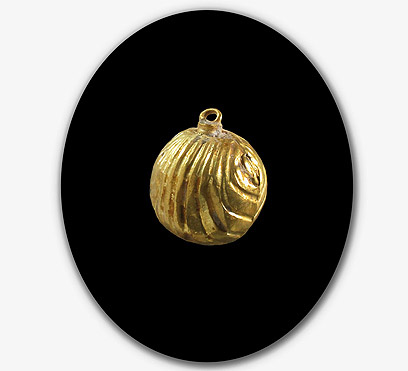
Golden bell found in Jerusalem drain. Photo: ynet.co.il.

Golden bell found in Jerusalem drain. Photo: IAA.

The best I can tell from the description of the location is that it is near the area of Robinson’s Arch. We saw workmen at the northern end of the drainage channel about which we have reported earlier (here) during our visit to the area in May. I understand that eventually the channel will be open all the way from the A.D. 70 street below Robinson’s Arch to the Pool of Siloam. I have lightened the area under the grill so you can see the workman’s arm.
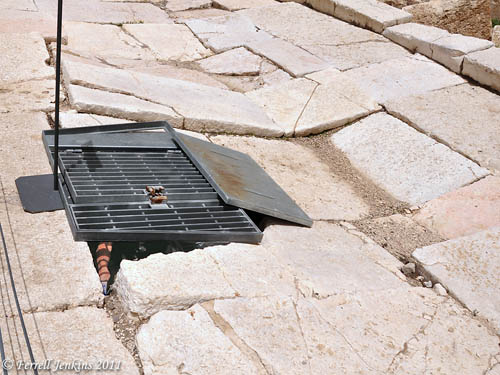
Opening in A.D. 70 street below Robinson's Arch. Photo by Ferrell Jenkins.

Opening in A.D. 70 street below Robinson's Arch. Photo by Ferrell Jenkins.

I note in the news report that the archaeologists did not rule out the possibility that this bell might have belonged to one of the high priests. Actually, one can not rule out much of anything with so little information. My first thought almost simultaneously was the bells on the garments of the high priest and a woman’s jewelry. Note the earlier discovery of jewelry here.

The adornment of the priestly garment is described in Exodus.

“You shall make on its hem pomegranates of blue and purple and scarlet material, all around on its hem, and bells of gold between them all around:  a golden bell and a pomegranate, a golden bell and a pomegranate, all around on the hem of the robe. (Exodus 28:33-34 NAU)

Jim Davila, at Paleojudaica, comments wisely on the suggestion that this bell might have belonged to a priest or a man of high authority:

Well, maybe. On the one hand it is true that the only references to golden bells in the Hebrew Bible are to bells on the vestments of the high priest (Exodus 28:33-34; 39:25-26). On the other hand, first, the only other mention of bells (a different Hebrew word) refers to horses’ trappings (Zechariah 14:20). Presumably, bells were used in many other contexts, so our sample of cultural allusions is limited. But, you say, what about golden bells? Well, second, Isaiah 3:16-18 refers to bangles that the rich women of Jerusalem wore on their ankles and which “tinkled” or made some kind of bangle noise. These ladies clearly had lots of jewelery and finery (cf. also vv. 19-23), so it seems entirely likely that they sometimes wore bells as jewelry and that some of those bells might well have been made of gold. And we know that Second-Temple-era ladies in Jerusalem had very nice gold earrings. So this bell need not have come from “a man of high authority.”

The Christian Standard Bible translation of Isaiah 3:16 is vivid:

The LORD also says: Because the daughters of Zion are haughty, walking with heads held high and seductive eyes, going along with prancing steps, jingling their ankle bracelets, (Isaiah 3:16 CSB)

HT: Joseph Lauer

Peeking into the Great Rift Valley

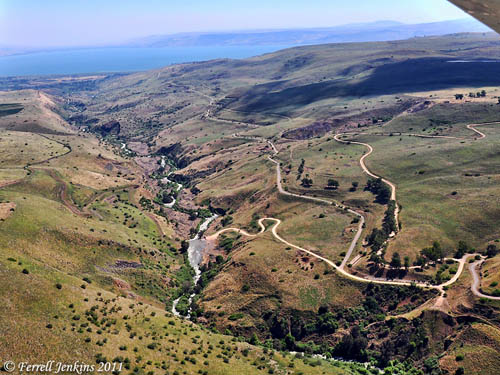
The natural depression that runs from northern Syria, through Lebanon, Israel/Jordan, continuing into the Gulf of Eilat/Aqaba, into eastern Africa, is known as the Great Rift. This rift has an important effect on travel and the life of the people of the area — perhaps more in ancient times than now.

This aerial view was made south of Lake Huleh, looking south toward the Sea of Galilee. You can see the Jordan River descending from north to south. Glueck calls this the Jordan Rift.

Jordan Valley north of the Sea of Galilee. Photo by Ferrell Jenkins.

The Jordan Valley north of the Sea of Galilee. Photo by Ferrell Jenkins.

The elevation at Lake Huleh is 230 feet above sea level. By the time the Jordan River flows into the Sea of Galilee, ten miles south, the elevation of about 700 feet below sea level. This is the area of most rapid descent.

Nelson Glueck describes this portion of the Jordan River.

…it tears out on a run that, for some distance, brooks no restraint. It tumbles and cascades almost continuously through a forbidding, black basalt gorge. Foaming and muddy, it bursts out of the ravine. Then, collecting itself somewhat, it wriggles its way for about another mile through a small plain and a delta of its own making into the clear waters of the Lake of Galilee. (The Jordan River, 35)

Jordan River baptism site reported to be open

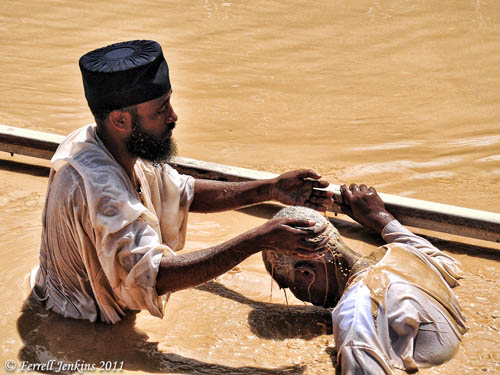
Several media outlets have reported the permanent opening of the Qasr el-Yahud Baptismal site. Our group made arrangements to visit the site May 3, but we had to wait for military personnel to open the gate. Some construction work was going on, and the road to the site needed repair. See here. See earlier reports here, and here.

Some reports have warned about the impurity of the water. I advised my group not to touch it. A group of Ethiopians were dipping themselves, dipping others, and pouring water on themselves while we were there. A hand full of water looked like mud as it left the hand.

Ethiopians in the Jordan River at Qasr el-Jahud. Photo by Ferrell Jenkins.

Ethiopians in the Jordan River at Qasr el-Yahud. Photo by Ferrell Jenkins.

Personally I understand baptism to be a one-time act “for the forgiveness of your sins” (Acts 2:28; 8:12; Matthew 28:19; Mark 16:16; Romans 6:3-4; et al.).

Bible students like to visit the Jordan River at this site for several reasons.

  • Ancient Israel crossed the Jordan to enter the promised land (Joshua 3).
  • Elijah and Elisha crossed the river (2 Kings 2).
  • John baptized in the Jordan (Matthew 3:6ff.; Mark 1:5-9; John 1:28; 10:40).
  • Jesus was baptized in the Jordan (Matthew 3:13).
  • Naaman dipped in the Jordan at a site further north (2 Kings 5).

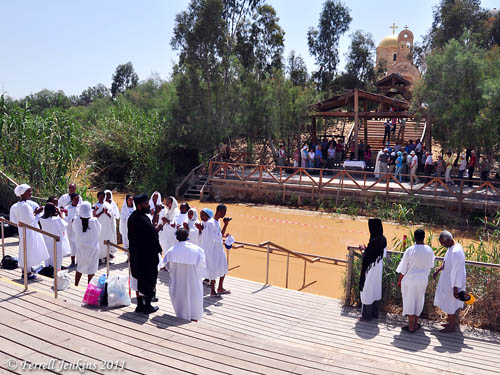
The view was made from the West Bank site looking northeast. A group of western pilgrims are visible on the (Hashemite Kingdom of) Jordan side of the river.

Jordan River Baptismal Site. Photo by Ferrell Jenkins.

Jordan River Baptismal Site. View to the NE. Photo by Ferrell Jenkins.

HT: Bible Places Blog.

Sunrise on the Sea of Galilee – May 4, 1968

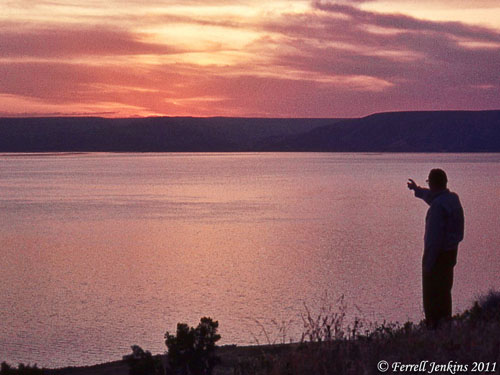
On my second tour to Israel in 1968 my group stayed at the Guberman Hotel in Tiberias. My room mate and I set our alarm for Saturday, May 4, in time to go down the hill to get an unobstructed view of the Sea and the sunrise to the East. This slide was made on Agfachrome.

Sunrise at the Sea of Galilee. May 4, 1968.

Sunrise at the Sea of Galilee - May 4, 1968.

Over the years I have made numerous similar photos. I always think about Jesus meeting His disciples after the resurrection on the shore of the Sea of Galilee and eating breakfast with them.

4 Just as day was breaking, Jesus stood on the shore; yet the disciples did not know that it was Jesus.
5 Jesus said to them, “Children, do you have any fish?” They answered him, “No.”
6 He said to them, “Cast the net on the right side of the boat, and you will find some.” So they cast it, and now they were not able to haul it in, because of the quantity of fish.
7 That disciple whom Jesus loved therefore said to Peter, “It is the Lord!” When Simon Peter heard that it was the Lord, he put on his outer garment, for he was stripped for work, and threw himself into the sea.
8 The other disciples came in the boat, dragging the net full of fish, for they were not far from the land, but about a hundred yards off.
9 When they got out on land, they saw a charcoal fire in place, with fish laid out on it, and bread.
10 Jesus said to them, “Bring some of the fish that you have just caught.”
11 So Simon Peter went aboard and hauled the net ashore, full of large fish, 153 of them. And although there were so many, the net was not torn.
12 Jesus said to them, “Come and have breakfast.” Now none of the disciples dared ask him, “Who are you?” They knew it was the Lord.
13 Jesus came and took the bread and gave it to them, and so with the fish.
14 This was now the third time that Jesus was revealed to the disciples after he was raised from the dead. (John 21:4-14 ESV)

Luxor’s Avenue of Sphinxes set to open in October

Many changes are taking place in Luxor. The residents of certain areas are being moved from their older houses in town to new locations. All of this is happening in order to do additional archaeological work and turn the town into an even more popular tourist area. At least that is my idea of what is happening.

The Luxor Times report on the scheduled opening of the Avenue of Sphinxes here.

A grand opening is due to take place in October 2011 to celebrate the newly restored Avenue of Sphinxes.…

Lined with sphinxes, the 2.7 km [1.68 miles] route that connects the grand temples of Luxor and Karnak will be lit by the Sound and Light Company of Egypt.…

For the last 5 years, the restoration project has focused on excavation, conservation, treatment of the water table, and the establishment of protective walls and entrances for tourist. The 120 million LE [20+ million US$] project also involved relocating houses and removing roads, with full compensation paid to all those affected by the development.

The impressive avenue has long been a place of religious significance. In her red chapel in Karnak, Queen Hatshepsut (1502-1482 BC) recorded that she built six chapels dedicated to the god Amun-Re on the route. Successive construction and restoration work commenced during the reigns of Akhenaten (1353-1336 BC), Tutankhamun (1336-1327 BC) and Horemheb (1323-1295 BC).

King Nectanebo I (380-362 BC) of the 30th Dynasty constructed the Avenue of Sphinxes on the older path. It was used for religious ceremonies and processions, marking the annual journey of the sacred boat of Amun on the god’s visit to his wife, Mut, at Luxor temple. An inscription from this time reads “I have built a beautiful road for my father Amun-Re surrounded by walls and decorated with flowers for the journey to the temple of Luxor”. Another inscription bears a cartouche for Queen Cleopatra. It is most likely to be from her visit to the avenue during a Nile trip with Mark Anthony.

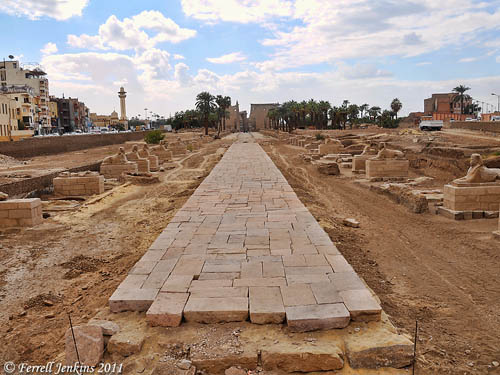
Here is a photo I made of a portion of the Avenue of Sphinxes with a view toward the Luxor Temple.

Avenue of Sphinxes with view toward Luxor Temple. Photo by Ferrell Jenkins.

Avenue of Sphinxes with view toward Luxor Temple. Photo by Ferrell Jenkins.

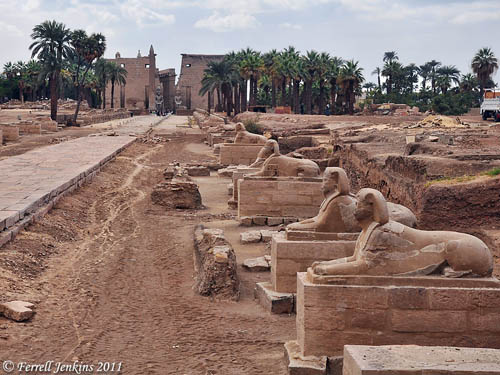
And here is a closer view.

Avenue of Sphinxes with a view view the Luxor Temple. Photo by Ferrell Jenkins.

Avenue of Sphinxes with a view toward the Luxor Temple. Photo by Ferrell Jenkins.

Luxor was known as Thebes in Old Testament times. Both Jeremiah and Ezekiel prophesied the Lord’s judgment of the city. Jeremiah says,

The LORD of hosts, the God of Israel, says, ‘Behold, I am going to punish Amon of Thebes, and Pharaoh, and Egypt along with her gods and her kings, even Pharaoh and those who trust in him’” (Jeremiah 46:25; see also Ezekiel 30:14-16).

HT: Bible Places Blog