Category Archives: Travel

The Bosporus

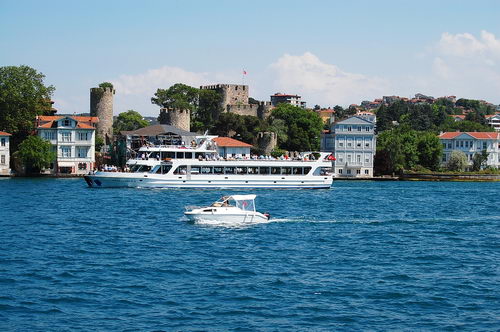
I think on all of my tours to Istanbul we have included and enjoyed a boat ride along the Bosporus (Bosphorus), vital waterway linking the Black Sea to the Mediterranean Sea. The Asian side was known as Bythinia in Roman times. Peter addressed his epistles to the saints in various parts of modern Turkey (1 Peter 1:1).

Today there is an interesting article in The New York Times about a boat ride on the Bosporus. I suggest you check this quickly if you are interested. I don’t know how long these links remain active. Click here.

Here is one of the many beautiful photos I have made during a boat ride on the Bosporus.

A view along the Bosphorus. Photo by Ferrell Jenkins.

A view along the Bosphorus. Photo by Ferrell Jenkins.

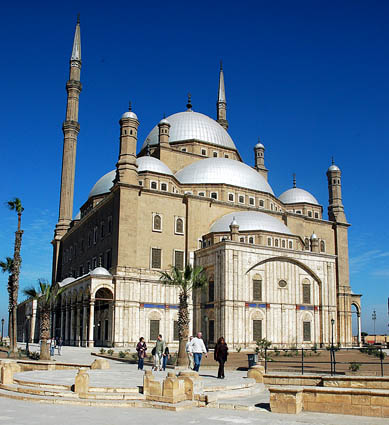
Mohammed Ali Mosque in Cairo

Mohammed (or Mohammad) Ali Alabaster Mosque in Cairo. No, not the boxer. He took the same name. Mohammed Ali was an Albanian who played a prominent role in the history of Egypt during the 19th century. He brought numerous reforms to Egypt and his influence continued until the middle of the 20th century.

Mohammed Ali Alabaster Mosque in Cairo. Photo by Ferrell Jenkins.

Mohammed Ali Alabaster Mosque in Cairo. Photo by Ferrell Jenkins.

My first visit here was in 1967. I vividly recall sitting on the floor of the mosque with the others of my group listening to our guide, Ahmad, explain about the history of the mosque and answering any questions we had about the Muslim religion. Someone asked him if one was free to be a Christian in Egypt. He said, “Yes, if you are born a Christian you are free to be a Christian.” He went on to say that one would not make a change of religion unless there was some bad motive involved.

In many countries the preaching of the gospel of Christ is not freely allowed. The very nature of the gospel assumes that one must make a change in order to be acceptable to God. Jesus makes this clear in his discussion with the Jewish leader Nicodemus. A spiritual birth is necessary for one to become a Christian.

Jesus answered, “I tell you the solemn truth, unless a person is born of water and spirit, he cannot enter the kingdom of God. (John 3:5 NET)

Temples along the Nile River

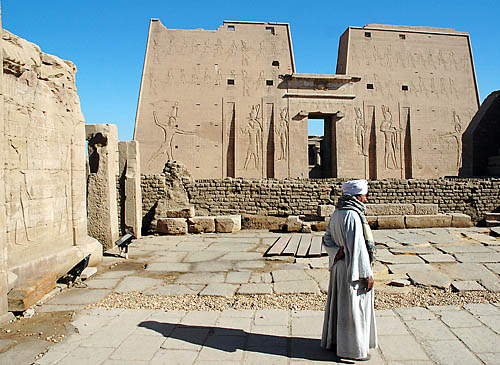
The temple of the sun god Horus at Edfu. Photo by Ferrell Jenkins.

The temple of the sun god Horus at Edfu. Photo by Ferrell Jenkins.

Edfu Temple. This is the temple of the sun god Horus who is represented by a falcon. The temple was begun by Ptolemy III in 237 B.C. and completed by 57 B.C. Ptolemy is portrayed repeatedly on the temple walls.

The Ptolemies were generally favorable to the Jews, whereas the Seleucids of Syria treated them unkindly during the period between the testaments. Ptolemy and Seleucus were generals of Alexander the Great who succeeded him in these area.

Interested in ancient Roman history?

I just ran across a website maintained by Jona Lendering that is meant to keep people updated about the websites LacusCurtius (maintained by Bill Thayer in Chicago) and Livius.Org.

The page that caught my attention has links to some photos of ancient Syracuse. Check here.

Paul and Luke stayed in Syracuse, Sicily, for three days on the voyage to Rome.

Putting in at Syracuse, we stayed there for three days. (Acts 28.12 ESV)

Syracuse is on my want list.

Baalbek – Roman Heliopolis

In the early days of my travel to the Middle East (1967-1975) our groups always visited Baalbek. From Beirut on the beautiful Mediterranean we drove  through the Lebanon Mountains.to the Beka Valley where Baalbek is located. This valley is more than 3800 feet above sea level. The headwaters of the Orentes and Libani rivers are in this valley.

In Roman times Baalbek was called Heliopolis, the City of the Sun. The ruins at Baalbek are among the most impressive in the world. There are three temples: (1)  Jupiter; (2) Baachus; (3) Venus.

In the quarry near Baalbek there is a stone which is estimated to weigh 2,000 tons,. It often suggested that it is the largest hewn stone in the world. The stone is 70 1/2 feet long x 13 3/4 feet high x 15 3/4 feet wide.

My last visit to Baalbek was in 2002. The Beka Valley was a Hezbollah stronghold and was filled with soldiers and artillery, all pointed south.

I would like to see peace prevail in Lebanon for many reasons. The one I will mention here is that it would allow many people of the West the opportunity to see the wonderful sites of the country, including Baalbek.

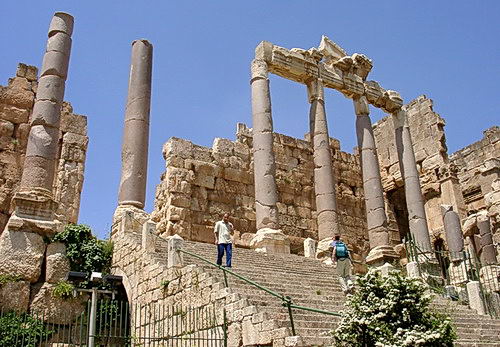
This photo is of the reconstructed propylaea, the monumental gateway, leading to the temple platform.

The reconstructed propylaea of Roman Baalbek. Photo by Ferrell Jenkins.

The reconstructed propylaea of Roman Baalbek. Photo by Ferrell Jenkins.

The Sower Went Out to Sow…

One of the best known parables of Jesus is the parable of the sower and the soils. Note the account recorded in Luke.

“The sower went out to sow his seed; and as he sowed, some fell beside the road, and it was trampled under foot and the birds of the air ate it up. “Other seed fell on rocky soil, and as soon as it grew up, it withered away, because it had no moisture. “Other seed fell among the thorns; and the thorns grew up with it and choked it out. “Other seed fell into the good soil, and grew up, and produced a crop a hundred times as great.” As He said these things, He would call out, “He who has ears to hear, let him hear.”  (Luke 8:5-8 NASB)

Jesus used this simple, easily understood illustration to teach about the word of God and the hearts of men. Read the full account in Luke 8:5-15, Matthew 13:3-23, and Mark 4:1-20.

A few weeks ago I was traveling in the vicinity of Hebron and saw these fields that had been plowed and readied for planting. I would assume the crop would be barley or wheat. I was standing on the road. You can see the rocks (be sure the soil is rocky), the weeds (if not thorns), and the good ground. In the time of Jesus seed would be broadcast, scattered by hand. Seed would fall on all the areas, but only that which fell on good ground would bring forth an acceptable crop. Many of the fields in the central mountain range north of Bethlehem are much smaller, but each field has the four elements of good soil, rocks, thorns, and road. How would you describe your heart?
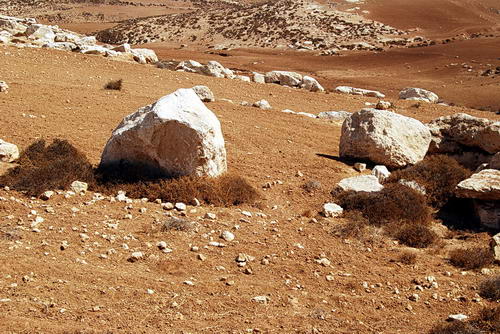
A field showing good soil, rocks, and weeds. Photo by Ferrell Jenkins.

A field showing good soil, rocks, and weeds. Photo by Ferrell Jenkins.
Toledo, Spain

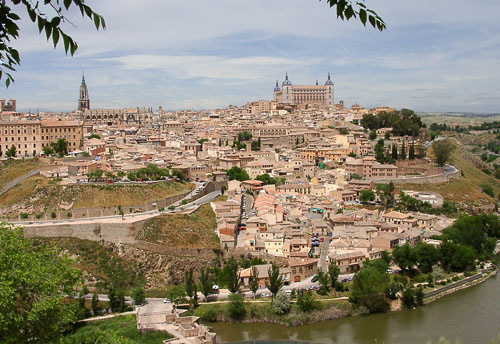
For a little diversion, here is a photo of Toledo, Spain. Toledo is less than 50 miles south of Madrid. The Tagus River flows on three sides of the city. The large building on the hill is the Alcazar. A fortress has been located here since Roman times.

Toledo, Spain. Photo by Ferrell Jenkins.

Toledo, Spain. Photo by Ferrell Jenkins.

More on Damascus and Paul

It has been my pleasure to visit Damascus several times since 1967. David McClister, a colleague from the Biblical Studies department at Florida College, and I visited the city in May, 2002. We tried to identify the traditional places associated with Saul’s stay in the vicinity. Southwest of the city, within sight of Mount Hermon, and on the road toward Jerusalem, there is a Greek Orthodox chapel marking the site where Jesus spoke to Saul. We drove as far south toward Quneitra in the Golan Heights as the military would allow. We can not be sure that the chapel marks the exact spot, but we know it was nearby.

Off Straight street one can visit the house of Ananias. All we can say with certainty is that this is another of those uncertain traditional places. Luke tells us that Ananias went to the house of Judas where Paul was staying.

An ancient wall still surrounds much of the old city. A modern chapel is built into the wall to indicate the place where Paul was let down through a window when a plot was made to kill him (Acts 9:25; 2 Cor 11:32-33).

Saul (Paul) in Damascus

Damascus is first mentioned in the Bible at the time of Abraham (Gen. 14:15; 15:2-3). As the capital of Syria, the city had much contact with the kingdoms of Israel and Judah.

All of the New Testament references to Damascus are related to the conversion of Saul of Tarsus (Acts 9; 22; 26; 2 Cor. 11:32; Gal. 1:17). Saul had participated in the stoning of Stephen and was active in the persecution of the disciples of Christ in Jerusalem. He asked the high priest for authority to go to Damascus and seek out men and women who belonged to the Way and bring them bound to Jerusalem.

The Lord appeared to Saul as he approached Damascus and told him to go into the city where he would be told what he must do (Acts 9:6). Saul stayed at a house on the street called Straight. Ananias came to him and told him to arise and be baptized so that his sins might be washed away (Acts 22:16; 9:18). Saul stayed with the disciples for several days and immediately began to proclaim Jesus in the synagogues as the Son of God (9:20).

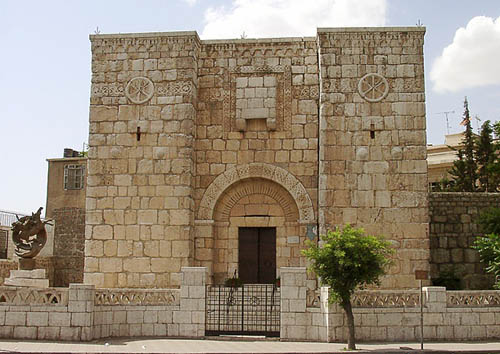
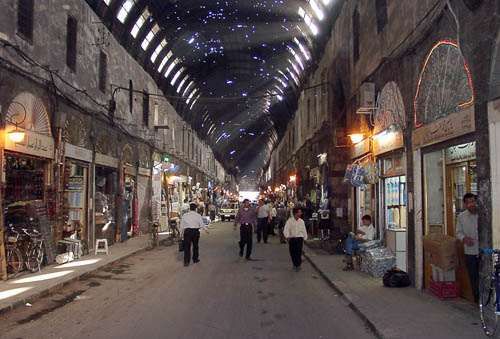
The street called Straight (Acts 9:11), the ancient Via Recta of the Roman city, now lies about 20 feet below the present street which runs the length of the old city, east to west. At the east end of the street a Roman gate has been elevated to the present level and partially restored. A small monumental arch can be seen near the middle of the street.

The photo below is one I made on Straight Street in 2002. This is not the main shopping street in the old city, but is historically significant.

The street called straight in Damascus. Photo by Ferrell Jenkins.

The street called straight in Damascus. Photo by Ferrell Jenkins.

The Roman city of Volubilis

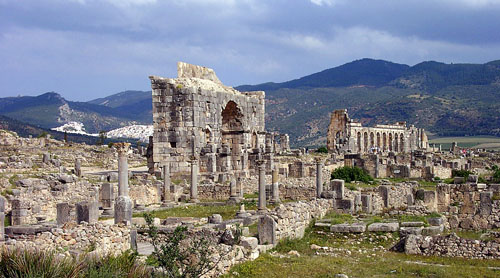
Students of the New Testament probably realize that the Roman Empire was vast. Did you know that there are ruins of a large Roman city in Morocco in north eastern Africa? Twice I have taken tours to Volubilis, about 20 miles from Meknes. Most of the ruins in the city date from the second and third centuries A.D. I have a slide from a 1980 tour with the name of the first century emperor Claudius (A,D, 51-54) on it. This was the time of Paul’s journeys (Acts 18:2).

This photo shows the Triumphal Arch dedicated to the Emperor Caracalla and his mother in A.D. 217. The Roman Basilica is visible on the right.

Roman ruins of Volubilis in Morocco. Photo by Ferrell Jenkins.

Roman ruins of Volubilis in Morocco. Photo by Ferrell Jenkins.

Volubilis has been added to the list of World Heritage Sites because “this site is an exceptionally well preserved example of a large Roman colonial town on the fringes of the Empire.”