Category Archives: Travel

Egyptian and Anatolian contacts with Galilee

Tel Aviv University reports on the discover of a rare Egyptian artifact dating to around 3000 BC from Tel Bet Yerah on the shore of the Sea of Galilee. The link to the report is here. The brief report from the Jerusalem Post is probably adequate here.

Although Egyptian-Israeli relations have been frosty in recent years, ties between the two lands were vibrant around 3,000 BCE during the Early Bronze Age – at least according to Tel Aviv University and University College London archeologists who discovered a rare, four-centimeter-long stone fragment at the point where the Jordan River exits Lake Kinneret.

The piece, part of a carved stone plaque bearing archaic Egyptian signs, was the highlight of the second season of excavations at Tel Bet Yerah (Khirbet el-Kerak). The site lies along an ancient highway that connected Egypt to the wider world of the ancient Near East.

Fragment of Egyptian plaque - c. 3000 BC - from Tel Bet Yerah.

Fragment of Egyptian plaque - c. 3000 BC - from Tel Bet Yerah.

. . . . . .

Earlier discoveries, both in Egypt and at Bet Yerah, have indicated that there was direct interaction between the site – then one of the largest in the Jordan Valley – and the Egyptian royal court. The new discovery suggests that these contacts were of far greater local significance than had been suspected.

The archeologists noted that the fragment – which depicts an arm and hand grasping a scepter and an early form of the ankh sign – was the first artifact of its type ever found in an archaeological site outside Egypt. It has been attributed to the period of Egypt’s First Dynasty, at around 3000 BCE.

. . . . . .

This year’s excavations also provided new insights into contacts between the early town and the distant north, when large quantities of “Khirbet Kerak Ware” (a distinctive kind of red/black burnished pottery first found at Tel Bet Yerah) were found in association with portable ceramic hearths, some of them bearing decorations in the form of human features.

One end of a decorated portable hearth - Khirbet Kerak Culture (c. 2700 BC)

One end of a decorated portable hearth - Khirbet Kerak Culture (c. 2700 BC)

“The hearths are very similar to objects found in Anatolia and the southern Caucasus,” noted Greenberg, “and most were found in open spaces where there was other evidence for fire-related activities.

“The people using this pottery appear to have been migrants or descendants of migrants, and its distribution on the site, as well as the study of other cultural aspects, such as what they ate and the way they organized their households, could tell us about their interaction with local people and their adaptation to new surroundings.”

. . . . . .

The tel was once described by influential American biblical archeologist William F. Albright as “perhaps the most remarkable Bronze Age site in all Palestine.” It presents the most complete sequence of the transition from village to city life in ancient Canaan.

Built on a raised peninsula near an important crossroads and a fertile valley, Tel Bet Yerah became a major regional center, and its fortification systems, city gate, streets and houses reveal elements of advanced urban planning.

Modern archeological research on the mound began in the early 1920s, when E.L. Sukenik (father of the late archeologist and politician Prof. Yigael Yadin) examined finds from the section of the old Samak (Tzemah)-Tiberias road that traversed the mound along its entire length.

At about the same time, Albright conducted his own investigation of the site; he was the first to identify and define the pottery known as Khirbet Kerak Ware.

The first archeological excavation was conducted in 1933, when the modern Tzemah -Tiberias highway was constructed. Over the next 70 years, about 20 excavation licenses were issued for Tel Bet Yerah and some 15,000 square meters were excavated, most of them in Early Bronze Age strata.

I think this type of information illustrates why the Lord placed His people on this land bridge between the great powers of the ancient world. It would continue to remain that way through the days of the Assyrians, Babylonians, Persians, Greeks, and Romans. And beyond.

HT: Joe Lauer
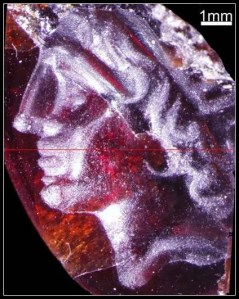
Miniature carving of Alexander the Great

Israel National News reports the discover of a rare miniature carving of Alexander the Great. The article by Nissan Ratzlav-Katz says,

Excavations in Tel Dor have turned up a rare and unexpected work of Hellenistic art: a precious stone bearing the miniature carved likeness of Alexander the Great. Archaeologists are calling it an important find, indicating the great skill of the artist.

The Tel Dor dig, under the guidance and direction of Dr. Ayelet Gilboa of Haifa University and Dr. Ilan Sharon of Jerusalem’s Hebrew University, has just ended its summer excavation season. For more than 30 years, scientists have been excavating in Tel Dor, identified as the site of the Biblical town of Dor. The town’s location, on Israel’s Mediterranean Sea coast some 30 kilometers south of Haifa, made it an important international port in ancient times.

“Despite the tiny proportions – the length of the gemstone (gemma) is less than a centimeter and its width less than half a centimeter – the artist was able to carve the image of Alexander of Macedon with all of his features,” Dr. Gilboa said. “The king appears as young and energetic, with a sharp chin and straight nose, and with long, curly hair held in a crown.”

According to the archaeologists involved in the Tel Dor excavations, the discovery of the miniature Alexander gemstone carving in Israel is fairly surprising. The Land of Israel was not, for the Greek Empire, a central or major holding.

The article concludes,

Historically, Alexander himself passed through Dor in 332 BCE, during his voyage to Egypt. It appears that the city fell to him without resistance. Since that time until its conquest by the Hasmonean Jewish King Alexander Yannai around 100 BCE, Dor served as a stronghold of non-Jewish Hellenists in the Land of Israel.

The full article may be read here.

Miniature carving of Alexander from Tel Dor.

Carving of Alexander from Tel Dor.

Dor is mentioned in several Old Testament references including Joshua 17:10-11.

HT: Joseph I. Lauer

Thessalonica on the Aegean

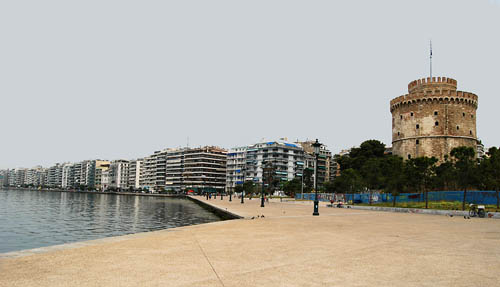
Thessalonica was located on the east-west Egnatian Way. The city was also located on the Bay of Thessalonica on the Aegean Sea. According to the records we have in the Book of Acts and Paul’s Epistles, Paul never used the sea port at Thessalonica.

The waterfront of Thessalonica with the White Tower. Photo by Ferrell Jenkins.

The waterfront of Thessalonica with the White Tower. Photo by Ferrell Jenkins.

The tower, called the White Tower, was built in the 15th century by the Venetians or the Turks. It is probably the best known landmark of the city today.

The Via Egnatia in Thessalonica

The Egnatian Way was one of the famous Roman roads used by the Apostle Paul in his travels to preach the gospel of Christ (Acts 16-17). F. F. Bruce gives a little history about the ancient road.

When Macedonia became a Roman province in 148 b.c., the Via Egnatia was constructed, running east from Dyrrhachium (modern Durres) and Apollonia (modern Poyani) on the Adriatic to Thessalonica, from which existing roads ran to the main Greek cities. The Via Egnatia was later extended farther to Neapolis (modern Kavalla), the port of Philippi, and later still to Byzantium on the Bosporus. When the Roman province of Asia was formed in 133 b.c., the Via Egnatia (with a short sea-crossing at either end) provided easy communication between Rome and the new province. (The Anchor Bible Dictionary, 6:649).

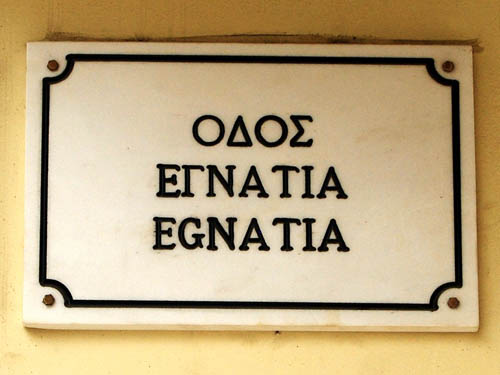
Very few remains from the first century have been exposed in Thessaloniki. Remember that the second largest city of Greece is built over the ancient city. One of the important streets running through the city is named Odos Egnatia (the Egnatian Way). The small street signs in Thessaloniki are located on building rather than on the corner of the street. This makes it difficult for a stranger to drive and read the street signs.

Street marker in Thessaloniki. Photo by Ferrell Jenkins.

Street marker in Thessaloniki. Photo by Ferrell Jenkins.

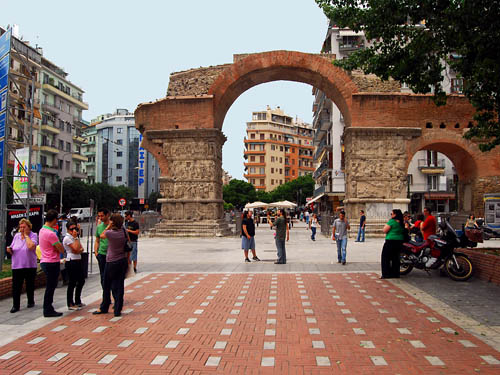
The Via Egnatia runs beside the monumental Arch of Galerius. This arch was built in A.D. 304 to commemorate the emperor’s victory over the Persians in A.D. 297 (Reddish & Fant 136).

Arch of Galerius (early 4th century A.D.). Photo by Ferrell Jenkins.

Arch of Galerius (early 4th century A.D.). Photo by Ferrell Jenkins.

Dropbox is a nifty tool for those who travel

dropbox_referral_ill_1 Dropbox allows you to store files at their site, but the best feature is the ability to sync the files on your desktop computer with those on your laptop. Before I leave home I put some of the files I am working with in my Dropbox. They are available online or on my laptop whenever I need them. If I make a change in one of the files on the laptop, the change is made on my desktop. If I add a new file in my Dropbox on the laptop that file will be in my Dropbox at home when I return. This program is really user friendly.

It is possible to create a share folder in your Dropbox that enables you to easily share files with a friend.

Here is how the features of Dropbox are described at their website.

  • Sync files across computers
  • Access files online from anywhere
  • Share and collaborate with others

You can get 2 Gb of space free by downloading Dropbox.

If you use the link below you will get an additional .25 Gb of space. Click this link to get Dropbox plus the bonus space.

I am enjoying this program and am pleased to inform my readers about it.

HT: Tyndale Tech.

The Meeting of the Waters

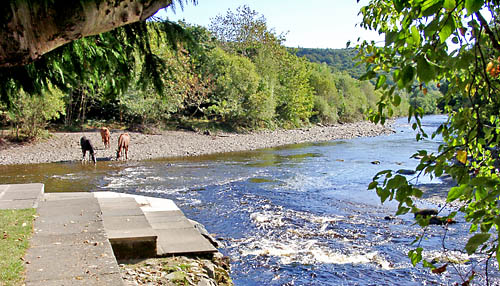
Thomas Moore (1779-1852) is known as one of Ireland’s best writers. A little south of Dublin, in Wicklow County, the Avonmore and Avonberg rivers meet. Moore made this spot famous in his poem The Meeting of the Waters.

Where the Sweet Waters Meet. Photo by Ferrell Jenkins.

Where the Sweet Waters Meet. Photo by Ferrell Jenkins.

The Meeting of the Waters

There is not in the wide world a valley so sweet
As that vale in whose bosom the bright waters meet
Oh the last rays of feeling and life must depart
Ere the bloom of that valley shall fade from my heart

Yet it was not that nature had shed o’er the scene
Her purest of crystal and brightest of green
‘Twas not her soft magic of streamlet or hill
Oh No ’twas something more exquisite still

‘Twas that friends, the belov’d of my bosom were near
Who made every scene of enchantment more dear
And who felt how the best charms of nature improve
When we see them reflected from looks that we love

Sweet vale of Avoca! How calm could I rest
In thy bosom of shade, with the friends I love best
Where the storms that we feel in this cold world should cease
And our hearts, like thy waters, be mingled in peace

How fortunate is any person to have a special place to recall as a place of peace. I have enjoyed several of these places through the years. First, there is home. My study, when my desk is clean and it’s raining outside, is another. I think also of the Sea of Galilee at sunrise, or sunset. Spiritually we find peace in Christ.

Be anxious for nothing, but in everything by prayer and supplication with thanksgiving let your requests be made known to God. And the peace of God, which surpasses all comprehension, will guard your hearts and your minds in Christ Jesus. (Philippians 4:6-7 NAU)

Reaching 200,000 hits

Overnight we registered our 200,000th hit on this blog. Our first post was May 2, 2007. Since that time we have covered two trips to Israel, two trips to Turkey, a trip to Greece and the Greek islands, a trip to Egypt, and a trip to Scotland. In addition we have reported on numerous archaeological developments and posted info on many biblical places and customs.

Actually we passed the 200,000 mark more than a week ago. Back in May we reported here on losing 3380 hits on our counter overnight.

Thanks should be extended to several people.

  • Thanks to WordPress for making this wonderful opportunity available at no cost. I would like to encourage everyone who thinks they have something worthwhile to say to get a blog and begin writing.
  • Thanks to our readers. The number has grown consistently in the past two years. We are delighted that you continue to check our blog. It has been fun to watch the increase of the traffic ranking at Alexa.
  • Thanks to everyone who has sent tips about items of interest that you think we should cover. Most of these come from acquaintances by email rather than as comments to the blog.
  • Thanks to Todd Bolen at blog.bibleplaces.com and BiblePlaces.com for his link to our page. Todd has called attention to this page several times and it has helped to increase the number of our readers.
  • Thanks to my wife for proofing many of the posts. I always appreciate her help.
  • Technological thanks to Nikon, Canon, and Adobe PhotoShop.

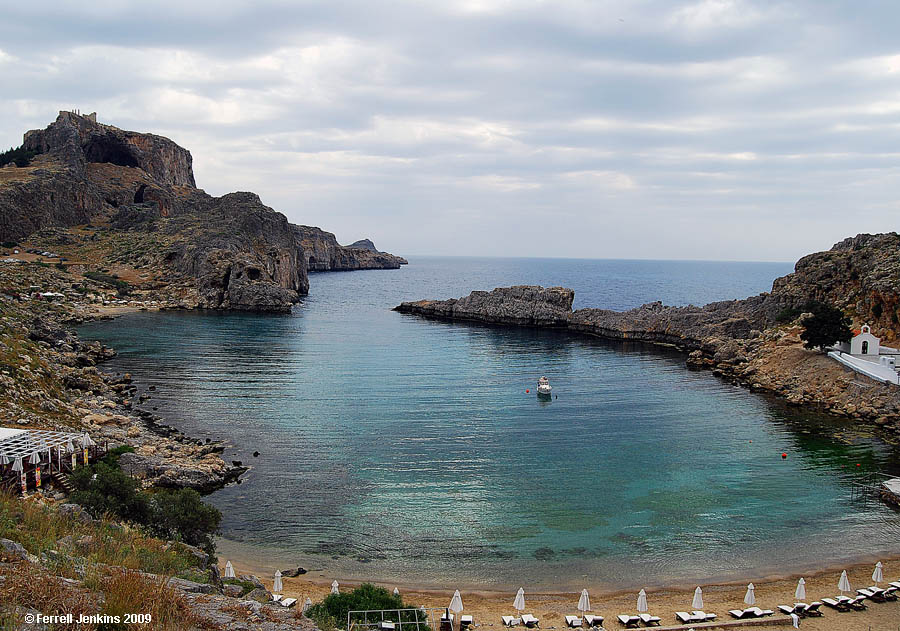
I would like to share a photo that is large enough to be of use to those who use visuals in teaching. This is a picture of St. Paul’s Bay on the island of Rhodes. Click on the photo for a larger image. For information about the place check our post for May 17, 2008.

St. Paul's Bay at Lindos, Rhodes. Photo by Ferrell Jenkins.

St. Paul's Bay at Lindos, Rhodes. Photo by Ferrell Jenkins.

Life at an archaeological dig can be fun

Luke and Royce Chandler, a couple of friends from Tampa, are participating in the dig at Khirbet Qeiyafa, a site above the Valley of Elah. It is also being called the Elah Fortress. The director of the dig, Prof. Yosef Garfinkel, thinks this is the site of Shaaraim (Joshua 15:36; 1 Samuel 17:52; 1 Chronicles 4:31).

Todd Bolen, of BiblePlaces.com has suggested the site should be identified with Ephes-dammim here, here, and here. Both places, Shaaraim and Ephes-dammim (1 Samuel 17:1) are associated with the conflict between David and Goliath. I will leave all of this for you to study as you wish.

Luke sent me a few photos to share with our readers.

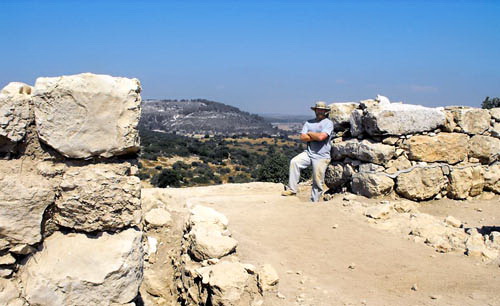
Luke is standing in the "Philistia Gate" with his left foot in the Iron Age threshold. Azekah can be seen in the distance.
Luke is standing in the “Philistia Gate” with his left foot in the Iron Age threshold. Azekah can be seen in the distance.The Valley of Elah is to the left.

Luke reports an interesting incident that happened at the dig last Wednesday.

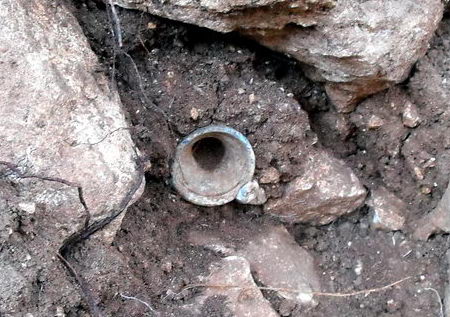
On this final day in the room, my father leaned his hand against the wall and accidentally caused a stone to fall out onto the ground. Behind where the stone had been, Royce saw a shiny turquoise circle. We called Guy Stiebel, the area archaeologist (also the chief excavator at Masada), to see it. When Guy saw the glass he took a keen interest. It turned out to be a complete ancient glass bottle that had been placed on its side into the wall during construction. Glassware such as this is common in burial locations, but very uncommon in this situation.

Read the full account here. Luke has several photos on his site. He received permission to include a photo of the glass bottle “in situ” (the place where it was found). He has given me permission to share it with our readers.

Glass bottle found in a wall at Khirbet Qeiyafa by Royce Chandler. Photo: Luke Chandler.

Glass bottle found in a wall at Khirbet Qeiyafa by Royce Chandler. Photo: Luke Chandler.

In 2008 one of the volunteers uncovered a large potsherd (broken piece of pottery) containing a Hebrew inscription. We are still awaiting a complete translation. We published a photo here.

We appreciate Luke sharing these experiences with us. By the time he and Royce get back home their wives will be expecting them to work in the flower beds!

You might also enjoy reading his account of walking through Hezekiah’s Tunnel (2 Kings 20:20), and seeing his video showing a stone from the Iron Age in the east wall of the Old City of Jerusalem, here.

Padfield’s visit to Explorations In Antiquity Center #2

We actually spent two days at the Explorations In Antiquity Center. We visited the Center on a Thursday morning, when they were not busy, so I could photograph the exhibits without other visitors getting in the way. We returned the following day to meet up with Gene and Sandy Taylor so we could have a guided tour of the Center and enjoy an authentic “Biblical meal” together.

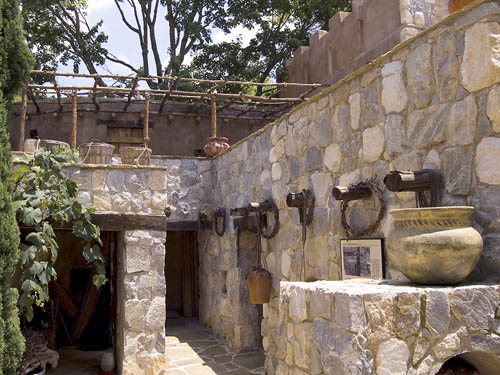
House exterior at Explorations in Antiquity Center. Photo by David Padfield.

House exterior at Explorations In Antiquity Center. Photo by David Padfield.

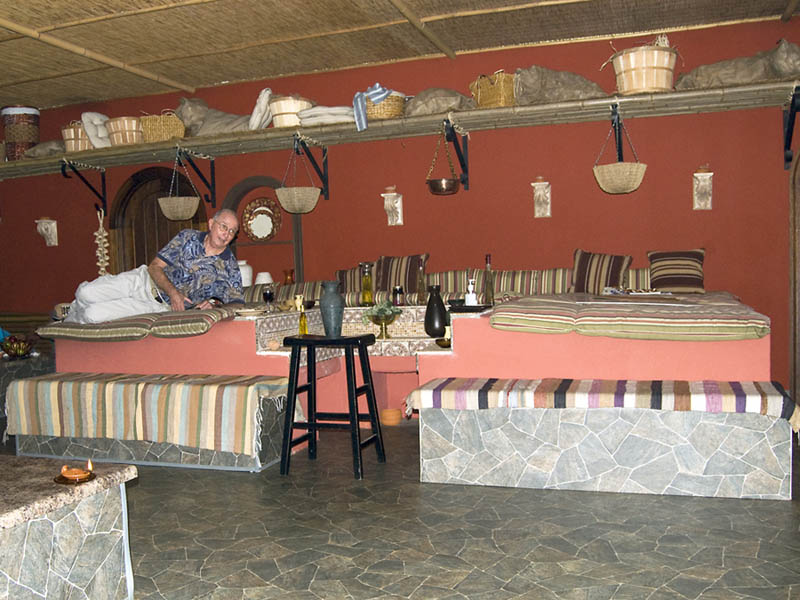
Our guide for the three-hour tour was Lamar Hamric and he did an excellent job of explaining the exhibits and putting them in a Bible context. The first half of the tour took place in the outside exhibit area and the last half was in a dining area designed to look like a Roman period banquet hall.

In the meal room we enjoyed a four-course meal with fifteen different food items, including unleavened bread, fruit, nuts, hard-boiled eggs, vegetables and bitter herbs. The meal was supposed to represent a Jewish Passover meal, but instead of roasted lamb they served roasted chicken (which, by the way, was excellent).

In the center of the room is a Roman triclinium—a U-shaped table like the one our Lord probably used at the Last Supper (Luke 22:12). During the meal Mr. Hamric discussed the various Passover customs and the social aspects of sharing a meal in the ancient Near East. Hamric gave the best explanation of the events at the Last Supper I have ever heard.

Roman period triclinium. Photo by David Padfield. Click for larger image.

Roman period triclinium. Photo by David Padfield. Click for larger image.

If you are anywhere near LaGrange, Georgia I would highly recommend you visit the Center. In fact, take your whole Bible class! The tour and meal costs $30 per adult and is well worth it. You need to make reservations in advance. They can prepare the Biblical meal for a small group (a minimum of 10) or a larger group of up to 140 people. Reservations can be made by calling the Center at (706) 885-0363.

-o-o-o-o-o-o-

David Padfield has visited the Bible Lands several times and is well qualified to evaluate the Explorations In Antiquity Center. Many of you have used his photographs and other materials that are made available through his web site (padfield.com).

The Explorations In Antiquity Center web site is available here.

David Padfield visits the Explorations In Antiquity Center at LaGrange, Georgia

If you have a desire to visit the lands of the Bible, but can’t afford the trip, I would suggest you visit the Explorations In Antiquity Center in LaGrange, Georgia. Recently my wife and I visited the Center for the first time and were amazed at the quality of the displays.

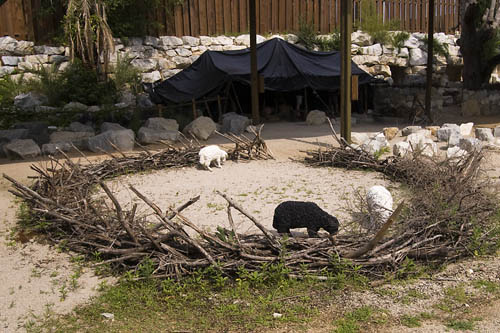
The Explorations In Antiquity Center is a living museum of life in Bible times. As you walk through the outdoor exhibits you will see realistic replicas of scenes from the Ancient Near East, such as water wells, vineyards, olive presses, mangers, and a sheepfold, watchtower and a threshing floor.

Sheepfold at Explorations in Antiquity Center. Photo by David Padfield.

Sheepfold at Explorations in Antiquity Center. Photo by David Padfield.

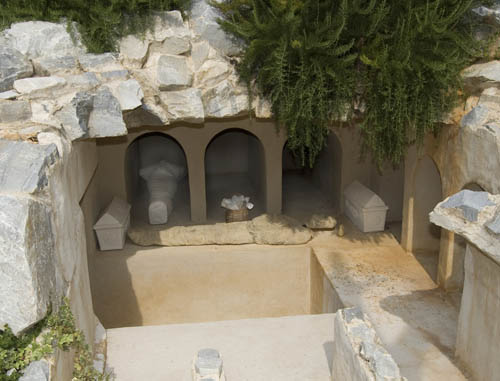
The tomb exhibit is especially worthy of notice. They have a replica of a typical Israelite tomb from around 700 to 500 BC, and a wonderful Herodian Period tomb like the one in which our Lord was probably buried. The replica was designed to show a cross section of the tomb (i.e., one of the walls is missing) and this makes it easier to explain the burial process in our Lord’s time upon this earth.

Cut-away replica of Herodian Period niche-type tomb. Photo by David Padfield.

Cut-away replica of Herodian Period niche-type tomb. Photo by David Padfield.

My favorite exhibit is the one that depicts life in an ancient village. They have built a typical four room Israelite house that will help you to understand the importance of a courtyard, the place of domestic animals in village life, how household storage was managed and the way the sleeping quarters were divided.

The center is open Tuesday through Saturday, from 10:00 AM to 6:00 PM. You can walk through the displays at your leisure, or call in advance for a guided tour that includes a Biblical meal (more about that in our second post).

-o-o-o-o-o-o-

David Padfield has visited the Bible Lands several times and is well qualified to evaluate the Explorations In Antiquity Center. Many of you have used his photographs and other materials that are made available through his web site (padfield.com).

The Explorations In Antiquity Center web site is available here.