Category Archives: Photography

Photo of Abel Beth Maacah

If you would like to see a hi-res photo that I made of Abel Beth Maacah, take a look at the announcement (here) of the new excavation scheduled for this summer.

My recent posts about the important site in northern Israel may be seen here and here.

I suppose my name is just too hard to spell.

Abel Beth Maacah. Photo by Ferrell Jenkins.

Abel Beth Maacah. View to the east. Photo by Ferrell Jenkins.

Israel government plans to preserve Tel Shiloh

Haaretz announces that the “Israeli government allocates NIS 5 million to preserve Tel Shiloh in West Bank.” According to the article, a large tourist center is planned at the site.

This is a precedent-setting decision, since Israeli governments up to now have not allocated funds for renovation and preservation of the site, located within the area of the Binyamin Regional Council. The committee’s decision to embark on the project states that “Tel Shiloh is a unique heritage asset” for the Jewish people, and mention was made of the fact that work at the site will be backed by supplementary funds totaling some NIS 10 million, to be provided by private sources.

The full article may be read here. For our US readers, 5 million NIS [New Israeli Shekels] equals approximately $1,338,000.

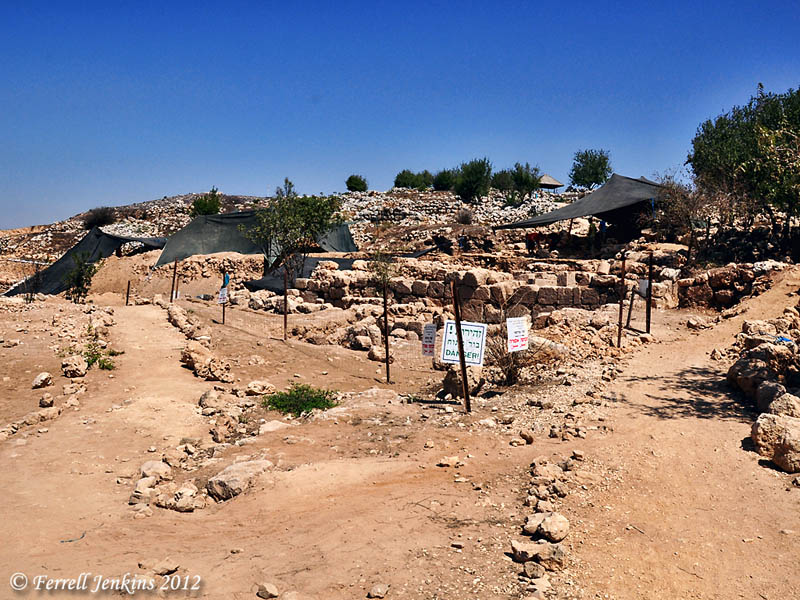
Some archaeological work was already underway last September when Leon Mauldin and I visited Tel Shiloh. The new excavation at the base of the mound dates to the Byzantine and Islamic period.

Tel Shiloh. New excavations at the base of the mound. Photo by Ferrell Jenkins.

Tel Shiloh. New excavations at the base of the mound. Photo by Ferrell Jenkins.

Shiloh is highly significant in Biblical history.

  • The tabernacle was set up at Shiloh, and it was here that the final division of the land among the tribes took place (Joshua 18).
  • Shiloh is located in specific terms.

However, there is an annual festival to the LORD in Shiloh, which is north of Bethel (east of the main road that goes up from Bethel to Shechem) and south of Lebonah.” (Judges 21:19 NET)

  • The Israelites took the ark of the covenant to the battle field near the coastal plain (1 Samuel 4). The ark never returned to Shiloh.
  • Shiloh was the home of Samuel (1 Samuel 1-3).

More info about Shiloh, with earlier photos, may be seen here.

HT: Joseph Lauer

Neil MacGregor: 2600 years of history in one object

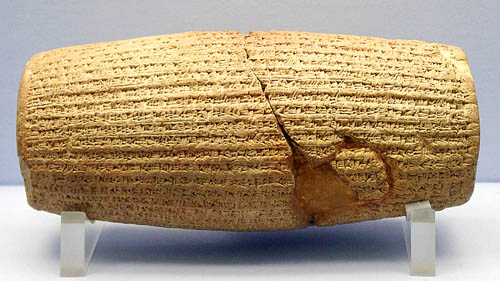
A friend just forwarded a link to a fascinating talk by Neil MacGregor, Director of the British Museum, about the Cyrus Cylinder. MacGregor took the Cyrus Cylinder from the British Museum to Iran when it was loan to the museum in Tehran.

What I learned was the use made of the Cyrus Cylinder by the Jews at the time of the Balfour Declaration, and the use made of it by the Shah of Iran.

MacGregor speaks of the Cyrus Cylinder as a “major player in the politics of the Middle East.”

Follow this link. The film is about 20 minutes old.

Now in the first year of Cyrus king of Persia, that the word of the LORD by the mouth of Jeremiah might be fulfilled, the LORD stirred up the spirit of Cyrus king of Persia, so that he made a proclamation throughout all his kingdom and also put it in writing:  “Thus says Cyrus king of Persia, ‘The LORD, the God of heaven, has given me all the kingdoms of the earth, and he has charged me to build him a house at Jerusalem, which is in Judah. Whoever is among you of all his people, may the LORD his God be with him. Let him go up.'” (2 Chronicles 36:22-23 ESV)

The Cyrus Cylinder in the British Museum. Photo by Ferrell Jenkins.

The Cyrus Cylinder in the British Museum. Photo by Ferrell Jenkins.

Check some of our previous links to the Cyrus Cylinder here and here. Use the search box to locate others.

Cooking at 4th century Qatzrin

Golan in Bashan is first mentioned in the Bible in connection with the priestly cities of refuge that were appointed to Israel east of the Jordan (Deuteronomy 4:43; cf. Joshua 20:8; 1 Chronicles 6:71).

After modern Israel captured the Golan Heights from Syria in 1967, considerable efforts was made to identify Jewish villages that may have existed in the area. One such village was Qatzrin (pronounced kats-REEN). Archaeologist Anne Killebrew spent a decade or more working at the site and directing the reconstruction of the site which included a synagogue and several houses.

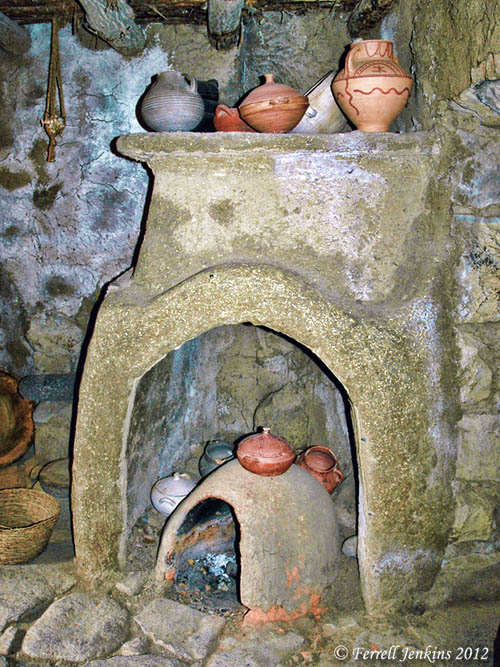
Qatzrin was originally built in the 4th century A.D. and remained in use till the mid-8th century. I wanted to show you the oven that we have from that village. The photo below shows a small clay oven placed within a mud-brick chimney. The chimney took the smoke out of the house and provided heat for the second floor bed room as well as for the kitchen. Not quite a microwave, but it wasn’t terribly different from the wood-burning stoves I knew as a child. (No, not in the 4th century!)

An oven inside a chimney at Qatzrin. Photo by Ferrell Jenkins.

An oven inside a mud-brick chimney at Qatzrin. Photo by Ferrell Jenkins.

Killebrew and Steven Fine wrote about “Qatzrin—Reconstructing Village Life in Talmudic Times” in Biblical Archaeology Review 17:03 (May/June 1991). The reconstruction of the oven and chimney are explained in a sidebar to the article.

The kitchen of the House of Rabbi Abun, seen on our cover, can be understood as a microcosm of the painstaking effort that went into the reconstruction of the whole house. The small domed oven at center stands within a mudbrick chimney. Excavated remains of this indoor oven—employed both for heating the house and for cooking in bad weather, when outdoor cooking was difficult—indicated the size and shape of the oven, a type still used by the Druze (a Moslem sect residing in the area). A portion of the chimney exits the roof in the corner, behind the period pottery on the chimney’s mantle, and rises high enough above the roof to create a draw that effectively pulls smoke out of the house. No remains of the original chimney were found, but the reconstruction was built, as was the rest the house, by Druze workmen using traditional styles and methods. Experiments have shown that this chimney works well.

Both Matthew and Luke record the statement of Jesus,

But if God so clothes the grass of the field, which today is alive and tomorrow is thrown into the oven, will he not much more clothe you, O you of little faith? (Matthew 6:30; cf. Luke 12:28 ESV)

The Greek word for oven or furnace (in a few English versions) is klibanos. According to BDAG it is used of “an oven (made of pottery),” exactly what you see in the photo.

Louw-Nida explains further:

a dome-like structure made of clay, in which wood and dried grass were burned, and then after being heated, was used for baking bread – ‘oven.’… ‘the grass of the field which is alive today and tomorrow is cast into the oven’ Mt 6.30. The function of klibanos may be described as ‘a place heated for baking bread,’…

After one gets the fire going with grass or other kindling, it was often kept going with dung cakes. See Ezekiel 4:15 for a biblical example.

Baking bread in Bible times

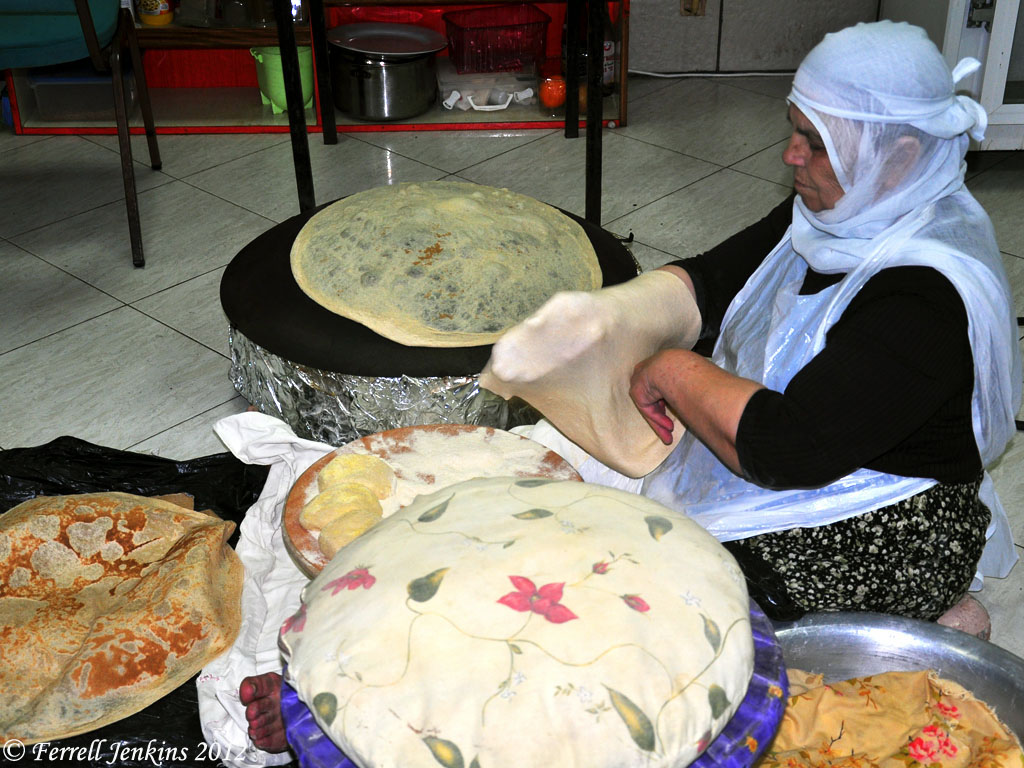
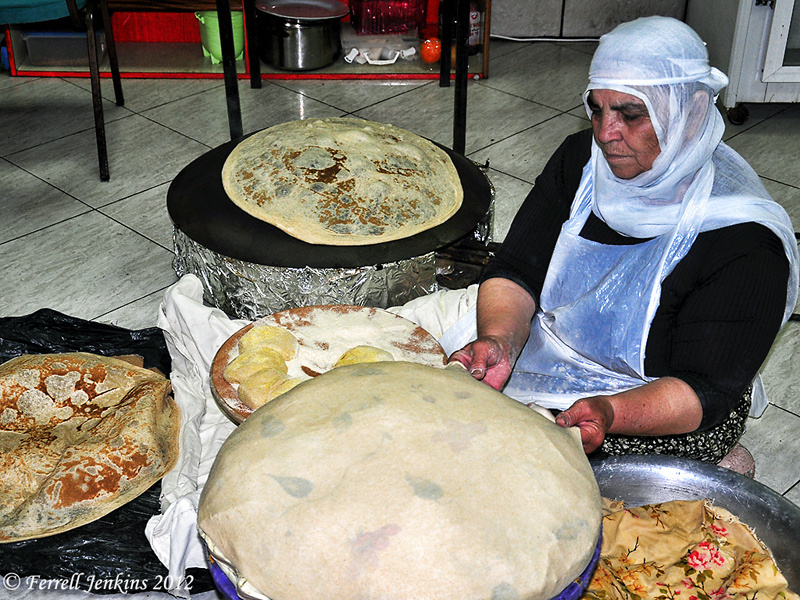
The Druze are especially noted in Israel for baking bread on a convex griddle. There are Druze villages on Mount Carmel and in the Golan Heights where the border with Israel and Syria come together. The photo below slows a woman preparing the dough for baking at a restaurant in the north of the Golan Heights at Birket Ram.

Druze woman preparing bread for baking at Birket Ram. Photo by Ferrell Jenkins.

Druze woman preparing bread for baking at Birket Ram. Photo by Ferrell Jenkins.

She will first place the dough on a rounded cushion which looks like a pillow (at the bottom of the photo).

After that she will turn it over on the griddle at the top of the photo. There you see bread cooking. To the left there is bread that has been taken from the griddle. Your chosen ingredients of meal and/or vegetables will be rolled in the thin bread.

Druze woman preparing bread for baking at Birket Ram. Photo by Ferrell Jenkins.

Druze woman preparing bread for baking at Birket Ram. Photo by Ferrell Jenkins.

I certainly am not an expert on cooking, nor even an expert on how this type of cooking might compare with some bread baking in Bible times. Ovens were often used by people of the Bible world, but some bread was cooked on a plate or griddle made of clay or iron.

King and Stager say,

“When a griddle (mahabat) of clay or iron (Ezek. 4:3) was used, it was set on stones over a pit in which a fire was kindled; then the dough was baked directly on the griddle” (Life in Biblical Israel, 66).

There are a few biblical references in which this type of griddle seems to be in mind.

And if your offering is a grain offering baked on a griddle, it shall be of fine flour unleavened, mixed with oil. (Leviticus 2:5; see also 6:21; 7:9 ESV)

For a visual aid, Ezekiel was told to take an iron griddle (plate, frying pan) and use it as an iron wall between himself and the city.

And you, take an iron griddle, and place it as an iron wall between you and the city; and set your face toward it, and let it be in a state of siege, and press the siege against it. This is a sign for the house of Israel. (Ezekiel 4:3 ESV)

Holladay’s Hebrew lexicon defines the Hebrew word for griddle as “(metal) plate, griddle for roasting & frying.”

I would write more, but I think I will go eat.

Those who ride white female donkeys

Deborah was a prophetess who judged Israel (Judges 4:4). In the Song of Deborah, the prophetess describes the conditions in the country before she arrived on the scene.

Caravans had ceased. Travelers kept to the side roads. There were no warriors in Israel till Deborah arose. She describes herself “as a mother in Israel” (Judges 5:7). She cared for and nurtured the nation just as a mother cares for and nurtures her own child. Under her leadership warriors arose and conditions improved.

6 “In the days of Shamgar son of Anath,
in the days of Jael, the caravans had ceased,
the travelers, they kept to the byways.
7 The warriors ceased;
they failed to appear in Israel;
until I, Deborah, arose;
I arose as a mother in Israel.
8 God chose new leaders,
then war was at the gates;
a small shield for a spear was not seen
among forty thousand in Israel.
9 My heart goes out to the commanders of Israel,
those offering themselves willingly among the people;
bless Yahweh!
10 The riders of white female donkeys,
those sitting on saddle blankets,
and those going on the way, talk about it!
11 At the sound of those dividing the sheep
among the watering places,
there they will recount the righteous deeds of Yahweh,
the righteous deeds for his warriors in Israel.
Then the people of Yahweh went down to the gates.
12 “Wake up, wake up, Deborah!
Wake up, wake up, sing a song!
Get up, Barak!
Take captive your captives, O son of Abinoam.  (Judges 5:6-12, The Lexham English Bible)

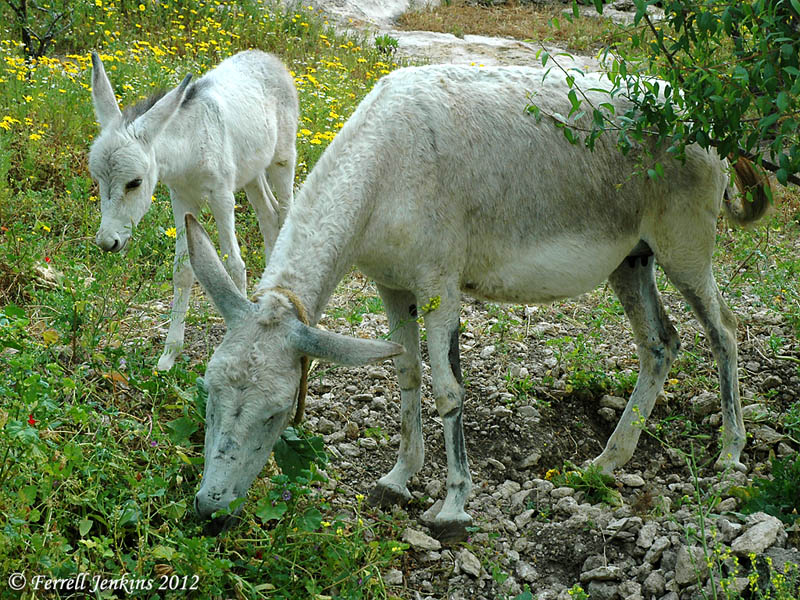
Verse 10 caught my attention. Deborah mentioned the riders of “white female donkeys” who sat on saddle blankets. I take it that these were the more well to do individuals.

Donkey and colt at Nazareth Village. Photo by Ferrell Jenkins.

Donkey and colt at Nazareth Village. Photo by Ferrell Jenkins.

The Hebrew word used for white is defined in several lexicons as “tawny.” The donkey being described by Deborah might look more like the one below.

Donkey near Nebi Samwil and Gibeon. Photo by Ferrell Jenkins.

Donkey between Nebi Samwil and Gibeon. Photo by Ferrell Jenkins.

Abel Beth Maacah excavation announced

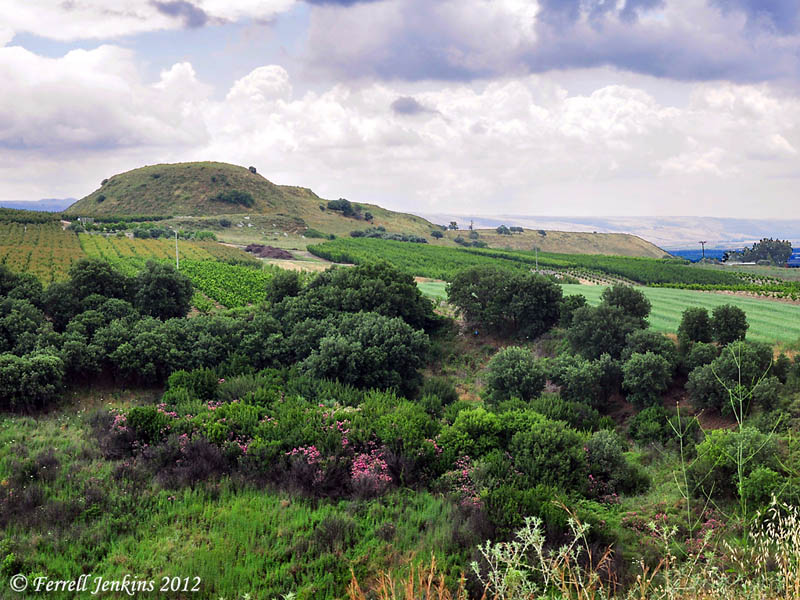
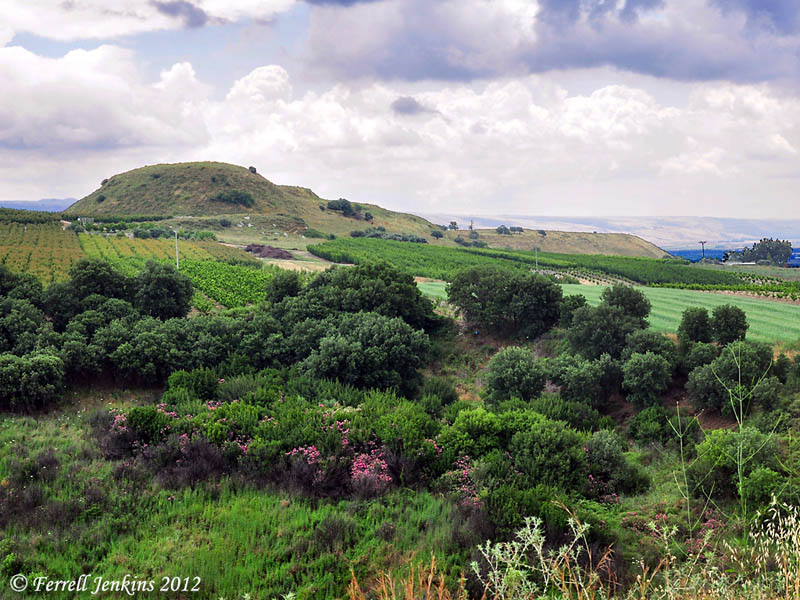
Azusa Pacific University announced the first archaeological excavation of Abel Beth Maacah (Tel Abil; Abil al-Qamh) in northern Israel. The site is located just a few miles south of the border with Lebanon. The mound overlooks the Beka Valley to the east, with Mount Hermon in the distance.

Abel Beth Maacah. View to the east. Photo by Ferrell Jenkins.

Abel Beth Maacah. View to the east. Photo by Ferrell Jenkins.

The dates suggested in the following announcement seems very short (May 27-31).

This spring, Azusa Pacific University (APU) embarks on an exciting joint expedition with the Hebrew University of Israel to oversee an archeological dig at Abel Beth Maacah, a site of historical interest long envied by the world’s archeologists.

To date, the mound has not been excavated. Robert Mullins, Ph.D., associate professor of biblical studies at APU, leads the team along with Nava Panitz-Cohen and Ruhama Bonfil, faculty at the Hebrew University. On Jan. 25—26, 2012, team members plan to conduct an initial survey of the site in preparation for the May 27—31 excavation.

“I can’t overstate the huge potential of this project,” said Mullins. “First, it is an honor to partner with Israel’s oldest and most prestigious university. Given the site’s connection with the period of David and later Kings of Israel, the dig will draw worldwide interest. We can potentially solve questions regarding the nature of Israel’s ties with neighboring Phoenicia and Syria, as well as documenting through the destruction levels the various Aramean [Syrian] and Assyrian military campaigns mentioned in the Bible and other ancient records.”

The complete announcement is available here. You may observe that (a poor quality image of) one of my photos has been used in the announcement, but the copyright notice and name have been cut off. Hopefully this will be corrected in future releases.

The wise woman of Abel Beth Maacah describes the city as being “a mother in Israel” (2 Samuel 20:19).

We have written about the importance of Abel Beth Maacah here and here.

HT: Bible Places Blog; HolyLandPhotos’ Blog.

Jesus and the Moneychangers

We noted in a previous post that there are two accounts of Jesus cleansing the temple. By this we mean the temple precinct (the hieron), not the sanctuary where only priests were allowed (the naos). For the first account, early in his ministry, see John 2:13-25. The second account, toward the close of his ministry, is recorded in Matthew 21:12-13; Mark 11:15-18; and Luke 19:45-48.

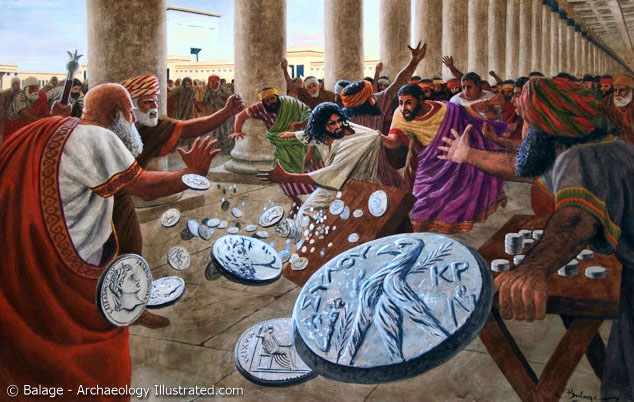
Artist Balage Balogh illustrates the scene of Jesus and the Money Changers. See more of his work at Archaeology Illustrated here.

Jesus and the Money Changers. Balage Balogh, Archaeology Illustrated.

Jesus and the Money Changers. Balage Balogh, ArchaeologyIllustrated.com.

The biblical account also mentions the animals and birds that were for sale to those coming to Jerusalem to worship (John 2:16; Matthew 21:12).

Money changers. (English versions use moneychagers, money-changers, and money changers.) The Jews normally would not bring the foreign money as an offering to the temple. The money had to be changed into the half-shekel of ancient Israel. This would necessitate money changers. Those who have traveled to foreign countries understand that money changers are common and necessary. Alfred Edersheim, who wrote a book on The Temple: Its Ministry and Services, pointed out that the total sum derived annually from the Temple tribute was large. The money changers were simply in the wrong place.

It is generally held that the coin used by the Jews for the temple tax was the Tyre shekel, which after 19 B.C. was most likely minted in Jerusalem (cf. Hendin, Guide to Biblical Coins, 175).

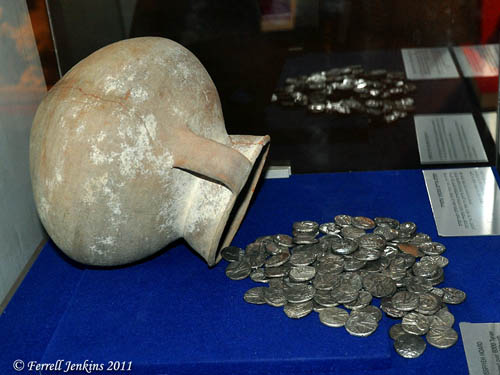
A hoard of coins including Tyrian Shekels, half shekels, and denarii bearing the image of  Roman Emperor Augustus (30 B.C.– A.D. 14) was found a few years ago at Ussifiyeh (Isfiya), a Druze village on Mount Carmel.

Ussifiyeh hoard of coins including Tyrian Shekels. Eretz Israel Museum.

Ussifiyeh hoard of coins including Tyrian Shekels. Photo by Ferrell Jenkins.

The information sign in the Eretz Israel Museum in Tel Aviv says,

The hoard probably represents a delivery of Temple tax intercepted and hidden away due to the events of the Jewish War which broke out in 66 C.E.

Click on the photo for an image large enough to use in classes and sermons.

Evil-merodach (562-560) graciously freed Jehoiachin

Evil-merodach came to power in Babylon upon the death of his father Nebuchadnezzar in 562 B.C. There are only two references to him in the Bible, and these are parallel accounts. Evidence suggests that Jehoiachin (Jeconiah, Coniah), the king of Judah who was taken to Babylon in 597 B.C., was treated like a king in exile during most, or all, of his time in Babylon. The kindness of Evil-merodach receives special attention.

27 And in the thirty-seventh year of the exile of Jehoiachin king of Judah, in the twelfth month, on the twenty-seventh day of the month, Evil-merodach king of Babylon, in the year that he began to reign, graciously freed Jehoiachin king of Judah from prison. 28 And he spoke kindly to him and gave him a seat above the seats of the kings who were with him in Babylon. 29 So Jehoiachin put off his prison garments. And every day of his life he dined regularly at the king’s table, 30 and for his allowance, a regular allowance was given him by the king, according to his daily needs, as long as he lived.  (2 Kings 25:27-30 ESV; cf. Jeremiah 52:31-34)

It is interesting that we have a biblical record mentioning Evil-merodach’s treatment of Jehoiachin (about 560 B.C.), and we have archaeological evidence of similar treatment at an earlier period. Four tablets mentioning Jehoiachin and his sons date to the period 595–570 B.C.

These tablets record rations that were given to the exiled king, his sons, and eight men of Judah. The one shown here is usually displayed in the Museum of the Ancient Near East (Vorderasiatische Museum), also called the Pergamon Museum, in Berlin (VAT 16378).
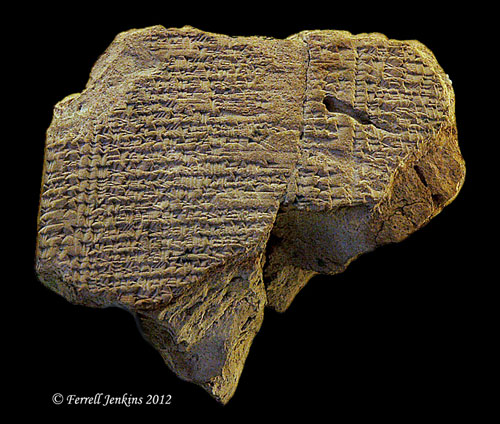
Babylonian ration tablet naming Jeconiah. Berlin. Photo by Ferrell Jenkins.

Babylonian ration tablet naming Jeconiah. Pergamum Museum. Photo by Ferrell Jenkins.

A trip to Berlin is worthwhile for many reasons, but one of the best is to visit the Museum of the Ancient East. Even though it could stand some revisions, you should find my Biblically Related Artifacts in the Museums of Berlin helpful. It is available in PDF here.

Here  is what I wrote about this tablet:

“Jehoiachin (Jeconiah, Coniah) was the young king of Judah who was taken captive to Babylon by Nebuchadnezzar in 597 BC. (2 Kings 24:15). The date of the capture of Jerusalem (March 16, 597 BC) was learned in 1955 when Donald J. Wiseman, then of the British Museum,  read a cuneiform tablet from Babylon. About 300 cuneiform tablets, dating between 595 and 570 BC, were found near the Ishtar Gate in Babylon. They contain lists of rations such as barley and oil paid to the captives and craftsmen. Persons from various countries are mentioned: Egypt, Philistia, Phoenicia, Asia Minor, Judah, etc. Some Biblical names are included: Gaddiel, Semachiah, and Shelemiah (a name mentioned prominently in Jeremiah 36-37). The most interesting name is Yaukin, king of the land of Yahud (Judah), along with five royal princes. The name, pronounced Yow-keen, is known to be an abbreviation for Jehoiachin. One document in which his name occurs is dated to 592 BC. These tablets show that the Babylonians continued to regard Jehoiachin as the legitimate king of Judah and gave him special treatment while he was in captivity (2 Kings 25:27-30; Jeremiah 52:31-34). The tablets were read by E. F. Weidner in the basement of the Kaiser Friedrich Museum, Berlin, after 1933.

[For those with access to this type of material:] Some Sources: Albright, BA 5 (1942), 49-55; ANET, 308 for translation; DOTT, 84-86; JFLAP, 225-227; IDB, II:811-13; Werner Keller, The Bible as History, 285-287;  Wiseman, Illustrations from Biblical Archaeology, 73 for photo [showing both the reverse and the obverse of the photo above].”

More Recent Source: Fant, Clyde E. and Mitchell G. Reddish, Lost Treasures of the Bible, 217-220.

Nebuchadnezzar, king of Babylon — 605-562 B.C.

Nebuchadnezzar, king of the Neo-Babylon empire for more than 40 years, is one of the best known royal personages of the Bible. His name occurs more than 90 times. He was responsible for huge building projects throughout his empire.

The arrogance of Nebuchadnezzar is seen in the comment attributed to him in the Book of Daniel.

The king uttered these words: “Is this not the great Babylon that I have built for a royal residence by my own mighty strength and for my majestic honor?” (Daniel 4:30 NET)

The Babylonians left many inscriptions bearing testimony to the building programs of the various kings.

Our first photo shows one of the cylinder annals of Nebuchadnezzar that mentions building projects of temples in Babylon, Borsippa, Larsa and Sippar for the gods Marduk, Nabu, Shamash and Ishtar. It also recounts rebuilding city walls. This annal is displayed in the Istanbul Archaeology Museum.

Nebuchadnezzar Cylinder Annal. Istanbul Archaeology Museum. Photo by Ferrell Jenkins.

Nebuchadnezzar Cylinder Annal. Istanbul Archaeology Museum. Photo by Ferrell Jenkins.

Building bricks bearing the name of the king, along with his titles, have been discovered in the various cities of Babylon. The one below comes from Sippar. It is displayed in the British Museum (BM90081).

Brick of Nebuchadnezzar (605-562 B.C.). British Museum. Photo by Ferrell Jenkins.

Brick of Nebuchadnezzar (605-562 B.C.). British Museum. Photo by Ferrell Jenkins.

The museum sign associated with this artifact describes the nature of these building bricks.

 “Nebuchadnezzar made extensive use of baked bricks in his many buildings. They are usually square, and often bear inscriptions, generally stamped but occasionally written by hand, which give the king’s name, titles, and patronym.”

A list of the major biblical events during the reign of Nebuchadnezzar should prove helpful for Bible students.

  • 605 BC — Nebuchadnezzar defeats Egypt, and Pharaoh Neco, at Carchemish.
  • 605 BC — Daniel and his friends taken from Judah to Babylon (Daniel 1).
    • Daniel was in Babylon during the entire reign of Nebuchadezzar (Daniel 1-4).
  • 597 BC — Jerusalem captured by Nebuchadnezzar.
    • March 16, 597 BC, according to a Babylonian Chronicle.
    • The young Judean king, Jechoichin (Jeconiah, Coniah), taken captive to Babylon (2 Kings 24:6-15; 2 Chronicles 36:8-10).
    • Mattaniah-Zedekiah becomes puppet king in Judah (2 Kings 24:17).
    • Many Judeans, including the prophet Ezekiel, taken captive to Babylon.
  • 587 BC — The fall of Jerusalem (2 Kings 25; Jeremiah 52).
    • Zedekiah rebelled; city destroyed; Zedekiah taken to Riblah (Ribleh in modern Syria) where his sons were slaughtered. Zedekiah’s eyes put out, and he was taken captive to Babylon.
The Correct MLA Way to Cite This Article

“Nebuchadnezzar, King of Babylon – 605-562 B.C.” Ferrell’s Travel Blog, 6 Feb. 2012, ferrelljenkins.blog/2012/02/06/nebuchadnezzar-king-of-babylon-605-562-b-c/.