Category Archives: Photography

Cenchrea — a port used by Paul and Phoebe

Cenchrea is located a few miles east of Corinth on the Saronic Gulf, an arm of the Aegean Sea. In the time of the Apostle Paul Cenchrea was considered the eastern port of Corinth. It was here that Paul had his hair cut before sailing for Syria.

Paul, having remained many days longer, took leave of the brethren and put out to sea for Syria, and with him were Priscilla and Aquila. In Cenchrea he had his hair cut, for he was keeping a vow. (Acts 18:18 NAU)

Our photo provides a view of the port and the northern breakwater.

The port of Cenchrea with view toward the northern breakwater. Photo by Ferrell Jenkins.

Port of Cenchrea with view toward the northern breakwater. Photo by Ferrell Jenkins.

Cenchrea was the home of Phoebe, who was a servant of the church there. Cenchrea would have been one of the unnamed churches “in the whole of Achaia” (2 Corinthians 1:1).

I commend to you our sister Phoebe, who is a servant of the church which is at Cenchrea; that you receive her in the Lord in a manner worthy of the saints, and that you help her in whatever matter she may have need of you; for she herself has also been a helper of many, and of myself as well. (Romans 16:1-2 NAU)

I think we may safely conclude that Phoebe sailed from this port to Rome with the epistle Paul write to the saints at Rome about A.D. 57.

Except for the port, little is to be seen of ancient Cenchrea. Some underwater excavations have taken place. Perhaps at a later time we will call attention to some of the discoveries.

Click on the image if you would like to have a copy of the photo suitable for use in teaching Acts, Romans, or the life and ministry of Paul.

Murex is not the only source of purple

Royal purple dye was made from the secretion of the Murex snail, typically found along the eastern Mediterranean coast, especially near Tyre.

In New Testament times (the first century A.D.), several cities in Asia Minor were noted as producers of dye. Colossae and Thyatira were located inland, far away from the Sea. These, and other cities of the region, made purple from the madder root.

Madder root, a source of purple in Turkey. Photo by Ferrell Jenkins.

Madder root, a source of purple in Turkey. Photo by Ferrell Jenkins.

The three colors shown in the yarn below come from the madder root. The darker color on the right might more closely resemble royal purple.

Yarn dyed with madder root. Photo by Ferrell Jenkins.

Yarn dyed with madder root. Photo by Ferrell Jenkins.

Thyatira was noted as a great center for the wool trade and for its dyeing industry. Lydia, the first convert of the gospel in Europe, was a native of Thyatira (in Asia). She seems to have represented this industry in Philippi. One inscription, found at Philippi in 1872, honored from among the purple dyers a man named Antiochus who was a “native of Thyatira” (Meinardus, St. John, 93).

The purple dye used around Thyatira was evidently a vegetable dye from the madder root which grew in abundance in the region. Hemer says that the madder root “was still cultivated in the district at least until the end of the last century.” The pigment is commonly called Turkey red. In addition to the colors shown in the yarn above, I am told by the Turkish carpet sellers that the “red” in this beautiful Turkish carpet comes from the madder root.

Carpet made from yarn made from the madder root. Photo by Ferrell Jenkins.

Carpet using yarn made from the madder root. Photo by Ferrell Jenkins.

Now when you read about Lydia as a seller of purpose you should think of the dye made from the madder root, or from the dyed products.

A woman named Lydia, a dealer in purple cloth from the city of Thyatira, who worshiped God, was listening. The Lord opened her heart to pay attention to what was spoken by Paul. (Acts 16:14 CSB)

Replica Phoenician ship completes 20,000 mile voyage

A replica of a 600 B.C. Phoenician ship has almost completed 20,000 miles and two years at sea.

The replica Phoenician ship, captained by British explorer Philip Beale, has completed the circumnavigation of Africa – a voyage made by Phoenicians in 600 BC. With up to 16 crew members on any one leg the replica vessel has welcomed sailors from all corners of the globe.

The voyage has presented Captain Beale and his international crew with many challenges including losing one of the ship’s rudders in the Red Sea, the threat of piracy off the Somali coast and gale force weather conditions around the Cape of Good Hope. At the end of the expedition the ship will have visited 14 countries – each time sparking interest in the achievements of ancient Phoenician mariners.

The successful completion of the voyage is of enormous significance to historians and archaeologists as it proves that the Phoenician vessels were capable of sailing around the African continent – something that has been the cause of much speculation over centuries.

The ship will complete its voyage  at Arwad, Syria, where it was built.

Phoenician Ship under sail in the North Atlantic. Courtesy Phoenicia Ship Expedition.

Phoenician Ship under sail in the North Atlantic. Courtesy Phoenicia Ship Expedition.

For more information read the short article in the Gibraltar Chronicle here. A web site about the expedition is available at Phoenicia.

The prophet Ezekiel foretold the fall of the ancient Phoenician city of Tyre. I suggest you read the entire account in Ezekiel 26-28. Notice especially these verses about the effect that the fall of Tyre had on other nations and merchants.

The ships of Tarshish traveled for you with your merchandise. So you were filled and heavily laden in the heart of the seas. “Your rowers have brought you out into the high seas. The east wind has wrecked you in the heart of the seas. Your riches, your wares, your merchandise, your mariners and your pilots, your caulkers, your dealers in merchandise, and all your men of war who are in you, with all your crew that is in your midst, sink into the heart of the seas on the day of your fall.

At the sound of the cry of your pilots the countryside shakes, and down from their ships come all who handle the oar. The mariners and all the pilots of the sea stand on the land and shout aloud over you and cry out bitterly. They cast dust on their heads and wallow in ashes; they make themselves bald for you and put sackcloth on their waist, and they weep over you in bitterness of soul, with bitter mourning. In their wailing they raise a lamentation for you and lament over you: ‘Who is like Tyre, like one destroyed in the midst of the sea? (Ezekiel 27:25-32 ESV)

For a larger image of the photo suitable for use in teaching click on the photo above.

HT: PaleoJudaica.

The watershed ridge — Part 2

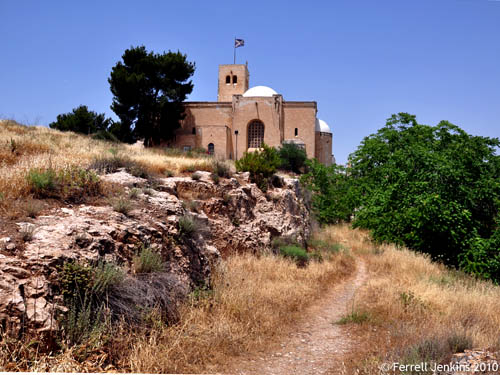
Walking to the top of Bible Hill we continue to look north with St. Andrews Church before us. Looking over to the right you may see some of the building of the old city of Jerusalem.

Bible Hill, the water parting ridge, and St. Andrews. Photo by Ferrell Jenkins.

Bible Hill, the water parting ridge, and St. Andrews. Photo by Ferrell Jenkins.

Next we take a look north east. The western side of the Old City wall is clearly visible. Jaffa Gate and the Citadel are can be seen near the middle of the wall. The tower of the Church of the Dormition is visible at the extreme right of the photo. The Valley of Hinnom lies between Bible Hill and the Old City.

View north east from Bible Hill. Photo by Ferrell Jenkins.

View north east from Bible Hill. Photo by Ferrell Jenkins.

As we look to the west we see the flat top of Bible Hill and some of the buildings of Jerusalem on the slope of the ridge.

View to the east from Bible Hill. Photo by Ferrell Jenkins.

View to the east from Bible Hill. Photo by Ferrell Jenkins.

The watershed ridge

Those who study Bible geography learn about the extension of the Lebanon Mountains that runs south through Upper Galilee, Lower Galilee, the mountains of Samaria, and the mountains of Judea. Every mountain ridge has a right side and a left side. The ridge of the central mountain route in Israel provides the watershed to the east and the west.

St. Andrew’s (Scottish) Church sits on the watershed ridge in Jerusalem. When you travel from the west side of the old city of Jerusalem crossing the Hinnom Valley on the way south to Bethlehem and Hebron, you pass the watershed ridge and St. Andrew’s Church on your right. The Menachem Begin Heritage Center Museum and the Church sit up above the road and are lost to view as you watch the traffic.

This view, showing the east side of the watershed ridge, looks north to the Church.

The watershed ridge in Jerusalem. Photo by Ferrell Jenkins.

The watershed ridge in Jerusalem. Photo by Ferrell Jenkins.

St. Andrew’s Church has an interesting history which is described briefly.

St Andrew’s Church, Jerusalem, was built as a memorial to the Scottish soldiers who were killed fighting the Turkish Army during World War I, bringing to an end Ottoman rule over Palestine. It is a congregation of the Church of Scotland. (Wikipedia)

A cornerstone on the Church indicates that the stone was laid on May 7, 1927, by Field Marshal the Viscount Allenby in commemoration of the liberation of Jerusalem on December 9, 1917. We have a photo of the liberation here. Another plaque in the Church indicates that King Robert Bruce wished for his heart to be buried here.

Before his death Bruce required Sir James Douglas to carry his heart to Jerusalem, in redemption of his unfulfilled vow to visit the Holy City. Accordingly Sir James set out, bearing with him the embalmed heart. On his way he fell fighting the Moors in Spain. The heart was recovered and found its resting-place at Melrose, while the body rests at Dunfermline, Scotland. (Vilnay, Israel Guide 1978, 87)

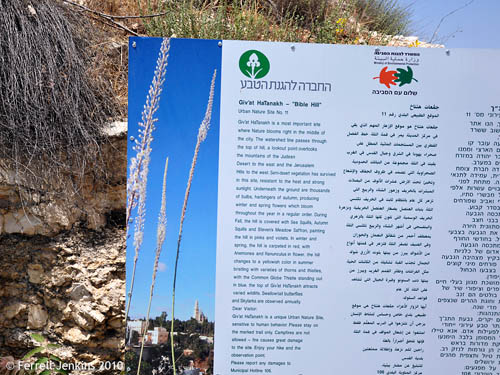
The barren hill on which the Church is built is called Bible Hill.

Sign marking Bible Hill, the watershed ridge in Jerusalem. Photo by Ferrell Jenkins.

Sign marking Bible Hill, the watershed ridge in Jerusalem. Photo by Ferrell Jenkins.

This hill marks a portion of the boundary of the biblical tribe of Judah. Notice the reference to “the top of the mountain.”

Then the boundary goes up by the Valley of the Son of Hinnom at the southern shoulder of the Jebusite (that is, Jerusalem). And the boundary goes up to the top of the mountain that lies over against the Valley of Hinnom, on the west, at the northern end of the Valley of Rephaim. (Joshua 15:8 ESV)

In another post we hope to show you more photos of the watershed ridge and the view on each side of it from this same location. Meanwhile, take a look at several photos of the Church, and a satellite view of the area at Bible Walks.

Report on Khirbet Qeiyafa — the Elah Fortress

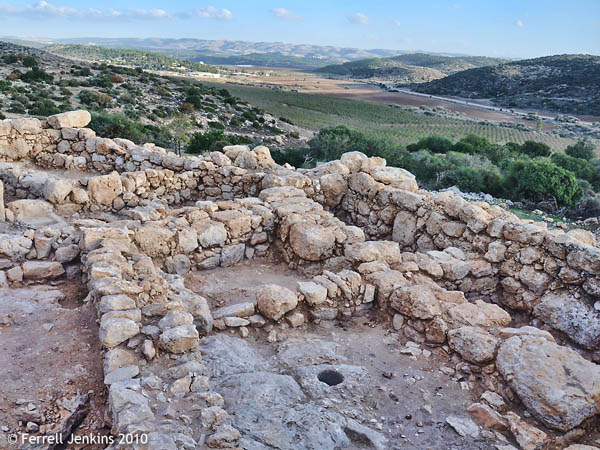
Luke Chandler has participated in the excavation at Khirbet Qeiyafa the past two summers. Recently he posted two brief articles on some of the discoveries during the past summer. Read here and here.

This area is associated with the events of 1 Samuel 17 (David and Goliath).

View to southeast over Elah Valley from Khirbet Qeiyafa. Photo by F. Jenkins.

View to southeast over Elah Valley from Khirbet Qeiyafa. Photo by Ferrell Jenkins.

Roman soldiers in Decapolis

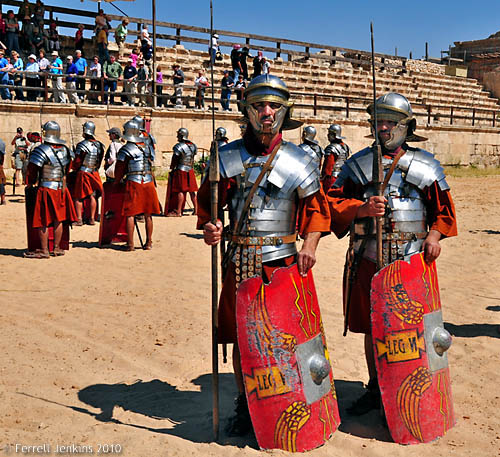
The RACE show at Jerash, Jordan, is a must if you have the opportunity to visit the area. RACE stands for Roman Army and Chariot Experience. You will see actors in authentic dress as armed legionaries, gladiators, and a short chariot race. The show takes place in the Roman hippodrome of Jerash. The view of the city ruins in the vicinity make this a wonderful setting for the performance. Full details may be found here. I have seen the program three times. On the last visit, earlier this year, I thought the performers showed less discipline and the show was not quite as good as on my previous visits.

Jerash was the second largest city of the Decapolis (after Damascus) in New Testament times. People from the Decapolis followed Jesus during His ministry in Galilee (Matthew 4:23-25). When Jesus traveled through the Decapolis he possibly visited the area around Jerash (Mark 7:31).

The photo shows the Roman soldiers of the 6th Legion from the time of the Emperor Hadrian (A.D. 117-138). A visit to this show provides several good photographs to illustrate New Testament times.

Roman soldiers at Jerash, Jordan. Photo by Ferrell Jenkins.

Roman soldiers at Jerash, Jordan. Photo by Ferrell Jenkins.

A larger image, suitable for presentations, is available by clicking on the photo.

A waterfall in the stronghold of En Gedi

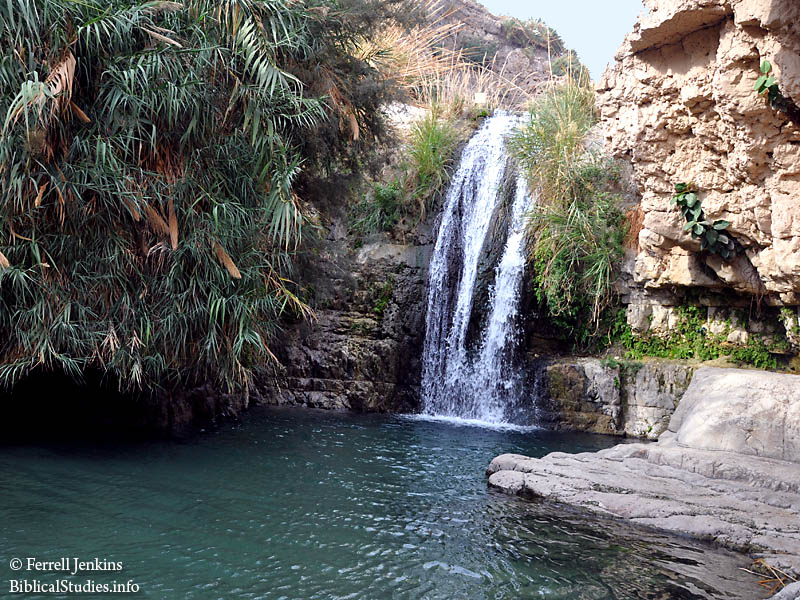
This week I haven’t had time to post much. Today, as I head home, I thought I would share this photo of one of the waterfalls at En Gedi.

Waterfall at En Gedi. Photo by Ferrell Jenkins.

One of the small waterfalls at En Gedi. Photo by Ferrell Jenkins.

This area, on the shore of the Dead Sea, is associated with David and Saul.

David went up from there and stayed in the strongholds of Engedi. (1 Samuel 23:29 NAU)

King of Israel felled by stray arrow

The story is in 1 Kings 22. Ahab, king of Israel (874-853 B.C.), and Jehoshaphat, king of Judah (870-848), decided to try to take back the city of Ramoth-gilead which had fallen under the control of the king of Aram (Syria). Ramoth-gilead is a city of tranjordan, now in the northern part of Jordan near the border with modern Syria.

Ahab was fearful to be seen in battle and disguised himself to avoid attack.

Now an archer shot an arrow at random, and it struck the king of Israel between the plates of his armor. The king ordered his charioteer, “Turn around and take me from the battle line, because I’m wounded.” (1 Kings 22:34 NET)

The king of Israel died and was taken to Samaria for burial.

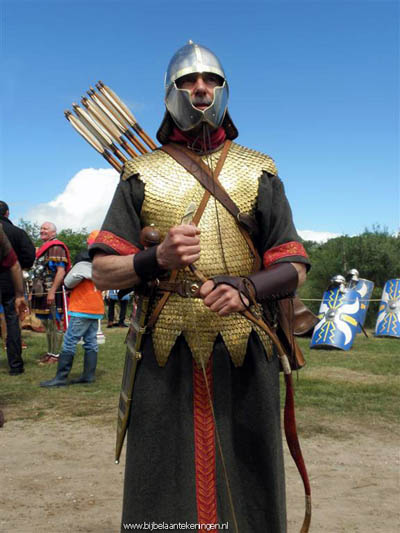
JP van de Giessen, a fellow blogger at Aantekeningen bij de Bijbel, has kindly granted permission for the use of these wonderful photos he made at the Romanfestival in Nijmegen (the Netherlands). He tells me that the festival is organized every two years with many actors. At this festival there were about 100 soldiers, 10 calvary and 120 civilian people (from slave to noble).

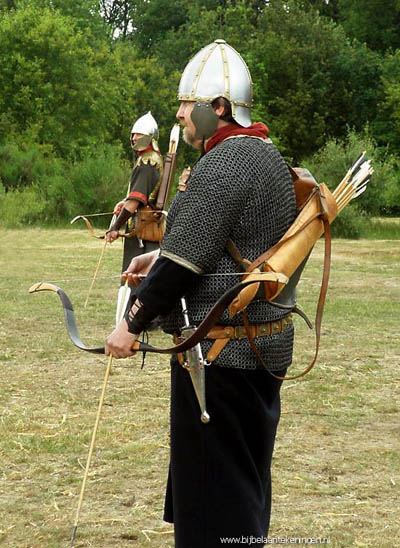
JP says the archers he photographed are Persian archers dressed according to the time of the Seleucids (the period between the testaments). They provide great illustrations for a lesson on 1 Kings 22.

Persian archer dressed as at the time of the Seleucids. Photo: JP van de Giessen.

Archer from the time of the Seleucids. Photo: JP van de Giessen.

According to JP, one of the archers he spoke with said he needed a year to create his costume, and another year for his bow and sword.

Archer from time of Seleucids. Photo by archer dressed as at the time of the Seleucids. Photo: JP van de Giessen.

Archer dressed as at the time of the Seleucids. Photo: JP van de Giessen.

More photos may be viewed here. JP van de Giessen holds the rights to these photos, but I think he is pleased when they are used in teaching. Click on the photo for a larger image.

Temple of Olympian Zeus in Athens

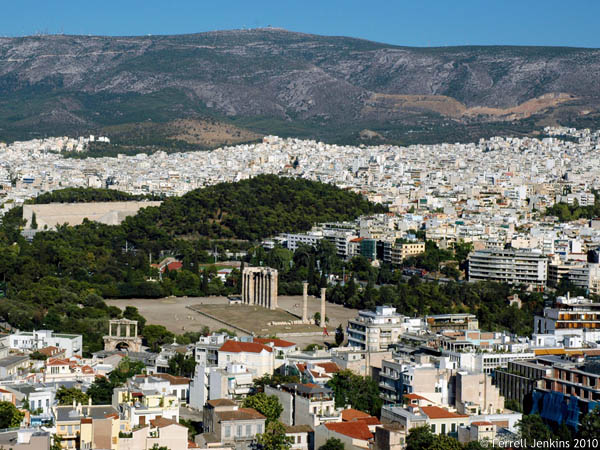
A reader asks about the location of the Arch of Hadrian that we wrote about in the previous post. The Arch is on the busy Leoforos Amalias. If you approach the arch and go through it, it leads to a park where the  Temple of Olympian Zeus, or Olympieion, stands. This is the area east of the Acropolis. The first photo shows the view from the Acropolis. The Temple is clearly visible. On the left you may also see the Olympic Stadium. The Arch of Hadrian is visible near the lower left corner.

The Temple of Olympian Zeus from the Acropolis. Photo by Ferrell Jenkins.

The Temple of Olympian Zeus from the Acropolis. Photo by Ferrell Jenkins.

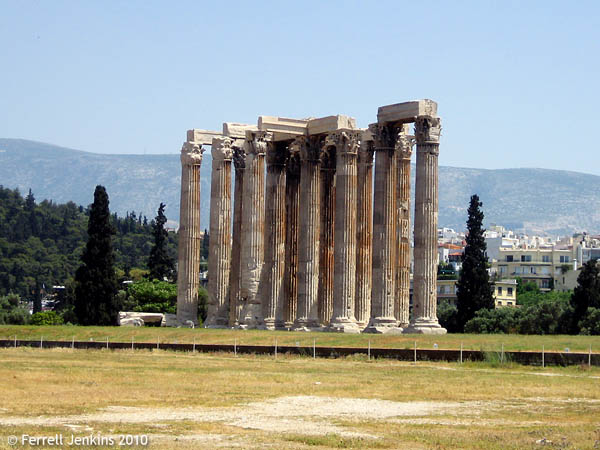
If you enter the park through the Arch of Hadrian you will have a nice view of the what remains of the Temple.

The Temple of Olympian Zeus in Athens. Photo by Ferrell Jenkins.

The Temple of Olympian Zeus in Athens. Photo by Ferrell Jenkins.

The Blue Guide on Athens and Environs says this is “the largest temple in Greece. It took 700 years to complete.” A temple was begun here as early as 550 B.C., but was not completed until the time of Hadrian.

Perhaps Paul saw this temple as he visited the sites of the city while awaiting the coming of Silas and Timothy from Macedonia.

For as I passed along and observed the objects of your worship, I found also an altar with this inscription, ‘To the unknown god.’ What therefore you worship as unknown, this I proclaim to you. (Act 17:23 ESV)

A map of Athens showing the central area, including the Arch of Hadrian, is available here.