Category Archives: Old Testament

The Vineyard

The prophet Isaiah records the song of the LORD for His vineyard that had become unfruitful.

1 Let me sing now for my well-beloved A song of my beloved concerning His vineyard. My well-beloved had a vineyard on a fertile hill.
2 He dug it all around, removed its stones, And planted it with the choicest vine. And He built a tower in the middle of it And also hewed out a wine vat in it; Then He expected it to produce good grapes, But it produced only worthless ones.
3 “And now, O inhabitants of Jerusalem and men of Judah, Judge between Me and My vineyard.
4 “What more was there to do for My vineyard that I have not done in it? Why, when I expected it to produce good grapes did it produce worthless ones?
5 “So now let Me tell you what I am going to do to My vineyard: I will remove its hedge and it will be consumed; I will break down its wall and it will become trampled ground.
6 “I will lay it waste; It will not be pruned or hoed, But briars and thorns will come up. I will also charge the clouds to rain no rain on it.”
7 For the vineyard of the LORD of hosts is the house of Israel And the men of Judah His delightful plant. Thus He looked for justice, but behold, bloodshed; For righteousness, but behold, a cry of distress. (Isaiah 5:1-7 NAU)

The photo was made in the hill country of Judah south of Bethlehem near the Patriarchs Way. This region of the country is filled with vineyards.
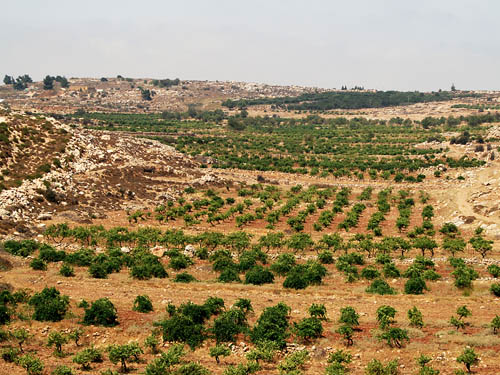
Vineyard in the hill country of Judah near the Patriarchs Way. Photo by Ferrell Jenkins.

Vineyard in the hill country of Judah. Photo by Ferrell Jenkins.
Jesus enters Jerusalem (The Lexham English Bible)

Last evening I downloaded The Lexham English Bible, which Logos is giving away to Logos Libronix users. Information here. The Lexham Bible is available free in several popular formats here. I decided to share this text about Jesus’ entry into Jerusalem in preparation for His death. Notes have been removed. The note are an important part of The Lexham Bible, but you may read those when you download your own copy.

And when they drew near to Jerusalem and came to Bethphage at the Mount of Olives, then Jesus sent two disciples, 2 saying to them, “Go into the village before you, and right away you will find a donkey tied and a colt with her. Untie them“bring them to me. 3 And if anyone says anything to you, you will say, ‘The Lord needs them,’ and he will send them at once.” 4 Now this took place so that what was spoken through the prophet would be fulfilled, saying,
5 “Say to the daughter of Zion,
‘Behold, your king is coming to you,
humble and mounted on a donkey,
and on a colt, the foal of a pack animal.’”
6 So the disciples went and did just as Jesus directed them, 7 and brought the donkey and the colt and put their cloaks on them, and he sat on them. 8 And a very large crowd spread their cloaks on the road, and others were cutting branches from the trees and spreading on the road. 9 And the crowds who went ahead of him and the ones who followed were shouting, saying,
“Hosanna to the Son of David!
Blessed is the one who comes in the name of the Lord!
Hosanna in the highest heaven!”
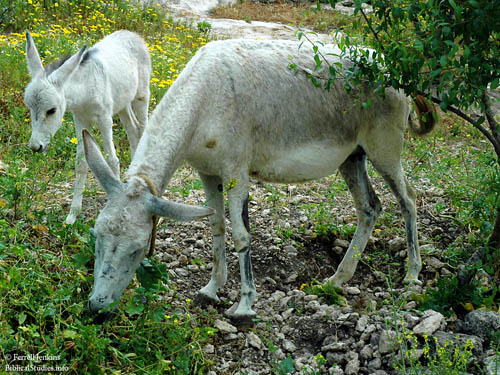
Donkey and Colt at Nazareth Village. Photo by Ferrell Jenkins.

Donkey and Colt at Nazareth Village. Photo by Ferrell Jenkins.

The late William Hendriksen makes these comments about this important event.

However, he also shows the crowds what kind of Messiah he is, namely, not the earthly Messiah of Israel’s dreams, the One who wages war against an earthly oppressor, but the One who came to promote and establish “the things that make for peace” (Luke 19:42), lasting peace: reconciliation between God and man, and between a man and his fellow man. Accordingly, Jesus enters Jerusalem mounted on a colt, the foal of an ass, an animal associated not with the rigors of war but with the pursuits of peace, for he is the Prince of Peace (Isa. 9:6).

But the people in general, their minds filled with earthly ideas concerning the Coming One, did not understand or appreciate this. In hailing him as the Messiah, the people were right; the Pharisees, chief priests, and scribes (Matt. 21:15, 16; Luke 19:39, 40) were wrong. But in expecting this Messiah to reveal himself as a political, earthly Messiah the Hosanna shouters were as wrong as were their leaders. Those who in every way rejected Jesus were committing a crime, but those who outwardly “accepted” and cheered him were also doing him a gross injustice, for they did not accept him for what he really was. Their tragic mistake was committed with dire results for themselves. (William Hendriksen, New Testament Commentary : Exposition of the Gospel According to Matthew, 760)

Scholarship or theft?

Someone unknown to me has copied numerous of my posts and posted them at their own site here.

I am delighted for others to use my material with a credit line, but this source includes no indication of the source of the material. It cost me many thousands of dollars to obtain the photos that I use on this page. Gaining permission to use material is not that difficult, and a credit line is certainly required.

You shall not steal. (Exodus 20:15 NAU)

He who steals must steal no longer; but rather he must labor, performing with his own hands what is good, so that he will have something to share with one who has need. (Ephesians 4:28 NAU)

Update Regarding Ethical and Legal Violations (March 27, 2010)

I knew that the person back of the actions mentioned above had done something unethical (sinful, according to the Hebrew Bible and the New Testament). I knew they were in violation of copyright law. After doing a little check, I learned that the practice is an infringement of the agreement made with WordPress, and a violation of the DMCA (Digital Millennium Copyright Act).

After checking the archives of the web site, I learned that this practice has been going on since December, 2009. The owner has used my photos with the same or similar captions, but has removed “Photo by Ferrell Jenkins” or other credits that I included. Outrageous, isn’t it?

Update (March 29, 2010): In response to my letter stating that my material had been plagiarized, WordPress has notified me that the offending web site “has been removed.” Thank you, WordPress. You are a great service.

Update # 2 (March 29, 2010): Soon after the single post that I reported to WordPress was taken down, others were moved to the top of the blog. Later, I reported 40 of my blogs that were copied. Late this afternoon I received this note: “The entire blog has now been removed, as per these multiple reports.”

ArchaeologyExcavations taken down from WordPress.

High places of the Gate

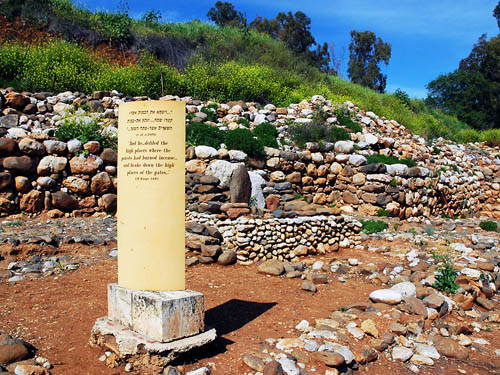
Standing stones (high places, bamah) are often found at the gate of Biblical cities. The photo below shows some standing stones from the gate of Tel Dan.  The informational sign immediately to the left of the standing stones includes a quotation from 2 Kings 23:8. The text describes the reforms of King Josiah of Judah (641/40–609 B.C.).

He brought all the priests from the cities of Judah and ruined the high places where the priests had offered sacrifices, from Geba to Beer Sheba. He tore down the high place of the goat idols situated at the entrance of the gate of Joshua, the city official, on the left side of the city gate. (2 Kings 23:8 NET)

[On “goat idols” see Leviticus 17:7 and 2 Chronicles 11:15]

Standing stones at the gate of Tel Dan. Photo by Ferrell Jenkins.

Standing stones at the gate of Tel Dan. Photo by Ferrell Jenkins.

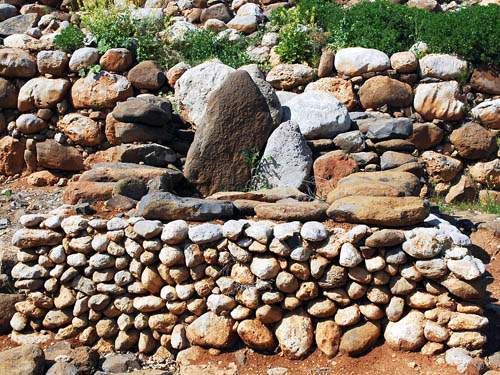
Here is a closer view showing the standing stones. The placement of these stones at the gate of the city allowed everyone who came into the city to make obeisance to whatever god was represented.

Standing stones at the gate of Tel Dan. Photo by Ferrell Jenkins.

Bamah at the gate of Tel Dan. Photo by Ferrell Jenkins.

See the previous post (here) for more information about the standing stones.

Cultic complex at Hazor

Hazor was one was the most important Canaanite cities when the Israelites entered the land.

And Joshua turned back at that time and captured Hazor and struck its king with the sword, for Hazor formerly was the head of all those kingdoms. (Joshua 11:10 ESV)

Stone stelae are commonly found during the excavation of Biblical cities. Archaeologists and Biblical scholars refer to an area of this type as a cultic center or complex. The word cult is used in several ways in modern writing and conversation, but it has a specialized meaning when we think of the archaeological context. The Hypertext Bible Commentary – Amos defines cultic as it is used in this context.

To do with organized religion and public worship, so “Israel’s cult” refers to the organized public religion of the kingdom of Israel. The word, when used in biblical studies, implies nothing (either way) about how theologically correct such worship or practice might be. It simply means public religion rather than private.

The photo below shows a cultic center found at Hazor from the Middle Bronze Age II (c. 1800-1550 B.C.). Sharon Zucherman, co-director of the Hazor excavations, refers to an area like this as “a ceremonial religious precinct” and “a cultic and ceremonial precinct” (BAR March/April 2006). An area like this is sometimes called a high place (Hebrew bamah).

Then I said to them, “What is the high place to which you go?’ So its name is called Bamah to this day.” (Ezekiel 20:29 NAU)

The crudely chiseled stones are designated by the Hebrew word massebah (plural masseboth). Some English translations use the phrase “standing stones” to translate massebah. Others use “sacred pillars” (NAU, NKJ, CSB) or “sacred stones” (NIV). The New Jerusalem Bible uses the phrase “cultic stones.”

The Israelites were instructed by the Lord to destroy these religious centers.

You will not bow down to their gods or worship them or observe their rites, but throw them down and smash their cultic stones. (Exodus 23:24 NJB)

In the left foreground of the area below there is a round basin. Perhaps for a libation?

Middle Bronze Age cultic complex at Hazor. Photo by Ferrell Jenkins.

Middle Bronze Age cultic complex at Hazor. Photo by Ferrell Jenkins.

A new Bible atlas

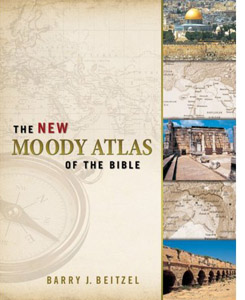
For the past three weeks I have had the opportunity to consult The New Moody Atlas of the Bible by Barry J. Beitzel.
The New Moody Atlas of the Bible
This work is a revision of The Moody Atlas of the Bible, published in 1985. This edition is a worldwide co-edition organized and produced by Lion Hudson in Oxford, England. You surely have seen some of their beautiful work in other publications. The USA edition is published by Moody Publishers. Many high quality books today are printed in the Orient. This one was printed in China. Amazing, isn’t it.
I don’t intend this as a review, but I am impressed with the clarity with which Beitzel discusses controversial material. In “The Route of the Exodus” he clearly discusses the historical background, the geographical setting, searching for Mt. Sinai in Saudi Arabia/South Jordan, searching for Mt Sinai in the northern Sinai peninsula, and searching for Mt. Sinai in southern Sinai. Pros and cons of the various positions are briefly set forth. No, I won’t tell!
This atlas sells for $49.99. I wish the publisher would sell it for $50. Does that one cent difference make anyone think they are getting a bargain? Amazon currently has the book for $31.49 (there we go again) from this link: The New Moody Atlas of the Bible.
Beitzel, with degrees from Dropsie, Fuller, and the University of Pennsylvania, is professor of Old Testament and Semitic Languages at Trinity Evangelical Divinity School.

Ancient Egypt in Pictures

Ancient Egypt in Pictures is the title of a slide-show collection of 47 nice photos on the Fox News web site here. Archaeology is alive and well in Egypt these days.

Egypt is an important travel destination for students of ancient history and archaeology, as well as for those interested in background studies for the Bible.

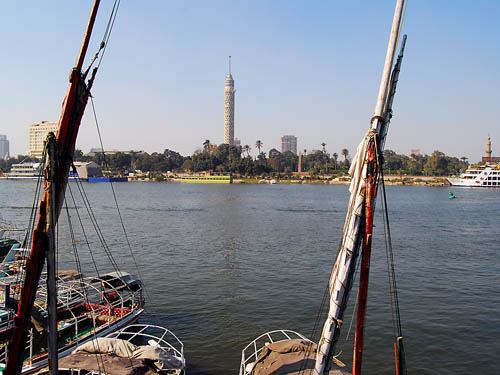
Nile River at Cairo. El Borg tower across river. Photo by Ferrell Jenkins.

Nile River at Cairo. El Borg tower across the river. Photo by Ferrell Jenkins.

HT: David Padfield

Jarmuth – a city of the Shephelah

Jarmuth (or Yarmuth) is located about 1 1/4 miles north of  the Valley of Elah, and 5 miles south of Beth-shemesh and the Sorek Valley. The site is mentioned 6 times in the book of Joshua (10:3, 5, 23; 12:11; 15:35), and in Nehemiah 11:29). The name is used in Joshua 21:29, but the Jarmuth mentioned there seems to be a town in the territory of Issachar.

Jarmuth was a Canaanite city conquered by the Israelites in the days of Joshua. It became part of the kingdom of Judah.

Michael Avi-Yonah says,

It has been identified with Khirbat al-Yarmūk (Eusebius calls it Iermochus), a large and prominent mound east of Kafr Zakariyya where surveys have revealed a large city surrounded by a massive stone wall from the Early Bronze Age and a smaller but higher mound containing pottery ranging from the Late Bronze to Byzantine periods. (Encyclopaedia Judaica)

Some excavations were conducted in the 1980s by Pierre De Miroschedji. The excavator says,

Given its size and the density of its construction, the EB III [about 2300 B.C.] city of Jarmuth may have had a population of about 3,000, engaged mainly in agriculture (cereals, vegetables, grapes, and especially olives) and animal husbandry (mostly sheep and goats, cattle and donkeys being used for traction and transport). (The Anchor Bible Dictionary 3:646)

The photo below was taken from Khirbet Qeiyafa, 1 1/4 miles south of Jarmuth.

Jarmuth from Khirbet Qeiyafa. Photo by Ferrell Jenkins.

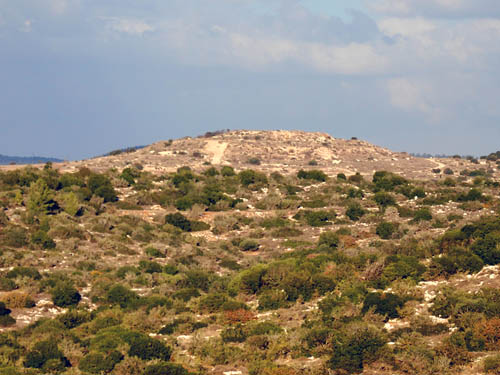
Jarmuth from Khirbet Qeiyafa (above the Valley of Elah). Photo by Ferrell Jenkins.

Dead Sea rises 8 centimeters

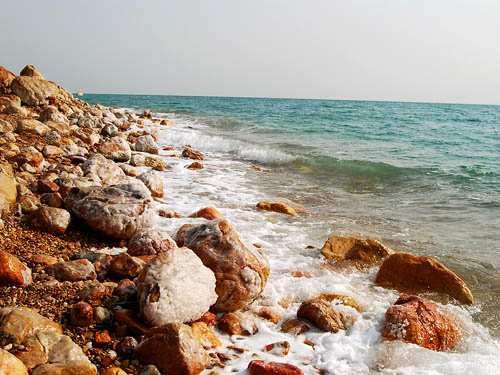
Haaretz reports that the water level of the Dead Sea rose 8 centimeters (3.15 inches) last year. This brings to mind the saying, “Every little bit helps.” Especially after the sea plummeted by more than 45 feet in the past 13 years. Read the report here.

The Salt Sea of the Bible (Genesis 14:3). Photo by Ferrell Jenkins.

HT: Bible Places Blog.

New Bible software map program

Scott Richardson, of Impressive Image Impressions, has released the third is his Discovering … series of Bible software. The first two are Discovering… Churches of the New Testament and Discovering… Kings of the Divided Monarchy. The new one is entitled Discovering… Lands and Places of the Bible (usable in both Windows and Mac). Maps cover all periods of the Bible in PDF and PNG format. These are suitable for use in presentations or printing for class.

The program includes a “Build-a-Map” feature for those who wish to edit maps for special purposes.

For detailed study involving the terrain these maps are lacking. With that said, I suspect that most preachers or teachers who use Bible maps in their presentations will find these adequate.

A Quicktime video shows the features of each program. The online store is temporarily down, but you may contact Scott by calling 1-800-762-4843.