Category Archives: Old Testament

Ophel Excavation 2012

Amir Kohen Klonymus, Area A supervisor of the Ophel Excavation, shows a few of the items found in a fire pit at the Ophel Excavation in December. You may find it difficult to understand his English, but stay with the 11 minute video, past the family visit of some sponsors of the dig, to the summation by Prof. Eilat Mazar.
I think anyone who has seen any part of the excavation areas on the south side of the Temple Mount will enjoy this video.

This video and others are available on the blog of The Key to David’s City here.

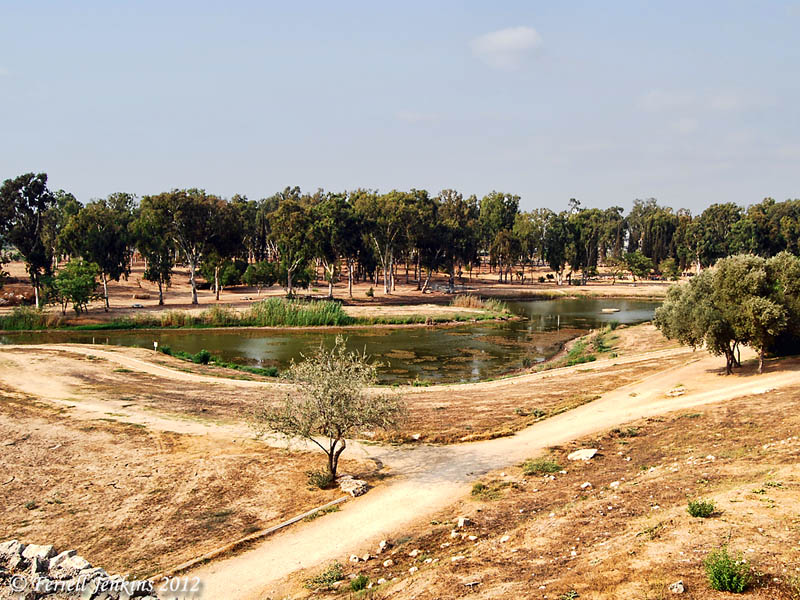
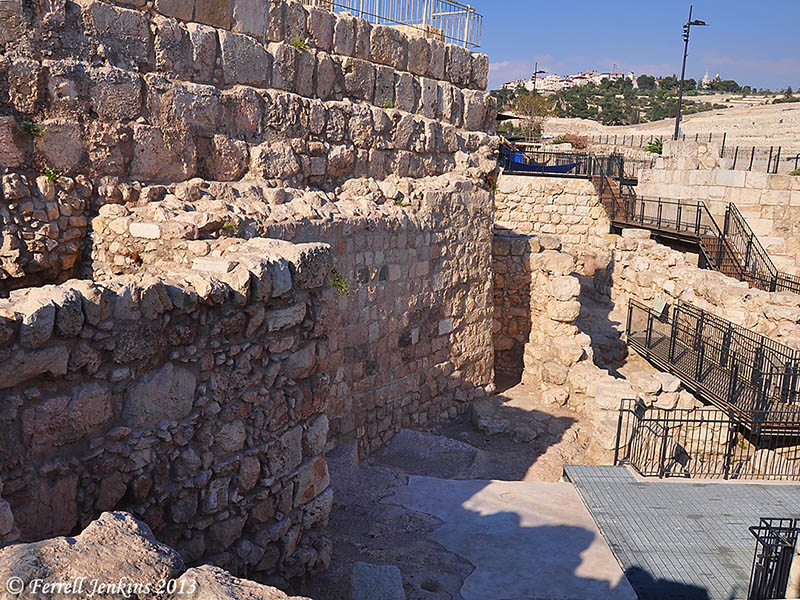
The photo below shows a portion of the Ophel Excavation.

Ophel Excavations - View East. Photo by Ferrell Jenkins.

Ophel Excavations – View East. Photo by Ferrell Jenkins.

Jothan, king of Judah (740-732 B.C.), is said to have built extensively in the area known as Ophel.

He built the Upper Gate to the LORD’s temple and did a lot of work on the wall in the area known as Ophel. (2 Chronicles 27:3 NET)

HT: Jack Sasson

The significance of Gaza

After my first tour to the Bible Lands, including Rome, Greece (Athens and Corinth), Egypt, Lebanon, Syria (Damascus), Jordan, and Israel, in April/May, 1967, I decided to make a second tour the following year. For many years, I always added some new places on each tour. In 1968 I added Beersheba and Gaza. The Gaza Strip (named such because of the long, narrow size of the small entity) had been under Egyptian control for several decades until June, 1967.

There was not much to see at Gaza. By the time we visited in 1968, Gaza was under Israeli control. We drove to the coast where there were only a few houses and some small fishing boats. This is one of the few slides that I have to illustrate the visit to Gaza.
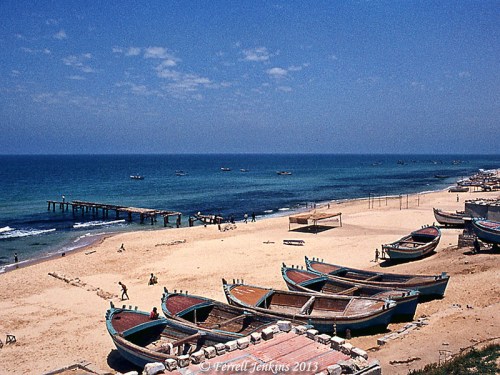
Gaza on the Mediterranean Sea in May, 1968. Photo by Ferrell Jenkins.

Gaza on the Mediterranean Sea in May, 1968. Photo by Ferrell Jenkins.

Gaza is mentioned several times in the Old Testament. Here is a summary of these references.

  • Gaza was the southwestern boundary of the Canaanites in the table of Nations (Genesis 10:19).
  • The original inhabitants of Gaza were replaced by the Caphtorim, likely the ancestors of the Philistines (Deuteronomy 2:23).
  • Joshua defeated Canaanites “even as far as Gaza” (Joshua 10:41).
  • Joshua eliminated the Anakites except in Gaza, Gath, and Ashdod (Joshua 11:21-22). We recognized these cities as later belonging to the Philistines.
  • Gaza is listed as belonging to the tribe of Judah (Joshua 15:47; Judges 1:18).
  • The Midianites oppressed Israel, “as far as Gaza”, for seven years (Judges 6:4).
  • Samson had contact with the inhabitants of Gaza (Judges 16).
  • Gaza is listed as one of the five Philistine cities in the time of the Israelite Judges (1 Samuel 6:17).
  • Solomon controlled territory as far southwest as Gaza (1 Kings 4:24).
  • Hezekiah defeated the Philistines as far as Gaza and its territory (2 Kings 18:8).
  • Jeremiah makes reference to Gaza being conquered by Pharaoh (Jeremiah 47:1).
  • The prophets of Judah pronounced judgments upon Gaza (Amos 1:6-7; Zephaniah 2:4; Zechariah 9:5).

The only New Testament reference to Gaza is in Acts 8:26. Philip the evangelist was instructed to go south on the road that descends from Jerusalem to Gaza. English translators struggle with the issue of whether the city was desert, or the road leading to the city ran through a desert area. (I will leave that for some other time.)

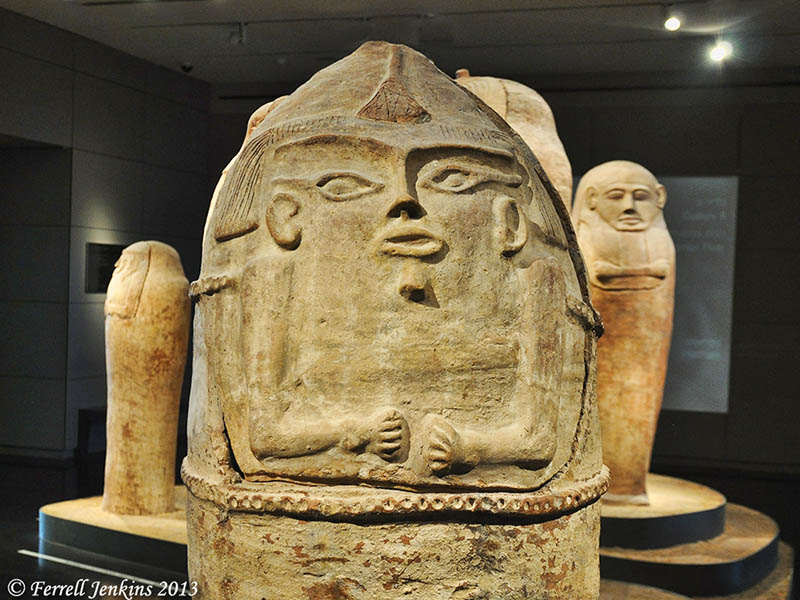
The first display one sees as he enters the archaeology wing of the Israel Museum is that of the anthropoid coffins from Deir el-Balah, a site south of Gaza city. The coffins, excavated by Trude Dothan in 1972, bear evidence of Egyptian influence. They date to the 13th century B.C.
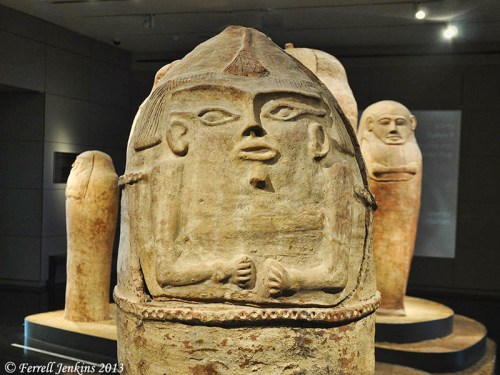
Anthropoid Coffins from Deir el-Balah in the Israel Museum. Photo by Ferrell Jenkins.

Anthropoid Coffins from Deir el-Balah in the Israel Museum. Photo by Ferrell Jenkins.
Hoping to grow frankincense in the Arava of Israel

Botanist Dr. Elaine Solowey is already known to us for the successful sprouting of a 2,000 year old date palm. See here.

Matthew Kalman reports that she is now trying her hand at growing frankincense in the Arava Institute for Environmental Studies.

“This is the first frankincense tree to set seed in Israel in 1500 years,” Dr Solowey told me as she presented the tiny sapling for its first public photo-call this week. “It was necessary to bring this variety back to the country because the last people growing these trees near the Dead Sea left and the trees left with them.”

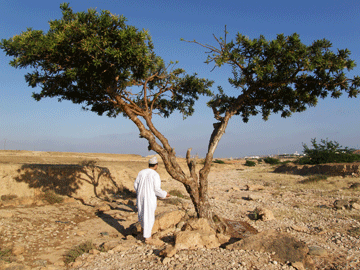
Frankincense tree, Salalah, Oman.

Frankincense tree, Salalah, Oman.

In biblical times, frankincense, myrrh  and balm of Gilead were used among the ingredients of the incense used in Solomon’s Temple (1 Chronicles 9:29-30). Solowey and other scientists are examining the medical uses of these products.

Every student of the New Testament remembers the gifts brought by the Magi (wise men) to Jesus.

As they came into the house and saw the child with Mary his mother, they bowed down and worshiped him. They opened their treasure boxes and gave him gifts of gold, frankincense, and myrrh. (Matthew 2:11 NET)

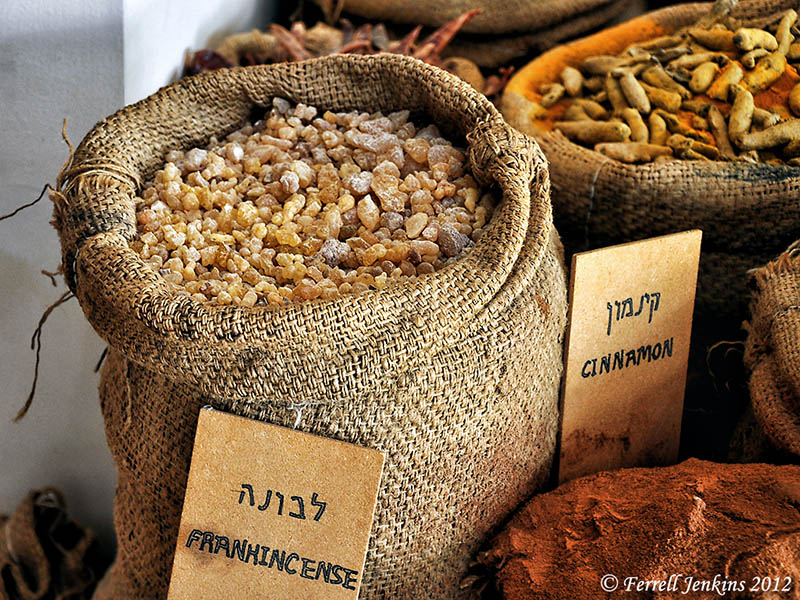
Our photo show frankincense displayed at Avdat, a Nabatean site along the ancient incense route. Frankincense is linked with gold in Isaiah 60:6, and is considered a great value.

Frankincense on the ancient spice route at Avdat, Israel. Photo by Ferrell Jenkins.

Frankincense on the ancient spice route at Avdat, Israel. Photo by Ferrell Jenkins.

To read all of Kalman’s informative article, see here.

We have written about frankincense and myrrh, with more photos and details, here and here and here.

HT: Joseph I. Lauer

“Dried up like a potsherd”

Simple things make good illustrations. Just ask Jesus.

David used many simple illustrations in the Psalms. In one he spoke of the common piece of broken pottery (potsherd) which could be found around every home and camp site.

my strength is dried up like a potsherd, and my tongue sticks to my jaws; you lay me in the dust of death. (Psalm 22:15 ESV)

In this text David describes his own feeling of weakness and/or that of the coming Messiah. There are times, I think, when each of us feels like this.

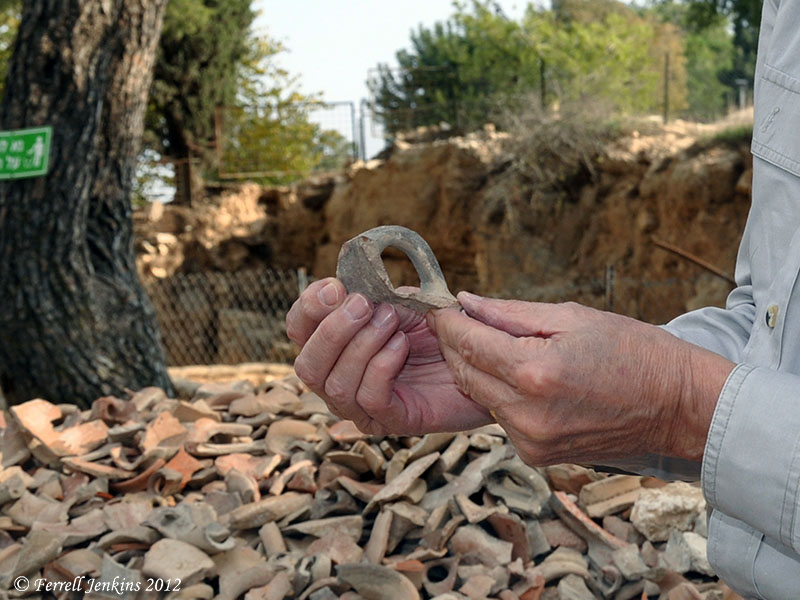
A common thing we see at archaeological digs is a pile of potsherds from ancient times. Archaeologists relish an unbroken piece of pottery, but even the sherds or potsherds reveal a lot about the age of the stratum being worked and the life of the ancient people. The broken jar handle from Ramat Rachel, south of Jerusalem, tells its own story.

Potsherds at Ramat Rachel excavation. Photo by Leon Mauldin.

Potsherds Potsherds at Ramat Rachel excavation. Photo by Leon Mauldin.

Unless it is an old college professor (pick your own), nothing is drier than a piece of broken pottery. Great illustration.

The “horns of the wild oxen”

Many Bible stories find their setting, and draw illustrations, based on the land where the writers lived.

David draws on the land when he prophesies the execution of the Messiah (Psalm 22). In one plea he says,

Save me from the mouth of the lion! You have rescued me from the horns of the wild oxen! (Psalm 22:21 ESV)

The term wild oxen in this text comes from the Hebrew word reem. The photo below shows the Arabian Oryx, thought to be the reem of the Hebrew Bible. The King James Version used the word unicorn to translate reem, but modern English versions typically translate it with “wild ox” (Psalm 22:21; Numbers 23:22; 24:8; Deuteronomy 33:17, et al.).

Arabian Oryx at Hai-Bar Nature Reserve near Eilat, Israel. Photo by Ferrell Jenkins.

Arabian Oryx at Hai-Bar Nature Reserve near Eilat, Israel. Photo by Ferrell Jenkins.

A new study guide for those who wish to understand the overall picture of the Bible

How do we deal with the problem of the person who does not know very much about the Bible and gets lost in some of our classes? I recall one time teaching Romans in a church class. I think we were already in chapter 11. A visitor came to the class. Toward the end of the class when I was entertaining questions, the visitor spoke up saying, “I don’t have any idea what you are talking about.” I sympathized with him and mentioned that we had set the stage for the current class over a period of months.

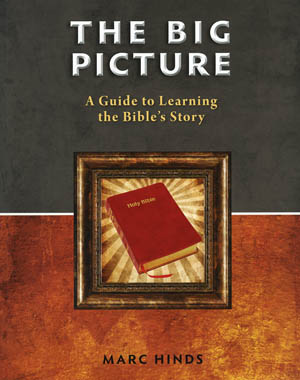
Marc Hinds, a former student of mine at Florida College, understands that many students need a general survey of the Bible. He has provided a solution for this problem in his newly published book by 21st Century Christian. The full name, The Big Picture: A Guide to Learning the Bible’s Story, explains what he is trying to do with this book. The book is suitable for classes of beginners or more advanced learners who haven’t yet understood the overall picture of the Bible.

The Big Picture, by Marc Hinds.

The Big Picture, by Marc Hinds.

In this book of 15 lessons, you will find a brief survey of both the Old Testament and the New Testament. The book is printed in full color with many illustrations, photographs, and maps drawn (by Marc) specifically to illustrate the lesson. This book will be suitable for church classes, or individual home study.

The book may be ordered from 21st Century Christian, other bookstores, or Amazon here: The Big Picture: A Guide to Learning the Bible’s Story.

Limited time bargain on a great Bible atlas

Christianbook.com is offering Carl Rasmussen’s Zondervan Atlas of the Bible for a limited time at the unusual price of $14.99. Click here.

zondervanatlascover01

I can’t promise that it will still be available by the time I get this posted, but you can try.

Update Noon  12-04-12:  I see the price is now $19.99. If you have a a Prime account with Amazon (postage free), or wish to add another item, the price may be better at $22.73 for Zondervan Atlas of the Bible.

This Atlas is an extremely good one. It is well written, accurate, colorful, filled with great photos and helpful maps. Earlier this evening I emailed a notice to folks who have traveled with me recently, or who plan to, with this note:

This is an excellent book for anyone planning a tour to Israel, or anyone who has been. It should be one of your most helpful Bible study tools.

One of the ladies who traveled to Israel earlier this year replied with this note:

That is a great price. I got one before we went. I use it daily as I read and it sure brings the scriptures alive. It is much more so now that we have seen the country.

Cyrus Cylinder scheduled for a U.S.A. tour

The British Museum announces that the Cyrus Cylinder will tour to five major U.S.A. museums in 2013. Plan your vacation how.

The Cylinder will travel with an exhibition of sixteen objects under the title ‘The Cyrus Cylinder in Ancient Persia’. The exhibition shows the innovations initiated by Persian rule in the Ancient Near East (550 BC-331 BC). The Persian Empire was then the largest the world had known. It had a huge impact on the ancient world, introducing changes in terms of ethical behaviour as witnessed in the proclamation on the Cyrus Cylinder.
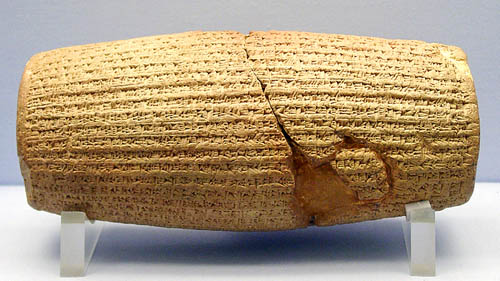
For more information see Artdaily here. A nice photo of the Cylinder is included.

The Cyrus Cylinder is important to Bible students because Cyrus is the Persian king who allowed the Judeans to return to Jerusalem and rebuild the temple.

Now in the first year of Cyrus king of Persia, that the word of the LORD by the mouth of Jeremiah might be fulfilled, the LORD stirred up the spirit of Cyrus king of Persia, so that he made a proclamation throughout all his kingdom and also put it in writing:  “Thus says Cyrus king of Persia, ‘The LORD, the God of heaven, has given me all the kingdoms of the earth, and he has charged me to build him a house at Jerusalem, which is in Judah. Whoever is among you of all his people, may the LORD his God be with him. Let him go up.'” (2 Chronicles 36:22-23 ESV; cf. Ezra 1:1-4).
Cyrus Cylinder.

Cyrus Cylinder in the British Museum. Photo by Ferrell Jenkins.
The U.S.A. schedule is as follows:
  • Smithsonian’s Arthur M. Sackler Gallery and Freer Gallery of Art, Washington D.C., 9th March – 28th April 2013
  • Museum of Fine Arts, Houston, 3rd May – 14th June 2013
  • The Metropolitan Museum of Art, New York 20th June – 4th August 2013
  • Asian Art Museum, San Francisco, 9th August – 22nd September 2013
  • J. Paul Getty Museum at the Getty Villa, Los Angeles, 2nd October – 2nd December 2013
HT: Jack Sasson

Maintaining control of a tour group

Occasionally I am asked if I ever have any trouble with individual tour members during a tour. The same might be asked about students in a class. After 45 years of directing tours I would have to say that there have been a few people who have given some problems for me or other tour participants. If they give trouble to others, that becomes a problem for me.

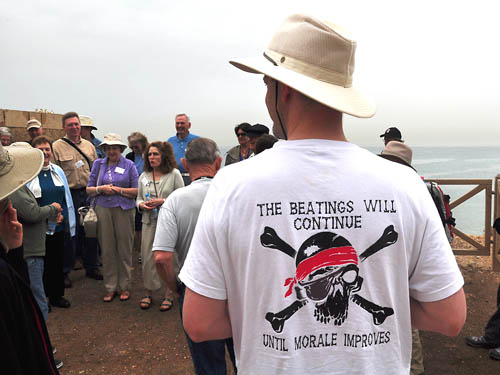
Mark, one of my friends, showed up on the first full day of touring with a T-shirt that I suppose he thought might help.

Dealing with trouble during a tour.

One tour member wanted everyone to improve their behavior. Photo by Ferrell Jenkins.

Really, the serious problems have been few and far between. I have become friends with some wonderful people through the years.

The advice of wisdom always works.

A soft answer turns away wrath, but a harsh word stirs up anger. (Proverbs 15:1 ESV)

Acts 23 — Photo Illustrations — Antipatris

The site of Antipatris was known as Aphek in Old Testament times. It it is the place where the Philistines were encamped when they took the ark of the covenant from the Israelites who had camped at nearby Ebenezer (1 Samuel 4:1).

Antipatris was built by Herod the Great and named in honor of his father.

Herod was also a lover of his father, if any other person ever was so; for he made a monument for his father, even that city which he built in the finest plain that was in his kingdom, and which had rivers and trees in abundance, and named it Antipatris. He also built a wall around a citadel that lay above Jericho, and was a very strong and very fine building, and dedicated it to his mother, and called it Cypros. (Jewish Wars 1:417)

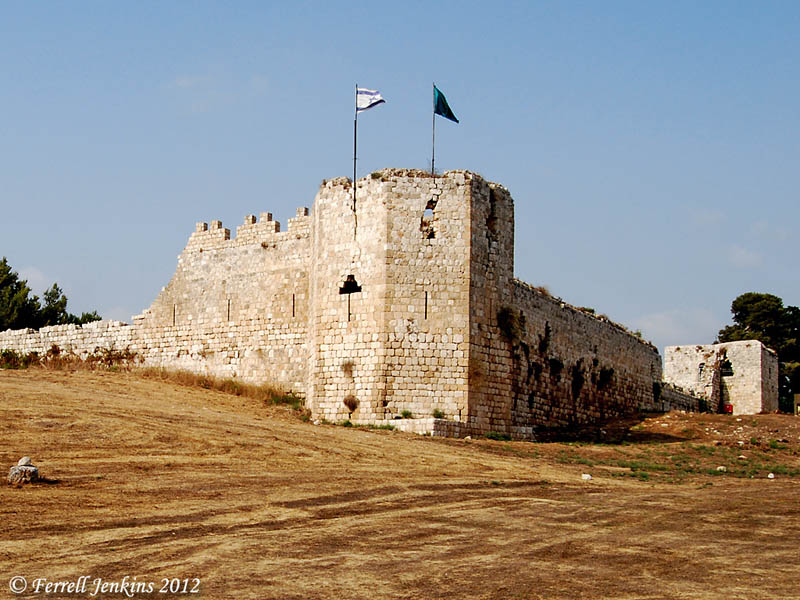
Because Aphek/Antipatris sat on a major south-north and west-east routes, it was dominated by many nations. The dominant feature of the site today is the Turkish fort. Inside are the excavated ruins of buildings from Canaanite to Herodian/Roman times.

Turkish fort at Aphek-Antipatris. Photo by Ferrell Jenkins.

Turkish fort at Aphek/Antipatris. Photo by Ferrell Jenkins.

Aphek/Antipatris is known by the modern name Ras el-Ain because it is located at the source of the Yarkon River which flows a few miles into the Mediterranean.

Source of the Yarkon River at Aphek-Antipatris. Photo by Ferrell Jenkins.

Source of the Yarkon River at Aphek-Antipatris. Photo by Ferrell Jenkins.

When a plot was raised against Paul while he was in the Fortress of Antonia in Jerusalem, he was sent by night to Antipatris. The next day he was escorted to Caesarea.

So the soldiers, according to their instructions, took Paul and brought him by night to Antipatris.  And on the next day they returned to the barracks, letting the horsemen go on with him.  When they had come to Caesarea and delivered the letter to the governor, they presented Paul also before him. (Acts 23:31-33 ESV)

From Jerusalem to Antipatris is about 30 miles. From there to Caesarea is an additional 27 miles.

Paul would remain in custody at Caesarea for two years.