Category Archives: New Testament

Hippos overlooks the Sea of Galilee

I think many Bible Land travelers pass En Gev on the eastern shore of the Sea of Galilee and never realize that the site of Hippos is visible about one and a half miles to the east. Perhaps that is because of the almost magnetic attraction of the Sea of Galilee.
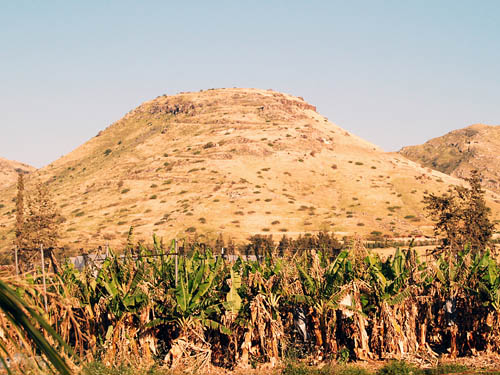
The site of Hippos (Susita), east of the Sea of Galilee. Photo by Ferrell Jenkins.

The site of Hippos (Susita), east of the Sea of Galilee. Photo by Ferrell Jenkins.

Vassilios Tzaferis wrote about Hippos in Biblical Archaeology Review:

If you look at the site of Sussita/Hippos from an adjacent mountain, or, better yet, from the air, and follow the adjoining ridge, or saddle, to the east, the site looks like the head of a horse and the saddle, or ridge, looks like the long, outstretched neck of a horse. It is this configuration that gave the site its name for nearly a thousand years. The ancient Greeks, who apparently were the first to settle the site, must have been aware of this resemblance because they named the place Hippos (horse). When the Jews conquered the city, they translated the name to Sussita, “mare” in Aramaic. When the Arabs conquered it, they called it Qal’at el Husn, the “fortress of the horse.”

The summit of the mountain is a plateau of about 37 acres on which lie scattered the ruins of what was once a beautiful town overlooking the lake.

Our story begins—perhaps it will begin much earlier after the site is thoroughly excavated—about a century after Alexander the Great conquered and Hellenized much of the then-known world. After Alexander’s death in 331 B.C., his empire split in two—the Ptolemies in Egypt and the Seleucids in Syria shared this world. Over the centuries Palestine passed from one side to the other, occasionally winning its own independence. The first evidence we now have of organized habitation at Hippos indicates that it was founded by the Seleucids in the middle of the third century B.C., very probably as a frontier fortress against the threat of the Ptolemaic kingdom to the south. The settlement was located on a most strategic point, on the western approach to Gaulanitis (today’s Golan Heights). The site’s natural fortification and defense allowed it to serve equally as a fortress stronghold and as an effective frontier post, controlling any movement to the east, both in time of war and peace. In about 200 B.C., the boundaries of the Seleucid kingdom were pushed down to southern Palestine, so Hippos lost much of its strategic significance but it retained its importance as an urban cultural center, with a social and political organization in accord with the principles of a Greek polis.

When the town was formally recognized as an official constitutional polis, it was renamed Antiocha, in honor of the head of the Seleucid kingdom, Antiochus the Great (III), although the old name Hippos was also officially used.

Hippos had a port on the Sea of Galilee “to serve the commercial and navigational needs” of the city.

The progress of the city as a Hellenistic center was interrupted for a period of about 20 years during the first half of the first century B.C. Sometime between 83 and 80 B.C., the Judean king Alexander Jannaeus, who then ruled an independent fiefdom, conquered Hippos. According to the first-century A.D. historian Flavius Josephus (Antiquities of the Jews 14.75), Jannaeus forced Hippos’ heathen inhabitants to be circumcised and to accept Judaism. In 64 B.C., however, the Roman army entered the scene. The Roman general Pompey took the city from the Jews; it was then included in the League of the Ten Cities, the Decapolis, created by Pompey in the northern Jordan Valley and adjacent Transjordan. Each city in the Decapolis had jurisdiction over an extensive area. As a member of the Decapolis, Hippos enjoyed internal autonomy and could even mint its own coins. The population of Hippos welcomed Pompey with open arms.

About 35 years later, Hippos again became part of a Jewish realm. In 30 B.C. the Roman emperor Augustus gave Hippos to Herod the Great, who ruled it until his death 26 years later, in 4 B.C. After Herod’s death, Hippos was assigned by the Romans to the province of Syria.

During the First Jewish Revolt against Rome (66–70 A.D.), the Jews attacked Hippos and its Greek inhabitants, who retaliated by killing or imprisoning the Jews residing there. (Biblical Archaeology Review 16:05, Sep/Oct 1990).

Riesner says that Hippos “must be” the city of the Decapolis presupposed in Mark 5:1-20 (the account of casting demons into swine; Dictionary of Jesus and the Gospels 40). It might be. Hippos is the closest of the cities of the Decapolis to the area of Jesus’ ministry which was centered in Capernaum. It would make sense that Gentiles in this area might be growing pigs.

And he [the healed demon-possessed man]went away and began to proclaim in the Decapolis how much Jesus had done for him, and everyone marveled. (Mark 5:20 ESV)

And great crowds followed him [Jesus] from Galilee and the Decapolis, and from Jerusalem and Judea, and from beyond the Jordan. (Matthew 4:25 ESV)

During excavations at Hippos in 2007, a sandal print identified as that of a Roman soldier was uncovered:
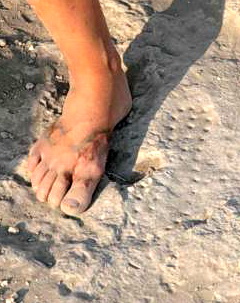
Sandal print from Hippos.

Roman sandal print from Hippos. Photo: University of Haifa.

Archaeologists have discovered a footprint made by the sandal of a Roman soldier in a wall surrounding the Hellenistic-Roman city of Hippos (Sussita), east of the Sea of Galilee.

The footprint was discovered during this eighth season of excavation, led by Prof. Arthur Segal from the Zinman Institute of Archaeology at the University of Haifa in conjunction with archaeologists from the Polish Academy of Sciences and Concordia University in St. Paul, Minnesota.

This rare footprint, which is complete and well preserved, hints at who built the walls, how and when,” said Michael Eisenberg of the Zinman Institute at the University of Haifa.

The print, made by a hobnailed sandal called caliga, the sandal worn by Roman soldiers, is one of the only finds of this type. The discovery of the print in the cement led archaeologists to presume that legionnaires participated in construction of the walls.

The full article may be read in Science Daily here.
Earthquake felt in Galilee

Haaretz reports a minor quake in the Galilean town of Carmiel (Karmiel). Carmiel is located west of the Sea of Galilee about half way to the Mediterranean town of Acco (Acre).

Residents near the northern town of Carmiel reported late-night vibrations which seismologists later confirmed as a minor quake measuring 3.0 on the Richter scale. No damage or injuries were caused.

In 2008 Israel was hit by a 4.1-magnitude quake with its epicenter in Lebanon, which caused damage across the country, ripping open a large hole in the Temple Mount plaza outside the Al-Aqsa mosque in Jerusalem and bringing down a house in the West Bank.

Israel also suffered four successive jolts in a four-week period in 2007.

The last major earthquake to strike the area was in 1927, measuring more than 6.0 Richter scale and killing 500 people.

Israeli experts say that because of population growth and high-rise construction, an earthquake of the same magnitude today would kill more than 18,000.

Read the complete article here.

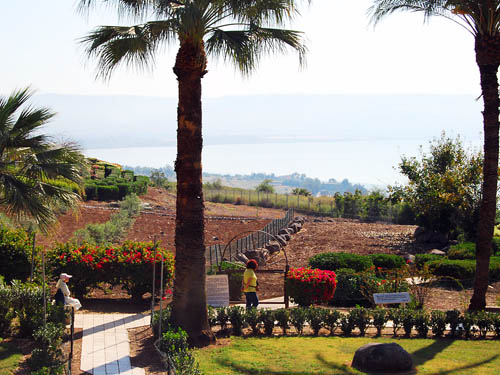
Our photo was made looking east from the traditional Mount of Beatitudes.

View east across the Sea of Galilee from Mount of Beatitudes. Photo by Ferrell Jenkins.

View east across the Sea of Galilee from Mount of Beatitudes. Photo by Ferrell Jenkins.

We have written about earthquakes in the Bible World several times. Check here, and use the Search box for the other posts.

The Fountain of Peirene at Corinth

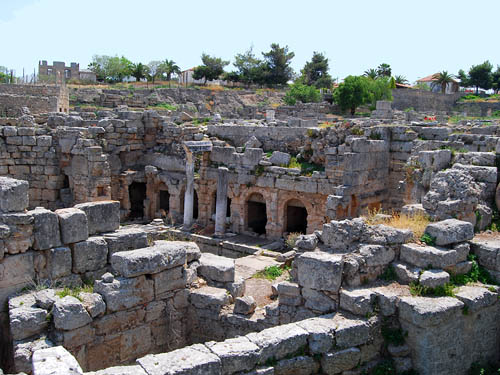
Food, Water, and the ability to defend, were the most important features in ancient cities. Corinth’s most important reservoir, the Fountain of Peirene, was fed from subterranean springs. It had a capacity of over 81,000 gallons.

Take a look at the horizon in the photo below. That was the level of the earth more than a century ago before archaeological excavations began at Ancient Corinth. The entire structure that we know as the Fountain of Peirene was covered with debris. This structure was built along the Lechaion Road which led from the Agora (Marketplace) to the Gulf of Corinth on the west side of the city.

The fountain is no longer in use, but if you walk close to the arches you can hear water flowing underneath the city.

Fountain of Peirene at Ancient Corinth. Photo by Ferrell Jenkins.

The Fountain of Peirene at Ancient Corinth. Photo by Ferrell Jenkins.

Paul visited Corinth on his second journey (A.D. 50-53). In spite of obstacles that brought fear to the heart of Paul, the Lord assured him that He had many people in the city (Acts 18:10).

And he stayed a year and six months, teaching the word of God among them. (Act 18:11 ESV)

Ancient Egypt in Pictures

Ancient Egypt in Pictures is the title of a slide-show collection of 47 nice photos on the Fox News web site here. Archaeology is alive and well in Egypt these days.

Egypt is an important travel destination for students of ancient history and archaeology, as well as for those interested in background studies for the Bible.

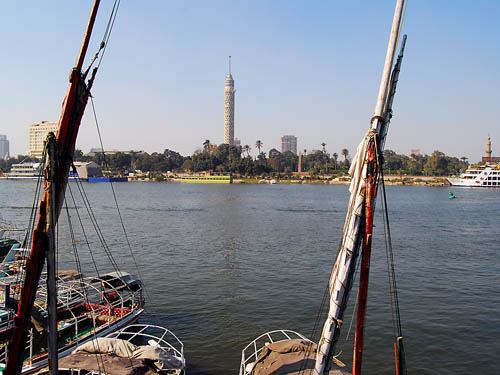
Nile River at Cairo. El Borg tower across river. Photo by Ferrell Jenkins.

Nile River at Cairo. El Borg tower across the river. Photo by Ferrell Jenkins.

HT: David Padfield

More on Paul’s shipwreck on Malta

Gordon Franz has written a critique on his Life and Land blog (here) of the CBN 700 Club’s program about Robert Cornuke’s “amazing Biblical discovery” on Malta. Previously we have called attention to Gordon’s blog and writings, and especially to his series on “Cracked Pot Archaeology” here.

The CBN video includes some nice footage and is, for that reason, worth viewing. If you have interest in this subject, I suggest you go to Life and Land and take a look at the video and read the critique.

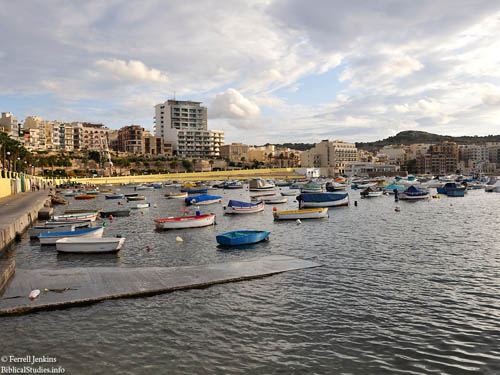
Our photo below shows one of the small pleasure harbors around St. Paul’s Harbor on Malta.

St. Paul's Harbor at Malta. Photo by Ferrell Jenkins.

St. Paul's Harbor at Malta. Photo by Ferrell Jenkins.

You may read our account of visiting Malta here and here. This is a significant topic because of the account of Paul’s shipwreck in Acts 28.

After we had safely reached shore, we learned that the island was called Malta. (Acts 28:1 NET)

New Bible software map program

Scott Richardson, of Impressive Image Impressions, has released the third is his Discovering … series of Bible software. The first two are Discovering… Churches of the New Testament and Discovering… Kings of the Divided Monarchy. The new one is entitled Discovering… Lands and Places of the Bible (usable in both Windows and Mac). Maps cover all periods of the Bible in PDF and PNG format. These are suitable for use in presentations or printing for class.

The program includes a “Build-a-Map” feature for those who wish to edit maps for special purposes.

For detailed study involving the terrain these maps are lacking. With that said, I suspect that most preachers or teachers who use Bible maps in their presentations will find these adequate.

A Quicktime video shows the features of each program. The online store is temporarily down, but you may contact Scott by calling 1-800-762-4843.

Earthquake hits Eastern Turkey

The earth seems to be shaking a lot in recent months. This morning we have reports of an earthquake which measured 6.0 on the Richter scale hit the mainly Kurdish region of eastern Turkey.

A powerful earthquake in eastern Turkey on Monday buried villagers as they slept in mud-brick houses, killing at least 57 and injuring dozens more, officials said.

The quake, which measured 6.0 on the Richter scale, struck at 4:32 am (0232 GMT) at a depth of five kilometres, with an epicentre near the Karakocan town in Elazig province, the Istanbul-based Kandilli observatory said.

Rescuers struggled to dig survivors from the rubble after the quake tore down mud-brick houses in several mountainous villages in the mainly Kurdish area, killing whole families in their sleep.

The report may be read in its entirety here.

In January I wrote about some preparations for earthquakes that I saw in eastern Turkey here.

Preparations for earthquake in Eastern Turkey

Preparing for an earthquake in Eastern Turkey. Photo by Ferrell Jenkins.

Several other blogs about earthquakes and the Bible World are here, and here, and here.

  • Earthquakes common in the Bible World here.
  • Earthquakes still a problem in the Middle East here.
  • Philadelphia (Revelation 3) – Church with an open door here.
  • Earthquake felt in Israel, Syria, and Lebanon here.

Earthquakes were so common in the Bible World that they are often used to provide imagery for the direct action of God. John uses this symbolism to describe what happened when the Lamb (Christ) broke the sixth seal (Revelation 6:12-17). A few words from the Dictionary of Biblical Imagery will give us something to think about today.

Some references to earthquakes appear to be bald statements of historic fact and seem to have little, if any, symbolic value (Amos 1:1, cf. Zech 14:5; Acts 16:26). Most references, however, particularly in the poetic parts of the Bible, accord a high degree of symbolism to earthquakes. Earthquakes in Scripture are often seen as manifestations of the direct action of God’s power. The example that is probably alluded to most is the earthquake at the giving of the law at Sinai (Ex 19:18). In their poetic reviews of the Exodus, later writers seem to have emphasized this element (Ps 68:8; 77:18; 114:4–7) and broadened its scope to cover the whole exodus event. Matthew’s linkage of the earthquake at Jesus’ crucifixion with the rending of the temple veil (Mt 27:54) is thus far more than a statement of physical cause and effect: it is profoundly symbolic. (225)

Witherington and Crossan on the Message of Jesus

Last week I attended The Greer-Heard Point-Counterpoint Forum in New Orleans. The forum is briefly described by Paul F. South, NOBTS Communications:

Two of the world’s best-known religious scholars will dialog at New Orleans Baptist Theological Seminary on a question that has sparked debate for some 2,000 years: What did Jesus really teach?

John Dominic Crossan and Ben Witherington III will be the featured speakers at the  2010 Greer-Heard  Point-Counterpoint  Forum, Feb. 26 and 27 at Leavell Chapel.

The event marks the seminary’s sixth Greer-Heard Point-Counterpoint Forum. The Forum is designed to provide a venue in which a respected evangelical scholar and a respected non-evangelical scholar discuss critical issues in religion, science, philosophy, or culture.

Audio CDs, MP3, or DVDs are available for all of the previous forums at a reasonable rate. Go here and click on STORE. The most recent forum (The Message of Jesus) is not on the list, but it is available. I think you can find a contact link somewhere on the page.

In addition to Witherington and Crossan, the other speakers were Darrell Bock, Craig Evans, Amy Jill Levine, and Stephen J. Patterson. Perhaps you recognize these names as representing both liberal and conservative perspectives on Jesus.

Crossan speaks while Witherington (R) waits his turn. Photo by Ferrell Jenkins.

Crossan (L) speaks while Witherington (R) waits his turn. Photo by Ferrell Jenkins.

He does not say so, but I think Ben Witherington III has posted his paper on his Bible and Culture blog here. It is a little difficult to read. Copy the document and save it in your word processor and it will be easier to read.

All of the speakers are distinguished scholars who have spent a great deal of their academic life writing on the general theme of Jesus Studies.

From the Temple Mount to the Pool of Siloam

Chris Mitchell, CBN News, reports on the steps leading from the Temple Mount to the Pool of Siloam.

Ancient steps and a storm sewer dating back to King Herod are two of the recent finds in Jerusalem.

The discoveries help tell the story of the Jewish pilgrimage to the Temple in the time of Jesus.

“I was glad when they said to me let us go to the house of the Lord,” King David wrote in the Psalms.

Some 2,000 years ago, Jewish pilgrims might have recited this psalm of ascents as they climbed stairs on their way to worship at the Temple.

Three times a year, the Bible commanded the Jewish people to go up to Jerusalem to celebrate the Feasts of the Lord.

“They probably camped outside the city in the valleys in the Kidron Valley… came in the city through the southern gate into the pool to take a ritual bath and then went up to the Temple Mount to pay their respects to the God of Israel,” said Haifa University archaeologist Roni Reich.

The excavation is located just outside the City of David. Many believe the area was Jerusalem at the time of King David.

Recently archaeologists uncovered the other side of the broad stairway leading to the Temple Mount. Paved with large limestone blocks, it is thought to be about 140 feet wide and climbs less than a half mile uphill to the Temple Mount.

Reich said Jesus, too, most likely walked the steps.

Just outside is the pool of Siloam, where Jesus healed the blind man as mentioned in the Gospel of John.

Read the full report, or watch a nice video featuring Archaeologists Ronnie Reich, here.

HT: Dr. Claude Mariottini

Shechem in biblical history

Tell Balata (Shechem) was excavated by Germans working periodically between 1907 and 1934. In 1956, G. Ernest Wright led the Drew-McCormick Expedition. Work continued in 1969 under the direction of Edward F. Campbell.
I had the privilege of visiting the ruins of Shechem last December. At the time I thought how sad to see such an important site neglected. Shechem is important in biblical history. Some of the significant events associated with the city are listed below.
  • Shechem is the first city of Canaan mentioned in the Bible. The land promise to Abraham was restated here (Genesis 12:6-7).
  • Jacob and his family settled at Shechem (Genesis 33:18). Jacob purchased a parcel of ground and erected an altar here.
  • Joseph’s brothers had gone from Bethlehem to near Shechem to graze their flocks (Genesis 37:12-13).
  • After entering Canaan, the Israelites gathered at Shechem on Mount Gerizim and Mount Ebal to hear Joshua read the blessings and cures of the Law (Joshua 8:30-34; cf. Deuteronomy 28-30).
  • Shechem was within the territory of Ephraim and served as a city of refuge (Joshua 20:7; 21:21).
  • Joseph was buried in a parcel of ground bought by Jacob (Joshua 24:32).
  • The Shechemites supported Abimelech in his bid to be ruler and gave him money from their temple of Baal-berith (Judges 8:33; 9). Jotham’s addressed the people of Shechem from Mount Gerizim with a fable (Judges 9:7ff.).
  • After the Exile, Shechem became a major religious center of the Samaritans. Their temple was built on Mount Gerizim (John 4:20-21).
  • Jesus visited Jacob’s Well near Shechem (John 4).

The photo below shows the excavated ruins of Tell Balata (Shechem). Mount Gerizim is on the left (to the south). Mount Ebal is on the right (to the North). The view is toward the west. The modern Arab town of Nablus is in the valley between these two mountains.

Shechem in the valley between Mount Gerizim & Mount Ebal.

Shechem — in the valley between Mount Gerizim and Mount Ebal.