Category Archives: New Testament

Pisidian Antioch was the site of an important announcement

One of the important cities visited by Paul and Barnabas on the first preaching journey was Pisidian Antioch.

Moving from Perga, they arrived at Pisidian Antioch, and on the Sabbath day they went into the synagogue and sat down. After the reading from the law and the prophets, the leaders of the synagogue sent them a message, saying, “Brothers, if you have any message of exhortation for the people, speak it.” (Acts 13:14-15 NET)

Don’t confuse this Antioch in Pisidia, about 100 miles north of Perga, with Antioch in Syria where Barnabas and Saul began their journey (Acts 13:1-4).

Pisidian Antioch had been founded about 350 B.C. by either Seleucus Nicator or his son Antiochus I in ancient Phrygia, near Pisidia. About two thousand Jewish families were brought to Phrygia from Babylon about 200 B.C. (Josephus Ant. xii.3.4). This explains the presence of Jews and the synagogue.

Our photo shows one of the Roman streets at Antioch. The modern Turkish town of Yalvac can be seen in the distance.
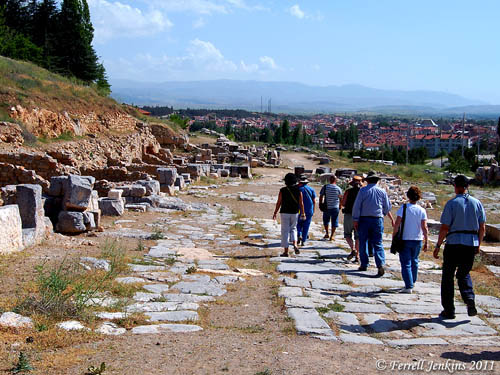
Roman Street in Pisidian Antioch. Photo by Ferrell Jenkins.

Roman Street in Pisidian Antioch. Photo by Ferrell Jenkins.

Acts 13 should be remembered as the chapter in which Luke records Paul’s sermon on the history of Israel to both Jews and God fearing Gentiles. The sermon recounted here is similar to the sermon Paul heard from the martyr Stephen (Acts 7).

The events at Pisidian Antioch are significant because it is here that we have many Jews and devout god-fearing proselytes accepting the message of Paul and Barnabas (Acts 13:43). When the Jews began contradicting the gospel we hear the announcement of a more concentrated effort to reach the Gentiles with the Gospel.

Both Paul and Barnabas replied courageously, “It was necessary to speak the word of God to you first. Since you reject it and do not consider yourselves worthy of eternal life, we are turning to the Gentiles. For this is what the Lord has commanded us: ‘I have appointed you to be a light for the Gentiles, to bring salvation to the ends of the earth.'” When the Gentiles heard this, they began to rejoice and praise the word of the Lord, and all who had been appointed for eternal life believed. So the word of the Lord was spreading through the entire region. (Acts 13:46-49 NET)
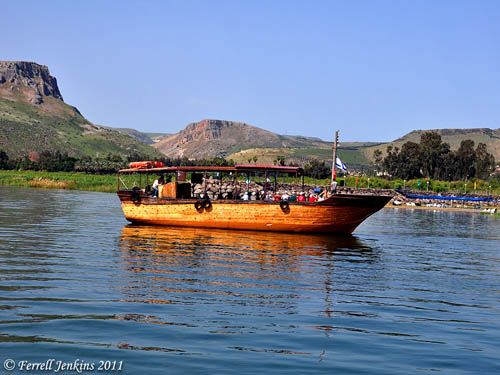
Approaching Gennesaret

The Sea of Galilee is called the “lake of Gennesaret” (Luke 5:1), and the “Sea of Tiberias” (John 6:1; 21:1). This indicates that both Tiberias, where Herod Antipas had built his capital in the mid-20s of the first century, and Gennesaret were significant places. When one traveled from Nazareth, Cana, or others places west of the Sea of Galilee, he would pass by Mount Arbel into the plain or land of Gennesaret.

This photo, taken on an unusually clear day, shows a small ship about to anchor at Nof Ginosaur (= Gennesaret). To the west we see Mount Arbel and the pass below allowing travel and commerce between lower Galilee and the towns around the Sea of Galilee.

Boat approaches the land of Genessaret. Photo by Ferrell Jenkins.

Boat approaching the land of Gennesaret. Photo by Ferrell Jenkins.

The photo nicely illustrates the text of Mark 6.

When they had crossed over they came to land at Gennesaret, and moored to the shore. When they got out of the boat, immediately the people recognized Him, and ran about that whole country and began to carry here and there on their pallets those who were sick, to the place they heard He was. Wherever He entered villages, or cities, or countryside, they were laying the sick in the market places, and imploring Him that they might just touch the fringe of His cloak; and as many as touched it were being cured. (Mark 6:53-56 NAU. cf. Matthew 14:34-36)

The first disciples of Jesus were called by the lake of Gennesaret (Luke 5:1).

Keep your lamps burning

Light is necessary for life and growth. We are introduced to light in the biblical account of creation.

And God said, “Let there be light,” and there was light.  And God saw that the light was good. And God separated the light from the darkness.  God called the light Day, and the darkness he called Night. And there was evening and there was morning, the first day.  (Genesis 1:3-5 ESV)

Of Jesus, the Gospel of John says, “In him was life, and the life was the light of men” (John 1:4 ESV).

David spoke of meditating on God during the watches of the night (Psalm 63:6). He watched his sheep by night, but most work was not done in the night prior to the introduction of electric power. We used one Aladdin lamp and a few kerosene lamps in our home in the rural South until I was about 8 or 10 years old. Then we began to use a single electric bulb in a room when we needed to be in the room.

Jesus said,

We must work the works of of him who sent me while it is day; night is coming, when no one can work.  As long as I am in the world, I am the light of the world” (John 9:4-5 ESV).

Herodian period lamp burning. Photo by Ferrell Jenkins.

Herodian period lamp from the time of Jesus. Photo by Ferrell Jenkins.

The photo above is one of the Herodian period lamps I have purchased in the Bible lands over the past 44 years. Two or three times I have used some olive oil (or Wesson oil, or a small piece of a candle) to show how much light the lamp gives.

In the parable of the watchful slaves Jesus said,

“Stay dressed for action and keep your lamps burning,  and be like men who are waiting for their master to come home from the wedding feast, so that they may open the door to him at once when he comes and knocks. (Luke 12:35-36 ESV)

The Apostle Paul commanded the saints at Philippi to shine as lights in the world.

Do all things without grumbling or questioning,  that you may be blameless and innocent, children of God without blemish in the midst of a crooked and twisted generation, among whom you shine as lights in the world, (Philippians 2:14-15 ESV)

Photos that are worth 1000 words each

Photos can be used effectively to illustrate Bible lands and customs. Otherwise dull presentations can come to life with the use and explanation of appropriate photos.

Pictorial Library of Bible Lands. We have suggested frequently that every Bible teacher needs access to Todd Bolen’s Pictorial Library of Bible Lands. Todd publishes a Newsletter every few months in which he gives away a few excellent photos already in PowerPoint format. If you don’t receive the Newsletter I suggest you download the November issue here. It contains several panoramic photos that give you the opportunity to see and understand a lot at once. And while you are there you should sign up to receive the Newsletter when it is published. Also take a look at the BiblePlaces Blog and the BiblePlaces.com web site. See also LifeintheHolyLand.com. BiblePaces is now availabe in French at BibleLieux.com and Spanish at LugaresBiblicos.com.

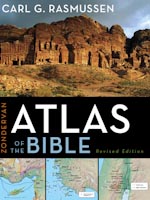
Holy Land Photos. Carl G. Rasmussen, author of the revised Zondervan Atlas of the Bible, is now posting the photos used in the Atlas at his Holy Land Photos site. Begin here. You will find thousands of useful photos at this site. These photos will be especially helpful to those seeking to teach Bible geography or to incorporate geographical information into lessons. These photos are in PowerPoint format. You also need the have and study the Atlas. Also check the HolyLandPhotosBlog for more recent photos and updates.

Order the Zondervan Atlas of the Bible from Amazon (currently $26.12).

David Padfield has a large number of photos of Bible lands available for free download here. Thanks to these men who have devoted much time and money to acquiring the photos and preparing them for others to use. I have used the work of all three in my presentations in recent years.

Wallace-Ehrman debate on the reliability of the text of the New Testament

The following announcement comes from the Center for the Study of New Testament Manuscripts web site here:

On October 1, 2011 Dr. Bart D. Ehrman and CSNTM’s Executive Director, Dr. Daniel B. Wallace, debated the reliability of the text of the New Testament at Southern Methodist University. This was the largest debate over the text of the New Testament in history. A professional film crew recorded the debate, which is now available to you. In this exciting dialogue you have the opportunity to listen to two leading scholars talk about this issue from opposing viewpoints. Can we trust the text of the New Testament? You decide.

The DVD is priced at only $15.50 plus shipping and handling. Currently only the USA format (NTSC) is available. Pick yours up today.

The DVD is copyrighted by CSNTM; please do not replicate or distribute it.

Click here to order the DVD.

The Tischendorf letter at Saint Catherine’s Monastery

Reader Ted Weis wrote,

Do you happen to have a photo of the letter that von Tischendorf wrote, saying that he would return codex Sinaiticus?

Well…, yes and no. A picture. But not a good one. There is now a museum or display area of a few small rooms in the Monastery near Moses’ Well. Signs are posted to restrict photography. A photo that I have from this year is too blurry to make sense of. A copy of the letter is posted on one wall and a sign about Codex Sinaiticus (in Greek, English, and Arabic), reads this way:

Codex Sinaiticus

The Codex Sinaiticus dates to the middle of the fourth century, and is possibly one of the fifty copies of the Holy Scriptures sent to Constantine the Great by Eusebius of Caesarea. This same manuscript was likely donated to the Monastery of Sinai at its foundation, where it was preserved until the middle of the nineteenth century. It was seen in the library of the Monastery by the German scholar Constantine Tischendorf on his visits in 1844 and 1859. The first folios that he took, he presented to the University of Leipzig. The rest he gave to the Emperor of Russia, folios he had received as a loan so that they might be published, secured with lying promises to the monks. In Russia they remained until 1933, when they were sold by the Soviet Union to the British Library in London, where they are to this day. In 1975, certain folios of the Codex came to light among the New Finds in the tower of Saint George. The monks of Sinai have never ceased in their justified request for the return of their Codex.

The photo below shows the sign on the right and a copy of the Tischendorf letter on the left.

Sinaticus Sign and Tischendorf Letter at Saint Catherine's Monastery. Photo by Ferrell Jenkins.

Tischendorf letter & sign at Saint Catherine's Monastery. Photo by Ferrell Jenkins.

I remember visiting the Monastery library on two previous occasions. At that time we were taken into the library during the visit. I saw a copy of the Tischendorf letter and an English translation. Here is a scan of a slide I made in 1986. Click on image for a larger photo.

Tischendorf Letter at Saint Catherine's in 1986. Photo by Ferrell Jenkins.

Tischendorf Letter at Saint Catherine's in 1986. Photo by Ferrell Jenkins.

The letter on the left is written in Greek. James Bentley says it was “bad Greek” and that the translation is “not very competent.” Here, he says, is what Tischendorf wrote:

I the undersigned, Constantin von Tischendorf, sent at present to the East by orders of Alexander, Tsar of All Russias, testify by the present letter that the Holy Confraternity of Mount Sinai, in accordance with the letter of His Excellency Ambassador Lobanov, has handed over to me, as a loan, an ancient manuscript of both Testaments, being the property of the aforementioned monastery and consisting of 346 folia and a small fragment. These I wish to take with me to St Petersburg in order that I may compare the original with the copy made by me when that is printed.

This manuscript is entrusted to me under the conditions laid down in the aforementioned letter of Mr Lobanov, dated 10 September 1859, numbered 510. I promise to return it, undamaged and in a good state of preservation, to the Holy Confraternity of Mount Sinai at its first request.

Several years ago I read James Bentley’s Secrets of Mount Sinai: The Story of the World’s Oldest Bible — Codex Sinaiticus (Doubleday, 1986). It is an interesting book and may still be available. The foreword is by James H. Charlesworth.

Sorry I can’t do better, but I hope this will be helpful to those who are interested in the history of Codex Sinaiticus, the oldest complete manuscript of the New Testament.

The largest part of Codex Sinaiticus is now in the British Library, but there are portions in three other places including Saint Catherine’s. The available pages of the manuscript are available online at the Codex Sinaiticus website.

The “Burning Bush” in Saint Catherine’s Monastery

Bible students are familiar with the Exodus account of Moses and the burning bush. Note these verses.

Now Moses was keeping the flock of his father-in-law, Jethro, the priest of Midian, and he led his flock to the west side of the wilderness and came to Horeb, the mountain of God.  2 And the angel of the LORD appeared to him in a flame of fire out of the midst of a bush. He looked, and behold, the bush was burning, yet it was not consumed.  3 And Moses said, “I will turn aside to see this great sight, why the bush is not burned.”  4 When the LORD saw that he turned aside to see, God called to him out of the bush, “Moses, Moses!” And he said, “Here I am.”  5 Then he said, “Do not come near; take your sandals off your feet, for the place on which you are standing is holy ground.”  (Exodus 3:1-5 ESV)

There are later biblical references to this event. Deuteronomy 33:16 speaks of “Him who dwelt in the bush.” Jesus called attention to the account in his answer to the questions about the resurrection.

And as for the dead being raised, have you not read in the book of Moses, in the passage about the bush, how God spoke to him, saying, ‘I am the God of Abraham, and the God of Isaac, and the God of Jacob’? (Mark 12:25 ESV)

Both Mark and Luke use the Greek term batos for the bush. This word describes a thorn bush or a bramble bush. Luke’s account of Stephen’s speech also mentions the “burning thorn bush” (Acts 7:30, 35). Josephus also refers to a “thorn bush” (Ant. 2:266).

for a fire fed upon a thornbush, yet did the green leaves and the flowers continue untouched, and the fire did not at all consume the fruit branches, although the flame was great and fierce.

From this event follows the commissioning of Moses to go to Pharaoh to bring God’s people out of oppression in Egypt. When Moses has brought the people out of Egypt he is to “serve God on this mountain” (Exodus 3:12).

Brown-Driver-Briggs define the Hebrew word seneh as “a thorn bush, perh. black-berry bush.”

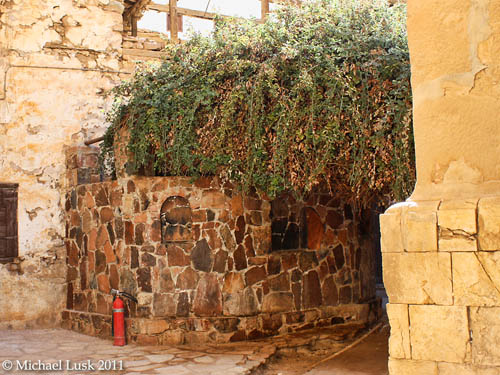
Another of the traditions associated with Saint Catherine’s Monastery is the burning bush. I am using another of the photos by Michael Lusk. Our visit to the Monastery was in the morning — a time when the lighting was bad for a photo of this bush. Michael went a little later than I did and his phot0 is better. I think the fire extinguisher is a nice touch.

The "burning bush" in Saint Catherine's Monastery. Photo by Michael Lusk.

The "burning bush" in Saint Catherine's Monastery. Photo by Michael Lusk.

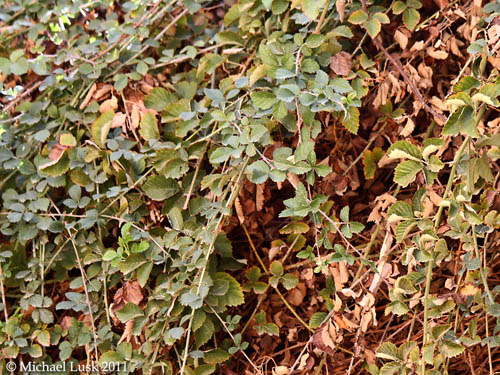
I have no idea about the specific kind of bush mentioned in Exodus. Here is a close up of the bush in Saint Catherine’s Monastery. A careful look reveals that this bush has small thorns on it.

Close up of "burning bush" in St. Catherine's Monastery. Photo by Michael Lusk.

Close up of "burning bush" in St. Catherine's Monastery. Photo by Michael Lusk.

Quake survivors plead for tents

With the death toll approaching 300 in Eastern Turkey, a headline from MSNBC says, “Turkish quake survivors plead for tents.” It is easy to locate photos of tent cities set up in the area of the earthquakes. Such is often true even for those whose houses were not destroyed. The fear of after shocks cause people to leave their houses.

One of the first questions we should ask in Bible study is “What did this text mean to the original readers?” Until we know the answer to that question we should not try making applications of our own. Sometimes we fail to understand a text because we do not understand the customs and conditions of the time in which the text was written.

The letters to the Seven Churches of Revelation are especially filled with local allusions to things common in that time and place. The saints at Philadelphia were told that the one who overcomes (conquers) would be made a pillar in the temple of God. Notice the next phrase: “Never shall he go out of it.”

The one who conquers, I will make him a pillar in the temple of my God. Never shall he go out of it, and I will write on him the name of my God, and the name of the city of my God, the new Jerusalem, which comes down from my God out of heaven, and my own new name. (Revelation 3:12 ESV)

Philadelphia was especially noted for volcanoes and earthquakes. We discussed this earlier here. Pillars crumble during earthquakes and people leave their houses to live in tents. The promise in this text is that the one who overcomes will become a pillar in the temple of God and “never shall he go out of it.” This was a wonderful promise to those saints who had suffered from earthquakes on several occasions.

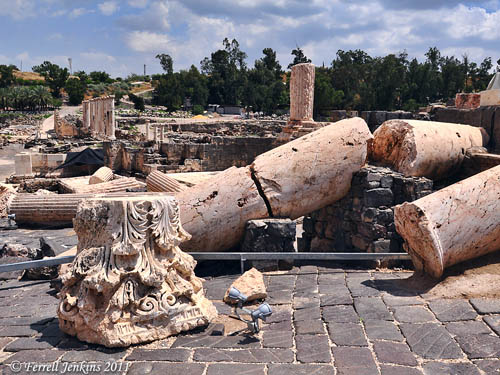
The photo below illustrates the effect of an earthquake on the pillars of temples and other buildings. It was made at Bethshan (Beth-shean) where an earthquake hit the city in 749 A.D.

Columns broken by earthquake at Bethshan. Photo by Ferrell Jenkins.

Columns broken by earthquake at Bethshan. Photo by Ferrell Jenkins.

Making your enemies your footstool

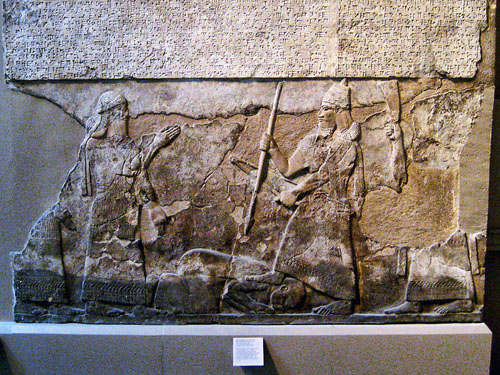
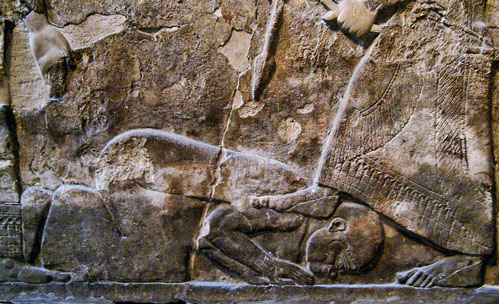
A common motif found in Ancient Near East reliefs shows a monarch placing his foot on his enemy. One illustration of this is the large relief showing the Assyrian King Tiglath-Pileser III (reigned 745-727 B.C.) with his foot on the neck of an enemy. Tiglath-Pileser III is known as Pul in the Bible.

Pul king of Assyria invaded the land, and Menahem paid him a thousand talents of silver to gain his support and to solidify his control of the kingdom. (2 Kings 15:19 NET)

So the God of Israel stirred up King Pul of Assyria (that is, King Tiglath-pileser of Assyria), and he carried away the Reubenites, Gadites, and half-tribe of Manasseh and took them to Halah, Habor, Hara, and the river of Gozan, where they remain to this very day. (1 Chronicles 5:26 NET)

The Assyrian relief below is displayed in the British Museum.

Tiglath-Pileser III Subjugates an Enemy. British Museum. Photo by Ferrell Jenkins.

Tiglath-Pileser III Subjugates an Enemy. British Museum. Photo by Ferrell Jenkins.

Here is a closeup of what we are seeking to illustrate.

Tiglath-Pileser III Puts His Foot on Neck of Enemy. British Museum. Photo by Ferrell Jenkins.

Tiglath-Pileser III Puts His Foot on the Neck of an Enemy. BM. Photo by Ferrell Jenkins.

Several biblical passages come to mind in this connection.

When they brought the kings out to Joshua, he summoned all the men of Israel and said to the commanders of the troops who accompanied him, “Come here and put your feet on the necks of these kings.” So they came up and put their feet on their necks. (Joshua 10:24 NET)

Here is the LORD’s proclamation to my lord: “Sit down at my right hand until I make your enemies your footstool!” (Psalm 110:1 NET)

Peter quotes Psalm 110:1 to show that Jesus is now seated on the throne of David at the right hand of God (Acts 2:35).

And Paul says,

For he must reign until he has put all his enemies under his feet. (1 Corinthians 15:25 NET)

The last enemy is death (1 Corinthians 15:26).

Not much remains at Capernaum

Capernaum, on the northern shore of the Sea of Galilee, played a significant role in the ministry of Jesus. The town became the Galilean center for the ministry of Jesus.

And leaving Nazareth he went and lived in Capernaum by the sea, in the territory of Zebulun and Naphtali, (Matthew 4:13 ESV)

The aerial photo below was made on approach to Capernaum from the east. The site most visited by tourists may be seen left of the center of the photo. You may recognize the new church and the ruins of the synagogue. This property is owned by the Franciscans. To the right you will see the Greek Orthodox Church and the property they own. Evidence of some excavations may be seen.

There is not much remaining of ancient Capernaum. This is not surprising in light of the pronouncement of Jesus.

And you, Capernaum, will you be exalted to heaven? You will be brought down to Hades. For if the mighty works done in you had been done in Sodom, it would have remained until this day. (Matthew 11:23 ESV)

Aerial View of Capernaum. Photo by Ferrell Jenkins.

Aerial View of Capernaum. Photo by Ferrell Jenkins.