Category Archives: New Testament

The Jordan River at Qasr el Yahud

From the Sea of Galilee to the Dead Sea is a distance of 65 miles but the Jordan river twists and turns for about 200 miles. The fall is about 590 feet (about 9 feet per mile). Nelson Glueck began his 1945 book, The River Jordan, by describing the river in beautiful terms.

THE JORDAN is a weird stream. It twists and tears its way swiftly downward in an almost incredibly sinuous manner from the sweet waters of the Lake of Galilee to the bitter wastes of the Sea of Salt or Dead Sea. Squirming frantically, burrowing madly, seeking wildly to escape its fate, the Jordan’s course from its crystal-clear beginnings to its literally dark and bitter end is a helpless race to a hopeless goal. Like Lot’s wife, it looks backward, but only inevitably to perish in the perdition of Bahr Lut, the “Sea of Lot,” as the Dead Sea is called by the Arabs. (p. 3)

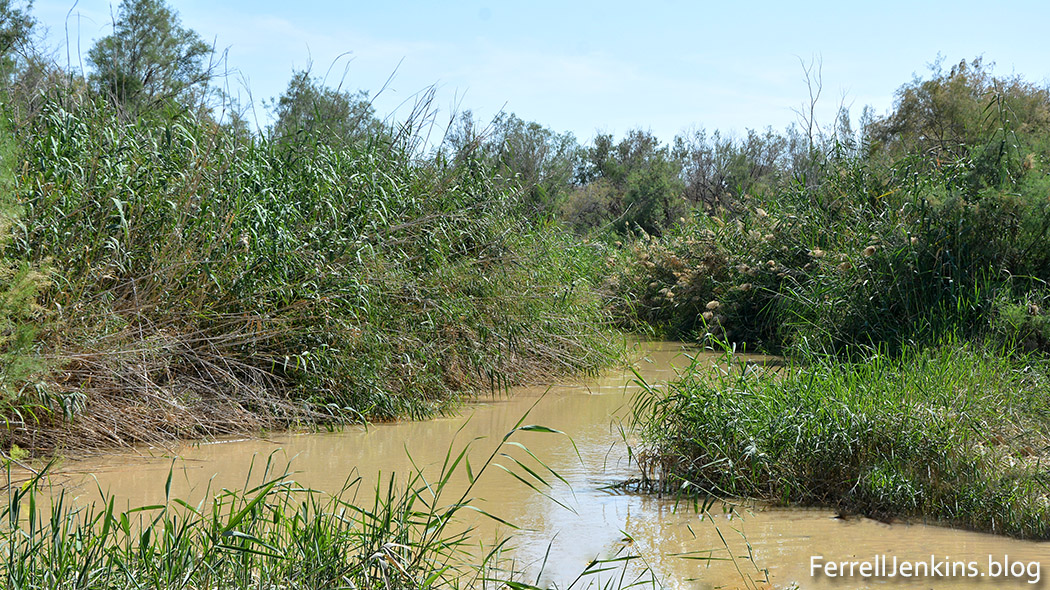
At the traditional site of the baptism of Jesus by John the Baptist, a place called Qasr el Yahud, a few miles north of the Dead Sea, only very short stretches of the river are visible (Matthew 3:13-17; John 1:28). The photo below shows one of the many curves in the river. Click on the photo for a larger image.

Jordan River at the site of the baptism of Jesus. Photo: ferrelljenkins.blog.

This photo was made at Qasr el Yahud, the traditional site of the baptism of Jesus in the Jordan River. Photo by Ferrell Jenkins.

The prophet Jeremiah describes the heavy growth on the banks of the Jordan as the thicket of the Jordan (Jeremiah 12:5; 50:44). Perhaps the reading in the Net Bible, “the thick undergrowth along the Jordan River,” provides a clearer understanding. “Lions could suddenly appear from the bushes” (Jeremiah 49:19; Lalleman, Tyndale Old Testament Commentaries).

Rolling stone tombs #6 – a tomb near Megiddo

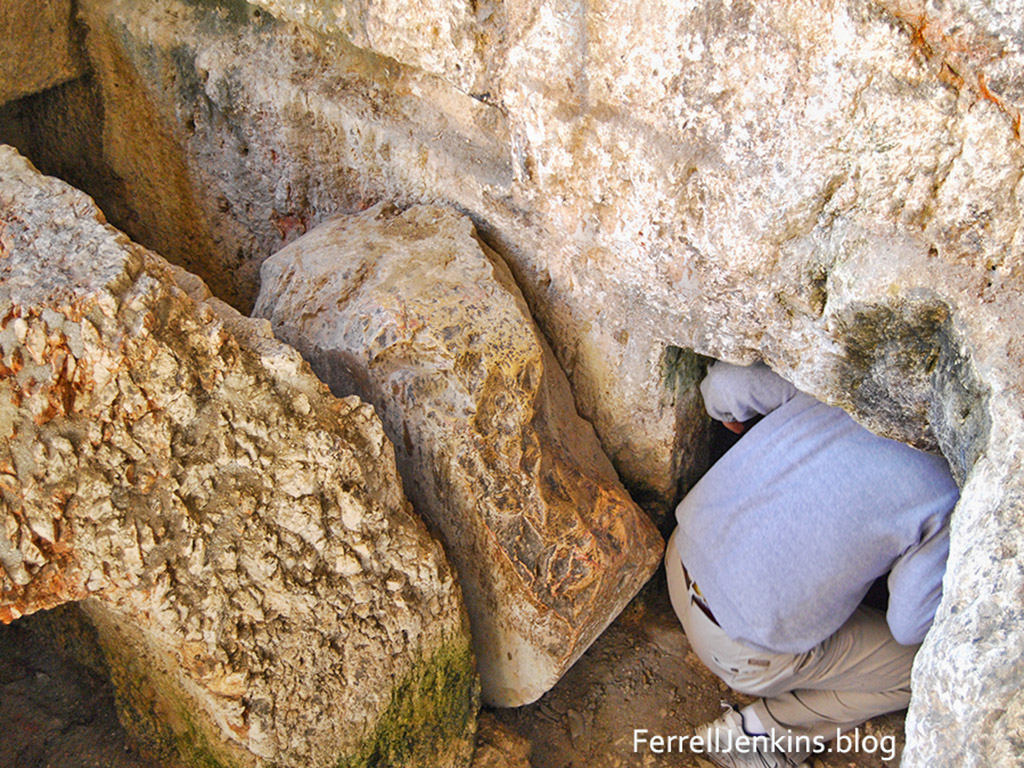
Several tombs of the type in which Jesus was buried have survived the centuries. This one was discovered during road construction a few years ago near the Jezreel Valley, not very far from Megiddo. This is my favorite photo of rolling stone tombs.

Rolling stone tomb near the Jezreel Valley and Megiddo. Photo: ferrelljenkins.blog.

This rolling stone tomb was discovered during road work. It is a beautiful example of a tomb of this type. Photo by Ferrell Jenkins.

To locate this tomb in Google Earth Pro or Google Maps these these coordinates: 32 36 43.31 N, 35 08 17.01 E. It also worked on my Android phone to locate the site on the map and provide a photo of the tomb along the highway.

Rolling stone tombs #5 – the site of the Holy Sepulchre

Jesus was crucified outside Jerusalem (John 19:20), probably not far from a gate (Hebrews 13:12), near a road (Mark 15:29; Matthew 27:39), and near a garden with a new tomb in it (John 19:41). Nothing about the Church of the Holy Sepulchre reminds one of the actual setting where Christ was crucified and buried. One must remember, that Jerusalem has been continuously inhabited for many centuries. Strong evidence suggests that the site now occupied by the Church of the Holy Sepulchre was outside the wall of Jerusalem at the time of Christ.

Holy Sepulchre, Jerusalem. Photo: ferrelljenkins.blog.

Crowds wait to enter the edicule covering the tomb of Jesus after examination and cleaning in 2017. Photo by Ferrell Jenkins.

Kathleen Kenyon found evidence in the 1970s that the wall which now encompasses the Church of the Holy Sepulchre was built on the foundation which was constructed about A.D. 41 by Herod Agrippa. In A.D.
30 [or 33, depending on how one reads the evidence], when Jesus stood before Pilate, the site of the Holy Sepulchre would have been outside the wall.

Some columns in the Church of the Holy Sepulchre date from the fourth century church built by Constantine. Excavators exposed part of the foundations of Hadrian’s Roman Forum, dating from A.D. 135, in which the Temple of Aphrodite was built.

A portion of the Herodian wall was discovered in the 1970s by M. Broshi within the Church of the Holy Sepulchre. This showed that Golgotha was just outside the city wall.

D. Katsimibinis, in the late 1970s, showed that the rock of Calvary still rises nearly 40 feet above bedrock. The rock bears the mark of ancient quarrying. Some scholars believe that this remnant of stone was a rejected quarry stone (Charlesworth, Jesus Within Judaism, 124). “And moreover, there are no competing places for Calvary or Golgotha prior to the last century” (Charlesworth, 123). See also André Parrot, Golgotha and the Church of the Holy Sepulchre.

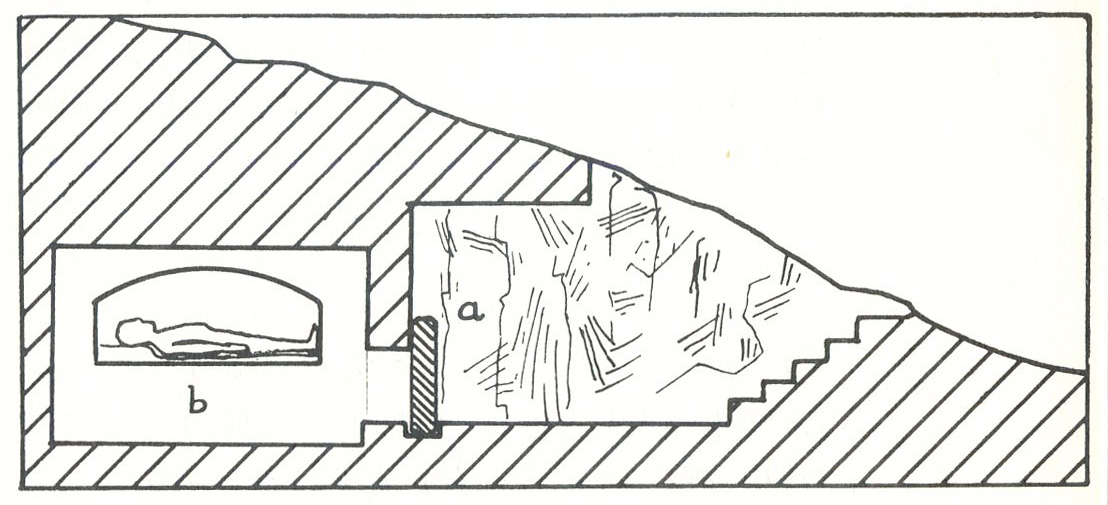
Jesus would have been placed in this tomb sometime before sun down on Friday, and raised sometime before sun up on the first day of the week (our Sunday). See Luke 24:1, 13, 21.

The tomb of Jesus. Parrot, Land of Christ.

Drawing showing the tomb of Jesus according to the data of the gospels. From Parrot, Land of Christ, 131.

We share the sentiment of the late F. F. Bruce that “interesting as the problem must be to every Christian, it is not of the first importance; wherever our Lord’s sepulchre is to be located, ‘he is not here, for he has risen’” (“Archaeological Confirmation of the New Testament,” Revelation and the Bible, ed. Henry, 330).

Model of the tomb at the Church of the Holy Sepulchre. From the Franciscian Museum, Jerusalem.

This model from the Franciscan Museum, Jerusalem, show the tomb at the Holy Sepulchre. Photo by Ferrell Jenkins.

Rolling stone tombs #4 – the Midras ruins

The Midras Ruins (Horvat Midras) in Israel are part of the Adulam Grove Nature Reserve east of Hwy 38 between the Elah Valley and Beit Guvrin. According to the Parks department sign at the site, the ruins are part of an ancient settlement including caves, pits, and other installations. The Carta touring atlas says the area was continuously inhabited from the time of the Kings of Judah to the Roman period.

For a more complete discussion of the Midras Ruins tomb, along with links to photos before the tomb was vandalized, read here.

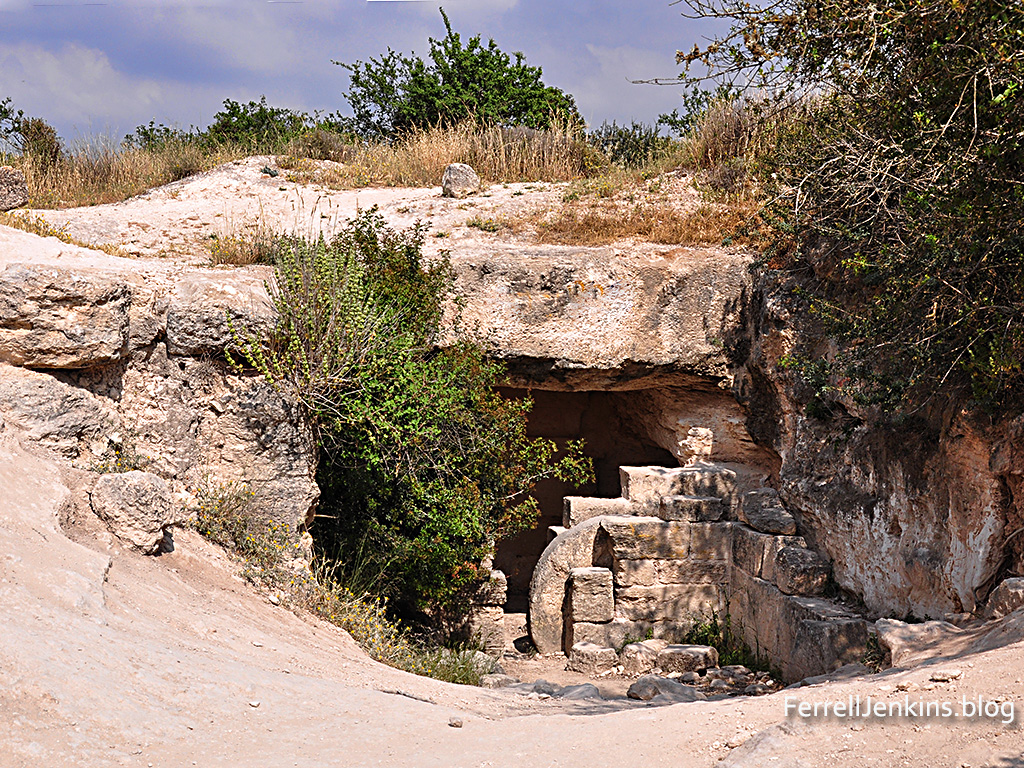
This photo was made in the late afternoon several years after the tomb was defaced by vandals. Photo by Ferrell Jenkins.

The sign at the cave indicates that it was in use from the first century B.C. until the Bar Kochba revolt (about A.D. 135).

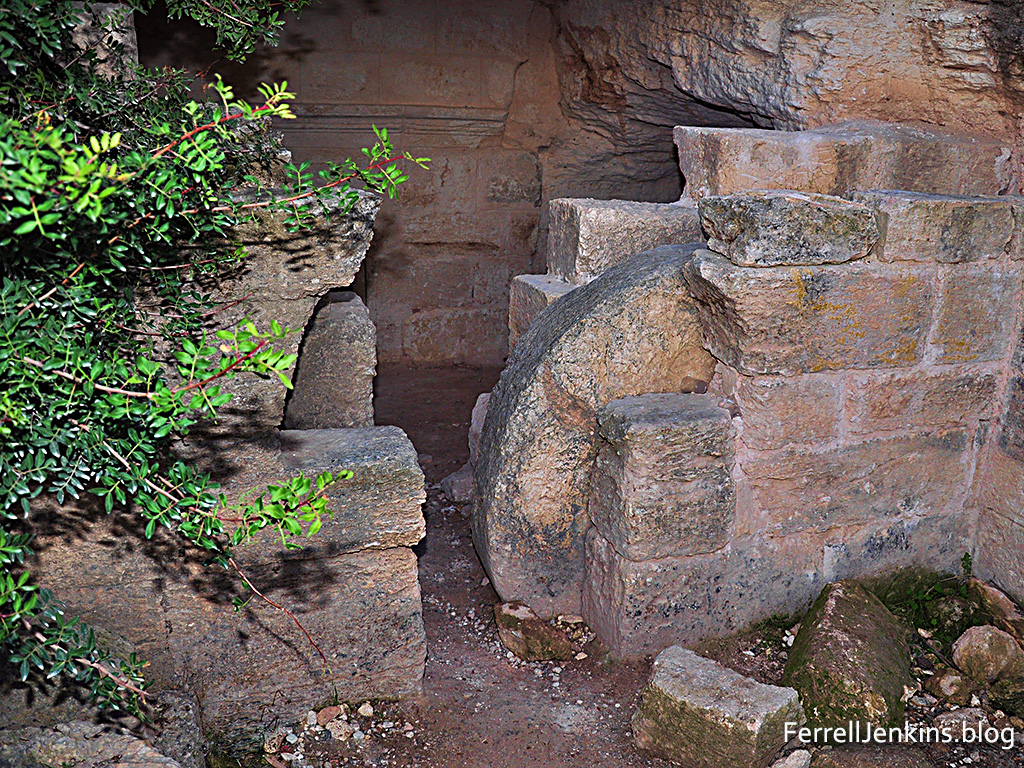
The large rolling stone now at the entrance to the cave is a remnant of the grand burial cave once located here.

Beyond the entrance, two chambers were discovered, containing burial niches 1.80 meters [almost 6 feet] long. The inner chamber contains decorated arches, arcosolia, in which ossuaries were placed, containing the bones of the deceased in secondary burial.

The sherds discovered in the cave indicate that it was in use from the end of the first century CE [AD] until the Bar Kokhba Revolt (132-135 CE).

Browsing through my photos I rediscovered the next photo from a visit to the site in 2011. It shows a more natural look except for the destroyed area above the rolling stone.

This photo shows the setting of the tomb with a rolling stone after it was defaced by vandals and then reconstructed. Photo by Ferrell Jenkins.

Rolling stone tombs #1 – the Tomb of the Kings

During this week many will have their mind on the events leading to the crucifixion and resurrection of Jesus. With this post I propose to begin a short series of blogs in which I will post pictures of some of the rock-cut tombs from Israel and Jordan that have rolling stones.

Why is it important to notice rock-cut tombs with rolling stones? It is because these illustrate the type of tomb in which Jesus was buried.

And Joseph [from Arimathea] took the body and wrapped it in a clean linen shroud and laid it in his own new tomb, which he had cut in the rock. And he rolled a great stone to the entrance of the tomb and went away. (Matthew 27:59-60 ESV)

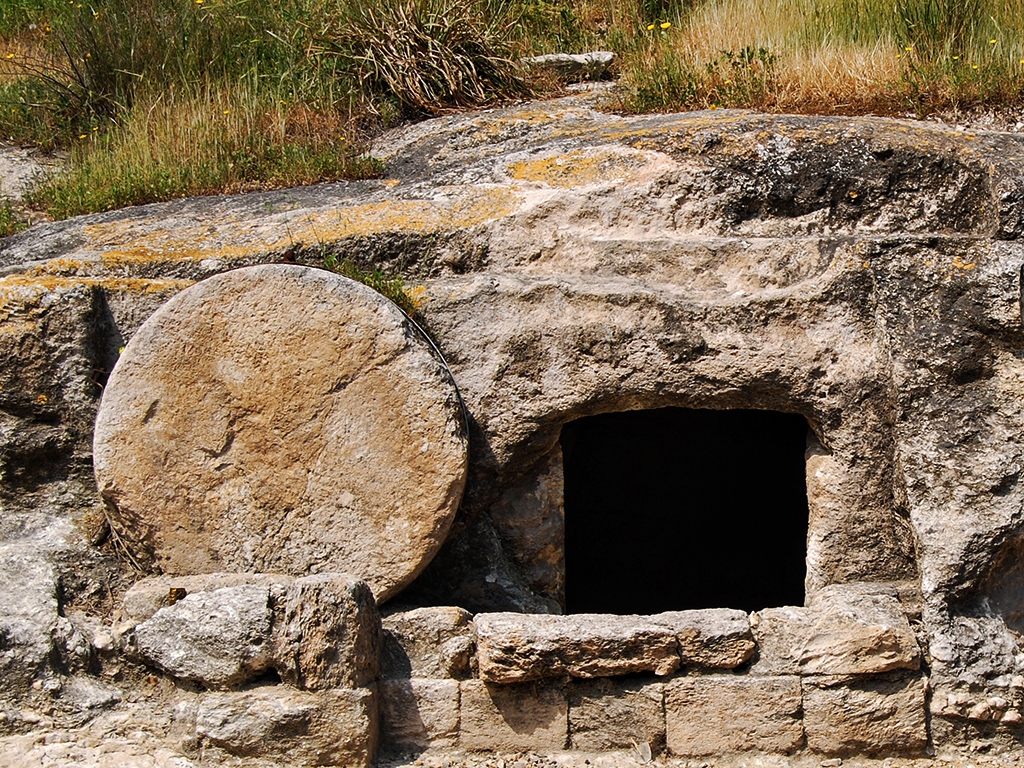
Here is the entrance to the rock-cut tomb at what we call the Tomb of the Kings. Notice that the rolling stone is set in a grove that more or less holds it in place. Perhaps tourist of past centuries have chiseled a souvenir to take back home with them.

Rolling stone at the Tomb of the Kings, Jerusalem. Photo: ferrelljenkins.blog.

The rolling stone at the tomb of the kings. Treasure hunters have chiseled off pieces in centuries past. Photo by Ferrell Jenkins.

J. A. Thompson describes the large tombs where several people might be buried as well as the smaller tombs like the one where Jesus was buried.

These larger tombs provided for the burial of a number of people. They were entered by a comparatively small opening which could be closed by rolling a stone in a groove across the entrance. After each burial the large stone was rolled across the door and the tomb sealed up until the next burial. Some of these stones, which are still to be seen in parts of Palestine, were so big as to require the effort of more than one man to move them. Such a discovery explains the concern of the women who came to the sepulcher where our Lord was buried. Joseph of Arimathaea “rolled a great stone to the door of the sepulchre” (Matt. 27:60), and later the angel came and “rolled back the stone from the door” (Matt. 28:2). Other passages in the Gospels which refer to the rolling of the great stone from the door are Mark 15:46; 16:3f.; Luke 24:2; John 11:38, 39, 41; 20:1. Even comparatively small tombs had this rolling stone, but angle graves were normally carved out in the rocky hillside and the body interred there. (Thompson, J. A. The Bible and Archaeology. 3rdrd ed., W. B. Eerdmans, 1982, p. 334.)

Gaza in the 1960s – postcards and phone calls

Over the years we have had an opportunity to read about Gaza many times. Currently there is concern by Israel over how to respond if the Corona virus outbreak becomes serious there.

Last August I read an interesting, well illustrated article about Gaza. It was published by PNR with the title “Here’s What Tourists Might See If They Were Allowed To Visit Gaza.” You may be able to access the article here.

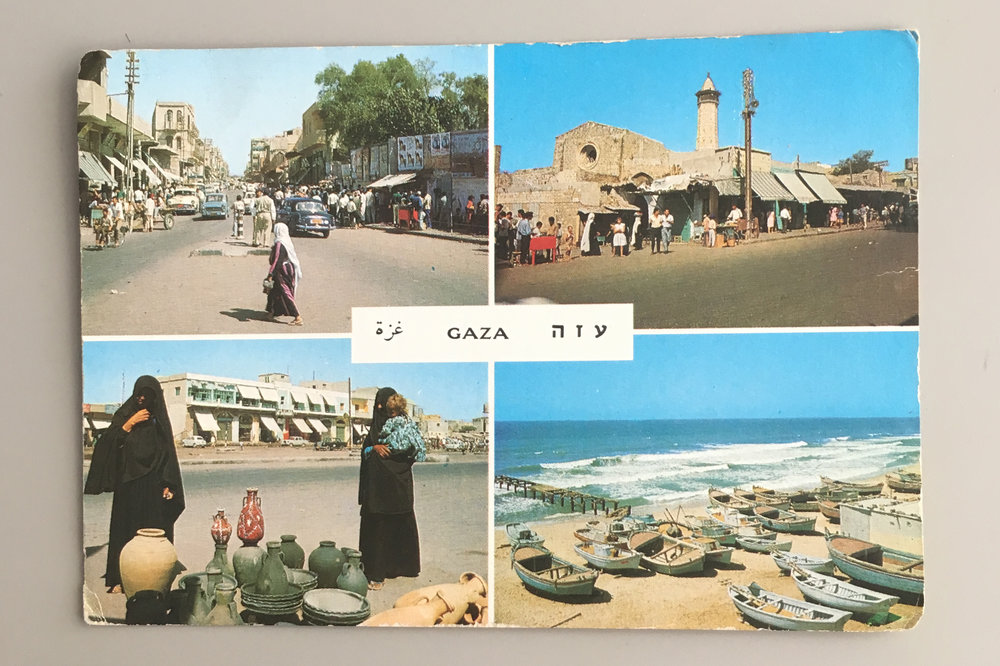
One of the images was the reproduction of a vintage post card published by the Israeli publisher Phalpot.

Vintage postcard of sites in Gaza. Published in 1967 by Phalpot in Israel.

Vintage postcard of sites in Gaza. Published in 1967 by Phalpot in Israel.

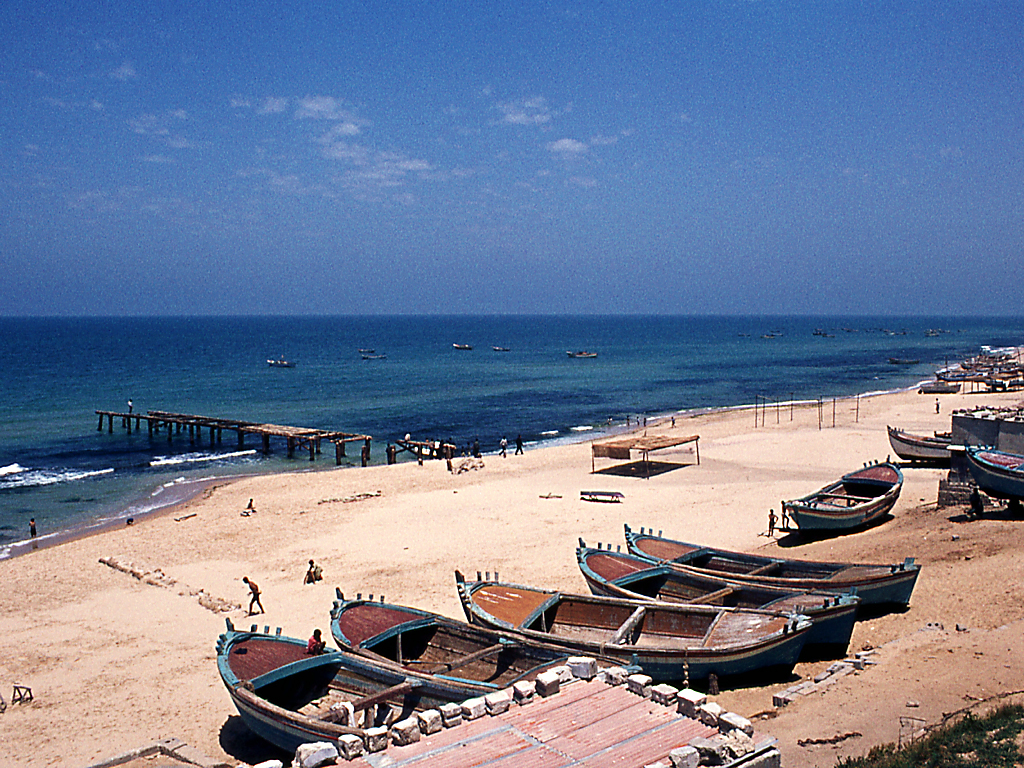
What impressed me about this postcard from 1967 is how similar the lower right photo was to a photo I made in 1968.

Gaza on the Mediterranean Sea in May, 1968. Photo by Ferrell Jenkins.

For more information about Gaza I suggest you read my longer article about “The Significance of Gaza” here.

I have been close to the border of the Gaza Strip a few times but that was my only visit to Gaza. When I told my guide that I wanted to take the group to Gaza he insisted that there was not much to see. I told him that we would be happy to see the sand and the sea. We did.

Long before digital cameras and cell phones tourists bought postcards similar to the one above and wrote home to tell their friends what a great tour they were enjoying. It took about a week for a card to make it back to the United States. Sometimes we made it back before the cards arrived. Phone calls were so expensive that most folks did not make a call. I would usually call my wife from the first stop just to quickly say that we had arrived safely. And the tours were longer in those days–usually about two weeks in length.

Those were in “good old days.”

Capernaum follow up – from the air

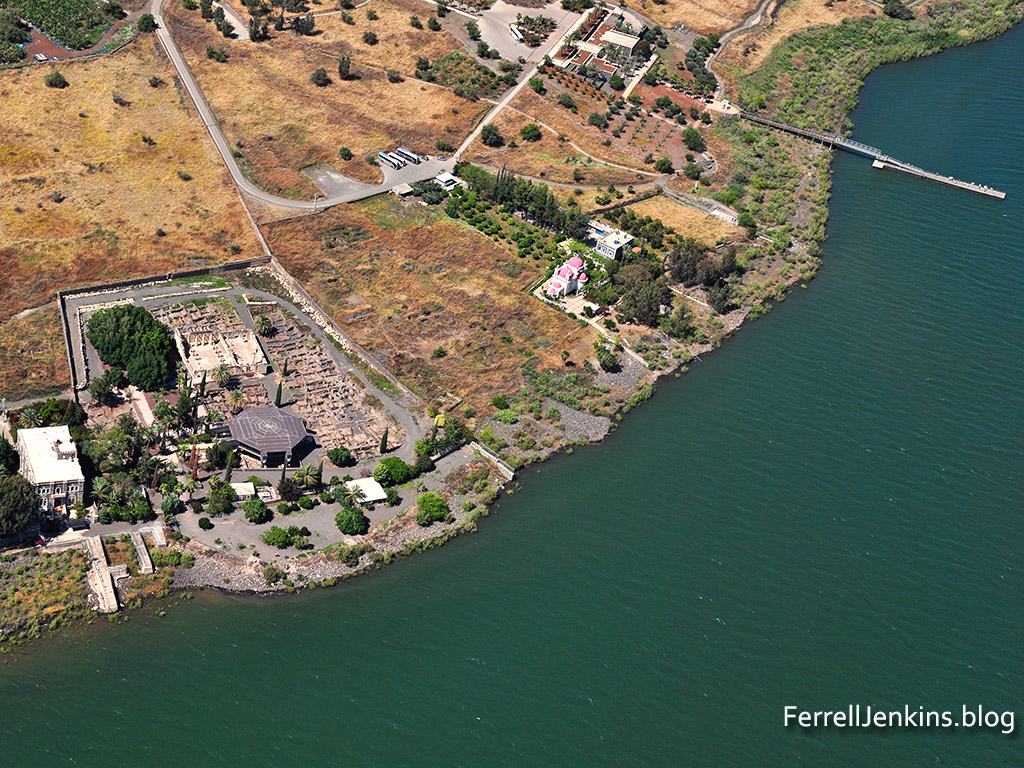
The first photo today shows that Caperanum is located on the [north] shore of the Sea of Galilee. The enclosed area belongs to the Franciscan Fathers who bought the property already thought to be Capernaum in 1894. The site was fenced to prevent removal of the materials.

In our photo you see the property as it has been edited by various archaeological digs. Two structures stand out among the ruins – the synagogue and the new memorial church we wrote about in the previous post. Click on the photo for a larger image suitable for use in teaching.

Capernaum from the air. Photo: ferrelljenkins.blog.

Viewing Capernaum from the air. Photo by Ferrell Jenkins.

With our view to the north, the property on the right of the Franciscan property belongs to the Greek Orthodox Church. You will see their little red-domed church near the middle of our image. The property between that church and the Franciscan property was excavated after 1978 under the direction of Vassilios Tzaferis but is not open to the public.

Further east a dock extending into the water provides a place for boats to dock and allow passengers to meet their bus to continue touring.

Capernaum from the air. Fransciscian property on left (west) and the Orthodox property on the right (east). Photo: ferrelljenkins.blog.

Capernaum from the air. Fransciscian property on left (west) and the Orthodox property on the right (east). Photo by Ferrell Jenkins.

Much of the earthly ministry of Jesus was conducted in this little plot of land. Imagine such a small beginning here and in the surrounding towns. By the early 60s of the first century the preaching that Jesus is the Christ had reached the capital of the Roman empire (Acts 28).

Ferrell’s Favorite Foto #37 – Now and Then at Capernaum

In 2015 we posted here about some changes that we noticed when we visited Capernaum on the north shore of the Sea of Galilee. These changes were more like refurbishing the site to make it easier and more pleasant to visit.

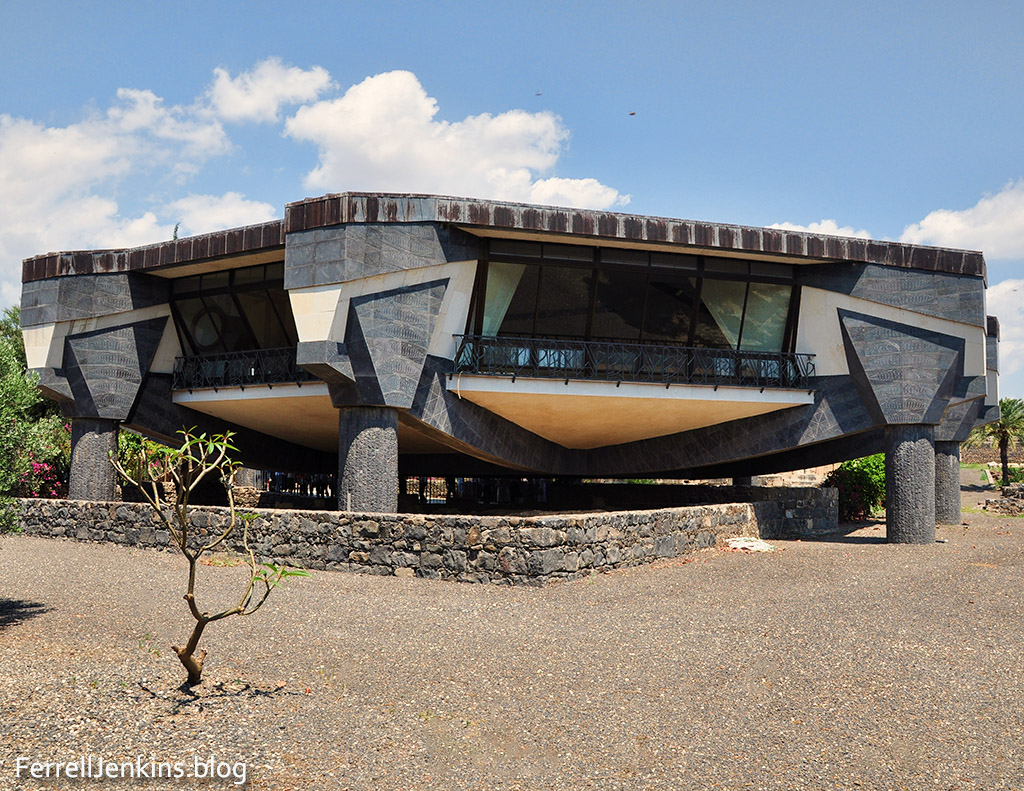
Today we will show you a significant change brought about by a new building. Having visited Capernaum many times since 1967 I have been able to see many changes. This church that some have described as looking like a space craft is built over the excavation of a Byzantine church that covered some of the first century houses. One of these house is said to have been designated as a place for Christians to meet. The Franciscans who own the property have designated this as the house of Peter. We know from Scripture that Peter lived here with his wife and mother-in-law (Matthew 8:14).

Capernaum was located on the frontier between the territory of Herod Antipas and that of Herod Philip. The city became important in the earthly ministry of Jesus. Notice just a few events that make it so significant.

  • Jesus settled here, making Capernaum His “own city” (Mark 1:232-34).
  • Many of the miracles of Jesus were performed here (Mark 1:21-28).
  • Matthew worked as a tax collector at Capernaum (Matthew 9:9).
  • Peter lived here (Matthew 8:14).

Capernaum was one of three cities of the area denounced by Jesus  on account of their failure to believe (Matthew 11:20-22 ESV).

If you visit Capernaum you will see the building pictured below that some have described as looking like a space craft. It was built about 1990. The entrance with steps leading up to the glass floor is on the west side of the building (to our left). Our photo shows the south side; we have our back to the Sea of Galilee. The building is located 84 feet south of the synagogue (*Strange).
Capernaum. The modern church erected in 1990 by the Franciscians. Photo: ferrelljenkins.blog.

This modern building was erected in 1990. It covers the excavated ruins of the octagonal Byzantine church and what some have said is the house of the apostle Peter. This view is to the north, with the Sea of Galilee to my back.The entrance steps are on the left, and the synagogue is on the other side of this building. Photo by Ferrell Jenkins.

James F. Strange says,

Friar Orfali had done some work on the octagonal building in the 1920s. His plan showed the building as consisting of three concentric octagons.

When the excavations were renewed by Corbo and Loffreda in 1968 they discovered a baptistry and an apse providing evidence that this was indeed an ancient church (Strange).

Strange says,

It is reasonable to assume, therefore, that this octagonal church at Capernaum was a memorial church. Some scholars believed that the octagonal church was built to memorialize Jesus’s temporary residence in Capernaum and may well have been connected with ancient memories or traditions regarding the location of St. Peter’s house, also called “the house of Simon and Andrew” in Mark 1:29.

Below is today’s Favorite Foto that I made in 1978. The floor of the new “memorial church” has a glass floor so that one can look below at the ancient structure. It is now difficult to make photos with ordinary photographic equipment because of the glare from the glass. Visitors to the site may also walk under the new church, but it is difficult to make sense of what is there.
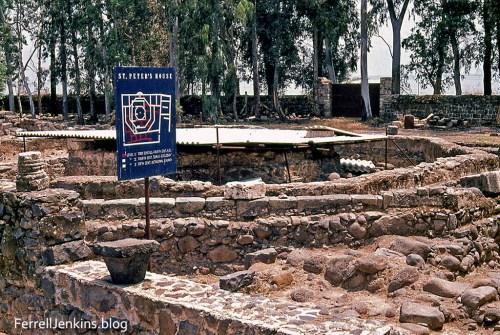
Capernaum. The octagonal Byzantine church which is said to cover the house of the apostle Peter. Photo: ferrelljenkins.blog.

This is the way the excavated area of Capernaum looked in 1978. We see ruins of the octagonal Byzantine church which is said to have been built over the house of the apostle Peter. Photo by Ferrell Jenkins.

Strange says, “According to the excavators, the central hall of this church was originally built as part of a house about the beginning of the Early Roman period, around 63 B.C.”

I will leave it to you to investigate more about this structure and the possibility that Jesus visited this home during His personal ministry in Capernaum.

* Source: When you see the name *Strange in one of my comments it indicates that the information was quoted directly or gleaned from the following source:

Strange, James F., and Hershel Shanks. “Has the House Where Jesus Stayed in Capernaum Been Found?” Biblical Archaeology Review, vol. 8, no. 6, Oct. 1982. Biblical Archaeology Review. BAR.

If you are interested in a recent scholarly essay on the excavations at Capernaum see he following:

Mattila, Sharon L. Galilee in the Late Second Temple and Mishnaic Periods. Vol. 2, edited by David A. Fiensy and James R. Strange, First ed., Minneapolis, Fortress Press, 2015, 2 vols, pp. 217-57.

Special Note about the Fiensy-Strange Volumes: The two volumes by David A. Fiensy and James R. Strange, Galilee in the Late Second Temple and Mishnaic Periods…, are currently available in Kindle Format as follows: Vol. 1, 352 pages, for $4.99 (pb is $50.33). Vol. 2, 502 pages, for $6.99 (pb is $26.00). James R. Strange is the son of the late James F. Strange quoted in my post. I am pleased with the quality of the diagram and photos display.

Ferrell’s Favorite Foto # 35 – Roman Milestone

In the IVP Bible Background Commentary Craig Keener says,

Roman soldiers had the legal right to impress the labor, work animal or substance of local residents (cf. Mk 15:21). Although impressment may not have happened often in Galilee, it happened elsewhere, and the fact that it could happen would be enough to raise the eyebrows of Jesus’ hearers at this example of nonresistance and even loving service to the oppressor. (Keener, Craig S. The IVP Bible Background Commentary: New Testament. Downers Grove, IL: InterVarsity Press, 1993. Print.)

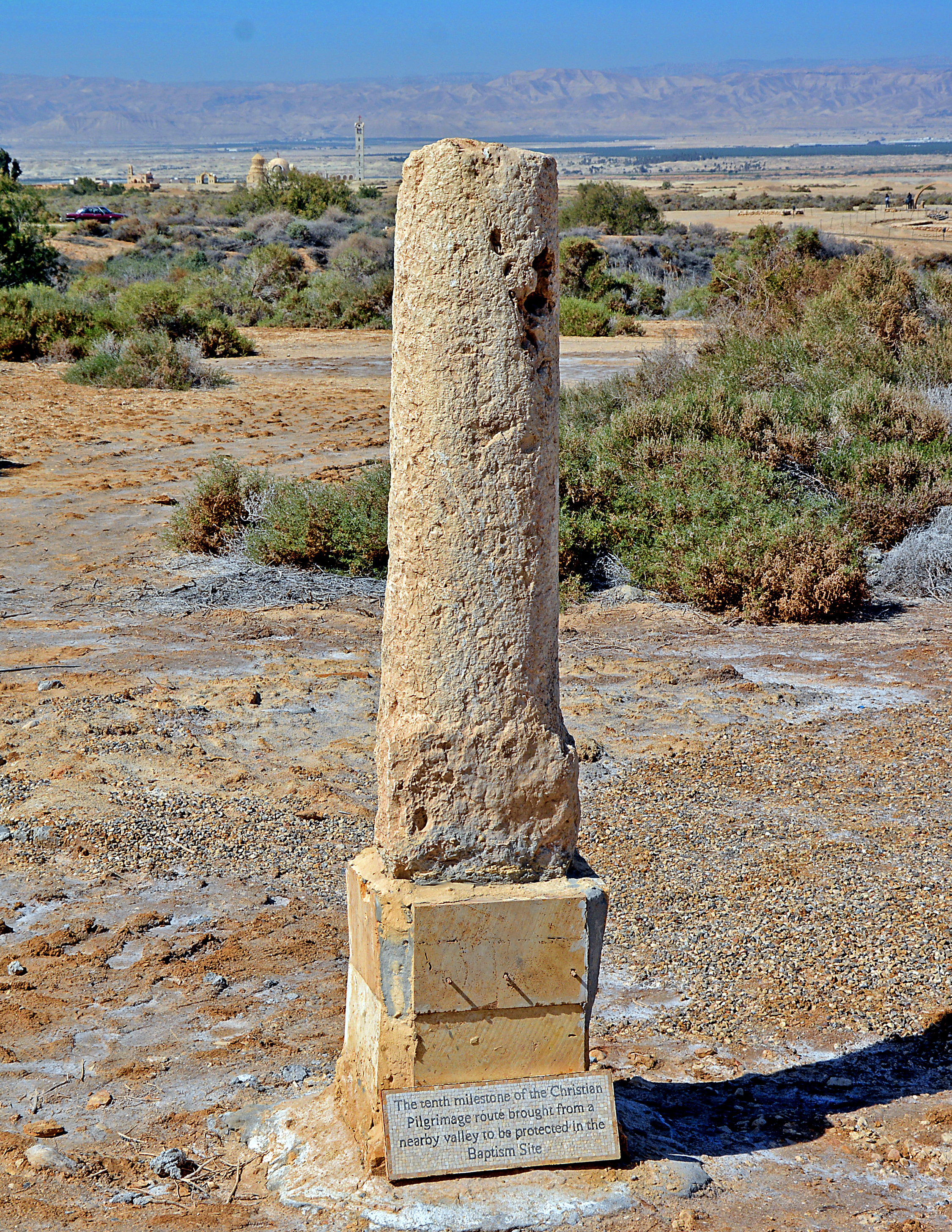
Though the milestone pictured below has been moved to the current location at Bethany Beyond (or across) the Jordan (in Jordan, John 1:28), it provided a beautiful setting. Our picture looks west to the Jordan Valley. The various buildings you see in the left part of the photo are mostly church buildings on the Jordanian side of the Jordan River. On the other side we see the eastern slopes of the Judean Wilderness. Jericho is in that general vicinity.

Milestone at Bethany Beyond the Jordan. Photo: ferrelljenkins.blog.

Roman period milestone at Bethany Beyond the Jordan. Photo by Ferrell Jenkins.

In the sermon recorded in Matthew 5-7 Jesus taught His disciples about the attitude they should have toward the Roman authorities.

And if anyone forces you to go one mile, go with him two miles. (Matthew 5:41 ESV)

New Testament writers gave distances in their descriptions of travel from one city to another. Luke says that Emmaus was about seven miles from Jerusalem (Luke 24:13). John says that Bethany [not Beyond the Jordan] was about two miles from Jerusalem (John 11:18).

Milestones were common in Roman times and numerous ones have been found throughout the land of Israel. Most of them have now been moved to some of the small museums found throughout the land. The same is true of some in Jordan.

Most of the Roman roads for which we have remnants were built in the second half of the first century A.D. and in the second century. Certainly in many cases it is reasonable to think that these roads were built over dirt paths that already existed.

For documentation about the Roman Road System in Galilee see James F. Strange, “The Galilean Road System,” in Galilee in the Late Second Temple and Mishnaic Periods, vol. 1, Life, Culture, and Society (ed. David A. Fiensy and James Riley Strange; Minneapolis: Fortress Press, 2014), 263-71 . Maps of the major and minor roads of Galilee are found in the front of the same volume.

David Graves has imposed known Roman roads in the vicinity of Bethany Beyond the Jordan on a Google Earth map here.

See one of our earlier post about Roman Roads and Milestones here.

Megiddo, Har Mageddon, Armageddon?

This morning’s Twitter feed brought a notice from Prof. Carl Rasmussen about a review of Eric Cline’s most recent book, Digging up Archaeology: The Search for the Lost City of Solomon by Andrew Robinson in Nature.

This is an interesting review about an important city in biblical history. I, too, think you will find it helpful, and you might decide you want to read Cline’s book. It is available at Amazon in print and Kindle format.

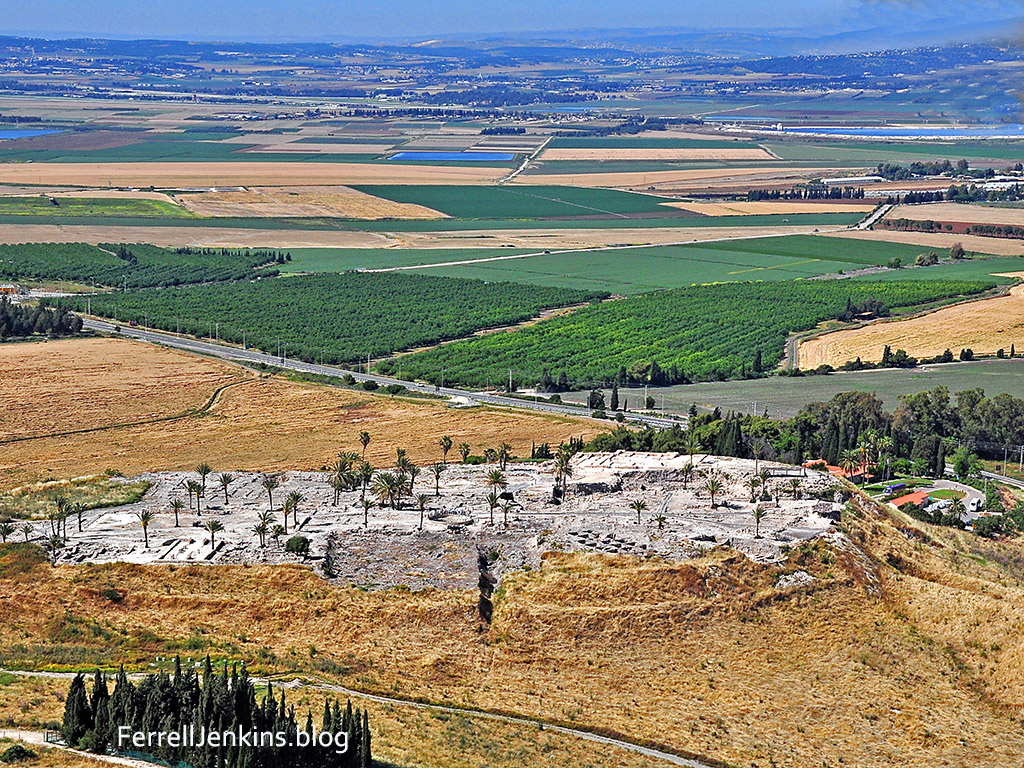
Here is one of my aerial photographs of Megiddo with a view of the Jezreel Valley and the hills of lower Galilee to the north. Perhaps you can use it in some of your teaching.

Megiddo and the Jezreel Valley. Photo: ferrelljenkins.blog.

View north of Tel Megiddo, the Jezreel Valley, and lower Galilee. Photo by Ferrell Jenkins.

We have several posts about Megiddo which you may locate by using the Search box. Perhaps the most general one which includes labeled panoramas of the Jezreel Valley may be found here.