Category Archives: New Testament

A glimpse of the River Jordan

The Jordan River is shy, rarely revealing very much of itself. As we travel in the Jordan Valley from the Sea of Galilee to the Dead Sea we only see the river on a few occasions. Even then we only see short distances.

The photo below is one I made yesterday about 12 km. south of the Sea of Galilee. You can see the dirt road on the Israeli side of the border and the River in Jordan.

The Jordan River flowing into Jordan for a short distance. Photo by Ferrell Jenkins.

The Jordan River flowing into Jordan for a short distance. Photo by Ferrell Jenkins.

Bible students enjoy visiting the Jordan River for several reasons.

  • The ancient Israelites crossed the Jordan to enter the land that had been promised to the seed of Abraham (Joshua 3).
  • Elijah and Elisha crossed the river (2 Kings 2).
  • John baptized in the Jordan (Matthew 3:6ff.; Mark 1:5-9; John 1:28; 10:40).
  • Jesus was baptized in the Jordan (Matthew 3:13).
  • Naaman, the Aramean [Syrian] military commander, dipped in the Jordan at a site further south (2 Kings 5).

I have been unable to post very much while traveling in Israel, but the mother of my favorite grandson said I should be posting more. She knows how to get things done.

Only one example of Roman crucifixion discovered

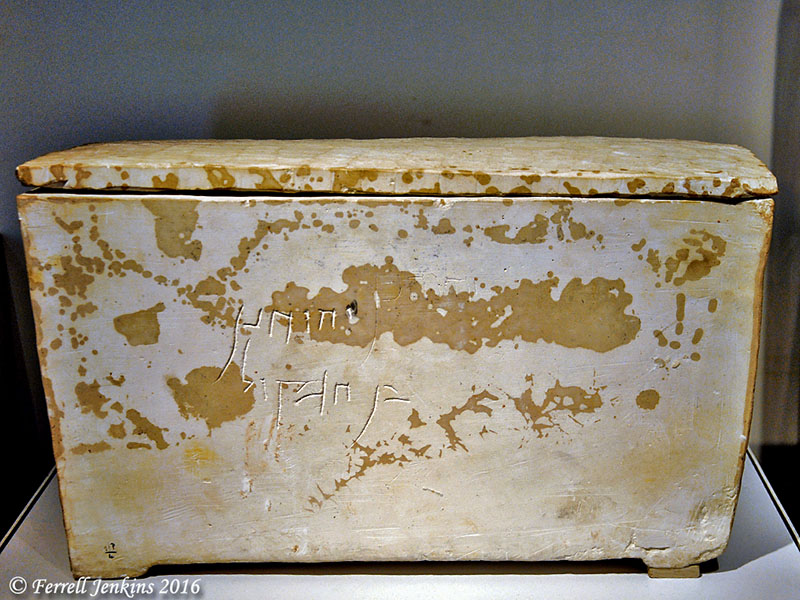
The Romans were adept at crucifixion, according to many historical sources. The first archaeological evidence of crucifixion was uncovered in 1968 when, during a controlled archaeological dig under the direction of the late Vasillios Tzaferis, an ossuary (bone box, or receptacle) was found north of Jerusalem containing the bones of a man who had been crucified. His name was “Yehohanan, the son of Hagakol.” He is thought to have been between 24 and 28 years of age, and was about 5 feet 6 inches in height.

Ossuary of Yehohanan, son of Hagkol. Dates to first century A.D., and is made of soft limestone. Israel Museum. Photo by Ferrell Jenkins.

Ossuary of Yehohanan, son of Hagkol. Dates to first century A.D., and is made of soft limestone. Israel Museum. Photo by Ferrell Jenkins.

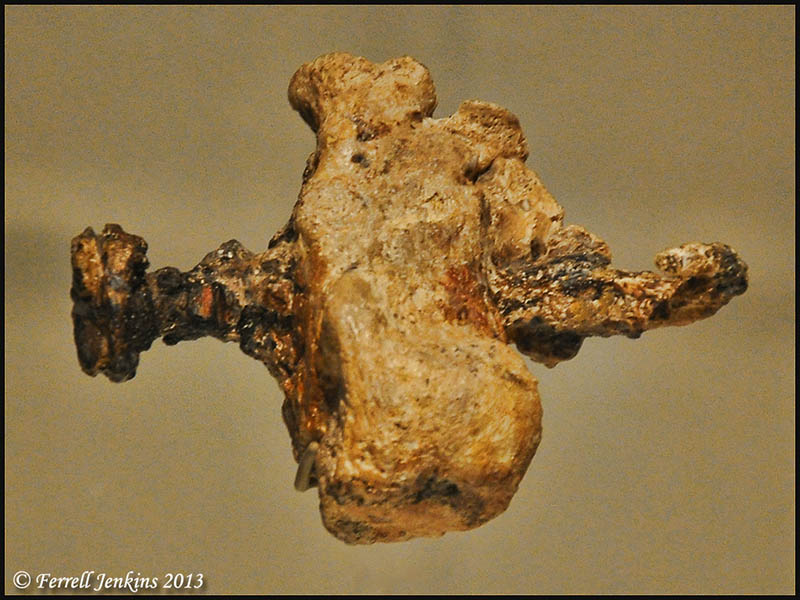
Both the ossuary and a replica of the heel bone are displayed in the Israel Museum. When Yehohanan was removed from the cross the nail pulled away from the wood. He was buried with the nail in his heel.

Ankle bone of a man crucified outside Jerusalem in Roman times. Photo by Ferrell Jenkins.

Ankle bone replica of  Yehohanan, son of Hagkol, who was crucified outside Jerusalem in Roman times. Display in Israel Museum. Photo by Ferrell Jenkins.

On Pentecost, Peter proclaimed the truth about Jesus. He said,

This man was handed over to you by God’s deliberate plan and foreknowledge; and you, with the help of wicked men, put him to death by nailing him to the cross. (Acts 2:23 NIV)

No ossuary or bones belonging to Jesus have been found. I am aware of the speculation that a tomb in the Talpiot neighborhood of Jerusalem contained the family of Jesus, and possibly even the ossuary of Jesus. One summary of this speculation was published by Bible Places Blog here.

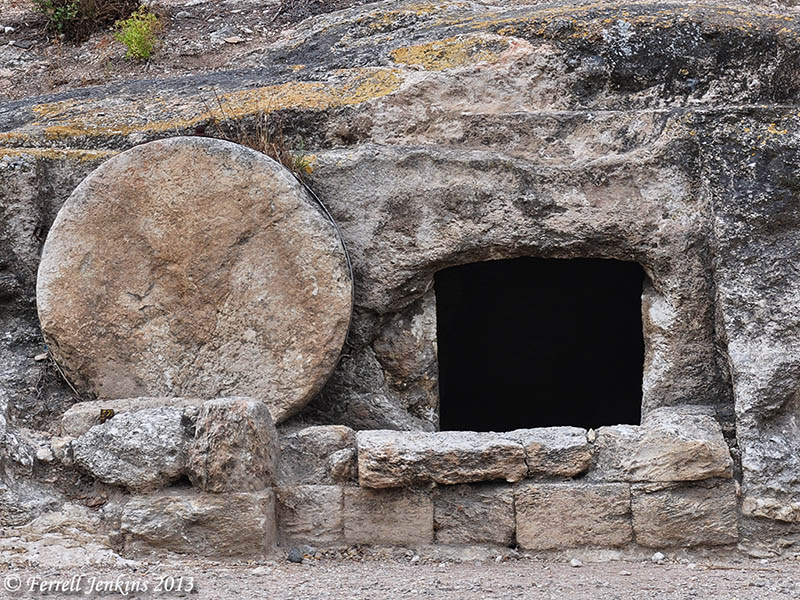
The angel at the empty tomb of Jesus announced to the women who had gone to complete the burial,

He is not here, for he has been raised, just as he said. Come and see the place where he was lying. (Matthew 28:6 NET)

Rock tomb with rolling stone near Jezreel Valley. Photo by Ferrell Jenkins.

Roman period rock tomb with rolling stone near Jezreel Valley. Photo by Ferrell Jenkins.

SourceFlix has posted a nice brief video of Passion Week Archaeology here.

Post updated from March, 2013.

The week leading to the crucifixion & resurrection

If we consider the Gospel of John a sort of “Day Planner” for Jesus, we have nearly complete activity recorded for two weeks of the earthly ministry of Jesus. The first is in John 1:19—2:11 where activity for six of the seven days is recorded. I think the omitted day is the Sabbath.

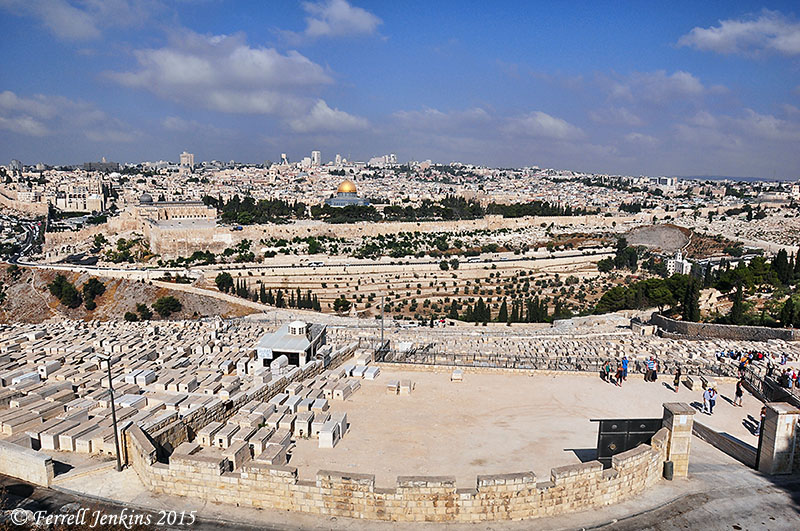
View of Jerusalem from the Mount of Olives. Photo by Ferrell Jenkins.

View of Jerusalem from the Mount of Olives. Imagine the city as it would have appeared to Jesus when he reached the top of the Mount of Olives. Photo by Ferrell Jenkins.

The next nearly complete week is the last week, leading up to the resurrection. John gives more attention to the last week than any other Gospel. Even here we have activities for only six of eight days. This section begins in John 12:1 and continues into John 20. Here is the way I have reconstructed it. Where John does not record the activity I have omitted the scripture reference.

  • Sunday — The King enters Jerusalem — 12:12-19
  • Monday — Cleansing the Temple —
  • Tuesday — Visit of the Greeks — 12:20-36
  • Tuesday — Jewish rejection — 12:37-50
  • Wednesday — No events recorded in the Gospels
  • Thursday Evening — Passover Meal, including Washing Disciples Feet (only in John) — 13:1-38
  • Thur. Eve — Farewell discourses — 14—16
  • Thur. Eve — Prayer — 17
  • Thur. Eve — Annas (only in John) — 18:12-14
  • Thur. Eve — Caiaphas — 18:24-28
  • Friday — Pilate — 18:28—19:16
  • Friday — Crucifixion — 19:16-42
  • Sabbath —
  • First Day — Resurrection — 20

It should be noted that the appearance before Annas and Caiaphas were the Jewish (Religious) trials. The appearance before Pilate [and Herod Antipas] were the Roman (Civil) trials.

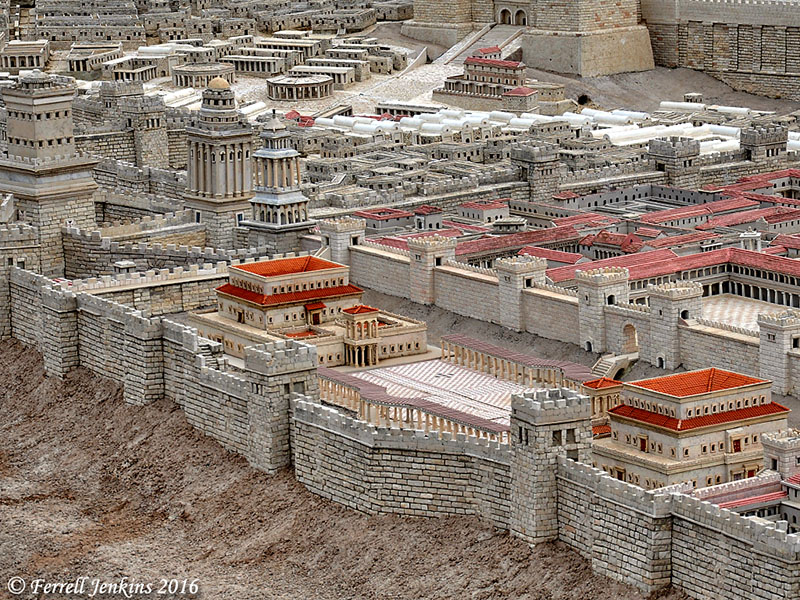
The Second Temple Model at the Israel Museum shows the location of the Palace of Herod Antipas and the Pretorium of Pontius Pilate. Photo by Ferrell Jenkins.

The Second Temple Model at the Israel Museum shows the location of the Palace of Herod Antipas and the Praetorium of Pontius Pilate. Photo by Ferrell Jenkins.

John does not record the pronouncement of woes on the religious leaders, the institution of the Lord’s Supper, and the account of the agony in the Garden of Gethsemane.

With this sparse attention given to two weeks, no wonder John says,

Now there are also many other things that Jesus did. Were every one of them to be written, I suppose that the world itself could not contain the books that would be written. (John 21:25 ESV)

———————————————————————–

Updated from earlier posts

Pigeon Valley and Uçhisar in Cappadocia

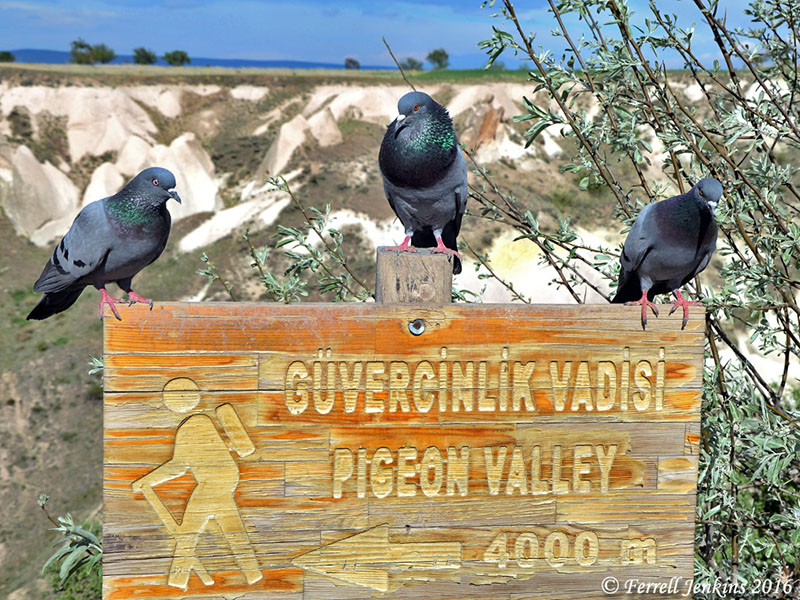
Both here and on social media a large number of readers showed an interest in our recent post about the fairy chimneys of Cappadocia here. I thought you might enjoy seeing some pictures in the vicinity of Pigeon Valley. Three well-fed pigeons are standing guard over the entrance to the sign pointing to the trail for those who wish to hike in the valley.

Pigeon Valley sign in Cappadocia. Photo by Ferrell Jenkins.

Pigeon Valley sign in Cappadocia. Photo by Ferrell Jenkins.

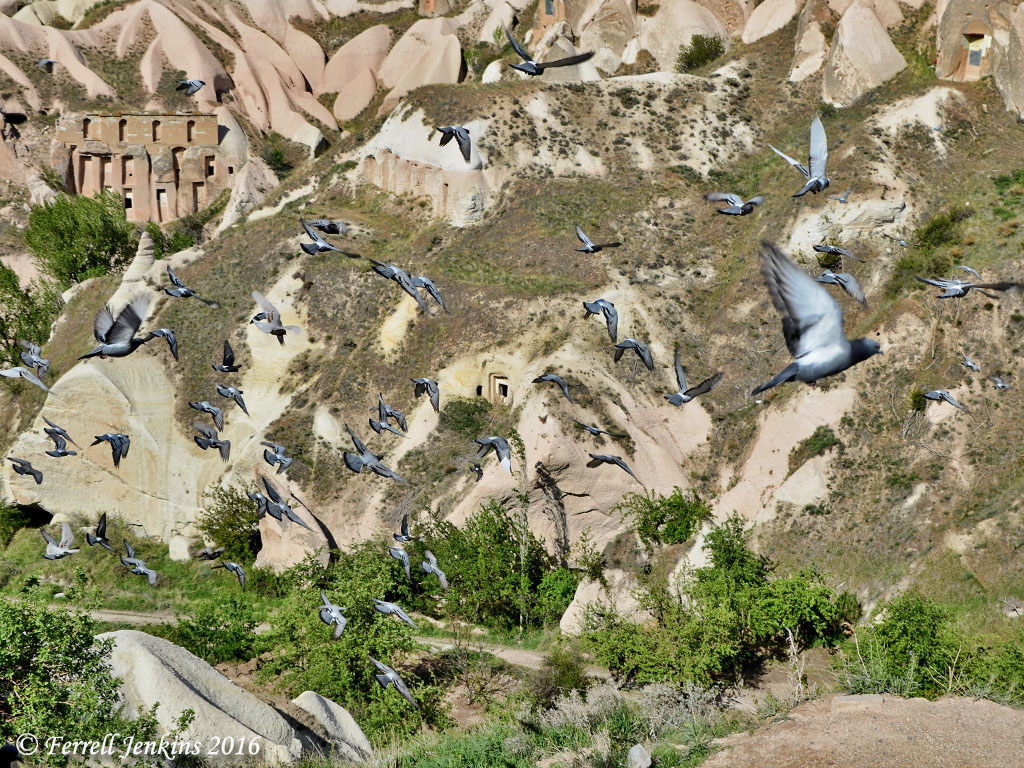
Hundreds of pigeons make their way through the valley to the delight of the bus loads of tourists and hikers who stop by.

Pigeons flying in Pigeon Valley, Cappadocia. Photo by Ferrell Jenkins.

Pigeons flying in Pigeon Valley, Cappadocia. Photo by Ferrell Jenkins.

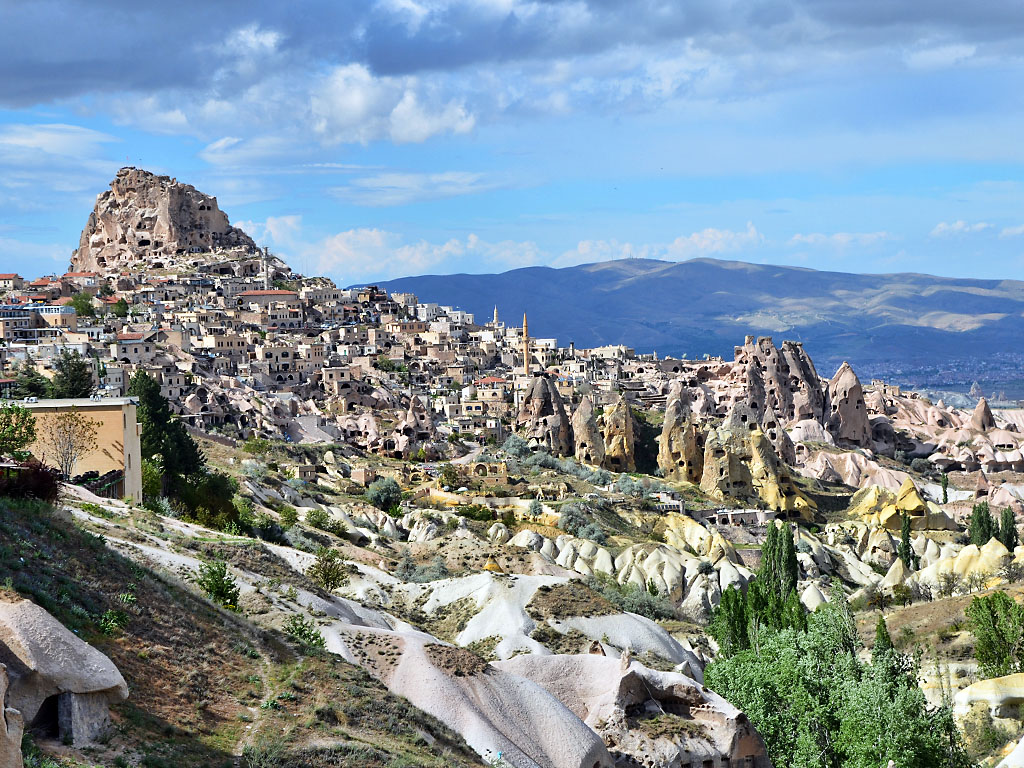
From Pigeon Valley one has a great view of the natural fortress of Uçhisar. Click on the photo for a larger image. You will be able to see the modern houses built among those dug from the natural formations of the area.

Uchisar in Cappadocia from Pigeon Valley. Photo by Ferrell Jenkins.

A view of Uchisar in Cappadocia from Pigeon Valley. Photo by Ferrell Jenkins.

The apostle Peter addressed his two epistles to Christians living in Cappadocia (1 Peter 1:1).

The fairy chimneys of Cappadocia

The New Testament mentions Cappadocia only twice.

  1. Devout Jews from Cappadocia were present in Jerusalem on Pentecost (Acts 2:9).
  2. Peter’s letters were addressed to Christians living in Cappadocia (1 Pet. 1:1).

In the centuries after New Testament times many Christians settled in this volcanic region of perhaps 50,000 cones, now part of Turkey.

John Freely describes Cappadocia in these words:

“Most of this part of Cappadocia is covered with a deep layer of tufa, a soft stone of solidified mud, ash and lava which once poured down from the now extinct volcanoes on Hasan Dagi and Ericiyes Dagi, the two great mountain peaks of Cappadocia. In the eons since then the rivers of the region have scoured canyons, gorges, valleys and gulleys through the soft and porous stone, and the elements have eroded it into fantastic crags, folds, turrets, pyramids, spires, needles, stalagmites, and cones, creating a vast outdoor display of stone sculptures in an incredible variety of shapes and colours” (The Companion Guide to Turkey, 238).

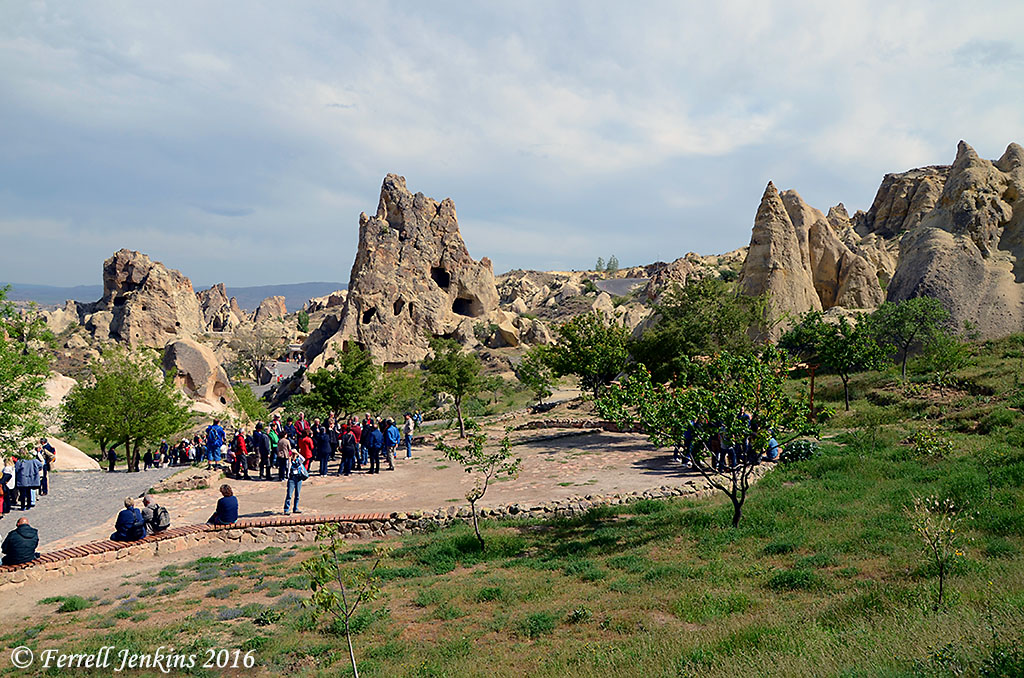
Our first photo today shows an area of Cappadocia known as Pasabagi Valley where the fairy chimneys may be seen in abundance.

Fairy Chimneys in Pasabagi Valley, Cappadocia. Photo by Ferrell Jenkins.

Fairy Chimneys in Pasabagi Valley, Cappadocia. Photo by Ferrell Jenkins.

The second photo is from the same area, but shows cones.

Fairy Chimneys in Pasabagi Valley, Cappadocia. Photo by Ferrell Jenkins.

Fairy Chimneys in Pasabagi Valley, Cappadocia. Photo by Ferrell Jenkins.

Digging in the vineyard

Vineyards are mentioned in more than 100 verses of the Bible. When traveling in the Bible lands one still sees many vineyards and the various work activities related to them.

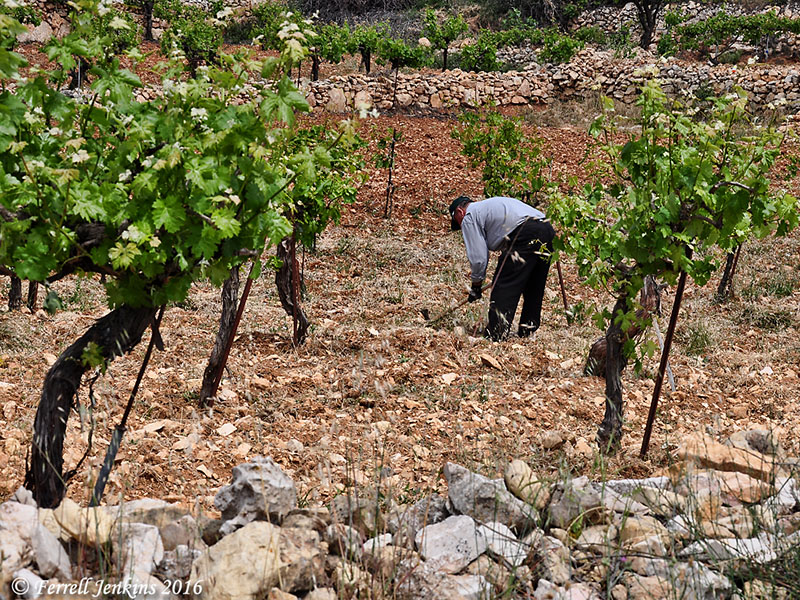
The photo below was made south of Bethlehem. It shows a man digging in the rocky soil within a vineyard.

Man digging in vineyard between Bethlehem and Hebron. Photo by Ferrell Jenkins.

Man digging in vineyard between Bethlehem and Hebron. Photo by Ferrell Jenkins.

One might recall the song of the unfruitful vineyard in Isaiah 5.

He dug it and cleared it of stones, and planted it with choice vines; he built a watchtower in the midst of it, and hewed out a wine vat in it; and he looked for it to yield grapes, but it yielded wild grapes. (Isaiah 5:2 ESV)

Or the parable of Jesus in Matthew 21.

“Hear another parable. There was a master of a house who planted a vineyard and put a fence around it and dug a winepress in it and built a tower and leased it to tenants, and went into another country. (Matthew 21:33 ESV)

The aqueducts at Caesarea Maritima

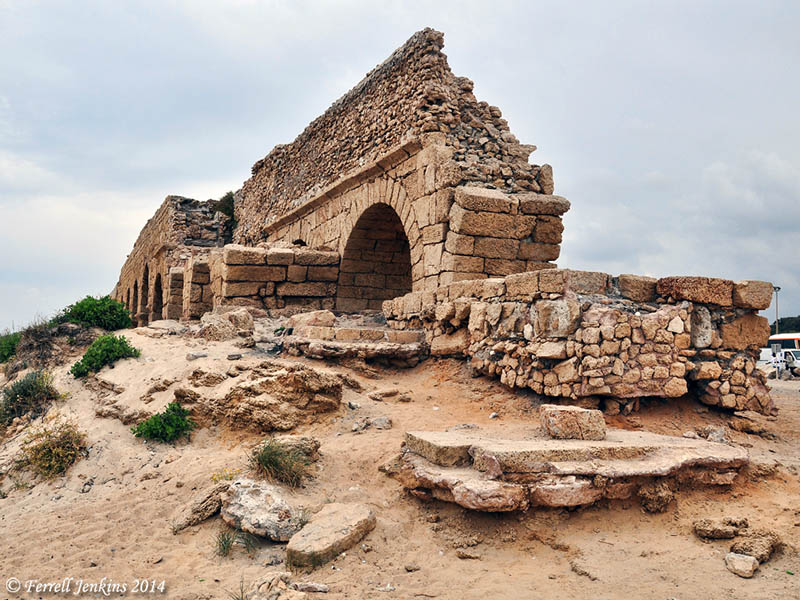
At Caesarea Maritima, visitors may see the high-level aqueduct at the point where it comes to an end likely due to erosion from the waves of the sea. According to Murphy-O’Connor the eastern channel (on the right) was “built by a Roman Procurator about the middle of the C1 AD.” The western channel was built by Hadrian. Some attribute the eastern channel to Herod the Great.

The high level aqueduct at Caesarea Maritima. Photo by Ferrell Jenkins.

The high level aqueduct at Caesarea Maritima. Photo by Ferrell Jenkins.

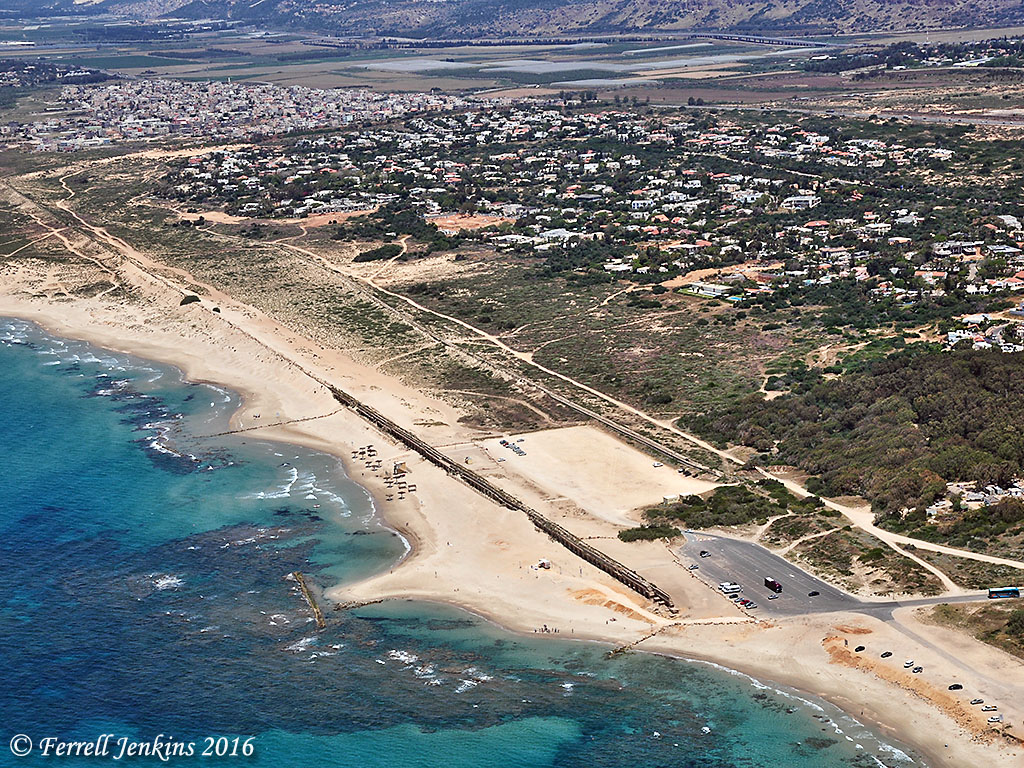
The next image is an aerial photo showing a long stretch of the high level aqueduct at Caesarea. You can also see the low level aqueduct a few yards inland (east). The low level aqueduct was built in the late 4th or early 5th century A.D.

Aerial view of the aqueduct north of the city. Photo by Ferrell Jenkins.

Aerial view of the aqueduct north of the city. Photo by Ferrell Jenkins.

Caesarea Maritima was a first century Roman capital and seaport. The gospel was first preached to the Gentiles here when Peter came from Joppa to Caesarea to tell Cornelius words by which he could be saved (Acts 10, 11).

The Apostle Paul used the harbor at Caesarea several times. He was imprisoned in the city for two years before departing for Rome (Acts 24:27; 27:1).

Turning from idols to serve the living God

Recently I was browsing through photos made in the Archaeological Museum of Thessaloniki (Salonica, Thessalonica), Greece, in 2008. I was impressed with the images of various gods and goddesses that were known in the city in the first century A.D. There were statues and busts of Egyptian gods such as Isis, Serapis, and Harpokrates/Horus. Greek gods and goddesses such as Dionysus, Hades, Apollo, Athena, Aphrodite, Demeter, and the mother of the gods often associated with Kybele (Cybele) were known. And there were others.
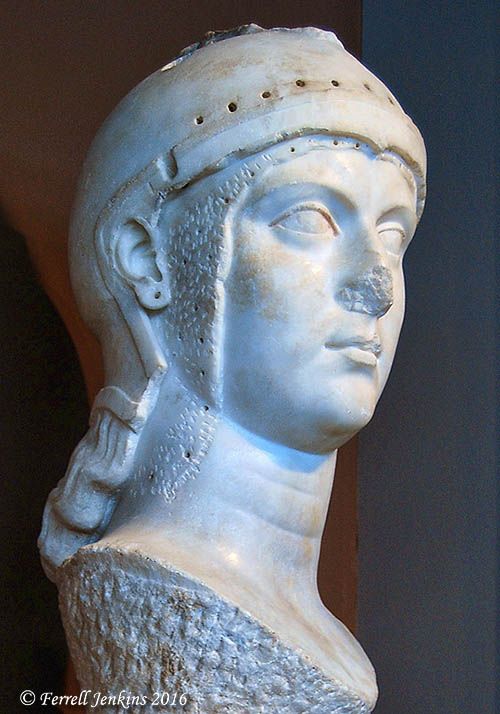
Athena. Archaeology Museum of Thessaloniki. Photo by Ferrell Jenkins.

Athena. Archaeology Museum of Thessaloniki. Photo by Ferrell Jenkins.

Immediately my mind was drawn to Paul’s commendation of the saints at Thessalonica in the middle of the first century A.D.

 6 And you became imitators of us and of the Lord, for you received the word in much affliction, with the joy of the Holy Spirit,
7 so that you became an example to all the believers in Macedonia and in Achaia.
8 For not only has the word of the Lord sounded forth from you in Macedonia and Achaia, but your faith in God has gone forth everywhere, so that we need not say anything.
9 For they themselves report concerning us the kind of reception we had among you, and how you turned to God from idols to serve the living and true God,
10 and to wait for his Son from heaven, whom he raised from the dead, Jesus who delivers us from the wrath to come.  (1 Thessalonians 1:6-10 ESV)

But there were other “gods” known to the Thessalonians. The deified Alexander, considered a son of Zeus, was represented in the museum. Another significant form of idolatry was the Cult of the Emperor of Rome. A sign associated with one display says,

The cult of the emperor was both an instrument of imperial policy propaganda and a means for the transmission of Roman culture. The image of the emperor gives a concrete form to the abstract idea of the Empire. Whether a full-length statue or a bust, it makes his presence felt everywhere: in outdoor and indoor spaces, in fora, in villas, and in libraries.

Here is a statue of Octavian Augustus, the first emperor of Rome (27 B.C. – A.D. 14). Augustus was emperor at the time of the birth of Christ (Luke 2:1).
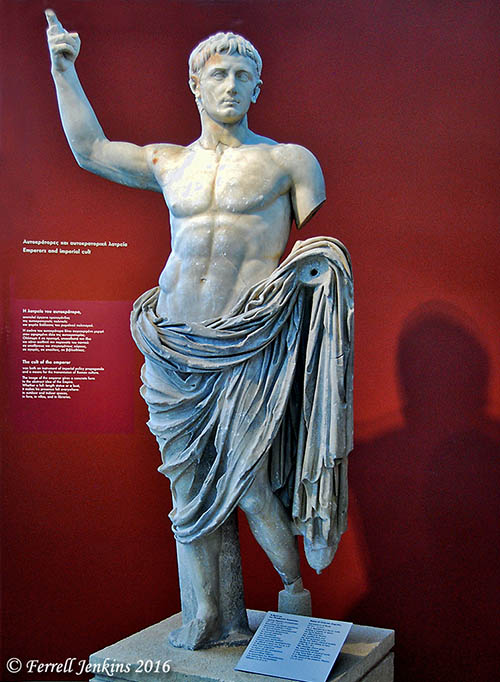
Statue of Augustus, Archaeology Museum of Thessaloniki. Photo by Ferrell Jenkins.

Statue of Augustus, Archaeology Museum of Thessaloniki. Photo by Ferrell Jenkins.

Claudius, Vespasian, Titus, and other emperors were represented in the museum displays.

An interesting temporary exhibition was about the discovery of an important archaeological site known as Kalindoia. The site is located about 48 km (30 miles) southeast of Thessalonica. Paul traveled a few miles north of Kalindoia when he went from Philippi, via Amphipolis and Apollonia, to Thessalonica (Acts 17:1). Below is the drawing of the chamber of the imperial cult. A temple for imperial worship was located here from the 1st century B.C. to the 3rd century A.D.
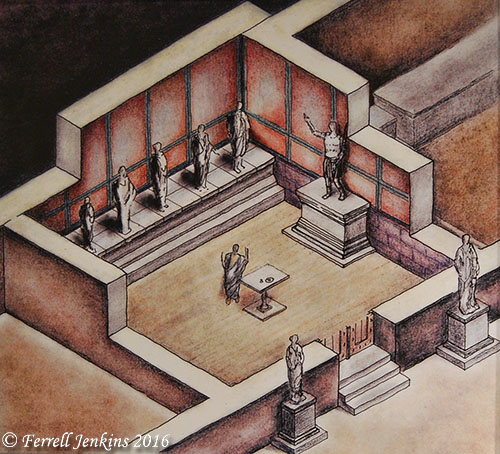
Artist conception of the chamber of the Imperial Cult. Photo by Ferrell Jenkins.

Artist conception of the chamber of the Imperial Cult. Photo by Ferrell Jenkins.

The sign associated with this drawing states that there were pedestals for statues here. “One of them was the statue of Emperor Octavian Augustus.” The Cult of the Emperor was especially pervasive in the eastern part of the Roman Empire and may have some bearing on understanding the man of lawlessness (sin) in 2 Thessalonians 2. It is certainly helpful in understanding the background of the book of Revelation.

But that’s not all. Another sign mentions the eponymous local heroes such as war heroes, deified mythological figures, or the heroized dead “were also worshipped.”

The gospel of Christ has power to touch the hearts of men and inform them about the difference between idols made of “gold or silver or stone, an image formed by the art and imagination of man,” and the God who does not dwell in temples made by man (Acts 17:29 ESV).

Unique Hadrian exhibit at the Israel Museum

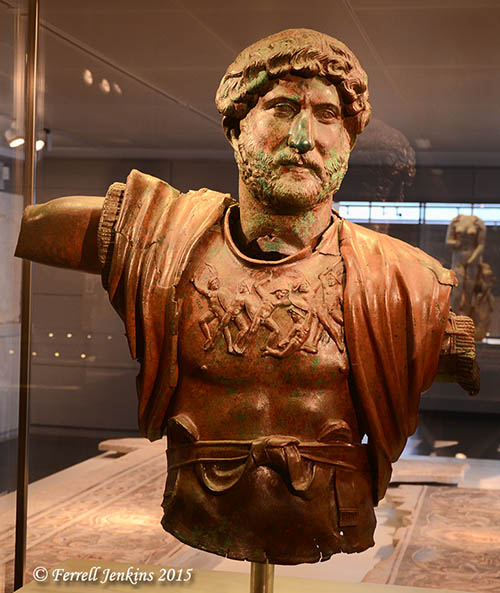
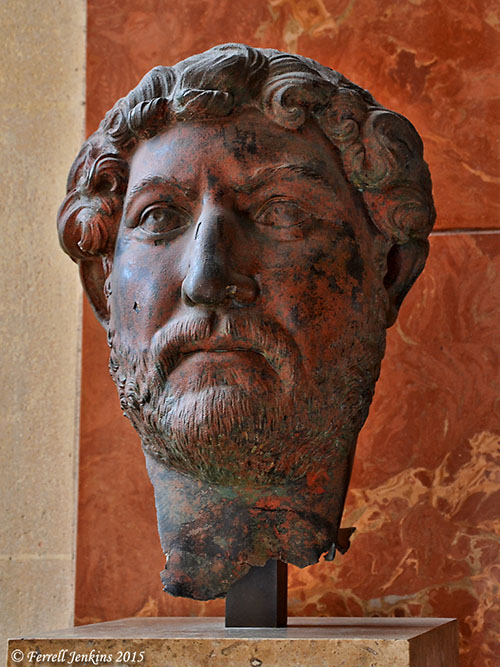
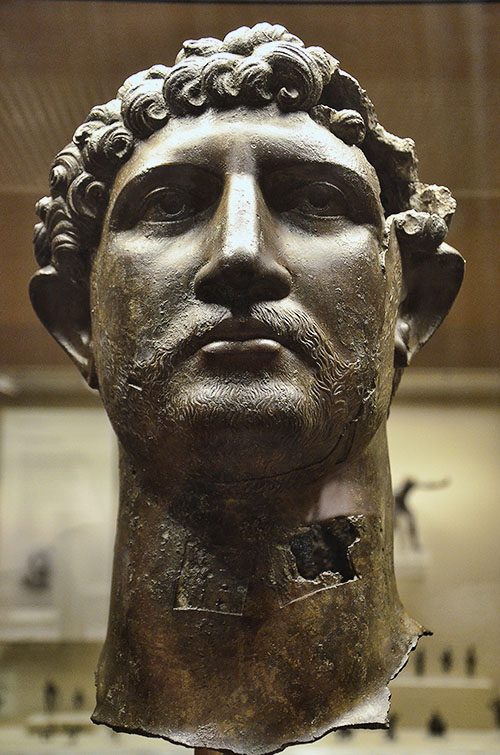
The Roman Emperor Hadrian (Publius Aelius Hadrianus) ruled the Empire from A.D. 117 to 138. Numerous statues of him are displayed in museums spread across the region. Most of them are made of stone, but there are three unique bronze statues of the Emperor. These are on display at the Israel Museum in Jerusalem until June. They come from the Israel Museum, the Louvre, and the British Museum.

Ilan Ben Zion says that Hadrian,

…was venerated by contemporary Roman historians as one of the Five Good Emperors: a just ruler, a peacemaker and great architect of the empire. The wall he famously constructed along the border with Scotland bears his name to this day. But in Jewish memory, Hadrian is best known as a brutal dictator who crushed the Bar Kochba revolt in 135, slaughtered hundreds of thousands of Jews, rebuilt Jerusalem as a pagan city, banned circumcision, and changed the name of Judaea to Palaestina. (The Times of Israel, Dec. 22, 2015)

I have seen all three of these pieces, but look forward to seeing them displayed together in the spring.

The most magnificent statue is the one of Hadrian discovered at Tel Shalem (Shalim) a few miles south of the Beth Shean (Beit She’an) in the Jordan Valley. Tel Shalem is thought to be the Salim mentioned in John 3:23.

Bronze statue of Hadrian discovered in a Roman army camp of the Sixth Roman Legion. He is portrayed as the supreme military commander. Photo by Ferrell Jenkins.

Bronze statue of Hadrian discovered in a Roman army camp of the Sixth Roman Legion at Tel Shalem. He is portrayed as the supreme military commander. Photo by Ferrell Jenkins.

Only the head remains of the other two statues. The first of these was acquired by the Louvre in 1984.

Bust of Hadrian thought to have come from Egypt. Louvre. Photo by Ferrell Jenkins.

Bust of Hadrian thought to have come from Egypt. Louvre. Photo by Ferrell Jenkins.

The next bronze head comes from a larger than life-size statue that is thought to have stood in a public area of Roman London. It commemorates Hadrian’s visit to Britain in A.D. 122. It was found in the River Thames near London Bridge in 1834. This head is displayed in a room of Roman statues in the British Museum, but I have never known it to be open. I arranged to visit the room one time and have a photo but it is not as sharp as I prefer. This photo comes from Following Hadrian here. I refer you to that blog and Twitter feed for everything Hadrian.

Bronze Head of Hadrian. Following Hadrian.

Bronze head from a statue of the Emperor Hadrian, Romain Britain, British Museum
Carole Raddato CC BY-SA

Richard Batey writes about Hadrian’s relation to Jerusalem:

Hadrian visited Jerusalem in A.D. 129–130 and rebuilt the city on the plan of a Roman military camp. On the Temple Mount he erected a temple dedicated to Jupiter Capitolinus and nearby a second temple honoring the goddess Aphrodite. Hadrian renamed Jerusalem Aelia Capitolina, a designation that combined one of his names with Rome’s Capitoline triad: Jupiter, Juno and Minerva. Hadrian’s actions and policies provoked a second revolt by the Jews in A.D. 132. Led by Bar Kokhba, the Jewish troops succeeded in taking control of Jerusalem briefly but were soon (A.D. 135) crushed by the superior Roman army. After this decisive defeat it became a capital offense for a Jew to set foot in Jerusalem. (Batey, R. A. “Jerusalem.” Ed. Craig A. Evans and Stanley E. Porter. Dictionary of New Testament background: a compendium of contemporary biblical scholarship 2000 : 561. Print.)

Shmuel Browns, Israel Tour Guide, includes a beautiful photo of the Tel Shalem bust currently on display (outside the case?), and he presents another opinion about the rebuilding of the city. He also includes a list of some other things related to Hadrian that can be seen in and around Jerusalem. See his post here.

Information about the exhibit at the Israel Museum may be found here.

Ram statue discovered at Caesarea Maritima

The IAA announced last Thursday the discovery of the statue of a ram at Caesarea Maritima. The announcement says,

The statue … might have been part of the decoration of a Byzantine church from the sixth–seventh centuries CE at Caesarea. By the same token it could also be earlier, from the Roman period, and was incorporated in secondary use in the church structure.”

The photo below seems to have been made in a metal storage shed and provides some idea of the size of the ram whose front legs are missing.

Ram discovered at Caesarea. Photo: Vered Sarig, The Caesarea Development Corp.

Ram discovered at Caesarea. Photo: Vered Sarig, The Caesarea Development Corp.

In the next photo the ram looks much larger than it is because of the relationship to the camera.

Ram discovered at Caesarea. Photo: Vered Sarig, The Caesarea Development Corp.

Ram discovered at Caesarea. Photo: Vered Sarig, The Caesarea Development Corp.

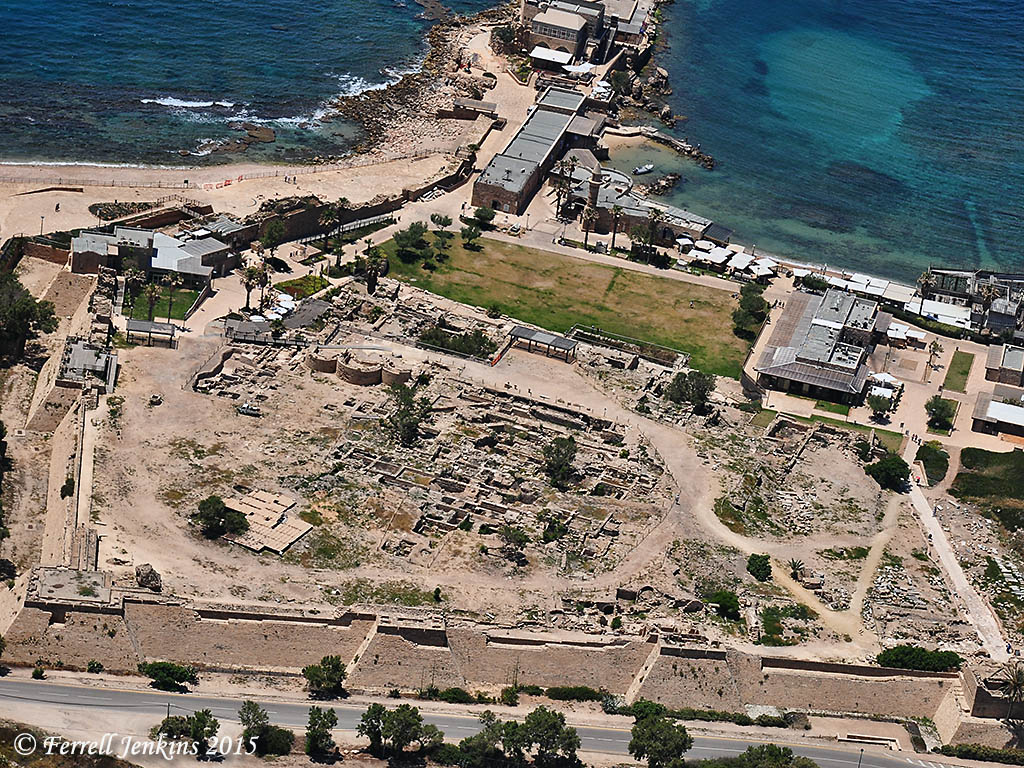
The aerial photo below will help you put the discovery location in perspective. It shows the area of the Byzantine church that was built on the site about A.D. 525. Kenneth Holum of the University of Maryland announced in 1995 the discovery of Herod the Great’s enormous temple dedicated to the Roman Emperor Augustus underneath the ruins of the Byzantine church.

Aerial view of Caesarea Maritima showing area of the Byzantine church ruins. Photo by Ferrell Jenkins.

Aerial view of Caesarea Maritima showing the area of the Byzantine church ruins. The view also shows the Crusader wall. Photo by Ferrell Jenkins.

When the Pharisees and scribes complained that Jesus received sinners and ate with them, He told them a parable that we call the parable of the lost sheep (Luke 15:1-7).

“What man of you, having a hundred sheep, if he has lost one of them, does not leave the ninety-nine in the open country, and go after the one that is lost, until he finds it?  And when he has found it, he lays it on his shoulders, rejoicing.  And when he comes home, he calls together his friends and his neighbors, saying to them, ‘Rejoice with me, for I have found my sheep that was lost.’  Just so, I tell you, there will be more joy in heaven over one sinner who repents than over ninety-nine righteous persons who need no repentance.  (Luke 15:4-7 ESV)

“When he has found it, he lays it on his shoulder, rejoicing.” This describes the work of good shepherds and a practice that was well known to those who heard Jesus. On another occasion Jesus called Himself the good shepherd (John 10:11, 14).

The motif of the good shepherd with the sheep on his shoulder became common in later Christian iconography. For some examples of Good Shepherd statues/statuettes from the Byzantine period see our post here.

HT: Joseph I. Lauer