Category Archives: Israel

The significance of Gaza

After my first tour to the Bible Lands, including Rome, Greece (Athens and Corinth), Egypt, Lebanon, Syria (Damascus), Jordan, and Israel, in April/May, 1967, I decided to make a second tour the following year. For many years, I always added some new places on each tour. In 1968 I added Beersheba and Gaza. The Gaza Strip (named such because of the long, narrow size of the small entity) had been under Egyptian control for several decades until June, 1967.

There was not much to see at Gaza. By the time we visited in 1968, Gaza was under Israeli control. We drove to the coast where there were only a few houses and some small fishing boats. This is one of the few slides that I have to illustrate the visit to Gaza.
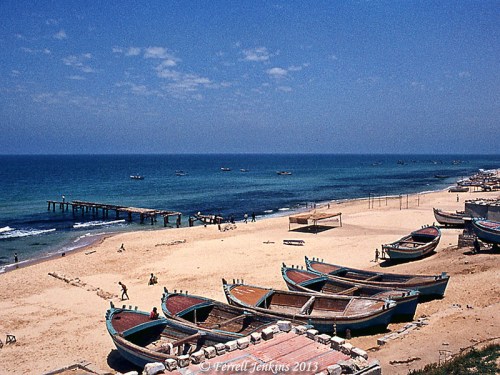
Gaza on the Mediterranean Sea in May, 1968. Photo by Ferrell Jenkins.

Gaza on the Mediterranean Sea in May, 1968. Photo by Ferrell Jenkins.

Gaza is mentioned several times in the Old Testament. Here is a summary of these references.

  • Gaza was the southwestern boundary of the Canaanites in the table of Nations (Genesis 10:19).
  • The original inhabitants of Gaza were replaced by the Caphtorim, likely the ancestors of the Philistines (Deuteronomy 2:23).
  • Joshua defeated Canaanites “even as far as Gaza” (Joshua 10:41).
  • Joshua eliminated the Anakites except in Gaza, Gath, and Ashdod (Joshua 11:21-22). We recognized these cities as later belonging to the Philistines.
  • Gaza is listed as belonging to the tribe of Judah (Joshua 15:47; Judges 1:18).
  • The Midianites oppressed Israel, “as far as Gaza”, for seven years (Judges 6:4).
  • Samson had contact with the inhabitants of Gaza (Judges 16).
  • Gaza is listed as one of the five Philistine cities in the time of the Israelite Judges (1 Samuel 6:17).
  • Solomon controlled territory as far southwest as Gaza (1 Kings 4:24).
  • Hezekiah defeated the Philistines as far as Gaza and its territory (2 Kings 18:8).
  • Jeremiah makes reference to Gaza being conquered by Pharaoh (Jeremiah 47:1).
  • The prophets of Judah pronounced judgments upon Gaza (Amos 1:6-7; Zephaniah 2:4; Zechariah 9:5).

The only New Testament reference to Gaza is in Acts 8:26. Philip the evangelist was instructed to go south on the road that descends from Jerusalem to Gaza. English translators struggle with the issue of whether the city was desert, or the road leading to the city ran through a desert area. (I will leave that for some other time.)
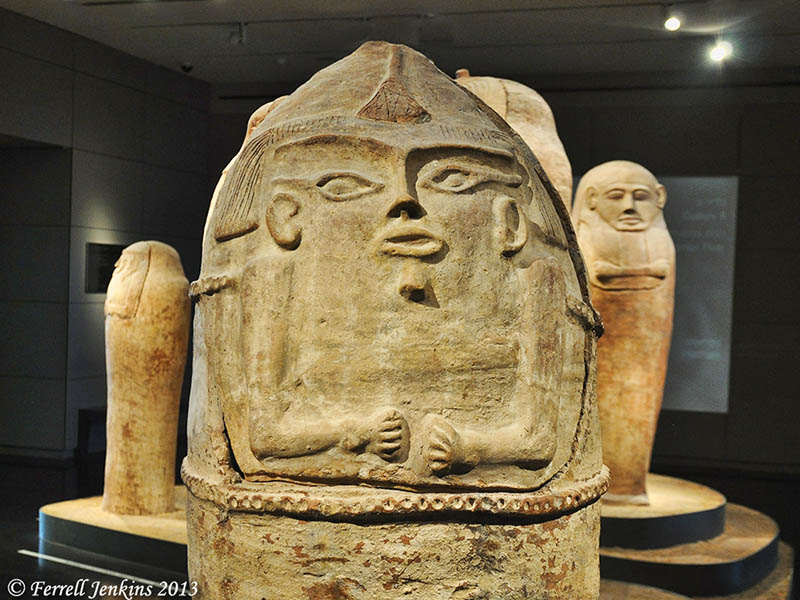
The first display one sees as he enters the archaeology wing of the Israel Museum is that of the anthropoid coffins from Deir el-Balah, a site south of Gaza city. The coffins, excavated by Trude Dothan in 1972, bear evidence of Egyptian influence. They date to the 13th century B.C.
Anthropoid Coffins from Deir el-Balah in the Israel Museum. Photo by Ferrell Jenkins.
Anthropoid Coffins from Deir el-Balah in the Israel Museum. Photo by Ferrell Jenkins.
Hoping to grow frankincense in the Arava of Israel

Botanist Dr. Elaine Solowey is already known to us for the successful sprouting of a 2,000 year old date palm. See here.

Matthew Kalman reports that she is now trying her hand at growing frankincense in the Arava Institute for Environmental Studies.

“This is the first frankincense tree to set seed in Israel in 1500 years,” Dr Solowey told me as she presented the tiny sapling for its first public photo-call this week. “It was necessary to bring this variety back to the country because the last people growing these trees near the Dead Sea left and the trees left with them.”

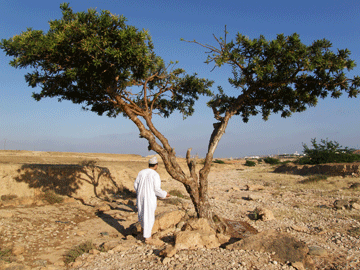
Frankincense tree, Salalah, Oman.

Frankincense tree, Salalah, Oman.

In biblical times, frankincense, myrrh  and balm of Gilead were used among the ingredients of the incense used in Solomon’s Temple (1 Chronicles 9:29-30). Solowey and other scientists are examining the medical uses of these products.

Every student of the New Testament remembers the gifts brought by the Magi (wise men) to Jesus.

As they came into the house and saw the child with Mary his mother, they bowed down and worshiped him. They opened their treasure boxes and gave him gifts of gold, frankincense, and myrrh. (Matthew 2:11 NET)

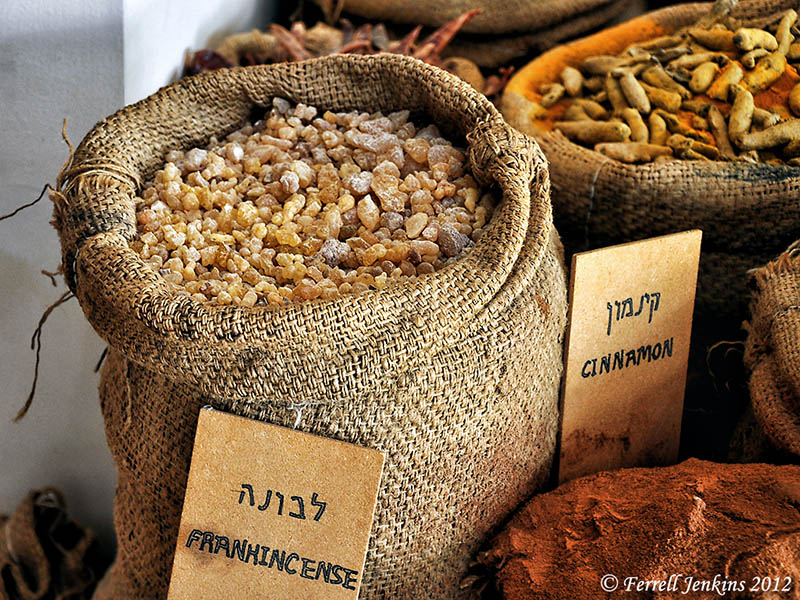
Our photo show frankincense displayed at Avdat, a Nabatean site along the ancient incense route. Frankincense is linked with gold in Isaiah 60:6, and is considered a great value.

Frankincense on the ancient spice route at Avdat, Israel. Photo by Ferrell Jenkins.

Frankincense on the ancient spice route at Avdat, Israel. Photo by Ferrell Jenkins.

To read all of Kalman’s informative article, see here.

We have written about frankincense and myrrh, with more photos and details, here and here and here.

HT: Joseph I. Lauer

When a lot of rain is a good thing

Having watched the rise and fall of the Sea of Galilee (Lake Kinneret) over a period of 45 years, it is exciting to learn that winter storms have pushed the lake to the sharpest December rise in 20 years.

According to an article in Haaretz the lake “is expected to have risen 26 centimeters [9.84″] since heavy rains began Thursday, it sharpest December rise in 20 years. [1991 and 1992]”

As a result of the increased flow in northern streams, the Kinneret’s water level rose sharply, reaching 212.07 meters [695.77 feet] below sea level Saturday morning.

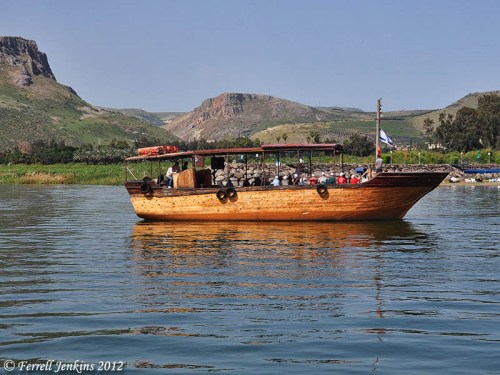
Sightseeing boat on the Sea of Galilee. Photo by Ferrell Jenkins.

Boat on the Sea of Galilee near the Plain of Gennesaret. Photo by Ferrell Jenkins.

And when they had crossed over, they came to land at Gennesaret. (Matthew 14:34 ESV)

Rain also fell as far south as Ashdod and Kiryat Gat, “but failed to affect the Negev this time.” This reminds us of the days of the Patriarchs whose lives were often disrupted by lack of rain in the Negev.

According to the report, almost 20 inches of snow has fallen on Mount Hermon.

If you have an interest in weather conditions in Israel, I suggest Kinneret Bot and the site of the Israel Meterological Service.

Geographer Carl Rasmussen says,

All of us who have traveled in Israel and the surrounding countries are well-aware of the importance of the winter rains for the well-being of the inhabitants of the area, local agriculture, and the water supply in general.

HT: Bible Places Blog; Holy Land Photos’ Blog.

“Dried up like a potsherd”

Simple things make good illustrations. Just ask Jesus.

David used many simple illustrations in the Psalms. In one he spoke of the common piece of broken pottery (potsherd) which could be found around every home and camp site.

my strength is dried up like a potsherd, and my tongue sticks to my jaws; you lay me in the dust of death. (Psalm 22:15 ESV)

In this text David describes his own feeling of weakness and/or that of the coming Messiah. There are times, I think, when each of us feels like this.

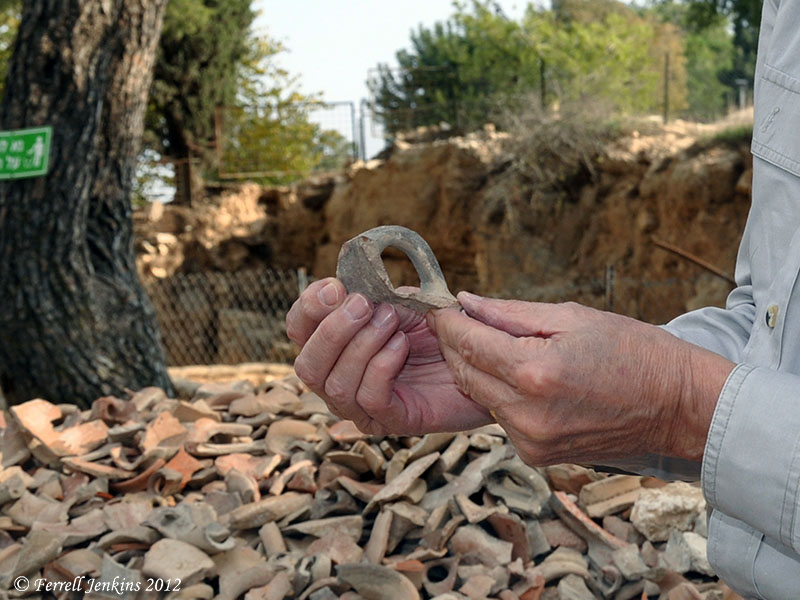
A common thing we see at archaeological digs is a pile of potsherds from ancient times. Archaeologists relish an unbroken piece of pottery, but even the sherds or potsherds reveal a lot about the age of the stratum being worked and the life of the ancient people. The broken jar handle from Ramat Rachel, south of Jerusalem, tells its own story.

Potsherds at Ramat Rachel excavation. Photo by Leon Mauldin.

Potsherds Potsherds at Ramat Rachel excavation. Photo by Leon Mauldin.

Unless it is an old college professor (pick your own), nothing is drier than a piece of broken pottery. Great illustration.

The “horns of the wild oxen”

Many Bible stories find their setting, and draw illustrations, based on the land where the writers lived.

David draws on the land when he prophesies the execution of the Messiah (Psalm 22). In one plea he says,

Save me from the mouth of the lion! You have rescued me from the horns of the wild oxen! (Psalm 22:21 ESV)

The term wild oxen in this text comes from the Hebrew word reem. The photo below shows the Arabian Oryx, thought to be the reem of the Hebrew Bible. The King James Version used the word unicorn to translate reem, but modern English versions typically translate it with “wild ox” (Psalm 22:21; Numbers 23:22; 24:8; Deuteronomy 33:17, et al.).

Arabian Oryx at Hai-Bar Nature Reserve near Eilat, Israel. Photo by Ferrell Jenkins.

Arabian Oryx at Hai-Bar Nature Reserve near Eilat, Israel. Photo by Ferrell Jenkins.

Acts 26 — Photo Illustrations — Herod’s Praetorium and Audience Hall

We have mentioned previously that the events of Acts 24-26 took place at Caesarea. The material we have presented may be used with either chapter.

Luke says that Agrippa and Bernice came amid great pomp into the audience hall.

So on the next day Agrippa and Bernice came with great pomp, and they entered the audience hall with the military tribunes and the prominent men of the city. Then, at the command of Festus, Paul was brought in. (Acts 25:23 ESV)

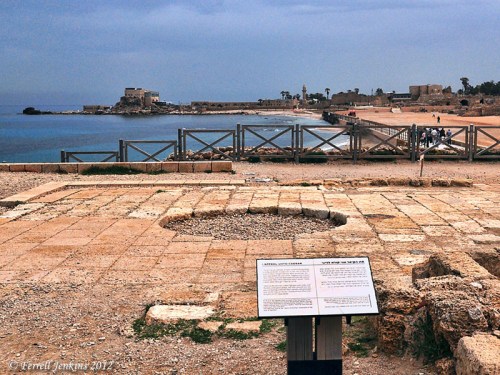
Excavations at Caesarea in 1997 caused Yosef Porat, of the Israel Antiquities Authority, to think that the auditorium or audience hall mentioned here has been discovered. This photo shows the general area within the Herodian Palace (cf. John McRay, Paul: His Life and Teaching).

Area of the Audience Hall at Caesarea. Photo by Ferrell Jenkins.

Area of the Audience Hall at Caesarea. Photo by Ferrell Jenkins.

The sign visible in the foreground is found only in my 2011 photographs. Signs are moved because they become incorrect, worn, or in the way of continued restoration. Here is the sign.

Sign at the Audience Hall in Caesarea. Photo by Ferrell Jenkins.

Sign at the suggested Audience Hall in Caesarea. Photo by Ferrell Jenkins.

Paul may have appeared before Felix, Festus, and Agrippa at this place. I often tell my tour groups, “If it didn’t happen right here (pointing down), it happened right here (motioning with arms extended, meaning nearby).”

When Paul first arrived at Caesarea, Felix said,

…  “I will give you a hearing when your accusers arrive.” And he commanded him to be guarded in Herod’s praetorium. (Acts 23:35 ESV)

Two prison inscriptions were found in the same area, leaving the scholars working there to conclude that this was indeed the Praetorium of the Palace.

The first reads, “The fraternity of the Frumentarii. Happiness for all.”

The inscription reads, “O, good hope, I came to this office. I will be secure.” An accompanying sign says,

“This inscription indicates that a Latin-speaking guard was in charge of the security of the building, and of the safety of the governor.”

Prison inscription found at Caesarea. Photo by Ferrell Jenkins.

Prison inscription found at Caesarea. Photo by Ferrell Jenkins.

The second inscription reads, “The fraternity of the Frumentarii. Happiness for all.” The Frumentarius was an official in charge of police duties and prisoners. The accompanying sign says that Paul was the most famous prisoner held there.

Prison inscription found at Caesarea. Photo by Ferrell Jenkins.

Prison inscription found at Caesarea. Photo by Ferrell Jenkins.

As a Roman citizen, Paul was allowed his right to appeal to Caesar (Acts 25:11-12). We all know that the wheels of justice often move slowly.

Limited time bargain on a great Bible atlas

Christianbook.com is offering Carl Rasmussen’s Zondervan Atlas of the Bible for a limited time at the unusual price of $14.99. Click here.

zondervanatlascover01

I can’t promise that it will still be available by the time I get this posted, but you can try.

Update Noon  12-04-12:  I see the price is now $19.99. If you have a a Prime account with Amazon (postage free), or wish to add another item, the price may be better at $22.73 for Zondervan Atlas of the Bible.

This Atlas is an extremely good one. It is well written, accurate, colorful, filled with great photos and helpful maps. Earlier this evening I emailed a notice to folks who have traveled with me recently, or who plan to, with this note:

This is an excellent book for anyone planning a tour to Israel, or anyone who has been. It should be one of your most helpful Bible study tools.

One of the ladies who traveled to Israel earlier this year replied with this note:

That is a great price. I got one before we went. I use it daily as I read and it sure brings the scriptures alive. It is much more so now that we have seen the country.

Acts 25 — Photo Illustrations — Coins of the Rulers

We continue our look at the three chapters describing Paul’s stay at Caesarea Maritima — Acts 24-26. Three civil rulers are mentioned in these chapters. They are known not only from Luke’s account, but in the writings of Josephus.

Rapske says that Caesarea “was the administrative seat of the Roman procurators of Palestine.” He adds that in the time of the Flavians it became a Roman Colony (The Book of Acts in its First Century Setting; Vol. 3, The Book of Acts and Paul in Roman Custody, 155).

After the Romans occupied “Palestine” the Jews had both a religious and a secular tax to pay. The procurators (prefects) were responsible for collecting the taxes for Rome. Coins were minted by various procurators, including Felix and Festus. I have chosen one example from each to show the type of coin current in their time.

Antonius Felix — A.D. 52-59.

Felix is described as a hegemon in the Greek New Testament. Major English versions use the term governor (Acts 23:24, 26; 24:2, 22, 24, 25, 27; 25:14). Hemer says that hegemon is a general word to describe a ruler, “the formal Latin title of these governors of Judaea being procurator or praefectus” (The Book of Acts, 128).

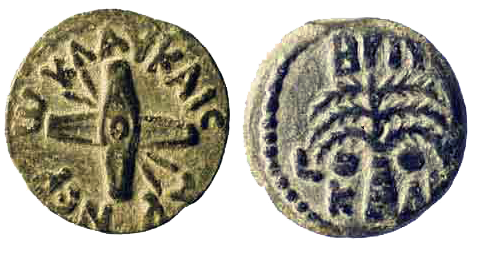
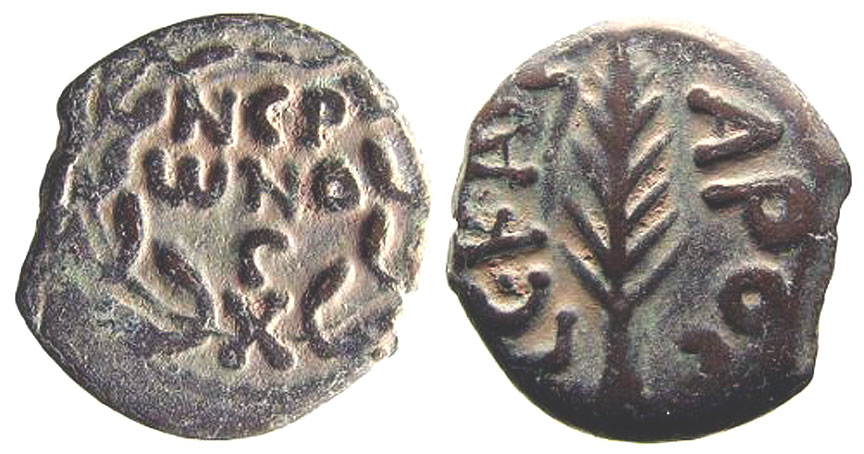
The obverse (head) of the coin of Felix shows two oblong shields and two spears. The inscription is translated “Nero Claudius Caesar–son of Claudius. The reverse (tail) shows a “six-branched palm tree bearing two bunches of dates” with a Greek inscription above and below (Hendin, Guide to Biblical Coins (1987), 117).

Coin of Roman Procurator Felix.

Coin of Roman Procurator Felix.

Porcius Festus — A.D. 59-61.

Porcius Festus followed Felix as governor or procurator. He is mentioned in each of the three chapters we are discussing. Paul had been left in custody by Felix, and Festus seems to be pleased to get the advice of King Agrippa when he visited Caesarea.

The coin of Festus, struck in A.D. 58, bears a Greek inscription within a wreath on the obverse. At the bottom is an X. The inscription reads NER ONO C (Nero). The reverse shows a palm branch with a Greek inscripton KAIC APOC (Caesar). The date LE means year five (Hendin, 118).

Coin of Porcius Festus.

Coin of Roman Procurator Porcius Festus.

Herod Agrippa II — A.D. 48-70.

Herod Agrippa II was the son of Herod Agrippa I, the grandson of Herod the Great (Acts 12:1, et al.). Agrippa II was the tetrarch of Chalcis and of northern territories. Chalcis was the small but beautiful territory between the Lebanon and Antilebanon mountains. Later he was granted the territories that had been controlled by Philip and Lysanias. Agrippa lived until the end of the first century, and minted coins even to the time of the Roman Emperor Domitian (A.D. 81-96).

According to Hendin, the obverse shows a laureate bust of Domitian facing right. The inscription around it reads DOMITIAMOC KAICAP (Domitian Caesar). The reverse shows Nike standing right. One foot is resting on a helmet. She is writing on a shield that is resting on her knee. The inscription reads ETO KZBA AΓPIΠΠA (Year 27 of King Agrippa). The coin was struck in A.D. 83. (I do not know how best to harmonize the dates associated with the reign of Agrippa II.)

Coin of Herod Agrippa II with image of Domitian. Struck A.D. 83.

The coin above is copied from FORVM ANCIENT COINS.


I have only the original edition of Hendin’s Guide to Biblical Coins, but recommend the newer fifth edition of his book in the event that you have a genuine interest in Biblical coins. From my limited collecting experience, I can say that it is both fascinating and educational.

Cyrus Cylinder scheduled for a U.S.A. tour

The British Museum announces that the Cyrus Cylinder will tour to five major U.S.A. museums in 2013. Plan your vacation how.

The Cylinder will travel with an exhibition of sixteen objects under the title ‘The Cyrus Cylinder in Ancient Persia’. The exhibition shows the innovations initiated by Persian rule in the Ancient Near East (550 BC-331 BC). The Persian Empire was then the largest the world had known. It had a huge impact on the ancient world, introducing changes in terms of ethical behaviour as witnessed in the proclamation on the Cyrus Cylinder.
For more information see Artdaily here. A nice photo of the Cylinder is included.

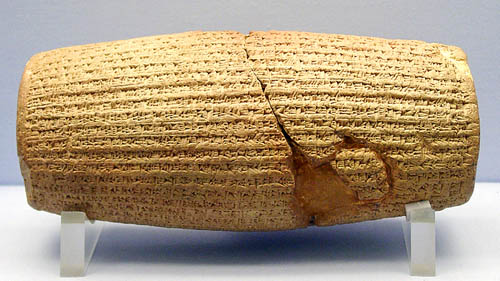
The Cyrus Cylinder is important to Bible students because Cyrus is the Persian king who allowed the Judeans to return to Jerusalem and rebuild the temple.

Now in the first year of Cyrus king of Persia, that the word of the LORD by the mouth of Jeremiah might be fulfilled, the LORD stirred up the spirit of Cyrus king of Persia, so that he made a proclamation throughout all his kingdom and also put it in writing:  “Thus says Cyrus king of Persia, ‘The LORD, the God of heaven, has given me all the kingdoms of the earth, and he has charged me to build him a house at Jerusalem, which is in Judah. Whoever is among you of all his people, may the LORD his God be with him. Let him go up.'” (2 Chronicles 36:22-23 ESV; cf. Ezra 1:1-4).
Cyrus Cylinder.

Cyrus Cylinder in the British Museum. Photo by Ferrell Jenkins.
The U.S.A. schedule is as follows:
  • Smithsonian’s Arthur M. Sackler Gallery and Freer Gallery of Art, Washington D.C., 9th March – 28th April 2013
  • Museum of Fine Arts, Houston, 3rd May – 14th June 2013
  • The Metropolitan Museum of Art, New York 20th June – 4th August 2013
  • Asian Art Museum, San Francisco, 9th August – 22nd September 2013
  • J. Paul Getty Museum at the Getty Villa, Los Angeles, 2nd October – 2nd December 2013
HT: Jack Sasson

Maintaining control of a tour group

Occasionally I am asked if I ever have any trouble with individual tour members during a tour. The same might be asked about students in a class. After 45 years of directing tours I would have to say that there have been a few people who have given some problems for me or other tour participants. If they give trouble to others, that becomes a problem for me.

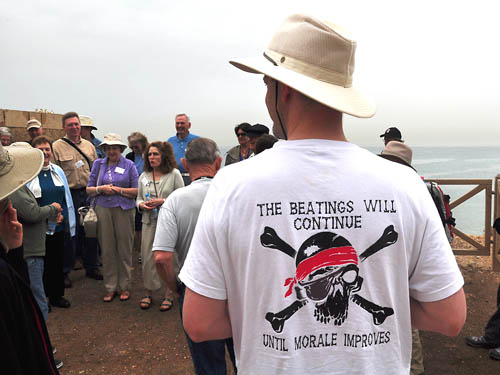
Mark, one of my friends, showed up on the first full day of touring with a T-shirt that I suppose he thought might help.

Dealing with trouble during a tour.

One tour member wanted everyone to improve their behavior. Photo by Ferrell Jenkins.

Really, the serious problems have been few and far between. I have become friends with some wonderful people through the years.

The advice of wisdom always works.

A soft answer turns away wrath, but a harsh word stirs up anger. (Proverbs 15:1 ESV)