Category Archives: Israel

March/April edition of BAR online

Biblical Archaeology Review announced today that the entire March/April edition is available online. Certainly this is to gain subscribers. Nonetheless it is a good opportunity for those who have not read the magazine to take a look.

Subjects include an article about a seal bearing the name Jezebel. Does it belong to the wicked Phoenician Queen, wife of Ahab?

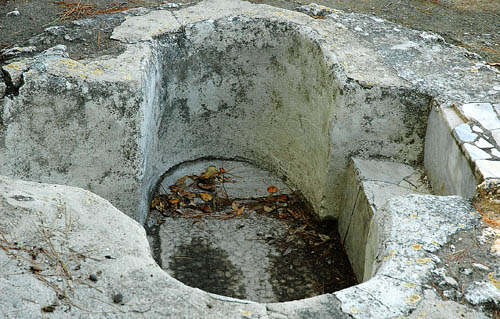
Another article is about Emmaus, or Emmaus-Nicopolis, where Jesus met with some disciples after his resurrection (Luke 24:13ff.). Here is a photo I made of the fifth century baptistry at Emmaus in 2005.

Baptistry in 5th century church at Emmaus. Photo by Ferrell Jenkins.

BAR has a photo of this baptistry, but calls it a “baptismal font.” The article says,

Two steps lead down into the basin where the penitent would stand when the priest poured water over him (the basin is not large enough for total immersion).

Of course, I must disagree with BAR. Many a preacher has baptized in a bathtub or some other small vessel when nothing else was available. In New Testament times baptism was immersion, as the word indicates, and as history records. The first known instance of the pouring of water as a substitute for immersion is the case of Novation in A.D. 251. It may well have been that pouring was practiced by the 5th century at Emmaus, but it is a departure from the New Testament (Romans 6:3-4). Baptism is commonly called a washing in the New Testament (Acts 22:16; 1 Corinthians 6:11; Ephesians 5:26; Titus 3:5; Hebrews 10:22).

Anyway, go online and read these and other articles from the current issue of BAR. Here is the link.

Earthquake Felt in Israel, Syria and Lebanon

The Jerusalem Post reports that an earthquake was felt in Israel last Friday, Feb. 15. Read the full story here.

The earth shook in many parts of Israel at 12:37 p.m. Friday. The quake was felt mainly in coastline cities, including Haifa, Tel Aviv and Nahariya.
The quake, Israel Radio reported, was also felt in Syria and Lebanon. A faded echo of the quake that hit the coast was also felt at the editorial offices of The Jerusalem Post in Jerusalem.
….

The European-Mediterranean Seismological Center said on its Web site that the quake Friday was 5.3 on the Richter scale and that its epicenter was in Lebanon.

The region is long overdue for an earthquake of epic and potentially catastrophic proportions, scientists say.

The Great Rift runs all the way from northern Syria through Lebanon, Israel, the Arabah, and into eastern Africa. In Israel the area is called the Jordan Valley or the Dead Sea Rift, It is not surprising that earthquakes are mentioned frequently in the Bible. The prophet Amos dates his visions to “two years before the earthquake” (Amos 1:1). The earthquake he makes reference to must have been so memorable that everyone would know what he was talking about. Zechariah (14:5) also calls attention to this earthquake in the days of Uzziah king of Judah.

Jesus, in predicting the fall of Jerusalem to the Romans, said, “and in various places there will be famines and earthquakes” (Matthew 24:7; see Luke 21:11).

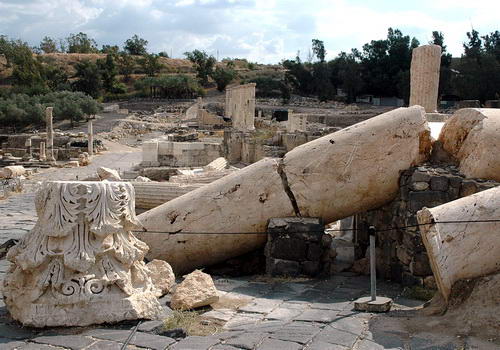
We have a wonderful example of the power of an earthquake in the Jordan Valley at the site of Bethshan [Bet-she’an, Beth-shean], about 25 miles south of the Sea of Galilee. The city was destroyed by an earthquake in A.D. 749. This photo shows the evidence brought to light during recently archaeological excavations in the city.

Earthquake Damage at Bethshan in A.D. 749. Photo by Ferrell Jenkins.

Waterfalls of Israel

Tourists often fail to see the waterfalls in Israel because they are hidden in the hills off the main roads and require a hike to get to them. Several years ago I was browsing the books at a profession meeting (SBL) I attended. One of the new publications was The Holman Bible Dictionary (1991). I noticed a photo of the waterfall at Engedi (En Gedi) on page 419. The caption for the photo reads:

The only natural waterfall in Israel is located at Engedi on the west side of the Dead Sea.

I spoke to one of the representatives of the publisher that I had come to know and told him this was a mistake that should be corrected. He thanked me and gave me a copy of the dictionary for having pointed out this error. I assume that future editions of the dictionary have a corrected caption.

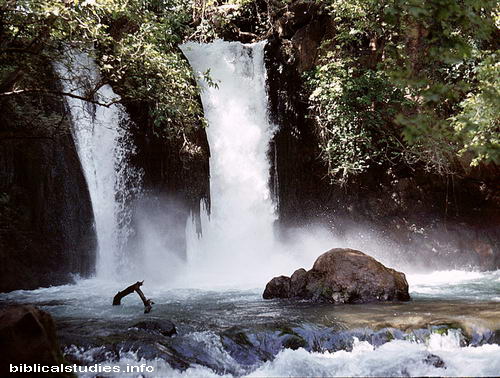
Here is a photo of the Jordan River Waterfall (sometimes called the Banias Falls) that I made in 1984. This waterfall is not far from the main road as you leave Banias (Caesarea Philippi) west toward Dan. A place like this would be most refreshing to a person like David as he was fleeing from Saul (1 Samuel 23:29-24:1). Of course, that was at Engedi, in the south.

Jordan River Falls (Banias Falls) Near Caesarea Philippi in Israel. Photo by Ferrell Jenkins 1984.

What really got me to thinking about this today is Todd Bolen’s BiblePlaces Newsletter which came today. In addition to links to news mentioned on the Bible Places Blog, the main feature includes the Waterfalls of Israel. There are five high-resolution photos and a PowerPoint presentation available for download. Todd also mentions other waterfalls in Israel.

Several times before I have recommended the BiblePlaces Newsletter and the Pictorial Library of Bible Lands. Click here to subscribe to the Newsletter. Click here to go to BiblePlaces for information about the Pictorial Library.

New Excavation Planned for Magdala

The town of Magdala is not mentioned in the Bible, but Mary Magdalene is mentioned a total of 12 times in the four gospels. This place may have been her birthplace or her home. A few late manuscripts mention Magdala (Matthew 15:39 KJV), but earlier manuscripts read Magadan. Magdala is located about 4 miles north of Tiberias on the western shore of the Sea of Galilee.

The Hebrew word Magdala means tower. In New Testament times the city had become Hellenized and bore the Greek name Tarichea because of the importance of the salted-fish industry there. Mendel Nun located a harbor at the site. He says,

“In ancient times, pickled sardines were an important element of diet throughout the countryespecially for those who lived near the lake” (BAR, Nov/Dec 1993).

Josephus had his headquarters at Magdala during the first Jewish Revolt against Rome (A.D. 66-70). He was able to get a group of at least 230 boats to go from Magdala to Tiberias (Jewish Wars 2.635-637). Vespasian attacked the town from the sea and destroyed it.

Archaeological excavations were conducted at Magdala in the early 1970s, on the plot owned by the Franciscan fathers, by Corbo and Loffreda. Biblical Archaeology Review announced (Sept/Oct 2007) that a new excavation will begin under the direction of Franciscan scholar Michele Piccirillo. In recent years entry to the site has been closed. The new excavations are welcomed.

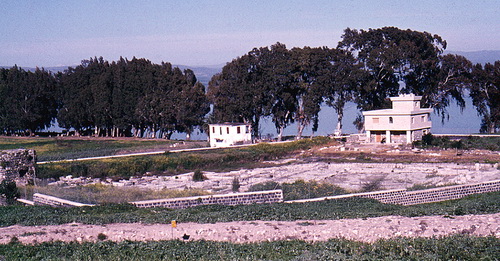
The photo below is one that I made in 1977 of the area overlooking the earlier excavations. A first century mosaic from Magdala showing a boat is on display at Capernaum. Moments after posting this blog I noticed that a report had been issued on new finds at Magdala. You may read the report and see new photos here. It will be exciting over the next few years to watch this ancient town give up its secrets.

Site of Magdala on the western shore of the Sea of Galilee. Photo by Ferrell Jenkins in 1977.

Israel Issues a New 2-Shekel Coin

A new 2-shekel coin entered circulation recently in Israel. This might be of interest to people who plan to travel to Israel. The Israeli New Shekel is worth about 27 cents in US money, so the 2-shekel (NIS 2) will be roughly equivalent to our half-dollar. Most American tourists who are in travel groups have prepaid their arrangements and have little need to exchange funds. Dollars are widely accepted in Israel.

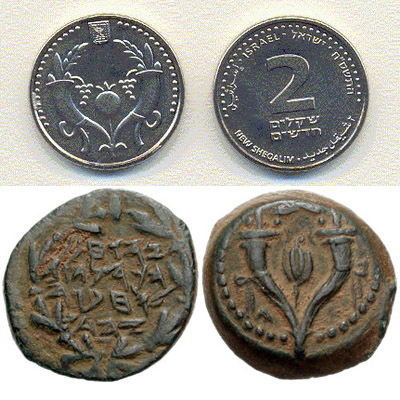
The new coin has an interesting historical association on the reverse side. It is a design of a cornucopia, a horn of plenty, and a pomegranate. This design is from an historical coin minted in the days of John Hyrcanus. Hyrcanus was one of the Maccabeans who successed Judas. He became high priest, and then ruler of the Hasmonean Dynasty from 135-104 B.C. During his reign we have the first reference to the Jewish parties, Pharisees and Sadducees, that are prominent in New Testament times.

John Hyrcanus extended the territory of the Maccabeans by seizing Idumaea (enter Herod!) and compelling the Idumaeans to be circumcised. He seized Samaritan territory and destroyed the temple of the Samaritans on Mount Gerizim. This is the temple alluded to by the woman of Samaria when she said to Jesus, “Our fathers worshiped in this mountain [Gerizim], and you people say that in Jerusalem is the place where men ought to worship” (John 4:20).

History is interesting, isn’t it? Here is a photo of the new 2-shekel and the bronze Prutah minted in the time of Hyrcanus. The photo is from Wikimedia Commons. Glancing through Hendin and Meshorer, I see that this design was fairly common during the period of the Maccabees.

Israel 2-shekel and coin from time of John Hyrcanus.

The pomegranate can be eaten fresh, used for fresh juice, or processed into an alcoholic drink for future use. Writers say the pomegranate,

“is a beautiful, symmetrical fruit, scarlet in color. Filled with small seeds surrounded by juicy pulp, the fruit became an obvious symbol of fertility” (King and Stager, Life in Biblical Israel, 104).

Another source says,

“The pulp is divided into 9 or 10 partitions which hold the numerous seeds. The pulp is delicious and very refreshing to eat because of its copious juice. the seeds yield a syrup called grenadine. The flowers are used in the treatment of dysentery” (Fauna and Flora of the Bible, 169).

Saul stayed on the outskirts of Gibeah “under the pomegranate tree” (1 Samuel 14:2). The girl of the Song of Solomon is told twice that her “temples are like a slice of a pomegranate behind your veil” (Song 4:3; 6:7). She also says, “I would give you spiced wine to drink from the juice of my pomegranates” (Song 8:2). The fruit was used as the design for decoration on the hem of the garment of the high priest (Exodus 28:33).

This beautiful pomegranate was growing at the site of ancient Aphrodisias in Turkey. The photo is better than some I have from Israel. Enjoy.

Pomegranate growing at Aphrodisias in Turkey.

“From Dan to Beersheba”

The tribe of Dan was assigned territory along the Mediterranean Sea where Joppa and the modern city of Tel Aviv now stand (Joshua 19:40-48). Because the Philistines lived in this territory the Danites found it necessary to move to a new location. A portion of the tribe moved north to the city of Laish at the foot of Mount Hermon and renamed it Dan (Judges 18). This northern city became the northern boundary of Israelite occupation and prompted the expression “from Dan to Beersheba” (Judges 20:1; 1 Kings 4:25).

An Aramaic inscription was found by Professor Avraham Biran at Dan July 21, 1993. The inscription mentions the king of Israel, the “the house of David,” and the Aramean (Syrian) god of storms and warfare, Hadad. The “house of David” is a reference to the southern kingdom of Judah. Two additional pieces of the inscription were found in June, 1994.

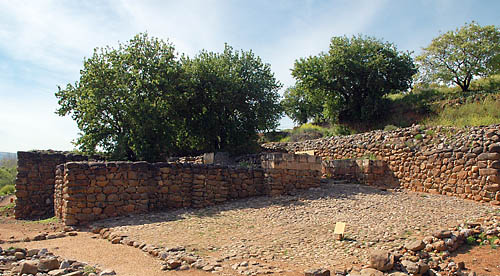
This photo show the partially reconstructed Iron Age (Israelite) gate at Dan.

The Iron Age City Gate at Dan. Photo by Ferrell Jenkins.

Approaching Y20K

When we began this little blog to post photos of our Ancient Crossroads Tour of Biblical and Historical Turkey, we never even thought about reaching 20,000 hits. But, it should happen today. Thanks for making this a site you visit regularly.

There are many things I would like to blog about if I could find the time, but I have basically tried to limit myself to things pertaining to travel in the Bible lands.

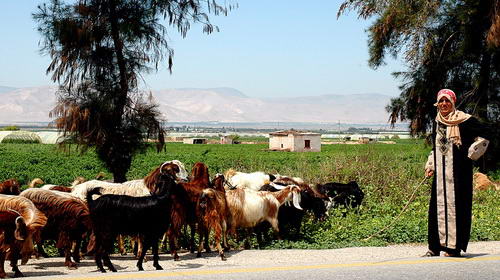
As our gift to you for traveling along with us, here is a picture of a woman caring for goats in the Jordan River valley on the east side. This photo was made in the Hashemite Kingdom of Jordan, looking across to Israel. In Roman times (the period of the New Testament) this area was known as Perea. The New Testament never uses the word Perea, but the Greek New Testament has the word peran (translated beyond), in the phrase “beyond the Jordan” (Matthew 19:1; John 1:28; 10:40). Jesus spent a considerable about of time in this region (John 10:40-42; Luke 13:22-35, et al.).

Caring for Goats in the Jordan Valley, the area of Perea in New Testament times. Photo by Ferrell Jenkins.
The desolate looking area across the valley is the northern end of the Wilderness of Judea. The Jordan River is rarely visible because it flows in a depression known as the Zor. The Zor is a depression cut into a wider depression called the Ghor. This valley is several hundred feet below sea level, making it ideal for truck farming today. If that expression (truck farming) is new to you, it means the growing of vegetables for use by people outside the area.
Thanks. Visit often.

Does this seal bear the name of a Bible character?

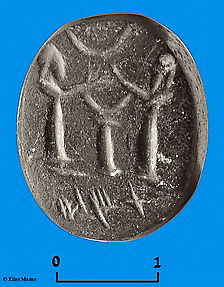
We now have dozens of seals bearing the names of characters mentioned in the Bible, but every new one is interesting. The Jerusalem Post, January 16, 2008, reports the discovery of a seal that it says bears the name of a family of temple servants who were exiled to Babylon in 586 B.C., and then returned to Jerusalem after the exile. The discovery was made by Dr. Eilat Mazar at the City of David Excavation.

The Jerusalem Post:

The seal, which was bought in Babylon and dates to 538-445 BCE, portrays a common and popular cultic scene, Mazar said.
The 2.1 x 1.8-cm. elliptical seal is engraved with two bearded priests standing on either side of an incense altar with their hands raised forward in a position of worship.
A crescent moon, the symbol of the chief Babylonian god Sin, appears on the top of the altar.
Under this scene are three Hebrew letters spelling Temech, Mazar said.
The Bible refers to the Temech family: “These are the children of the province, that went up out of the captivity, of those that had been carried away, whom Nebuchadnezzar the king of Babylon had carried away, and came again to Jerusalem and to Judah, every one unto his city.” [Nehemiah 7:6]… “The Nethinim [7:46]”… The children of Temech.” [7:55].
. . .
“The seal of the Temech family gives us a direct connection between archeology and the biblical sources and serves as actual evidence of a family mentioned in the Bible,” she said. “One cannot help being astonished by the credibility of the biblical source as seen by the archaeological find.”

The full article is here.

Seal Discovered by Dr. Eilat Mazar in City of David Excavation.

According to the article, Dr. Mazar reads the inscription as Temech. In many English versions this name is translated as Temah. The Nethinim are mentioned in Nehemiah 7:24 rather than 7:46. See also Ezra 2:53. Other scholars were quick to point out that Mazar had read the inscription left to right, but that seals are normally in the reverse order so that when they are impressed in clay the name reads right to left. Thus the suggestion has been made that the name should be Shelomith. Others have pointed out that there was a Shelomith among the returnees from Babylon (Ezra 8:10).

A warning is in order. There is no way to connect a name on a seal, without additional information such as a title, to a specific person in the Bible. The best one can say is that the name was common to the time of a given event or book. And we are never quite sure if the reporter with a deadline to meet got the comment correct, or placed it in the correct context. In other words, we must await additional, more detailed information. A context for the dating of the seal to a particular year, or span of years, must be provided.

Be patient and wait at least another week (month, year, decade) before using this in your sermon!

Many scholars are critical of Dr. Eilat Mazar and her work in the City of David Excavation. They paint her as a person with an agenda to prove the Bible true, and that she stretches the evidence to fit the theory. If this is true, it is not good. On the other hand, I suspect it is the lack of belief in the veracity of the Bible that prompts some to criticize her every shovel of dirt.

In 2005 Mazar announced the discovery of a clay bulla (the impression of a seal) bearing the inscription, “Yehukal son of Shelemyahu son of Shobi.” The suggestion has been made, and seems legitimate, that this is the name of the “Jehucal the son of Shelemiah” mentioned in Jeremiah 37:3. This bulla is added to several others, published much earlier, of persons named in the book of Jeremiah.

Archaeology has been a wonderful tool for the Bible expositor, but we must be careful not to expect too much from it.

The aerial photo below, which I commissioned a fews years back, shows the area of the Temple Mount to the north (top of photo) and the City of David to the south (bottom of photo).
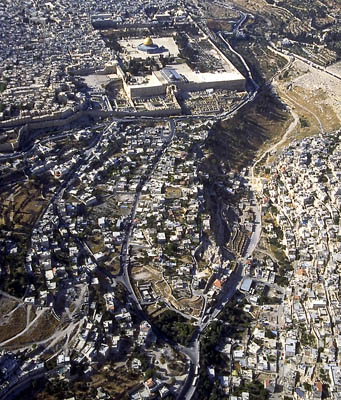
Aerial View of Jerusalem - Temple Mount and City of David. Photo belongs to Ferrell Jenkins.

HT: Paleojudaica; Todd Bolen; Chris Heard

“An amazing experience”

An Associated Press report by Anne Gearan is headlined “Bush Visits Biblical Holy Sites.” You may read the entire article here. The article says,

Bush retraced the steps of Jesus and his disciples in the ancient town of Capernaum and gazed out on the nearby Sea of Galilee, where the Bible says Jesus walked on water and calmed a sudden storm by commanding the wind and waves to cease. The waters were crystal blue and calm when Bush visited, leaning in to listen as a brown-robed friar narrated his tour with New Testament passages.

“An amazing experience,” Bush happily said later.

It is an amazing experience for anyone with an interest in the Bible and Jesus. Bush is reported to have said, “I came as a pilgrim.” Many people make pilgrimages to worship at a particular holy site. There is, perhaps, a higher purpose for visiting these sites. On our tours we seek to demonstrate the accuracy of the Bible in describing the Bible land. This involves learning about the geography and topography of the land that help one to better understand the important events that transpired there.

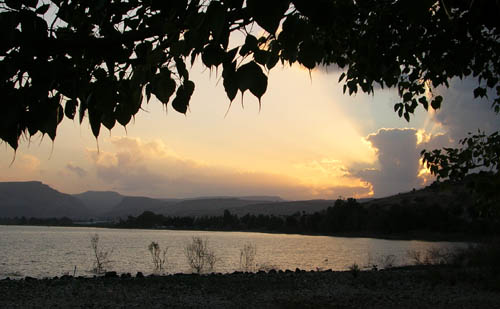
Sunset at Dalmanutha (Mark 8:10) at the northwest corner of the Sea of Galilee. Photo by Ferrell Jenkins.

Sunset at Dalmanutha

The photo above was made at sunset from the site known as Dalmanutha, near the Mount of Beatitudes. Dalmanutha is mentioned only once in the New Testament. After the feeding of the 4000, Mark records that Jesus immediately “entered the boat with His disciples and came to the district of Dalmanutha” (Mark 8:10). In the distance, on the left, you can see the silhouette of Mount Arbel. Then, just to the right of that is the Via Maris (the way to the Mediterranean Sea) from Galilee. The saddle-shaped hill is an extinct volcano known as the Horns of Hattin.

It is “an amazing experience” to visit this land and contemplate these great events.

Bethlehem and the birth of Jesus

The media is giving its usual Christmas Eve attention to Bethlehem today. The New Testament teaches that Jesus was born in Bethlehem of Judea in the days of Herod the king (Matthew 2:1). The month, day, and year of the birth of Jesus is not stated in the New Testament. We do have some historical information that helps with the date, but not precise information is available (Luke 2).
Do we know the place of the birth of Jesus in Bethlehem? About A.D. 160 Justin Martyr said, “when the child was born in Bethlehem, since Joseph could not find a lodging in that village, he took up his quarters in a certain cave near the village” (Dialogue With Trypho, 78). Near the middle of the third century Origen said that the cave where Jesus was born was being shown and that even the enemies of the faith were talking of it. Jerome was a resident of Bethlehem from A.D. 386 until his death in A.D. 420. He tells how the birthplace of Jesus, the place of the crucifixion and the tomb where Jesus had lain were defiled from the time of Hadrian to the reign of Constantine. The Church of the Nativity now stands at this spot. Of this location, Dalman says:

No one could discern in this former rocky chamber the place of the Nativity. The altar at the east end was perhaps not erected originally to designate the exact spot, although the background of the grotto would make it probable. Here also is the only remarkable feature in it, namely a small adjoining room which contains in the right wall a low niche resembling a manger (Sacred Sites and Ways, 38).

Typical of so many, this site has enjoyed its share of fanciful speculations. Tradition locates the spot where the adoration of the Magi took place and a projection in the background is taken to be the table at which the Virgin ate with the Magi. Like so much speculation, these overlook the fact that the gospel account represents the Magi as arriving at some time after the birth of Jesus and that they found the child with Mary in a “house.” The Wise Men may have had a fast means of transportation, but one should not forget that they traveled by plain, not plane; they came not from the east side of town, but from the East.
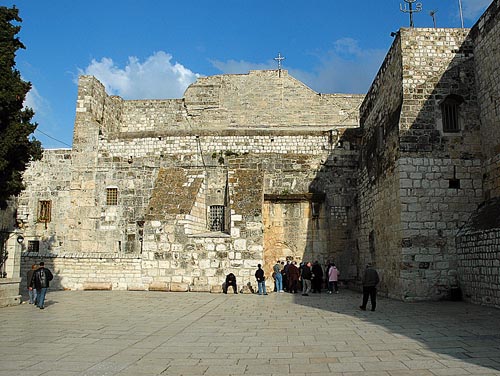
This photo shows the exterior of the Church of Nativity in Bethlehem.

Bethlehem - The Church of Nativity

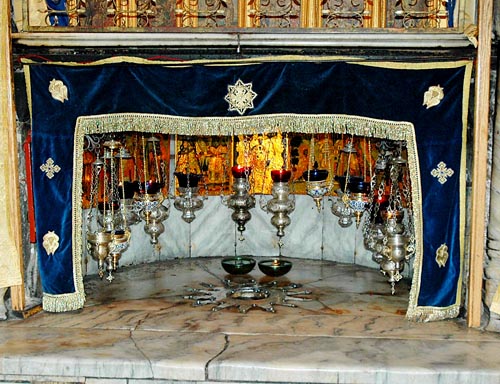
The Church of the Nativity has a long history. It is now a Greek Orthodox church. Underneath the altar is the Grotto of the Nativity where it is said that Jesus was born. Maybe, maybe not. A silver star was set in the marble pavement in 1717. The Latin inscription, “HIC DE VIRGINE MARIA JESUS CHRISTUS NATUS EST.” The translation: “Here Jesus Christ was born of the Virgin Mary.”

Bethlehem - The Church of Nativity - Star in the Grotto of the Nativity

Among the confusion of the date of the birth of Jesus, and the lack of New Testament authority for a church celebration on a certain day, let us not forget that the eternal Word became flesh, and dwelt among men in order to bring salvation to those who obey Him through his death upon the cross (John 1:1, 14; Luke 19:10).

“Although he was a son, he learned obedience through what he suffered. And being made perfect, he became the source of eternal salvation to all who obey him.” – Hebrews 5:8-9, ESV