Category Archives: Greece

The museum at Hierapolis

There is a small, but nice, museum at Pamukkale (ancient Hierapolis, Colosians 4:13). It is housed in a second century Roman bath house. The exhibits indicate a large Roman presence in the area during the second and third century A.D.

The museum has the nicest statue of the “god” Hades that I have seen.
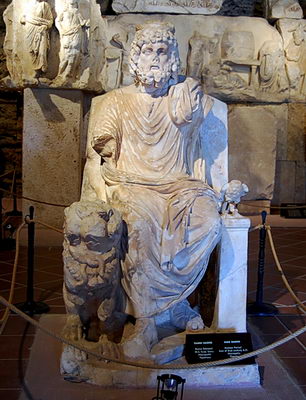
The god Hades in the Pamukkale Museum. Photo by Ferrell Jenkins.

The god Hades in the Pamukkale Museum. Photo by Ferrell Jenkins.

Hades was known in Greek mythology as the lord of death and the god of the underworld or nether world. The term hades is used in the New Testament of the abode of the souls of the wicked prior to the judgment. Note the comments by William Hendriksen.

As to the word “hell,” which here in the original is Gehenna (and so also in [Matthew] 5:22, 29, 30; 18:9; 23;15, 33; Mark 9:43-47; Luke 12:5; James 3:6), it generally refers to the abode of the wicked, body and soul, after the judgment day. When the same abode is called Hades the references is to the time before the judgment day, though Hades also has other meanings in Scripture. (New Testament Commentary: Exposition of the Gospel According to Matthew 472).

The Book of Revelation makes it clear that Jesus has control over both Death and Hades.

When I saw Him, I fell at His feet like a dead man. And He placed His right hand on me, saying, “Do not be afraid; I am the first and the last,  and the living One; and I was dead, and behold, I am alive forevermore, and I have the keys of death and of Hades. (Revelation 1:17-18 NAU; see also 6:8; 20:13, 14)
Thanks for following our tours

Thanks to your interest we noticed an increase in readers during our trip to Egypt. We appreciate your interest in the subjects we write about.

A blog is different from a web page. On a web page, such as the Biblical Studies Info Page, there are many categories and pages available. When you check the blog you see the last entry at the top of the page. You must click on the Archives listing, or use the Search Box to locate earlier posts.

A list of some other trips we have covered on this blog might be helpful to you (from the most recent to the earliest).

  • Egyptian Adventure (begin January 16, 2009).
  • Israel (personal study) trip (begin August 20, 2008).
  • Steps of Paul and John (Greece and Turkey) (May, 2008).
  • Bible Land Tour of Israel and Jordan (April, 2008).
  • Scotland Highlights (September 2007).
  • Biblical & Historical Sites in Turkey (May and June, 2007).

The purpose of these trips is educational. We seek to relate the history and the land to the biblical account.

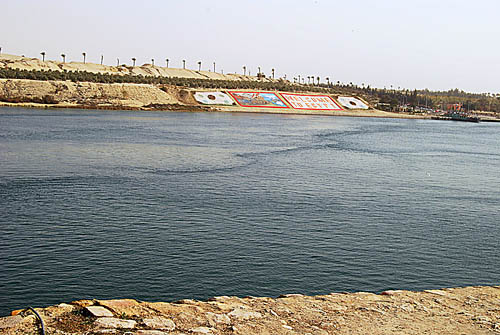
Suez Canal near Ismailia. Photo by Ferrell Jenkins.

Suez Canal near Ismailia. Photo by Ferrell Jenkins.

This view of the Suez Canal at Ismailia looks from the east to the west. The ancient Egyptians dug numerous canals in the general area. This modern canal was officially opened November 17, 1869.

We would like for you to continue to check the blog several times a week as we write about other matters of interest to Bible students.

China Olympics opening is spectacular

I suspect that everyone reading this post saw either the opening ceremony of the Beijing 2008 Olympics or at least a few news clips about it. The Olympics originated with the Greeks centuries before Christ. The Isthmian games were conducted at Isthmia, a few miles from Corinth.

Paul used several illustrations relating to athletics in the epistles to the Corinthians.

Do you not know that those who run in a race all run, but only one receives the prize? Run in such a way that you may win. Everyone who competes in the games exercises self-control in all things. They then do it to receive a perishable wreath, but we an imperishable. Therefore I run in such a way, as not without aim; I box in such a way, as not beating the air;  but I discipline my body and make it my slave, so that, after I have preached to others, I myself will not be disqualified. (1 Corinthians 9:24-27 NASB)

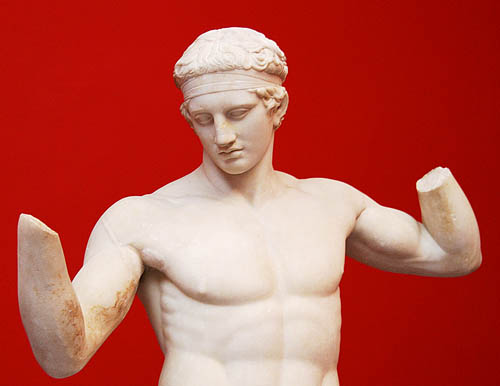
The Greeks had two words for crown. The diadema was the crown of the king. The stephanos was the crown of the victor in the races. This is the term used by Paul in the text above (the word wreath). Here is a photo of a nice sculpture displayed in the Athens National Archaeological Museum showing a young athlete wearing the stephanos. Incidentally, the stephanos was often made of olive branches, or other perishable items.

Young athlete wearing a crown (stephanos). Athens National Archaeological Museum. Photo by Ferrell Jenkins.

Young athlete wearing a crown (stephanos). Athens National Archaeological Museum. Photo by Ferrell Jenkins.

John also speaks of the stephanos. To the saints at Smyrna (modern Izmir in Turkey) he says,

Be faithful until death, and I will give you the crown of life. (Revelation 2:10).

Enjoy the Olympics, but think of the more important spiritual lessons.

Assos temple to be restored

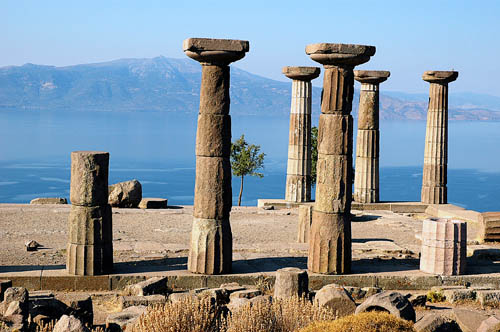
The current issue of Artifax reports that the temple of Athena at Assos in northwestern Turkey is to be restored. The temple was built originally about 540-530 BC. The project is expected to take about three years. Many pieces of the temple are scattered in museums (Istanbul Archaeological Museum, Louvre, Boston Museum of Fine Arts). The temple is built on a high cliff overlooking the sea. Here is the way the temple looks now.

The apostle Paul undoubtedly saw the temple of Apollo when he traveled the approximate 20 miles from Alexandria Troas to Assos by land. His companions had traveled by boat from Troas to Assos. The historical account reads this way:

But going ahead to the ship, we set sail for Assos, intending to take Paul aboard there, for so he had arranged, intending himself to go by land. And when he met us at Assos, we took him on board and went to Mitylene. (Acts 20:13-14 ESV)

The island across the strait is Lesbos. Further south is the town of Mitylene on Lesbos. Lesbos is now a Greek island in the Aegean.

From the mountains of Ararat to the island called Patmos

Or, from Genesis to Revelation. I did not make an intentional plan to do so, but within the past twelve months I have visited areas of the Bible world, from the mountains of Ararat to the island of Patmos. What a blessing to have the opportunity to spend about four weeks in Turkey, covering most of the sites mentioned in the Bible, about 10 days in Greece, more than a week in Israel, and a week in Jordan.

This means that I have been able to visit some of the most significant portions of the Bible world. Better than visiting the area alone, I have been able to share the area with other teachers (both men and women) who will be incorporating this information into their lessons for years to come.

When I first reflected on the past year and realized that I had been to Mount Ararat, in the mountains of Ararat, and on the Island of Patmos, I realized that this covers from Genesis 6 to the book of Revelation. Of course, this doesn’t mean that I have visited every place in between, but it does give a sense of comprehensive overview.

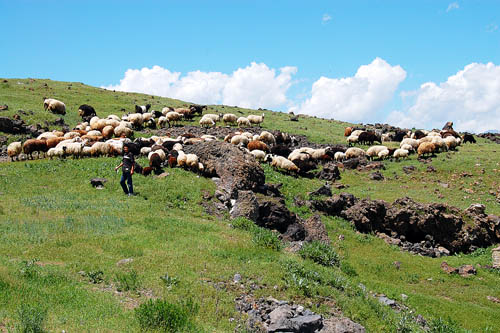
Here are a couple of photos I trust you will find helpful. The first is of a shepherd with his sheep in the mountains of Ararat. Remember that the book of Genesis records that Noah’s ark rested “upon the mountains of Ararat” (Genesis 8:4).

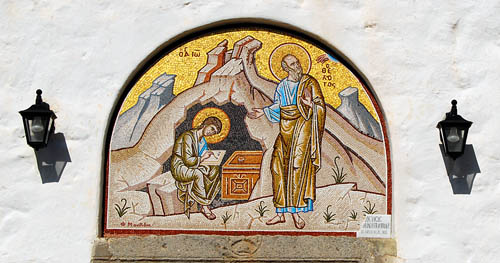
This photo was made at the entry to the cave of the Apocalypse on “the island called Patmos” (Revelation 1:9). John was exiled here during the reign of the Roman emperor Domitian. Whether the book of Revelation was written on Patmos, or after John’s release, we can not say with certainty. The mosaic over the entry to the cave shows John dictating the revelation given to him by the Lord.

It is my conviction that Bible land travel can enhance one’s Bible study and improve one’s understanding of the text. This, in turn, needs to be converted to action in obedience to the will of the Lord, and in service to Him.

Thessalonica in Macedonia

The Capsis hotel in Thessalonica was our home for two nights. Wednesday we used our time visiting the city. Thessalonica (called Thessaloniki now) is in biblical Macedonia. The area is still known as Macedonia, but is not to be confused by the modern country by that name. It is marked on maps of Greece as FYROM (former Yugoslav Republic of Macedonia). I know too little about the dispute to make any comments.

Paul came to Thessalonica on his second journey (A.D. 50-53; Acts 17). He wrote two letters to the church at Thessalonica while he was at Corinth. Aristarchus, a Macedonian of Thessalonica accompanied Paul on the voyage to Rome (Acts 27:2). When Demas forsook Paul he went to Thessalonica (2 Timothy 4:10).

I went to the Archaeological Museum of Thessalonica thinking I would jump in, make a few shots of some items I had need of and then move along. In fact, I found a new (since my last visit in 2001) museum with wonderful educational exhibits, nice displays, and great lighting.

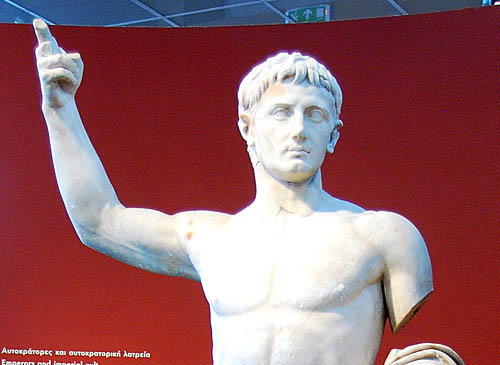
There is an impressive full-length statue of the Emperor Augustus (30 B.C. to A.D. 14). Augustus was emperor at the time of the birth of Jesus (Luke 2:1). Here is a photo of the top portion of the statue. This gives some indication of the wonderful lighting in the museum. This photo was made without flash.

On the display around the statue of the emperor there is a statement about the cult of the emperor. In our travels in Asia Minor (western Turkey) we saw many evidences that the admiration of the emperor grew into worship of the emperor as a divine being. This placed a real burden on the Christians of the time. It is this type of tribulation that the book of Revelation addresses.

The cult of the emperor was both an instrument of imperial policy progaganda and a means for the transmission of Roman culture. The image of the emperor gives a concrete form to the abstract idea of the Empire. Whether a full-lenth statue [as this one] of a bust, it makes his presence felt everywhere; in outoor and indoor spaces, in fora, in villas, and in libraries.

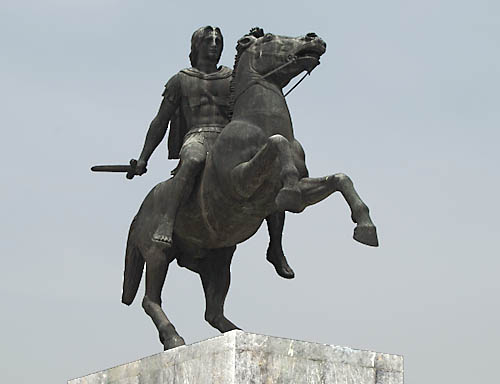
Elizabeth and I walked down by the harbor to see the colossal statue of Alexander the Great on his horse, ready to go into battle with sword drawn. We must put Alexander of Macedon among the most influential people of world history. His conquest of the areas we know as the Bible world continue to influence us till this day. He left his mark with the introduction of the oikumene concept of one world and the introduction of Greek culture and language. The Hebrew scriptures were translated into Greek in Alexandria beginning about 280 B.C. The New Testament was written in Greek. Even Paul, the Hebrew of Hebrews (Philippians 3:5), could speak Greek (Acts 21:37).

We visited the Arch of Galerius on the modern Via Egnatia, one of the main streets of Thessalonca. I made a few photos in the Roman agora before we rushed to get our bags packed to fly back to Athens.

By the time we arrived at our hotel, near the airport we had both decided that we were too tired to try to go to Delphi today. From our hotel room we are enjoying the beautiful view of a small town surrounded by mountains draped by blue sky with white clouds.

Paul’s journey in Macedonia

During his second journey, while at Troas, Paul saw a vision of a man of Macedonia. Luke gives the following record of the vision and of the subsequent action of the apostle.

A vision appeared to Paul in the night: a man of Macedonia was standing and appealing to him, and saying, “Come over to Macedonia and help us.” When he had seen the vision, immediately we sought to go into Macedonia, concluding that God had called us to preach the gospel to them. (Acts 16:9-10)

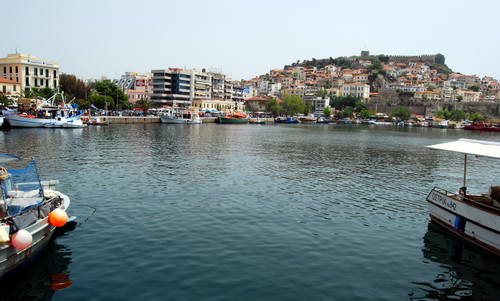
Paul and his companions, including Luke, landed at Neapolis (modern Kavalla). The text indicates that the real goal of their mission was to reach the Roman colony of Philippi. Someone has commented that it is often the case that preachers have a call from a man to come preach somewhere. When they arrive they find mostly women. Paul found Lydia of Thyatira. She was a seller of purple. Whether the cloth or the dye, we are not told. She was the first convert on European soil. We make much of the fact that this was the first preaching in Europe. At the time the most important thing is that it was the first preaching in the Roman province of Macedonia (now northern Greece). Here is a photo of the modern port at Kavalla.

Luke’s account of the first convert in the city is recorded in Acts 16.

And on the Sabbath day we went outside the gate to a riverside, where we were supposing that there would be a place of prayer; and we sat down and began speaking to the women who had assembled. A woman named Lydia, from the city of Thyatira, a seller of purple fabrics, a worshiper of God, was listening; and the Lord opened her heart to respond to the things spoken by Paul. And when she and her household had been baptized, she urged us, saying, “If you have judged me to be faithful to the Lord, come into my house and stay.” And she prevailed upon us. (Acts 16:13-15)

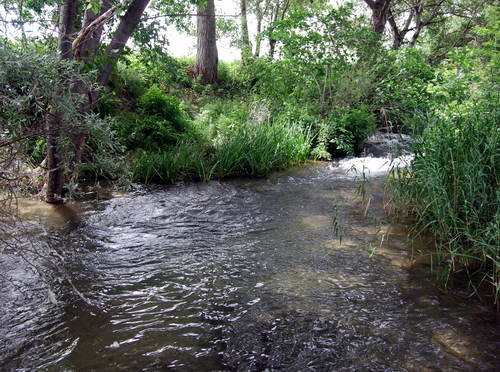
The river Ganga (some say Gangites) is a short distance north of the Agora of Philippi (IDB, III.787). This must be the river under consideration in the biblical account. Here is a photo of the river that I made yesterday.

We also visited Neapolis (modern Kavalla), Amphipolis and Appollonia.

Now when they had traveled through Amphipolis and Apollonia, they came to Thessalonica, where there was a synagogue of the Jews. (Acts 17:1)

Today we plan to visit some important sites in Thessalonica.

Group back in the USA

Early yesterday our group left for home. We have received several Emails from tour members saying that they have arrived home safely. For this we are thankful.

Elizabeth and I are spending a few days in northern Greece (biblical Macedonia). Yesterday we visited Berea (Acts 17) and Dion. Dion is in the shadow of Mount Olympus and is suggested by some as the place where the brethren from Berea took Paul down to the sea so he could continue on to Athens.

Today we plan to visit Neapolis, Philippi, et al. (Acts 16). We are staying in Thessalonica. Photos later.

Corinth, where Paul stood before Gallio

Corinth is one of my favorite places to visit. I think that is because it plays such a prominent role in the New Testament story. Paul first came to Corinth on his second journey, after visiting Philippi, Thessalonica, and Berea in Macedonia (now northern Greece), and Athens in Achaia. Another reason I enjoy going here is becaue we know the names of so many people associated with the city: Chloe, Aquila, Priscilla, Crispus, Gaius, Apollos, Stephanos, Erastus, et al.

Luke’s historical account is recorded in Acts 18. Paul met Aquila and Priscilla, natives of Pontus, who had been expelled from Rome because of a decree by the Emperor Claudius. There was success in the work at Corinth as individuals heard the gospel of Christ and were baptized.

But there was also opposition. Soon, the Jews brought charges against Paul and had him brought before the proconsul Gallio.

But while Gallio was proconsul of Achaia, the Jews with one accord rose up against Paul and brought him before the judgment seat, saying, “This man persuades men to worship God contrary to the law.” But when Paul was about to open his mouth, Gallio said to the Jews, “If it were a matter of wrong or of vicious crime, O Jews, it would be reasonable for me to put up with you; but if there are questions about words and names and your own law, look after it yourselves; I am unwilling to be a judge of these matters.” And he drove them away from the judgment seat. (Acts 18:12-16)

The Gallio inscription, now exhibited in the museum at Delphi, provides the date for the time when Gallio was proconsul. This, in turn, helps us build a chronology for Paul’s ministry. Based on this information we generally think of Paul entering Corinth in the fall of A.D. 51, and leaving in the spring of A.D. 53.

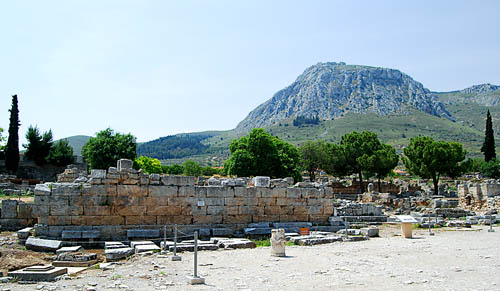
Our photo shows the “judgment seat” (Greek, bema) in the agora (marketplace) at Corinth. The Acrocorinth is the mountain in the background. The Temple of Aphrodite stood on the Acrocorinth in New Testament times.

Earlier I have written two posts on dealing with Corinth. Check here for Did the apostle Paul attend the Isthmian Games?, and here for The Corinth Canal. We visited both sites yesterday.

Santorini and the Minoan Civilization

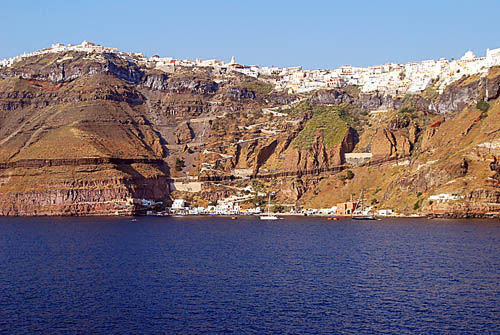
Last Thursday we visited Santorini on the way from Crete to Athens. Ships anchor (not dock) at Santorini while tender boats ferry the passengers back and forth to the island city built on the half-moon rim of the crater. Some writers hold that Santorini is the ancient island of Atlantis. Santorini is not mentioned in the Bible, but several writers have tried to connect it to biblical events. It has been suggested that one of the several volcanic eruptions at Santorini is to be connected with the drying up of the Red Sea when the Israelites crossed. This is highly speculative, and there are chronological difficulties.

Items from Akrotiri, Santorini, a city covered by volcanic ash about 1600 B.C. are part of the collection of the National Archaeology Museum in Athens. It is good to see these things in Athens because the ruins at Akrotiri are closed for reconstruction. These artifacts from Akrotiri provide a good look at the Minoan civilization.

This photo was made from our ship which was anchored in the crater. The city is built along the rim of the crater. We are able to look into the heart of the volcano.