Category Archives: Culture

Max McLean in C. S. Lewis The Screwtape Letters

During World War II when Great Britain was dealing with the threat of extinction,  C. S. Lewis wrote The Screwtape Letters. These letters of unknown provenance are from the senior devil Screwtape to a junior tempter named Wormwood.

Saturday afternoon I saw actor Max McLean in a Broadway-type production, C. S. Lewis The Screwtape Letters. The production begins with Screwtape giving the graduation address at the Tempters’ Training College for Young Devils. After that, everything else takes place in Screwtape’s Office in Hell.

C. S. Lewis The Screwtape Letters

Screwtape writes a series of letters to his nephew Wormwood to help him in working with one of his “patients” – a young Christian man on earth. Wormwood is supposed to keep the patient distracted from serving the Enemy (God), and to deliver him to “our Father below” (the Devil).

In addition to McLean’s superb acting, Toadpipe is a delightful addition to the stage production. She is Screwtape’s secretary in his office in Hell.
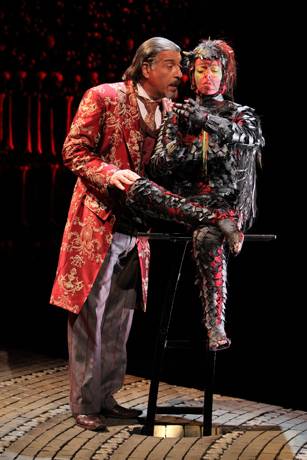
Max McLean as Screwtape and his secretary Toadpipe.

Max McLean as Screwtape and his secretary Toadpipe in The Screwtape Letters.

If you have never read The Screwtape Letters, you should do so. The book is available from Amazon in both print and Ebook.

This little except from Letter XII shows us how easily it is for the Devil to distract one from genuine service to the Enemy (God).

You will say that these are very small sins; and doubtless, like all young tempters, you are anxious to be able to report spectacular wickedness. But do remember, the only thing that matters is the extent to which you separate the man from the Enemy. It does not matter how small the sins are provided that their cumulative effect is to edge the man away from the Light and out into the Nothing. Murder is no better than cards if cards can do the trick. Indeed the safest road to Hell is the gradual one—the gentle slope, soft underfoot, without sudden turnings, without milestones, without signposts.

C. S. Lewis The Screwtape Letters is scheduled for several other cities. Take a look at the ScrewtapeOnStage.com for details.

If you are interested in C. S. Lewis, take a look at this photo essay about Lewis here.

Two references from Paul’s second letter to the church at Corinth are appropriate here.

And no wonder, for even Satan disguises himself as an angel of light. (2 Corinthians 11:14 ESV)

so that we would not be outwitted by Satan; for we are not ignorant of his designs. (2 Corinthians 2:11 ESV)

Ponies and Sea Horses

Barely settling in at home after weeks of travel we are engrossed in the beginning of a week of birthday activities for our grandson. His other grandparents are in town. We always enjoy visiting with them, going to two Pony League baseball games, making a special visit or two, and eating together. Last year our special visit was a visit to see Winter, the famous tailless dolphin. This year we visited the Florida Aquarium in Tampa, Florida.

The Leafy Dragon is one of the most unusual sea creatures we saw at the Aquarium.

Leafy Dragon at the Florida Aquarium, Tampa, FL. Photo by Ferrell Jenkins.

Leafy Dragon at the Florida Aquarium, Tampa, FL. Photo by Ferrell Jenkins.

The posted information at the Florida Aquarium says,

In the cool waters off the coast of south Australia, forests of kelp hide rare sea dragons. They move through the waving fronds of seaweed with stately grace, festooned with their own leafy camouflage.

Despite their fabulous foliage, leafy sea dragons are fish, relatives of seahorses and pipe fish. Like their kin, dragons have tube-like mouths and a gender-bending approach to reproduction.

In one of those baseball games our little guy hit his first home run and received the game ball. He is having a great birthday celebration and we are pleased to share it.

“You could feel the wheels turning”

Obituaries for Frank Moore Cross (1921–2012) are beginning to appear in various sources. William Yardley writes in The New York Times about Cross:

Dr. Cross studied culture, religion and politics of the period in which the Hebrew Bible, or Old Testament, was written and revised, and he traced the ways different nations and cultures had translated its early texts. He also traced the evolution of ancient script and developed expertise in dating documents by the slightest shifts in writing style.

“That we know that a particular scroll comes from 100 B.C. and not 50 A.D. is almost entirely due to the study of the scripts and their development that he worked out,” Mr. Machinist said. “That may seem like a trivial point, but if you don’t have a sense of when these texts are dated, you have no sense of their historical importance.”

Once, several colleagues said, after carbon dating confirmed dates that he had established through script analysis, Dr. Cross joked that he was happy to hear that his script studies had validated the practice of carbon dating.

The article mentions the study habits of Dr. Cross.

Dr. Cross often sequestered himself in his study at home until late into the night.

“He was very intense, and we would just kind of tiptoe by the study,” Ms. Gindele [one of his daughters] recalled. “My mother liked to say you could feel the wheels turning and not to bother him.”

The full article may be read here.

Hershel Shanks, editor of Biblical Archaeology Review, writes here about the life and influence of Cross under the title, “The End of an Era.”

Jim Davila, who wrote a dissertation under Cross, offers some interesting reminiscences here.

HT: Jack Sasson and Joseph Lauer

New discoveries at Paphos, Cyprus

The Cyprus Mail reports the results of archaeological work in the agora at ancient Paphos, Cyprus, by the Institute of Archaeology of the Jagiellonian University, Kraków, Poland.

One of the significant discoveries during the August/September excavations was a small tablet with the name of an official on it in the Greek language. According to the article, the Greek inscription reads,

Seleukos, son of Agoranomos (market administrator) Ioulios Bathylos.

Architectural remains from the Roman period were also uncovered in the same area as the Greek inscription.

The short article maybe read here.

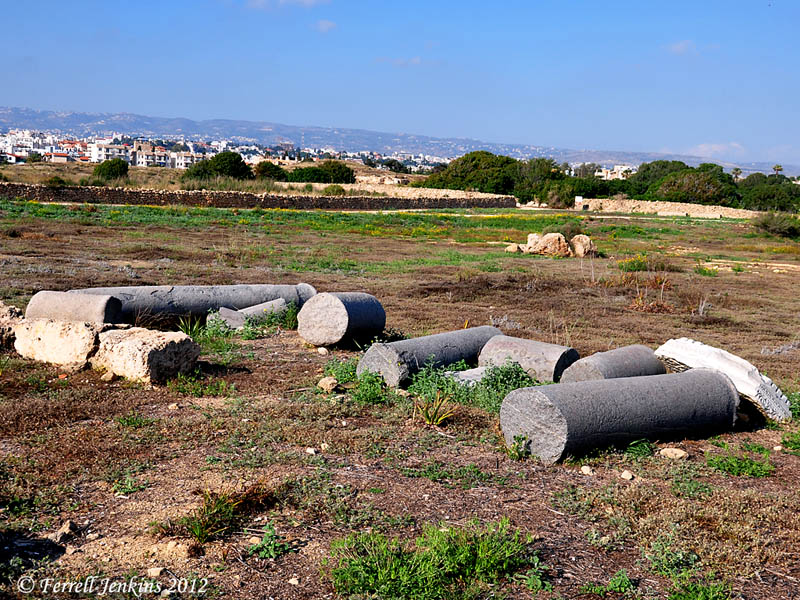
The photo below shows a few fallen columns in the mostly unexcavated agora in mid-May, 2012.

Ancient agora at Paphos, Cyprus. Photo by Ferrell Jenkins.

Ancient agora at Paphos, Cyprus. Photo by Ferrell Jenkins.

Barnabas, Saul, and John Mark arrived at Paphos after crossing the length of the island of Cyprus on the first missionary journey. It was here that Saul’s name was changed to Paul.

 6 When they had gone through the whole island as far as Paphos, they came upon a certain magician, a Jewish false prophet named Bar-Jesus.
7 He was with the proconsul, Sergius Paulus, a man of intelligence, who summoned Barnabas and Saul and sought to hear the word of God.
8 But Elymas the magician (for that is the meaning of his name) opposed them, seeking to turn the proconsul away from the faith.
9 But Saul, who was also called Paul, filled with the Holy Spirit, looked intently at him
10 and said, “You son of the devil, you enemy of all righteousness, full of all deceit and villainy, will you not stop making crooked the straight paths of the Lord?
11 And now, behold, the hand of the Lord is upon you, and you will be blind and unable to see the sun for a time.” Immediately mist and darkness fell upon him, and he went about seeking people to lead him by the hand.
12 Then the proconsul believed, when he saw what had occurred, for he was astonished at the teaching of the Lord. (Acts 13:6-12 ESV)

HT: Jack Sasson

Visiting the Lynn H. Wood Archaeological Museum

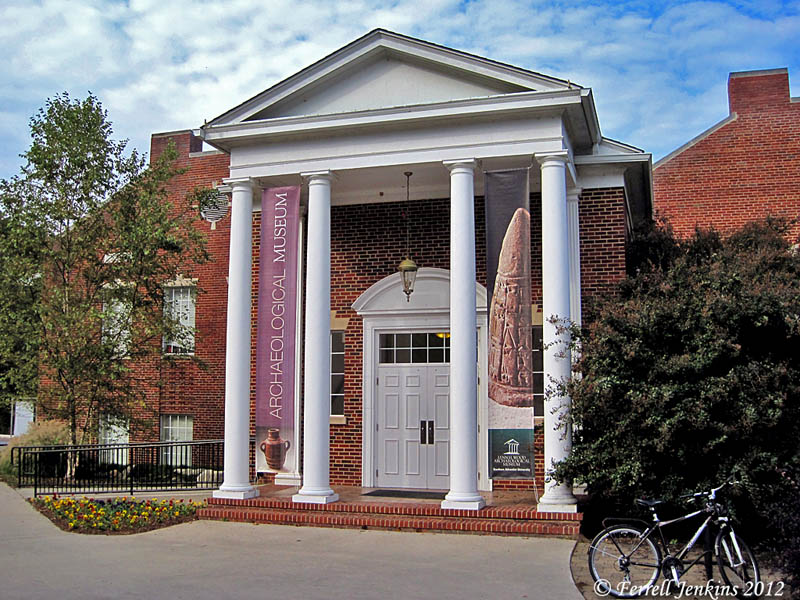
You might never expect to find an excellent archaeological museum nearly hidden in the woods of eastern Tennessee. But that is what you will find at the Lynn H. Wood Archaeological Museum on the campus of  Southern Adventist University in Collegedale, Tennessee.

When we arrived on campus we asked a student the location of the Museum. After walking up a long series of steps that some students were skipping up (ah, youth!), we asked two other students. Each of them offered to show us. And, neither had been to the Museum. Everyone on campus that we spoke with was friendly and helpful.

Inside Hackman Hall is housed a wonderful educational exhibit.

The Lynn H. Wood Archaeological Museum is located in this building.

The Lynn H. Wood Archaeological Museum is located in this building.

A few years ago William G. Dever gave his research library of nearly 3000 volumes and a large collection of archaeological artifacts to Southern. The artifacts are built into an award-winning exhibition under the title Vessels in Time: A Journey Into the Biblical World. Archaeology Professor Dr. Michael G. Hasel serves as curator of the Museum.

Iron Age IIA (1000-900 B.C.) Pottery in the Lynn H. Wood Museum.

Iron Age IIA (1000-900 B.C.) Pottery in the Lynn H. Wood Museum.

The exhibits follow a chronological order from the early days in Mesopotamia to New Testament times.  Each display has a good timeline which coordinates the archaeological periods with the Biblical record. The photo above shows some pottery from the Iron Age IIA (1000-900 B.C.). This is the period of the United Kingdom (or Monarchy). The bowl on the left has been slipped and shinned. The accompanying information explains that during this period vessels were sometimes dipped “into red watery clay” to create the colored slip. The bowl was then hand burnished with a stone like the one shown above it.

Three examples of dipper juglets from the period are shown:

  1. A Phoenician import.
  2. A simple local juglet.
  3. A black-slipped, burnished juglet.

There is a nice model of Solomon’s Temple in the same room.

If your travels take you anywhere near Chattanooga, Tennessee, I suggest you take time to drive a few miles east to Collegedale and visit the Lynn H. Wood Archaeological Museum.

Full information about the Museum including visiting hours may be found here.

Beauties and Perils of Travel in the Fall

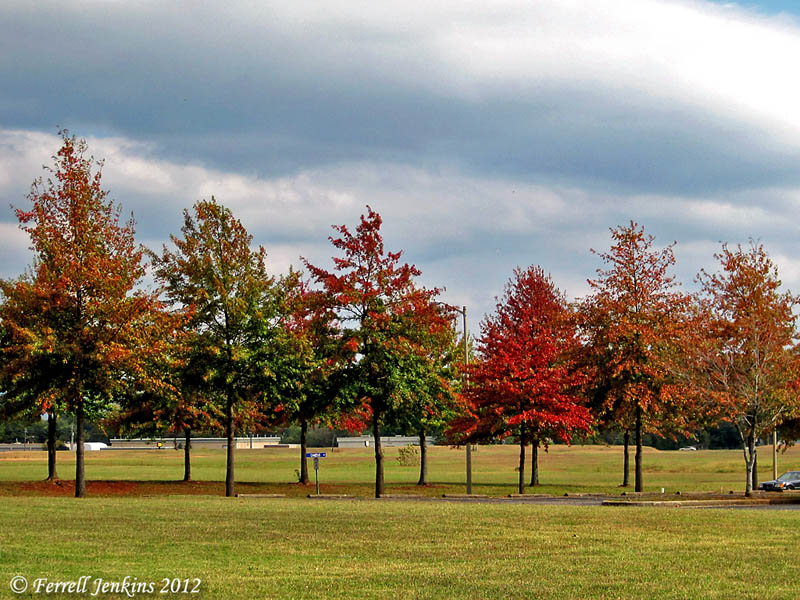
The leaves have only begun to change in North Alabama, but they are beautiful to a Florida transplant of more than four decades.

Fall Leaves in North Alabama. Photo by Ferrell Jenkins.

Fall Leaves in North Alabama. Photo by Ferrell Jenkins.

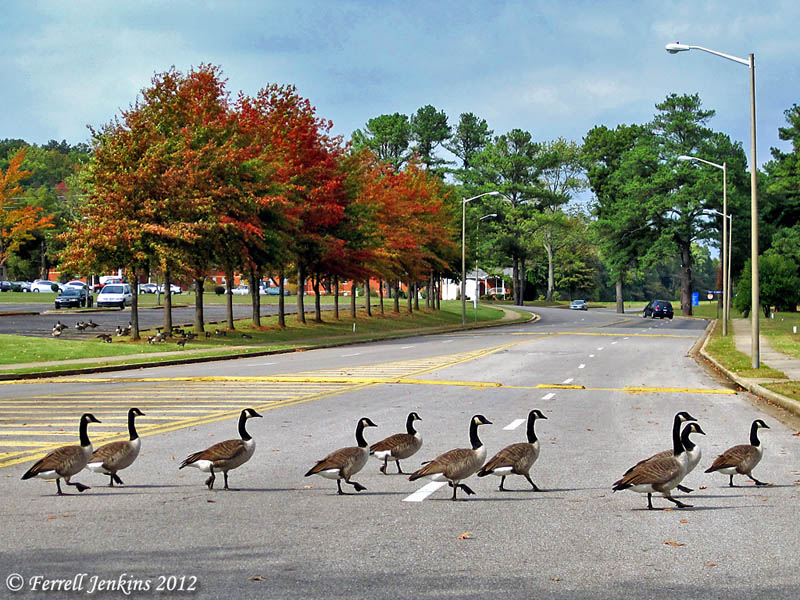
There are perils of driving at this time of the year. I am not a bird watcher, but I do watch for geese crossing the street. The best I can tell, from a few minutes on the Internet, these are Canadian Geese.

Geese in North Alabama. Photo by Ferrell Jenkins.

Geese in North Alabama. Photo by Ferrell Jenkins.

Fall of the year

During a break between two speaking engagements, we visited some of our family in Scottsville, Kentucky. Leaves were already showing some color, and the pleasant afternoon was perfect to visit the town square to see some of the decorations for the Fall Festival.

I was pleased to see some wholesome decorations, like this one from a local school emphasizing the fruit of the spirit (Galatians 5).

Fall Festival at Scottsville, Kentucky. Photo by Ferrell Jenkins.

Fall Festival at Scottsville, Kentucky. Photo by Ferrell Jenkins.

A few of the displays were definitely geared toward Halloween.

Fall Festival at Scottsville, Kentucky. Photo by Ferrell Jenkins.

Fall Festival at Scottsville, Kentucky. Photo by Ferrell Jenkins.

I trust you are enjoying a nice Fall of the year, wherever you may be.

6 year old palm from 2000 year old seed

A few date palm seed were uncovered by Professor Yigael Yadin during his excavation of Masada. Six years ago one of these seed was planted at the Arava Institute in Israel. The seed sprouted, and has grown into a nice little six year old palm.

Yishai Fleisher of EyeOnZionTV interviews Dr. Elaine Solowey at the Arava Institue about this seed and plant. In addition to the information about the palm, I especially like the way Dr. Solowey refuses to fall for some of the speculative journalistic questions.

The photo below shows one of the modern date palms on the southwestern shore of the Sea of Galilee.

Date Palm growing near the Sea of Galilee. Photo by Ferrell Jenkins.

Date Palm growing near the Sea of Galilee. Photo by Ferrell Jenkins.

Jericho is mentioned as “the city of palm trees” in Deuteronomy 34:3.

The righteous are compared to the palm tree.

The righteous flourish like the palm tree and grow like a cedar in Lebanon. (Psalm 92:12 ESV)

HT: Jack Sasson

“From the Land of Black Tents”

In his book The Apostle: A Life of Paul, noted biographer John Pollock begins his book with information about Paul’s background at Tarsus. He calls the first chapter, “From the Land of Black Tents.”

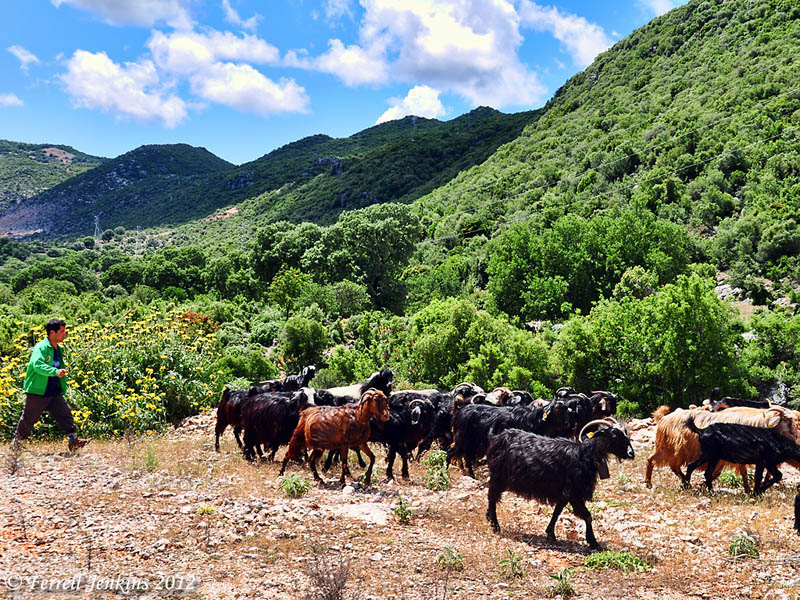
His father most likely was a master tentmaker, whose craftsmen worked in leather and in cilicium, a cloth woven from the hair of the large long-haired black goats that grazed (as they still do) on the slopes of the Taurus. The black tents of Tarsus were used by caravans, nomads, and armies all over Asia Minor and Syria.

We still see these herds of long-haired black goats in many parts of Turkey. The photo below was made east of Myra near the Mediterranean coast of Turkey.

Goats with long black hair, east of Myra, Turkey. Photo by Ferrell Jenkins.

Goats with long black hair east of Myra, Turkey. Photo by Ferrell Jenkins.

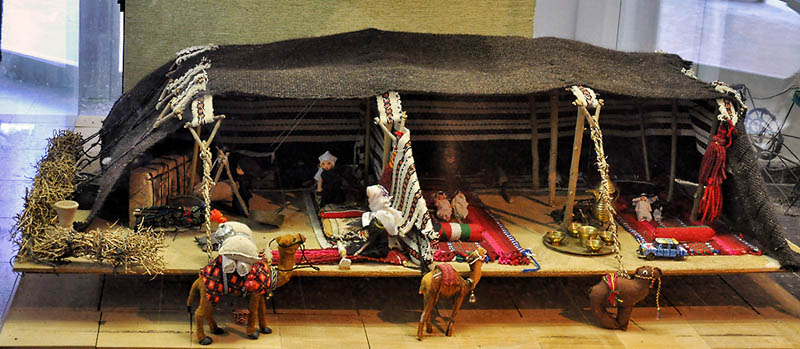
The Museum for Beduin Culture at Kibbutz Halav in the Negev of Israel displays a small model of a beduin (bedouin) tent. This museum intends to preserve the memory of the original bedouin life that is quickly being replaced by a permanent life and housing.

Bedouin Tent Model displayed at the Museum for Beduin Culture. Photo by Ferrell Jenkins.

Tent Model displayed at the Museum for Beduin Culture. Photo by Ferrell Jenkins.

Paul said,

But Paul said, “I am a Jew of Tarsus in Cilicia, a citizen of no insignificant city; and I beg you, allow me to speak to the people.” (Acts 21:39 NAU)

Acts 14 — Photo Illustrations

G. Walter Hansen comments on the religious life of Galatia and the importance of Zeus and Hermes to the people who lived there.

Zeus was the most widely worshipped god in Galatia; temples to Zeus were ubiquitous. Zeus was often linked with other gods. In the territory of Lystra there are carvings and inscriptions which show Zeus accompanied by Hermes. An inscription found near Lake Sugla is a dedication to Zeus of a sundial and a statue of Hermes. The names of the dedicators are Lycaonian. A stone altar near Lystra is dedicated to “the Hearer of Prayer [presumably Zeus] and Hermes.” A relief near Lystra depicts Hermes with the eagle of Zeus. In Lystra a stone carving shows Hermes with two other gods, G and Zeus. (Gill and Gempf, The Book of Acts in its First Century Setting, Vol. 2: Graeco-Roman Setting, 393)

This evidence, says Hansen, provides the setting for the events of Paul and Barnabas at Lystra. Luke describes the reaction of the Lystrans when they saw Paul heal a lame man.

When the crowds saw what Paul had done, they raised their voice, saying in the Lycaonian language, “The gods have become like men and have come down to us.”  And they began calling Barnabas, Zeus, and Paul, Hermes, because he was the chief speaker.  The priest of Zeus, whose temple was just outside the city, brought oxen and garlands to the gates, and wanted to offer sacrifice with the crowds.  (Acts 14:11-13 NAU)

Bruce reminds us that “Zeus was the chief god in the Greek pantheon; Hermes, the son of Zeus by Maia, was the herald of the gods” (The Book of the Acts, NICNT, 292).

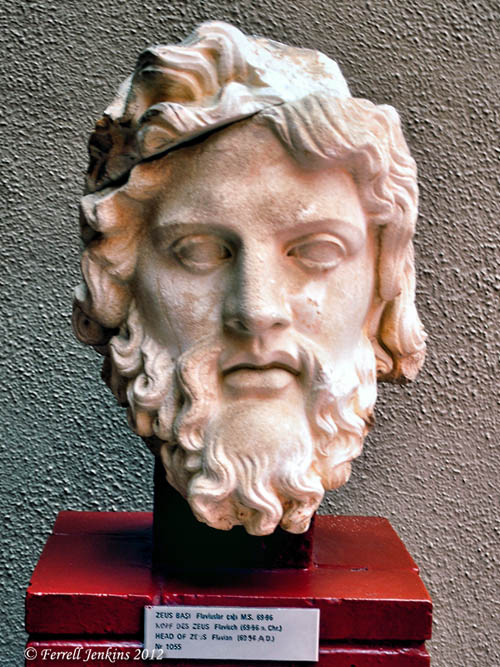
Our photo of Zeus is of a bust displayed in the archaeological museum at Ephesus.
Image

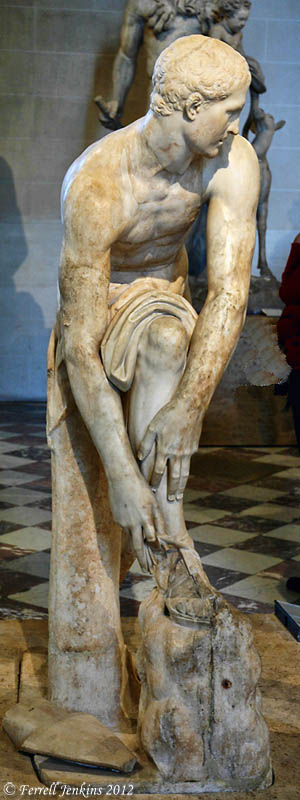
Paul was called Hermes because he was the chief speaker. Hermes was the messenger of the gods. How appropriate that our word hermeneutics, coming from the name Hermes, is used to describe the important work of interpreting the Scriptures. I have heard some speakers make fun of the word and then proceed to say that a certain phrase in the Scripture means … ! The photo below shows Hermes tying on his sandal in preparation for delivering a message. Some may recognize Hermes as the Latin Mercury, who is used as the symbol for the floral industry.

Image

The King James Version used the Latin terms Jupiter and Mercurius in Acts 14:12. Bruce says this is “due to an old and foolish fashion of replacing Greek proper names by their Latin equivalents in English translations from the Greek.”

This post is reprinted from December 1, 2011, with improved photos.