Category Archives: Culture

The new Satellite Bible Atlas

Todd Bolen announced Monday the publication of the Satellite Bible Atlas. This new work is by Bill Schlegel, Associate Professor of the Bible at IBEX in Israel. Bill has lived and taught in Israel since 1984. He taught at the Jerusalem University College (formerly the Institute of Holy Land Studies) before joining The Master’s College IBEX program in 1995.

According to Bolen,

This resource is ready for personal use, classroom use, and field trip use. The author, Bill Schlegel, has been teaching college and seminary students in Israel for 25 years. Everything in the Satellite Bible Atlas is field-tested by a professor who knows God’s land and loves God’s Word.

He continues to give 7 additional reasons why he loves the Satellite Bible Atlas. I will leave it for you to read more details at the Bible Places Blog here.

sba2000c-t

I have had the opportunity for several days to see the various materials associated with the Satellite Bible Atlas, but late Monday I received my beautiful copy and have found it to be an amazing production.

After 17 pages of beautiful satellite maps, the additional maps are printed on one page with a brief, numbered, commentary on the opposite page. For example, looking at map 5-1, Samuel’s Ministry, we see a marked map of the portion of the land where Samson was born, and the places of his activity. Map 9-4 shows Jesus’ Move from Nazareth to Capernaum. Map 10-1 shows Acts of the Apostles in Israel. While the emphasis is on the Promised Land and the history of Israel, Jesus and the Early Church, there are maps showing the Journeys of Paul, The First Revolt Against Rome (c. 66-73 AD), the Bar Kochva Revolt, Jerusalem, the modern Middle East, etc. Eighty-five maps in all.

This beautiful book is published in Israel. I am surprised that the book is available for $30 plus tax and $3 shipping (in the U.S.). You will also be granted access to download the maps.

More information and ordering instructions are available here. Sample Maps, Commentary, Study Questions, and an Index to Sites, are available for download. There are also some Teaching Videos, and more are expected from time to time.
“Every man under his vine” again

A few days ago I wrote here about a biblical way of describing a time of peace and prosperity.

And Judah and Israel lived in safety, from Dan even to Beersheba, every man under his vine and under his fig tree, all the days of Solomon. (1 Kings 4:25 ESV)

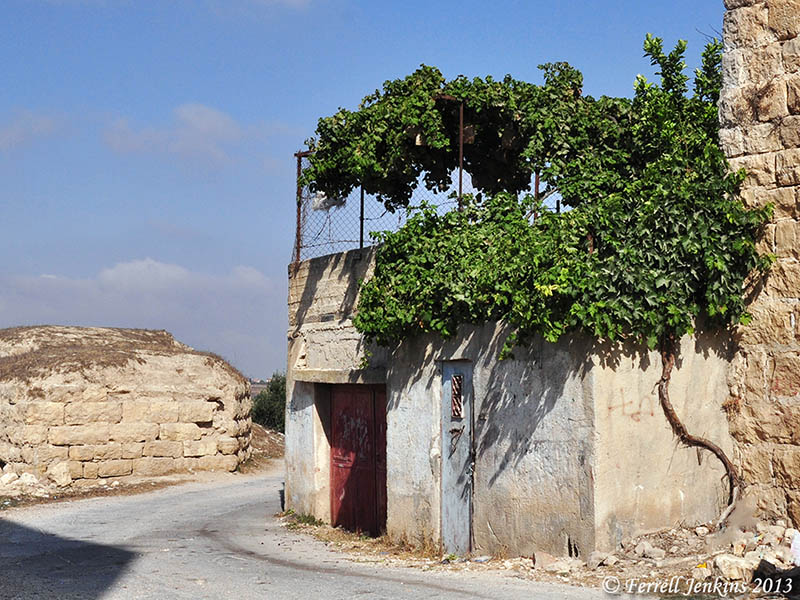
I mentioned that it is not uncommon in the Middle East to see a vine running up the side of a house to cover a porch on the roof. Since the last post I located one of my photos showing this practice. This photo was made at El Jib, the site believed to be Gibeon (Joshua 9; 2 Samuel 2).

A vine growing up the side of a house to provide shade on the roof. Photo by Ferrell Jenkins at Gibeon.

A vine growing up the side of a house to provide shade on the roof. Photo by Ferrell Jenkins at Gibeon (El Jib).

The Watchtower

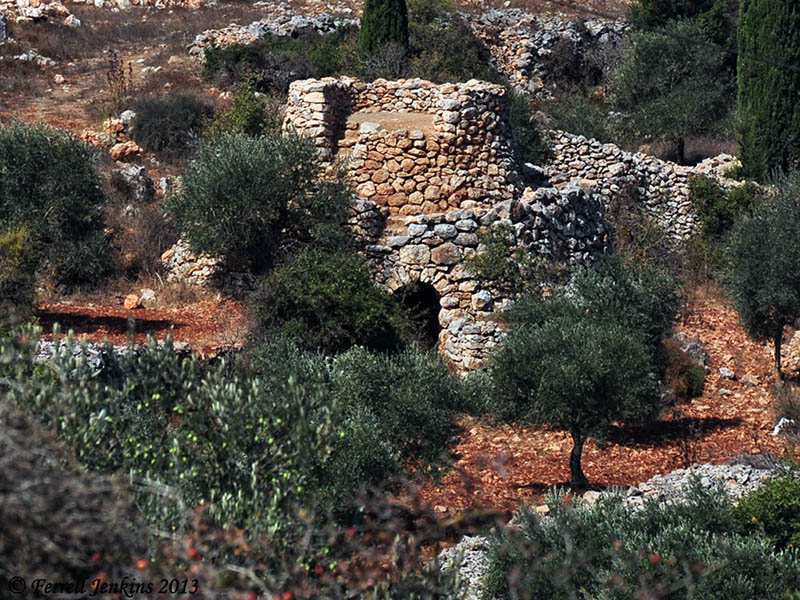
The watchtower was sometimes used as a lookout for the enemy (2 Chronicles 20:24; Isaiah 21:8; 32:14).

Watchtowers, or just towers, were also built in the fields. They might provide a place for a watchman to keep watch over the field (Isaiah 5:2; Matthew 21:33). Stones were picked up out of the fields to make the tower which also served as a place for workmen to go for shade in the heat of the day.

The only place we see watchtowers today is in the West Bank, and these are usually off the main roads. During the past few years I have photographed several of these old watchtowers. So far as I know they are no longer in use. I am sure that I have shown some watchtowers before, but I thought you might enjoy some of these new photos.

A watchtower in an olive orchard in the West Bank. Photo by Ferrell Jenkins.

A watchtower in an olive orchard in the West Bank. Photo by Ferrell Jenkins.

“Every man under his vine…”

A biblical way of describing a time of peace and prosperity is expressed in the following passage describing the time of King Solomon.

And Judah and Israel lived in safety, from Dan even to Beersheba, every man under his vine and under his fig tree, all the days of Solomon. (1 Kings 4:25 ESV)

It is not uncommon in the middle east to see vines used as a shade. Sometime the vine runs up the side of a house and covers a porch on the roof. When I saw this single vine by itself in front of the theater at Miletus I could not help but think of the biblical saying. I asked my traveling buddy, Leon Mauldin, to make a picture of me sitting under my vine.

I can imagine a person sitting under the vine in the late summer and enjoying the fresh grapes from the vine.

Miletus-theater_fj-vine_fjenkins072906_07t

Sitting under the vine at the theater of Miletus. Photo by Leon Mauldin.

Miletus is the city where the Apostle Paul met with the elders from the church at Ephesus as he returned to Jerusalem at the end of his third journey (Acts 20).

The prophet Micah used the same illustration to describe the nature of the Messiah’s kingdom.

It shall come to pass in the latter days that the mountain of the house of the LORD shall be established as the highest of the mountains, and it shall be lifted up above the hills; and peoples shall flow to it, 2 and many nations shall come, and say: “Come, let us go up to the mountain of the LORD, to the house of the God of Jacob, that he may teach us his ways and that we may walk in his paths.” For out of Zion shall go forth the law, and the word of the LORD from Jerusalem. 3 He shall judge between many peoples, and shall decide for strong nations far away; and they shall beat their swords into plowshares, and their spears into pruning hooks; nation shall not lift up sword against nation, neither shall they learn war anymore; 4 but they shall sit every man under his vine and under his fig tree, and no one shall make them afraid, for the mouth of the LORD of hosts has spoken. (Micah 4:1-4 ESV)

New biography of C. S. Lewis by Allister McGrath

Allister McGrath, a native of Belfast, Ireland, and currently a professor of theology and apologetics at Kings College, London, announces that his  biography of C. S. Lewis is to be published this year.

In this video, McGrath speaks about the biography from the study of C. S. Lewis at the Kilns.

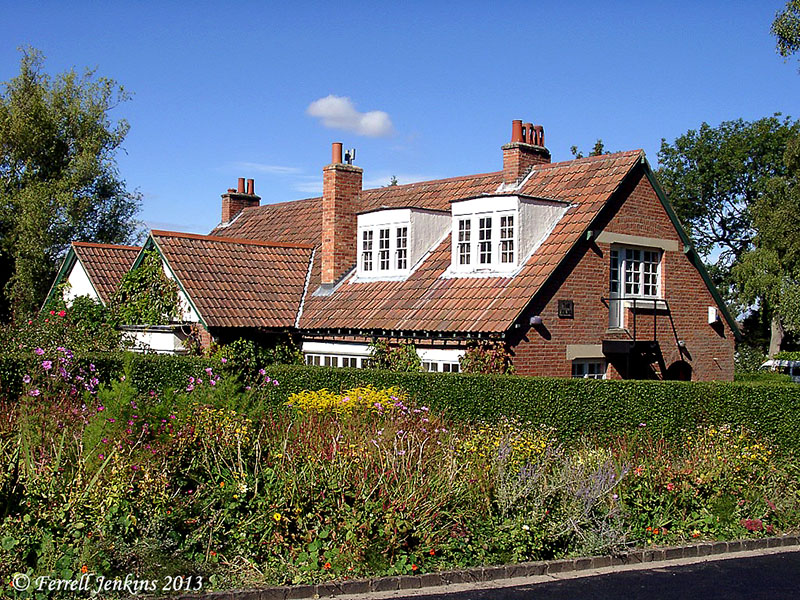
Several years ago I had the opportunity to visit Lewis sites in and around Oxford, England. The photo below shows the Kilns, former home of C. S. Lewis and his older brother Warnie. The house was not open for visitors at that time, but I understand it is now open at certain times.

The Kilns, Oxford, home of C. S. Lewis. Photo by Ferrell Jenkins.

The Kilns, former home of C. S. Lewis. Photo by Ferrell Jenkins.

If you have an interest in Lewis and his writing, you will probably enjoy looking at some of the other photos I made. Click here.

The significance of Gaza

After my first tour to the Bible Lands, including Rome, Greece (Athens and Corinth), Egypt, Lebanon, Syria (Damascus), Jordan, and Israel, in April/May, 1967, I decided to make a second tour the following year. For many years, I always added some new places on each tour. In 1968 I added Beersheba and Gaza. The Gaza Strip (named such because of the long, narrow size of the small entity) had been under Egyptian control for several decades until June, 1967.

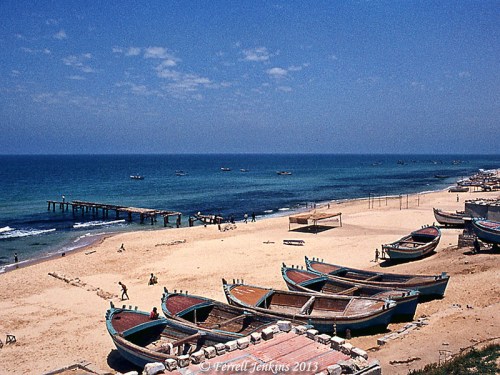
There was not much to see at Gaza. By the time we visited in 1968, Gaza was under Israeli control. We drove to the coast where there were only a few houses and some small fishing boats. This is one of the few slides that I have to illustrate the visit to Gaza.

Gaza on the Mediterranean Sea in May, 1968. Photo by Ferrell Jenkins.

Gaza on the Mediterranean Sea in May, 1968. Photo by Ferrell Jenkins.

Gaza is mentioned several times in the Old Testament. Here is a summary of these references.

  • Gaza was the southwestern boundary of the Canaanites in the table of Nations (Genesis 10:19).
  • The original inhabitants of Gaza were replaced by the Caphtorim, likely the ancestors of the Philistines (Deuteronomy 2:23).
  • Joshua defeated Canaanites “even as far as Gaza” (Joshua 10:41).
  • Joshua eliminated the Anakites except in Gaza, Gath, and Ashdod (Joshua 11:21-22). We recognized these cities as later belonging to the Philistines.
  • Gaza is listed as belonging to the tribe of Judah (Joshua 15:47; Judges 1:18).
  • The Midianites oppressed Israel, “as far as Gaza”, for seven years (Judges 6:4).
  • Samson had contact with the inhabitants of Gaza (Judges 16).
  • Gaza is listed as one of the five Philistine cities in the time of the Israelite Judges (1 Samuel 6:17).
  • Solomon controlled territory as far southwest as Gaza (1 Kings 4:24).
  • Hezekiah defeated the Philistines as far as Gaza and its territory (2 Kings 18:8).
  • Jeremiah makes reference to Gaza being conquered by Pharaoh (Jeremiah 47:1).
  • The prophets of Judah pronounced judgments upon Gaza (Amos 1:6-7; Zephaniah 2:4; Zechariah 9:5).

The only New Testament reference to Gaza is in Acts 8:26. Philip the evangelist was instructed to go south on the road that descends from Jerusalem to Gaza. English translators struggle with the issue of whether the city was desert, or the road leading to the city ran through a desert area. (I will leave that for some other time.)

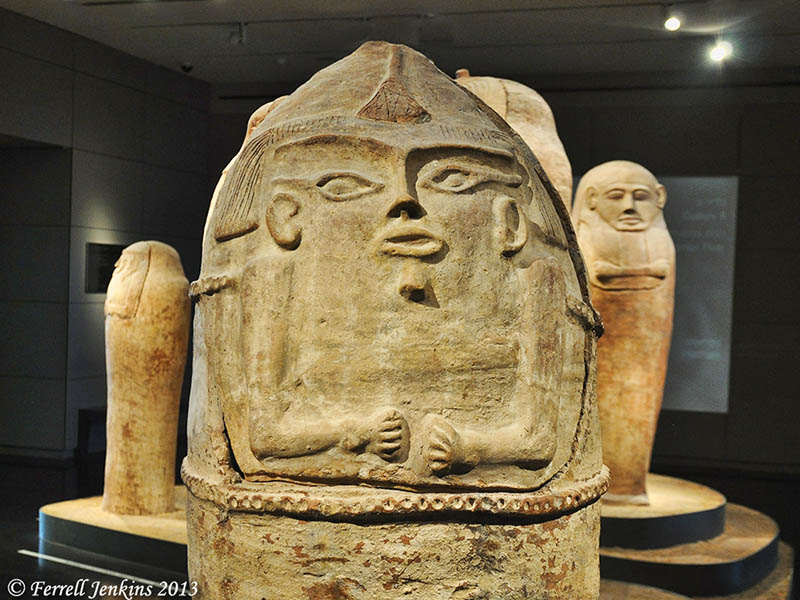
The first display one sees as he enters the archaeology wing of the Israel Museum is that of the anthropoid coffins from Deir el-Balah, a site south of Gaza city. The coffins, excavated by Trude Dothan in 1972, bear evidence of Egyptian influence. They date to the 13th century B.C.
Anthropoid Coffins from Deir el-Balah in the Israel Museum. Photo by Ferrell Jenkins.

Anthropoid Coffins from Deir el-Balah in the Israel Museum. Photo by Ferrell Jenkins.

2012 in review, according to WordPress

The WordPress.com stats helper monkeys prepared a 2012 annual report for this blog. We have readers in 204 countries.

Here’s an excerpt:

About 55,000 tourists visit Liechtenstein every year. This blog was viewed about 410,000 times in 2012. If it were Liechtenstein, it would take about 7 years for that many people to see it. Your blog had more visits than a small country in Europe!

Click here to see the complete report.

Happy New Year to Each Reader.

When a lot of rain is a good thing

Having watched the rise and fall of the Sea of Galilee (Lake Kinneret) over a period of 45 years, it is exciting to learn that winter storms have pushed the lake to the sharpest December rise in 20 years.

According to an article in Haaretz the lake “is expected to have risen 26 centimeters [9.84″] since heavy rains began Thursday, it sharpest December rise in 20 years. [1991 and 1992]”

As a result of the increased flow in northern streams, the Kinneret’s water level rose sharply, reaching 212.07 meters [695.77 feet] below sea level Saturday morning.

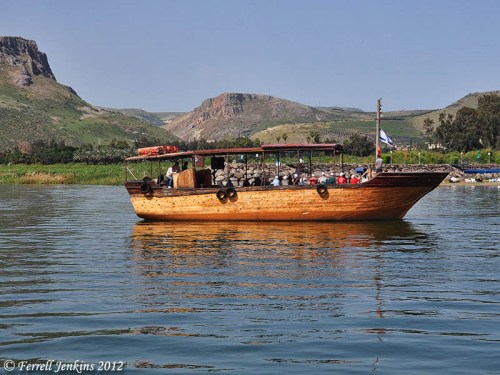
Sightseeing boat on the Sea of Galilee. Photo by Ferrell Jenkins.

Boat on the Sea of Galilee near the Plain of Gennesaret. Photo by Ferrell Jenkins.

And when they had crossed over, they came to land at Gennesaret. (Matthew 14:34 ESV)

Rain also fell as far south as Ashdod and Kiryat Gat, “but failed to affect the Negev this time.” This reminds us of the days of the Patriarchs whose lives were often disrupted by lack of rain in the Negev.

According to the report, almost 20 inches of snow has fallen on Mount Hermon.

If you have an interest in weather conditions in Israel, I suggest Kinneret Bot and the site of the Israel Meterological Service.

Geographer Carl Rasmussen says,

All of us who have traveled in Israel and the surrounding countries are well-aware of the importance of the winter rains for the well-being of the inhabitants of the area, local agriculture, and the water supply in general.

HT: Bible Places Blog; Holy Land Photos’ Blog.

Myra, home of Saint Nicholas

The town Myra is known to students of the New Testament as a place where Paul transferred ships while he was being taken to Rome for trial before Caesar (Acts 27:5).

In the centuries following, Myra became the home of a (Greek Orthodox) bishop known as Nicholas. Born in Patara, Nicholas died December 6, 343. Several legends arose around Nicholas who was noted for giving gifts to the poor and raising the dead.

Highly revered in Greece and Russia, St. Nicholas is known as the patron saint of children, sailors, merchants, and scholars. From his life of piety, kindness, and generosity arose the legendary figure celebrated today as St. Nicholas, Father Christmas, or Santa Claus. (Fant & Reddish, A Guide to Biblical Sites in Greece and Turkey, 256)

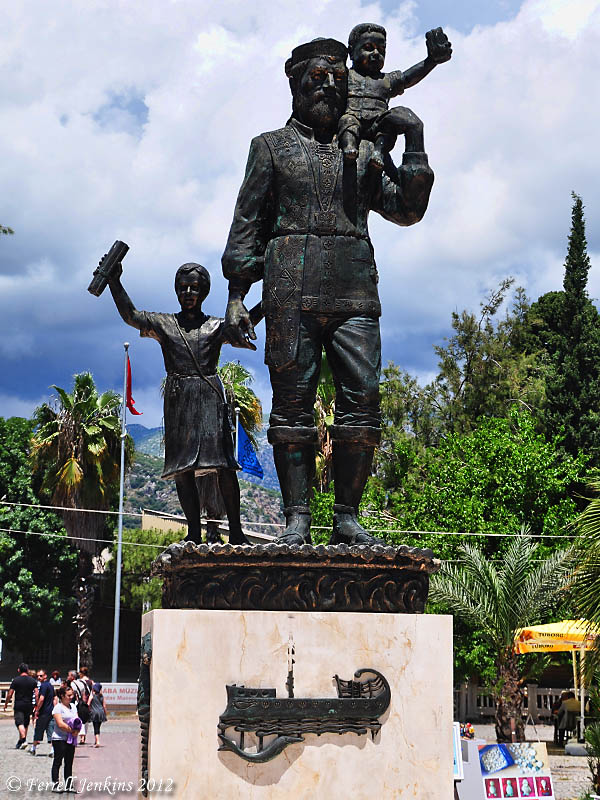
The ancient Myra is associated with the modern Turkish town Demre (or Kale). I thought you might enjoy seeing a few pictures related to Saint Nicholas. In the town square is a recent statue showing St. Nicholas with children. The statue was a gift of the Russian government in 2000. Many Russian tourists were visiting the day I was there.

Modern statue of Saint Nicholas at Myra. Photo by Ferrell Jenkins.

Modern statue of Saint Nicholas at Myra. Photo by Ferrell Jenkins.

A few decades ago I saw an older statue near the entrance to the church. It now has a fresh coat of black paint.

Older statue of St. Nicholas near the entrance of the Byzantine church ruins. Photo by Ferrell Jenkins.

Older statue of St. Nicholas near the entrance of the Byzantine church ruins.This statue depicts him carrying a bag of gifts.  Photo by Ferrell Jenkins.

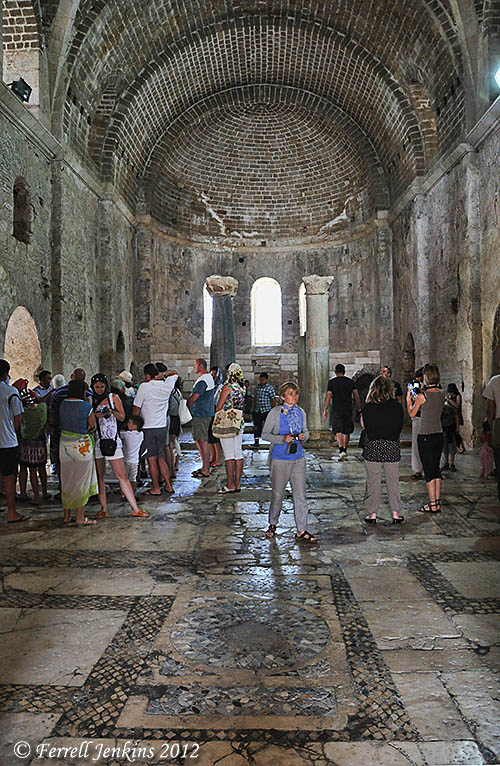
The Byzantine church dates to the 6th century A.D. Several writers point out that the sarcophagus of Nicholas was broken into by Italian merchants in the 1087 A.D., and his bones were taken to Bari, Italy.

Wilson says the church is built like a basilica “in the shape of an orthodox cross” (Biblical Turkey 88).

St. Nicholas Byzantine church, Myra, Turkey. Photo by Ferrell Jenkins.

Ruins of the St. Nicholas Byzantine church, Myra, Turkey. Photo by Ferrell Jenkins.

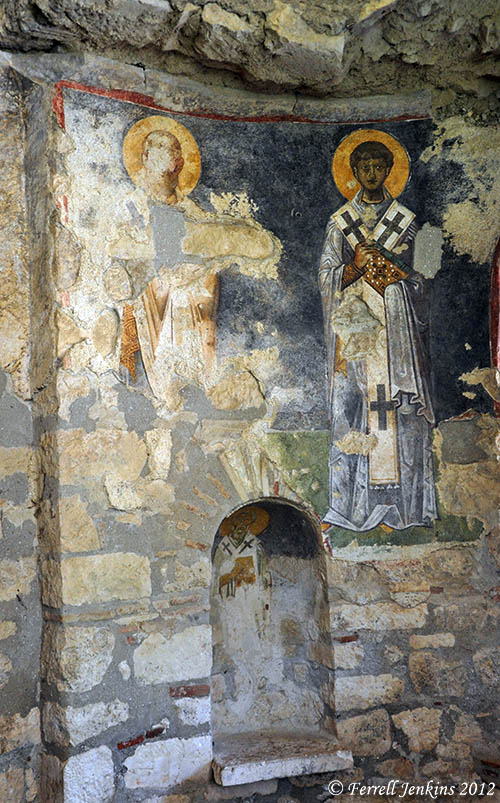
This last photo shows one of the poorly preserved frescoes.

Fresco on the wall of St. Nicholas church in Demre. Photo by Ferrell Jenkins.

Fresco on the wall of St. Nicholas church in Demre. Photo by Ferrell Jenkins.

Tourism seems to be thriving at Myra even though the town is off the beaten track. Whether there are any Christians in the town is doubtful.

For an earlier post about Myra and St. Nicholas, see here.

“Dried up like a potsherd”

Simple things make good illustrations. Just ask Jesus.

David used many simple illustrations in the Psalms. In one he spoke of the common piece of broken pottery (potsherd) which could be found around every home and camp site.

my strength is dried up like a potsherd, and my tongue sticks to my jaws; you lay me in the dust of death. (Psalm 22:15 ESV)

In this text David describes his own feeling of weakness and/or that of the coming Messiah. There are times, I think, when each of us feels like this.

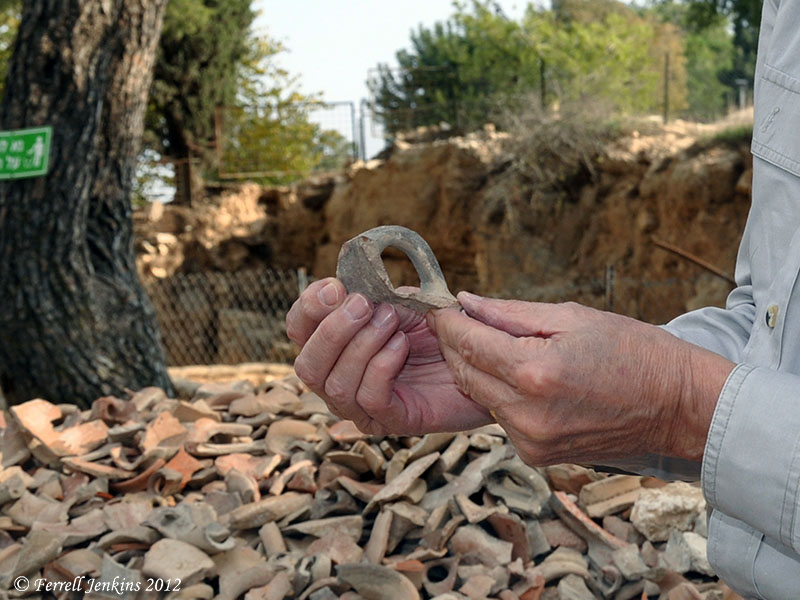
A common thing we see at archaeological digs is a pile of potsherds from ancient times. Archaeologists relish an unbroken piece of pottery, but even the sherds or potsherds reveal a lot about the age of the stratum being worked and the life of the ancient people. The broken jar handle from Ramat Rachel, south of Jerusalem, tells its own story.

Potsherds at Ramat Rachel excavation. Photo by Leon Mauldin.

Potsherds Potsherds at Ramat Rachel excavation. Photo by Leon Mauldin.

Unless it is an old college professor (pick your own), nothing is drier than a piece of broken pottery. Great illustration.