Category Archives: Culture

National Geographic’s Top 10 Museums and Galleries

National Geographic recently released a list of Top 10 Museums and Galleries here.

  1. Smithsonian Institution, Washington, D.C.
  2. Le Louvre, Paris, France
  3. The Acropolis Museum, Athens, Greece
  4. State Hermitage, St. Petersburg, Russia
  5. The British Museum, London, England
  6. The Prado, Madrid, Spain
  7. The Metropolitan Museum of Art, New York City
  8. The Vatican Museum, Vatican City, Italy
  9. The Uffizi Gallery, Florence, Italy
  10. Rijksmuseum, Amsterdam, the Netherlands
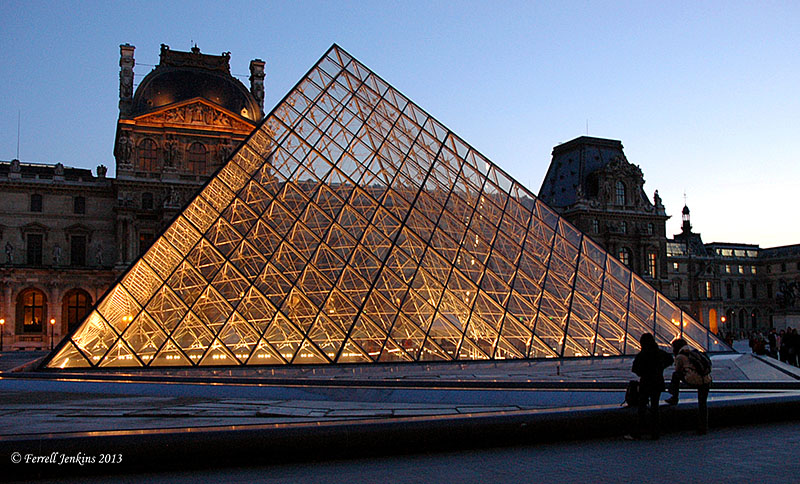
Entrance to the Louvre at night. Photo by Ferrell Jenkins.

Entrance to the Louvre at night. Photo by Ferrell Jenkins.

Over the years I have had the opportunity to visit each of these museums at least once. While I enjoy the art, I am usually looking for artifacts that provide some background for the Bible. That would make a good list.

If I should be asked to suggest number 11, it would be the Pergamon Museum, Berlin, Germany.

July 4, 2013

This morning I went out on the front porch and made this photo of my veteran neighbor putting up the flag.

A veteran puts up his flag on July 4th. Photo by Ferrell Jenkins.

A veteran puts up his flag on July 4th. Photo by Ferrell Jenkins.

Then, I put up my flag.

The synagogue — a place of study and discussion

The origin of the synagogue is difficult to determine, but it is generally held that it arose during the time of the Babylonian exile. Synagogues did not become common until the intertestamental period. The term intertestamental is used by many writers to describe the period between the close of the Old Testament (about 425 B.C.) and the coming of John the Baptist in the early first century A.D. Others use the term interbiblical, or the longer phrase, between the testaments.

With the destruction of the Temple (586 B.C.), sacrifices ceased. Prayer and the study of the sacred Scriptures, however knew no geographical limitations. The Book of Ezekiel describes the elders of Israel gathering in the prophet’s house (8:1; 20:1-3) (Charles Pfeiffer, Between the Testaments, 59).

In the sixth year, in the sixth month, on the fifth day of the month, as I sat in my house, with the elders of Judah sitting before me, the hand of the Lord GOD fell upon me there. (Ezekiel 8:1 ESV)

In the seventh year, in the fifth month, on the tenth day of the month, certain of the elders of Israel came to inquire of the LORD, and sat before me. And the word of the LORD came to me: “Son of man, speak to the elders of Israel, and say to them, Thus says the Lord GOD, Is it to inquire of me that you come? As I live, declares the Lord GOD, I will not be inquired of by you. (Ezekiel 20:1-3 ESV)

The word synagogue is of Greek origin. It simply refers to a gathering of the people, or a congregation. “The Hebrew word for such a gathering is keneseth, the name used for the parliament in the modern state of Israel” (Pfeiffer, 59).
After the rebuilding of the Temple (520–516 B.C.), the synagogue continued to fill the spiritual needs of the Jews of the Diaspora. There were synagogues in many of the cities visited by Paul: Damascus (Acts 9:2); Salamis (13:5); Antioch of Pisidia (13:14); Thessalonica (17:1); Corinth (18:4); Ephesus (19:8), and others. Only ten families were needed to compose a synagogue.

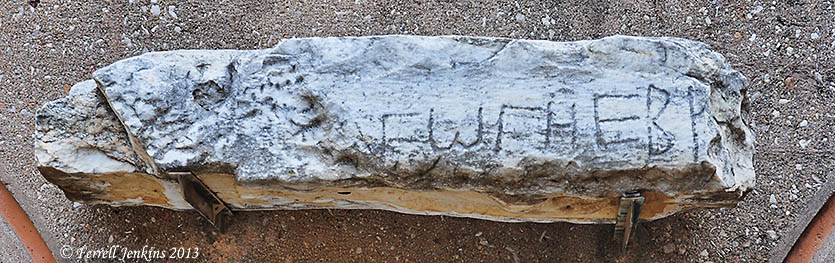
In 1898 a partial inscription mentioning a “synagogue of the Hebrews” was found at Corinth. It was published by Benjamin Powell in 1903 and identified as having come from the synagogue where Paul preached. McRay says that further study showed that it should be dated considerably later than the time of Paul. (Archaeology and the New Testament, p. 319).

Synagogue Inscription displayed in Corinth Museum. Photo by Ferrell Jenkins.

Synagogue Inscription displayed in Corinth Museum. Photo by Ferrell Jenkins.

A small plaque mounted underneath the inscription at the Corinth Museum reads, “Inscription from a late Roman synagogue.”

One rabbinic tradition has it that there were 480 synagogues in Jerusalem alone. Even the small villages of Galilee had synagogues at the time of Jesus (Mt. 4:23; 9:35).

Why did Moses have a staff in his hand?

Recently during a mid-week Bible study, a brother presented a short talk on the question the LORD asked Moses.

The LORD said to him, “What is that in your hand?” He said, “A staff.” (Exodus 4:2 ESV)

We are not surprised to find a staff in the hand of Moses. Earlier in the same context we have learn that Moses was shepherding the flock of his father-in-law Jethro.

Now Moses was keeping the flock of his father-in-law, Jethro, the priest of Midian, and he led his flock to the west side of the wilderness and came to Horeb, the mountain of God. (Exodus 3:1 ESV)

Shepherd with his sheep at Nazareth Village. Photo by Ferrell Jenkins.

Shepherd with his sheep at Nazareth Village. Photo by Ferrell Jenkins.

The staff and the rod (Psalm 23:4) were the tools of the shepherd of Bible times. Here is a brief comment about the rod and staff from the Florida College Annual Lectures of 1993.

“Thy rod and Thy staff, they comfort me” (vs. 4). Shepherding was a dangerous profession. There were wild animals, thieves and robbers, and some means for defense was needed. The shepherd would carry the rod and staff for the protection of his flock. The rod (Hebrew, shēbet) was a short club about 30 inches long made from an oak sapling. The bulging head was shaped out of the stem at the beginning of the root. It was especially used as a weapon against men and animals who might threaten the flock. The staff (Hebrew, mish’eneth) was a straight pole about six feet long. Mackie says,

“Its service was for mountain climbing, for striking troublesome goats and sheep, beating leaves from branches beyond the reach of his flock, and especially for leaning upon. As he stood clasping the top of his stick with both hands, and leaning his head against it, his conspicuous and well-known figure gave confidence to the sheep grazing around him among the rocks and bushes of the wilderness.” (Mackie 291)

Most of the shepherds that I have seen throughout the Middle East carry a short staff – one that comes about waist high.

Churning to make butter

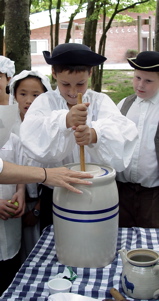
Churning Butter

Churning Butter

When I was a kid in the rural south, churning was done in a heavy duty ceramic pot. Butter was made by moving the stick (which had a sort of paddle attached) up and down.  I did not live in Colonial times, but the churn we used looked very much like the one shown in the picture to the left. Ours was a bit taller, I think.

The practice of churning to make butter has been around for thousands of years. It is mentioned in the Wisdom Literature of the Bible.

For the churning of milk produces butter, And pressing the nose brings forth blood; So the churning of anger produces strife. (Proverbs 30:33 NAU)

The ESV consistently uses the word pressing, from the Hebrew mits, three times in that verse.

For pressing milk produces curds, pressing the nose produces blood, and pressing anger produces strife. (Proverbs 30:33 ESV)

The NET Bible probably best conveys the meaning of the text by the use of churning, punching, and stirring up.

For as the churning of milk produces butter and as punching the nose produces blood, so stirring up anger produces strife. (Proverbs 30:33 NET)

The photo below shows a pottery churn from Beersheba, now displayed in the Israel Museum. The sign associated with the churn says,

The churn, used for making butter from milk, first appeared in the Chalcolithic Period [6,500–5,500 years ago] and became an important symbol of the time. To speed up the churning process, a rope was tied to the handles, and the churn was rocked back and forth.
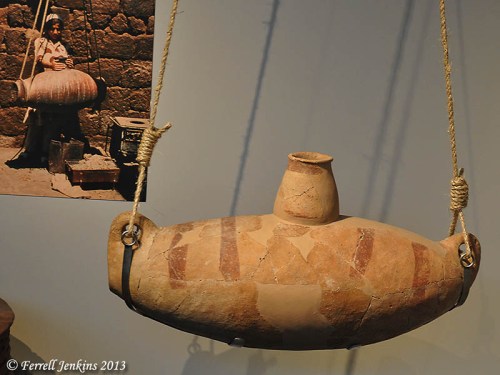
Chalcolithic pottery churn from Beersheba. Israel Museum. Photo by Ferrell Jenkins.

Chalcolithic pottery churn from Beersheba. Israel Museum. Photo by Ferrell Jenkins.

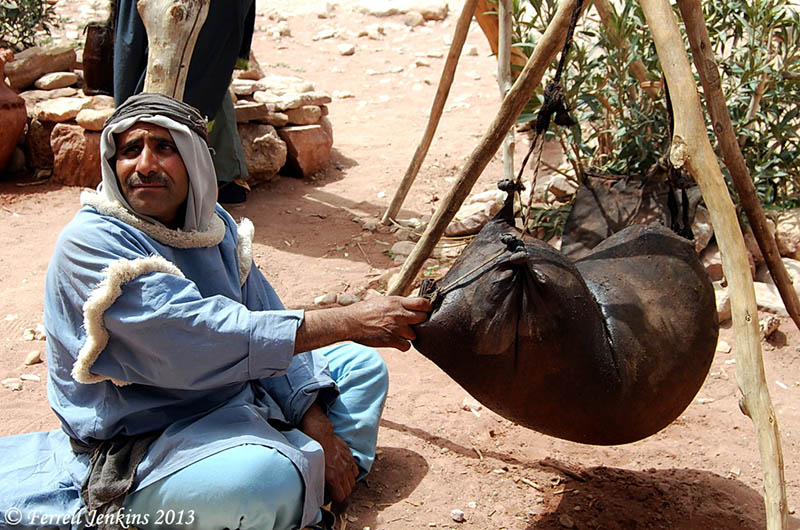
During a visit to Petra, Jordan, in 2008, a group of people were portraying the costumes and activity of earlier Bedouin. Many of the customs portrayed are the same as those we read about in the Bible.

In the photo below the man is rocking a churn made from an animal skin.
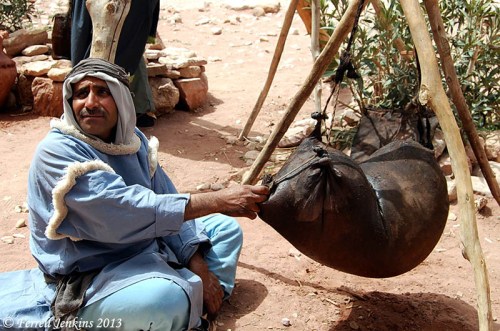
Bedouin churning in an animal skin at Petra. Photo by Ferrell Jenkins.

Bedouin churning butter in an animal skin at Petra. Photo by Ferrell Jenkins.

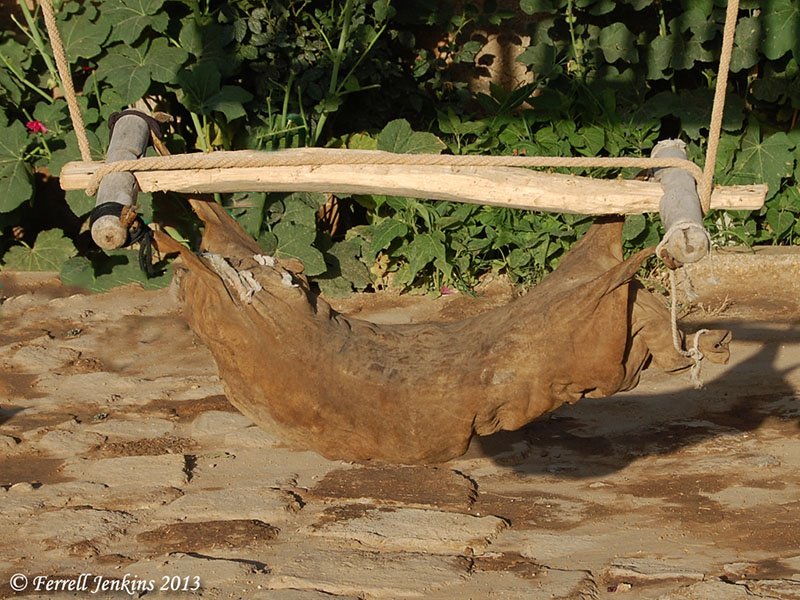
Finally, here is a photo that I made at Haran in southeastern Turkey, once the home of Abraham (Genesis 11:31 – 12:4), showing a churn made from an animal skin.
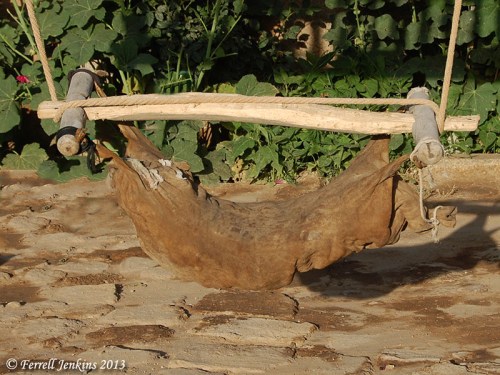
Churn made from animal skin at Haran. Photo by Ferrell Jenkins.

Churn made from animal skin at Haran. Photo by Ferrell Jenkins.

Wool and flax used in weaving

Proverbs 31 describes the Capable Wife as one who looks for the wool and the flax to use in weaving.

She obtains wool and flax, and she is pleased to work with her hands. (Proverbs 31:13 NET)

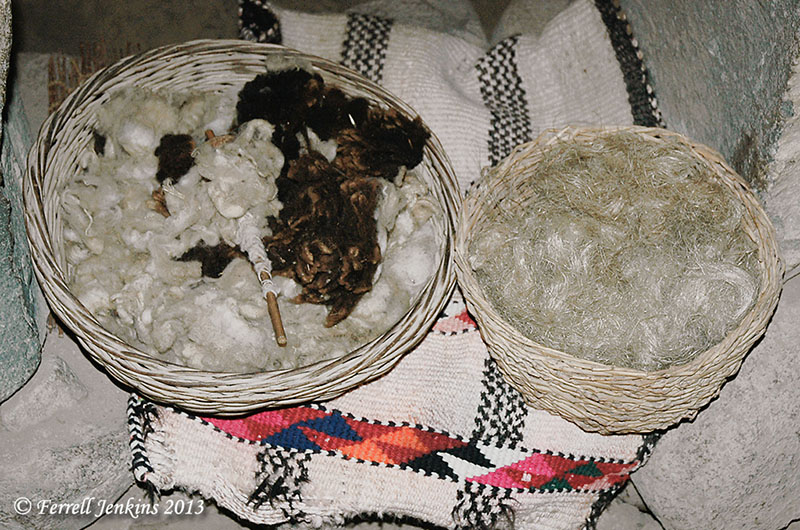
In the reconstructed house at Qatzrin (in Israel’s Golan Heights), wool and flax are waiting to be spun, and then made into clothing.

Wool and flax were used in the making of clothes in Bible times. Photo by Ferrell Jenkins.
Wool & flax were used in the making of clothes in Bible times. Photo by Ferrell Jenkins.
The two other texts where wool and flax are mentioned together are in the prophet Hosea. Israel, in her unfaithfulness to the LORD, is described as getting here wool and flax, along with other household goods, from her lovers (Hosea 2:5). The LORD makes it clear that he is the source of her supplies.

Therefore, I will take back my grain during the harvest time and my new wine when it ripens; I will take away my wool and my flax which I had provided in order to clothe her. (Hosea 2:9 NET)

Jesus wore a tunic (Greek, chiton) that was woven in one piece (John 19:23). The chiton was a garment worn next to the skin by both men and women.

We have posted several articles about weaving at the following links:

The priest’s servant used a three-pronged fork

When the tabernacle (the temple of the LORD, 1 Samuel 1:9; the house of the LORD, 1 Samuel 1:24) was at Shiloh, the priests became corrupt. First Samuel 2 recounts the practices of the wicked sons of Eli.

The custom of the priests with the people was that when any man offered sacrifice, the priest’s servant would come, while the meat was boiling, with a three-pronged fork in his hand, 14 and he would thrust it into the pan or kettle or cauldron or pot. All that the fork brought up the priest would take for himself. This is what they did at Shiloh to all the Israelites who came there.  (1 Samuel 2:13-14 ESV)

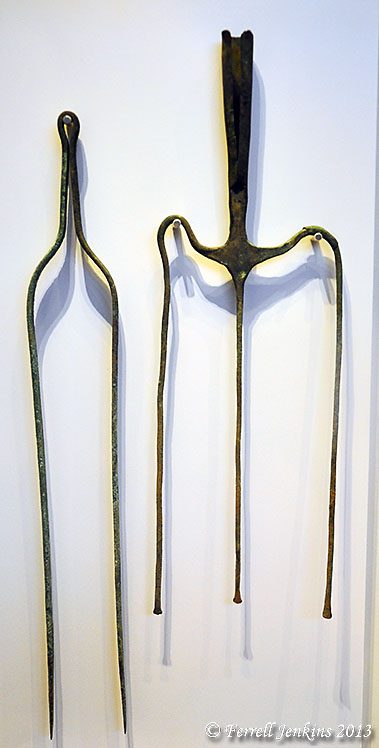
Three-pronged forks, like the one mentioned in this text have been found at a number of archaeological sites where sacrifices were offered by the Canaanites to their gods. The trident pictured here is from Akko (Acco), and is said to date to the 14th-13th century B.C. It appears to have had a wooden handle that would fit into it.

Trident and tongs from Akko (14th-13th Century B.C. Israel Museum. Photo by Ferrell Jenkins.

Bronze trident and tongs from Akko (14th-13th Century B.C. Israel Museum. Photo by Ferrell Jenkins.

For more information about Shiloh and the biblical events that took place there, see here.

Fort Babylon in Old Cairo

Daily News Egypt carried a brief article about the Roman ruins in Old Cairo here. The article says,

The fort was built on the southern end of the old Pharaonic town Per-Hapi-On, or ‘The river house of On’. According to some historians the mispronunciation of the name by the Romans led to the name Fort Babylon but others claim it was named after a number of captives brought there from Babylonia during the time of Sesostris.

Roman Emperor Diocletian built the fort in 300 C.E. as the stronghold of three legions in charge of securing Egypt. The garrison of Fort Babylon vowed to secure ships on the Nile and a canal that passed through the town connecting the Nile with the Red Sea. This canal was first established by the Pharaohs, and was restored and enlarged by the Roman Emperor Trajan. The fort was renovated and fortified by the Roman Emperor Arcadius.

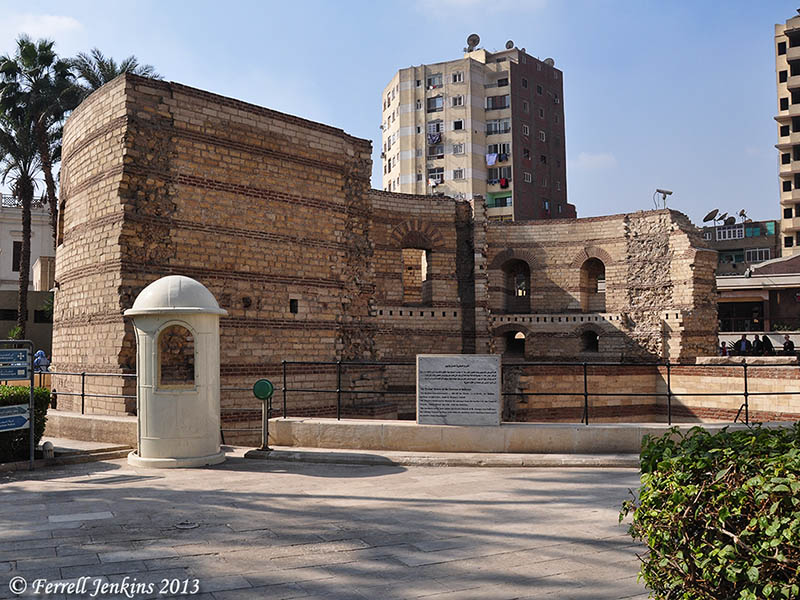
Our photo shows ruins of the Roman fort that was known as Fort Babylon in Roman times. At that time the Nile River flowed beside the Fort, but has since changed its course. New building of Old Cairo dwarf the old structure.

Roman Tower (Fort Babylon in Old Cairo. Photo by Ferrell Jenkins.

Roman Tower (Fort Babylon in Old Cairo). Photo by Ferrell Jenkins.

The sign in front of the structure says that it was constructed by Diocletian (c. A.D. 300) to fortify the Roman harbor of Old Cairo built by Trajan (c. A.D. 110).

HT: Agade List

Syrian archaeological site endangered — a look at Ebla

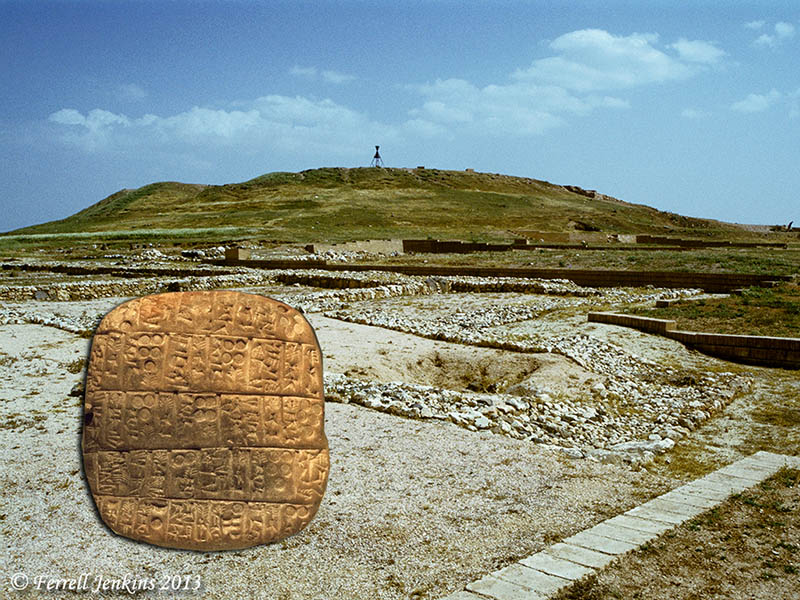
During the course of the bloody civil war in Syria we have heard of damage to various archaeological sites such as Aleppo and Palmyra. A recent article in The New York Times here includes a report specific to Tell Mardikh in northern Syria, about 30 miles SW of Aleppo.

The headline tells the story, “Grave Robbers and War Steal Syria’s History.” An excellent video illustrates what both of these factors (vandalism and war) are doing to destroy the ancient site.

Tell Mardikh, ancient Ebla, and one of the tablets discovered in 1975. Photo by Ferrell Jenkins.

Tell Mardikh, ancient Ebla, and one of the tablets discovered in 1975. Photo by Ferrell Jenkins.

We have previously written about Ebla, and the Ebla tablets, here, and here.

More than 17,000 cuneiform tablets were discovered in 1975. They date to the mid-third millennium B.C. when Ebla was the capital of a great Canaanite empire. Scholars state that there are important affinities between the Eblaite language and biblical Hebrew, both being members of the Northwest Semitic family.

The first golden age of Ebla is dated to 2400–2250 B.C. This is long before the time of Abraham who lived north of Ebla at Haran in Padan Aram for a time. Haran is about 150 miles north of Ebla.

So Abram went, as the LORD had told him, and Lot went with him. Abram was seventy-five years old when he departed from Haran.  (Genesis 12:4 ESV)

The death and destruction that has been going on in Syria is almost beyond comprehension. When we destroy our ancient history we become what Elton Trueblood called the Hippie generation, “a cut-flower generation.”

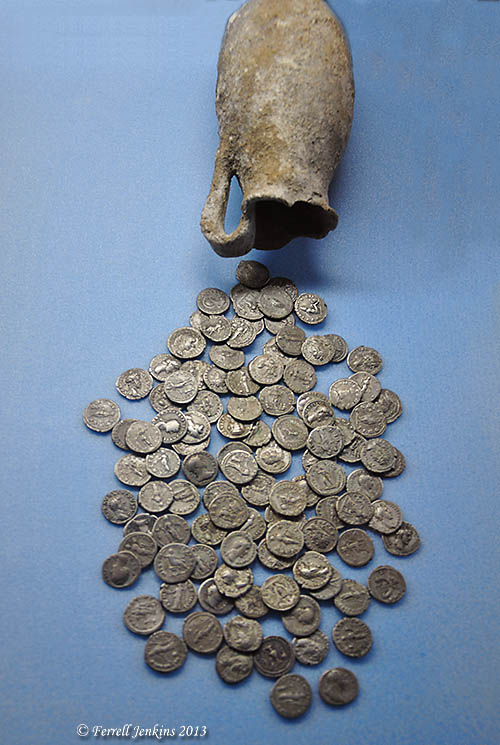
Hidden treasure

The discovery of hidden treasure is fairly common in and near ancient sites. Individuals may not have a bank account, but they keep the funds they have stored in what they consider a safe place.

The photo below shows a clay jar with a hoard of silver coins displayed in the Samsun (Turkey) Archaeological Museum. These coins date from the Roman Imperial Period (69-79 A.D. and 238/244 A.D.). The earliest coins are not far removed from the time of the delivery of Peter’s Epistles to saints in Pontus and other Roman provinces (1 Peter 1:1). For more information about the delivery of Peter’s Epistles, see here.

For more information about the museum, check here and here.

Hoard of Roman coins displayed in Samsun Archaeological Museum. Photo by Ferrell Jenkins.

Roman coins displayed in Samsun Archaeological Museum. Photo by Ferrell Jenkins.

Photos such as this remind us of several Biblical passages. For today, consider Paul’s instruction to Timothy regarding what he was to teach those who set their hope on the uncertainty of riches.

 17 As for the rich in this present age, charge them not to be haughty, nor to set their hopes on the uncertainty of riches, but on God, who richly provides us with everything to enjoy.
18 They are to do good, to be rich in good works, to be generous and ready to share,
19 thus storing up treasure for themselves as a good foundation for the future, so that they may take hold of that which is truly life. (1 Timothy 6:17-19 ESV)