Category Archives: Book of Acts

Acts 25 — Photo Illustrations — Coins of the Rulers

We continue our look at the three chapters describing Paul’s stay at Caesarea Maritima — Acts 24-26. Three civil rulers are mentioned in these chapters. They are known not only from Luke’s account, but in the writings of Josephus.

Rapske says that Caesarea “was the administrative seat of the Roman procurators of Palestine.” He adds that in the time of the Flavians it became a Roman Colony (The Book of Acts in its First Century Setting; Vol. 3, The Book of Acts and Paul in Roman Custody, 155).

After the Romans occupied “Palestine” the Jews had both a religious and a secular tax to pay. The procurators (prefects) were responsible for collecting the taxes for Rome. Coins were minted by various procurators, including Felix and Festus. I have chosen one example from each to show the type of coin current in their time.

Antonius Felix — A.D. 52-59.

Felix is described as a hegemon in the Greek New Testament. Major English versions use the term governor (Acts 23:24, 26; 24:2, 22, 24, 25, 27; 25:14). Hemer says that hegemon is a general word to describe a ruler, “the formal Latin title of these governors of Judaea being procurator or praefectus” (The Book of Acts, 128).

The obverse (head) of the coin of Felix shows two oblong shields and two spears. The inscription is translated “Nero Claudius Caesar–son of Claudius. The reverse (tail) shows a “six-branched palm tree bearing two bunches of dates” with a Greek inscription above and below (Hendin, Guide to Biblical Coins (1987), 117).
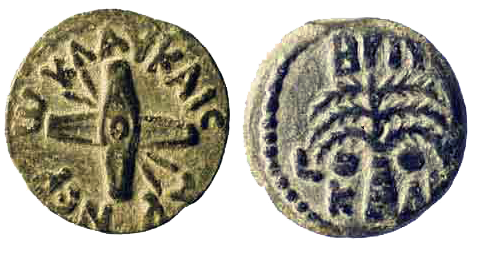
Coin of Roman Procurator Felix.

Coin of Roman Procurator Felix.

Porcius Festus — A.D. 59-61.

Porcius Festus followed Felix as governor or procurator. He is mentioned in each of the three chapters we are discussing. Paul had been left in custody by Felix, and Festus seems to be pleased to get the advice of King Agrippa when he visited Caesarea.

The coin of Festus, struck in A.D. 58, bears a Greek inscription within a wreath on the obverse. At the bottom is an X. The inscription reads NER ONO C (Nero). The reverse shows a palm branch with a Greek inscripton KAIC APOC (Caesar). The date LE means year five (Hendin, 118).
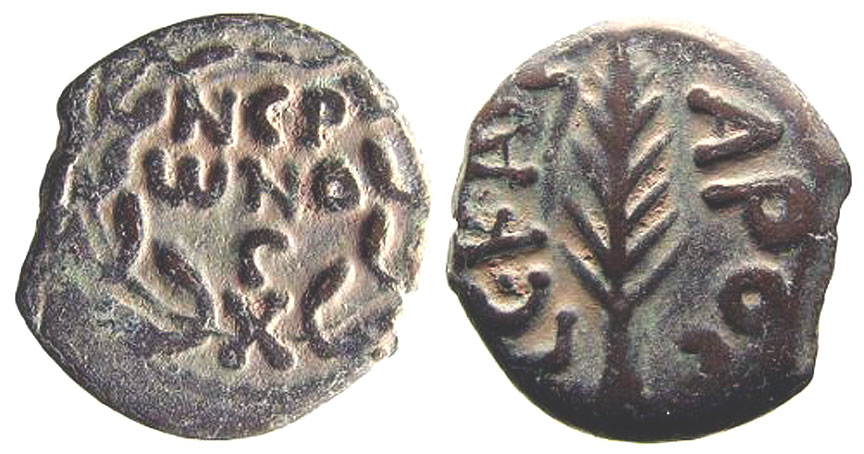
Coin of Porcius Festus.

Coin of Roman Procurator Porcius Festus.

Herod Agrippa II — A.D. 48-70.

Herod Agrippa II was the son of Herod Agrippa I, the grandson of Herod the Great (Acts 12:1, et al.). Agrippa II was the tetrarch of Chalcis and of northern territories. Chalcis was the small but beautiful territory between the Lebanon and Antilebanon mountains. Later he was granted the territories that had been controlled by Philip and Lysanias. Agrippa lived until the end of the first century, and minted coins even to the time of the Roman Emperor Domitian (A.D. 81-96).

According to Hendin, the obverse shows a laureate bust of Domitian facing right. The inscription around it reads DOMITIAMOC KAICAP (Domitian Caesar). The reverse shows Nike standing right. One foot is resting on a helmet. She is writing on a shield that is resting on her knee. The inscription reads ETO KZBA AΓPIΠΠA (Year 27 of King Agrippa). The coin was struck in A.D. 83. (I do not know how best to harmonize the dates associated with the reign of Agrippa II.)

Coin of Herod Agrippa II with image of Domitian. Struck A.D. 83.

The coin above is copied from FORVM ANCIENT COINS.


I have only the original edition of Hendin’s Guide to Biblical Coins, but recommend the newer fifth edition of his book in the event that you have a genuine interest in Biblical coins. From my limited collecting experience, I can say that it is both fascinating and educational.

Acts 24 — Photo Illustrations — Caesarea

The events of Acts 24-26 take place at Caesarea Maritima. Paul was protected by the Romans in Herod’s Praetorium (Palace) for more than two years.

And he [Felix] commanded him to be guarded in Herod’s praetorium. (Acts 23:35b ESV)

When two years had elapsed, Felix was succeeded by Porcius Festus. And desiring to do the Jews a favor, Felix left Paul in prison. (Acts 24:27 ESV)

Caesarea Maritima was a first century Roman capital and seaport. The gospel was first preached to the Gentiles here when Peter came from Joppa to Caesarea to tell Cornelius words by which he could be saved (Acts 10, 11).

Herod the Great built a city on the site of Strato’s Tower and named it Caesarea in honor of Caesar Augustus. It became a center of Roman provincial government in Judea. The city had a harbor and was located on the main caravan route between Tyre and Egypt. This city is called Caesarea Maritima (on the sea) to distinguish it from Caesarea Philippi.

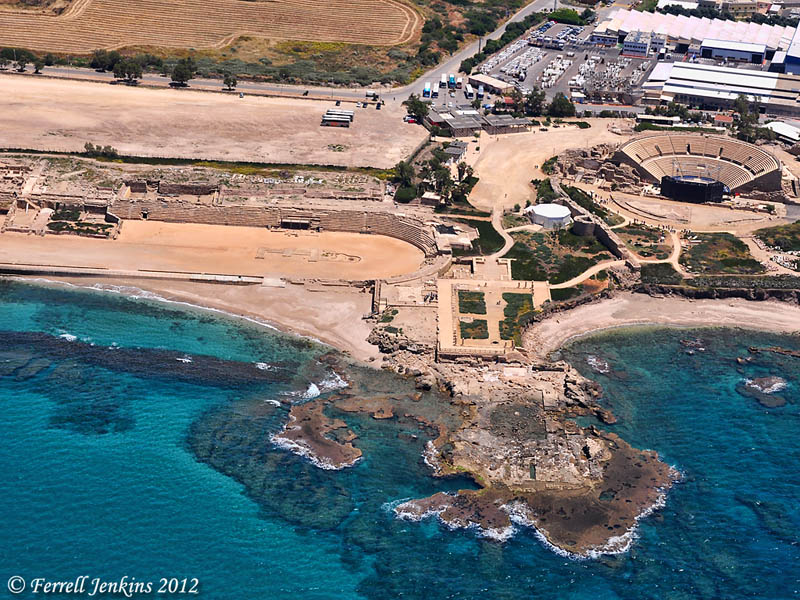
Our aerial photo below shows the Roman theater on the right of the photo. The southern portion of the hippodrome is on the left. The Palace of the Procurators is in the center, extending out into the sea.

Aerial view of Caesarea theater, hippodrome, and Palace of the Procurators. Photo by Ferrell Jenkins.

Aerial view of Caesarea theater (right), hippodrome (left), and Palace of the Procurators (center foreground). Photo by Ferrell Jenkins.

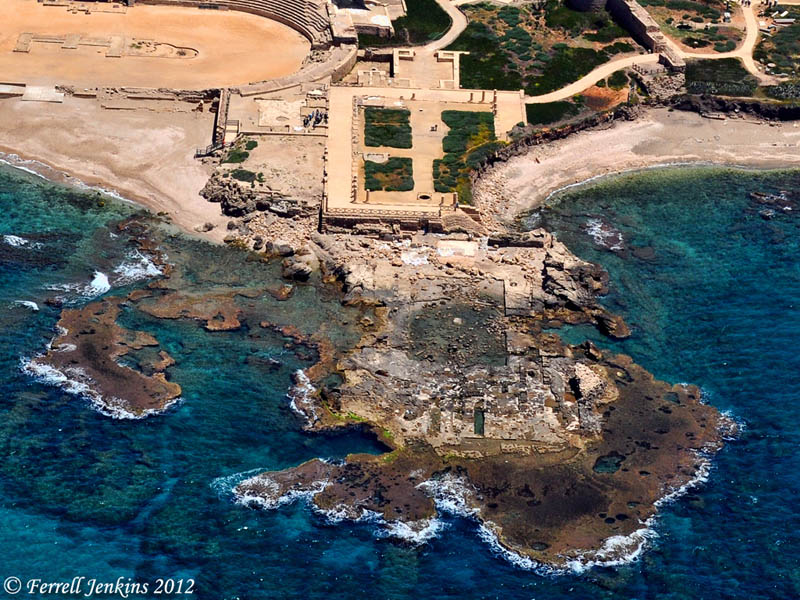
Jerome Murphy-O’Connor explains the rock-cut pool you see in the photos above and below.

From the west colonnade one can look down to the sea shore at a point where its dominant feature is a rectangular rock-cut pool (35 x 18 [meters]). There are channels to the sea on both sides. A square statue base can be discerned in the middle. The colonnades pool was originally the centrepiece of a two-storey building (83 x 51 m) which surrounded it on all sides. Presumably it was here that the Roman procurators lived. Wave action and the activities of stone robbers have ensured that virtually nothing remains. A staircase in the north-east corner gave access to the upper level. (The Holy Land, 5th ed., 243).

Aerial view of the Palace of the Procurators at Caesarea. Photo by Ferrell Jenkins.

Aerial view of the Palace of the Procurators at Caesarea. Photo by Ferrell Jenkins.

Acts 23 — Photo Illustrations — Antipatris

The site of Antipatris was known as Aphek in Old Testament times. It it is the place where the Philistines were encamped when they took the ark of the covenant from the Israelites who had camped at nearby Ebenezer (1 Samuel 4:1).

Antipatris was built by Herod the Great and named in honor of his father.

Herod was also a lover of his father, if any other person ever was so; for he made a monument for his father, even that city which he built in the finest plain that was in his kingdom, and which had rivers and trees in abundance, and named it Antipatris. He also built a wall around a citadel that lay above Jericho, and was a very strong and very fine building, and dedicated it to his mother, and called it Cypros. (Jewish Wars 1:417)

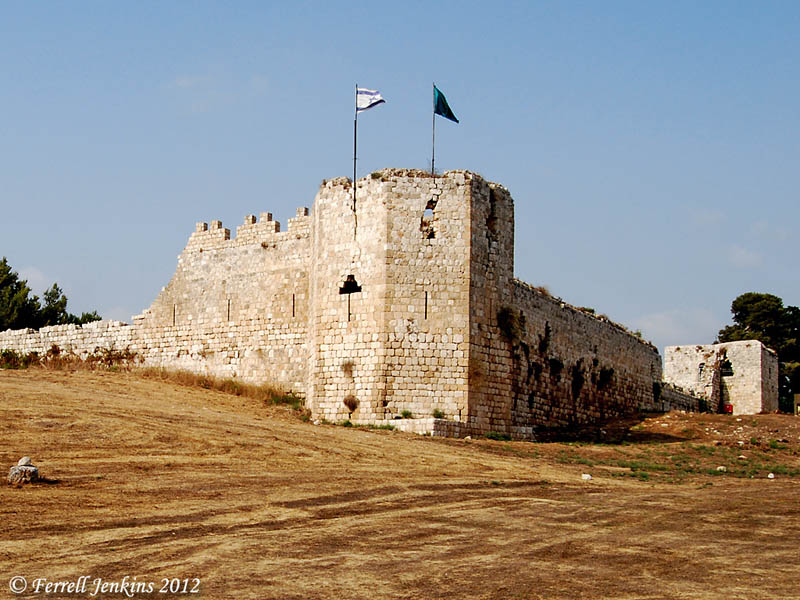
Because Aphek/Antipatris sat on a major south-north and west-east routes, it was dominated by many nations. The dominant feature of the site today is the Turkish fort. Inside are the excavated ruins of buildings from Canaanite to Herodian/Roman times.

Turkish fort at Aphek-Antipatris. Photo by Ferrell Jenkins.

Turkish fort at Aphek/Antipatris. Photo by Ferrell Jenkins.

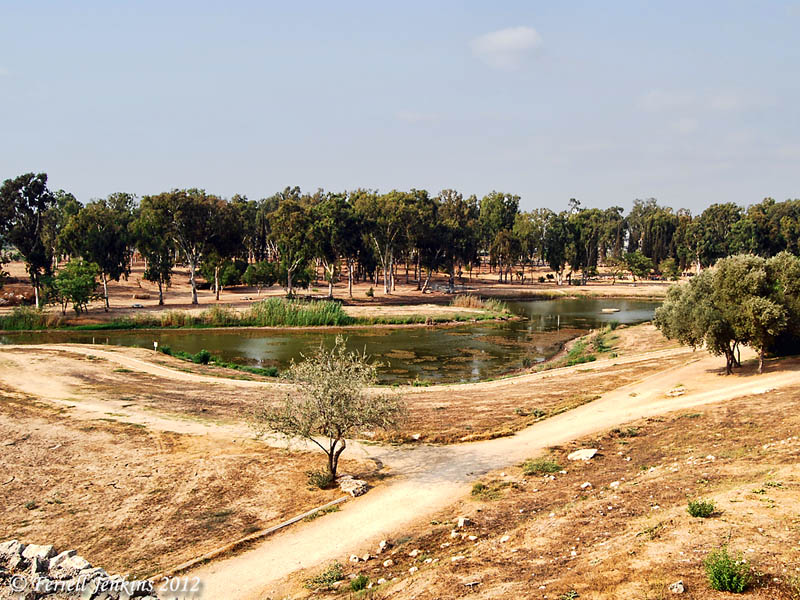
Aphek/Antipatris is known by the modern name Ras el-Ain because it is located at the source of the Yarkon River which flows a few miles into the Mediterranean.

Source of the Yarkon River at Aphek-Antipatris. Photo by Ferrell Jenkins.

Source of the Yarkon River at Aphek-Antipatris. Photo by Ferrell Jenkins.

When a plot was raised against Paul while he was in the Fortress of Antonia in Jerusalem, he was sent by night to Antipatris. The next day he was escorted to Caesarea.

So the soldiers, according to their instructions, took Paul and brought him by night to Antipatris.  And on the next day they returned to the barracks, letting the horsemen go on with him.  When they had come to Caesarea and delivered the letter to the governor, they presented Paul also before him. (Acts 23:31-33 ESV)

From Jerusalem to Antipatris is about 30 miles. From there to Caesarea is an additional 27 miles.

Paul would remain in custody at Caesarea for two years.

Acts 22 — Photo Illustrations — the Antonia

As a result of the unjustified beating of Paul by the Jews in the temple precinct, Paul was rescued by the commander of the Roman cohort. Orders were given for Paul to be bought into the barracks. The KJV and the NKJV use the word castle. The CEB use of military headquarters probably conveys the correct idea. (Acts 21:27-40). The parembole served as headquarters for the Roman troops in Jerusalem (BDAG).

The building under consideration in Acts 21 is the Fortress of Antonia. The massive structure was built by Herod the Great and named in honor of Mark Anthony. Murphy-O’Connor says the fortress “both protected and controlled the Temple” (The Holy Land, 34). The temple was surrounded by the Kidron Valley on the east, the Tyropean Valley on the west, and a steep decline on the south. The area needing special protection was the northwest corner.

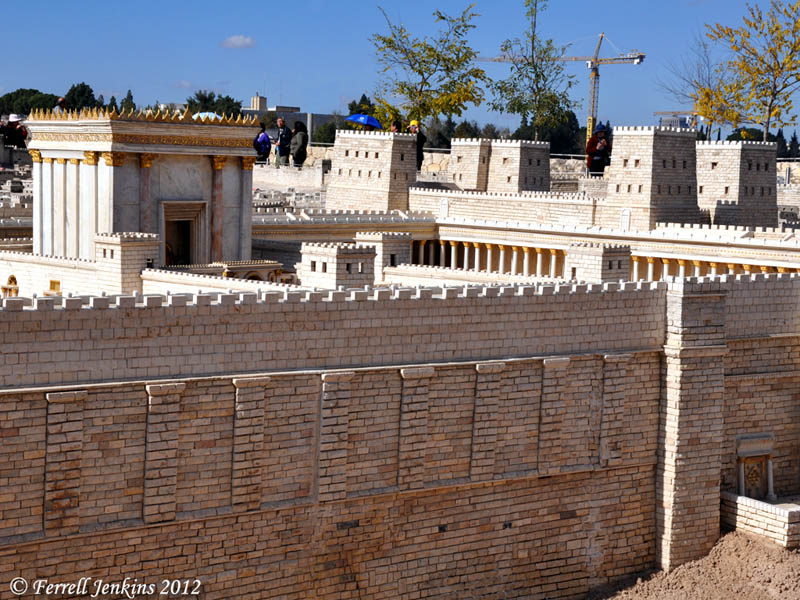
Second Temple Model, Jerusalem. The Fortress of Antonia stands on the northwest corner of the temple precinct. Photo by Ferrell Jenkins.

Second Temple Model, Jerusalem. The Fortress of Antonia stands on the northwest corner of the temple precinct. Photo by Ferrell Jenkins.

Josephus describes the “tower of Antonia” in the Wars of the Jews.

238 Now, as to the tower of Antonia, it was located at the corner of two cloisters of the court of the temple; of that on the west, and that on the north; it was erected upon a rock of fifty cubits in height, and was on a great precipice; it was the work of King Herod, wherein he demonstrated his natural magnanimity.  239 In the first place, the rock itself was covered over with smooth pieces of stone, from its foundation, both for ornament, and that anyone who would either try to get up or to go down it might not be able to hold his feet upon it.  240 Next to this, and before you come to the edifice of the tower itself, there was a wall three cubits high; but within that wall all the space of the tower of Antonia itself was built upon, to the height of forty cubits.  (JW 5:238-240)

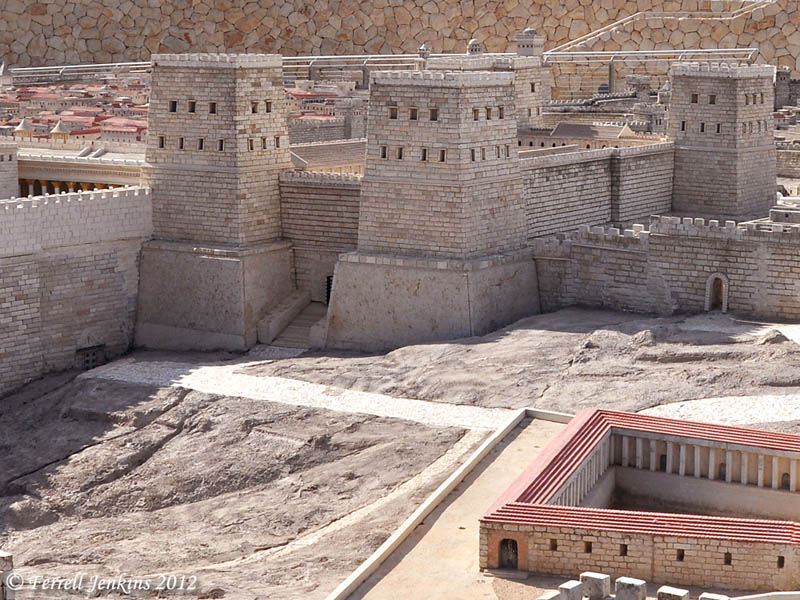
Fortress of Antonia in the Second Temple Model. Photo by Ferrell Jenkins.

Fortress of Antonia in the Second Temple Model. Photo by Ferrell Jenkins.

The photo above shows the Tower of Antonia built on the natural rock foundation at the northwest corner of the temple precinct. A portion of the Pool of Bethesda (John 5) is visible on the right.

Paul’s speech recorded in Acts 22 took place on the stairs leading up from the temple platform into the fortress. When the crowd drowned out Paul, the commander ordered that he be brought into the fortress (22:24). After Paul’s nephew informed the Roman officers about a planned conspiracy to kill Paul, he was sent to Caesarea where he would remain for two years (23:23; 24:27).

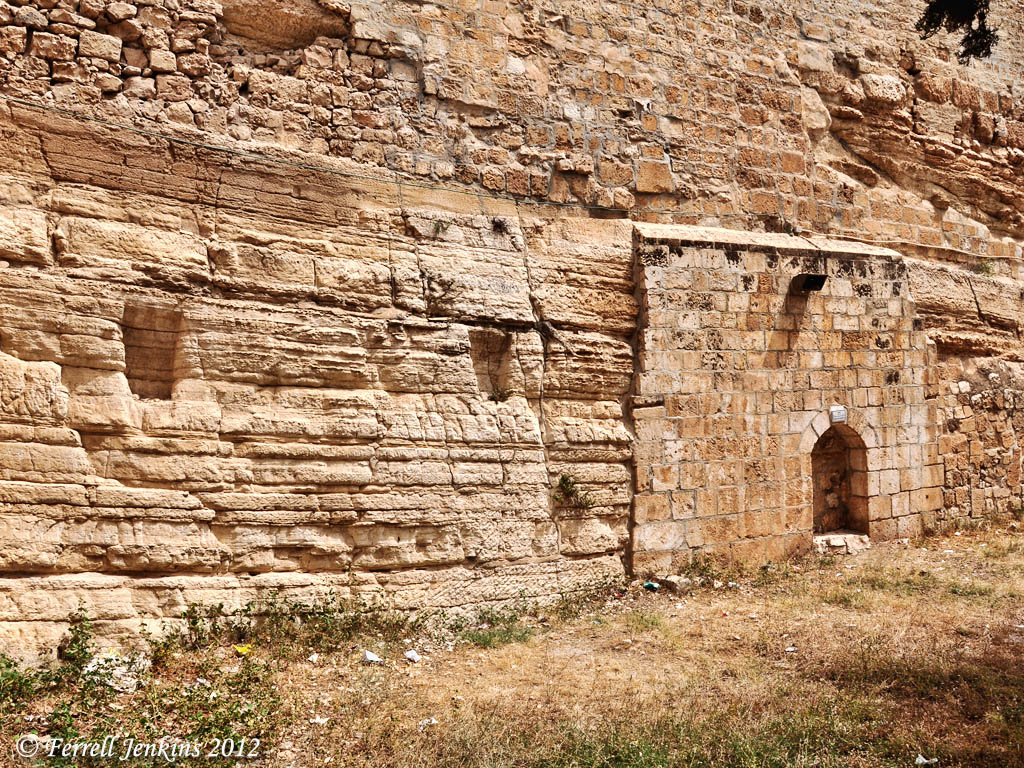
The photo below was made from inside the temple precinct. It shows the natural rock scarp in the northwest corner on which the Fortress of Antonia was built. See Leen Ritmeyer’s post about this, and his drawing showing the location of the steps mentioned in Acts 21. Ritmeyer sells digital images of his drawings.

The natural rock scarp at the NW corner of the Temple Mount. Photo by Ferrell Jenkins.

The natural rock scarp at the NW corner of the Temple Mount. Photo by Ferrell Jenkins.

Acts 21 # 2 — Photo Illustrations – Tyre

Luke records the journey from Patara to Tyre in these words:

 2 and having found a ship crossing over to Phoenicia, we went aboard and set sail.  3 When we came in sight of Cyprus, leaving it on the left, we kept sailing to Syria and landed at Tyre; for there the ship was to unload its cargo.  4 After looking up the disciples, we stayed there seven days; and they kept telling Paul through the Spirit not to set foot in Jerusalem.  5 When our days there were ended, we left and started on our journey, while they all, with wives and children, escorted us until we were out of the city. After kneeling down on the beach and praying, we said farewell to one another.  6 Then we went on board the ship, and they returned home again.  7 When we had finished the voyage from Tyre, we arrived at Ptolemais, and after greeting the brethren, we stayed with them for a day.  (Acts 21:2-7 NAU)

Tyre was well known to the Old Testament writers, especially the prophet Ezekiel. In Ezekiel 26-28 you will find a proclamation against Tyre, a prophetic lamentation over the fall of the city, and a proclamation against the king of Tyre.

The ministry of Jesus took Him to the district of Tyre and Sidon (Matthew 15:21).

The disciples, with wives and children, escorted Paul and his companions out of the city. The group kneeled and prayed on the beach before saying farewell to one another.

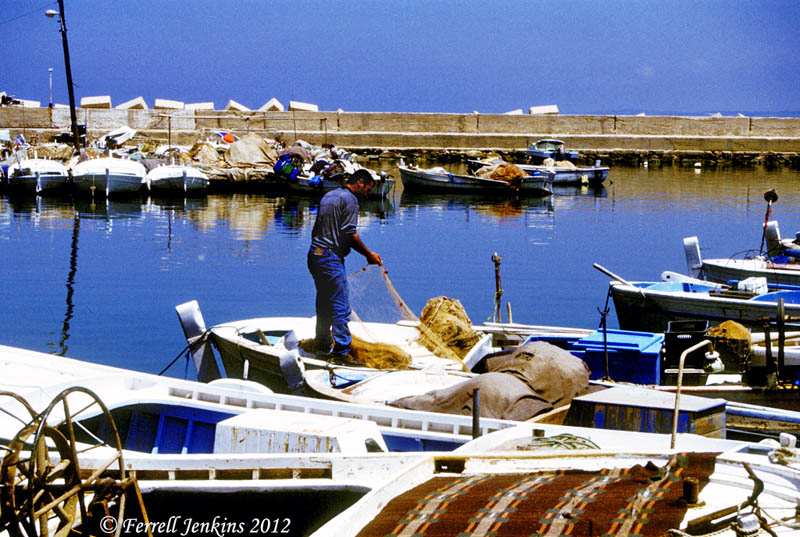
Tyre was once an important Phoenician city, but is now a small town known as Sur in Lebanon. It has a small fishing port that you see in the photograph below.

A fisherman works with his nets in the small harbor of Tyre. Photo by Ferrell Jenkins.

A fisherman works with his nets in the small harbor of Tyre. Photo by Ferrell Jenkins.

Acts 21 — Photo Illustrations – Patara

Patara is mentioned only once in the New Testament. When Paul and his companions sailed from Miletus on their way to Syria (Caesarea), they made stops at Cos, Rhodes, and Patara in the Roman province of Lycia in Asia Minor (Acts 27:5).

And when we had parted from them and set sail, we came by a straight course to Cos, and the next day to Rhodes, and from there to Patara. And having found a ship crossing to Phoenicia, we went aboard and set sail.  (Acts 21:1-2 ESV)

Patara is known as Gelemis (in Turkey) today, but the sign on the main highway from Fethiye to Kas points to the ancient site of Patara.

Wilson says,

Patara served as a way station for sea travelers, and Paul changed ships here to Phoenicia at the end of his third journey in AD 57 (Acts 21:1). (Biblical Turkey, 91).

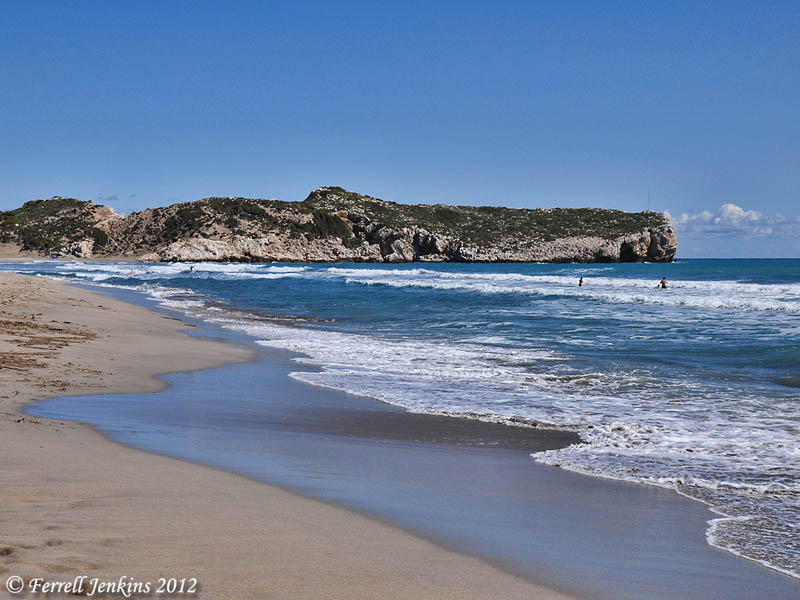
The beach at Patara is a popular leisure place for locals as well as visitors to the area. For this photo we drove the narrow road from the main highway through the ruins of the city to the water.

Beach on the Mediterranean Sea at Patara, Turkey. Photo by Ferrell Jenkins.

Beach on the Mediterranean Sea at Patara, Turkey. Photo by Ferrell Jenkins.

Patara already had a long history before Paul stopped there. Tradition has it that it was founded by Patarus, a son of Apollo. Persians used the port during the Persian Wars. The city later came under the control of Alexander the Great, the Ptolemies, and the Seleucids in succession before being given freedom by the Romans in 167 B.C. In 43 B.C. the city became part of the province of Lycia (Biblical Turkey, 90-91).

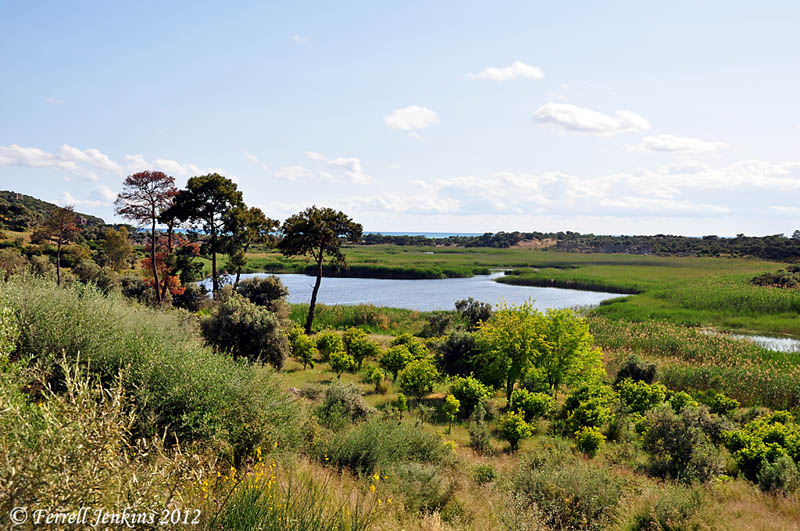
Our next photo shows the site of the silted up harbor of Patara. In the distance you will see a narrow sliver of blue between the trees and the sky. That is the Mediterranean Sea. Entrance to the harbor from the Sea is blocked. Ruins of granaries built in the days of Hadrian (A.D. 117-138) are visible on the west side of the harbor. Click on the photo for a larger image.

Silted up harbor at Patara. The Mediterranean Sea is visible on the horizon. Photo by Ferrell Jenkins.

Silted up harbor. The Mediterranean is visible on the horizon. Photo by Ferrell Jenkins.

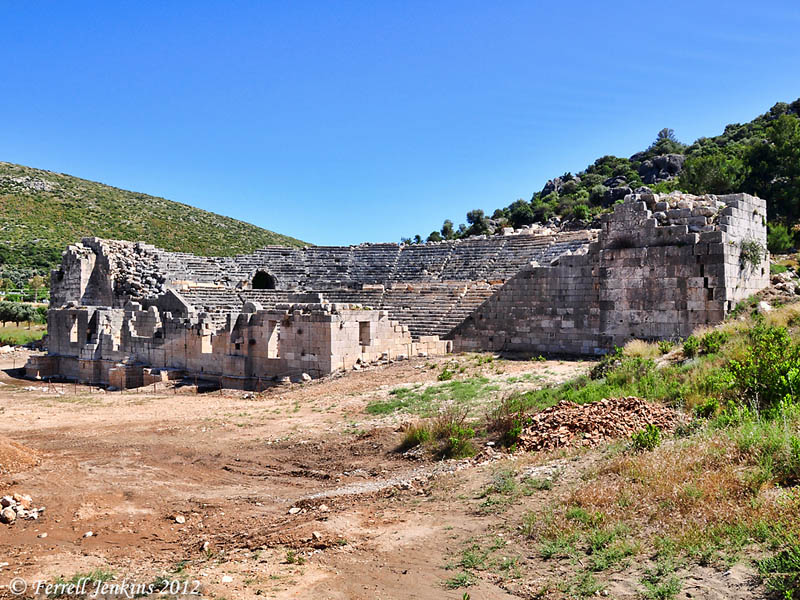
Our last photo shows the theater which was built in the Hellenistic period, but was rebuilt in the time of the Roman Emperor Tiberias (A.D. 14-37). It seated more than 6,000 people.

Theater at Patara. Photo by Ferrell Jenkins.

Theater at Patara. Photo by Ferrell Jenkins.

Use the search box for posts about some of the other places mentioned in Acts 21: Rhodes, Cyprus, Tyre, Ptolemais, and Caesarea.

Acts 20–21 — Paul’s Travel Itinerary with Photo Illustrations

The precision and chronological exactitude with which this journey is recounted is amazing. F. F. Bruce says,

The description of this critical journey of Paul and his disciples to Jerusalem is given in considerable detail; some have compared the detailed description in the Third Gospel of Jesus’ critical journey to Jerusalem with His disciples. But the kind of details is different; the chronological exactitude of this second “we” narrative of acts is due mainly to the fact that Luke was one of the party and kept a log-book. (The Book of Acts in the NICNT, 407).

Acts 20:6    —    Paul left Philippi “after the days of Unleavened Bread”(Passover). He was hurrying to be in Jerusalem “on the day of Pentecost” (20:16). This would be 50 days after Passover. He had been in Ephesus on Pentecost one year earlier (1 Cor. 16:8).
Acts 20:6    —    Paul came to Troas within 5 days. Tarried 7 days. A “door” had been opened for Paul at Troas less than a year earlier, but he was not able to enter it (2 Cor. 2:12).
Acts 20:7    —    On the first day of week — gathered together with the disciples to break bread.
Acts 20:11    —    Monday (or ? Sunday) — Paul departed. This depends on whether they followed the Jewish practice of sundown beginning the new day, or the Roman practice of mid-night to mid-night.
Acts 20:13-14    —    Assos. Paul’s companions went by boat from Troas to Assos. Paul traveled overland.
Acts 20:14    —    Mitylene (on the island of Lesbos).
Acts 20:15    —    Following day — opposite Chios.
Acts 20:15    —    Next day — Samos.

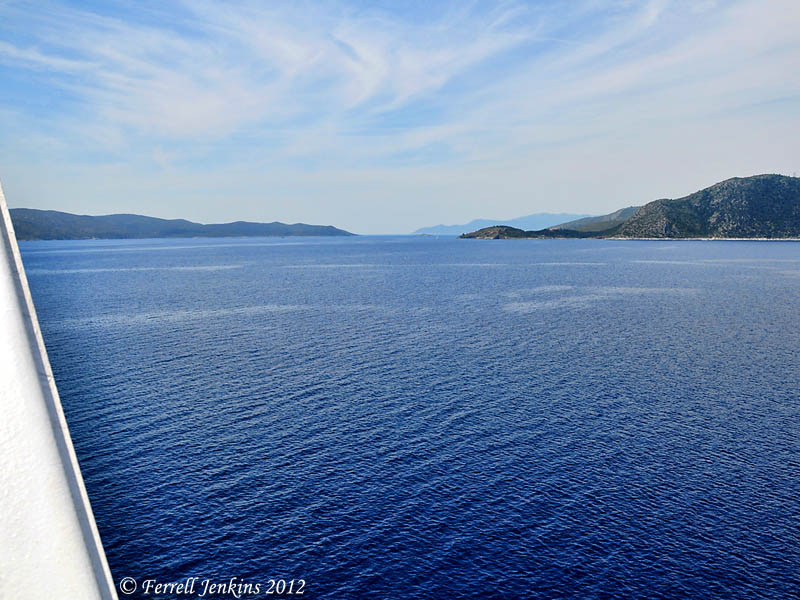
The photo below was made from a ship after it passed from north to south through the narrow strait between Samos (on the left) and the Turkish coast (on the right).  The ancient site of Trogyllium is located on the small peninsula extending into the Aegean Sea.

Samos-Turkey Strait. View North. Photo by Ferrell Jenkins.

View north of the Samos-Turkey Strait. Photo by Ferrell Jenkins.

Acts 20:15    —    Tarried at Trogyllium. (Appears in Western and Byzantine texts and in the KJV and NKJV.) The omission of the name in most manuscripts is explained by Bruce M. Metzger:

“Chiefly because of superior external attestation, a majority of the Committee preferred the shorter text” (A Textual Commentary on the Greek New Testament, 478).

Ramsay points out that the information is,

“in itself highly probable, for the promontory of Trogyllian or Trogylia projects far out between Samos and Miletus, and the little coasting vessel would naturally touch there, perhaps becalmed, or for some other reason” (The Church in the Roman Empire, 155).

Acts 20:15    —    The day following — Miletus.

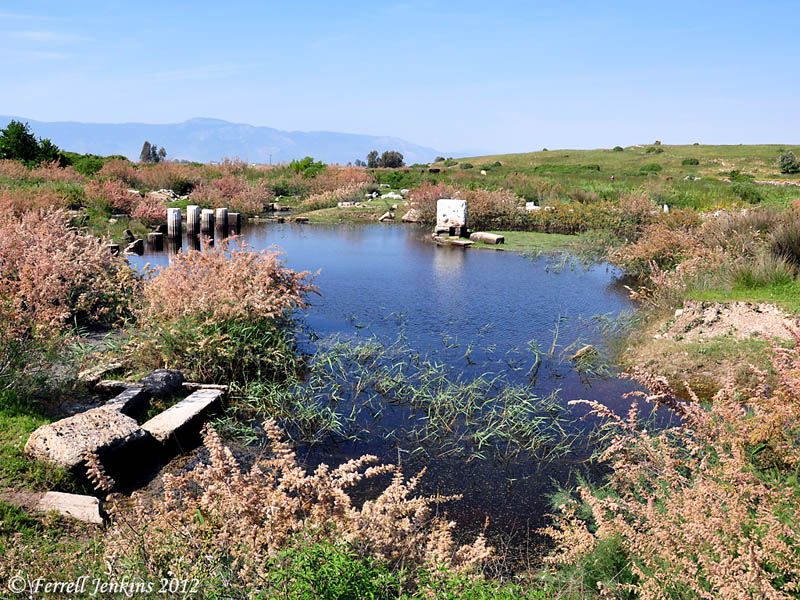
This photo shows some standing water in the Lion Harbor of Miletus.

Ruins of the Lion Harbor at Miletus. Photo by Ferrell Jenkins.

Ruins of the Lion Harbor at Miletus. Photo by Ferrell Jenkins.

Acts 20:16    —    Paul had decided to sail past Ephesus — to be in Jerusalem on Pentecost (fifty days after leaving Philippi).

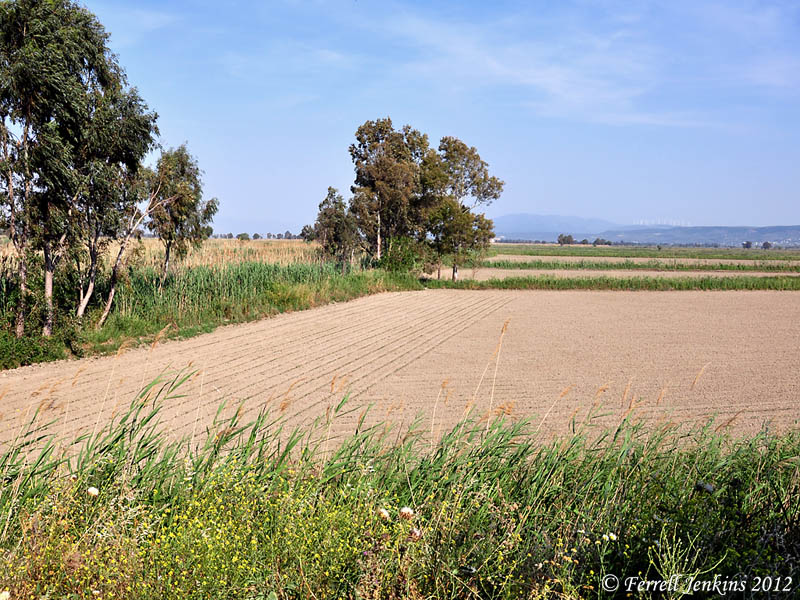
From Miletus Paul sent for the Ephesian elders. Consider the distance. How long would it take the courier to go to them and for them to come to him at Miletus? The distance was 63 miles by land or 38 if they went across the gulf of Latmos. This gulf is now silted up, leaving only a small inland lake.

The photo shows the site of the Gulf of Latmos which is now silted up. Turkish farmers grow rice in the area. The Meander River flows to the left of this photograph.

Site of Lake Latmos, now silted up, within two miles of Miletus. Photo by Ferrell Jenkins.

Site of the Gulf of Latmos, now silted up, within 2 miles of Miletus. Photo: F. Jenkins.

Acts 21:1    —    Set sail on a straight course to Cos.

  •  Next day to Rhodes. Tradition identifies this stop at St. Paul’s Bay at Lindos.
  • Patara.
  • Patara to Tyre. According to Chrysostom this trip took five days (Homily XLV.2; cf. Bruce, The Book of Acts in NICNT  421). They were always at the mercy of the wind. When they came within sight of Cyprus they sailed past to the south of the island as they headed to Syria (21:3).

Acts 21:4    —    Tyre — Paul tarried 7 days (note 20:6-7).
Acts 21:7    —    Ptolemais [modern Acre in Israel] — stayed one day.
Acts 21:8    —    Caesarea. They arrived the next day. The text does not say whether they went by boat or land. At Caesarea they stayed with Philip for “many days” (21:10).

Acts 21:15-17    —    Up to Jerusalem of Judea (cf. 21:10).

Acts 21:18    —    The following day Paul and the others visited James and the elders.

If our study of the Book or Acts, or any book of the Bible, is only a cursory one without attention to details, we miss much of what was intended for us.

Note: Use the Search Box to locate posts about Philippi, Assos and Mitylene, Ephesus, Miletus, Rhodes, Tyre, Ptolemais, and Caesarea.

Acts 19 — Photo Illustrations

Ephesus is one of the most excavated sites from the Biblical world. Teams of Austrian archaeologists have worked at the site since 1895.

Items of interest at Ephesus include the single standing column of the Temple of Diana (Artemis), the harbor which is now silted up, the great theater which seated nearly 25,000 (Acts 19:29), the Marble street, the Library of Celsus, the Agora, the Temple of Hadrian, the Temple of Domitian (or the Flavian Emperors), and much more.

The first instance of believers baptized into Christ at Ephesus is recorded in Acts 19. Many changes took place in the church between the time when Paul spent nearly three years in the city, and the time when John lived there. There are two letters in the New Testament addressed to the church at Ephesus. The first is the letter of Paul to the Ephesians. The other is the letter included in the book of Revelation (Revelation 2:1-7).

Yamauchi comments on the size of Ephesus in the first century:

“In the New Testament era it was probably the fourth greatest city in the world (after Rome, Alexandria, and Antioch) with a population of about 250,000” (Archaeology of New Testament Cities, 79).

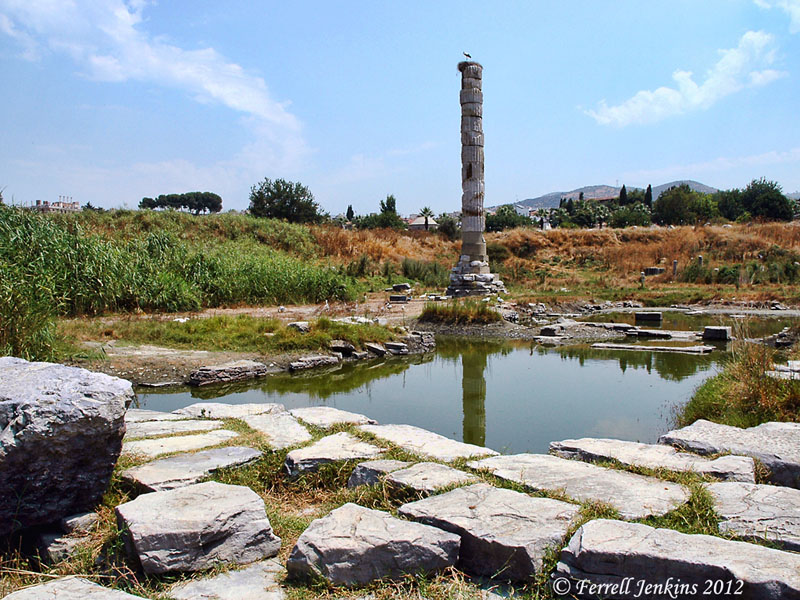
The photo below shows the site of the Temple of Artemis (Diana). Notice the stork standing on top of the sole standing column. Click on the photo for a larger image.

The site of the Artemis temple at Ephesus. Photo by Ferrell Jenkins.

The site of the Temple of Artemis at Ephesus. Photo by Ferrell Jenkins.

The ruins of the famous temple were discovered in 1869 by J. T. Wood, an English engineer.  Pausanias, the second century A.D. geographer, said the “temple of Diana surpassed every structure raised by human hands.” The temple was four times as large as the Parthenon. The platform of the temple was 239 feet wide by 418 feet long. The temple itself was 180 feet wide by 377 feet long, and the roof was supported by more than 100 sixty-foot columns. The temple served as a bank and a place of asylum for criminals. The earliest stage of the temple was built about 600 B.C. The Hellenistic temple which Paul and John saw was destroyed in A.D. 262.

Acts 18 — Photo Illustrations: the Emperor Claudius

Claudius was the emperor of Rome from A.D. 41-54. This was a time when the message of Christ was spreading across the Roman Empire beginning from Jerusalem (Acts 1:8; 9:15). Much of the ministry of Paul took place during this period.

Claudius is mentioned twice in the Book of Acts.

  1. The great famine which affected the Empire during the time of Claudius prompted the disciples at Antioch to send relief to their brethren living in Judea (Acts 11:28-30). This is thought to have occurred about A.D. 46.
  2. The Emperor ordered all Jews to leave Rome. Because the Christians were considered by many as a sect of the Jews, Aquila and Priscilla left and went to Corinth where they met Paul (Acts 18:1-3). Paul was at Corinth for a period of 18 months between A.D. 51-53.
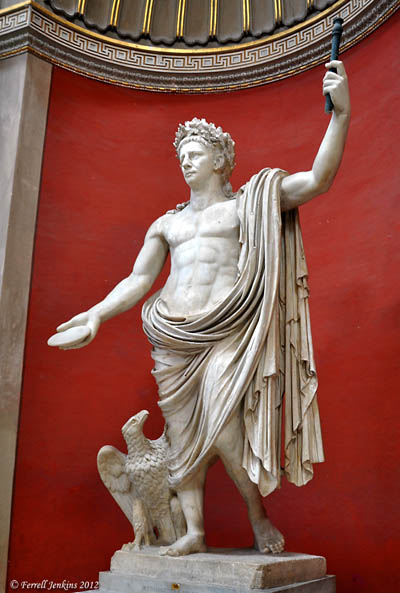
Emperor Claudius (37-54 A.D.). Vatican Museum. Photo by Ferrell Jenkins.

Emperor Claudius (41-54 A.D.), shown as Jupiter, wearing the civil crown of oak leaves and with the eagle at his feet. Found at Lanuvio, Italy, in 1865.Vatican Museum. Photo by Ferrell Jenkins.

The beautiful sculpture of Claudius is now displayed in the Vatican Museum.

Acts 17 — Photo Illustrations

Paul came to Thessalonica on his second journey (A.D. 50-53; Acts 17).

Now when they had passed through Amphipolis and Apollonia, they came to Thessalonica, where there was a synagogue of the Jews. (Acts 17:1 ESV)

Thessalonica (called Thessaloniki now) is in biblical Macedonia. The area is still known as Macedonia, but is not to be confused with the modern country by that name. It is marked on maps of Greece as FYROM (former Yugoslav Republic of Macedonia). I know too little about the dispute to make any comments.

Paul wrote two letters to the church at Thessalonica while he was at Corinth. Aristarchus, a Macedonian of Thessalonica accompanied Paul on the voyage to Rome (Acts 27:2). When Demas forsook Paul he went to Thessalonica (2 Timothy 4:10).

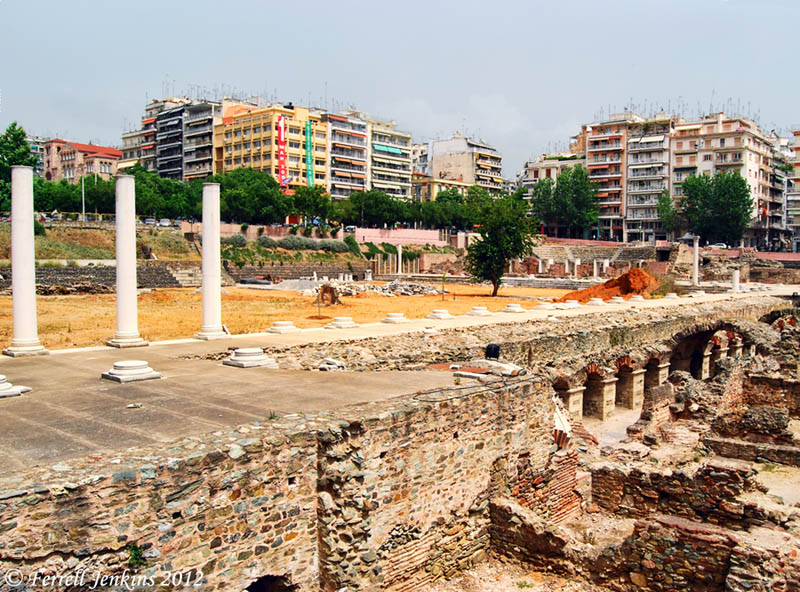
The photo below shows excavated ruins of the 2nd-3rd century A.D. Roman Forum in the center of the modern city of Thessalonica. Fant and Reddish comment on the Forum:

Extensive, ongoing excavations are being conducted in this area. Likely the same site was the location for the Hellenistic agora as well. The forum originally covered two extensive terraces. The forum originally covered two extensive terraces. The one to the north contained a large courtyard surrounded on four sides by two-story stoas; to the rear of the stoa on the east side stood the odeion, originally a theater for music and performances, later converted into an arena for gladiatorial contests. (A Guide to Biblical Sites in Greece and Turkey, 137).

Roman forum in the center of Thessalonica. Photo by Ferrell Jenkins.

Roman Forum in the center of Thessalonica. Photo by Ferrell Jenkins.

I think if you click on the photo to enlarge it, you will see the odeion to the right of the image.

There are several posts about Thessalonica on this blog. Just put the word Thessalonica in the Search Box. You will also find posts about Amphipolis, Berea, and Athens.