Category Archives: blog

Christmas article gets attention in London

Clay Harris, formerly (perhaps, still) with the Financial Times, calls attention to “The Truth About Christmas” which is posted on our Biblical Studies Info Page here, and at Bible World. Harris argues for an appropriate secular observance of Christmas in his post in The London Echo here.

Two years ago I wrote about the origin of the legend about Santa Claus in a post on “Christmas, St. Nicholas, and Myra” here.

Take a look at all of this material.

Preparing for a Trip to Israel

Occasionally I get a request from someone planning their first trip to Israel asking for suggestions on books to help them prepare for the trip.

There are some excellent books we suggest for your study before and during the tour. Below is a list of books which we recommend for your use. Begin with The Holy Land by Murphy- O’Connor. It will take you a while to read and mark the book. You will enjoy the book much more once you return home and begin to use it as a resource. Of course, this is true of many of the books listed here.

  • Baly, Denis. Basic Biblical Geography (Fortress) paperback. Brief introduction. Any books by Baly can be helpful.
  • Beitzel, Barry J. The Moody Atlas of Bible Lands (Moody). A complete atlas of Bible lands.
    Dyer, Charles H. and Gregory A. Hatteberg. The Christian Traveler’s Guide to the Holy Land. Broadman and Holman, 1998.
  • Eyewitness Travel Guides. Jerusalem & the Holy Land. DK Publishing. This book has beautiful plans of the buildings.
  • Frank, Harry Thomas (ed.). Atlas of the Bible Lands (Broadman). Concise atlas; good maps.
  • Hoppe, Leslie J. A Guide to the Lands of the Bible. Liturgical Press., 1999. Cover Israel, Jordan, and other areas.
  • Miller, Max. Introducing the Holy Land. This book is out of print, but you might be able to locate a used copy.
  • Murphy-O’Connor, Jerome. The Holy Land (Oxford), paperback. Excellent.
  • Page, Charles R. and Carl A. Volz, The Land and the Book (Abingdon).
  • Ullian, Robert, ed. Israel: Past and Present. A beautiful guide to the 16 top archaeological sites in Israel. Overlays illustrate how the sites might have looked in ancient times.
  • Vos, Howard F. The Wycliffe Historical Geography of Bible Lands (Hendrickson). This is the completely revised 2003 edition. The book was originally published in 1967, edited by Pfeiffer and Vos. Excellent.

The books we have listed above are not typical travel books, but accurate, scholarly books. Some are in a popular style. Travel books can be helpful, however. Many sites you visit will offer small booklets about those places.

If you can only buy three books, I suggest Murphy-O’Connor, Eyewitness Travel Guides and Hoppe.

Some of the popular travel guides that provide good info include: Let’s Go Israel, Fodor’s, Lonely Planet, and Rough Guides. The last two guides are intended primarily for individual travelers, but I find them helpful.

You may order any of these books from Amazon by going to our Biblical Studies Info Book Store here.

Internet Sites. What web pages would be helpful for the first time (or repeat) traveler? Obviously I suggest Ferrell’s Travel Blog and the BiblePlaces Blog by Todd Bolen. You will need to use the search box to search for posts dealing with places you plan to visit.

Go to the Biblical Studies Info Page here. Click on Bible Places. There you will find many links to specific places in Israel and other countries. I suggest you also go to the Scholarly Page and check the Archaeology section and the Blogs. Todd Bolen’s BiblePlaces is an excellent source. You will likely find good information and photos from the places you plan to visit.

The books may be ordered at a discount from Amazon at the Biblical Studies Info Bookstore. Perhaps some of our readers with experience in traveling to the Bible lands will add some additional suggestions in comments.
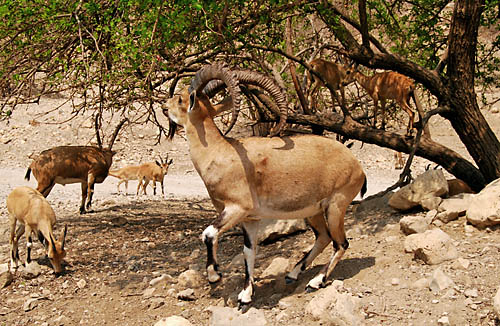
Ibex at En Gedi near the Dead Sea. Photo by Ferrell Jenkins.

Ibex at En Gedi near the Dead Sea. Photo by Ferrell Jenkins.

Buying the best Bible Software

Logos_iconAs time permits I am trying to catch up on some of the blogs that I follow. I see that C. Michael Patton has a post at Parchment and Pen (I love that title) on “The Other Best Bible Software.” He is talking about Logos Bible Software. The other one he reviewed earlier is BibleWorks 8. Michael says he uses both. So do I.

Every young preacher should stop buying junk, ready-mixed pabulum, and get some real tools. Another advantage is that you will have no books to loan! Read Patton’s review here.

You will find some comments about the free software that so many preachers and teachers use.

The earlier review about BibleWorks 8 is here.

David Instone-Brewer, Tyndale Tech, has also written recently about Logos Libronix 3 here.

Morris Proctor is an (the?) authorized trainer for Logos Bible Software. His Tips and Tricks are helpful. You might also find a helpful note at the Logos Blog.

You will also find notes about both of these programs at Biblical Studies and Technological Tools.

Recently I wrote here about the problem of having to use Pradis to have access to Zondervan publications. In recent weeks, Zondervan and Logos announced that Zondervan books will be available from Logos. Good news. Now we must wait to see have much (or little?) we will have to pay for the conversion of the programs we already have.

Do your best to present yourself to God as one approved, a worker who has no need to be ashamed, rightly handling the word of truth. (2 Timothy 2:15 ESV)

Make every effort to present yourself before God as a proven worker who does not need to be ashamed, teaching the message of truth accurately. (2 Timothy 2:15 NET)

Luke Chandler on Israel National Radio

We have had several things to say about Luke Chandler and his participation in the archaeological dig at Khirbet Qeiyafa (the Elah Fortress) a few weeks ago. This is because Luke is a friend and a former student. Luke has been interviewed by Gordon Govier on The Book and the Spade program. That interview emphasized the role of volunteers in archaeology.

Willner & Selevan

Willner & Selevan

Now he has been interviewed for the Judean Eve program on Israel National Radio to discuss the use of blogs in reporting on archaeological work. To hear this interview you must look for the program entitled Tell Me About Digs. Click on Part 2 to listen or download the mp3 file. Follow this link for the interview. Luke’s blog may be found at lukechandler.wordpress.com.

There is another interview on the same program with some guy named Herschel Shanks.

Khirbet Qeiyafa is an important site historically because of the part it plays in the account of the conflict between Israel and the Philistines (David and Goliath). See 1 Samuel 17 for the full story.

Reaching 200,000 hits

Overnight we registered our 200,000th hit on this blog. Our first post was May 2, 2007. Since that time we have covered two trips to Israel, two trips to Turkey, a trip to Greece and the Greek islands, a trip to Egypt, and a trip to Scotland. In addition we have reported on numerous archaeological developments and posted info on many biblical places and customs.

Actually we passed the 200,000 mark more than a week ago. Back in May we reported here on losing 3380 hits on our counter overnight.

Thanks should be extended to several people.

  • Thanks to WordPress for making this wonderful opportunity available at no cost. I would like to encourage everyone who thinks they have something worthwhile to say to get a blog and begin writing.
  • Thanks to our readers. The number has grown consistently in the past two years. We are delighted that you continue to check our blog. It has been fun to watch the increase of the traffic ranking at Alexa.
  • Thanks to everyone who has sent tips about items of interest that you think we should cover. Most of these come from acquaintances by email rather than as comments to the blog.
  • Thanks to Todd Bolen at blog.bibleplaces.com and BiblePlaces.com for his link to our page. Todd has called attention to this page several times and it has helped to increase the number of our readers.
  • Thanks to my wife for proofing many of the posts. I always appreciate her help.
  • Technological thanks to Nikon, Canon, and Adobe PhotoShop.

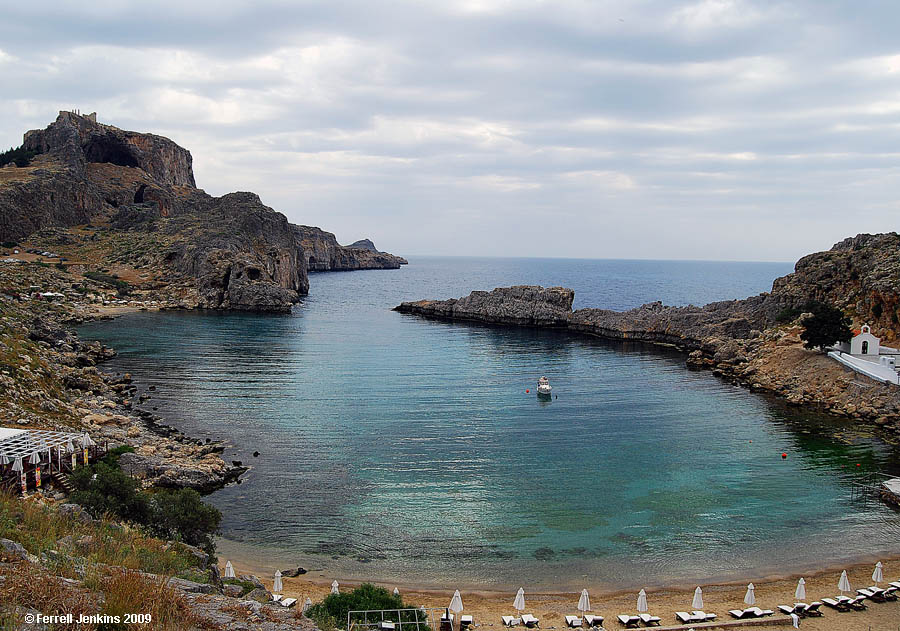
I would like to share a photo that is large enough to be of use to those who use visuals in teaching. This is a picture of St. Paul’s Bay on the island of Rhodes. Click on the photo for a larger image. For information about the place check our post for May 17, 2008.

St. Paul's Bay at Lindos, Rhodes. Photo by Ferrell Jenkins.

St. Paul's Bay at Lindos, Rhodes. Photo by Ferrell Jenkins.

Laodicea Photos

Laodicea is known to us from the book of Revelation (1:11; 3:14-22), and from Paul’s epistle to the Colossians.

For I testify for him that he has a deep concern for you and for those who are in Laodicea and Hierapolis. Luke, the beloved physician, sends you his greetings, and also Demas. Greet the brethren who are in Laodicea and also Nympha and the church that is in her house. When this letter is read among you, have it also read in the church of the Laodiceans; and you, for your part read my letter that is coming from Laodicea. (Col 4:13-16 NAU)

Ben Witherington has posted several nice photos recently made at Laodicea. Take a look here. These photo are high resolution and may be reduced and enhanced a bit for use in class and sermon presentation. Ben concludes his post with these words:

There is much more to be said, but let this be said at this juncture.  The archaeological evidence at Laodicea simply confirms what the NT suggests about the city– it was large,  rich in the first century, a city materially on the rise, but sometimes prosperity has a deadening effect on spirituality as John of Patmos reminds.   The reconstruction of the city today is a work still in progress— but then, so are we. If even Laodicea warrants a visit from the Master who knocks and promises to enter and sup with them, despite all its sin and shortcomings, then there is still hope for us.

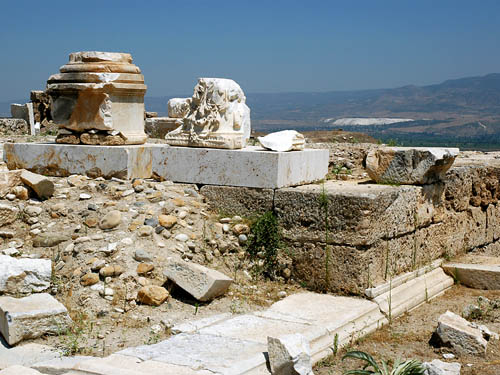
The photo below is one I took showing what was labeled “North Temple” at the time. I see on the new sign Ben includes among his photos the structure (# 15) is labeled “Corinth Temple and North Basilica.” The white area on the hillside across the Lycus River valley marks the limestone formations of Hierapolis (Colossians 4:13; modern Pamukkale).

Temple ruins at Laodicea. View north to Hierapolis. Photo by Ferrell Jenkins.

Temple ruins at Laodicea. View north to Hierapolis. Photo by Ferrell Jenkins.

Thanks, Ben. We look forward to more good material from Turkey.

We called attention to the water distribution system of Laodicea here.

HT: Brooks.

Reverse Reading?

Overnight we lost 3380 hits. Long ago I put a simple counter, supplied by WordPress, on this page. There is also a stats chart that I can see when I login. The chart was based on some time zone other than the one in which I live. So, each morning when I am home I write down my own daily stats. When I opened the page to do that this morning I noted that I had 3380 hits less than yesterday morning.

What happened to all of my readers? Maybe you had been reading and decided to take it back! I don’t know what happened, but I see that WordPress has changed the stats chart to match my time zone. I don’t know how that could have messed up the total number. Anyway, deep in my heart I know you have been here. The count this morning should have been about 170,685 +/-. I was looking forward to a big 200,000-hit party and inviting each of you to come read and see. Don’t know what I will do now.

More importantly, my ranking at Alexa has continued to improve significantly. Thanks for coming my way.

Thanks for following our tours

Thanks to your interest we noticed an increase in readers during our trip to Egypt. We appreciate your interest in the subjects we write about.

A blog is different from a web page. On a web page, such as the Biblical Studies Info Page, there are many categories and pages available. When you check the blog you see the last entry at the top of the page. You must click on the Archives listing, or use the Search Box to locate earlier posts.

A list of some other trips we have covered on this blog might be helpful to you (from the most recent to the earliest).

  • Egyptian Adventure (begin January 16, 2009).
  • Israel (personal study) trip (begin August 20, 2008).
  • Steps of Paul and John (Greece and Turkey) (May, 2008).
  • Bible Land Tour of Israel and Jordan (April, 2008).
  • Scotland Highlights (September 2007).
  • Biblical & Historical Sites in Turkey (May and June, 2007).

The purpose of these trips is educational. We seek to relate the history and the land to the biblical account.

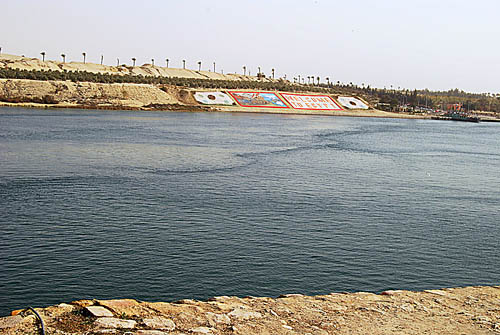
Suez Canal near Ismailia. Photo by Ferrell Jenkins.

Suez Canal near Ismailia. Photo by Ferrell Jenkins.

This view of the Suez Canal at Ismailia looks from the east to the west. The ancient Egyptians dug numerous canals in the general area. This modern canal was officially opened November 17, 1869.

We would like for you to continue to check the blog several times a week as we write about other matters of interest to Bible students.

No opportunity to post tonight

We are on a Nile River cruise boat. Even though I uploaded some photos last night, I was told tonight that it would cost $25 for 30 minutes if I uploaded any photos, etc. Since I don’t have a “Donate to this web site now” on my blog I will just wait until I can get to an Internet cafe in Aswan tomorrow night, or Friday night in the hotel in Cairo.

Thanks for keeping in touch. I appreciate the interest you have in this trip.

Newsweek attacks biblical authority & marriage

Perhaps you have already seen the cover, and cover story, of Newsweek (Dec. 15, 2008). The cover, showing a drawing of a Bible, touts the main article by Lisa Miller, “The Religious Case for Gay Marriage.” Miller is the religion editor of Newsweek.

Rather than write my own reply, I would like to direct you to the Blog by R. Albert Mohler, Jr. Read it here.  Mohler correctly points out that the real issue in this discussion is one of biblical authority.

As always, the bottom line is biblical authority.  Lisa Miller does not mince words.  “Biblical literalists will disagree,” she allows, “but the Bible is a living document, powerful for more than 2,000 years because its truths speak to us even as we change through history.”  This argument means, of course, that we get to decide which truths are and are not binding on us as “we change through history.”

Newsweek editor Jon Meacham says,

No matter what one thinks about gay rights–for, against or somewhere in between–this conservative resort to biblical authority is the worst kind of fundamentalism. Given the history of the making of the Scriptures and the millennia of critical attention scholars and others have given to the stories and injunctions that come to us in the Hebrew Bible is more than intellectually bankrupt–it is unserious, and unworthy of the great Judeo-Christian tradition. (Newsweek, Dec. 15, 2008, p. 4)

Well, there you have it. The editor of Newsweek has resolved this matter with one editorial.

If you are interested in a good study of this subject you might enjoy the video by Dr. Robert Gagnon, author of  several works on Homosexuality and the Bible, here. Or, read Dr. Gagnon’s 26 page response to the Miller article here.