Category Archives: Biblical Studies

Sargon II, Ashdod, and Isaiah 20:1

Ashdod was located along an international highway known as the Way of the Sea, the Way of Philistia, or the Via Maris. This was the important route connecting Egypt and Assyria. We have already discussed, in the past few posts, that the Assyrian king Sargon II captured Ashdod in 712/11 B.C. The prophet Isaiah makes reference to this event in Isaiah 20:1.

 The LORD revealed the following message during the year in which King Sargon of Assyria sent his commanding general to Ashdod, and he fought against it and captured it. (Isa 20:1 NET)

Sometime discoveries are made, but get little attention. A discovery at Tel Ashdod in 1963 falls into this category. Tel Ashdod was excavated from 1962 to 1972 under the direction of Moshe Dothan. David Noel Freedman wrote an article in Biblical Archaeologist (26:4, 1963)) about “The Second Season at Ancient Ashdod.” He describes the fragments of a stele of Sargon II.

Fragments of another stele, commemorating the victories of Sargon, were found at Ashdod during the current season, thus offering direct confirmation and vivid illustration of the biblical and Assyrian accounts. In all, three pieces of the stele were discovered. Enough can be made of their contents to show that the inscription duplicated in content if not precisely in wording other victory steles of the Assyrian king. By comparing the Ashdod stele with the others it will be possible to reconstruct the missing parts, one of which described the actual conquest of Ashdod. The inscription was carved in cuneiform signs characteristic of Sargon and his period, on all four sides of a slab of basalt which had been imported from a region north of Megiddo. It may have served as a pedestal for an obelisk, or a statue of the emperor. It must have been erected between the year of victory at Ashdod and the death of the king in 705 B.C., perhaps in 707 when a similar stele was set up in Cyprus. With the accession of Sennacherib in 704, most of the vessel countries revolted; Hezekiah of Judah and Sidqa of Ashkelon were the ringleaders in the west. They were able to liberate Ashdod from Assyrian control, and doubtless the event was observed by the destruction of Sargon’s victory stele, symbol of foreign oppression. These fragments of a monumental Assyrian inscription are the first ever found in Palestine.

The photos below were published in an article by Hayam Tadmor (“Philistia Under Assyrian Rule.” Biblical Archaeologist (29:3, 1966). Several years ago I used a digital camera to copy the photo. Sorry it is not better, but at least you can see the pieces. A photo of the piece in the middle below is also published in a BAR article (Jan-Feb, 2007) by H. Shanks on the “Assyrian Palace Discovered in Ashdod,” but the quality is about the same.
Fragment of the Sargon II inscription found at Ashdod.

Fragment of the Sargon II inscription found at Ashdod.

For several years the fragments were displayed in a case across from the replica of the Siege of Lachish in the Israel Museum. For the past years the fragments have not been on display. I made inquiry at the Museum earlier this year without any success. I wonder if the pieces have been moved to the Corine Maman Museum of Philistine Culture in Ashdod. Can anyone help with this?

This discovery is one of those that complement the biblical record. Sargon II (721–705 B.C.) is mentioned only once in the Bible — Isaiah 20:1. Isaiah says that the commanding general of Sargon II fought against Ashdod and captured it.

The photo below shows Sargon II (right) facing a person who is generally considered to be an Assyrian high dignitary. (See the discussion in Fant & Reddish, Lost Treasures of the Bible, 133-140.
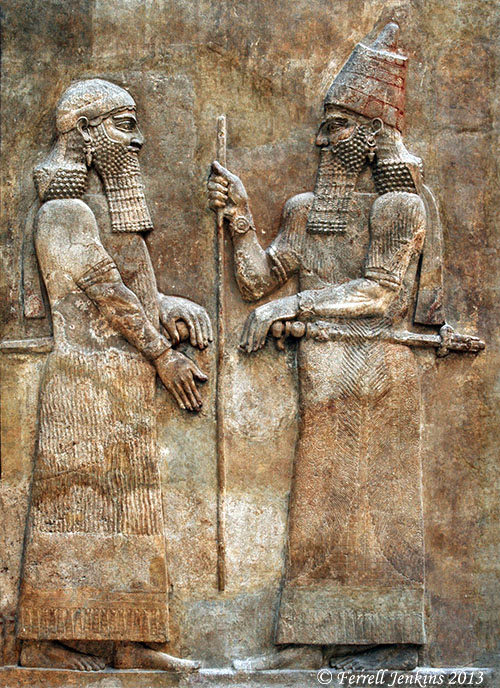
Sargon II and an attendant. Displayed in Louvre. Photo by Ferrell Jenkins.

Sargon II and an official. Displayed in Louvre. Photo by Ferrell Jenkins.

Jack Finegan says of the reference to Sargon II in Isaiah 20:1,

… for a long time this was the only place in extant literature where his name was known.

The palace of Sargon II was discovered by Paul Emile Botta at Khorsabad in 1843. This relief comes from that palace, and is displayed in the Louvre. Other reliefs and artifacts from the palace are exhibited in the British Museum and the Oriental Institute of the University of Chicago.

Written copies of Isaiah existed in what we know as the Dead Sea Scrolls nearly 2000 years before the discovery of Sargon’s palace and archive. Perhaps we should be slow to think of Isaiah and other biblical writers as being unhistorical. To say this in a positive way, this illustrates the historical trustworthiness of the Bible. That the only reference to Sargon is specifically linked to Ashdod is even more impressive.
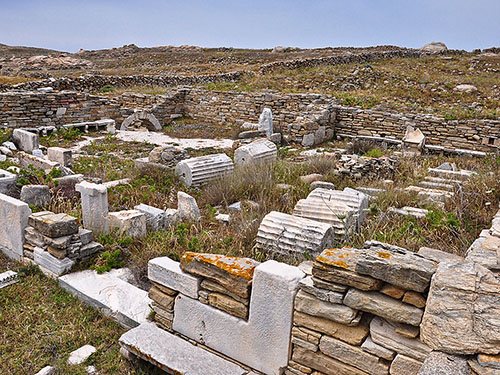
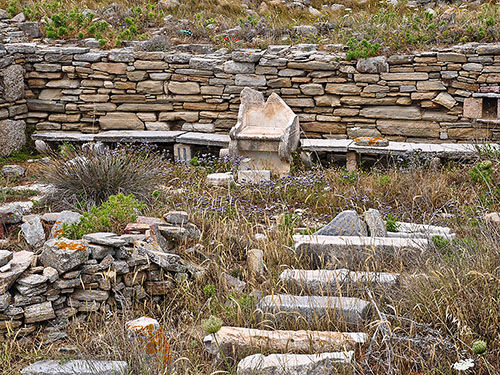
A synagogue on the island of Delos

In the previous post we mentioned that there were numerous synagogues used by Jews of the Diaspora. Paul visited synagogues in many of the cities where he preached.

During his Spring travels, Dr. Carl Rasmussen visited the Greek island of Delos. Delos is one of those places that can only be reached with much effort. Carl has graciously granted permission for me to use a couple of his photos here. The first one shows a view to the west, southwest, showing various rooms of the synagogue. Note the “Moses Seat” in the upper right of the photo. The entrance is visible in the lower left.

Delos synagogue. Photo by HolyLandPhotos.

Delos synagogue. Photo by Carl Rasmussen, HolyLandPhotos.

The second photo shows a close up of the “Moses Seat” and the marble seats on each side. You may click on the photos for larger images provided by Dr. Rasmussen at the HolyLandPhotos’ Blog.

Delos synagogue. Photo by Carl Rasmussen, HolyLandPhotos.

Delos synagogue. Photo by Carl Rasmussen, HolyLandPhotos.

This large synagogue dates to the mid-second century B.C. Two inscriptions found in 1979-80 indicate that the worshipers here (Israelites) were likely Samaritans who revered Argarizein (Mount Gerizim). (See Kraabel, “New Evidence of the Samaritan Diaspora has been Found on Delos.” BA 47:1; 1984).

The Moses Seat. We commonly identify a special seat like the one in this synagogue as the Seat of Moses. Jesus may have made reference to such a seat (Matthew 23:2-3). For more information about the “Moses Seat” see here. Michael White suggests at least the possibility that this seat may be a “Proedrion, either for the major donor (or patron) or for the leader of the group” (HTR 80:2 (1987). I don’t see that this changes the fact that a reader and teacher of the Law might sit here.

If you have any interest in the synagogues scattered over the Mediterranean world, you will want to visit the HolyLandPhotos’ Blog here.

Tradition has it that Delos is the birthplace of Apollo, the son of Zeus, and his twin sister Artemis.

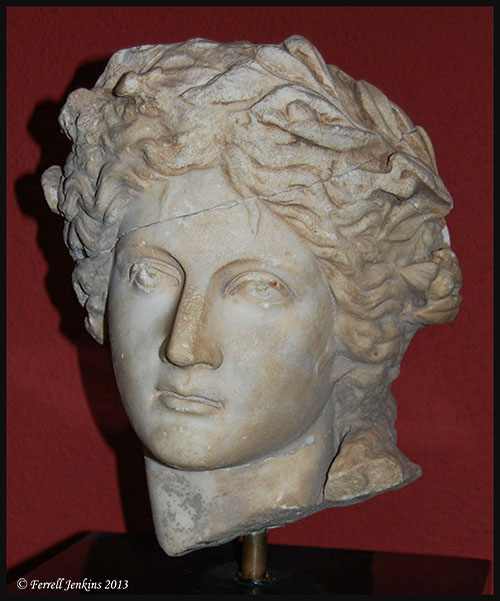
Marble head of Apolls from Perga. Second century A.D. Photo by Ferrell Jenkins.

Marble head of Apolls from Perga. Second century A.D. Photo by Ferrell Jenkins in the Antalya Archaeological Museum.

An article by Gordon Franz a few years ago piqued my interest in Delos. He wrote on “The Synagogue On The Island Of Delos And The Epistle Of James” in Bible and Spade (18:3; 2005). Franz provides the history and geography of the island. He includes a photo of the “Samaritan inscription,” and then proceeds to use the synagogue of Delos to illustrate two passages from the Epistle of James. He discusses James 2:2-4 and selected verses from James 3.

For those who have an interest in visiting Delos, Prof. Rasmussen explains exactly how to reach the synagogue from the Delos Museum. Rasmussen is author of the Zondervan Atlas of the Bible, and provides nearly 4000 thousand photos at the Holy Land Photos archive.

Free Ebook for Kindle

How the Bible Came to Be is an Ebook short (about 60 pages) from The Baker Illustrated Bible Handbook. It is available free today only (May 25). The link I am including is only good for the United States.

Here is a list of the subjects covered.

  • Inspiration
  • Production and Shaping of the Old Testament Canon
  • Writing, Copying, and Transmitting the New Testament Text
  • The Canon of the New Testament
  • The Dead Sea Scrolls
  • The Septuagint
  • Bible Translation and the English Bible
  • Translations for the World

Use this link.

HT: Brooks Cochran

Does “Abba” mean “Daddy”?

You have heard it many times. Many of the things a preacher reads or hears sound good. So, he repeats it the next time he is speaking on a related topic. Then the members of the congregation begin to repeat it to their friends.

Child holding hand of adult.

But, is it true that Abba means something like daddy or papa?

In a series of posts beginning with the word FactChecker, Glenn T. Stanton  tracks down the origin of this idea to the German Lutheran New Testament scholar Joachim Jeremias in 1971. He also shows that several other reputable scholar responded in a scholarly way to the claim.

One of the sources he cites is a 1988 article by James Barr:

But in any case it was not a childish expression comparable with ‘Daddy’: it was a more solemn, responsible, adult address to a Father.

Ministers should read Stanton’s blog (here) before completing Sunday’s sermon.

And he said, “Abba, Father, all things are possible for you. Remove this cup from me. Yet not what I will, but what you will.” (Mark 14:36 ESV)

For you did not receive the spirit of slavery to fall back into fear, but you have received the Spirit of adoption as sons, by whom we cry, “Abba! Father!” (Romans 8:15 ESV)

And because you are sons, God has sent the Spirit of his Son into our hearts, crying, “Abba! Father!” (Galatians 4:6 ESV)

HT: BibleX

Florida College Lectures on Logos Pre-pub

Yesterday I explained a little about Logos Bible Software and their Community Pricing and Pre-publication Specials. Today I want to tell you about a set of Pre-pub books that are of special interest to me.

Florida College is an accredited (by the Southern Association) private liberal arts college that for decades has offered four years of Bible studies. The college does not accept funds from churches, but the board, administration and faculty are members of Churches of Christ that are often designated as non-instiutional.

Accreditation as a junior college was granted to Florida College in the mid-1950s, but the college continued to offer four years of Bible studies. Biblical Studies was the first accredited Bachelor’s degree to be offered in 1997.

Since its beginning in 1946, Florida College (earlier named Florida Christian College) conducted an annual Bible lecture program. Beginning in 1974 the main lessons in these lectureships were published in book form from the manuscripts of invited speakers. The speakers were teachers and ministers associated with Churches of Christ.

Melvin Curry followed Homer Hailey as chair of the Bible department after Hailey’s retirement in 1973. Nineteen of the volumes were edited by Curry. After that, it came my turn to edit ten volumes while I served as chair of Biblical Studies. Since my retirement in 2001, Daniel Petty has served as department chair and edited the annual lecture book.

FC Lectures 1996

There are a total of 38 volumes (1974–2011) in the series. Some of these volumes have been out of print for several years.

The Logos web site offers the following overview of the lecture books:

The Florida College Annual Lectures (1974–2011) brings you thirty-eight years of the college’s annual lectures series in complete written form. Prior to the first published lecture series in 1974, only content outlines were available.

Each volume includes fifteen or more lectures from contributors from various biblical fields, and focus on a specific theme. These themes deal with modern issues and are supported by recent scholarship. Learn what true worship entails. Discover how God can restore your life. Challenge yourself to share the gospel message. The Florida College Annual Lectures (1974–2011) (38 vols.) contains both informative and stimulating topics that allow you to apply the biblical principles found in its lectures to your daily walk with Christ.

With Logos, every word is essentially a link! Scripture references are linked directly to the Bibles in your library—both the original language texts and English translations. Logos Bible Software allows you to quickly move from the table of contents to your desired content and search entire volumes and collections by topic, title, or Scripture reference, making Logos the perfect software to expand your understanding of the Word.

How Pre-publication works. Books on Pre-pub will not be produced until Logos sees that there are enough orders to make the publication feasible. Interested customers lock in the pre-pub price. You must set up an account with Logos, but your card is not charged until the book or set is ready to deliver. You will be notified when the book is ready. At that time you have a choice to continue or cancel. You may have to wait 6 months or more until the work is ready.

The deal is great. This 38 volume set of Florida College Lectures is available on Pre-pub for $74.95. This set is scheduled to sell for $174 when it is published. Even that is a bargain.

In order for this great resource to become a reality, Logos need a few more people to agree to buy the completed work. Help yourself, and others, in this worthy effort.

Think about these 38 volumes for $75. There are more than 600 lectures. That’s about 12 cents per lecture. Even mine are worth that. The entire collection is searchable, along with all other works you have in your Logos collection. When a Scripture reference appears, simply mouse over it and the Scripture is visible in your preferred version of the Bible.

In a previous post here I have explained that you must have a Logos base package, or already have Logos on your computer.

Logos Bible Software is the premier digital publishing format for books dealing with Biblical Studies. If you are serious about Bible study, you need to investigate Logos.

Meanwhile. Go to the Logos web site and place your Pre-pub order NOW. The sooner Logos publishes, the sooner we can begin to utilize the search features in this entire set. You can always get to the information by going to Logos.com. Look under Products for the Pre-publication Specials. The direct link to info about the Florida College Annual Lectures, with a list of every lecture, is here.

Logos Community Pricing

Logos Bible Software has a feature called Community Pricing. It works like this. A book (or set) is chosen for publication. Interested persons are asked to place a bid on the completed digital publication. When there are enough bids to pay for publication the book is published. After the initial publication, the price goes up. I have purchased many Logos publications using Community Pricing and Pre-Publication Specials.

To use the Community Pricing or Pre-Pub specials you must already have Logos (or the older Libronix) on your computer. You may purchase a base package from Logos (here), or buy a relatively inexpensive set of books from someone like Rejoice Christian Software. I suggestion you buy something like the  Baker New Testament Commentary ($79.95 here), the Norman Geisler Apologetics CD-Rom Library ($29.95 here), or one of the other great specials they offer.

thompson_land-and-the-bookHere is a Community Pricing special too good to miss for anyone interested in the land of the Bible: The Land and the Book by William M. Thomson. This is an old work that is rich in information about the land and the culture of the Bible land.

Rich with scriptural landmarks and filled with hundreds of beautiful pen-and-ink illustrations, Thomson’s The Land and the Book has been a popular classic for over 100 years. Learn more about the people, places, and historical events behind the text you’re studying. Incorporate pictures, illustrations, and graphics into sermons, school papers, or Sunday school lesson plans. Whether you are a student, pastor, scholar, or layperson, the 3-volume Land and the Book is a must-have resource for Bible study or reading.

A work like this does not replace current studies, but it supplements them. Just go to Logos (here) and bid $18 on this work. If it sells for less you will pay less.
In the next post I will share another special pre-pub bargain.

The significance of Gaza

After my first tour to the Bible Lands, including Rome, Greece (Athens and Corinth), Egypt, Lebanon, Syria (Damascus), Jordan, and Israel, in April/May, 1967, I decided to make a second tour the following year. For many years, I always added some new places on each tour. In 1968 I added Beersheba and Gaza. The Gaza Strip (named such because of the long, narrow size of the small entity) had been under Egyptian control for several decades until June, 1967.

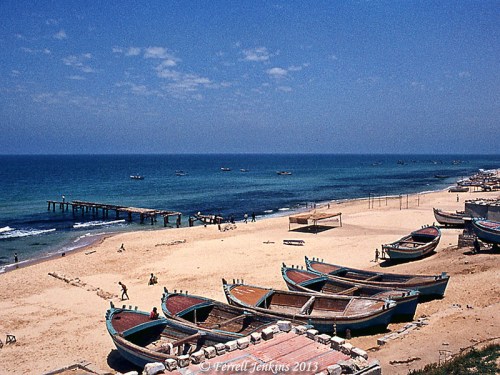
There was not much to see at Gaza. By the time we visited in 1968, Gaza was under Israeli control. We drove to the coast where there were only a few houses and some small fishing boats. This is one of the few slides that I have to illustrate the visit to Gaza.

Gaza on the Mediterranean Sea in May, 1968. Photo by Ferrell Jenkins.

Gaza on the Mediterranean Sea in May, 1968. Photo by Ferrell Jenkins.

Gaza is mentioned several times in the Old Testament. Here is a summary of these references.

  • Gaza was the southwestern boundary of the Canaanites in the table of Nations (Genesis 10:19).
  • The original inhabitants of Gaza were replaced by the Caphtorim, likely the ancestors of the Philistines (Deuteronomy 2:23).
  • Joshua defeated Canaanites “even as far as Gaza” (Joshua 10:41).
  • Joshua eliminated the Anakites except in Gaza, Gath, and Ashdod (Joshua 11:21-22). We recognized these cities as later belonging to the Philistines.
  • Gaza is listed as belonging to the tribe of Judah (Joshua 15:47; Judges 1:18).
  • The Midianites oppressed Israel, “as far as Gaza”, for seven years (Judges 6:4).
  • Samson had contact with the inhabitants of Gaza (Judges 16).
  • Gaza is listed as one of the five Philistine cities in the time of the Israelite Judges (1 Samuel 6:17).
  • Solomon controlled territory as far southwest as Gaza (1 Kings 4:24).
  • Hezekiah defeated the Philistines as far as Gaza and its territory (2 Kings 18:8).
  • Jeremiah makes reference to Gaza being conquered by Pharaoh (Jeremiah 47:1).
  • The prophets of Judah pronounced judgments upon Gaza (Amos 1:6-7; Zephaniah 2:4; Zechariah 9:5).

The only New Testament reference to Gaza is in Acts 8:26. Philip the evangelist was instructed to go south on the road that descends from Jerusalem to Gaza. English translators struggle with the issue of whether the city was desert, or the road leading to the city ran through a desert area. (I will leave that for some other time.)

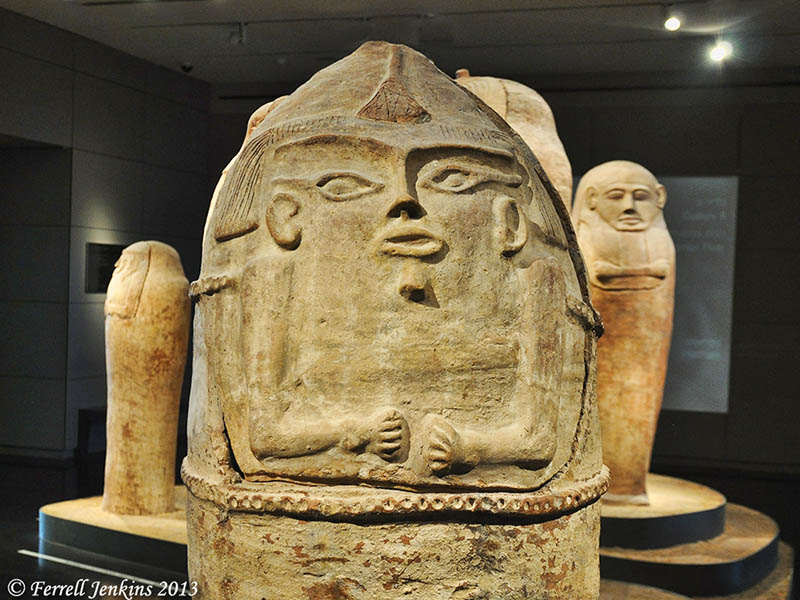
The first display one sees as he enters the archaeology wing of the Israel Museum is that of the anthropoid coffins from Deir el-Balah, a site south of Gaza city. The coffins, excavated by Trude Dothan in 1972, bear evidence of Egyptian influence. They date to the 13th century B.C.
Anthropoid Coffins from Deir el-Balah in the Israel Museum. Photo by Ferrell Jenkins.

Anthropoid Coffins from Deir el-Balah in the Israel Museum. Photo by Ferrell Jenkins.

Limited time bargain on a great Bible atlas

Christianbook.com is offering Carl Rasmussen’s Zondervan Atlas of the Bible for a limited time at the unusual price of $14.99. Click here.

zondervanatlascover01

I can’t promise that it will still be available by the time I get this posted, but you can try.

Update Noon  12-04-12:  I see the price is now $19.99. If you have a a Prime account with Amazon (postage free), or wish to add another item, the price may be better at $22.73 for Zondervan Atlas of the Bible.

This Atlas is an extremely good one. It is well written, accurate, colorful, filled with great photos and helpful maps. Earlier this evening I emailed a notice to folks who have traveled with me recently, or who plan to, with this note:

This is an excellent book for anyone planning a tour to Israel, or anyone who has been. It should be one of your most helpful Bible study tools.

One of the ladies who traveled to Israel earlier this year replied with this note:

That is a great price. I got one before we went. I use it daily as I read and it sure brings the scriptures alive. It is much more so now that we have seen the country.

Reading the Blogs

Charles Savelle (Bible X) tells about his enjoyable afternoon at Southwestern Baptist Theological Seminary to visit the Dead Sea Scrolls and the Bible Exhibit (Fort Worth).  He describes the entire visit, step by step, including a list of “the scroll fragments and other manuscripts and Bibles” including a list of the Biblical verses included in the scroll fragments. A Qumran simulated dig is part of the exhibit. Charles includes a a hi-res photo of himself standing in a nice replica of a mikvah (ritual bath) at Qumran. Read the complete report here. The exhibit runs through January 13, 2013.

I enjoyed lunch with Charles one day at the recent ETS annual meeting. I find his Bible X blog helpful.

Luke Chandler reports here that a different Dead Sea Scrolls Exhibit is now open at the Cincinnati Museum Center. This exhibit includes about “600 biblically-related artifacts on loan from the Israel[i] Antiquities Authority.” Read more here. This exhibit which runs through April, 2013, has already been in New York and Philadelphia. Check our link to the New York exhibition here. The 39 page guide to the exhibit by Gordon Franz is still available.

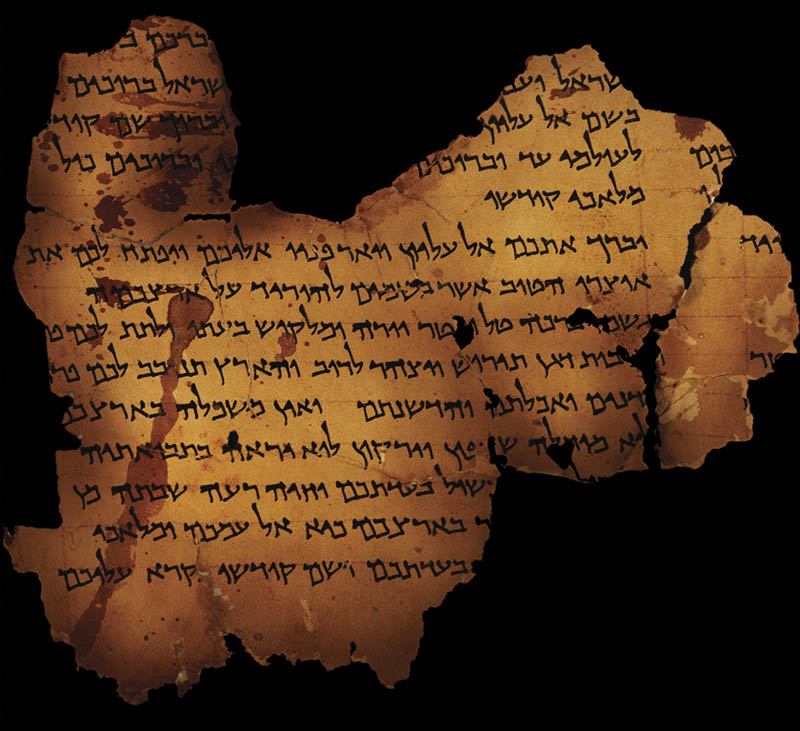
The War Scroll displayed at the Cincinnati Museum.

The War Scroll displayed at the Cincinnati Museum Center.

Luke also comments on a recent comment by Dr. William Dever regarding the lack of evidence for the “Low Chronologyhere.

It was only yesterday that I came caught up with a post by Seth Rodriquez (Wild Olive Shoot)  written the day after the U.S. presidential election. He has some important words for those who may have been disappointed in the outcome of the election. See here.

The Annual Meetings # 3 (SBL)

The annual meetings of the American Academy of Religion and the Society of Biblical Literature were held this year at the McCormick Place Convention Center in Chicago. I think McCormick Place is the largest facility of this type that I have ever been in. Much walking was required to move between sessions. Fortunately there is a good system of escalators to move between levels of the facility.

With the two scholarly organizations meeting together the book exhibit is extremely large. It is impossible to show it all from floor level. Here is a little glimpse of the Baker Academic section.

The AAR/SBL book exhibit, Chicago, 2012. Photo by Ferrell Jenkins.

The AAR/SBL book exhibit, Chicago, 2012. Photo by Ferrell Jenkins.

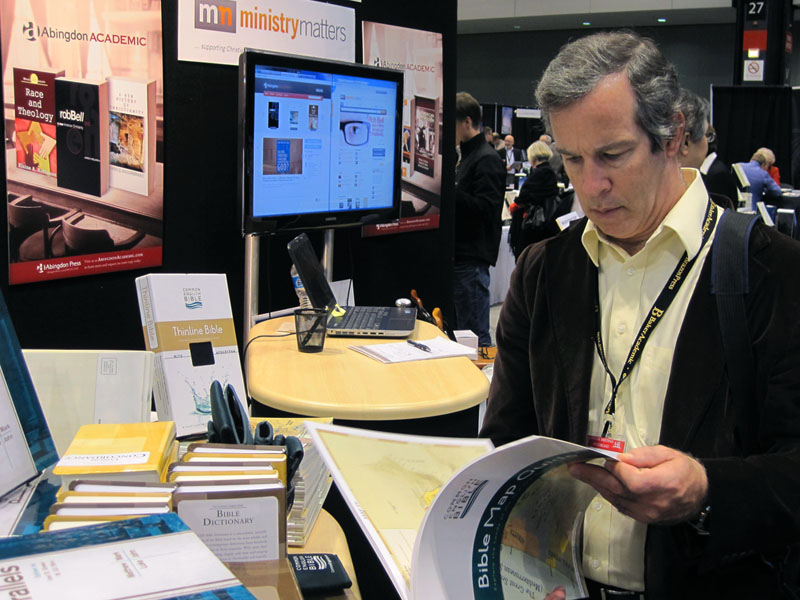
David McClister, my former student and colleague at Florida College, looks over one of the map books on display in the exhibit hall.

Dr. David McClister looks over a map book at AAR/SBL 2012. Photo by Ferrell Jenkins.

Dr. David McClister looks over a map book at AAR/SBL 2012. Photo by Ferrell Jenkins.

I spent my time at the SBL sessions dealing with Places in the Bible World. I attended the session on Polis and Ekklesia: Investigations of Urban Christianity Consultation. The theme for the five speakers this year was Roman Corinth.

The Biblical Lands and Peoples in Archaeology and Text Section covered a number of subjects including Moab, Ammon, the Philistines, first century priestly house in Jerusalem (Shimon Gibson), the possibility of a priestly order at Migdal-Gennesar (Richard Notley), et al.

One session consisted of archaeological reports on the new excavations at Azekah (Oded Lipschits, Yuval Gadot), the ongoing work at Khirbet Qeiyafa (Michael Hasel, Yosef Garfinkel, and Madeleine Mumcuoglu), and the new work at Jezreel (Norma Franklin).

Another session featured studies on the Egyptian invasion of the Sea Peoples (James Hoffmeier), Tell Tayinat (Tim Harrison), Tel Dor (Elizabeth Bloch-Smith), Ashkelon (Daniel Master), and Gath (Aren Maeir). There were a couple of other reports on the Philistines that I did not hear. It is always good to hear these reports first hand, long before the reports find their way into journals and books.

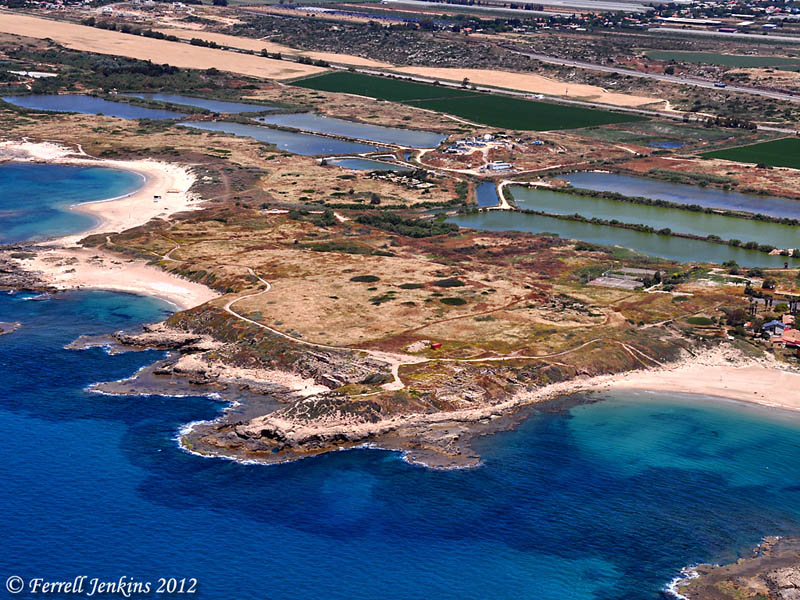
Aerial view of Tel Dor. Photo by Ferrell Jenkins.

Aerial view of Tel Dor on the Mediterranean Coast. Photo by Ferrell Jenkins.

Dor has a long history extending from the Canaanite period around the 20th century B.C. It was also controlled by the Phoenicians, the Sea People, the Israelites, the Assyrians, the Babylonians, the Persians, the Greeks, and the Romans. Dor was abandoned in the third century A.D. (Biblical Archaeology Review, Nov./Dec. 2002).

For Biblical references to Dor, see here.

It is nice to be back home with on time flights.