Category Archives: Bible Study

Historical Reliability of Acts

Apologetics 315 recently called attention to a PDF document by James Hickey on The Historical Reliability of Acts: Support from Extra-Biblical Primary Sources. I thought this document might be helpful, along with our photo illustrations, to those studying the Book of Acts.

https://i0.wp.com/3.bp.blogspot.com/-4sfuh5jjh8A/UD_H2fkFeII/AAAAAAAAJz4/a0OYCvz3zJk/s1600/historical-reliability-acts.jpg

You may download the document here, or from Apologetics 315 (above).

Logos Book of the Month — Psalms and Hymns of Isaac Watts

Pick up almost any book of hymns and you will note several songs by Isaac Watts (1674-1748), a native of Southhampton, England. The Dictionary of the Christian Church says,

Watts deservedly holds a very high place among English hymn-writers. His hymns reflect his strong and serene faith and did much to make hymn-singing a powerful devotional force, especially in Nonconformity… [especially nonconformity to the Church of England at the time, but used of nonconformity to any Established Church]

Logos is offering The Psalms and Hymns of Isaac Watts free to Logos users for the month of September. See details here.
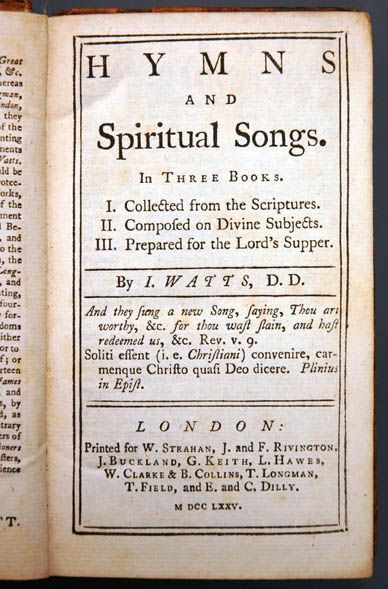
A 1775 edition of a book by Isaac Watts. U. of Otago.

I have Logos Bible Software 4 open now to a hymn based on Galatians 6:14. The title is “Crucifixion to the world by the cross of Christ.” We probably know this song by the first words, “When I survey the wondrous cross.”

Crucifixion to the world by the cross of Christ.
(Gal. 6:14)

 When I survey the wondrous cross
On which the Prince of glory died,
My richest gain I count but loss,
And pour contempt on all my pride.

Forbid it, Lord, that I should boast,
Save in the death of Christ my God!
All the vain things that charm me most,
I sacrifice them to his blood.

See from his head, his hands, his feet,
Sorrow and love flow mingled down!
Did e’er such love and sorrow meet,
Or thorns compose so rich a crown!

[His dying crimson, like a robe,
Spreads o’er his body on the tree:
Then am I dead to all the globe,
And all the globe is dead to me.]

Were the whole realm of nature mine,
That were a present far too small;
Love so amazing, so divine,
Demands my soul, my life, my all.

Watts, I. (1998). The Psalms and hymns of Isaac Watts. Oak Harbor, WA: Logos Research Systems, Inc.

Don’t expect modern shaped notes. And if you know nothing of the Meters that were used in Watts’ time, you may simply use the book for devotional readings.

Notice the vivid fourth stanza describing the dying Christ which is often left out of modern hymn books.

Acts 12 — Photo Illustrations

In presenting some photo illustrations for the book of Acts, I see that I skipped Acts 12.

“Herod the king” of Acts 12 is Herod Agrippa I who ruled as king of Judea (A.D. 37-44). He was the son of Aristobulus and grandson of Herod the Great. After the death of Agrippa, Roman procurators began to rule in Judea. Three of Agrippa’s children are mentioned later in Acts: Herod Agrippa II and Bernice (25:13), and Drusilla, who married Felix the procurator of Judea (24:24). The events recorded in Acts 12 took place shortly before the death of Herod in A.D. 44.

I invite your attention to a previous article about the death of Herod Agrippa I at Caesarea here.

In addition, I will provide a new aerial photo. On the left (north) you will see a portion of the amphitheater (hippodrome). At the end of the amphitheater is the partially reconstructed promontory palace of Herod the Great. On the right (south) is the theater which was built originally by Herod the Great.

Aerial view of Caesarea Maritima. From Left to Right: hippodrome, palace of Herod, theater.

Aerial view of Caesarea Maritima. From Left to Right: amphitheater (hippodrome), promontory palace of Herod the Great, theater. Photo by Ferrell Jenkins.

Could the “Herodian Mansion” have been the house of Annas the high priest?

Archaeological architect Leen Ritmeyer is interviewed by Justin Taylor about the “Palatial Mansion” or “Herodian Mansion” here. Ritmeyer takes the position that the Palatian Mansion, identified as the Wohl Museum, may be “the place of residence for Annas the high priest.”

Todd Bolen, at the Bible Places Blog, says,

While I appreciate the way that Ritmeyer makes these discoveries so accessible to the average Bible reader, I am less optimistic that this particular house is the very house where Jesus stood on trial and Peter denied the Lord. In favor of making this positive identification is the fact that this is the largest house known from this time period in Jerusalem. On the other hand, most of the land in the Old City has never been excavated. If there were 100 houses in Jerusalem in the first century, how likely is it that the only complete one excavated is the same one mentioned in the Bible?

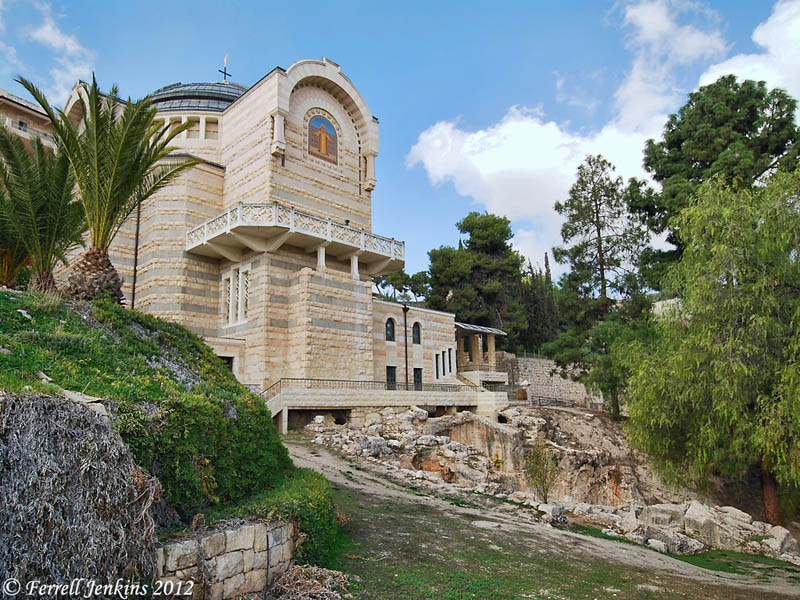
A similar claim is made for the site known as Saint Peter in Gallicantu. Tour groups to Jerusalem often visit both sites. Maybe one of these places is the house of Annas and Caiaphas, and maybe not. Each may provide a good illustration of what happened when Jesus was brought before the high priest. I often say to my groups, “It may not have been right here, but it wasn’t far away.”

St. Peter in Galicantu, Jerusalem. Photo by Ferrell Jenkins.

St. Peter in Galicantu, Jerusalem. This exterior view shows the modern building covering the excavation that some suggest was the house of the high priest. Photo by Ferrell Jenkins.

In comments to the Ritmeyer interview, Shannon Brown shares an album of photos he made at the Wohl Museum a few years ago.

For the Biblical background of this discussion, see John 18:13-24; Matthew 26:57-68; Mark 14:53-65; and Luke 22:54-65.

Acts 11 & 13 — Photo Illustrations

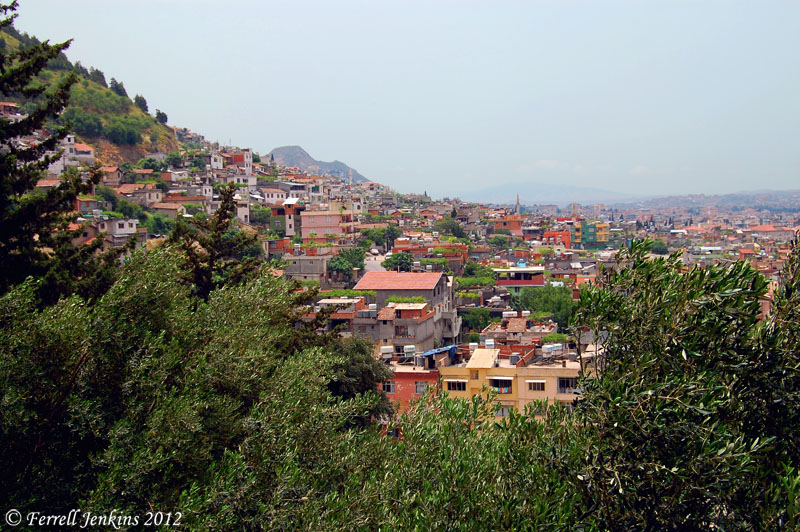
Antioch was founded on the Orontes River by Seleucus I Nicator in 300 B.C. The city is about 18 miles from the sea and is the most famous of 16 Antiochs built by Seleucus and named for his father Antiochus. Four of these cities are mentioned in the New Testament (Antioch of Syria, Pisidian Antioch, Seleucia, and Laodicea). Antioch continues today as Antakya, Turkey, with a population of more than 200,000.

Antakya, Turkey (biblical Antioch of Syria). View south from slopes of Mt. Silpius. Photo by Ferrell Jenkins.

Antakya, Turkey (biblical Antioch of Syria). View south from slopes of Mt. Silpius. Photo by Ferrell Jenkins.

The Romans came in 64 B.C. and put an end to Seleucid rule. Antioch became the capital of the new province of Syria. It became the third greatest city of the Roman empire after Rome and Alexandria. Some have estimated that in New Testament times the population of the city neared a half million. Even Herod the Great assisted Augustus and Tiberias in beautifying the city.

Seleucus I Nicator, King of Syria (358-280 B.C.). Louvre. Photo by Ferrell Jenkins.

Seleucus I Nicator, King of Syria (358-280 B.C.). Seleucus was the founder of Antioch. Displayed in the Louvre. Photo by Ferrell Jenkins.

After Jerusalem, Antioch was the second great center of Christianity in New Testament times. When the disciples were scattered from Jerusalem after the stoning of Stephen, some came to Antioch from Cyprus and Cyrene (area of modern Lybia) and preached to Greeks as well as Jews (Acts 11:19-21). Nicolas, a proselyte of Antioch, had been one of the seven chosen to serve in Jerusalem (Acts 6:5). When the church at Jerusalem, some 300 miles away, heard of the new work they sent Barnabas. When the work became too much for him he left for Tarsus to look for Saul. The two of them labored at Antioch for a whole year and the disciples of Christ were called Christians first at Antioch (Acts 11:22-26).

Acts 10 & 11 — Photo Illustrations

Cornelius was the first Gentile convert to the faith. This case illustrates clearly that morality alone is not adequate to save one. It was necessary for Cornelius to hear and obey the word of God (Acts 11:14).

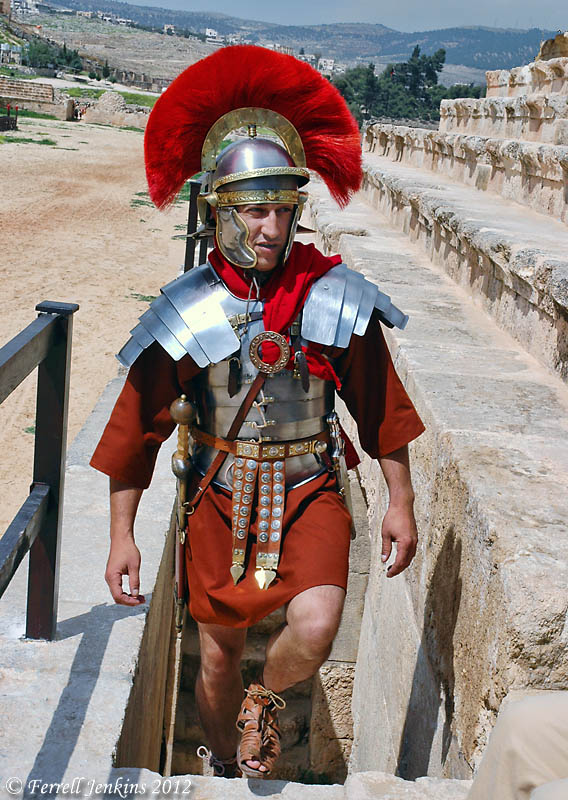
A centurion enters the hippodrome. An actor in the RACE show at Jerash, Jordan. Photo by Ferrell Jenkins.

An actor playing the role of a centurion in the RACE show at Jerash, Jordan, enters the hippodrome. Photo by Ferrell Jenkins.

A centurion in the Roman army normally had charge of 100 men (= to Army captain). A regular cohort was one tenth of a legion and had a paper strength of 600 men. An auxiliary cohort was usually comprised of 1,000 men. Cornelius was of the Italian cohort. There is inscriptional evidence for the “Italian cohort” from Syria (See Bruce, The Book of Acts in NICNT, 215). When Paul set sail from Caesarea for Rome he was accompanied by a centurion of the Augustan cohort named Julius (Acts 27:1).

The centurions mentioned in the New Testament make a favorable impression:

  • At Capernaum – Matthew 8:5-13; Luke 7:2-10
  • At the crucifixion – Luke 23:47.

This was not true of soldiers generally (Luke 3:14).

Acts 9 & 11 — Photo Illustrations: Tarsus in Cilicia – home of Saul (Paul)

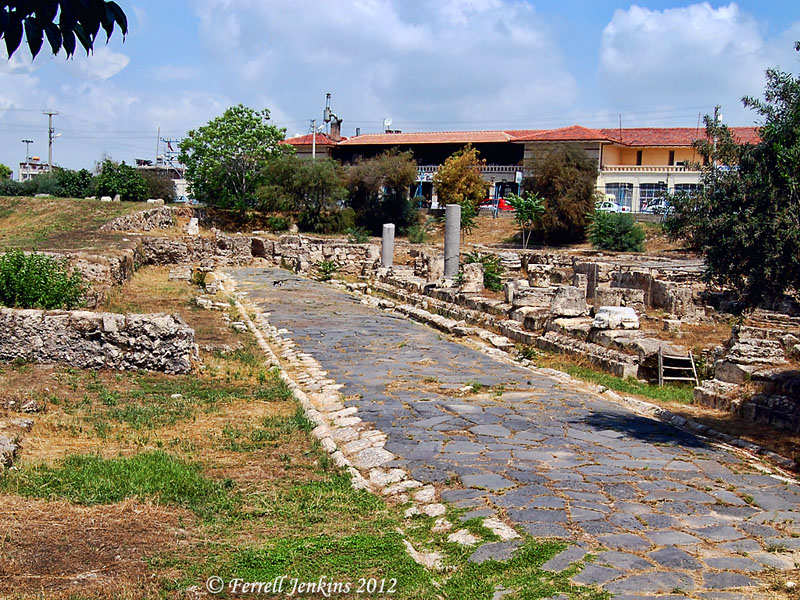
Tarsus in Cilicia was Paul’s native home, described as “no insignificant city” (Acts 9:11; 21:39; 22:3). The city had been important historically. Located near the Mediterranean on the River Cydnus, about 30 miles from the famous Cilician Gates, it was a fortified city and trade center as early as 2000 B.C. It had been captured by the Assyrian kings, Shalmaneser III (833 B.C.) and Sennacherib (698 B.C.), and had seen the likes of Alexander the Great and Cleopatra.

Roman Road at Tarsus in Cilicia. Photo by Ferrell Jenkins.

Roman Road at Tarsus in Cilicia. Photo by Ferrell Jenkins.

Tarsus was important commercially. Ancient writers mention the linen woven here from flax which grew in the fertile plain. A material called cilicium was woven from goat’s hair and used to make coverings which would protect against cold and wet. The city was also culturally important. Strabo describes the people as being avid in the pursuit of culture. Tarsus was a university town and noted as the home of several well-known philosophers, especially of the Stoic school. Barclay says:

“If a man was destined to be a missionary to the world at large, there was no better place in all the east for him to grow to manhood than in Tarsus” (The Mind of Paul, 25-26).

After Hellenistic Jews in Jerusalem sought to put Saul to death, the brethren sent him off to Tarsus.

And he was talking and arguing with the Hellenistic Jews; but they were attempting to put him to death. But when the brethren learned of it, they brought him down to Caesarea and sent him away to Tarsus. (Acts 9:29-30 NAU)

When Barnabas was overwhelmed in the work at Antioch, he went to Tarsus to look for Saul. Saul came to Antioch with Barnabas and they taught a large number of people (Acts 11:25-26).

Acts 10 — Photo Illustrations

Joppa (Yafo, Jaffa) is about 35 miles northwest of Jerusalem on the coast of the Mediterranean Sea. Yafo is on the south side of Tel Aviv.

Joppa has a history dating back to the 15th century B.C. when it is mentioned in the town lists of Pharaoh Thutmose III.

In this post I will limit my comments to some of the significant events of the Book of Acts related to Joppa.

  • Tabitha (Dorcas) lived in Joppa. When she died the disciples sent for Peter who was a Lydda. He came to Joppa and raised Dorcas (Acts 9:36-42). (Acts 10:6).
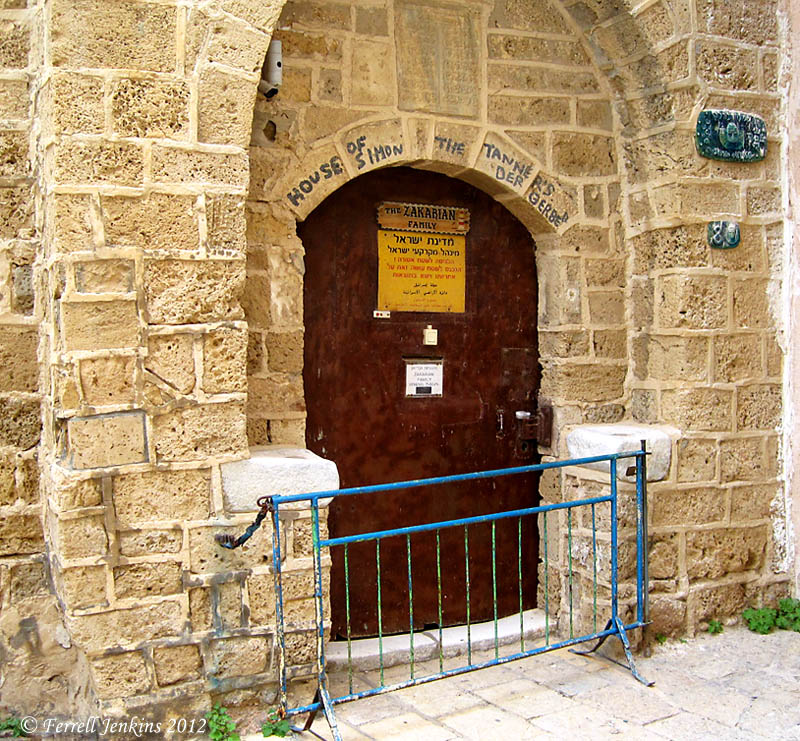
  • Peter stayed many days in Joppa with Simon the tanner (Acts 9:43). His house was by the sea (Acts 10:6). A house near the port is shown as the house of Simon, but there is no way to know this with certainty.
  • Peter received the housetop vision and learned that he was to go to Caesarea to preach the gospel to the Gentiles at the house of the Roman centurion Cornelius (Acts 10:23).

On one of the narrow streets of Joppa is a fairly modern house identified as the House of Simon the Tanner. Directly behind the house stands the lighthouse standing watch over the harbor. We take claims like this one with a grain of salt. But I often tell members of my tour groups, “It may not have been here, but it was not far from here.”

The traditional house of Simon the Tanner at Joppa. Photo by Ferrell Jenkins.

The traditional house of Simon the Tanner at Joppa. Photo by Ferrell Jenkins.

At least some houses during Bible times were build with a flat roof which could serve some practical uses. In the case of Peter it provided a good place to pray and to fall into a trance.

Paul and the Nabatean ruler Aretas IV

Luke’s account of the conversion of Saul and his subsequent time in Damascus records the nighttime escape from the city.

When many days had passed, the Jews plotted to kill him, but their plot became known to Saul. They were watching the gates day and night in order to kill him,  but his disciples took him by night and let him down through an opening in the wall, lowering him in a basket.  (Acts 9:23-25 ESV)

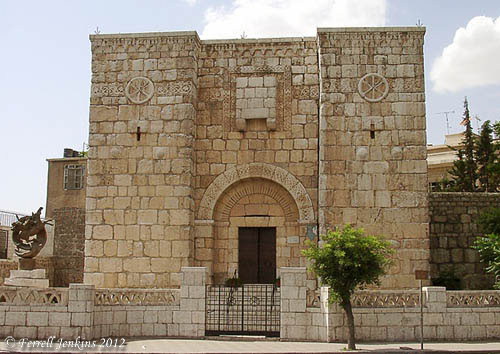
A modern chapel built into the old city wall marks a spot where this might have happened. Tradition calls it St. Paul’s Window.

St. Paul's Window in Damascus. Photo by Ferrell Jenkins.

St. Paul’s Window in Damascus. Photo by Ferrell Jenkins.

In 2 Corinthians, Paul provides historical context for this event.

At Damascus, the governor under King Aretas was guarding the city of Damascus in order to seize me,  but I was let down in a basket through a window in the wall and escaped his hands. (2 Corinthians 11:32-33 ESV)

Paul says that the governor (literally ethnarch) under Aretas the king was guarding the city. Aretas IV was a Nabatean ruler whose jurisdiction, in some way, extended to Damascus. The king, whose rule extended from 9 B.C. to A.D. 40, was father-in-law to Herod Antipas. This chronological note lets us know that Saul’s conversion was prior to A.D. 40.

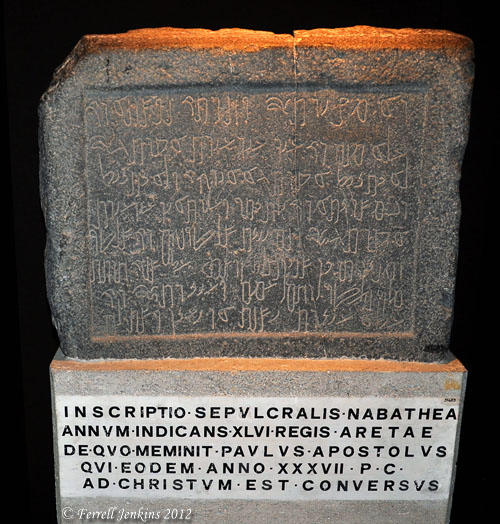
Sometimes one gets lucky when visiting certain sites or museums. My last visit to the Vatican Museum in Rome provided a nice surprise. A Nabatean tomb inscription mentioning Aretas was on display in a special exhibit.

Nabatean inscription mentioning King Aretas. Vatican Museum. Photo by Ferrell Jenkins.

Nabatean inscription mentioning King Aretas. Vatican Museum. Photo: Ferrell Jenkins.

A friend in Pisa, Italy, Dr. Arrigo Corazza, has provided me with a quick translation of the Latin sign underneath the inscription:

NABATEAN SEPULCHRAL INSCRIPTION REFERRING TO THE 46th YEAR OF THE KING ARETAS (37 AD), WHO IS QUOTED BY THE APOSTLE PAUL (WHO CONVERTED AROUND THIS TIME).

For those who may have forgotten, the Nabateans were responsible for the beautiful temples and tombs we see when we visit Petra.

Acts 9 — Photo Illustrations

Damascus is first mentioned in the Bible at the time of Abraham (Gen. 14:15; 15:2-3). As the capital of Syria, the city had much contact with the kingdoms of Israel and Judah.

All of the New Testament references to Damascus are related to the conversion of Saul of Tarsus (Acts 9; 22; 26; 2 Cor. 11:32; Gal. 1:17). Saul had participated in the stoning of Stephen and was active in the persecution of the disciples of Christ in Jerusalem. He asked the high priest for authority to go to Damascus and seek out men and women who belonged to the Way and bring them bound to Jerusalem.

The Lord appeared to Saul as he approached Damascus and told him to go into the city where he would be told what he must do (Acts 9:6). Saul stayed at a house on the street called Straight. Ananias came to him and told him to arise and be baptized so that his sins might be washed away (Acts 22:16; 9:18). Saul stayed with the disciples for several days and immediately began to proclaim Jesus in the synagogues as the Son of God (9:20).

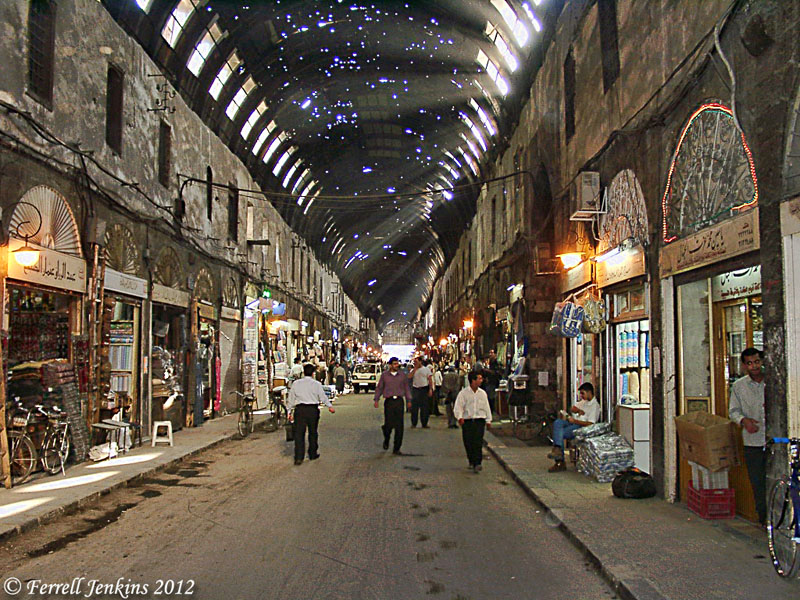
The photo below is one I made on Straight Street in 2002. This is not the main shopping street in the old city, but is historically significant.

The street called Straight in Damascus (the Via Recta). Photo by Ferrell Jenkins.

The street called Straight in Damascus (the Via Recta). Photo by Ferrell Jenkins.

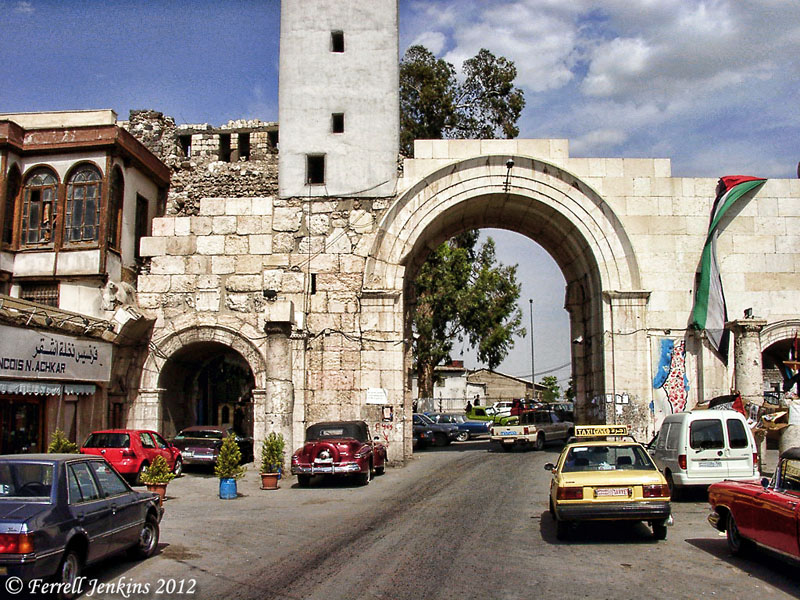
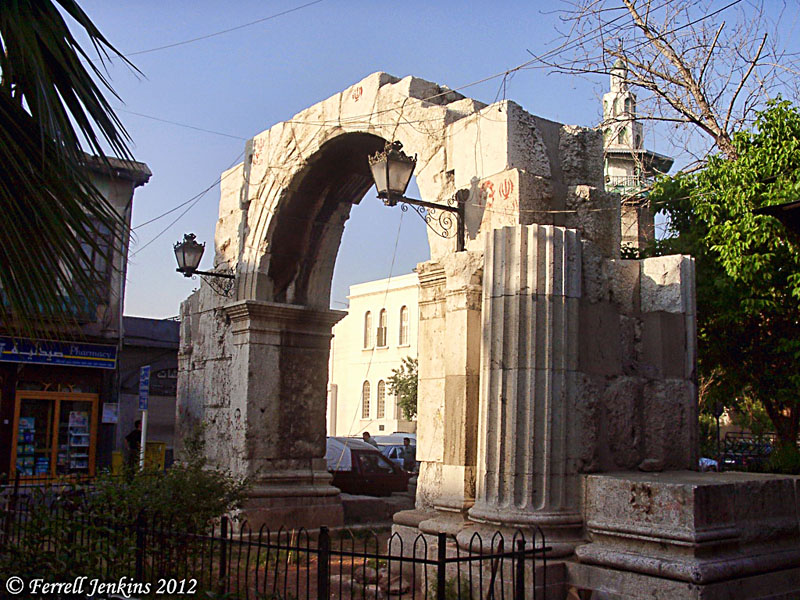
The street called Straight (Acts 9:11), the ancient Via Recta of the Roman city, now lies about 20 feet below the present street which runs the length of the old city, east to west. At the east end of the street a Roman gate has been elevated to the present level and partially restored.

Roman arch at the east end of Straight Street. Photo by Ferrell Jenkins.

Roman arch at the east end of Straight Street. Some of the stone work on the left of the central arch is original. The gate is now called Bab Sharki (Eastern Gate). Photo by Ferrell Jenkins.

A small monumental arch, pictured below, can be seen near the middle of the Via Recta.

Roman Gate on Straight Street in Damascus. Photo by Ferrell Jenkins.

Roman Gate on Straight Street in Damascus. Photo by Ferrell Jenkins.

Note: This post is repeated, with editing, from Sept. 26, 2008 where it was entitled “Saul (Paul) in Damascus.” Another post on Damascus and Paul may be read here.