Category Archives: Bible Study

Acts 20–21 — Paul’s Travel Itinerary with Photo Illustrations

The precision and chronological exactitude with which this journey is recounted is amazing. F. F. Bruce says,

The description of this critical journey of Paul and his disciples to Jerusalem is given in considerable detail; some have compared the detailed description in the Third Gospel of Jesus’ critical journey to Jerusalem with His disciples. But the kind of details is different; the chronological exactitude of this second “we” narrative of acts is due mainly to the fact that Luke was one of the party and kept a log-book. (The Book of Acts in the NICNT, 407).

Acts 20:6    —    Paul left Philippi “after the days of Unleavened Bread”(Passover). He was hurrying to be in Jerusalem “on the day of Pentecost” (20:16). This would be 50 days after Passover. He had been in Ephesus on Pentecost one year earlier (1 Cor. 16:8).
Acts 20:6    —    Paul came to Troas within 5 days. Tarried 7 days. A “door” had been opened for Paul at Troas less than a year earlier, but he was not able to enter it (2 Cor. 2:12).
Acts 20:7    —    On the first day of week — gathered together with the disciples to break bread.
Acts 20:11    —    Monday (or ? Sunday) — Paul departed. This depends on whether they followed the Jewish practice of sundown beginning the new day, or the Roman practice of mid-night to mid-night.
Acts 20:13-14    —    Assos. Paul’s companions went by boat from Troas to Assos. Paul traveled overland.
Acts 20:14    —    Mitylene (on the island of Lesbos).
Acts 20:15    —    Following day — opposite Chios.
Acts 20:15    —    Next day — Samos.

The photo below was made from a ship after it passed from north to south through the narrow strait between Samos (on the left) and the Turkish coast (on the right).  The ancient site of Trogyllium is located on the small peninsula extending into the Aegean Sea.
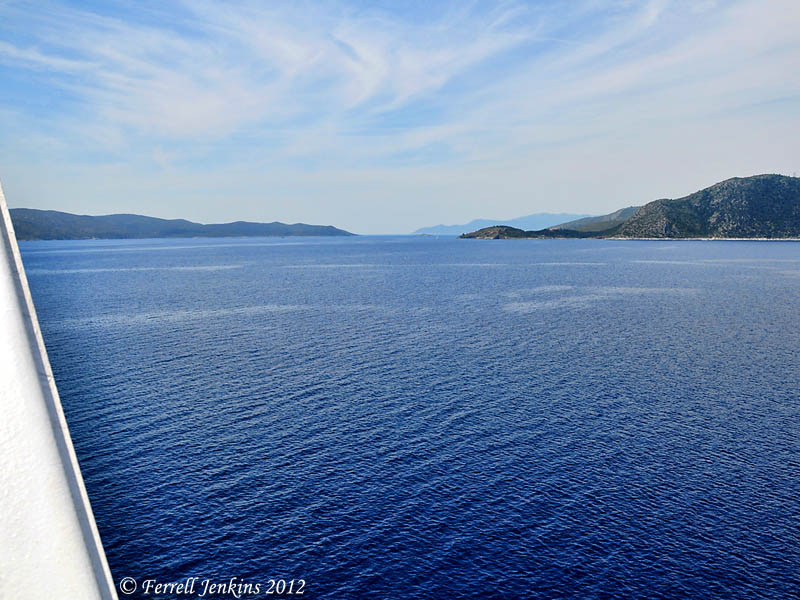
Samos-Turkey Strait. View North. Photo by Ferrell Jenkins.

View north of the Samos-Turkey Strait. Photo by Ferrell Jenkins.

Acts 20:15    —    Tarried at Trogyllium. (Appears in Western and Byzantine texts and in the KJV and NKJV.) The omission of the name in most manuscripts is explained by Bruce M. Metzger:

“Chiefly because of superior external attestation, a majority of the Committee preferred the shorter text” (A Textual Commentary on the Greek New Testament, 478).

Ramsay points out that the information is,

“in itself highly probable, for the promontory of Trogyllian or Trogylia projects far out between Samos and Miletus, and the little coasting vessel would naturally touch there, perhaps becalmed, or for some other reason” (The Church in the Roman Empire, 155).

Acts 20:15    —    The day following — Miletus.

This photo shows some standing water in the Lion Harbor of Miletus.
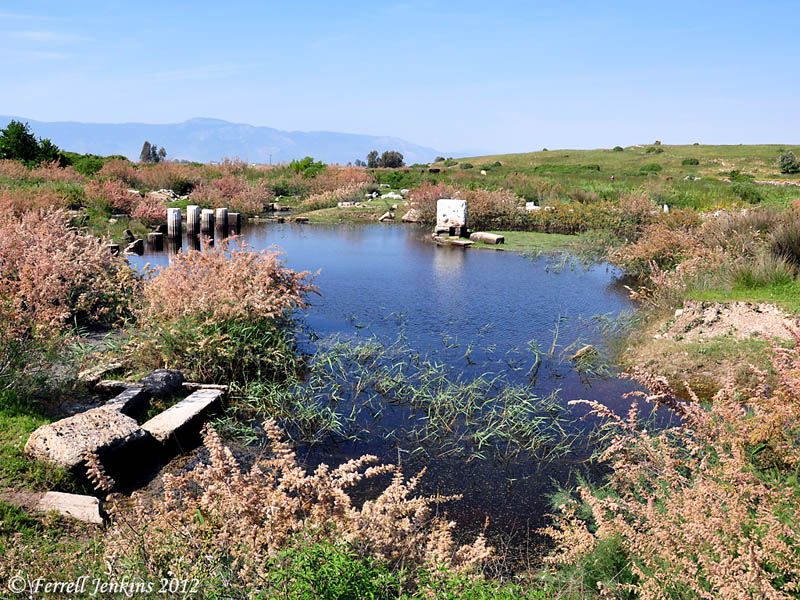
Ruins of the Lion Harbor at Miletus. Photo by Ferrell Jenkins.

Ruins of the Lion Harbor at Miletus. Photo by Ferrell Jenkins.

Acts 20:16    —    Paul had decided to sail past Ephesus — to be in Jerusalem on Pentecost (fifty days after leaving Philippi).

From Miletus Paul sent for the Ephesian elders. Consider the distance. How long would it take the courier to go to them and for them to come to him at Miletus? The distance was 63 miles by land or 38 if they went across the gulf of Latmos. This gulf is now silted up, leaving only a small inland lake.

The photo shows the site of the Gulf of Latmos which is now silted up. Turkish farmers grow rice in the area. The Meander River flows to the left of this photograph.
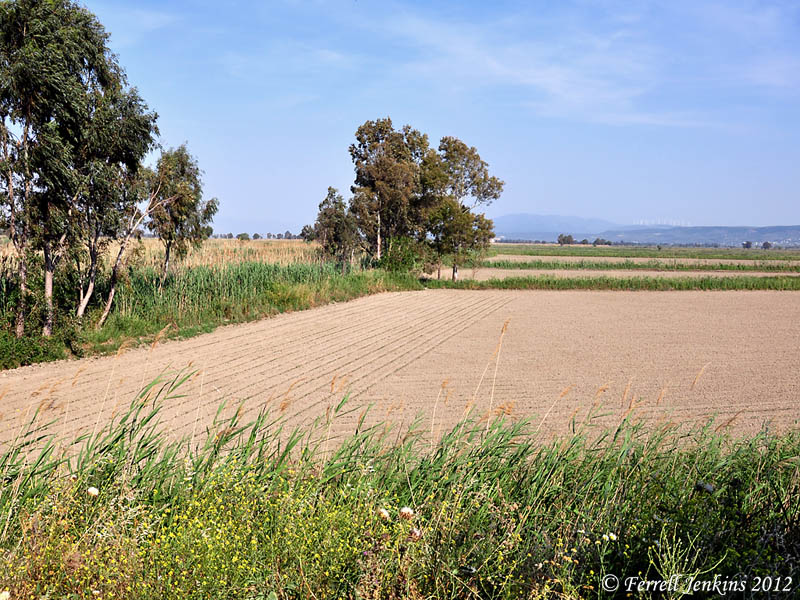
Site of Lake Latmos, now silted up, within two miles of Miletus. Photo by Ferrell Jenkins.

Site of the Gulf of Latmos, now silted up, within 2 miles of Miletus. Photo: F. Jenkins.

Acts 21:1    —    Set sail on a straight course to Cos.

  •  Next day to Rhodes. Tradition identifies this stop at St. Paul’s Bay at Lindos.
  • Patara.
  • Patara to Tyre. According to Chrysostom this trip took five days (Homily XLV.2; cf. Bruce, The Book of Acts in NICNT  421). They were always at the mercy of the wind. When they came within sight of Cyprus they sailed past to the south of the island as they headed to Syria (21:3).

Acts 21:4    —    Tyre — Paul tarried 7 days (note 20:6-7).
Acts 21:7    —    Ptolemais [modern Acre in Israel] — stayed one day.
Acts 21:8    —    Caesarea. They arrived the next day. The text does not say whether they went by boat or land. At Caesarea they stayed with Philip for “many days” (21:10).

Acts 21:15-17    —    Up to Jerusalem of Judea (cf. 21:10).

Acts 21:18    —    The following day Paul and the others visited James and the elders.

If our study of the Book or Acts, or any book of the Bible, is only a cursory one without attention to details, we miss much of what was intended for us.

Note: Use the Search Box to locate posts about Philippi, Assos and Mitylene, Ephesus, Miletus, Rhodes, Tyre, Ptolemais, and Caesarea.

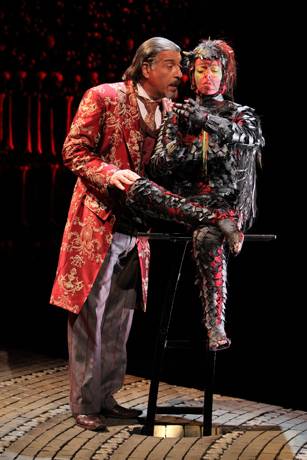
Max McLean in C. S. Lewis The Screwtape Letters

During World War II when Great Britain was dealing with the threat of extinction,  C. S. Lewis wrote The Screwtape Letters. These letters of unknown provenance are from the senior devil Screwtape to a junior tempter named Wormwood.

Saturday afternoon I saw actor Max McLean in a Broadway-type production, C. S. Lewis The Screwtape Letters. The production begins with Screwtape giving the graduation address at the Tempters’ Training College for Young Devils. After that, everything else takes place in Screwtape’s Office in Hell.

C. S. Lewis The Screwtape Letters

Screwtape writes a series of letters to his nephew Wormwood to help him in working with one of his “patients” – a young Christian man on earth. Wormwood is supposed to keep the patient distracted from serving the Enemy (God), and to deliver him to “our Father below” (the Devil).

In addition to McLean’s superb acting, Toadpipe is a delightful addition to the stage production. She is Screwtape’s secretary in his office in Hell.

Max McLean as Screwtape and his secretary Toadpipe.

Max McLean as Screwtape and his secretary Toadpipe in The Screwtape Letters.

If you have never read The Screwtape Letters, you should do so. The book is available from Amazon in both print and Ebook.

This little except from Letter XII shows us how easily it is for the Devil to distract one from genuine service to the Enemy (God).

You will say that these are very small sins; and doubtless, like all young tempters, you are anxious to be able to report spectacular wickedness. But do remember, the only thing that matters is the extent to which you separate the man from the Enemy. It does not matter how small the sins are provided that their cumulative effect is to edge the man away from the Light and out into the Nothing. Murder is no better than cards if cards can do the trick. Indeed the safest road to Hell is the gradual one—the gentle slope, soft underfoot, without sudden turnings, without milestones, without signposts.

C. S. Lewis The Screwtape Letters is scheduled for several other cities. Take a look at the ScrewtapeOnStage.com for details.

If you are interested in C. S. Lewis, take a look at this photo essay about Lewis here.

Two references from Paul’s second letter to the church at Corinth are appropriate here.

And no wonder, for even Satan disguises himself as an angel of light. (2 Corinthians 11:14 ESV)

so that we would not be outwitted by Satan; for we are not ignorant of his designs. (2 Corinthians 2:11 ESV)

The early rain damages Hai-Bar Yotvata Nature Reserve

According to The Jerusalem Post’s Sharon Udasin, heavy rains caused damage to the Hai-Bar Yotvata Nature Reserve located in the Arabah (Arava) north of Eilat.

The heavy rains that drenched the Eilat mountains and southern Arava region on Sunday night led to the flooding of the Hai-Bar Yotvata Nature Reserve, the Israel Nature and Parks Authority (INPA) said on Monday.

Over the course of the night, park workers evacuated animals that were in danger of drowning, and others worked all night to rebuild fences that had collapsed during the flood.

By Tuesday, the nature reserve will be open as usual to visitors, an INPA statement said.

Despite the damage caused to the nature reserve, the rains brought with them “many blessings” as they watered the acacia trees – which are “a source of life in the desert” – and created a “rare, breathtaking site,” according to the INPA.

“The desert is now beautiful and gleaming, and this is the best time to hike in it and to enjoy the rich and spectacular landscape it has to offer,” said Doron Nissim, the Eilat district manager at the INPA.

More information about the weather expectations for this year is available here.

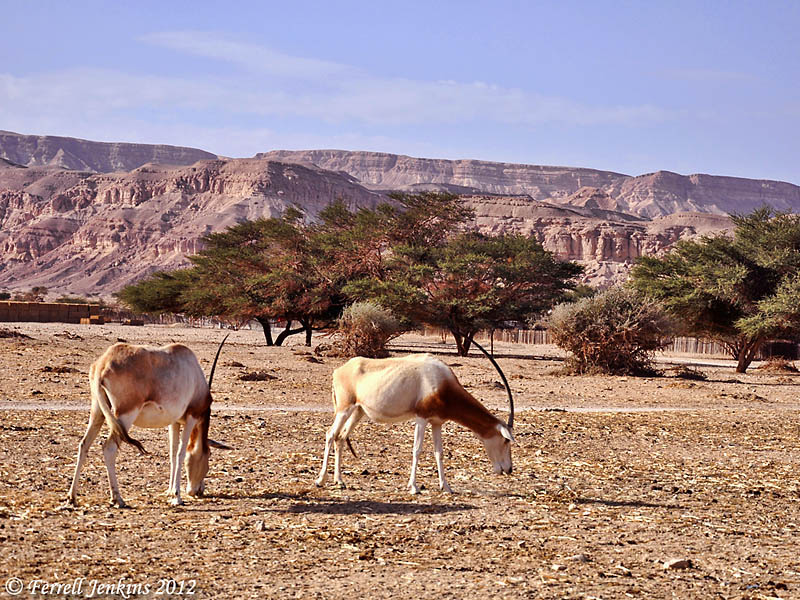
The photo below shows the Arabian Oryx, thought to be the reem of the Hebrew Bible. English versions typically translate this word with “wild ox” (Numbers 23:22; 24:8; Deuteronomy 33:17, et al. The King James Version uses the word unicorn.

Arabian Oryx at Hai-Bar Nature Reserve. Photo by Ferrell Jenkins.

Arabian Oryx at Hai-Bar Nature Reserve. Photo by Ferrell Jenkins.

If one travels in the desert during the summer months he will see a dry, desolate bad land with only an isolated acacia or tamarisk tree or a shrub where the last water of the winter rain flowed. In the winter it can be different. Israel has two dominant seasons: winter and summer. The summer is dry and the winter is wet. The early rains begin about mid-October and continue till the late rains of early April. See Deuteronomy 11:14; Psalm 84:6; Joel 2:23; James 5:7.

 “And if you will indeed obey my commandments that I command you today, to love the LORD your God, and to serve him with all your heart and with all your soul,  he will give the rain for your land in its season, the early rain and the later rain, that you may gather in your grain and your wine and your oil.  And he will give grass in your fields for your livestock, and you shall eat and be full. (Deuteronomy 11:13-15 ESV)

You might enjoy reading our earlier post about “Rivers in the Desert” here.

HT: Todd Bolen, Bible Places Blog. This Wednesday Roundup is especially full of helpful information.

Acts 19 — Photo Illustrations

Ephesus is one of the most excavated sites from the Biblical world. Teams of Austrian archaeologists have worked at the site since 1895.

Items of interest at Ephesus include the single standing column of the Temple of Diana (Artemis), the harbor which is now silted up, the great theater which seated nearly 25,000 (Acts 19:29), the Marble street, the Library of Celsus, the Agora, the Temple of Hadrian, the Temple of Domitian (or the Flavian Emperors), and much more.

The first instance of believers baptized into Christ at Ephesus is recorded in Acts 19. Many changes took place in the church between the time when Paul spent nearly three years in the city, and the time when John lived there. There are two letters in the New Testament addressed to the church at Ephesus. The first is the letter of Paul to the Ephesians. The other is the letter included in the book of Revelation (Revelation 2:1-7).

Yamauchi comments on the size of Ephesus in the first century:

“In the New Testament era it was probably the fourth greatest city in the world (after Rome, Alexandria, and Antioch) with a population of about 250,000” (Archaeology of New Testament Cities, 79).

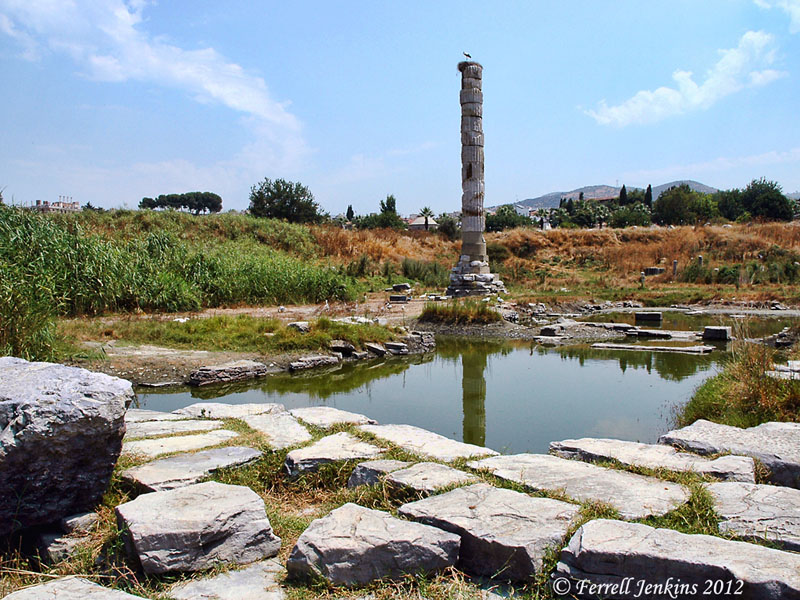
The photo below shows the site of the Temple of Artemis (Diana). Notice the stork standing on top of the sole standing column. Click on the photo for a larger image.

The site of the Artemis temple at Ephesus. Photo by Ferrell Jenkins.

The site of the Temple of Artemis at Ephesus. Photo by Ferrell Jenkins.

The ruins of the famous temple were discovered in 1869 by J. T. Wood, an English engineer.  Pausanias, the second century A.D. geographer, said the “temple of Diana surpassed every structure raised by human hands.” The temple was four times as large as the Parthenon. The platform of the temple was 239 feet wide by 418 feet long. The temple itself was 180 feet wide by 377 feet long, and the roof was supported by more than 100 sixty-foot columns. The temple served as a bank and a place of asylum for criminals. The earliest stage of the temple was built about 600 B.C. The Hellenistic temple which Paul and John saw was destroyed in A.D. 262.

Acts 17 — Photo Illustrations

Paul came to Thessalonica on his second journey (A.D. 50-53; Acts 17).

Now when they had passed through Amphipolis and Apollonia, they came to Thessalonica, where there was a synagogue of the Jews. (Acts 17:1 ESV)

Thessalonica (called Thessaloniki now) is in biblical Macedonia. The area is still known as Macedonia, but is not to be confused with the modern country by that name. It is marked on maps of Greece as FYROM (former Yugoslav Republic of Macedonia). I know too little about the dispute to make any comments.

Paul wrote two letters to the church at Thessalonica while he was at Corinth. Aristarchus, a Macedonian of Thessalonica accompanied Paul on the voyage to Rome (Acts 27:2). When Demas forsook Paul he went to Thessalonica (2 Timothy 4:10).

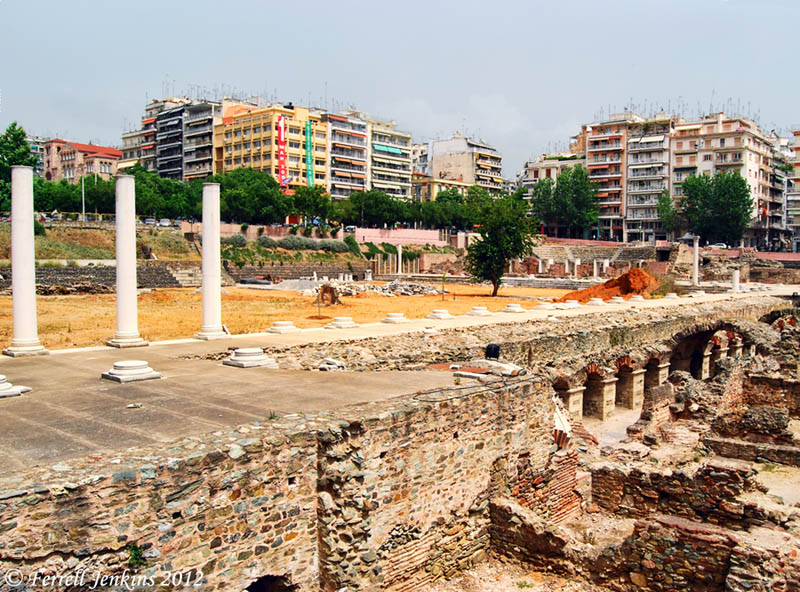
The photo below shows excavated ruins of the 2nd-3rd century A.D. Roman Forum in the center of the modern city of Thessalonica. Fant and Reddish comment on the Forum:

Extensive, ongoing excavations are being conducted in this area. Likely the same site was the location for the Hellenistic agora as well. The forum originally covered two extensive terraces. The forum originally covered two extensive terraces. The one to the north contained a large courtyard surrounded on four sides by two-story stoas; to the rear of the stoa on the east side stood the odeion, originally a theater for music and performances, later converted into an arena for gladiatorial contests. (A Guide to Biblical Sites in Greece and Turkey, 137).

Roman forum in the center of Thessalonica. Photo by Ferrell Jenkins.

Roman Forum in the center of Thessalonica. Photo by Ferrell Jenkins.

I think if you click on the photo to enlarge it, you will see the odeion to the right of the image.

There are several posts about Thessalonica on this blog. Just put the word Thessalonica in the Search Box. You will also find posts about Amphipolis, Berea, and Athens.

New discoveries at Paphos, Cyprus

The Cyprus Mail reports the results of archaeological work in the agora at ancient Paphos, Cyprus, by the Institute of Archaeology of the Jagiellonian University, Kraków, Poland.

One of the significant discoveries during the August/September excavations was a small tablet with the name of an official on it in the Greek language. According to the article, the Greek inscription reads,

Seleukos, son of Agoranomos (market administrator) Ioulios Bathylos.

Architectural remains from the Roman period were also uncovered in the same area as the Greek inscription.

The short article maybe read here.

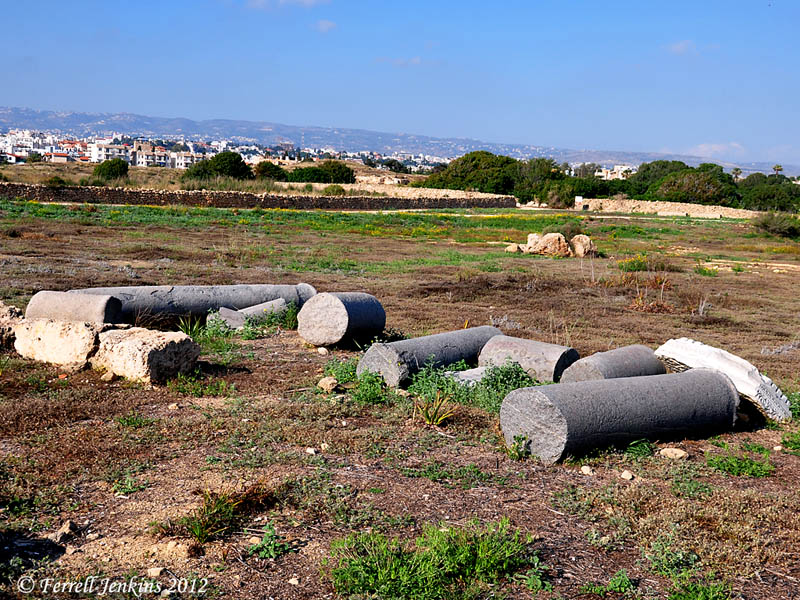
The photo below shows a few fallen columns in the mostly unexcavated agora in mid-May, 2012.

Ancient agora at Paphos, Cyprus. Photo by Ferrell Jenkins.

Ancient agora at Paphos, Cyprus. Photo by Ferrell Jenkins.

Barnabas, Saul, and John Mark arrived at Paphos after crossing the length of the island of Cyprus on the first missionary journey. It was here that Saul’s name was changed to Paul.

 6 When they had gone through the whole island as far as Paphos, they came upon a certain magician, a Jewish false prophet named Bar-Jesus.
7 He was with the proconsul, Sergius Paulus, a man of intelligence, who summoned Barnabas and Saul and sought to hear the word of God.
8 But Elymas the magician (for that is the meaning of his name) opposed them, seeking to turn the proconsul away from the faith.
9 But Saul, who was also called Paul, filled with the Holy Spirit, looked intently at him
10 and said, “You son of the devil, you enemy of all righteousness, full of all deceit and villainy, will you not stop making crooked the straight paths of the Lord?
11 And now, behold, the hand of the Lord is upon you, and you will be blind and unable to see the sun for a time.” Immediately mist and darkness fell upon him, and he went about seeking people to lead him by the hand.
12 Then the proconsul believed, when he saw what had occurred, for he was astonished at the teaching of the Lord. (Acts 13:6-12 ESV)

HT: Jack Sasson

Visiting the Lynn H. Wood Archaeological Museum

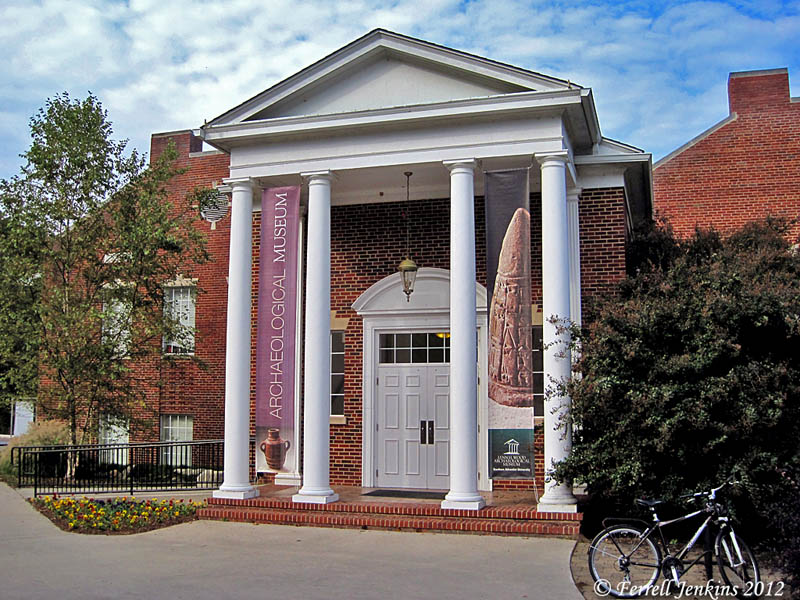
You might never expect to find an excellent archaeological museum nearly hidden in the woods of eastern Tennessee. But that is what you will find at the Lynn H. Wood Archaeological Museum on the campus of  Southern Adventist University in Collegedale, Tennessee.

When we arrived on campus we asked a student the location of the Museum. After walking up a long series of steps that some students were skipping up (ah, youth!), we asked two other students. Each of them offered to show us. And, neither had been to the Museum. Everyone on campus that we spoke with was friendly and helpful.

Inside Hackman Hall is housed a wonderful educational exhibit.

The Lynn H. Wood Archaeological Museum is located in this building.

The Lynn H. Wood Archaeological Museum is located in this building.

A few years ago William G. Dever gave his research library of nearly 3000 volumes and a large collection of archaeological artifacts to Southern. The artifacts are built into an award-winning exhibition under the title Vessels in Time: A Journey Into the Biblical World. Archaeology Professor Dr. Michael G. Hasel serves as curator of the Museum.

Iron Age IIA (1000-900 B.C.) Pottery in the Lynn H. Wood Museum.

Iron Age IIA (1000-900 B.C.) Pottery in the Lynn H. Wood Museum.

The exhibits follow a chronological order from the early days in Mesopotamia to New Testament times.  Each display has a good timeline which coordinates the archaeological periods with the Biblical record. The photo above shows some pottery from the Iron Age IIA (1000-900 B.C.). This is the period of the United Kingdom (or Monarchy). The bowl on the left has been slipped and shinned. The accompanying information explains that during this period vessels were sometimes dipped “into red watery clay” to create the colored slip. The bowl was then hand burnished with a stone like the one shown above it.

Three examples of dipper juglets from the period are shown:

  1. A Phoenician import.
  2. A simple local juglet.
  3. A black-slipped, burnished juglet.

There is a nice model of Solomon’s Temple in the same room.

If your travels take you anywhere near Chattanooga, Tennessee, I suggest you take time to drive a few miles east to Collegedale and visit the Lynn H. Wood Archaeological Museum.

Full information about the Museum including visiting hours may be found here.

Acts 16 — Photo Illustrations (corrected)

What is the best way to correct a blunder? Shall I totally delete the post and start anew, or shall I edit the existing one? I decided to leave the existing one for the time being and post the correction here.

Forum/Agora. One reader suggests that I have incorrectly identified the forum at Philippi as the agora. Some sources indicate that the forum was primarily used for civic or judicial matters while the agora was considered the commercial center or market place.

My intention was to use both words because they are often used interchangeably. At Philippi, Corinth, and other places, these activities are not far removed from each other. In fact, the Forum at Philippi, and the Agora at Corinth contain a Bema (judgment seat) as well as numerous commercial shops.

I am not at home and do not have access to some of the sources I might normally use to check these things, but I have access to some dictionaries online.

The American Heritage Dictionary gives this definition for forum:

The public square or marketplace of an ancient Roman city that was the assembly place for judicial activity and public business.

The Compact Oxford English Dictionary defines the forum…

(in an ancient Roman city) a public square or marketplace used for judicial and other business.

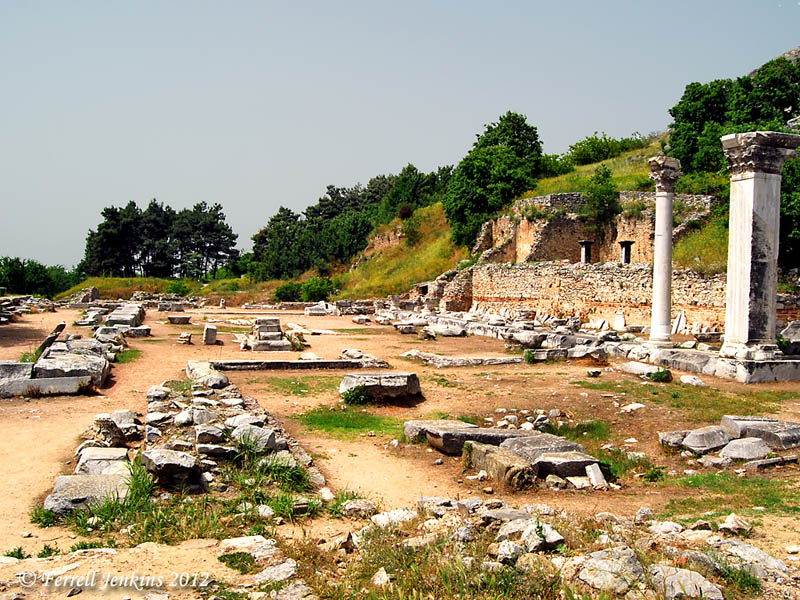
The Wrong Photo. But my serious blunder was in the photo I labeled as the forum/agora. After publishing it I began to think I had uploaded the wrong photo. A friend has written privately to remind me that I have posted a photo of one of the basilicas at Philippi rather than the forum. I plead guilty. My oversight.

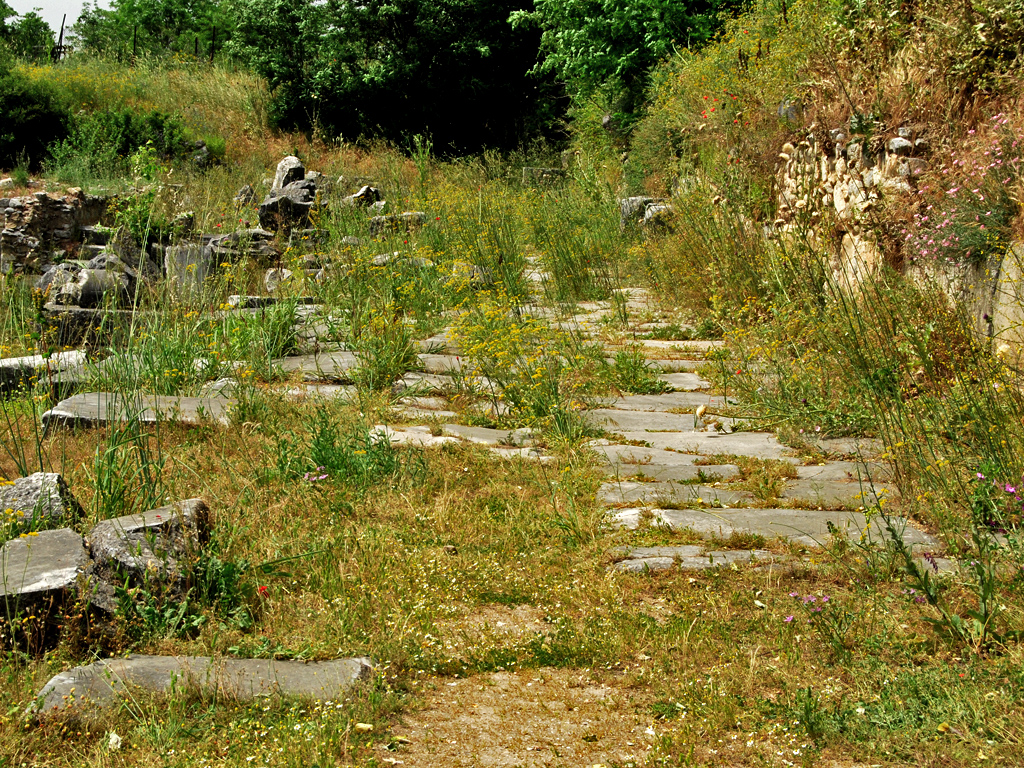
Here is a photo of a portion of the Via Egnatia (the Egnatian Way) in the forum at Philippi. Much of it is covered by several feet of earth. The modern road runs above the ancient one.

A portion of the Via Egnatia in the Forum at Philippi. Photo by Ferrell Jenkins.

A portion of the Via Egnatia in the Forum at Philippi. Photo by Ferrell Jenkins.

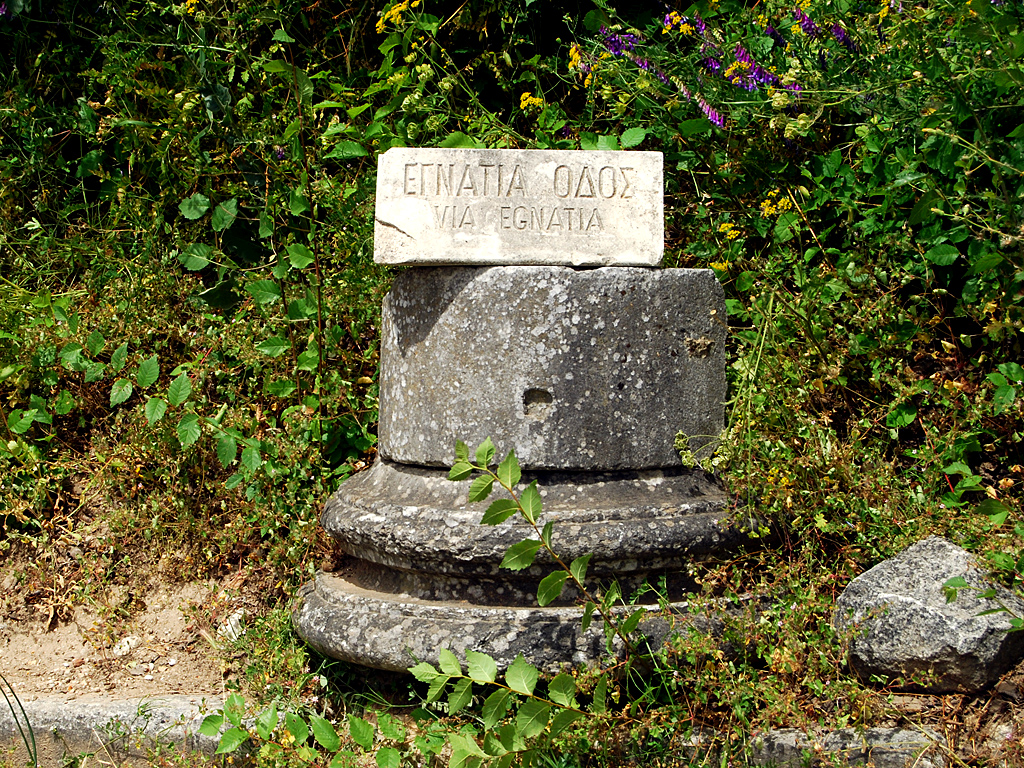
The next photo shows a sign that once sat on the road.

Identifying the Via Egnatia in the Forum at Philippi. Photo by Ferrell Jenkins.

Identifying the Via Egnatia in the Forum at Philippi. Photo by Ferrell Jenkins.

Perhaps later I will post a photo of some of the shops in the forum.

Acts 16 — Photo Illustrations

The Apostle Paul came to Philippi on his second preaching journey. Luke accurately describes the city with these words:

So putting out to sea from Troas, we ran a straight course to Samothrace, and on the day following to Neapolis; and from there to Philippi, which is a leading city of the district of Macedonia, a Roman colony; and we were staying in this city for some days. (Act 16:11-12 NAU)

The photo below shows ruins of the forum (or agora) of the city where much of the activity took place. Portions of the famous Egnatian Way may be seen at the edge of the forum, but partially buried under the earth and modern road on the right. [See correction here.]

Forum of Philippi. Photo by Ferrell Jenkins.

The Forum (Agora) of Philippi. Photo by Ferrell Jenkins.

At Philippi, Paul preached to and baptized Lydia and her household, and the jailer.

Wallace: Fifteen Myths about Bible Translation

Prof. Daniel B. Wallace discusses “Fifteen Myths about Bible Translation.” Wallace is a well known and respected scholar dealing with issues pertaining to the Greek language and Textual Criticism.

Wallace says,

Perhaps the number one myth about Bible translation is that a word-for-word translation is the best kind.

Whatever your current level of knowledge about Bible translations, you are sure to learn something from these “Fifteen Myths” even if you don’t agree with all of them.

Read the full article here.

HT: BibleX