Category Archives: Bible Study

David leaves 200 men at the Brook Besor

In addition to the tours I led between 1967 and 2016 I have made numerous personal study trips with a variety of friends beginning as early as 1984. The largest number of those trips have been made with Leon Mauldin. On these trips we visit places that are difficult to reach by bus or take an unusual amount of time to reach — too time consuming for a group looking to see all they can in a typical 10-12 day tour.

In September, 2011, Leon and I spent some time in the south of Israel. One of the fascinating places we visited was the Brook Besor. Israelis call it Nahal Besor. Various English versions of the Bible use the terms Brook, brook or Wadi to describe the stream. For anyone who might wish to visit the area I will explain how we got there.

Using the modern maps at your disposal locate Beersheba (Be’er Sheva), then take highway 25 NW to highway 241 and turn left. Our first photo was made on the north side of highway 241 after we crossed the Besor.
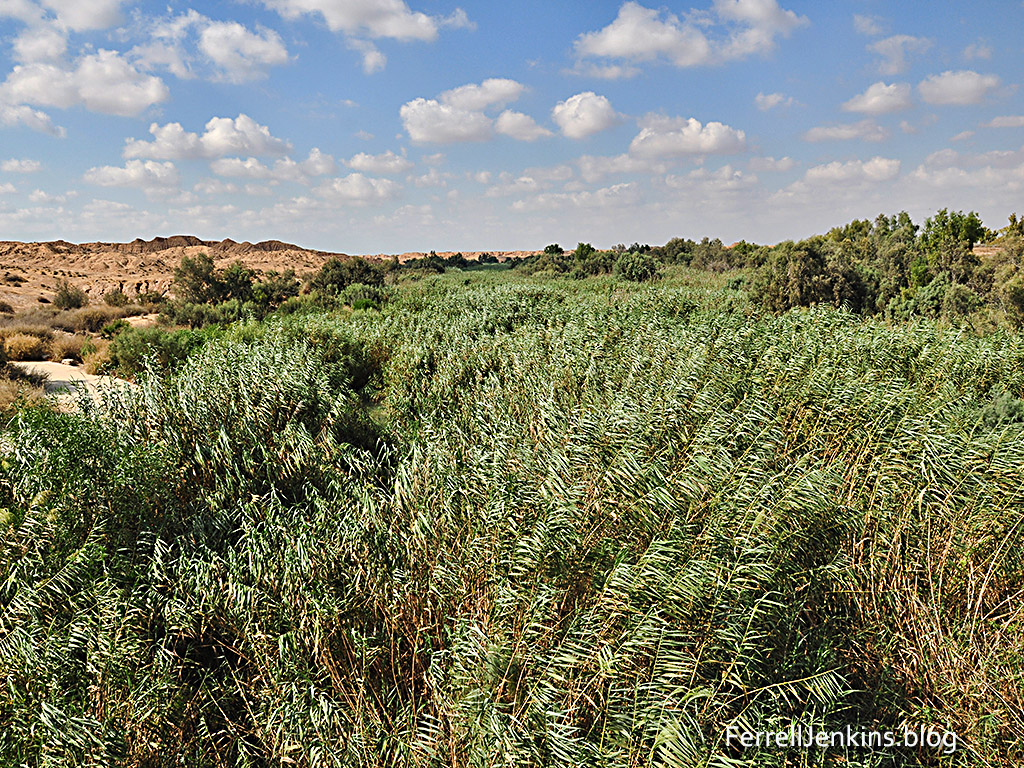
Brook Besor on the north side of highway 241. Photo: ferrelljenkins.blog.

The Brook Besor on the north side of highway 241. Notice the typical dry terrain of the Negev in the background. Photo by Ferrell Jenkins.

Water is flowing somewhere among these reeds and during the winter rains we may be sure that the water is visible. Notice the dry terrain in the distance.

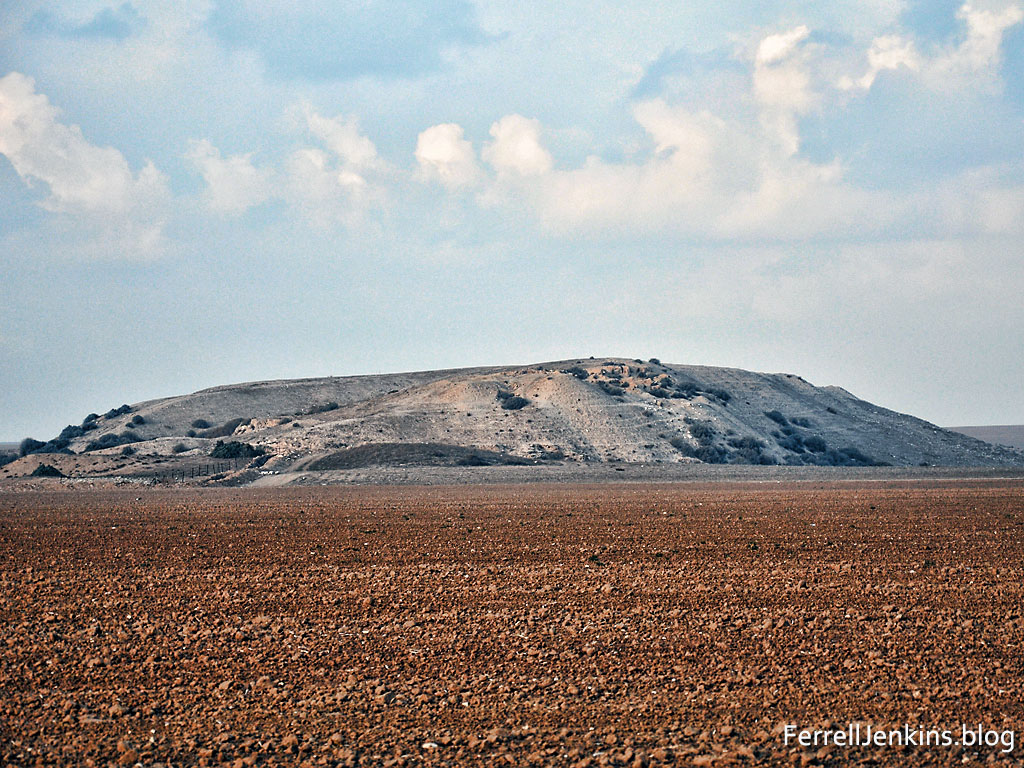
A short distance from the location of this photo, on the south side of the highway we saw this impressive mound. It is easy to reach, at least in dry weather, using the road across the fields.
Tel Sharuhen on the banks of Nahal Besor. ferrelljenkins.blog.

Tel Sharuhen on the banks of Nahal Besor. Most of the reeds like those we have shown in the photo above are on the opposite side of the tel. Photo by Ferrell Jenkins.

The Arab name for this archaeological mound is Tell el-Farah (South) to distinguish it from Tell el-Farah (North), the site of biblical Tirza near Shechem (1 Kings 15:33).

The Archaeological Encyclopedia of the Holy Land (1990) entry begins with this description of the Tell el-Farah (South).

The site is some 14 miles south of Gaza and 16 miles west of Beer-Sheba, near the ancient Via Maris (Roads) connecting Egypt and Mesopotamia. W.M.F. Petrie identified Tell el-Farah with Beth-Pelet (Josh. 15:27; Authorized Version: ‘Beth-Palet’), but W.F. Albright’s identification with Sharuhen (Josh. 19:6) is now accepted by most scholars. Apart from the biblical reference, Sharuhen appears three times in Egyptian sources of the New Empire: in the description of the Hyksos expulsion from Egypt, when Amosi besieged the Hyksos for three years at Sharuhen; in the records of the first campaign of Tuthmosis III; and in those of the campaign of Pharaoh Sheshonq.

Sharuhen is mentioned only once in the Bible as a city of the tribe of Simeon (Joshua 19:1-8; see especially verse 6).

This area looks rather hidden from society, but it was on two major international highways in biblical times.

Leon and I were looking for the possible site where David left 200 men who were too exhausted to make the trek to chase those who had burned Ziklag and taken several captives including two wives of David (1 Samuel 30; see especially verses 9, 10, and 21). I can easily envision this area being the place of the crossing of the Besor.
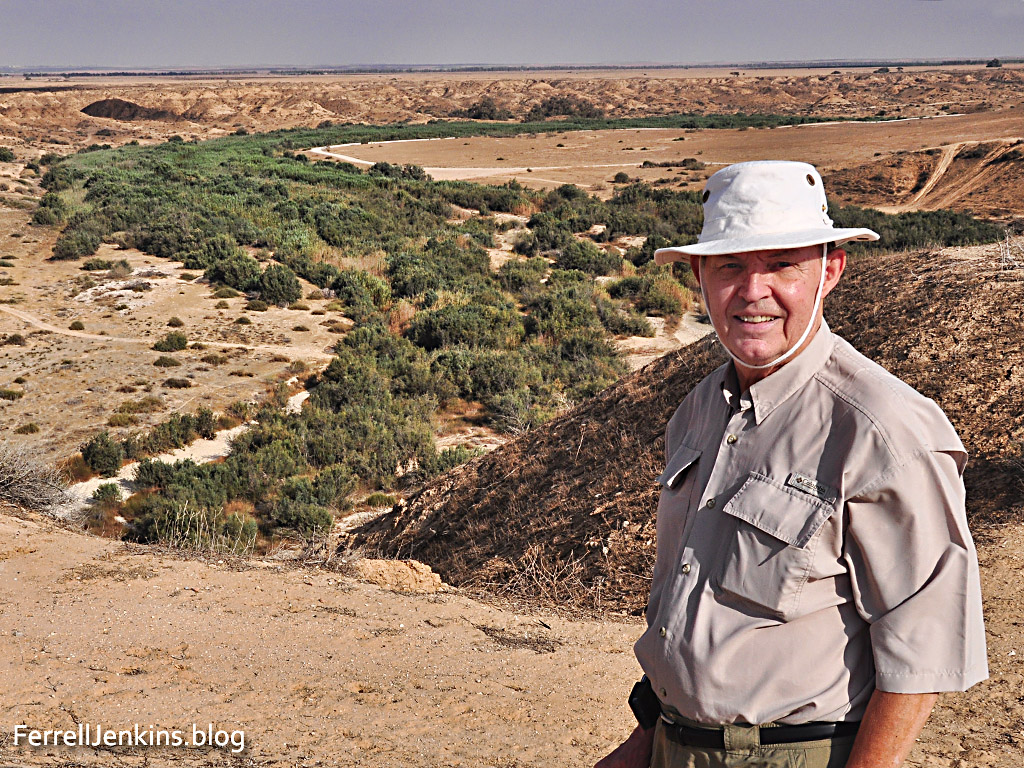
Ferrell Jenkins at Tel Sharuhen. ferrelljenkins.blog.

Brook Besor on the north side of Tel Sharuhen. This picture including Ferrell Jenkins was apparently made by Leon Mauldin. You have a nice view of the Brook Besor. Photo: ferrelljenkins.blog.

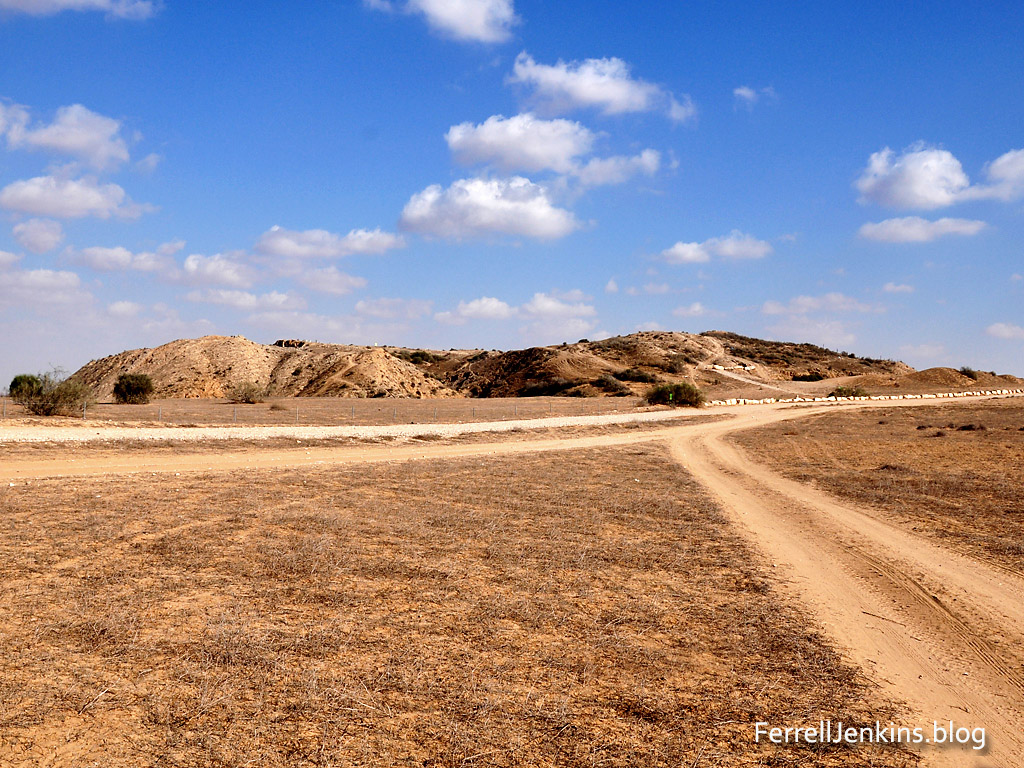
From the south side of the tel we took the steps (lower left corner of the photo) to the top.
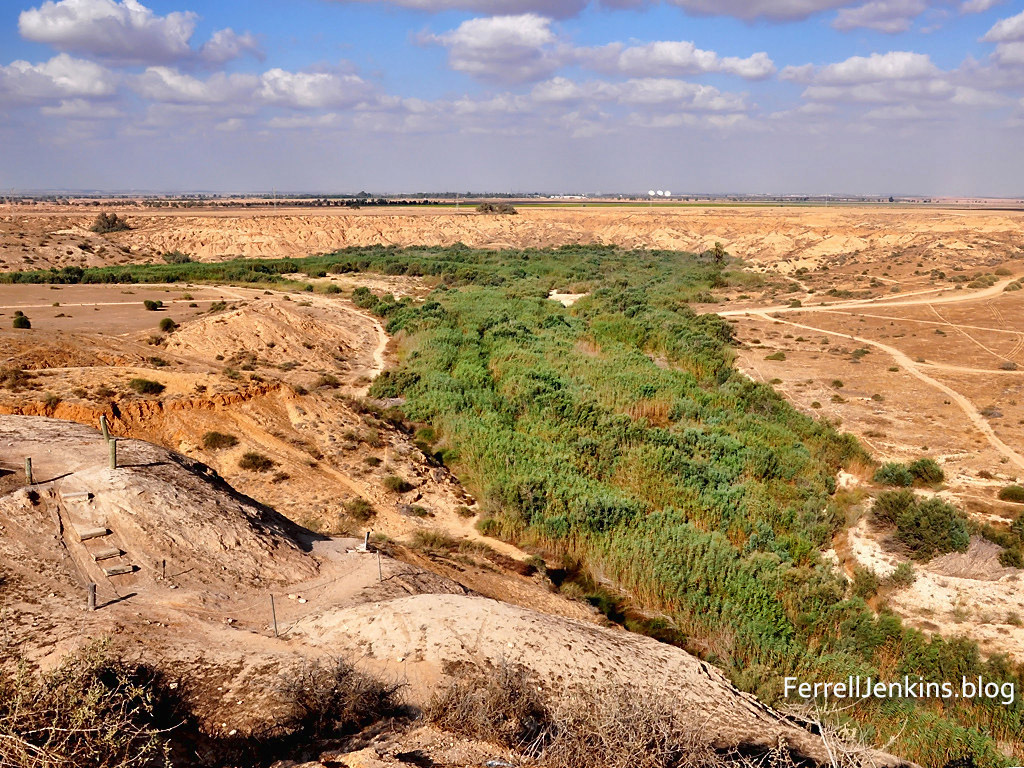
Approach to Tel Shuarhen from the south. View of Brook Besor. Photo ferrelljenkins.blog.

Approach to Tel Sharuhen from the south. View of Brook Besor. Photo by Ferrell Jenkins.

The following signs in Hebrew and English identify the site as Tel Sharuhen.
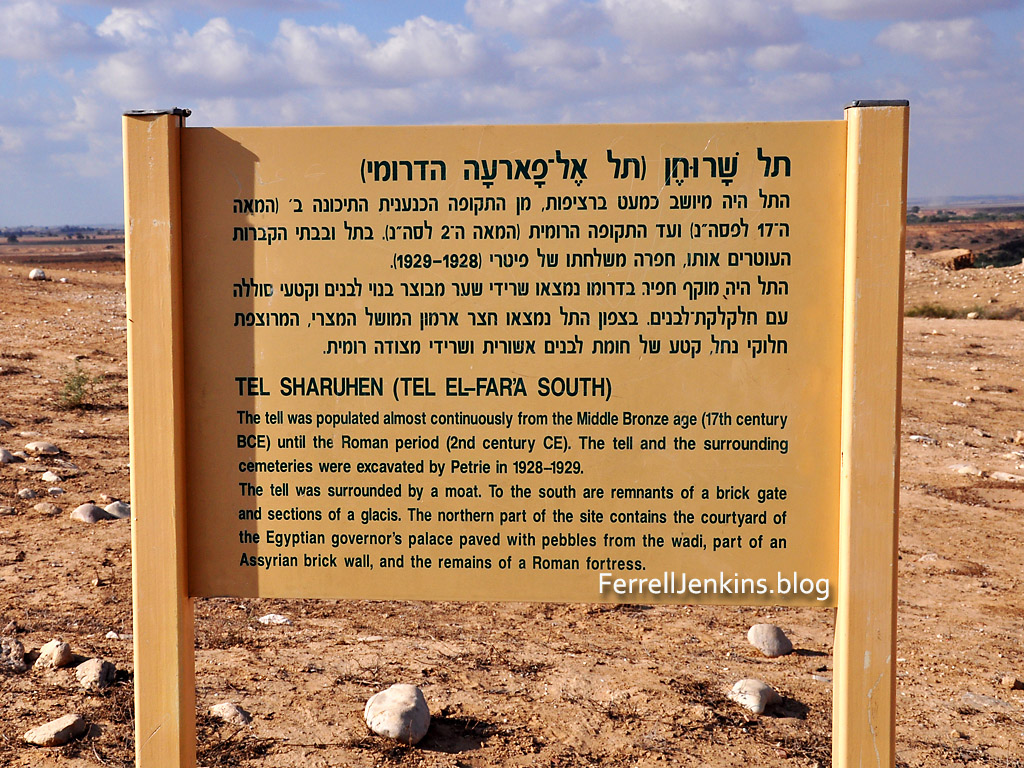
Sign identifying Tel Sharuhen. Photo: ferrelljenkins.blog.

A nice sign identifying the tel as Tel Sharuhen. Photo by Ferrell Jenkins.

I was delighted when I saw these signs were  new.
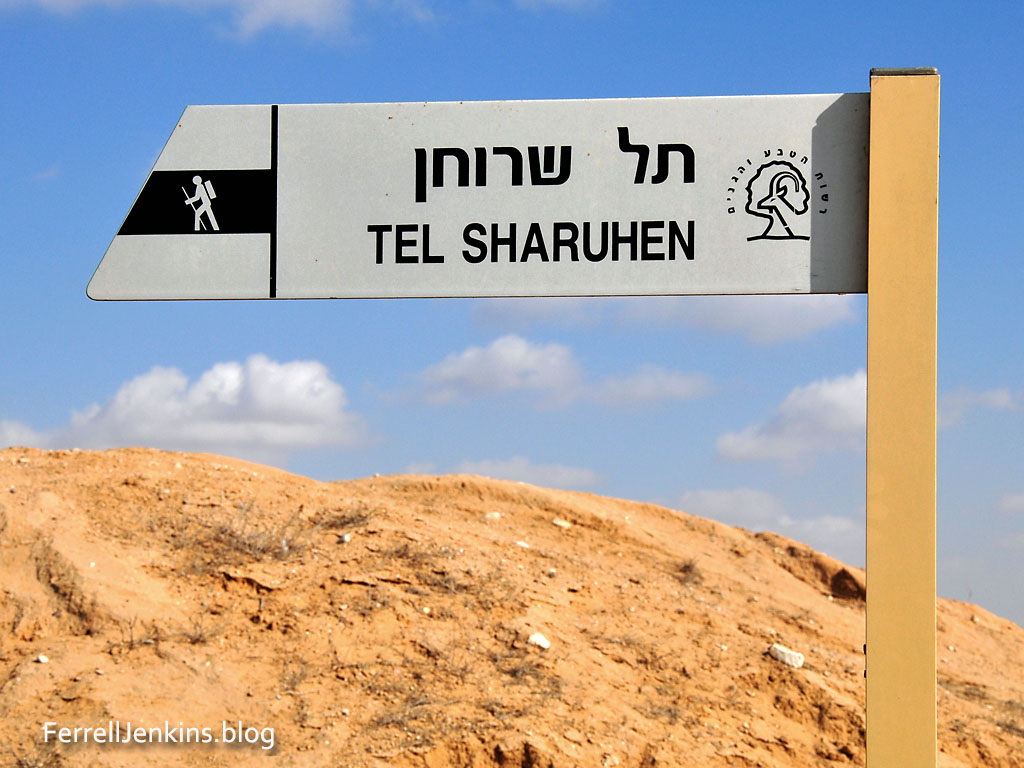
Sign identifying Tel Sharuhen. Photo: ferrelljenkins.blog.

Sign in Hebrew and English identifying the mound as Tel Sharuhen. Photo by Ferrell Jenkins.

There are also signs at the site identifying Tel Sharuhen as part of the ANZAC Trail. This trail was made famous in 1917 when a light horse brigade of mostly Australian and New Zealand aboriginals defeated the Germans in the region.
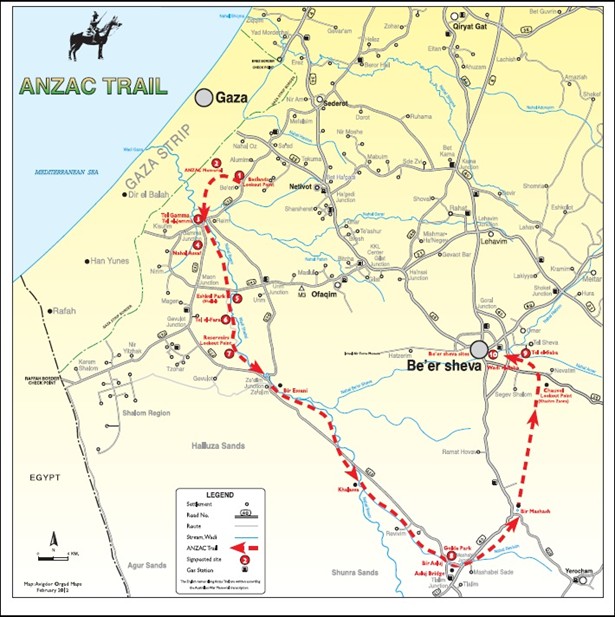
The Anzac Trail of 1917. Tel Sharuhen is marked as number 6.

For those with further interest in the historic battle of 1917 I suggest two links. This link in the Times of Israel tells about the centennial retracing the route of the battle by descendants of the Aboriginal ANZAC soldiers in 2017.

More general information about the ANZAC Trail, including directions and a PDF of the map above, may be read here.

The seven photos in this post are sized suitable for use in a PowerPoint presentation for teaching.
Ferrell’s Favorite Foto # 28 – Moses as Shepherd

Shepherds were highly significant in the ancient near eastern culture. It is no wonder that many of the outstanding characters of the Old Testament are called shepherds.

The LORD frequently chose shepherds to be the leaders of His people. Consider David (Psalm 78:70-72) and Moses (Exodus 3:1) as examples. Moses understood that there should be someone to lead Israel after his death. He made a recommendation to the LORD, saying,

Let the LORD, the God of the spirits of all flesh, appoint a man over the congregation who shall go out before them and come in before them, who shall lead them out and bring them in, that the congregation of the LORD may not be as sheep that have no shepherd.” (Numbers 27:16-17 ESV)

The LORD chose Joshua the son of Nun to fill that role.

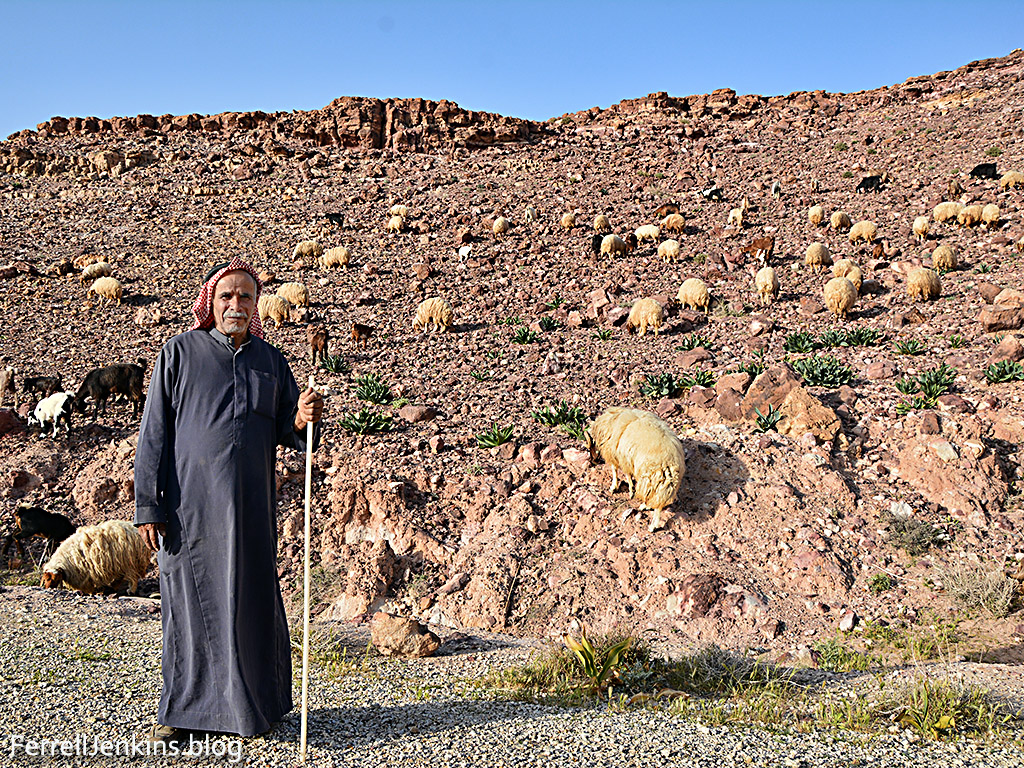
Previously I have mentioned that Leon Mauldin and I spent a week visiting biblical and other historical sites in Jordan in 2018. One day as we were returning to our hotel from our travel we went past Mount Nebo, a site we had visited a day or two earlier. A short distance from Mount Nebo, the place from which Moses viewed the promised land, we came upon an impressive scene. There was a shepherd standing near the road while his sheep were eating whatever available grass there was on the rocky hillside. Leon was driving. I said, “Slow down; there’s Moses.” Obviously I knew better but you can have a look for yourself.

A shepherd watches his sheep near Mount Nebo in Jordan. Photo by Ferrell Jenkins.

One nice thing about traveling in the Middle East today is that most photos do not have to be staged. You are welcome to use this image in your teaching if you wish. It is sized to fit a PowerPoint presentation.

Ferrell’s Favorite Foto # 27 – Living in Tents

When I see tents in the Middle East I do not think of going camping. I think of the biblical patriarchs who moved about from place to place taking their tents with them.

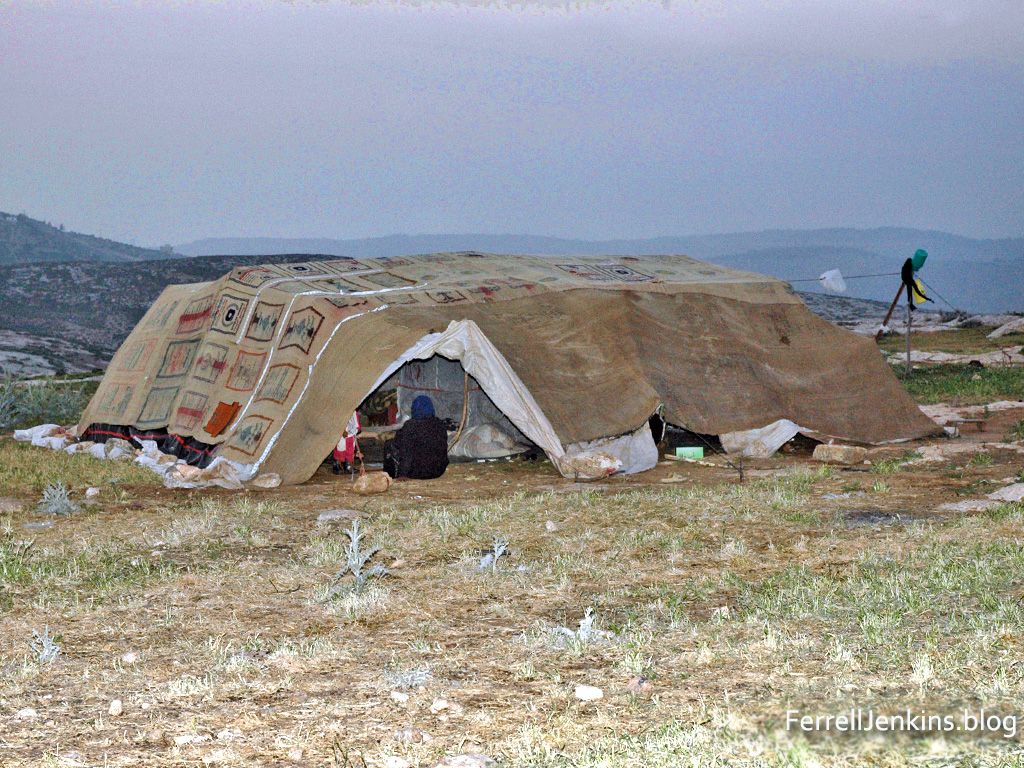
Sheperd's tent near Heshbon, Jordan. ferrelljenkins.blog.

A shepherd’s tent near Heshbon, Jordan, at dusk. Photo by Ferrell Jenkins.

The book of Genesis recounts the movement of Abraham, Isaac, and Jacob as they traveled in Mesopotamia and the Levant. Notice these references:

From there he moved to the hill country on the east of Bethel and pitched his tent, with Bethel on the west and Ai on the east. And there he built an altar to the LORD and called upon the name of the LORD. And Abram journeyed on, still going toward the Negeb. (Genesis 12:8-9 ESV)

The Book of Hebrews recounts events in the life of those who lived by faith.

By faith he [Abraham] went to live in the land of promise, as in a foreign land, living in tents with Isaac and Jacob, heirs with him of the same promise. For he was looking forward to the city that has foundations, whose designer and builder is God. (Hebrews 11:9-10 ESV)

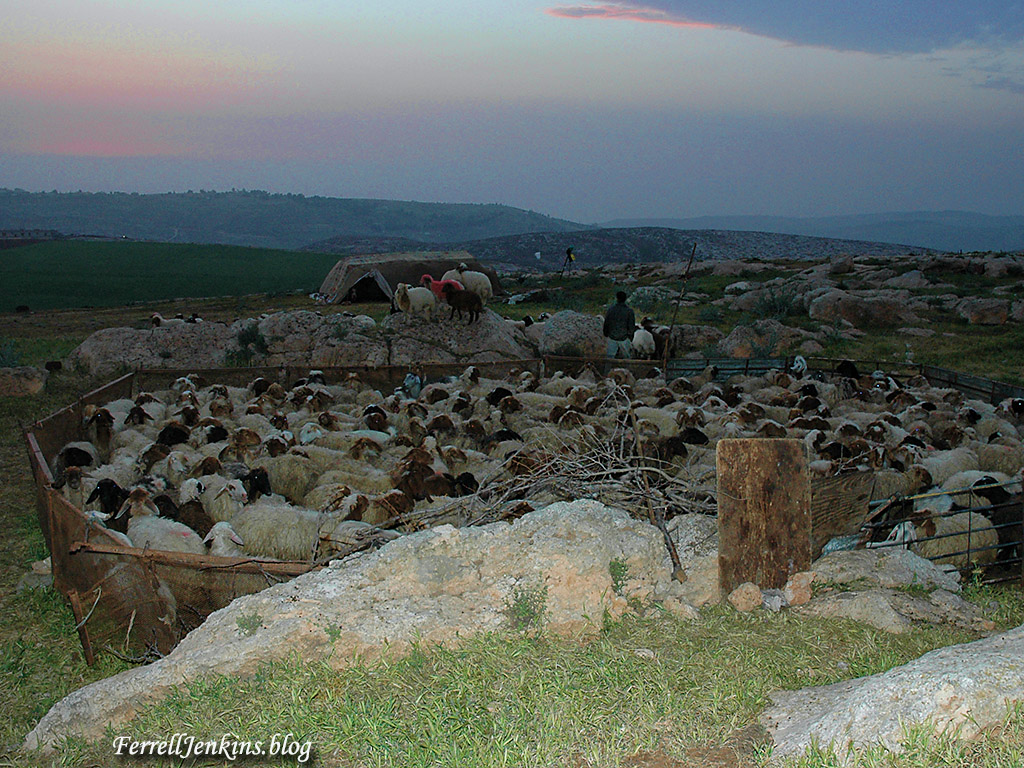
Our photo above was made at dusk when the shepherds were gathering their sheep into the sheepfold. I noticed this nicely decorated tent nearby. I see the lady of the tent sitting on the ground. There is a little child dressed in red partially visible in the tent. Notice to the right of the woman there is a screen covering for the bed. Luxury accommodations compared to some.

While viewing this photo read Genesis 18, the account of the announcement that Sarah would have a child, and see if it doesn’t become more real to you.

Ferrell’s Favorite Foto # 26 – Shepherds by Night

Luke’s account of the birth of Jesus mentions the shepherds “out in the field, keeping watch over their flock by night.”

7 And she gave birth to her firstborn son and wrapped him in swaddling cloths and laid him in a manger, because there was no place for them in the inn. 8 And in the same region there were shepherds out in the field, keeping watch over their flock by night. (Luke 2:7-8 ESV)

I have made many photos of shepherds and sheep over the years, but not many at night. However, in 2006 I visited with some shepherds at Heshbon, Jordan, one afternoon. I inquired about what they did with the sheep at night and decided to return about sundown to make some photos. The photo shown here has been lightened some to allow you to see the sheep in the sheepfold.

A shepherd watches his flock by night at Heshbon. Photo by Ferrell Jenkins.

A shepherd watches his flock by night at Heshbon. Photo by Ferrell Jenkins.

Just to the right of the center of the photo you should be able to see one of the shepherds with his back to the sheepfold. Click on the photo for a larger image suitable for use in teaching.

Agreement of Book and Land – # 1

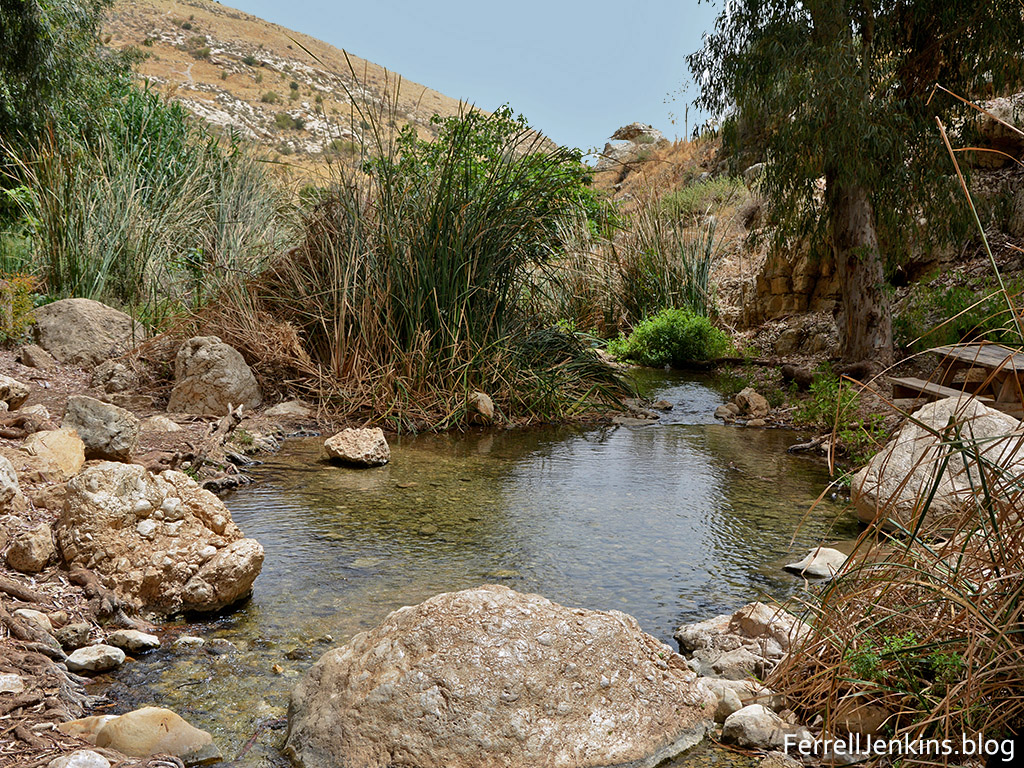
The Scripture and photo below of a perennial stream from En Prat illustrates perfectly the person described in Psalm 1.

Blessed is the man who walks not in the counsel of the wicked, nor stands in the way of sinners, nor sits in the seat of scoffers; but his delight is in the law of the LORD, and on his law he meditates day and night. He is like a tree planted by streams of water that yields its fruit in its season, and its leaf does not wither. In all that he does, he prospers. (Psalm 1:1-3 ESV)

Trees planted by the river. ferrelljenkins.blog.

En Prat where Wadi Kelt begins to flow down past Jericho and to the Jordan Valley. Photo by Ferrell Jenkins.

Ferrell’s Favorite Foto #24

Gibeon, modern El Jib, is mentioned more that three dozen times in the Old Testament. This is where the Lord appeared to Solomon, the newly appointed king of Israel, and told him to “Ask what I shall give you.” Solomon asked for wisdom.

And now, O LORD my God, you have made your servant king in place of David my father, although I am but a little child. I do not know how to go out or come in. And your servant is in the midst of your people whom you have chosen, a great people, too many to be numbered or counted for multitude. Give your servant therefore an understanding mind to govern your people, that I may discern between good and evil, for who is able to govern this your great people?” (1 Kings 3:7-9 ESV)

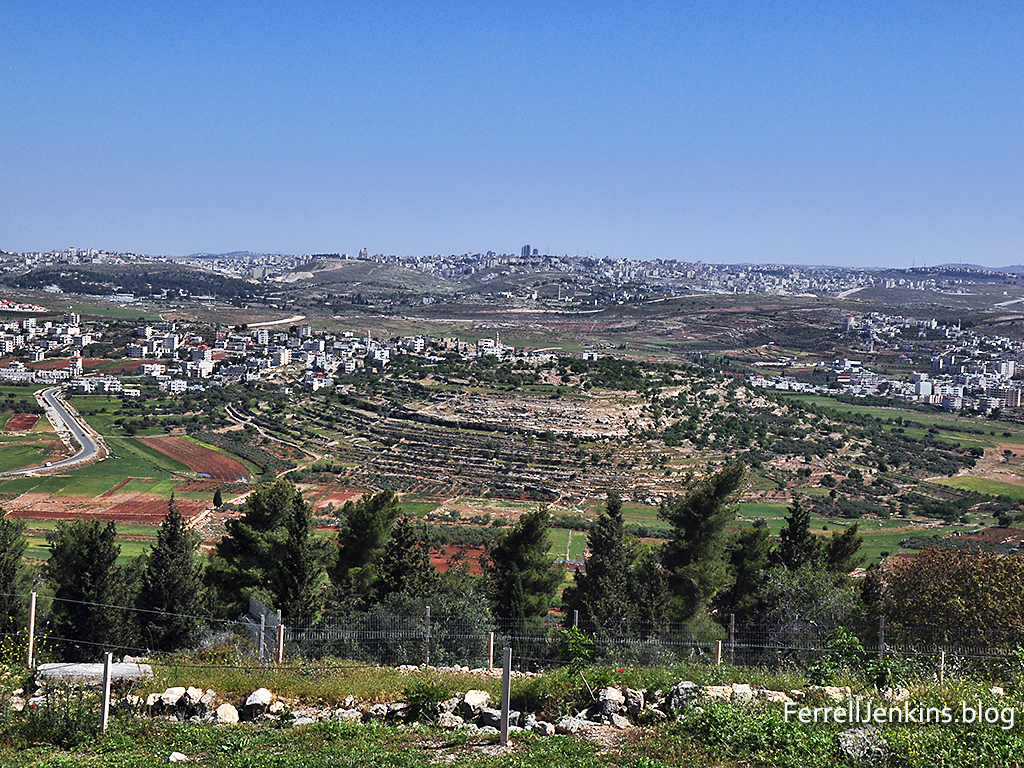
The photo below was made looking north from Nebi Samwil. It shows Tel Jib, believed to be the site of Biblical Gibeon, and the Benjamin plateau. Archaeological excavations have been carried out on the eastern (right) side of the mound. It is currently difficult to visit the site because it in the the Palestinian territory and the route is difficult to navigate. This view is quite beautiful and I happened to catch the weather just right.

Gibeon and the Benjamin Plateau.. Photo: ferrelljenkin.blog.

View north from Nebi Samwil of Gibeon and the Benjamin plateau. Photo by Ferrell Jenkins.

For information on the pool of Gibeon which is mentioned twice in the Bible go here.

Ferrell’s Favorite Foto #22

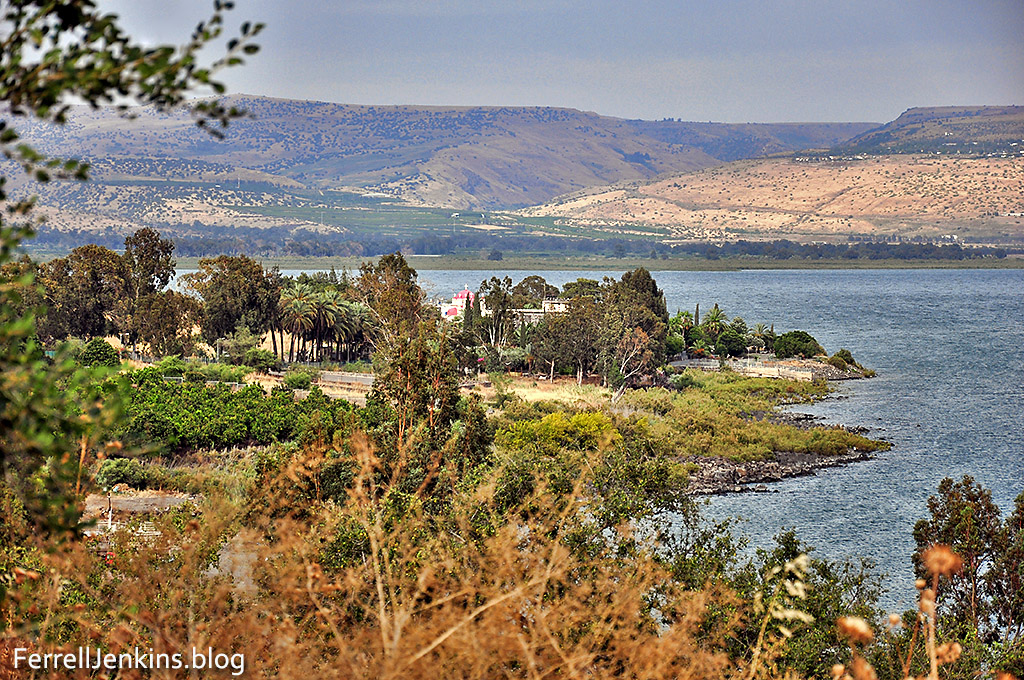
This unusual photo of Capernaum was made from the hill above, up toward the Mount of Beatitudes. The photo shows the northeast corner of the Sea of Galilee with the Golan Heights visible.

Capernaum became the Galilean center for the ministry of Jesus.

And leaving Nazareth he went and lived in Capernaum by the sea, in the territory of Zebulun and Naphtali, (Matthew 4:13 ESV)

Capernaum from above the location on the Sea of Galilee. Photo: ferrelljenkins.blog.

View to the east of Capernaum from above the site. Photo by Ferrell Jenkins.

This photo was made May 15, 2010. The sky was fairly clear and the eastern shore of the Sea of Galilee is visible with perhaps a portion of the Plain of Bethsaida. Those are dried thistles in the foreground of the photo.

Not Ziklag, says other archaeologists

Did you read the press release published yesterday about the locating of Ziklag at Tel al-Rai? Perhaps you did not read down to my closing comments. I said,

Certainly there will be much discussion among scholars, some of whom will suggest other possible locations …

Before I continue I think I should say that Prof. Yosef Garfinkel of Hebrew University did not start out trying to locate Ziklag, but he and the others working with him began to see that the evidence they were uncovering seemed to suggest the location of Ziklag.

I first met Garfinkel through Luke Chandler, a former student and friend, who had worked with him in the excavations at Khirbet Qeiyafa, Tel Lachish, and now Tel al-Rai. Professor Garfinkel has presented two lectures at Florida College where I taught for 25 years. Luke and I made a personal study trip to Israel in March/April this year and visited Yossi, as he is affectionately called by friends. He took us down to Dr. Eilat Mazar’s office and introduced us to her, showed us around the archaeology lab at Hebrew University, took us to lunch at the faculty lounge, and visited the campus of HU and the botanical garden with us. I have provided aerial photos to Yosi for his lectures on Lachish. Our visit at HU was educational and pleasant.

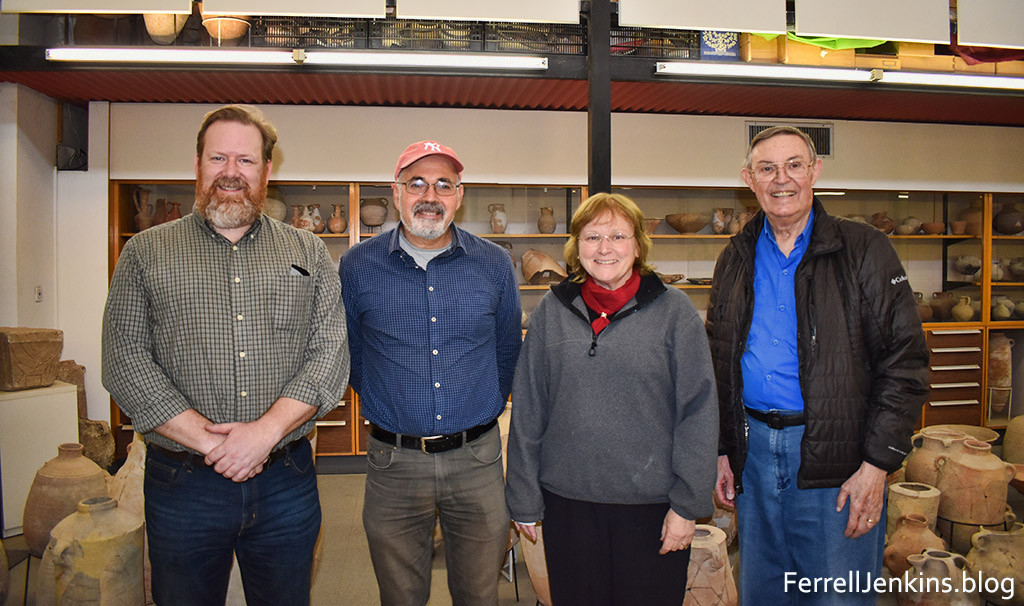
Luke Chandler, Yosef Garfinkel, Eilat Mazar and Ferrell Jenkins in the archaeology lab at Hebrew University. Photo: ferrelljenkins.blog.

Luke Chandler, Yosef Garfinkel, Eilat Mazar and Ferrell Jenkins in the archaeology lab at Hebrew University. Photo: ferrelljenkins.blog.

Well, today’s newspaper gives attention to the views of Prof. Aren Maeir, and Prof. Israel Finkelstein in response. Maeir, of Bar-Ilan University,  has been directing the excavations at Tel es-Safi/Gath for more than two decades, and Finkelstein, a professor at Tel Aviv University, is known as one of the most outspoken proponents of the so-called “minimalist” school. He is known for his work at various archaeological sites.

I refer you to the well-written article of Amanda Borschel-Dan in today’s The Times of Israel for that story.

My article today is neither to defend nor dismiss Tel al-Rai = Ziklag. I have known for years that there have been numerous suggestions for the identity of Ziklag. In fact, back in 2009 Leon Mauldin and I visited Tel Halif, north and slightly east of Beersheba,  and Tel Sera, northwest of Beersheba, because we knew they had been suggested as Ziklag.

The late Professor Anson F. Rainey held that Ziklag should be identified with Tell esh-Shariah, now known as Tel Sera. His four pages (147-150) in The Sacred Bridge would be equivalent to 12 or more pages in many publications.

Leon and I spent a long time driving through fields along the banks of Nahal Gerar till we located Tel Sera.

Tel Sera, identified as Ziklag by Anson Rainey. Photo: FerrellJenkins.blog.

Tel Sera, identified as Ziklag by Anson Rainey. This late afternoon view is to the north. Nahal Gerar, or one of its tributaries, is hidden between the field and the tel. Photo by Ferrell Jenkins.

Archaeologists work with a hypothesis as long as they think it can be sustained, but when new information comes along they move with it.

We may never know the exact location of Ziklag, but I know enough about the Bible to believe that the account of David at Gath, Ziklag, and Jerusalem is one I can hold to.

Researchers claim to have found Biblical Ziklag

It’s that time of the year. Archaeological digs are closing down for the season and the directors of the digs want you to know what they have uncovered. You probably have not heard of Khirbet a-Ra‘i or Tel a-Ra‘i but you know that the Bible reports that David was given the site of Ziklag by Achish, King of Gath.

So that day Achish gave him Ziklag. Therefore Ziklag has belonged to the kings of Judah to this day. And the number of the days that David lived in the country of the Philistines was a year and four months. (1 Samuel 27:6-7 ESV)

Here is the complete Israel Antiquities Authority news release from earlier today with a few of the nice photos provided by the IAA.

—  “ —

Researchers from the Hebrew University, the Israel Antiquities Authority and Macquarie University in Sydney: “We Have Found Biblical Ziklag”

Aerial photo of Tel Arai. Photo by Emil Aljem, Israel Antiquities Authority.

The site, from the time of King David, was discovered near Kiryat Gat *
According to the Biblical narrative, David found refuge in Ziklag while fleeing
from King Saul. From there he went to Hebron to be anointed as King *
Dozens of complete pottery vessels were found at the site, 3,000 years old
How was Biblical Ziklag found? Researchers from the Hebrew University in Jerusalem, the Israel Antiquities Authority and Macquarie University in Sydney, Australia, believe they have discovered the Philistine town near Kiryat Gat, immortalized in the Biblical narrative. Ziklag is mentioned multiple times in the Bible in relation to David (in 1 Samuel and 2 Samuel). According to the Biblical narrative, Achish, King of Gat, allowed David to find refuge in Ziklag while fleeing King Saul and from there David also departed to be anointed King in Hebron. According to scripture, Ziklag was also the scene of a dramatic event, in which the Amalekites, desert nomads, raided and burned the town taking women and children captive.

The excavation, which began in 2015 at the site of Khirbet a-Ra‘i in the Judaean foothills – between Kiryat Gat and Lachish, has proceeded in cooperation with Prof. Yosef Garfinkel, Head of the Institute of Archaeology at the Hebrew University in Jerusalem, Saar Ganor of the Israel Antiquities Authority and Dr. Kyle Keimer and Dr. Gil Davis of Macquarie University in Sydney, Australia. The excavation was funded by Joey Silver of Jerusalem, Aron Levy of New Jersey, and the Roth Family and Isaac Wakil both of Sydney. The excavation has been ongoing for seven seasons with large areas being exposed – approximately 1,000 sq.m., leading to this new identification for Ziklag.

Walls from Tel a-Rai. Photo Israel Antiquities Authority.

Massive walls from Tel a-Rai. Photo: Israel Antiquities Authority.

The name Ziklag is unusual in the lexicon of names in the Land of Israel, since it is not local Canaanite-Semitic. It is a Philistine name, given to the town by an alien population of immigrants from the Aegean. Twelve different suggestions to identify Ziklag have been put forward, such as Tel Halif near Kibbutz Lahav, Tel Sera in the Western Negev, Tel Sheva, and others. However, according to the researchers, none of these sites produced continuous settlement which included both a Philistine settlement and a settlement from the era of King David. At Khirbet a-Ra‘i, however, features from both these populations have been found.

Evidence of a settlement from the Philistine era has been found there, from the 12-11th centuries BC. Spacious, massive stone structures have been uncovered
containing finds typical of the Philistine civilization. Additional finds are foundation deposits, including bowls and an oil lamp – offerings laid beneath the
floors of the buildings out of a belief that these would bring good fortune in the
construction. Stone and metal tools were also found. Similar finds from this era were discovered in the past in excavations in Ashdod, Ashkelon, Ekron and Gath–the cities of the Lords of the Philistines.

Showing Tel a-Rai excavation in Israel.

A young lady cleans around one of the jars found in the excavation at Tel a-Rai this year. Photo courtesy of Israel Antiquities Authority.

Above the remains of the Philistine settlement was a rural settlement from the time of King David, from the early 10th century BC. This settlement came to an end in an intense fire that destroyed the buildings. Nearly one hundred complete pottery vessels were found in the various rooms. These vessels are identical to those found in the contemporary fortified Judaean city of Khirbet Qeiyafa—identified as biblical Sha‘arayim—in the Judaean foothills. Carbon 14 tests date the site at Khirbet a-Ra‘i to the time of King David.

The great range of complete vessels is testimony to the interesting everyday life during the reign of King David. Large quantities of storage jars were found during the excavation- medium and large-which were used for storing oil and wine. Jugs and bowls were also found decorated in the style known as “red slipped and hand burnished,” typical to the period of King David.

Following a regional archaeological study in the Judaean foothills managed by Professors Garfinkel and Ganor, a picture of the region’s settlement in the early Monarchic era is emerging: the two sites – Ziklag and Sha‘arayim-are situated on the western frontier of the kingdom. They are both perched atop prominent hills, overlooking main routes passing between the Land of the Philistines and Judea: Khirbet Qeiyafa in the Elah Valley sits opposite Philistine Gath, and Khirbet a-Ra‘i, sits opposite Ashkelon. This geographic description is echoed in King David’s Lament, in which he mourns the death of King Saul and Jonathan in their battle against the Philistines: “Tell it not in Gath, publish it not in the streets of Ashkelon.”

—  ” —

Various newspapers, especially those in Israel, have covered this notice today. Certainly there will be much discussion among scholars, some of whom will suggest other possible locations, but all within a reasonable distance, for Ziklag. Perhaps I will be able to add some additional information in the next few days.

Luke Chandler and other friends participated in the dig at Tel a-Rai during the past few weeks.

HT: Joseph Lauer and others.

Sealing a document in Bible times

This text in the book of the prophet Jeremiah describes the importance of documents and seals in Judah in the sixth century B.C.

Jeremiah said, “The word of the LORD came to me:  Behold, Hanamel the son of Shallum your uncle will come to you and say, ‘Buy my field that is at Anathoth, for the right of redemption by purchase is yours.’ Then Hanamel my cousin came to me in the court of the guard, in accordance with the word of the LORD, and said to me, ‘Buy my field that is at Anathoth in the land of Benjamin, for the right of possession and redemption is yours; buy it for yourself.’ Then I knew that this was the word of the LORD. “And I bought the field at Anathoth from Hanamel my cousin, and weighed out the money to him, seventeen shekels of silver. I signed the deed, sealed it, got witnesses, and weighed the money on scales. Then I took the sealed deed of purchase, containing the terms and conditions and the open copy. ( Jeremiah 32:6-11 ESV. Continue reading in Jeremiah for the full story.)

Important documents were rolled and then tied with string. A small amount of damp clay was placed on the string and the person would impress his seal into the clay. When the impression dried it made a permanent copy of the seal. This was called a bulla (plural is bullae). Both seals and bulla of various biblical characters have been discovered in Israel.

The photo below  is of a display at the Hecht Museum at the University of Haifa.

Sealed document at Hecht Museum. ferrelljenkins.blog.

Seal document and ancient bullae display at Hecht Museum, University of Haifa. Photo by Ferrell Jenkins.

You can find more information about seals and sealing by putting the word seal in the Search Box. Click on the photo for a larger image suitable for use in teaching.