Category Archives: Bible Study

BiblePlaces Newsletter

Todd Bolen’s BiblePlaces Newletter for December is now available. It includes a wonderful aerial photo of the Elah Valley. The main feature is a series of (Google) satellite photos of Jerusalem with the natural features (hills, valleys, springs, quarters of the city, etc.) identified. If you teach any lesson dealing with the city of Jerusalem you need these PowerPoint slides.

You should subscribe to the BiblePlaces Newsletter, but if you have not yet done so you may access the current issue here. The subscription link is at the bottom of the page.

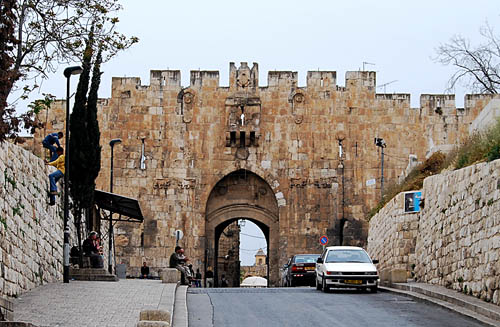
The photo below shows one of the modern gates of Jerusalem. It is labeled Stephen’s Gate on one of the slides mentioned above. Murphy-O’Connor says that Suliman called it the Bab el-Ghor (the Jordan Valley Gate). In Hebrew it is called the Lions’ Gate, but you may notice that the animals to the left of the gate are panthers. Murphy-O’Connor says this was “the heraldic emblem of the Mamluk sultan Baybar (1260-77). This is the only gate of the Old City on the east side that is currently open.

Lions Gate or St. Stephen Gate. Photo by Ferrell Jenkins.

Lions' Gate or St. Stephen's Gate. Photo by Ferrell Jenkins.

Newsweek attacks biblical authority & marriage

Perhaps you have already seen the cover, and cover story, of Newsweek (Dec. 15, 2008). The cover, showing a drawing of a Bible, touts the main article by Lisa Miller, “The Religious Case for Gay Marriage.” Miller is the religion editor of Newsweek.

Rather than write my own reply, I would like to direct you to the Blog by R. Albert Mohler, Jr. Read it here.  Mohler correctly points out that the real issue in this discussion is one of biblical authority.

As always, the bottom line is biblical authority.  Lisa Miller does not mince words.  “Biblical literalists will disagree,” she allows, “but the Bible is a living document, powerful for more than 2,000 years because its truths speak to us even as we change through history.”  This argument means, of course, that we get to decide which truths are and are not binding on us as “we change through history.”

Newsweek editor Jon Meacham says,

No matter what one thinks about gay rights–for, against or somewhere in between–this conservative resort to biblical authority is the worst kind of fundamentalism. Given the history of the making of the Scriptures and the millennia of critical attention scholars and others have given to the stories and injunctions that come to us in the Hebrew Bible is more than intellectually bankrupt–it is unserious, and unworthy of the great Judeo-Christian tradition. (Newsweek, Dec. 15, 2008, p. 4)

Well, there you have it. The editor of Newsweek has resolved this matter with one editorial.

If you are interested in a good study of this subject you might enjoy the video by Dr. Robert Gagnon, author of  several works on Homosexuality and the Bible, here. Or, read Dr. Gagnon’s 26 page response to the Miller article here.

Bethlehem and Shrines

Shrines. Throughout the lands where Bible events transpired church buildings have been erected over this or that “sacred spot.” These buildings, whether in Jerusalem, Nazareth or Bethlehem are little more than show places. Tourists stream through them at a steady rate observing the ancient ornamentation.

In Bethlehem the traditional place where Jesus was born, now covered by the Basilica of the Nativity, would hardly remind one of anything he reads in the New Testament. The visitor now finds a building which reveals “a succession of slow decay and hasty repairs” The Middle East, 1966 ed., 622). In this building he sees mosaics with gold backgrounds dating from the 12th century, and art of the middle ages. The ruins of the large buildings erected by Justinian in the 6th century simply serve to cover the 4th century building by Constantine. The student of church history never forgets that all of this was the activity of an apostate church and does not reflect New Testament Christianity.

Their value. The shrines do serve a useful purpose. We have no record to indicate that the earliest Christians built any shrines at the sites associated with the ministry of Jesus. One can imagine, however, that fathers would tell their sons and that residents would tell visitors where certain events happened. If this information was faithfully transmitted from the first to the fourth century when the first shrines were erected, then the shrine has kept alive the memory till now.

The shrines have preserved sites, which if left in the open would have eroded or been damaged or built over so that the memory would be lost.

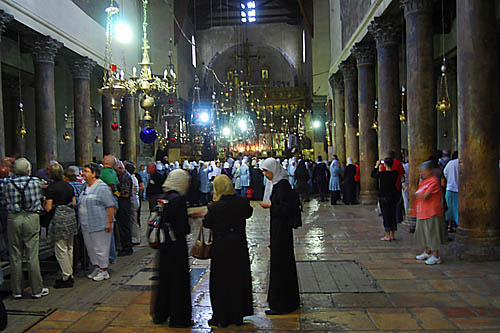
This photo shows the interior of the Greek Orthodox Church that is said to be built over the birthplace of Jesus.

Interior of the Church of the Nativity. Photo by Ferrell Jenkins.

Interior of the Church of the Nativity. Photo by Ferrell Jenkins.

Our study about Bethlehem brings to our mind the reality of the earthly ministry of Jesus. In Bethlehem we see the expression of the love of God who sent His own son to the earth.

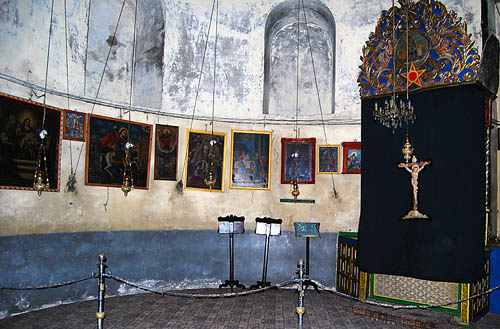
The next photo shows the Armenian chapel in the Church of the Nativity. It stands between the Greek Orthodox and Roman Catholic churches.

Armentian altar in the Church of the Nativity. Photo by Ferrell Jenkins.

Armenian altar in the Church of the Nativity. Photo by Ferrell Jenkins.

Bethlehem – the Birthplace of Jesus

Years ago we would say that Bethlehem is located in the hill country of Judea about six miles south of Jerusalem. Today, Jerusalem stretches all the way to Bethlehem. It is no longer easy to get to Bethlehem. The massive wall built by Israel (Israelis call it the “fence”) separates Bethlehem from Israel.

During the Patriarchal period the town was called Ephrath (Genesis 48:7; 35:9-27). Later, as part of the territory allotted to the tribe of Judah, it was the home of Ruth and Boaz and became the birthplace and early home of David (1 Samuel 17:12, 15). The town was sometimes called the “city of David” (Luke 2:4, 11), but is most famous as the birthplace of Jesus (Micah 5:2; Luke 2:4-15; Matthew 2:1-16).

When one visits the Bible lands today he must realize that 2,000 years of history, involving both repeated building and the destruction of what has been built, has left nothing to remind one of the original place where Jesus was born. Justin Martyr (ca. A.D. 160) said Joseph “took up his quarters in a certain cave near the village.” Origen (mid-third century) said the cave where Jesus was born was being shown and even the enemies of the faith were talking of it. Jerome, a resident of Bethlehem (A.D. 386-420), tells how the birthplace of Jesus and other places associated with the ministry of Jesus were defiled from the time of Hadrian to the reign of Constantine. The Church of the Nativity now stands at this spot.

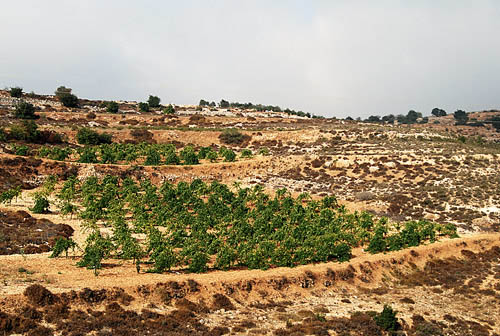
Today I have chosen to include a photograph of vineyards in the hill country immediately to the west of Bethlehem.

Terraces in the hill country of Judea near Bethlehem. Photo by F. Jenkins.

Terraces in the hill country of Judea near Bethlehem. Photo by F. Jenkins.

Gordon Franz has written a good article about Bethlehem which is posted on the ABR web site. Read it here.

Jerome in Bethlehem

Recently I was reading a manuscript written by a friend on the general subject of how we got the Bible. Of course, he mentioned Jerome and his work of translating the ancient Hebrew and Greek manuscripts into what would be called the Latin Vulgate.

The earliest English versions of the Bible were translated from the Latin Vulgate. Even though the translations of today rely mostly on the Hebrew and Greek texts, we are still indebted to the work of Jerome.

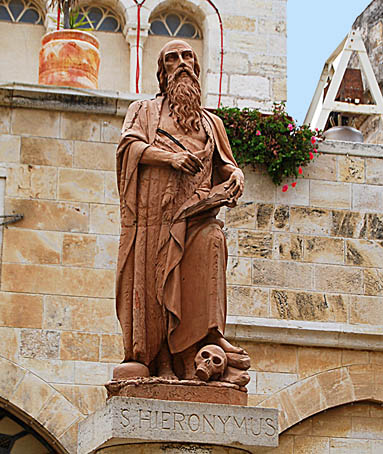
Jerome lived in Bethlehem from about 384 A.D. to 420 A.D. In the front of the Church of St. Catherine in Bethlehem there is a modern statue of Jerome showing him in the act of writing. Everyone always asks about the skull at the foot of the statue. Some have suggested that Jerome kept a skull on his desk to remind him of his mortality. That would do it for me!

Statue of Jerome in front of St. Catherine's Church. Photo by Ferrell Jenkins.

Statue of Jerome in front of the church of St. Catherine in Bethlehem. Photo by Ferrell Jenkins.

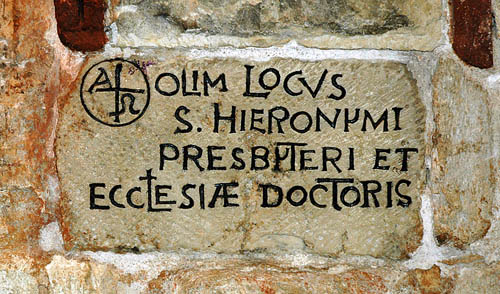
Underneath the Church of the Nativity there are a series of grottoes or caves. One of these is said to have been the place where Jerome did his work of translation and writing. This sign presently marks the place where he once lived.

The place where Jerome once lived. Photo by Ferrell Jenkins.

The place where Jerome once lived. Photo by Ferrell Jenkins.

Reliability of the New Testament Manuscripts

Earlier I mentioned hearing Dr. Daniel Wallace speak on New Testament Textual Criticism at the annual ETS meeting. Dan is NT editor of the NET Bible and a respected textual critic. He has a DVD video of this lecture and of another one (“Is What We Have Now What They Wrote Then?”) available for the small sum of $15.00 plus $3 S&H. This is good, up-to-date, material on this subject. I ordered my copies this morning. Here is the info about the DVDs:

“Is What We Have Now What They Wrote Then?”
A lecture at an apologetics conference in Providence, Rhode Island, 2008, about whether our printed New Testaments today accurately represent the original text.

“Challenges in New Testament Textual Criticism for the 21st Century”
A plenary lecture at the annual Evangelical Theological Society meeting in Providence, Rhode Island, 2008, on current issues in NT textual criticism.

Use this link to get to the order page: Wallace DVDs. To read a bit more about the DVDs and see comments by readers, click here.

Information about The Center for the Study of New Testament Manuscripts, which is headed by Wallace, is available here.

McGarvey’s Land of the Bible

J. W. McGarvey was one of the best scholars of the 19th century Restoration Movement. He was president of the College of the Bible in Lexington, KY. One of my first books was his practical New Commentary on Acts of Apostles (1892). He had earlier (1868) written A Commentary on Acts of Apostles dealing with some of the critical issues of the book. McGarvey addressed some of the critical questions of the day in The Authorship of Deuteronomy, Jesus and Jonah, and Biblical Criticism.

McGarvey visited Palestine in 1879. His former students paid for the trip [I like that!], with the understanding that he would write a book. They would get their money back from the sale of the book. His book, Lands of the Bible, was published by J. B. Lippincott & Co., London and Philadelphia, in 1881. The title page indicates that 15,000 copies were printed. Impressive for a book on that subject.

J. W. McGarvey’s Lands of the Bible is available at the Restoration Movement pages here. For other works by McGarvey and other Restoration leaders begin with the home page here.

When I led my first group to the Bible Lands in 1967, one friend in the group had studied McGarvey’s book carefully. He took a tape measure with him. When we came to certain sites he took out the tape to take measurements. He wanted to be sure he was at the same place McGarvey visited.

Chapter IX in McGarvey’s book is titled “Argument from the Agreement of the Land and Book.” I have an outline of this material in my Introduction to Christian Evidences [OP], and use some of this material in my Daily Life in Bible Times series. One would be mistaken not to move beyond McGarvey, Thompson, Robertson, and the other early explorers. On the other hand, it would be amiss to dismiss what these scholars wrote.

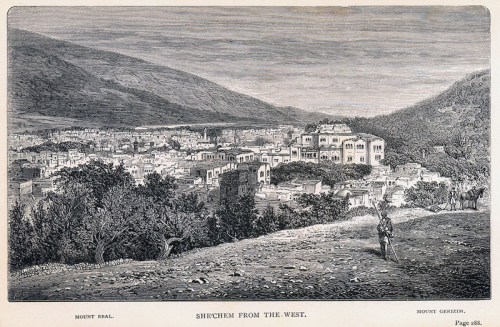
What prompted all of this? Todd Bolen recently wrote a post on The Acoustics of Mounts Gerizim and Ebal in which he quotes from one of McGarvey’s letters here. I urge you read his post now. Also follow the link to the Biblical Studies and Technology Tools post showing the valley between Ebal and Gerizim using digital mapping tools.

I wanted to contribute something to this study by including here a scan of the plate from my original edition of Lands of the Bible (opposite page 288).

Shechem from the West. McGarvey, Land of the Bible.

Shechem from the West. McGarvey, Land of the Bible.

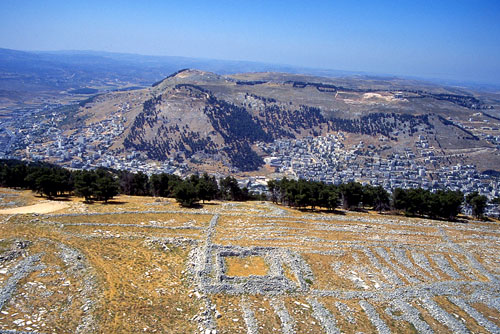
Todd Bolen has a great photo of Mount Ebal from Mount Gerizim. I would like to add the other side of the valley. Here is a photo showing Mount Gerizim from above Mount Ebal. It is an aerial shot made for me by the well known photographer Zev Radovan.

View of Mount Gerizim from above Mount Ebal.

View of Mount Gerizim from above Mount Ebal.

Maybe later we will discuss some of the important biblical events that took place in this area. For not let us note that this is where the blessings and curses of the law were read after the children of Israel entered the promised land (Deuteronomy 11:19). Here is the account of that event:

All Israel with their elders and officers and their judges were standing on both sides of the ark before the Levitical priests who carried the ark of the covenant of the LORD, the stranger as well as the native. Half of them stood in front of Mount Gerizim and half of them in front of Mount Ebal, just as Moses the servant of the LORD had given command at first to bless the people of Israel. Then afterward he read all the words of the law, the blessing and the curse, according to all that is written in the book of the law.  There was not a word of all that Moses had commanded which Joshua did not read before all the assembly of Israel with the women and the little ones and the strangers who were living among them. (Joshua 8:33-35 NASB)

Healing of the blind man at Bethsaida

There are several accounts in the Gospels (Matthew, Mark, Luke, John) of Jesus giving sight to the blind.

  • Two blind men were healed (Matthew 9:27-31).
  • A blind, mute, demon-possessed man was healed by Jesus (Matthew 12:22).
  • Two blind men near Jericho were given sight (Matthew 20:29-34). It may be that the blind beggar named Bartimaeus was one of these (Mark 10:46-52).
  • A blind man was brought to Jesus at Bethsaida and healed (Mark 8:22-25).
  • The man who was blind from birth, and was told to go wash in the pool of Siloam in Jerusalem (John 9).

My eyes have experienced several problems over the past few years. I am fortunate to have received excellent care from a team of competent professionals. Earlier this week I had my first cataract surgery. I have been surprised that most of my friends who knew about the surgery asked “which eye?” I always said, “right,” but I wonder if their response would have been different if I had said “left.”

When you had your cataract surgery I thought it was minor and routine. When I had mine it was more serious! Actually it was not too difficult. I can tell that I see better in the right eye, but I must wait a couple of weeks to see what will be done about the lens I have been wearing before I will know how effective it has been. And then there is the left eye.

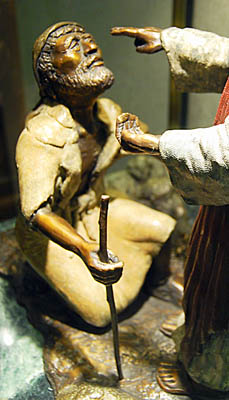
Well, all of this got me to thinking about the miracles of Jesus in the healing of the blind. One of the physicians at the clinic where I go has a nice piece of sculpture in his waiting area.

"Miracle of Sight" at Tampa Eye Clinic. Photo by Ferrell Jenkins.
Miracle of Sight.

I suspect that this sculpture is based on the account of the blind man in John 9. It could possibly be the account of the man at Bethsaida (Mark 8).

Bethsaida is now identified with et-Tell. In with Jesus through Galilee according to the fifth Gospel, the late Bargil Pixner points out that the man was healed in stages. He then says,

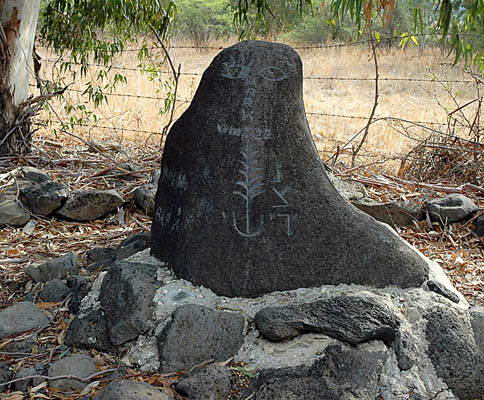
The place of the healing near Bethsaida is marked today by a memorial stone on which two eyes have been chiselled, one half-closed and the other open brightly. (page 95)

I had the opportunity to meet Pixner once at Tabgha and have him autograph a copy of his book. I asked him if he knew how long the marker had been at the site. He told me exactly and then added, “I put it there.” You might like to see that memorial stone.

Memorial stone placed at Bethsaida by Bargil Pixner. Photo by Ferrell Jenkins.

Celebrating 100,000 visitors; a gift for you

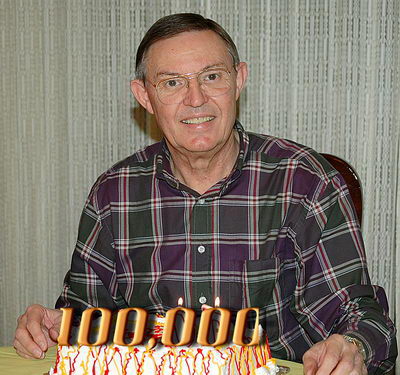
Thanks for visiting Ferrell’s Travel Blog. This afternoon our Blog Stats moved above 100,000. I think when we began the blog we only had in mind that families of some of our tour members could follow our route of travel. Then I began to write about other places I had visited. Well, here we are today.

As my wife and I looked at the stats I said, “Well, we have reached a millstone, if not a milestone.” She said, “Yes, it is a millstone.” I must admit it has become addictive. But when I realize that I am reaching a large number of people each day/week/month with something that may be beneficial in Bible study and teaching, I am delighted.

Ferrell Jenkins celebrating 100,000 visitors.

Ferrell Jenkins celebrating 100,000 visitors.

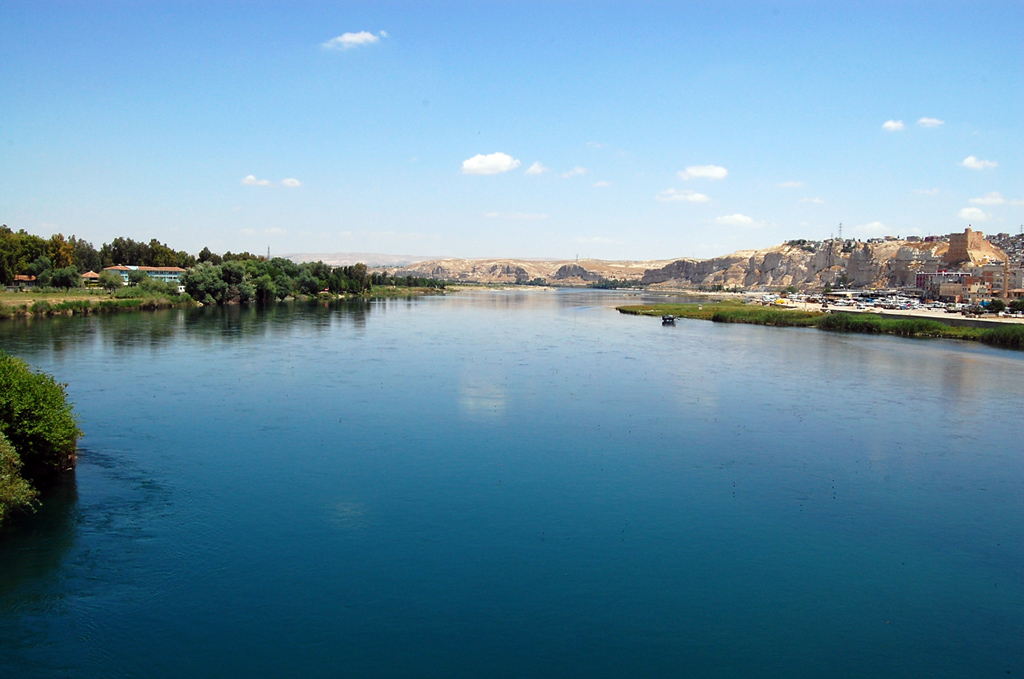
I want to share a gift that may be of benefit to those who use PowerPoint presentations in teaching. During the life of the blog, more people have visited our pages on the Euphrates River than any other. Here is a photo of the Euphrates at Birecik, Turkey. Click on the small photo below and it will take you to a high resolution photo that you may download and use. We request that you not publish the photo without permission. A digital copyright notice is embedded in the image.

The Euphrates River at Birecik, Turkey. Photo by Ferrell Jenkins.

The Euphrates River at Birecik, Turkey. Photo by Ferrell Jenkins.

The Euphrates is the largest, longest and most important river of Western Asia. It is nearly 1800 miles long and was the northeastern boundary of the land promised to Abraham (Gen. 15:18). The empires of Assyria and Babylon, the greatest enemies of Israel, were east of the Euphrates. The Old Testament prophets often put the Euphrates by metonomy for these countries to designate the place from which the punishment of God would come (Isa. 7:20; 8:7; Jer. 46:10). For more information on the Euphrates River read the article here.

Traveling without a bag

Read the previous post, Treasures old and new, for an introduction to this one.

Recently I was reading a section in Light From the Ancient East by Adolf Deissman about the value of understanding the meaning of New Testament words through words in common use in New Testament times.

Deissman takes up the account of Jesus sending out the twelve and shows how one simple word is understood better through the use of documents from the same time period.

Jesus said to the disciples,

“Heal the sick, raise the dead, cleanse the lepers, cast out demons. Freely you received, freely give. “Do not acquire gold, or silver, or copper for your money belts, or a bag for your journey, or even two coats, or sandals, or a staff; for the worker is worthy of his support. (Matthew 10:8-10 NASB)

See also Mark 6:8 (the KJV uses scrip for the Greek pera) and Luke 9:3; 22:35-36.
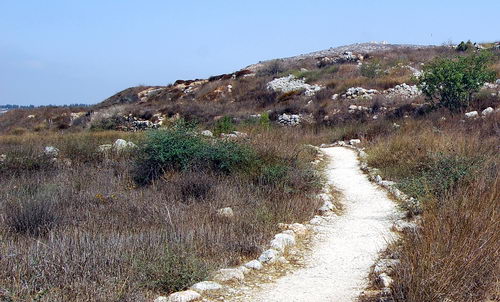
A path at Shiloh. Photo by Ferrell Jenkins.

A path at Shiloh. Photo by Ferrell Jenkins.

Below is the rather lengthy quotation from Deissman which I have in the Libronix format now. Because of the length of this paragraph I will not indent it as we normally do, and will divide it into three paragraphs for ease of reading.

——

One of the characteristic utterances of Jesus has here been handed down, not without variations, but still in such form that the original can be discerned beneath them: the apostles were told to take with them for their journey only the barest necessaries, among which was to be reckoned neither money nor bread. According to St. Matthew’s report they were further forbidden even to earn money on their way, as they might have done by working miracles of healing, etc. The meaning of the “wallet” (A.V. “scrip”) has seldom been questioned, because it seems so obvious: most commentators probably think of it as a travelling-bag, or, more precisely defined, as a bread-bag.

The word in the original Greek, πήρα, is capable of either meaning, according to circumstances. In the context “travelling-bag” would do very well; “bread-bag” not so well, being superfluous after the mention of “bread,” and tautology seems out of place in these brief, pointed commands given by Jesus. But there is a special meaning, suggested by one of the monuments, which suits the context at least as well as the more general sense of “bag” or “travelling-bag.” The monument in question was erected in the Roman Imperial period at Kefr-Hauar in Syria by a person who calls himself, in the Greek inscription, a “slave” of the Syrian goddess. “Sent by the lady,” as he says himself, this heathen apostle tells of the journeys on which he went begging for the “lady” and boasts triumphantly that “each journey brought in seventy bags.”

The word here employed is πήρα. Of course it has nothing to do with well-filled provision-bags for the journey: it clearly means the beggar’s collecting-bag. The same special meaning would make excellent sense in our text, particularly in St. Matthew’s version: there is to be no earning, and also no begging of money. With this possible explanation of the word πήρα the divine simplicity of Jesus stands out afresh against the background suggested by the heathen inscription. While Christianity was still young the beggar-priest was making his rounds in the land of Syria on behalf of the national goddess. The caravan conveying the pious robber’s booty to the shrine lengthens as he passes from village to village, and assuredly the lady will not forget her slave. In the same age and country One who had not where to lay His head sent forth His apostles, saying:—

“Freely ye received, freely give. Get you no gold, nor silver, nor brass in your purses: no wallet for your journey.”

——

I was looking at some material on the financial support of preachers. John encouraged his readers to receive those who come preaching the gospel. He says,

You will do well to send them on their journey in a manner worthy of God. For they have gone out for the sake of the name, accepting nothing from the Gentiles. (3 John 1:6-7)

The Linguistic and Exegetical Key to the Greek New Testament points out the difference between those who went out preaching the message of Christ and those who were out for the money. The preachers of Christ were to be supported by fellow Christians. This was “in marked contrast both to the wandering philosophers of the day and to the beggar priests of the Syrian goddess” [mentioned by Deissmann].