Category Archives: Bible Study

Treasures old and new

The use of current, reliable sources in our study and teaching is important. A study of the background and customs in Bible times is essential if we want to come to an understanding of the original meaning of the biblical text. One set of books that are helpful in this area is entitled New Testament Documents Illustrating Early Christianity. I think Eerdmans now handles the complete set of 9 volumes.

This is not to say, however, that older works are without value in our study. I have observed that some important material, after being noted by several scholars, will then be overlooked by later writers. Eventually few people have the original book and are unaware of the material.

One of the valuable older works is Light From the Ancient East by Adolf Deissman which was published originally in English in 1910. Deissman is the scholar who informed us that the Greek of the New Testament was the koine, common, vernacular Greek of everyday communication. Soon I plan to share a comment from Deissman about travel and preaching.

Listen to one of the parables of Jesus:

Then he said to them, “Therefore every expert in the law who has been trained for the kingdom of heaven is like the owner of a house who brings out of his treasure what is new and old.” (Matthew 13:52)

Final SBL report

Sunday afternoon I attended a session on Rome and Religion: A Cross-Disciplinary Dialogue. The featured speaker was Karl Galinsky, a distinguished professor of classics from the University of Texas. His topic was The Cult of the Roman Emperor: Uniter or Divider. Galinsky began by saying that he was pleased to see that New Testament scholars had finally discovered the “historic context of the New Testament.”

Galinsky emphasized that the Emperor cult existed. He said that we must not think of it as the prominent cult, but as being intertwined with the other cults known throughout the Roman Empire. Another speaker, Barbette Stanley Spaeth, cited evidence of the emperor cult in Corinth. I found the information significant in the study of the book of Revelation as well as the epistles of Paul.

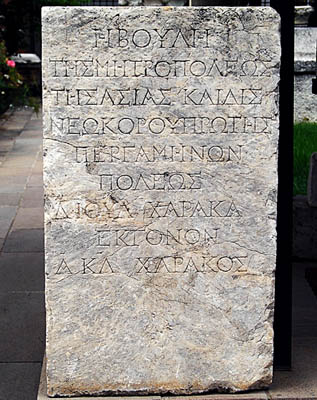
A Travel Note: The photo below shows an inscription which is now displayed in the garden of the archaeology museum in Bergama, Turkey (ancient Pergamum; Revelation 3:12-17). The inscription states that Pergamum was metropolis of Asia and twice NEOKOROS. This last word was the one commonly used when a city of Asia Minor was awarded the right to build a temple to the Emperor. This type of information must be taken into account when we consider the setting of the Book of Revelation.

Inscription at Pergamum claiming that the city was twice NEOKOROS. Photo by Ferrell Jenkins.

Inscription at Pergamum claiming that the city was twice NEOKOROS. Photo by Ferrell Jenkins.

Monday morning I attended another session on Biblical Lands and Peoples in Archaeology and Text. This one dealt with Samaria and the Samaritans. There were seven presenters. I especially enjoyed hearing Robert J. Bull of Drew University. Bull excavated a site called Tell er Ras on Mount Gerizim between 1964 and 1968 when it was under the control of the Hashemite Kingdom of Jordan. I enjoyed seeing his photos, drawings, and explanations. His work uncovered evidence of Hadrian’s temple in the early second century A.D. In more recent excavations Y. Magen claims to have discovered the Samaritan temple destroyed by John Hyrcanus. Magen was not present. Some of the speakers indicated that a final report has not been made by Magen and they did not comment on the matter.

This whole area is of great significance to students of the New Testament. The conversation between Jesus and the woman of Samarian dealt with this issue.

“Our fathers worshiped in this mountain, and you people say that in Jerusalem is the place where men ought to worship.” (John 4:20).

Learning more at the SBL meeting

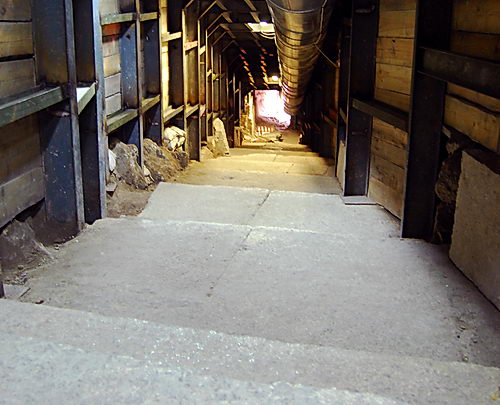
Sunday afternoon I attended two good sessions for a total of 10 papers or presentations. The first was on Biblical Lands and Peoples in Archaeology and Text. Ronny Reich of Haifa University spoke on the discovery of the road leading from the Pool of Siloam to the Temple Mount in Jerusalem. I saw a portion of this street and the tunnel underneath it earlier this year.

Street leading from Pool of Siloam up to the Temple Mount. Photo by Ferrell Jenkins.

Street leading from Pool of Siloam up to the Temple Mount. Photo by Ferrell Jenkins.

Doron Ben-Ami of the Israel Antiquities Authority spoke about the Givati Garage excavation south of Dung Gate. The structure found there is very large and is thought to have belonged to the family of Queen Helena of Adiabene. You can find more information and photos here.

One young scholar read a paper on Roman Jerusalem as a Setting of Earliest Christianity. He cited someone as saying that Acts might have been written in the middle of the second century. That theory is almost as old as the material he was dealing with. He thought that Luke’s account of the beginnings of Christianity was “magical.” Well, some presentations are well researched and profitable, and others are not.

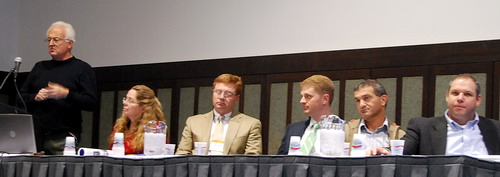
Bible Lands and Peoples in Archaeology and Text presenters. Reich is speaking. Photo by Ferrell Jenkins.

Bible Lands and Peoples in Archaeology and Text presenters.Photo by Ferrell Jenkins.

More later about the second section I attended.

The Semitic Museum at Harvard

Friday afternoon I went with two of my former students, friends, and fellow-preachers to visit the Semitic Museum at Harvard. Tim Reeves preaches in Providence, RI. He offered to take Leon Mauldin and me to our hotel in Boston. I suggested going by the Museum before going to the hotel so Tim could visit also. I have been at the Museum before, but not since the new exhibit has been on view.

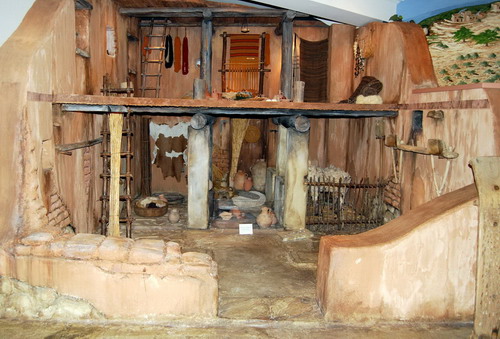
The Houses of Ancient Israel: Domestic, Royal, Divine is the featured exhibit at the Semitic Museum now. This exhibit traces the development and importance of the house in ancient Israel, from the family dwelling to the house of the king, and the house of the Lord (the temple). Here is a photo of the typical pillared “four-room” Israelite house that was common during the periods of the United and Divided Kingdoms.

Typical Iron Age (1200-586 B.C.) Israelite house. Photo by Ferrell Jenkins.

Typical Iron Age (1200-586 B.C.) Israelite house. Photo by Ferrell Jenkins

It would take several pages of writing to explain all of the items on display in the house. Their use could be illustrated with a variety of Bible verses. The research back of this house has been presented by Phillip J. King and Lawrence E. Stager in Life in Biblical Israel (Knox/Westminster, 2001). I highly recommend this book to all Bible teachers.

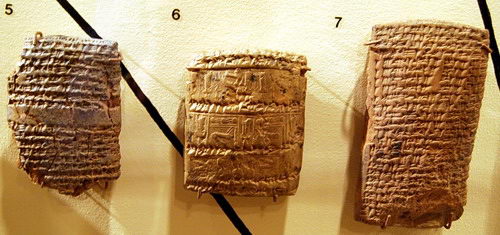
This is the only Museum I know about with displays of tablets from ancient Nuzi. About 4000 tablets in the Hurrian language were discovered by archaeologists in the early part of the twentieth century. Ancient Nuzi was not an important urban center, but these tablets reveal much about economic and domestic life from a period beginning about 2400 B.C. and continuing several centuries. It has been pointed out that several events associated with the biblical patriarchs, mentioned in the Book of Genesis, can better be illustrated  through an understanding of these documents.

Three Nuzi tablets at the Semitic Museum at Harvard. Photo by Ferrell Jenkins.

Three Nuzi tablets at the Semitic Museum at Harvard. Photo by Ferrell Jenkins.

For more information about the Semitic Museum at Harvard University check the web page here.

Text and Canon in Providence, RI

For the past few days I have been in Providence, RI, attending meetings of the Evangelical Theological Society (ETS) and the Near East Archaeological Society (NEAS). The theme for the ETS annual meeting was Text and Canon. I attended the four plenary session papers. These were extremely worthwhile. Here are the topics and speakers:

  • Old Testament Text – Peter J. Gentry
  • Old Testament Canon – Stephen Dempster
  • New Testament Text – Daniel B. Wallace
  • New Testament Canon – Charles E. Hill

Current, scholarly, material on these topics are needed among God’s people today.

I also attend several sessions of the NEAS. I heard Bryant Wood present evidence suggesting that Mount Sinai possibly should be identified with Gebel Khashm et-Tarif, and calling for more research in the area. This site is located about 22 miles north-northwest of the Gulf of Aqaba/Eilat in the Wilderness of Paran on the current Egyptian side of the border. For more information check the Associates for Biblical Research website here.

In one session I heard Rex Geissler present some of the historical evidence for the area of ancient Urartu as the place associated with Noah’s Ark. Rex is president of Archaeological Imaging Research Consortium (ArcImaging). Over at the Biblical Studies Info Page I have several links to good photos by Rex in various parts of the world. You can get to his material at the ArcImaging page.

Bill Crouse presented material to bolster the case for an identification of the landing place of the ark with Mount Cudi in southereastern Turkey. I think Gordan Franz presented material in defense of this view also, but I was unable to be present.

There were two reports on the excavations this year at Tel Gezer in Israel.

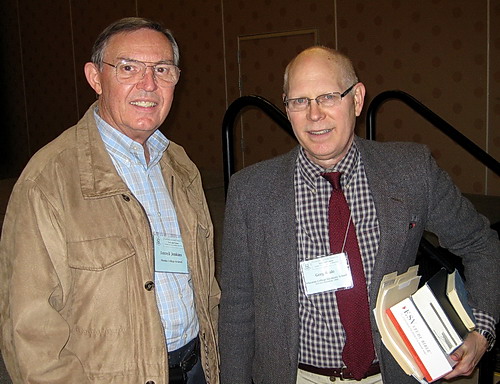
Crossway, publisher of the English Standard Version of the Bible, has been sponsoring a special lecture for the past few years. The lecture this year featured Gregory K. Beale of Wheaton College on The Authority of Scripture: A Biblical Theology According to John’s Apocalypse. This was a great paper. Beale is author of The Book of Revelation: A Commentary on the Greek Text (New International Greek Testament Commentary). I had heard Beale speak before, but it was a pleasure to hear him again and visit for a few moments. I am honored that my The Old Testament in the Book of Revelation is mentioned in a footnote of this commentary.

Ferrell Jenkins and Gregory K. Beale at ETS Annual Meeting. Photo by Leon Mauldin.

Ferrell Jenkins and Gregory K. Beale at ETS Annual Meeting. Photo by Leon Mauldin.

The book display at ETS has grown substantially over the years I have been attending the annual meetings(since 1975). The professors and others who attend get an opportunity to buy the recent publications in biblical studies at a sizable discount. I buy very few these days, but I have taken advantage of this opportunity over the years.

Well, its on to Boston for more meetings.

For a Florida guy, I must say that it is cold up here.

Iron Age stele speaks of soul apart from body

The New York Times reports here on the discovery of an interesting stele at Sam’al/ Zincirli (ZIN-jeer-lee), an ancient site in southeastern Turkey.

In a mountainous kingdom in what is now southeastern Turkey, there lived in the eighth century B.C. a royal official, Kuttamuwa, who oversaw the completion of an inscribed stone monument, or stele, to be erected upon his death. The words instructed mourners to commemorate his life and afterlife with feasts “for my soul that is in this stele.”
…..
“Normally, in the Semitic cultures, the soul of a person, their vital essence, adheres to the bones of the deceased,” said David Schloen, an archaeologist at the university’s Oriental Institute and director of the excavations. “But here we have a culture that believed the soul is not in the corpse but has been transferred to the mortuary stone.”

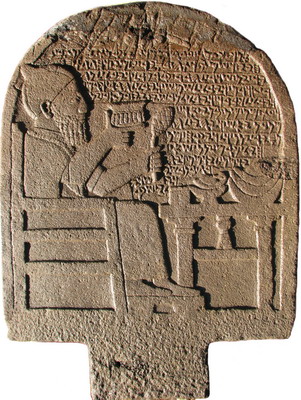
A translation of the inscription by Dennis Pardee, a professor of Near Eastern languages and civilization at Chicago, reads in part: “I, Kuttamuwa, servant of [the king] Panamuwa, am the one who oversaw the production of this stele for myself while still living. I placed it in an eternal chamber [?] and established a feast at this chamber: a bull for [the god] Hadad, a ram for [the god] Shamash and a ram for my soul that is in this stele.”

Here is a photograph of the stele provided by the University of Chicago.

University of Chicago.

Stele from Zincirli in which the king says that his soul is in this stone. Photo: University of Chicago.

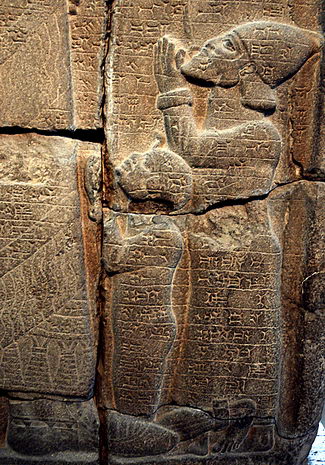
A well known monuments discovered at Zincirli in 1888 depicts the Assyrian king Esarhaddon holding ropes leading to Tirhakah, king of Egypt and Ethiopia [Cush], and Ba’alu of Tyre. Tirhakah is the kneeling figure with negroid features befriended King Hezekiah of Judah against the Assyrians (2 Kings 19:9). The photo below shows the two captives on the lower portion of the stele. It is now displayed in the Pergamum Museum in Berlin.

Esarhaddon stele showing Tirhakah and the king of Tyre. Photo by Ferrell Jenkins.

Esarhaddon stele showing Tirhakah and the king of Tyre. Photo by Ferrell Jenkins.

Archaeologist thinks he has located Shaaraim

To most folks this probably evokes a yawn. To me it is exciting. We have reported earlier here and here about the excavation at Khirbet Qeiyafa, a site overlooking the Elah Valley. The San Francisco Chronicle, in an article by Matthew Kalman, reports that Prof. Garfinkel will announce today that he has found the site of the biblical city of Shaaraim (this is the way popular English versions transliterate the Hebrew word).

For 3,000 years, the 12-foot high walls of an ancient city have been clearly visible on a hill towering above the Valley of Elah where the Bible says David slew Goliath.

But no one has ever linked the ruins to the city mentioned in the First Book of Samuel’s famous account of the legendary duel and the victory of the Israelites – until now. On Tuesday, Hebrew University archaeology Professor Yosef Garfinkel will present compelling evidence to scholars at Harvard University that he has found the 10th century biblical city of Sha’arayim, Hebrew for “Two Gates.” Garfinkel, who made his startling discovery at the beginning of this month, will also discuss his findings at the American Schools of Oriental Research conference hosted by Boston University on Thursday.

Garfinkel believes the city provides evidence that King David ruled a kingdom from his capital of Jerusalem. Some modern scholars have questioned the biblical account of David’s kingdom and even whether he existed. Although it is not clear how the Sha’arayim relates to David, Garfinkel says finding a Judean city along the ancient highway to Jerusalem that appears to have been a fortress on the western border with the Philistines indicates a kingdom with a developed political and military organization that was powerful enough to include a major fortified city.

The Bible makes reference to Shaaraim in the following verses:

  • Joshua 15:36 – a town of Judah.
  • 1 Samuel 17:52 -After David’s defeat of Goliath, “the wounded Philistines fell on the way from Shaaraim as far as Gath and Ekron” (ESV).
  • 1 Chronicles 4:31 – belonged to the descendants of Simeon until the reign of David.

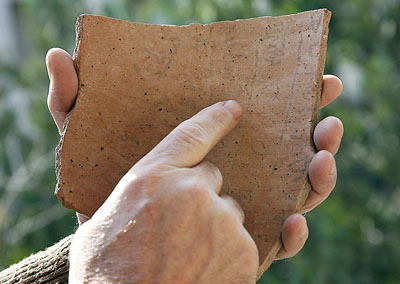
This photograph of the ostracon is found at the Qeiyafa Ostracon Chronicle web page. Only 10 of 50 words on the shard have yet been read.

Qeiyafa Ostracon. Photo by G. Laro.

Qeiyafa Ostracon. Photo by G. Laro.

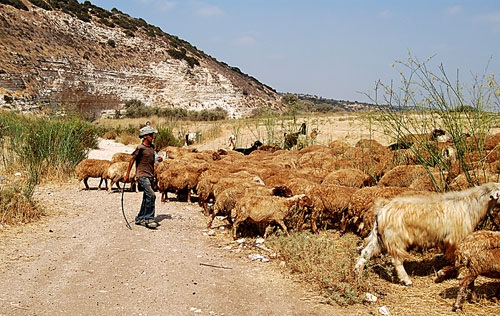
Check the Elah Fortress web page for a nice high res. promotional video. The video claims that the Bedouin who tend their sheep in the area call the ruin Khirbet Daoud (Ruin of David).

Bedouin shepherd in the Elah brook in the area below Khirbet Qeiyafa, Elah Fortress, or Khirbet Daoud. Photo by Ferrell Jenkins.

Bedouin shepherd in the Elah brook in the area below Khirbet Qeiyafa, Elah Fortress, or Khirbet Daoud. Photo by Ferrell Jenkins.

The Importance of Water in the Bible World

Dr. Claude Mariottini, Professor of Old Testament at Northern Baptist Seminary, has shared two good articles on the importance of water in the development of civilization. These are worthwhile post, and I urge you to take time to read both of them.

The first article is here.

The second article is here.

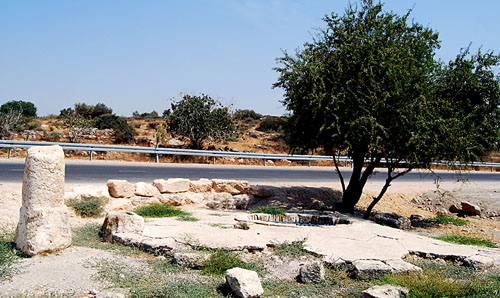
The photo below was made a Beit Guvrin (near Old Testament Mareshah). It shows a well for water, a tree for shade, and a milestone (which has been moved from the general area to this place.

A well, shade, and milstone at Beit Guvrin. Photo by Ferrell Jenkins.

A well, shade, and milstone at Beit Guvrin. Photo by Ferrell Jenkins.

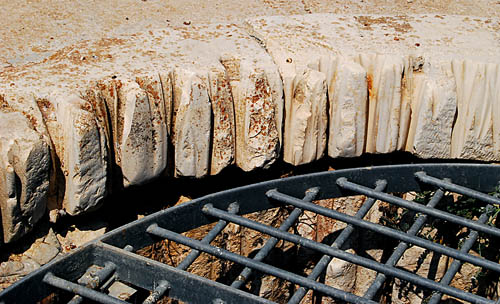
The next photo shows how ropes pulling water from the well cut grooves in the soft stone from which the curb was made.

Grooves cut in the well curb. Photo by Ferrell Jenkins.

Grooves cut in the well curb. Photo by Ferrell Jenkins.

There are many accounts in the Bible showing the importance of such a place as this. Note a few.

  • Hagar and Ishmael (Genesis 21:19).
  • David craved the water from the well at Bethlehem (2 Sam. 23:15-17).
  • The figurative use in Proverbs 5:15 and Song 4:15.
  • The Samaritan woman at Jacob’s well (John 4).

Brawls at the Holy Sepulchre

According to the biblical records, Jesus was crucified outside Jerusalem (John 19:20), probably not far from a gate (Hebrews 13:12), near a road (Mark 15:29; Matthew 27:39), and near a garden with a new tomb in it (John 19:41).

This photo of the Second Temple model, now located at the Israel Museum, shows the location of Calvary in the center of the image.
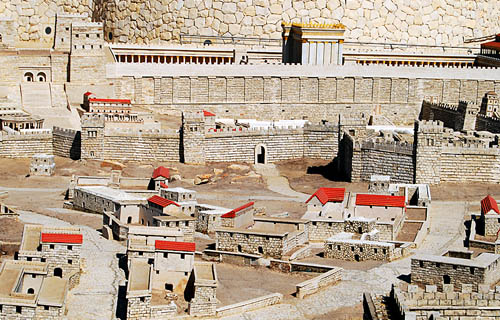
Second Temple model showing location of Calvary. Photo by F. Jenkins.

Second Temple model showing location of Calvary. Photo by F. Jenkins.

Nothing about the Church of the Holy Sepulchre reminds one of the actual setting where Christ was crucified and buried. One must remember, however, that Jerusalem has been continuously inhabited for many centuries. Strong evidence suggests that the site now occupied by the Church of the Holy Sepulchre was outside the wall of Jerusalem at the time of Christ.

Charlesworth points out that “there are no competing places for Calvary or Golgotha prior to the last century.” He has reference to Gordon’s Calvary and Garden Tomb which is located about a block north of Damascus Gate.

Some columns in the Church of the Holy Sepulchre date from the fourth century church built by Constantine. Through the centuries many additions and changes have been made. It reminds one of a building that needs to be remodeled.

Five religious groups compete for time and space in the Church today. From time to time we hear of a brawl breaking out among the competing groups for certain rights. This link leads to a video of the latest scuffle.

Elizabeth and I were in the Church one afternoon in September at the time of one of the services.
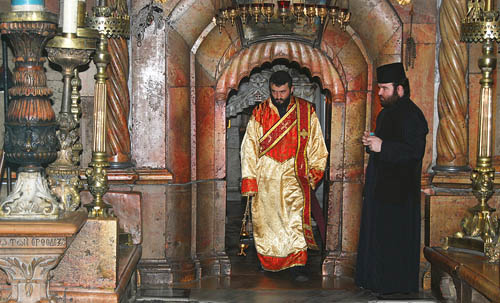
Entrance to the tomb of Jesus in the Church of the Holy Sepulchre. Photo by FJ.

Entrance to the tomb of Jesus in the Church of the Holy Sepulchre. Photo by FJ.

Numerous disputes have arisen through the centuries, and some have not yet been resolved. In photos of the entrance you will see a ladder on the ledge above the blocked door. It has been there since the middle of the 19th century because the sects cannot agree who should remove it.
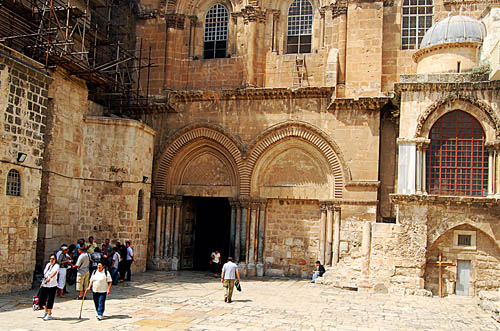
Entrance to the Church of the Holy Sepulchre. Photo by Ferrell Jenkins.

Entrance to the Church of the Holy Sepulchre. Photo by Ferrell Jenkins.

These things are shameful. I have often remarked that many non-Christians of Palestine known nothing of New Testament Christianity except what they have learned from Church History (read: the Crusades) and the Shrines. If one wishes to learn about Christ and the Early Church let him/her read the New Testament.

We know what the Lord desires of those who believe in Him:

“I do not ask on behalf of these alone, but for those also who believe in Me through their word; that they may all be one; even as You, Father, are in Me and I in You, that they also may be in Us, so that the world may believe that You sent Me. (John 17:20-21 NAS)

Alexandria Troas # 3

For # 1 scroll down to November 7, or click here. For # 2 scroll down to November 10, or click here.

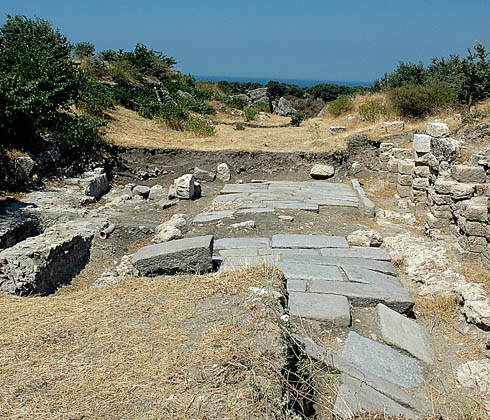
Recent excavations by the University of Münster have uncovered a portion of the Roman road at Troas. A member of the staff said, “We like to think that this is the road traveled by the apostle Paul when he entered the city.” Perhaps this photo helps illustrate the statement in Acts 16:8 which says “they came down to Troas.” The Aegean Sea is visible in the distance.

Recently excavated Roman road at Troas. Photo by Ferrell Jenkins 2006.

Recently excavated Roman road at Troas. Photo by Ferrell Jenkins 2006.