Category Archives: Bible Study

The temple of Baal-Berith at Shechem

The book of Judges describes the situation at Shechem after the death of Gideon.

After Gideon died, the Israelites again prostituted themselves to the Baals. They made Baal-Berith their god. (Judges 8:33 NET)

Abimelech, the son of Gideon was such a desperate politician that he took money from the Shechemites from the temple of Baal-Berith (Judges 9:4). Dr. Bryant Wood describes the temple of Baal-Berith.

References to the “house of Baal-berith” (v. 4), “Beth-millo” (v. 6,20), “house of their god” (v. 27), “tower of Shechem” (vv. 46,47,49), and “temple of El-berith” (v. 46), all appear to be the same structure at Shechem. Berit is the Hebrew word for covenant, so the temple was for “Baal of the covenant.”

A large fortress (or Migdal) temple discovered on the acropolis of Shechem has been identified as the temple of Judges 9. It was  constructed in the seventeenth century B.C. and lasted until the destruction of the city by Abimelech in the twelfth century B.C. The largest temple yet found in Canaan, it measures 21.2 x 26.3 m, and has foundations 5.1 m thick that supported a multistoried superstructure of mud bricks and timber. On the east, two towers containing stairwells to the upper stories flanked the entrance. Inside, two rows of columns, three in each row, divided the space into a nave and two side aisles (cf. vv. 46-49)” (Bryant Wood. “From Ramesses to Shiloh.” Giving the Sense. Kregel, 2003).

The photo shows the foundation of the Temple of Baal-Berith at Shechem. This structure was brought to light in the
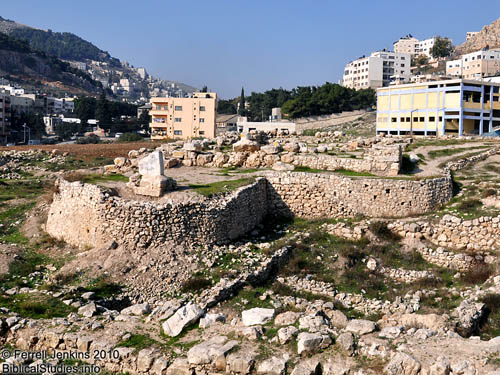
Temple of Baal-Berith in center of photo. Ebal in distance. Photo by F. Jenkins.

Temple of Baal-Berith in center of photo. Gerizim (L) & Ebal (R). Photo by F. Jenkins.

G. Ernest Wright says, “Before 1903 biblical geographers all thought that Shechem was once located where the modern city of Nablus is.” They associated the Roman city of Neapolis with Nablus. The German scholar Herman Thiersch found the walls of “old Shechem” June 26, 1903. He said, “The place is somewhat under cultivation with vegetables and seed-crops.” (G. Ernest Wright, Biblical Archaeologist: Vol. 20 1-4, electronic ed. (Philadelphia: American Schools of Oriental Research, 2001, c1957). This site is identified with the mound of Tell Balata.

The first excavations at Shechem were conducted by Prof. Ernst Sellin in 1913 and 1914. More extensive excavations took place between 1926-1928.
Witherington and Crossan on the Message of Jesus

Last week I attended The Greer-Heard Point-Counterpoint Forum in New Orleans. The forum is briefly described by Paul F. South, NOBTS Communications:

Two of the world’s best-known religious scholars will dialog at New Orleans Baptist Theological Seminary on a question that has sparked debate for some 2,000 years: What did Jesus really teach?

John Dominic Crossan and Ben Witherington III will be the featured speakers at the  2010 Greer-Heard  Point-Counterpoint  Forum, Feb. 26 and 27 at Leavell Chapel.

The event marks the seminary’s sixth Greer-Heard Point-Counterpoint Forum. The Forum is designed to provide a venue in which a respected evangelical scholar and a respected non-evangelical scholar discuss critical issues in religion, science, philosophy, or culture.

Audio CDs, MP3, or DVDs are available for all of the previous forums at a reasonable rate. Go here and click on STORE. The most recent forum (The Message of Jesus) is not on the list, but it is available. I think you can find a contact link somewhere on the page.

In addition to Witherington and Crossan, the other speakers were Darrell Bock, Craig Evans, Amy Jill Levine, and Stephen J. Patterson. Perhaps you recognize these names as representing both liberal and conservative perspectives on Jesus.

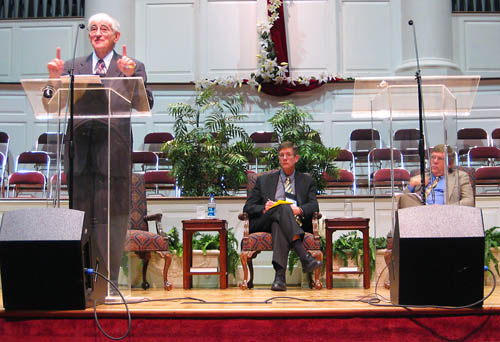
Crossan speaks while Witherington (R) waits his turn. Photo by Ferrell Jenkins.

Crossan (L) speaks while Witherington (R) waits his turn. Photo by Ferrell Jenkins.

He does not say so, but I think Ben Witherington III has posted his paper on his Bible and Culture blog here. It is a little difficult to read. Copy the document and save it in your word processor and it will be easier to read.

All of the speakers are distinguished scholars who have spent a great deal of their academic life writing on the general theme of Jesus Studies.

Alexander coins found in northern Syria

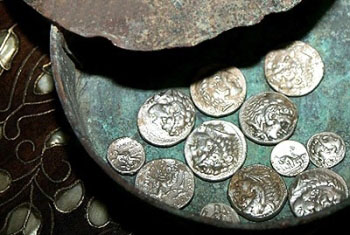
The Global Arab Network, in an article by H. Sabbagh, reports here on the discovery of a collection of Hellenistic coins in northern Syria. The photo shows the coins dating back to the time of Alexander the Great. They were found in the Aleppo district.

Hellenistic coins from discovered in northern Syria.

The coins were found by a local man as he was preparing his land for construction, uncovering a bronze box that contained around 250 coins. He promptly delivered the coins to the authorities who in turn delivered them to Aleppo Department of Archaeology and Museum.

Director of archaeological excavations at Aleppo Department of Archaeology and Museum Yousef Kanjo said the box contained two groups of silver Hellenistic coins: 137 tetra drachma (four drachmas) coins and 115 drachma coins.

One side of the tetra drachma coins depicts Alexander the Great, while the other side depicts the Greek god Zeus sitting on a throne with an eagle on his outstretched right arm. 34 of these coins bear the inscription “King Alexander” in Greek, while 81 coins bear the inscription “Alexander” and 22 coins bear “King Phillip.”

The drachma coins bear the same images as the tetra drachma, with “Alexander” inscribed on 100 of them and “Philip” on 15 of them.

HT: Dr. Claude Mariottini

Shechem in biblical history

Tell Balata (Shechem) was excavated by Germans working periodically between 1907 and 1934. In 1956, G. Ernest Wright led the Drew-McCormick Expedition. Work continued in 1969 under the direction of Edward F. Campbell.
I had the privilege of visiting the ruins of Shechem last December. At the time I thought how sad to see such an important site neglected. Shechem is important in biblical history. Some of the significant events associated with the city are listed below.
  • Shechem is the first city of Canaan mentioned in the Bible. The land promise to Abraham was restated here (Genesis 12:6-7).
  • Jacob and his family settled at Shechem (Genesis 33:18). Jacob purchased a parcel of ground and erected an altar here.
  • Joseph’s brothers had gone from Bethlehem to near Shechem to graze their flocks (Genesis 37:12-13).
  • After entering Canaan, the Israelites gathered at Shechem on Mount Gerizim and Mount Ebal to hear Joshua read the blessings and cures of the Law (Joshua 8:30-34; cf. Deuteronomy 28-30).
  • Shechem was within the territory of Ephraim and served as a city of refuge (Joshua 20:7; 21:21).
  • Joseph was buried in a parcel of ground bought by Jacob (Joshua 24:32).
  • The Shechemites supported Abimelech in his bid to be ruler and gave him money from their temple of Baal-berith (Judges 8:33; 9). Jotham’s addressed the people of Shechem from Mount Gerizim with a fable (Judges 9:7ff.).
  • After the Exile, Shechem became a major religious center of the Samaritans. Their temple was built on Mount Gerizim (John 4:20-21).
  • Jesus visited Jacob’s Well near Shechem (John 4).

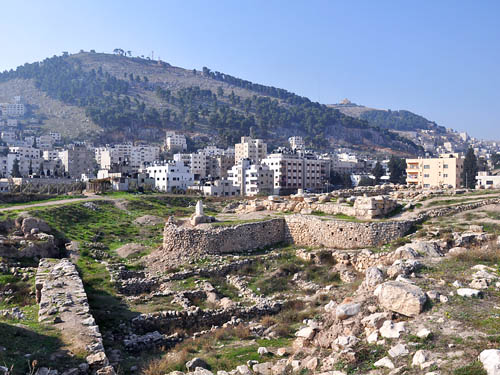
The photo below shows the excavated ruins of Tell Balata (Shechem). Mount Gerizim is on the left (to the south). Mount Ebal is on the right (to the North). The view is toward the west. The modern Arab town of Nablus is in the valley between these two mountains.

Shechem in the valley between Mount Gerizim & Mount Ebal.

Shechem — in the valley between Mount Gerizim and Mount Ebal.

Palestinian archaeology gets a boost at Shechem

Ha’aretz reports that the Dutch government has donated 300,000 euros (about $408,000) to the Palestinian Authority to finance the excavation and conservation of Tell Balata in Nablus. This is the biblical city of Shechem. The full account is here.

The site, according to the Ma’an report, is listed by UNESCO in the Inventory of Cultural and Natural Heritage Sites of Potential Outstanding Universal Value in Palestine, with experts estimating some of its towers and buildings from the Chalcolithic and Bronze Age dating back 5,000 years.
The Netherlands’ representative to the PA, Jack Twiss Quarles van Ufford, said the initiate was meant to bolster PA Prime Minster Salam Fayyad’s plan to work toward a unilateral declaration of Palestinian by 2011.
“The creation of institutions can only be sustainable if it goes hand in hand with the strengthening of the cultural identity of the Palestinian people,” Twiss told Ma’an, adding that “sites like Tell Balata are simply too important to be neglected.”
The photo shows the previously excavated ruins of Tell Balata (Shechem) in the valley below Mount Gerizim.
Ruins of Tell Balata (Shechem) below Mount Gerizim. Photo by Ferrell Jenkins.

Ruins of Tell Balata (Shechem) below Mount Gerizim. Photo by Ferrell Jenkins.

In the next post we will note the importance of Shechem in biblical history.

HT: Joseph I. Lauer

Older than the pyramids

Newsweek, March 1, 2010, has an article here about a temple complex in Turkey that is said to predate the pyramids.
Göbekli tepe in southeastern Turkey. The site is southeast of Sanliurfa, the Moslem traditional birthplace of Abraham. It is east of Haran, the home of Abraham according to Genesis 12:4, and north of the Syrian border.

German archaeologist Prof. Klaus Schmidt is directing the dig at the site said to have a temple built 11,500 years ago — 7,000 years before the pyramids.

Ben Witherington has a good post about this temple and some of the biblical implications at his Bible and Culture blog here. Among other good things he says,

The importance of this find for Biblical thinking is this— the Bible says that from the outset, human beings were created in God’s image.  Human beings were religious creatures from Day One.  Archaeologists and sociologists have long dismissed this theory saying organized religion comes much later in the game than the beginning of civilization and city building.  As  Ian Holder director of Stanford’s prestigious archaeology program says— this is a game changer. Indeed, it changes everything experts in the Neolithic era have been thinking.   Schmidt is saying that religion is the cause of civilization, not the result of it. Towns were built to be near the Temple complex. Agriculture was undertaken to feed those living there and supply the temple complex, and so on. The first instincts of humans were to put religion first. Maybe there is more to that Genesis story than some have been willing to think or admit. Maybe human beings are inherently homo religiosis.

This short video features Prof. Schmidt at Göbekli tepe.

HT: Ben Witherington

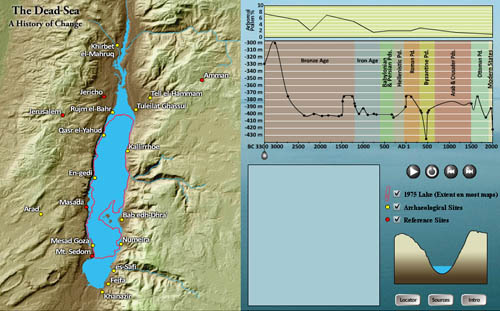
Kudos to Riddle & Parker for Dead Sea: A History of Change

A.D. Riddle and David Parker have been honored by the North American Cartographic Information Society for their Dead Sea: A History of Change. Congratulations. I used this great resource a couple of days ago.

Our earlier post is here.

The Dead Sea may be the most fascinating body of water on earth. It lies along the Great Rift (Afro-Arabian Rift), and is the lowest body of water on earth. A.D. Riddle and David Parker have created a relief map showing the level of the Dead Sea from 3500 B.C. to the present. The authors explain how they made the map at the site.

The Dead Sea: A History of Change

HT: Bible Places Blog.

1,400 year old wine press discovered in Sorek Valley

The wine press was found during an excavation by the Israel Antiquities Authority in an agricultural area in the vicinity of Nahal Soreq [English, Sorek]

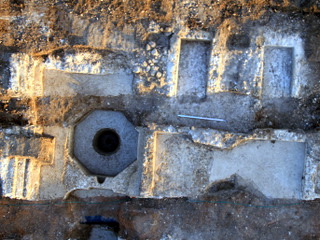
One of the largest wine presses ever revealed in an archaeological excavation in the country, which was used to produce wine in the Late Byzantine period (sixth-seventh centuries CE), was recently exposed in excavations conducted by the Israel Antiquities Authority. The excavation was carried out in a region that will be the farmland of Ganei Tal, a new settlement slated to be built for the evacuees from Gush Katif.

The impressive wine press is 1,400 years old and measures 6.5 x 16.5 meters [c. 21 x 54 feet]. It was discovered southwest of Kibbutz Hafetz-Haim and was partly damaged during the installation of the infrastructure there.

According to Uzi Ad, excavation director on behalf of the Israel Antiquities Authority, “What we have here seems to be an industrial and crafts area of a settlement from the sixth-seventh century CE, which was situated in the middle of an agricultural region. The size of the wine press attests to the fact that the quantity of wine that was produced in it was exceptionally large, and was not meant for local consumption. Instead it was intended for export, probably to Egypt, which was a major export market at the time, or to Europe.

wine-press from Sorek Valley

Aerial view of wine press from Sorek Valley. Photo: IAA.

The excavation director says,

“This is a complex wine press that reflects a very high level of technology for this period, which was acquired and improved on from generation to generation”.

According to the press release,

Rectangular surfaces were also discovered around the treading floor. These too were originally paved with a mosaic floor and were connected to the treading floor by way of a hole in the wall they shared with it. The grapes were probably placed on these surfaces before being trod on, and sometimes the initial fermentation process of the grapes would begin.

A spokesman for the Nahal Soreq Regional Council says the Council will converse the site and open it to the public.

The full press release may be read here. I am hopeful that later in the day we will have a better photo to share.

Wine presses were in common use throughout biblical times, and we learn that some of them were large. One, during the period of the Judges, is described as large enough to use for a threshing floor for wheat.

The LORD’s angelic messenger came and sat down under the oak tree in Ophrah owned by Joash the Abiezrite. He arrived while Joash’s son Gideon was threshing wheat in a winepress so he could hide it from the Midianites. (Judges 6:11 NET)

We posted an aerial view of the Sorek Valley here.

HT: Joseph I. Lauer

More on flash floods

Flash floods in the Negev caught the attention of several bloggers in January. We noted them here. Harriett called my attention to an article in Al-Ahram weekly online about the flash floods in Egypt the same day.

As the dawn mists began to lift on 18 January in the small village of Atef Al-Sadat in the governorate of Northern Sinai, newlyweds Himdan Khalil and his wife found their tiny home swamped with water. They left their belongings behind to flee as the water inside their mud-brick house continued to rise, reaching a metre and a half.

“We are used to these floods but the watercourses that drain the floodwater were blocked by newly built chalets and clubs which resulted in the overflow into our homes,” Khalil told Al-Ahram Weekly. “The entire village was swamped and most villagers are now homeless””

Khalil’s devastated house was one of 3,645 homes destroyed in the governorates of North Sinai, South Sinai and Aswan. The floods left 10 people dead, two missing and 40 injured, according to government estimates. Seventy-two roads were destroyed and 13,000 olive trees uprooted. Sewage treatment stations and Arish hospital were badly damaged and part of the ceiling of Hall No. 2 at Sharm El-Sheikh Airport collapsed. In the southern city of Aswan strong winds overturned 80 high- pressure electricity towers, disrupting power supplies. Initial assessments of the cost of the damage are LE400 million.

Read the full report here.

A photo from the northern Sinai town of Arish shows damages caused by the torrential rains. Remember that this wadi was dust-dry a few hours earlier.

Damages caused by torrential rains in Arish. Al-Ahram weekly online.

Damages caused by torrential rains in Arish. Al-Ahram weekly online.

Arish is located one the Wadi el-Arish, generally thought to be the River [nahar] of Egypt, the southern boundary of the land promised to Abraham.

On that day the LORD made a covenant with Abram, saying, “To your offspring I give this land, from the river of Egypt to the great river, the river Euphrates…” (Genesis 15:18 ESV)

The Wadi el-Arish is a few miles south of Gaza in the northern Egyptian Sinai.

Laju Paul posted many photos of the flash flood in the Negev at Through the Land of Israel III January 18. Scroll down to that date.

Those lost books of the Old Testament

Now the rest of the acts of Amaziah, are they not written in the Book of the Chronicles of the Kings of Judah? They conspired against him in Jerusalem, and he fled to Lachish; but they sent after him to Lachish and killed him there. Then they brought him on horses and he was buried at Jerusalem with his fathers in the city of David. (2 Kings 14:18-20 NAU)

A few weeks back Dr. Claude Mariottini posted a list of 33 books mentioned in the Old Testament that have not survived. I suggest you capture this list and save it for use in future studies. The link is here.

Think what we might learn about Amaziah (796-767 BC) and the fortress city of Lachish if we had access to this book. Does this mean that the Bible is not complete for its purpose? I would say, “Absolutely not.” The Bible reveals God’s plan for the salvation of man. An important part of that plan is worked out in the history of His people Israel.

We learn better how to understand the Bible through other historical records, archaeology and the study of the land of the Bible. The aerial photo of Tel Lachish gives an impression of the possibility of the city serving as a place of refuge for King Amaziah.

Aerial view of Tel Lachish. Photo by Ferrell Jenkins.

Aerial view of Tel Lachish. Photo by Ferrell Jenkins.