Category Archives: Bible Study

Prof. Donald Wiseman – 1918-2010

The passing of Professor Donald Wiseman is reported by Rob Bradshaw here.

Wiseman was well known as an Old Testament scholar. The bibliography of his writings is extensive. His Illustrations from Biblical Archaeology, published in 1958, has been one of the most practical and helpful books in my library. Wiseman read the small Babylonian Chronicle for 605-594 B.C. in the British Museum in 1955. He describes the document in these words:

The events described include the Battle of Carchemish and the accession of Nebuchadnezzar II in 605 BC. The fifth paragraph related the capture of Jerusalem on March 16th, 597 BC, the appointment of Zedekiah as king and the removal of Jehoiachin and other prisoners to exile in Babylonia. (Illustrations from Biblical Archaeology 69)

Babylonian Chronicle for 605-594 B.C.

Babylonian Chronicle for 605-594 B.C. Photo by Ferrell Jenkins.

The Biblical account of these events is recorded in 2 Kings 24:10-17.

HT: Bible Places Blog.

Speaking at Florida College lectures

This is the week for the annual Bible lectures at Florida College in Temple Terrace, FL. Even though I retired from teaching in 2001, I have been invited to speak each year. Most of these have been lectures that do not require writing a manuscript for publication. That is my preference, of course.

Yesterday I spoke in Puckett Auditorium on Roads and Seas Less Traveled. For a 45 to 50 minute presentation I had to be very selective. I explained what I meant by the title. I was speaking of places (roads and seas) that tourists rarely visit. I limited myself to the land of Goshen and Malta.

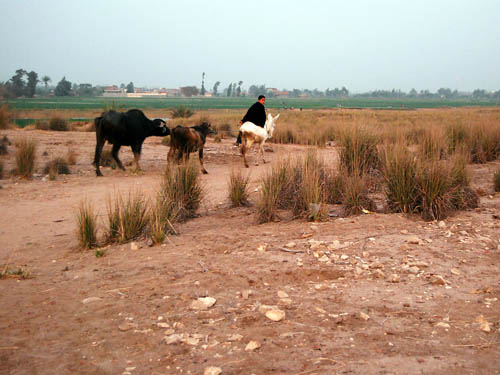
Using a map, I showed the location of the land of Goshen in the eastern Nile Delta. This is where Jacob’s family settled when they went from Canaan to Egypt (Genesis 45:10), and where they grew to a nation and spent time in bondage. This area was also called the “land of Rameses.”

Then Joseph settled his father and his brothers and gave them a possession in the land of Egypt, in the best of the land, in the land of Rameses, as Pharaoh had commanded. (Genesis 47:11 ESV)

Dr. Manfred Bietek of the Austrian Institute in Cairo has excavated since the mid-1960s at Tell el-Dab’a, Ezbet Helmi, and Qantir. All of these sites are located a few miles north of modern Faqus in the eastern Delta. I have taken my tour group to visit sites in Goshen on two tours, but tourists are not allowed to visit Tell el-Dab’a. In fact we were not allowed to get off the bus to make photographs of the canal that follows the path of the ancient Pelusiac branch of the Nile. I have a friend in Egypt who knows the territory and offered to take me to visit some of these places. We went late in the afternoon. In fact, by the time we arrived at Tell el-Dab’a it was already dark.

Here is the original photo:

Tell el-Dab'a in the Eastern Nile Delta. Photo by Ferrell Jenkins.

Tell el-Dab'a in the Eastern Nile Delta. Original Photo by Ferrell Jenkins.

After a little work in Photoshop, the photo looks as if it were taken during a hazy day.

Tell el-Dab'a in the Eastern Nile Delta. Photo by Ferrell Jenkins.

Tell el-Dab'a in the Eastern Nile Delta. Photo by Ferrell Jenkins.

In the original larger photo it is easy to see shards of pottery scattered in the area.

The children of Israel once lived in this flat, fertile area of Egypt. In fact, if this is indeed the land of Rameses, the Israelites departed from this region for the promised land (Exodus 12:37).

A fuller discussion about the Land of Rameses may be read here.

A scholarly article by Dr. Bryant  G. Wood about New Discoveries at Rameses is available at the Associates for Biblical Research web site here. I also recommend the article on Israel in Egypt by Gary Byers at the same site (here).

Ponder the path of your feet

From this narrow dirt path one can see the mountains that surround Samaria (Amos 3:9).

A path at Samaria. Photo by Ferrell Jenkins.

A path at Samaria. Photo by Ferrell Jenkins.

Ponder the path of your feet; then all your ways will be sure. Do not swerve to the right or to the left; turn your foot away from evil. (Proverbs 4:26-27 ESV)

Topping 300,000 and the BiblioBlog rankings

On Friday evening, January 22, at 11:24 p.m. (EST) I checked the counter on this blog. The total number of visitors registered since May, 2007, was 300,004. Today the count has topped 305,000.

The first post on Ferrell’s Travel Blog was May 2, 2007, in anticipation of a tour to central Turkey. The intention was to keep the families of the tour members informed about what we were doing. A total of 575 persons visited the blog that month. In December, 2009, we averaged 593 hits each day. This month the average will be near 630 per day.

One friend (SC) who has been a reader since the first month wrote about a week ago,

I just checked your WordPress for today’s message – lo and behold – you have gone over 300,000 reads! Congratulations! (I can’t remember when you started this service, but obviously we all love it – please keep it up!)

I am thankful for the loyal followers, and for everyone who drops by from time to time. Originally I had no plan to make this blog a near-daily project. I plan to continue as long as I enjoy doing it and think it is a good expenditure of my time.

My wife keeps telling me that the title, Ferrell’s Travel Blog, causes people to think that the blog is just about my travels. Had I envisioned the future back in May, 2007, I suppose I would have chosen a different name. The ratings now are too high to make a change!

Almost every day I am tempted to comment on a number of things, but I usually resist and keep the focus on the Bible Lands, biblical archaeology, and Bible-related places and events.

What is a BiblioBlog?

What is a BiblioBlog? I suppose it is a blog that in some way deals with the Bible.

The Alexa Ranking for the third week for the month of January shows Ferrell’s Travel Blog to be number 11 out of more than 358 BiblioBlogs. Normally these rankings are published monthly. Our blog has been in the top 20 several times, and as high as 5 for the month of July, 2009. We are thankful to our loyal readers who find the material we publish to be useful.

Jeremy Thompson of Free Old Testament Audio has volunteered to post these rankings on a monthly basis, but he is trying some new things and decided to make a weekly posting. The full list of BiblioBlogs is here. The list is somewhat arbitrary and it may not show the ranking of some significant blogs, but it interesting to follow.

My blog has never been intended as part of a competition, but I enjoy seeing it move up in the rankings. I see every visitor as someone who is potentially informed and/or edified by what he/she reads.

Thanks to WordPress

Thanks to the kind folks at WordPress who make possible this opportunity. I hope they are making lot’s of money (from others!).  If you have something worth saying get a blog. WordPress is a good place to begin.

The land of Gennesaret

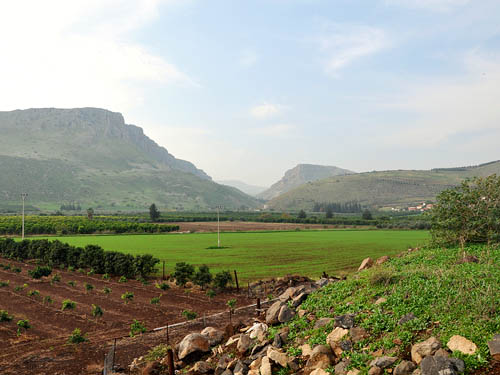
The Sea of Galilee is called the “lake Gennesaret” by Luke (Luke 5:1). The area on the northwest corner of the Sea of Galilee is called the “land at Gennesaret.” In the view below we see the land of Gennesaret and the Via Maris. The route here leads to the Beit Netofa Valley and the sites of (Khirbet) Cana, Sepphoris, Nazareth, and Yodfat (Jotapata). Yodfat was fortified by Josephus during the Jewish revolt against Rome. Josephus, commander of the Jewish rebels, surrendered to the Roman Emperor Vespasian at Yodfat.

The land of Gennesaret and the Via Maris. Photo by Ferrell Jenkins.

The land of Gennesaret and the Via Maris. Photo by Ferrell Jenkins.

Many of the miracles of Jesus were performed in this area.

When they had crossed over, they came to land at Gennesaret. And when the men of that place recognized Him, they sent word into all that surrounding district and brought to Him all who were sick; and they implored Him that they might just touch the fringe of His cloak; and as many as touched it were cured. (Matthew 14:34-36 NAU)

William G. Dever on Solomon and the Revisionists

Benjamin Hawkins reports on a recent lecture  by William G. Dever at the Southwest Baptist Theological Seminary. The headline says, “Scholar counters attacks on existence of Solomon’s kingdom.”

Contesting the views of revisionist scholars, world-renowned archaeologist William G. Dever defended the existence of an Israelite state in Palestine during the 10th century B.C., the biblical era of Solomon’s reign.

Dever, a leading figure in biblical archaeology for nearly half a century, was the guest speaker for Southwestern Baptist Theological Seminary’s Biblical Archaeology Lecture sponsored by the seminary’s Charles D. Tandy Archaeology Museum and Tandy Institute of Archaeology.

“Tonight, I want to talk about the age of Solomon, but before I do that, I want to set it up by telling you something about a school of European biblical scholarship,” Dever said. “These people call themselves revisionists because they are rewriting the history of ancient Israel, but when they finish, there is no history. They call themselves revisionists. I call them nihilists.”

According to Dever, the revisionist scholars deny that an Israelite united monarchy, like the biblical kingdom that flourished under Solomon, ever existed. Dever contested this claim, arguing that the archaeological evidence confirms the existence of a centralized Israelite state in 10th century Palestine.

According to a “wonderful, detailed description” in 1 Kings 9:15-17, the Egyptian pharaoh attacked and destroyed the city of Gezer, Dever said. The pharaoh then gave the city as a dowry to his daughter when she married Solomon. The passage then states that Solomon fortified or refortified four sites: Hazor, Megiddo, Gezer and Jerusalem.

“Wouldn’t it be wonderful if we had archaeological evidence from those sites for an early stage? Well, we do,” Dever said. “And what do you suppose the revisionists make of this evidence? They just ignore it, because it is inconvenient for their theories.”

Dever reported that excavations, especially at Hazor, Megiddo and Gezer, have uncovered “monumental architecture” that cannot be explained without reference to a centralized government. The architecture of each of these cities is adapted to topography for strategic military advantage, but all the cities show the same structural patterns, such as six-chambered gates, double or casemate fortification systems, similar palace structures and Phoenician masonry (according to 1 Kings, Solomon utilized Phoenician craftsmen in his building projects).

These architectural structures can be dated to the 10th century B.C., Dever said, with reference to stratigraphy, ceramic typology and ancient Egyptian chronology. This process is aided by the discovery of destruction levels, filled with rubble and showing evidence of fires “so fierce that it melted the limestone and it flowed down like lava.” According to Dever, the destruction can be attributed to the military invasions of the Egyptian Pharaoh Sheshonq, that is, the biblical Shishak (1 Kings 14 and 2 Chronicles 12).

“At one time, there stood a monumental Egyptian inscription at the site of Megiddo celebrating the destruction by Shishak,” Dever said. Shishak was the first pharaoh in the 22nd Egyptian dynasty, and archaeological evidence shows that he raided Palestine in the late 10th century B.C. Amid the rubble of destruction, archaeologists also have discovered the hand-burnished pottery characteristic of the 10th century. According to Dever, this implies that the monumental architecture that Shishak and his army destroyed “must have been built a generation or so earlier — and that places us precisely in the middle of the reign of Solomon.”

Here is another of the aerial photos I made of Gezer in December. This one shows what many archaeologists have called the Solomonic Gate at the bottom of the photo. The new excavation under the direction of Steve Ortiz is Field A. Click for a larger image.
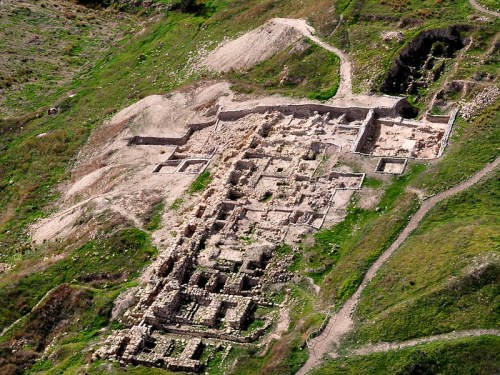
Solomonic Gate and Field A at Gezer. Photo by Ferrell Jenkins 2009.

Solomonic Gate and Field A at Gezer. Photo by Ferrell Jenkins 2009.

Dever explains why there isn’t evidence from the 10th century B.C. in Jerusalem.

“Of course, the revisionists argue that, ‘Well, you’ve never found anything from the 10th century, nothing monumental in Jerusalem.’ That’s true, because we never were able to excavate [in Jerusalem],” Dever said. Jerusalem was the fourth city that Solomon refortified, and it was the center of his kingdom. Despite the lack of access to the archaeological evidence that lies below modern Jerusalem, Dever argued that biblical descriptions of Solomon’s Temple resemble other 10th-century temples in the Middle East.

“All the descriptions in the Hebrew Bible,” Dever said, “make good sense in the light of what we know about ancient architecture.”

Revisionist scholars also contend that a centralized state could not have existed in 10th century Israel because literacy was not widespread, and the knowledge of reading and writing is necessary for the administration of a kingdom. Archaeological evidence like the Gezer calendar, however, has shown that even in rural areas young boys were learning to read during the 10th century and earlier, Dever said.

Encouraging Southwestern to remain involved in biblical archaeology, Dever said the seminary’s ongoing excavations at Tel Gezer would play an important role in affirming the existence of a united Israelite monarchy in 10th-century Palestine. Southwestern Seminary has led excavations at Tel Gezer under the supervision of Steven Ortiz, professor of archaeology and biblical backgrounds, since 2006.

While Dever affirmed the importance of ministerial training in his Nov. 3 lecture, he encouraged students to study archaeology and urged Southwestern to train biblical archaeologists who can challenge the skeptics in the field. Biblical archaeology, especially in the United States, is in “disarray,” he said. Many academic programs are floundering, and some have been shut down or replaced by academic programs emphasizing modern Middle Eastern studies.

“I always say to my Israeli colleagues, ‘The archaeology of Israel is too important to be left to you alone. This is our Holy Land, too.’ So we have to be involved, even though the Israelis dominate the field,” Dever said. “You have a unique opportunity at this particular juncture in time. Step in. There is not a lot of competition. Step in, and do something significant.”

Underscoring the need for rigorous academic training, Dever said, “Don’t ever apologize for your faith, or for the Bible, or for the Western tradition, or for being an American. Fight, and make sure you have the facts on your side.”

To learn more about Southwestern Seminary’s involvement in biblical archaeology, visit swbts.edu or gezerproject.org here.

One may not always agree with Dever, but one can not say that he did not make his point clearly. The gezerproject web site is out of date. I would like to see it updated soon.

The full report may be read here. © Copyright 2010 Baptist Press.

Worship of Bastet extended to the Ptolemaic Period

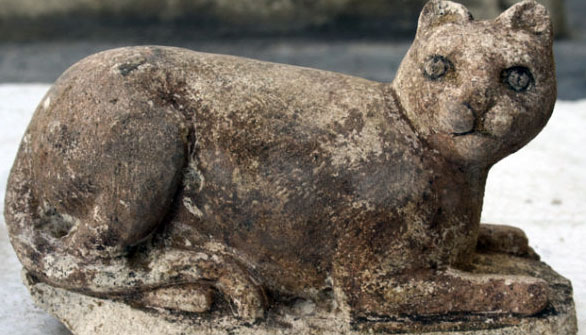
Fox News reported here recently on the discovery of a Greek temple dedicated to the Egyptian cat goddess Bastet.

Egyptian archaeologists unearthed the remains of an ancient Greek temple dedicated to Egyptian cat goddess Bastet in the Mediterranean city of Alexandria, the antiquities department said Tuesday.

The mission, led by Mohamed Abdel Maqsoud, head of Antiquities of Lower Egypt, discovered the remains of a temple of Queen Berenike, the wife of King Ptolemy III who ruled Egypt between 246 and 222 B.C., in the Kom al Dikka area in Alexandria.

“The discovered remains are 196 feet tall and 49 feet in width,” antiquities chief Zahi Hawass said in a statement. He said the temple was “subjected to destruction during later eras when it was used as a quarry, which led to the disappearance of many of its stone blocks.”

A group of 600 Ptolemaic statues were also unearthed during the routine excavations, including a large collection of icons depicting Bastet, goddess of protection and motherhood.

The discovery in Kom al Dikka is the first Ptolemaic temple discovered in Alexandria to be dedicated to the goddess Bastet, Abdel Maqsoud was quoted as saying in the statement.

“It indicates that the worship of the goddess Bastet continued in Egypt after the decline of the ancient Egyptian era,” he said.

The Ptolemaic period marks the Greek rule of Egypt from 305 B.C. until the Roman conquest in 30 B.C.

Alexandria became the capital city of Ptolemaic Egypt and thrived as the center of Greek culture and trade.

Bastet. Discovered at Alexandria. AP photo.

Image of Bastet, the cat goddess of Egypt, discovered at Alexandria. AP.

Egypt was noted for the worship of numerous gods. The plagues of Egypt were a judgment against “all the gods of Egypt” (Exodus 12:12). Later, in the time of the prophet Jeremiah, the LORD again warned of judgment upon the gods of  Egypt (Jeremiah 43:12-13).

Every time I read Paul’s discussion about the condition of the Gentiles I think of the gods of ancient Egypt.

Professing to be wise, they became fools,  and exchanged the glory of the incorruptible God for an image in the form of corruptible man and of birds and four-footed animals and crawling creatures. (Romans 1:22-23 NAU)

Bubastis in ancient Egypt was especially devoted to Bastet. The ruins of the city are now surrounded by the city of Zagazig in the Eastern Delta. It was mentioned by the prophet Ezekiel under the name Pi-beseth (Ezekiel 30:17).

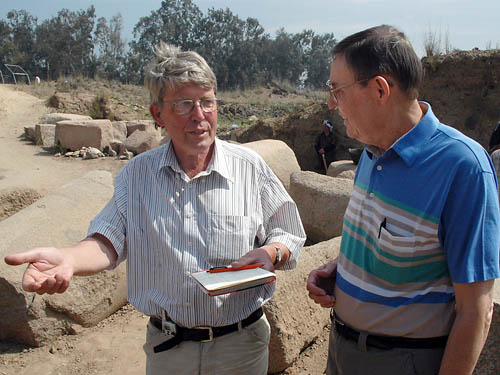
Prof. Christian Tietze and a team of Egyptian archaeologists have been working at Tell Basta (Bubastis).

Prof. Christian Tietze and Ferrell Jenkins at Tell Basta, Egypt, 2005.

Prof. Christian Tietze and Ferrell Jenkins at Tell Basta, Egypt, 2005.

The new discovery from Alexandria in the Ptolemaic period shows that the worship of Bastet continued, and was more wide spread than commonly thought.

The Mountains of Judea

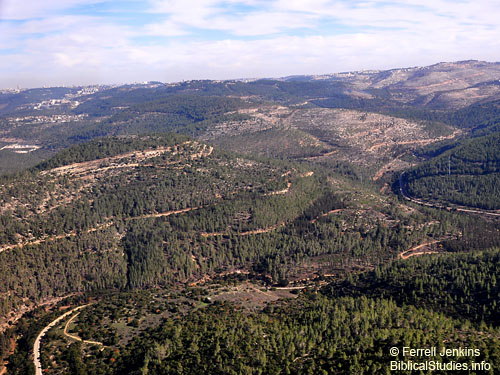
This photo shows the mountainous terrain southwest of Jerusalem. Our camera is pointed east and, in the left of the photo, we can see the tall buildings of Jerusalem along the central mountain range.

Judean Mountains SW of Jerusalem. Photo by Ferrell Jenkins.

Judean Mountains SW of Jerusalem. Photo by Ferrell Jenkins.

Throughout the Bible the writers speak of going UP to Jerusalem. This is because of the elevation of Jerusalem in the central mountain range, also called the water-parting route, that runs north to south in the country.

The timber for the temple was shipped from Lebanon to Joppa on rafts, then taken up to Jerusalem.

And we will cut whatever timber you need from Lebanon and bring it to you in rafts by sea to Joppa, so that you may take it up to Jerusalem.” (2 Chronicles 2:16 ESV)

In our series of aerial photos we have moved eastward from the coastal plain, to the shephelah (lowland; 2 Chronicles 26:10), to the mountains. This understanding of the topography of the country of Israel helps in understanding many biblical accounts.

Earthquakes common in the Bible world

Earthquakes were, and are, common in the Bible world. Earthquakes are common in Iran (Persia), Turkey (Asia Minor), Syria, Lebanon, Israel, and Jordan.

The Great Rift runs all the way from northern Syria through Lebanon, Israel, the Arabah, and into eastern Africa. In Israel the area is called the Jordan Valley or the Dead Sea Rift, It is not surprising that earthquakes are mentioned frequently in the Bible. The prophet Amos dates his visions to “two years before the earthquake” (Amos 1:1). The earthquake he makes reference to must have been so memorable that everyone would know what he was talking about. Zechariah (14:5) also calls attention to this earthquake in the days of Uzziah king of Judah.

Jesus, in predicting the fall of Jerusalem to the Romans, said, “and in various places there will be famines and earthquakes” (Matthew 24:7; see Luke 21:11).

About a year and a half ago I wrote about Philadelphia with special attention to the danger of earthquakes here. I suggest you read that post. The letter to the church at Philadelphia (Revelation 3:7-13) makes an allusion to the events that occur after an earthquake. In the promise to the overcomers the Lord says “I will make him a pillar in the temple of My God, and he will not go out from it anymore (v 12). In the case of earthquakes people stay outside for several days due to the fear of aftershocks. Those who overcome need not fear being toppled, as a pillar might be toppled in the earthquake.

He who overcomes, I will make him a pillar in the temple of My God, and he will not go out from it anymore; and I will write on him the name of My God, and the name of the city of My God, the new Jerusalem, which comes down out of heaven from My God, and My new name. (Revelation 3:12 NAU)

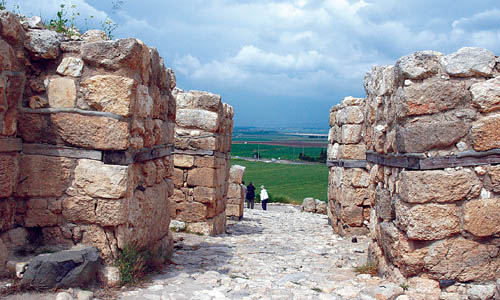
The archaeological excavations of many Biblical cities throughout Asia Minor, and along the Great Rift, reveal evidence of earthquakes. Some of the gates were built with pieces of timber to absorb the shock from the tremors. The reconstructed gate at Megiddo illustrates this practice.

Megiddo Gate with view of Jezreel Valley. Photo by Ferrell Jenkins.

Megiddo Gate with view of Jezreel Valley. Photo by Ferrell Jenkins.

The same practice is reflected in Scripture in the account of the rebuilding of the temple according to the order of the Persian King Cyrus.

In the first year of Cyrus the king, Cyrus the king issued a decree: Concerning the house of God at Jerusalem, let the house be rebuilt, the place where sacrifices were offered, and let its foundations be retained. Its height shall be sixty cubits and its breadth sixty cubits, with three layers of great stones and one layer of timber. Let the cost be paid from the royal treasury. (Ezra 6:3-4 ESV)

Pieces of Cyrus cylinder found in British Museum

A report in PressTV, which appears to be an Iranian source, says:

Iranian inscription expert Abdolmajid Arfaei says the newly-found pieces of the Cyrus cylinder had been housed in the British Museum.

“The pieces have most probably been housed in the museum and only recently recognized as parts of the Cyrus cylinder,” Arfaei told ISNA.

The British Museum recently announced that some new parts of the cylinder’s broken pieces have been found, which might be a clue to some other documents sent by Cyrus the Great to other regions.

“If there are any new pieces, then they can provide more information about the contents of the cylinder,” Arfaei said.

When asked about the theory of Cyrus making 10 cylinders and sending to different territories, Arfaei said, “If there existed more than one cylinder, at least one of them should have been found by now.”

Head of Iran’s Cultural Heritage, Handicrafts and Tourism Organization (ICHTO) Hamid Baqaei announced on Saturday that the British Museum had invited an Iranian team to collaborate on studying the newly-found pieces.

The Cyrus the Great cylinder is inscribed in Babylonian cuneiform with an account by Cyrus II, king of Persia (559-530 BC) and is considered the world’s first charter of human rights.

The ancient cylinder was scheduled to be given to Iran on loan in September 2009; however, the British Museum backed out of the agreement, citing Iran’s post-election unrest.

Tehran had earlier said that it would cease cooperation with the British Museum until the cylinder is loaned to the National Museum of Iran.

Iran has assured the British side about the safety of the priceless artifact.

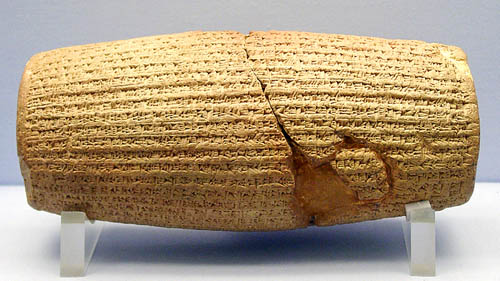
The Cyrus Cylinder in the British Museum. Photo by Ferrell Jenkins.

The Cyrus Cylinder in the British Museum. Photo by Ferrell Jenkins.

Cyrus was the Persian King who conquered Babylon and later allowed captives, such as the Jews, to return to their home and rebuild their temple.

In the first year of the reign of King Cyrus of Persia, in fulfillment of the promise he delivered through Jeremiah, the LORD moved King Cyrus of Persia to issue a written decree throughout his kingdom. It read: “This is what King Cyrus of Persia says: ‘The LORD God of the heavens has given to me all the kingdoms of the earth. He has appointed me to build for him a temple in Jerusalem in Judah. May the LORD your God energize you who belong to his people, so you may be able to go back there!” (2 Chronicles 36:22-23 NET’ cf. Ezra 1:1-2)

HT: Dr. Claude Mariottini