Category Archives: Bible Study

Scholarship or theft?

Someone unknown to me has copied numerous of my posts and posted them at their own site here.

I am delighted for others to use my material with a credit line, but this source includes no indication of the source of the material. It cost me many thousands of dollars to obtain the photos that I use on this page. Gaining permission to use material is not that difficult, and a credit line is certainly required.

You shall not steal. (Exodus 20:15 NAU)

He who steals must steal no longer; but rather he must labor, performing with his own hands what is good, so that he will have something to share with one who has need. (Ephesians 4:28 NAU)

Update Regarding Ethical and Legal Violations (March 27, 2010)

I knew that the person back of the actions mentioned above had done something unethical (sinful, according to the Hebrew Bible and the New Testament). I knew they were in violation of copyright law. After doing a little check, I learned that the practice is an infringement of the agreement made with WordPress, and a violation of the DMCA (Digital Millennium Copyright Act).

After checking the archives of the web site, I learned that this practice has been going on since December, 2009. The owner has used my photos with the same or similar captions, but has removed “Photo by Ferrell Jenkins” or other credits that I included. Outrageous, isn’t it?

Update (March 29, 2010): In response to my letter stating that my material had been plagiarized, WordPress has notified me that the offending web site “has been removed.” Thank you, WordPress. You are a great service.

Update # 2 (March 29, 2010): Soon after the single post that I reported to WordPress was taken down, others were moved to the top of the blog. Later, I reported 40 of my blogs that were copied. Late this afternoon I received this note: “The entire blog has now been removed, as per these multiple reports.”

ArchaeologyExcavations taken down from WordPress.

Hippos overlooks the Sea of Galilee

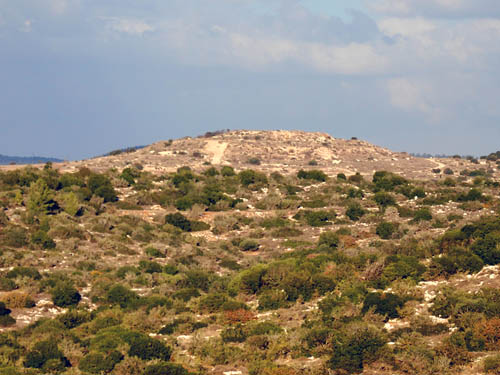
I think many Bible Land travelers pass En Gev on the eastern shore of the Sea of Galilee and never realize that the site of Hippos is visible about one and a half miles to the east. Perhaps that is because of the almost magnetic attraction of the Sea of Galilee.
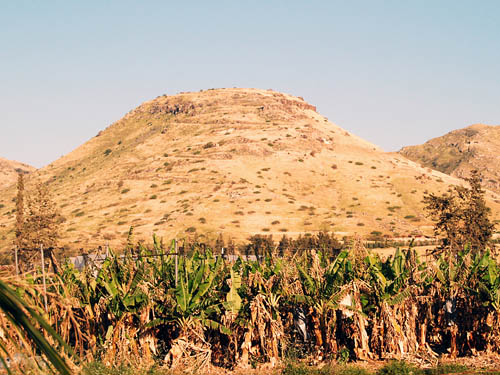
The site of Hippos (Susita), east of the Sea of Galilee. Photo by Ferrell Jenkins.

The site of Hippos (Susita), east of the Sea of Galilee. Photo by Ferrell Jenkins.

Vassilios Tzaferis wrote about Hippos in Biblical Archaeology Review:

If you look at the site of Sussita/Hippos from an adjacent mountain, or, better yet, from the air, and follow the adjoining ridge, or saddle, to the east, the site looks like the head of a horse and the saddle, or ridge, looks like the long, outstretched neck of a horse. It is this configuration that gave the site its name for nearly a thousand years. The ancient Greeks, who apparently were the first to settle the site, must have been aware of this resemblance because they named the place Hippos (horse). When the Jews conquered the city, they translated the name to Sussita, “mare” in Aramaic. When the Arabs conquered it, they called it Qal’at el Husn, the “fortress of the horse.”

The summit of the mountain is a plateau of about 37 acres on which lie scattered the ruins of what was once a beautiful town overlooking the lake.

Our story begins—perhaps it will begin much earlier after the site is thoroughly excavated—about a century after Alexander the Great conquered and Hellenized much of the then-known world. After Alexander’s death in 331 B.C., his empire split in two—the Ptolemies in Egypt and the Seleucids in Syria shared this world. Over the centuries Palestine passed from one side to the other, occasionally winning its own independence. The first evidence we now have of organized habitation at Hippos indicates that it was founded by the Seleucids in the middle of the third century B.C., very probably as a frontier fortress against the threat of the Ptolemaic kingdom to the south. The settlement was located on a most strategic point, on the western approach to Gaulanitis (today’s Golan Heights). The site’s natural fortification and defense allowed it to serve equally as a fortress stronghold and as an effective frontier post, controlling any movement to the east, both in time of war and peace. In about 200 B.C., the boundaries of the Seleucid kingdom were pushed down to southern Palestine, so Hippos lost much of its strategic significance but it retained its importance as an urban cultural center, with a social and political organization in accord with the principles of a Greek polis.

When the town was formally recognized as an official constitutional polis, it was renamed Antiocha, in honor of the head of the Seleucid kingdom, Antiochus the Great (III), although the old name Hippos was also officially used.

Hippos had a port on the Sea of Galilee “to serve the commercial and navigational needs” of the city.

The progress of the city as a Hellenistic center was interrupted for a period of about 20 years during the first half of the first century B.C. Sometime between 83 and 80 B.C., the Judean king Alexander Jannaeus, who then ruled an independent fiefdom, conquered Hippos. According to the first-century A.D. historian Flavius Josephus (Antiquities of the Jews 14.75), Jannaeus forced Hippos’ heathen inhabitants to be circumcised and to accept Judaism. In 64 B.C., however, the Roman army entered the scene. The Roman general Pompey took the city from the Jews; it was then included in the League of the Ten Cities, the Decapolis, created by Pompey in the northern Jordan Valley and adjacent Transjordan. Each city in the Decapolis had jurisdiction over an extensive area. As a member of the Decapolis, Hippos enjoyed internal autonomy and could even mint its own coins. The population of Hippos welcomed Pompey with open arms.

About 35 years later, Hippos again became part of a Jewish realm. In 30 B.C. the Roman emperor Augustus gave Hippos to Herod the Great, who ruled it until his death 26 years later, in 4 B.C. After Herod’s death, Hippos was assigned by the Romans to the province of Syria.

During the First Jewish Revolt against Rome (66–70 A.D.), the Jews attacked Hippos and its Greek inhabitants, who retaliated by killing or imprisoning the Jews residing there. (Biblical Archaeology Review 16:05, Sep/Oct 1990).

Riesner says that Hippos “must be” the city of the Decapolis presupposed in Mark 5:1-20 (the account of casting demons into swine; Dictionary of Jesus and the Gospels 40). It might be. Hippos is the closest of the cities of the Decapolis to the area of Jesus’ ministry which was centered in Capernaum. It would make sense that Gentiles in this area might be growing pigs.

And he [the healed demon-possessed man]went away and began to proclaim in the Decapolis how much Jesus had done for him, and everyone marveled. (Mark 5:20 ESV)

And great crowds followed him [Jesus] from Galilee and the Decapolis, and from Jerusalem and Judea, and from beyond the Jordan. (Matthew 4:25 ESV)

During excavations at Hippos in 2007, a sandal print identified as that of a Roman soldier was uncovered:
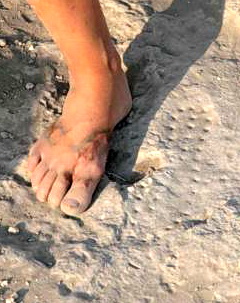
Sandal print from Hippos.

Roman sandal print from Hippos. Photo: University of Haifa.

Archaeologists have discovered a footprint made by the sandal of a Roman soldier in a wall surrounding the Hellenistic-Roman city of Hippos (Sussita), east of the Sea of Galilee.

The footprint was discovered during this eighth season of excavation, led by Prof. Arthur Segal from the Zinman Institute of Archaeology at the University of Haifa in conjunction with archaeologists from the Polish Academy of Sciences and Concordia University in St. Paul, Minnesota.

This rare footprint, which is complete and well preserved, hints at who built the walls, how and when,” said Michael Eisenberg of the Zinman Institute at the University of Haifa.

The print, made by a hobnailed sandal called caliga, the sandal worn by Roman soldiers, is one of the only finds of this type. The discovery of the print in the cement led archaeologists to presume that legionnaires participated in construction of the walls.

The full article may be read in Science Daily here.

High places of the Gate

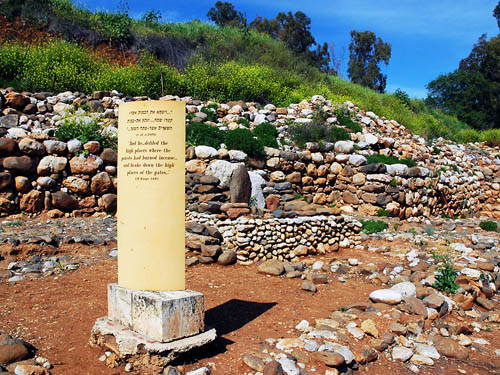
Standing stones (high places, bamah) are often found at the gate of Biblical cities. The photo below shows some standing stones from the gate of Tel Dan.  The informational sign immediately to the left of the standing stones includes a quotation from 2 Kings 23:8. The text describes the reforms of King Josiah of Judah (641/40–609 B.C.).

He brought all the priests from the cities of Judah and ruined the high places where the priests had offered sacrifices, from Geba to Beer Sheba. He tore down the high place of the goat idols situated at the entrance of the gate of Joshua, the city official, on the left side of the city gate. (2 Kings 23:8 NET)

[On “goat idols” see Leviticus 17:7 and 2 Chronicles 11:15]

Standing stones at the gate of Tel Dan. Photo by Ferrell Jenkins.

Standing stones at the gate of Tel Dan. Photo by Ferrell Jenkins.

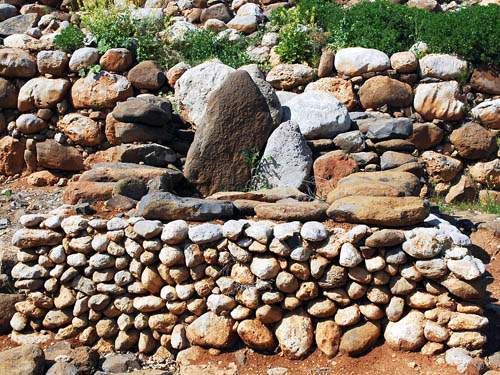
Here is a closer view showing the standing stones. The placement of these stones at the gate of the city allowed everyone who came into the city to make obeisance to whatever god was represented.

Standing stones at the gate of Tel Dan. Photo by Ferrell Jenkins.

Bamah at the gate of Tel Dan. Photo by Ferrell Jenkins.

See the previous post (here) for more information about the standing stones.

A new Bible atlas

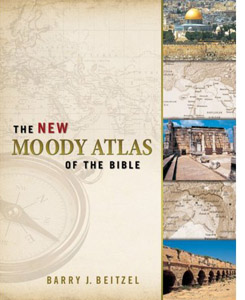
For the past three weeks I have had the opportunity to consult The New Moody Atlas of the Bible by Barry J. Beitzel.
The New Moody Atlas of the Bible
This work is a revision of The Moody Atlas of the Bible, published in 1985. This edition is a worldwide co-edition organized and produced by Lion Hudson in Oxford, England. You surely have seen some of their beautiful work in other publications. The USA edition is published by Moody Publishers. Many high quality books today are printed in the Orient. This one was printed in China. Amazing, isn’t it.
I don’t intend this as a review, but I am impressed with the clarity with which Beitzel discusses controversial material. In “The Route of the Exodus” he clearly discusses the historical background, the geographical setting, searching for Mt. Sinai in Saudi Arabia/South Jordan, searching for Mt Sinai in the northern Sinai peninsula, and searching for Mt. Sinai in southern Sinai. Pros and cons of the various positions are briefly set forth. No, I won’t tell!
This atlas sells for $49.99. I wish the publisher would sell it for $50. Does that one cent difference make anyone think they are getting a bargain? Amazon currently has the book for $31.49 (there we go again) from this link: The New Moody Atlas of the Bible.
Beitzel, with degrees from Dropsie, Fuller, and the University of Pennsylvania, is professor of Old Testament and Semitic Languages at Trinity Evangelical Divinity School.

The fish of ancient Egypt and Ashkenazi Jews

A human interest story by Stephen Gabriel Rosenberg draws a connection between the fish eaten by the Israelites in ancient Egypt and the fish eaten by Ashkenazi Jews today during Passover (Pesach). The Ashkenazi Jews of Israel and America are those who descended from Jews living along the Rhine River in Germany. Because of their movement to other areas, we think of them as having come from central and eastern Europe. Non-Ashkenazi Jews are known as Sephardic Jews. We typically think of them as having lived in the Iberian peninsula and Yemin, among other places.

Rosenberg paints a fascinating history of the gefilte fish which is eaten on the Passover and as the Sabbath (Shabbat) afternoon meal. He cites the work of the late George Freudenstein of Riverdale, New York. He calls Freudenstein “an eminent nutritional scientist and Hebrew scholar.  Freudenstein was chief chemist of the Jewish food giant Rokeach for 50 years and also an ardent talmudist.”

IN ANCIENT Egypt fish was a staple diet for the workers, and that included the Hebrew slaves. Not satisfied with the manna, they complained to Moses, “We remember the fish that we ate in Egypt for nothing” (Numbers 11:5) and the Egyptian sources confirm that Rameses II, perhaps the pharaoh of the Exodus, gave his workers a free allowance of 10 kilos of salted fish each month. Under his descendent Rameses III, around 1150 BCE, it is recorded that the grave diggers requested an increase in this generous amount to compensate them for their heavy and unpleasant work.

In spite of the hot climate, Nile fish could be preserved by drying and salting, as evidenced by the discovery of a warehouse of dried fish at the Sun Temple of El-Amarna, in central Egypt.

Freudenstein quotes a German Egyptologist, who claims that the composition of the fish in the Nile Delta has hardly changed over the last five millennia and that there are 30 species still active from ancient times. These include carp, pike and mullet, and the species of Nile mullet is exactly the one that is in use for today’s gefilte fish, at least as produced by Rokeach.

Let it be noted that we do not concur that Rameses II was the Pharaoh of the Exodus, but that is for another time. Rosenberg’s fascinating article, “In praise of gefilte fish,”  may be read in its entirety here in the Jerusalem Post. We learn that Secretary of State Hillary Clinton “is engaged in diplomatic moves” to resolve a USA export/Israel import issue dealing with the gefilte.

We noted that the ancient Israelites longed for the fish of Egypt (Numbers 11:5). After the return from exile in Babylon, Nehemiah informs us that the men of Tyre sold imported fish in Jerusalem.

The people from Tyre who lived there were bringing fish and all kinds of merchandise and were selling it on the Sabbath to the people of Judah– and in Jerusalem, of all places! (Nehemiah 13:16 NET)

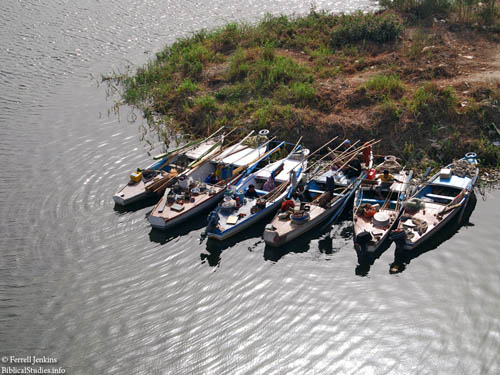
Our photo today shows the Nile River immediately south of Cairo where it divides to go around the islands, such as Roda Island, in the river. Fishermen get ready to go out for the day’s catch.

The Nile River near Cairo. Photo by Ferrell Jenkins.

The Nile River near Cairo where the river goes around the islands that are visible in the city. Photo by Ferrell Jenkins.

HT: Joesph I. Lauer

Jarmuth – a city of the Shephelah

Jarmuth (or Yarmuth) is located about 1 1/4 miles north of  the Valley of Elah, and 5 miles south of Beth-shemesh and the Sorek Valley. The site is mentioned 6 times in the book of Joshua (10:3, 5, 23; 12:11; 15:35), and in Nehemiah 11:29). The name is used in Joshua 21:29, but the Jarmuth mentioned there seems to be a town in the territory of Issachar.

Jarmuth was a Canaanite city conquered by the Israelites in the days of Joshua. It became part of the kingdom of Judah.

Michael Avi-Yonah says,

It has been identified with Khirbat al-Yarmūk (Eusebius calls it Iermochus), a large and prominent mound east of Kafr Zakariyya where surveys have revealed a large city surrounded by a massive stone wall from the Early Bronze Age and a smaller but higher mound containing pottery ranging from the Late Bronze to Byzantine periods. (Encyclopaedia Judaica)

Some excavations were conducted in the 1980s by Pierre De Miroschedji. The excavator says,

Given its size and the density of its construction, the EB III [about 2300 B.C.] city of Jarmuth may have had a population of about 3,000, engaged mainly in agriculture (cereals, vegetables, grapes, and especially olives) and animal husbandry (mostly sheep and goats, cattle and donkeys being used for traction and transport). (The Anchor Bible Dictionary 3:646)

The photo below was taken from Khirbet Qeiyafa, 1 1/4 miles south of Jarmuth.

Jarmuth from Khirbet Qeiyafa. Photo by Ferrell Jenkins.

Jarmuth from Khirbet Qeiyafa (above the Valley of Elah). Photo by Ferrell Jenkins.

More on Paul’s shipwreck on Malta

Gordon Franz has written a critique on his Life and Land blog (here) of the CBN 700 Club’s program about Robert Cornuke’s “amazing Biblical discovery” on Malta. Previously we have called attention to Gordon’s blog and writings, and especially to his series on “Cracked Pot Archaeology” here.

The CBN video includes some nice footage and is, for that reason, worth viewing. If you have interest in this subject, I suggest you go to Life and Land and take a look at the video and read the critique.

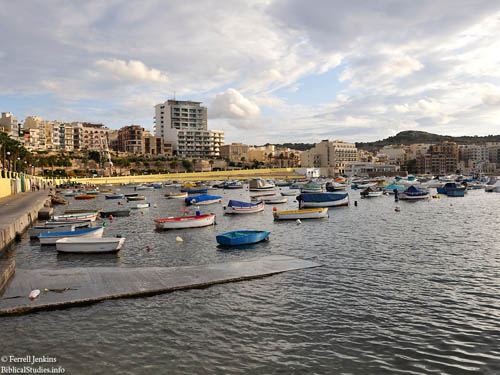
Our photo below shows one of the small pleasure harbors around St. Paul’s Harbor on Malta.

St. Paul's Harbor at Malta. Photo by Ferrell Jenkins.

St. Paul's Harbor at Malta. Photo by Ferrell Jenkins.

You may read our account of visiting Malta here and here. This is a significant topic because of the account of Paul’s shipwreck in Acts 28.

After we had safely reached shore, we learned that the island was called Malta. (Acts 28:1 NET)

New Bible software map program

Scott Richardson, of Impressive Image Impressions, has released the third is his Discovering … series of Bible software. The first two are Discovering… Churches of the New Testament and Discovering… Kings of the Divided Monarchy. The new one is entitled Discovering… Lands and Places of the Bible (usable in both Windows and Mac). Maps cover all periods of the Bible in PDF and PNG format. These are suitable for use in presentations or printing for class.

The program includes a “Build-a-Map” feature for those who wish to edit maps for special purposes.

For detailed study involving the terrain these maps are lacking. With that said, I suspect that most preachers or teachers who use Bible maps in their presentations will find these adequate.

A Quicktime video shows the features of each program. The online store is temporarily down, but you may contact Scott by calling 1-800-762-4843.

The sacred standing stone at Shechem

Robert J. Bull, in a 1960 article in Biblical Archaeologist, tells the story of the earlier discovery of the sacred standing stone that still stands in the courtyard of the temple of Baal-Berith at Shechem.

“Sellin records that the altar base, when uncovered in 1926, was 2.20 meters long and 1.65 meters wide. Today there remain only a few stones arranged in an irregular pattern roughly 1 by 1 1/2 meters in extent. A large hollowed-out stone base and a broken piece of hard white limestone were uncovered by Sellin just southeast of the altar. The hollow in the base was 40 centimeters deep, and measured 45 cms. in width and 1.65 meters in length, while the limestone slab was 1.45 meters by 40 cms., and stood 1.65 meters in height. Since the limestone slab would fit into the base neatly; Sellin concluded he had found the main standing-stone or maṣṣebah of the city. A story which I am not able to confirm relates that Dr. Aage Schmidt, visiting the tell during a temporary absence of Sellin, came upon one of the workmen breaking up the limestone slab with a maul and prevailed upon him to cease until Sellin could be summoned!

Thus it was that some portion of the maṣṣebah was saved. In 1956, the Drew-McCormick Expedition found the socket and slab cast down from the bank of altar fill into the palace area some 6 meters below. One end of the base had been broken off, so that only an open ended niche remained, four-fifths of the original length. Of the maṣṣebah, only 1.45 meters of its original height remained on one side and only 62 cms. on the other. With great effort, a team of workers tugged and hauled these massively heavy stones back up onto the forecourt of the temple, securing the standing stone in its original base with cement. Once again the maṣṣebah dominates the area from a point where it probably stood originally, at least from what we can learn from the drawings and photographs in the Sellin and Welter reports” (Robert J. Bull, Biblical Archaeologist : Vol. 23 1-4, electronic ed. (American Schools of Oriental Research, 2001, c1960).

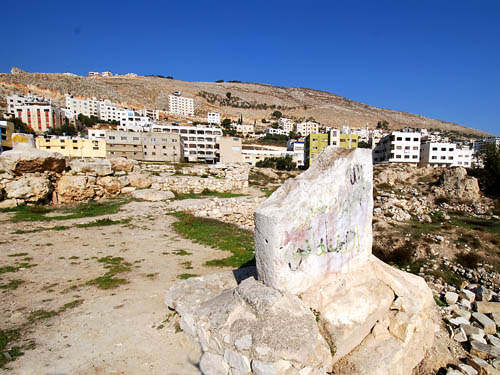
The broken sacred standing stone (massebah) stands in the courtyard in front of the entrance to the Temple of Baal-Berith. The near-barren Mount Ebal, where the curses of the law were read (Deuteronomy 27); Joshua 8:30-33), is visible to the north.

The sacred standing stone at Shechem. Photo by Ferrell Jenkins.

The sacred standing stone at Shechem. Photo by Ferrell Jenkins.

Dr. Bryant Wood says,

Since the temple existed in Joshua’s day, it is possible this was the “large stone” he set up “under the oak that was by the sanctuary of the Lord” at Shechem (Josh. 24:26). The stela is undoubtedly the “pillar” where Abimelech was made king (v. 6)” (Bryant Wood. “From Ramesses to Shiloh.” Giving the Sense. Kregel, 2003).

The entrance to the temple of Baal-Berith

Edward F. Campbell, in a report on the 1960 excavation at Shechem, tells about Sellin’s discovery more than three decades earlier.

“While this work was underway, he found time to study some stones in the court before the temple. On each side of the door there was a large stone block, one of them nearly 4M ft. long, the other nearly 6 ft. long. Both had long depressions cut into their tops, and Sellin had first thought that they were watering troughs—though how such small depressions could have served any such purpose in front of the temple is difficult to imagine. Directly in front of the door in the courtyard to the southeast was a much larger stone with a similar though much deeper and wider trough, which also had been interpreted as a receptacle for water. Now, however, Sellin took note of a large, flat stone with rounded sides lying nearby. Though broken and much of it gone the reminder is still over 5 ft. high, some 4M ft. wide and 1 m ft. thick. Experiment showed that the smooth flat stone had been made to stand up in the trough, so Sellin put the two together. Two more flat stones were found to fit together in the left (southwestern) stone base beside the temple door. Sellin concluded that these three could only be installations of sacred standing stones that once framed the temple entrance—stones that in Old Testament Hebrew are called massebot” (Biblical Archaeologist: Vol. 20 1-4, electronic ed. (American Schools of Oriental Research).

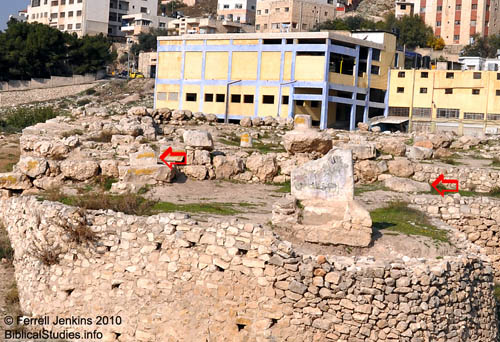
The stone bases on either side of the entrance to the temple are visible today, and marked here by the red arrows. The base on the left has the broken sacred standing stone in place.

Courtyard and entrance to temple of Baal-Berith. Photo by F. Jenkins.

Notice the courtyard in front of the temple entrance. In a future post we will report how the largest standing stone was almost destroyed.