Category Archives: Bible Lands

Horses in the Golan Heights

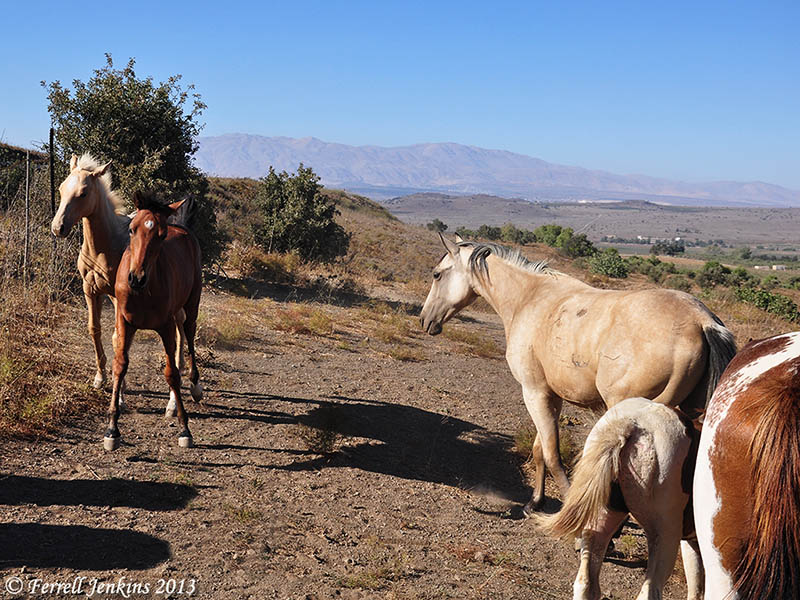
Last September we stopped in the Golan Heights at the overlook east to Kuneitra, Syria. A few horses were being pastured in the area. Mount Hermon is visible to the north.

Horses in the Golan Heights. Mount Hermon in the distance. Photo by Ferrell Jenkins.

Horses in the Golan Heights. Mount Hermon in the distance. Photo by Ferrell Jenkins.

This area is included in the description of the victories of the Israelites.

Now these are the kings of the land whom the people of Israel defeated and took possession of their land beyond the Jordan toward the sunrise, from the Valley of the Arnon to Mount Hermon, with all the Arabah eastward: (Joshua 12:1 ESV)

James Leslie Starkey, excavator of Lachish

James Leslie Starkey was born in London January 3, 1895. He became interested in ancient history by reading books such as Layard’s Nineveh and Its Remains. He took a course in Egyptology and came in contact with Flinders Petrie. Later he worked with Petrie in Egypt.

Starkey joined Petrie in the excavation at Tell Jemmeh, then at Tell el Far’ah (South) in southern Palestine, where he directed the dig during the final season.

In 1932 Starkey began his own dig at Tell ed-Duwer, identified as biblical Lachish. During his six years at the site, one of the more significant finds was the Lachish Letters which date to the period of the end of the Babylonian conquest of Judah, during the time of the prophet Jeremiah.

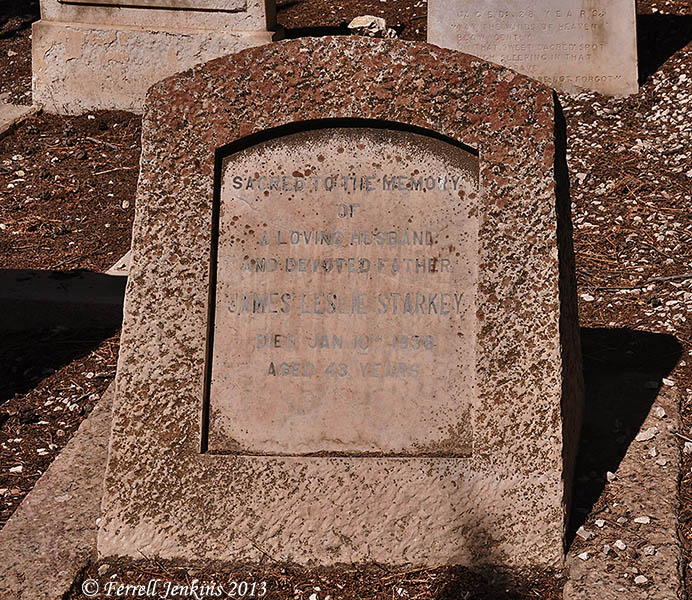
While on his way to Jerusalem in January 1938, for the opening of the new Palestine Archaeological (Rockefeller) Museum, Starkey was shot in an ambush.

Starkey was buried in the Protestant Cemetery on Mount Zion. Four years later the body of his former mentor, Flinders Petrie, was laid to rest a few yards away.

Tomb of James Leslie Starkey, excavator of Lachish. Photo by Ferrell Jenkins.

Tomb of James Leslie Starkey, excavator of Lachish. Photo by Ferrell Jenkins.

I found that information about Starkey is somewhat limited. Much of the info here has been gleaned from a page about Starkey on The Palestine Exploration Fund web site here. There you will see a photograph of Starkey with Petrie, and Olga Tufnell who spent twenty years to complete the four volumes of the Lachish Excavation Reports.

The Spafford grave in the Protestant Cemetery

How the Spaffords came to make Jerusalem their home is an interesting story, but I will leave it for you to read in Bertha Spafford Vester, Our Jerusalem: An American Family in the Holy City 1881–1949. It may be difficult to locate a copy of the book for a reasonable price, but it is available in Kindle format for $8.39. Click here: Our Jerusalem.

The members of the American Colony lived under a series of governments — the Turks, British, Jordanians, and Israelis. Horatio died in 1888 during the Turkish rule. The American Colony had secured a place for burials on the south eastern slope of the traditional Mount Zion overlooking the Hinnom Valley.

Before I can show you the grave marker of Horatio Spafford I should tell you about the desecration of his original grave. Toward the end of the 19th century, when the members of the American Colony needed a grave site, they learned that earlier burials had been removed and the remains placed “temporarily” in a large pit. After much effort, permission was granted by various ruling authorities for the bones to be gathered, and a small plot was granted for the burial of the American Colony members.

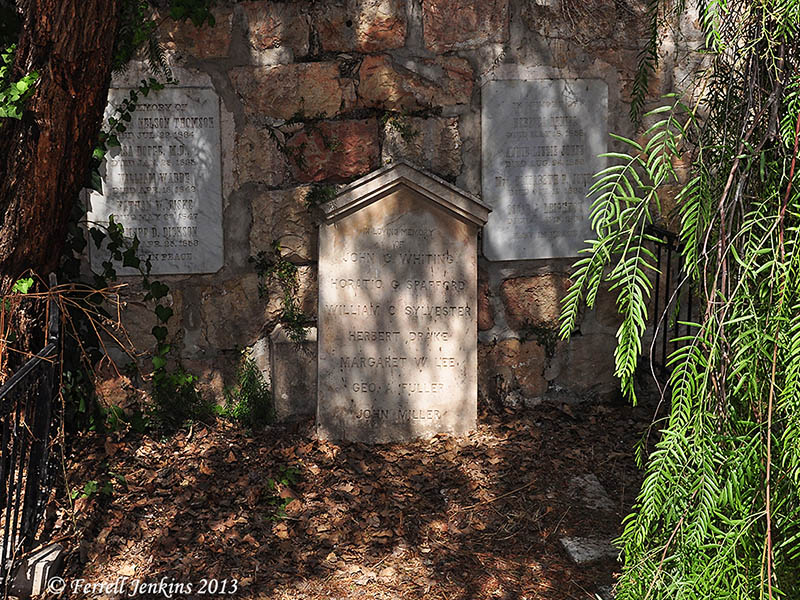
That small plot is pictured below. It is immediately inside the gate to the cemetery. The large marker identifies seven members of the American Colony whose remains were recovered: John C. Whiting; Horatio G. Spafford; William C. Sylvester; Herbert Drake; Margaret W. Lee; Geo. A. Fuller; John Miller. I have noticed at least four of these names in Vester’s Our Jerusalem. Whiting was also from Chicago. He and his family came to Jerusalem with the Spaffords, as did Margaret Lee.
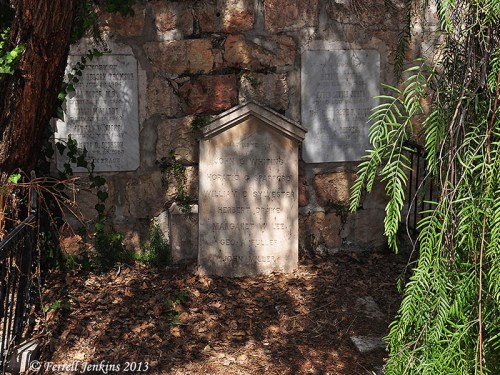
Grave stone for Spafford and other members of the American Colony in the Protestant Cemetery on Mount Zion. Photo by Ferrell Jenkins.

Grave stone for Spafford and other members of the American Colony in the Protestant Cemetery on Mount Zion. Photo by Ferrell Jenkins.

The two smaller markers in the wall identify others whose bones were recovered and buried in the common grave.

In 1896 a group of 37 Swedish farmers left Nås, Sweden, and made their way to Jerusalem. They took up residence at the American Colony. (Vester says there were 38, including 17 children, and a babe in arms. Perhaps the infant was born after leaving Sweden.) The Swedes mostly engaged in farming in the nearby Kidron Valley. I think you would enjoy reading the comment to the last post written by reader Erik Wold. You may see his photographs of Nås and read his Norwegian comments here (use Google Translate if you do not read Norwegian). The Swedish writer Selma Lagerlöf won a Nobel prize for her novel called Jerusalem, which was based on the American Colony. Bertha Vester says that her mother, Anna Spafford, “is the heroine in her book and is called Mrs. Gordon.”

Something else that has fascinated me is the fact that Eric Matson and the American Colony photographers worked from this location. About 40 years ago I edited a series of Bible Class literature called Truth in Life. We used some of Eric Matson’s wonderful Bible land photographs in the series. For more information about the work of Matson and the other photographers see Life in the Holy Land. I think Matson was the heir of one of the settlers from Sweden.

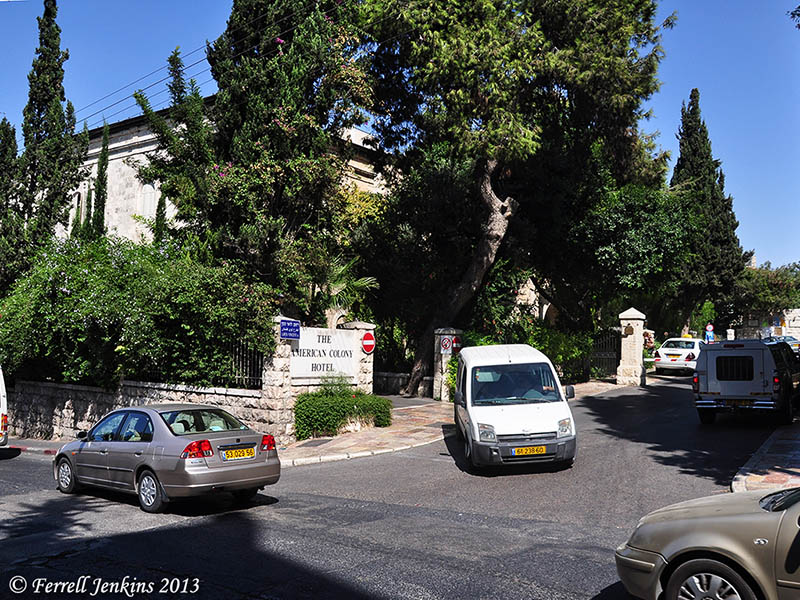
I do not know anything about the present ownership of the American Colony Hotel, but it is a prestigious 5-star luxury hotel.
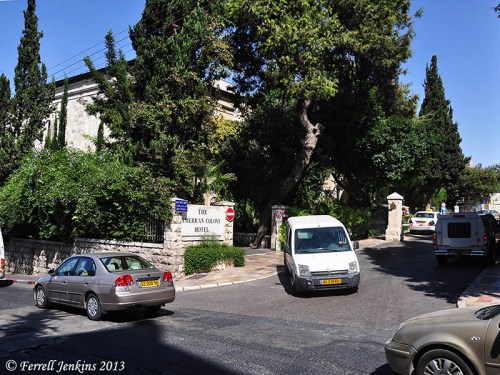
Entrance to the American Colony Hotel, Jerusalem. Photo by Ferrell Jenkins.

Entrance to the American Colony Hotel, Jerusalem. Photo by Ferrell Jenkins.

Would you like to see more photographs from the Protestant Cemetery?

Green pastures

David, in describing the LORD as his shepherd, pictures himself as a sheep.

The LORD is my shepherd; I shall not want. He makes me lie down in green pastures. He leads me beside still waters. (Psalm 23:1-2 ESV)

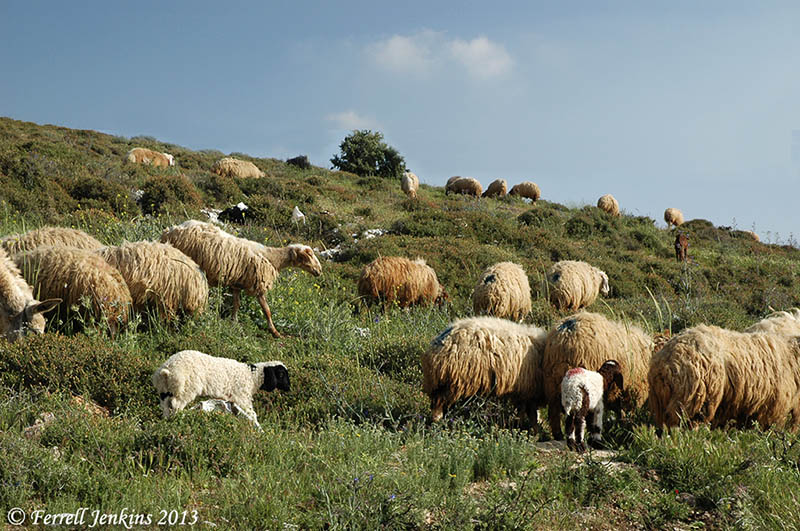
The picture below was made near Heshbon on the Transjordan plateau. It is rare in Israel or Jordan to see sheep in such an abundance of grass.

Sheep near Heshbon in Trans-Jordan. Photo by Ferrell Jenkins.

Sheep near Heshbon in Trans-Jordan. Photo by Ferrell Jenkins.

The Hebrew term mishor describes “level country, table-land, plain … specifically of the elevated plateau or table-land between the Arnon and Heshbon” (Brown, Driver, Briggs). Take a look at Joshua 13:17 in several English translations. Most of the popular English versions use the term plain. The NIV and the CSB use the term plateau.

We describe the area east of the Jordan Valley, now in the Hashemite Kingdom of Jordan, as Transjordan (the area across the Jordan). There are many hills, even mountains, in Transjordan, but the entire area is a plateau. In Israel there is a central mountain range between coastal plains and the Jordan Valley.

Speaking at Florida College Annual Lectures

Tuesday morning at 10 a.m. I am scheduled to present an illustrated lecture on Biblical Coastal Towns of Turkey in Puckett Auditorium at the Florida College Annual Lectures. Normally in these sessions, in which I have participated in for many years, I present material on lesser-visited places that are important to Bible study.

There are several important coastal towns in Turkey that are mentioned in the Bible, mostly in connection with the journeys of Paul. These include Troas, Assos, Ephesus, Miletus, Patara, Myra, Attalia, Perga, and Seleucia. I have chosen to discuss two Black Sea cities (Sinope and Samsun) that are related to the discussion of the route of delivery of the Epistles of Peter, and to two cities on the Mediterranean Sea (Patara and Myra). I was able to visit all of these cities during the past year.

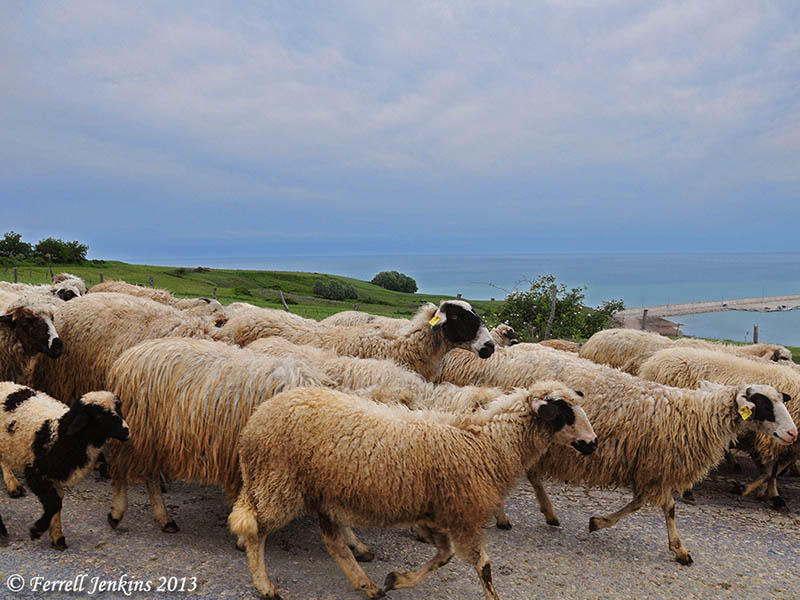
The photo below was made a few miles east of Sinope along the Black Sea (ancient Euxine). The territory is mountainous and the road is often far enough inland that the sea is not visible. Here the road runs along the sea, but still considerably above it. To the south, the mountains are much higher.

Sheep on the road east of Sinope, above the Black Sea. Photo by Ferrell Jenkins.

Sheep on the road east of Sinope, above the Black Sea. Photo by Ferrell Jenkins.

Nabatean town of Avdat restored

Avdat is located in the Wilderness of Zin, about 50 miles south of Beersheba. The beautiful ruins were vandalized about three years ago. Six different Israeli ministries invested nearly $2 million to repair the damage. The city has been designated by UNESCO as a world’s cultural heritage site.

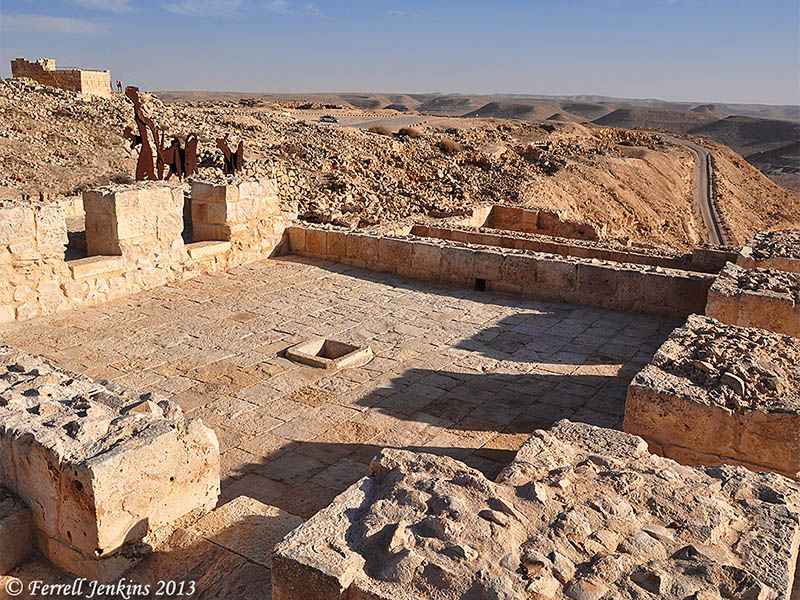
There are four wine presses at Avdat. The one I am showing below is a large Byzantine wine press.

Byzantine wine press at Avdat. Photo by Ferrell Jenkins.

Byzantine wine press at Avdat. Photo by Ferrell Jenkins.

Murphy-O’Connor describes the winepress.

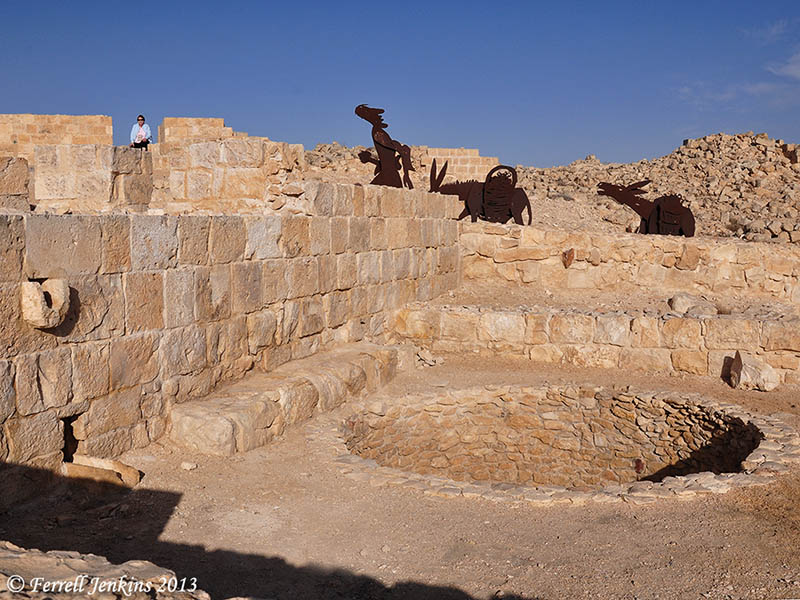
The winepress has a square treading area into which grapes were fed from small storage rooms on three sides. On the fourth side is a round pit into which the grape juice flowed via a channel under the treading floor from a central sump. – The Holy Land, 201.

The next photo shows the round pit.

The round pit into which the juice flowed. Photo by Ferrell Jenkins.

The round pit into which the juice flowed. Photo by Ferrell Jenkins.

I have never been able to take a group to Avdat, but I have made personal visits twice. See here and here.

For more information on the restoration see here.

The new Satellite Bible Atlas

Todd Bolen announced Monday the publication of the Satellite Bible Atlas. This new work is by Bill Schlegel, Associate Professor of the Bible at IBEX in Israel. Bill has lived and taught in Israel since 1984. He taught at the Jerusalem University College (formerly the Institute of Holy Land Studies) before joining The Master’s College IBEX program in 1995.

According to Bolen,

This resource is ready for personal use, classroom use, and field trip use. The author, Bill Schlegel, has been teaching college and seminary students in Israel for 25 years. Everything in the Satellite Bible Atlas is field-tested by a professor who knows God’s land and loves God’s Word.

He continues to give 7 additional reasons why he loves the Satellite Bible Atlas. I will leave it for you to read more details at the Bible Places Blog here.

sba2000c-t

I have had the opportunity for several days to see the various materials associated with the Satellite Bible Atlas, but late Monday I received my beautiful copy and have found it to be an amazing production.

After 17 pages of beautiful satellite maps, the additional maps are printed on one page with a brief, numbered, commentary on the opposite page. For example, looking at map 5-1, Samuel’s Ministry, we see a marked map of the portion of the land where Samson was born, and the places of his activity. Map 9-4 shows Jesus’ Move from Nazareth to Capernaum. Map 10-1 shows Acts of the Apostles in Israel. While the emphasis is on the Promised Land and the history of Israel, Jesus and the Early Church, there are maps showing the Journeys of Paul, The First Revolt Against Rome (c. 66-73 AD), the Bar Kochva Revolt, Jerusalem, the modern Middle East, etc. Eighty-five maps in all.

This beautiful book is published in Israel. I am surprised that the book is available for $30 plus tax and $3 shipping (in the U.S.). You will also be granted access to download the maps.

More information and ordering instructions are available here. Sample Maps, Commentary, Study Questions, and an Index to Sites, are available for download. There are also some Teaching Videos, and more are expected from time to time.

The Watchtower

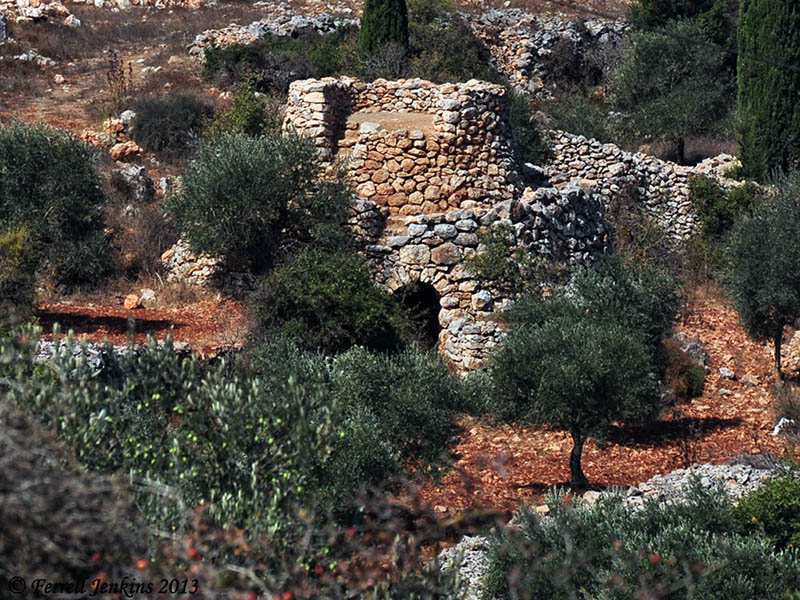
The watchtower was sometimes used as a lookout for the enemy (2 Chronicles 20:24; Isaiah 21:8; 32:14).

Watchtowers, or just towers, were also built in the fields. They might provide a place for a watchman to keep watch over the field (Isaiah 5:2; Matthew 21:33). Stones were picked up out of the fields to make the tower which also served as a place for workmen to go for shade in the heat of the day.

The only place we see watchtowers today is in the West Bank, and these are usually off the main roads. During the past few years I have photographed several of these old watchtowers. So far as I know they are no longer in use. I am sure that I have shown some watchtowers before, but I thought you might enjoy some of these new photos.

A watchtower in an olive orchard in the West Bank. Photo by Ferrell Jenkins.

A watchtower in an olive orchard in the West Bank. Photo by Ferrell Jenkins.

“Every man under his vine…”

A biblical way of describing a time of peace and prosperity is expressed in the following passage describing the time of King Solomon.

And Judah and Israel lived in safety, from Dan even to Beersheba, every man under his vine and under his fig tree, all the days of Solomon. (1 Kings 4:25 ESV)

It is not uncommon in the middle east to see vines used as a shade. Sometime the vine runs up the side of a house and covers a porch on the roof. When I saw this single vine by itself in front of the theater at Miletus I could not help but think of the biblical saying. I asked my traveling buddy, Leon Mauldin, to make a picture of me sitting under my vine.

I can imagine a person sitting under the vine in the late summer and enjoying the fresh grapes from the vine.

Miletus-theater_fj-vine_fjenkins072906_07t

Sitting under the vine at the theater of Miletus. Photo by Leon Mauldin.

Miletus is the city where the Apostle Paul met with the elders from the church at Ephesus as he returned to Jerusalem at the end of his third journey (Acts 20).

The prophet Micah used the same illustration to describe the nature of the Messiah’s kingdom.

It shall come to pass in the latter days that the mountain of the house of the LORD shall be established as the highest of the mountains, and it shall be lifted up above the hills; and peoples shall flow to it, 2 and many nations shall come, and say: “Come, let us go up to the mountain of the LORD, to the house of the God of Jacob, that he may teach us his ways and that we may walk in his paths.” For out of Zion shall go forth the law, and the word of the LORD from Jerusalem. 3 He shall judge between many peoples, and shall decide for strong nations far away; and they shall beat their swords into plowshares, and their spears into pruning hooks; nation shall not lift up sword against nation, neither shall they learn war anymore; 4 but they shall sit every man under his vine and under his fig tree, and no one shall make them afraid, for the mouth of the LORD of hosts has spoken. (Micah 4:1-4 ESV)

The land east of the Sea of Galilee

The land of Bashan is located east of the Sea of Galilee and the Hula Valley along the strip of land north of the Yarmuk River as far north as Mount Hermon. Bashan is mentioned no less than 60 times in the Hebrew Bible.

Og is designated as the king of Bashan about 20 times. Bashan is territory given to half of the Israelite tribe of Manasseh (Joshua 17:1). One of the cities of refuge was Golan in Bashan (Joshua 21:27).

Bashan was noted for its cattle, especially bulls (Psalm 22:12; Ezekiel 39:18). The prophet Amos calls the women of Samaria “cows of Bashan” (Amos 4:1). For sure, he was not a very popular prophet.

In recent history Bashan (Golan) was controlled by Syria, but was annexed by Israel in 1981.

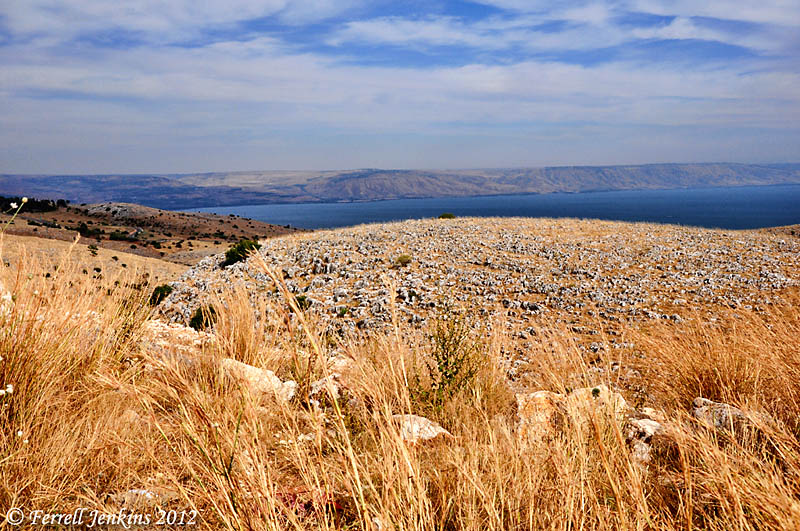
The photo below was made one afternoon as I approached the Sea of Galilee from the north. The view is to the southeast. The visible plateau on the east side of the Sea of Galilee is the southern part of the Golan Heights, the ancient land of Bashan.

The Sea of Galilee from the north. View toward Bashan in the east. Photo by Ferrell Jenkins.

The Sea of Galilee from the north. View toward Bashan in the east. Photo by Ferrell Jenkins.

In New Testament times the same territory, immediately east of the Sea of Galileee, and possibly a little south, was known as the land of the Gadarenes (Mark 5:1; Luke 8:26,37, KJV, NKJV), or the land of the Gergesenes in most modern English versions. These texts record the episode of the healing by Jesus of a man possessed with an unclean spirit. The unclean spirits entered into a herd of swine (pigs) and ran down the steep cliffs, visible in our photo, into the sea (Mark 5:11-13).