Category Archives: Archaeology

New insights into the clothing of the Qumran inhabitants

The recent edition of Dead Sea Discoveries has an article by Orit Shamir and Naama Sukenik on “Qumran Textiles and the Garments of Qumran’s Inhabitants.” The article costs $35 from Brill. To order click here. Here is the abstract.

Among the Qumran textiles that were kept at the Rockefeller Museum was a group of textiles that were unusual for Qumran. Most of them were made of wool, and some were dyed or decorated. Their marking QCC—Qumran Christmas Cave indicates their origin. In 2007 the cave was investigated by Porat, Eshel, and Frumkin. The cave is located in the bottom section of Kidron valley and doesn’t belong to Qumran caves. It can now be determined that all of the textiles from Qumran are made solely of linen. They were free of any colored decoration, except for scroll wrappers that decorated in blue. This, and the simplicity and whiteness of the textiles from Qumran, is compatible with the literary sources. It appears that the people of Qumran wished to differentiate themselves from the rest of the population also on the basis of their style of garments.

A popular article based on the technical paper appears in LiveScience here. Some speculation about the writers of the scrolls is based on the cloths found with the scrolls. Look also for an Image Album of 8 captioned photos including the textiles from Qumran and the Christmas Cave.

Most of the cloth wrappings found at Qumran were white and made of linen. The wrappings found at Christmas Cave were colorful and made of wool. The Mosaic law was clear about the clothing to be worn by the Israelites.

Do not wear clothes made of both wool and linen. (Deuteronomy 22:11 CSB)

Jodi Magness cites the War Scroll to illustrate that the “Qumran sectarian clothing must be made entirely of linen” (Stone and Dung, Oil and Spit, 116).

Most Bible students probably think of the Kidron valley running north to south between Jerusalem and the Mount of Olives. That is correct, except that the brook joins with the Hinnom valley and continues east to the Dead Sea.

The photo below was made about 4.25 miles south of Qumran along the Dead Sea Road (Hwy. 90) as it crosses the brook Kidron (Qidron). The Christmas Cave mentioned in the article is to the west (left) of the highway as the brook comes down from Jerusalem. (Click on the photo for a larger image.)
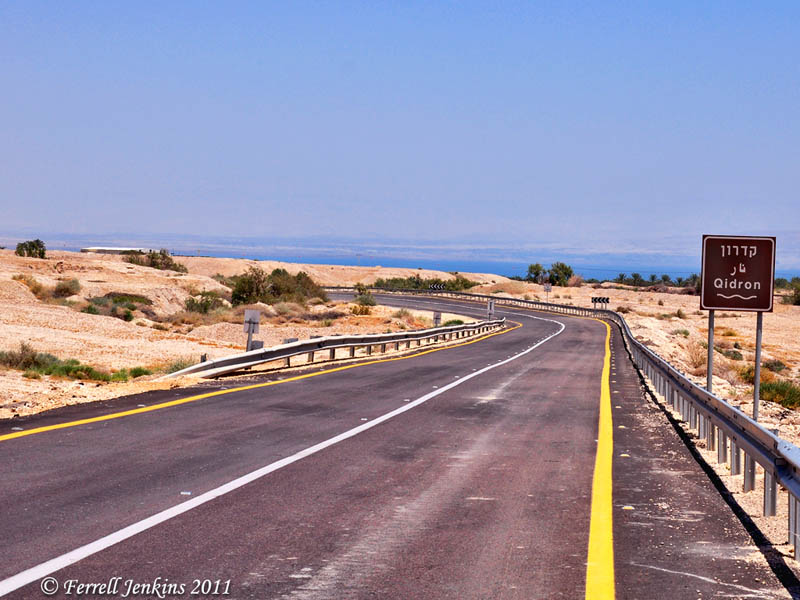
Location of the Brook Kidron on Dead Sea Road (view north). Photo by Ferrell Jenkins.

Crossing Brook Kidron on Dead Sea Road (view northeast). Photo by Ferrell Jenkins.

When David fled from Jerusalem at the time of Absalom’s rebellion, he crossed the Kidron “toward the way of the wilderness.”

Everyone in the countryside was weeping loudly while all the people were marching past. As the king was crossing the Kidron Valley, all the people were marching past on the road that leads to the desert. (2 Samuel 15:23 CSB)

HT: Joseph I. Lauer
Photos that are worth 1000 words each

Photos can be used effectively to illustrate Bible lands and customs. Otherwise dull presentations can come to life with the use and explanation of appropriate photos.

Pictorial Library of Bible Lands. We have suggested frequently that every Bible teacher needs access to Todd Bolen’s Pictorial Library of Bible Lands. Todd publishes a Newsletter every few months in which he gives away a few excellent photos already in PowerPoint format. If you don’t receive the Newsletter I suggest you download the November issue here. It contains several panoramic photos that give you the opportunity to see and understand a lot at once. And while you are there you should sign up to receive the Newsletter when it is published. Also take a look at the BiblePlaces Blog and the BiblePlaces.com web site. See also LifeintheHolyLand.com. BiblePaces is now availabe in French at BibleLieux.com and Spanish at LugaresBiblicos.com.

Holy Land Photos. Carl G. Rasmussen, author of the revised Zondervan Atlas of the Bible, is now posting the photos used in the Atlas at his Holy Land Photos site. Begin here. You will find thousands of useful photos at this site. These photos will be especially helpful to those seeking to teach Bible geography or to incorporate geographical information into lessons. These photos are in PowerPoint format. You also need the have and study the Atlas. Also check the HolyLandPhotosBlog for more recent photos and updates.

Order the Zondervan Atlas of the Bible from Amazon (currently $26.12).

David Padfield has a large number of photos of Bible lands available for free download here. Thanks to these men who have devoted much time and money to acquiring the photos and preparing them for others to use. I have used the work of all three in my presentations in recent years.

New religious finds from Khirbet Qeiyafa

Luke Chandler shares some photos sent to him by Prof. Yossi Garfinkel. Luke says,

Yossi Garfinkel recently presented finds from a cultic room unearthed at Khirbet Qeiyafa in 2010. He sent me some photos for this blog just before his presentation in Jerusalem. They are shown here with his permission.

Luke gives his own summary of what is currently known of Khirbet Qeiyafa.

It was a planned fortress city constructed around the beginning of the 10th century B.C. – the time of David’s monarchy in the Bible. It sits at the border of ancient Judah and Philistia along the Elah Valley, where David fought Goliath in 1 Samuel 17.

Chandler then enumerates a summary of six reasons why the site should be considered part of Judah.

Read Luke Chandler’s Blog and see Prof. Garfinkel’s photos here.

View SE over Valley of Elah toward Socoh from Kh. Qeiyafa. Photo by Ferrell Jenkins.

View SE over Valley of Elah toward Socoh from Kh. Qeiyafa. Photo by Ferrell Jenkins.

I prepared the above material Saturday evening with the intention of posting it on Sunday morning. It was a bit surprising this morning to note that Joseph Lauer calls attention to Luke’s blog. He does so as a foreword to an article in the Huffington Post here by Douglas Knight and Amy-Jill Levine. If you have wondered how liberal scholars deal with biblical history, this is your opportunity to see.

Making your enemies your footstool

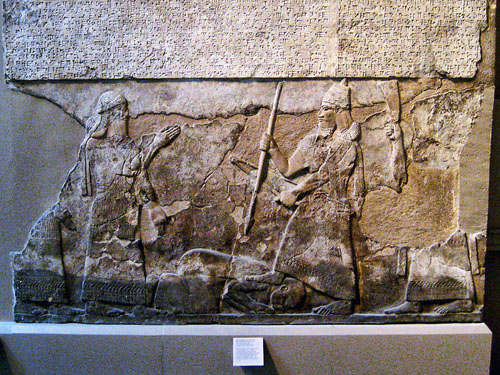
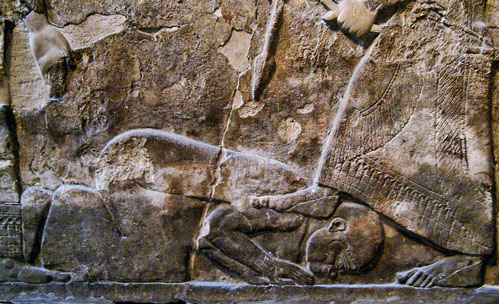
A common motif found in Ancient Near East reliefs shows a monarch placing his foot on his enemy. One illustration of this is the large relief showing the Assyrian King Tiglath-Pileser III (reigned 745-727 B.C.) with his foot on the neck of an enemy. Tiglath-Pileser III is known as Pul in the Bible.

Pul king of Assyria invaded the land, and Menahem paid him a thousand talents of silver to gain his support and to solidify his control of the kingdom. (2 Kings 15:19 NET)

So the God of Israel stirred up King Pul of Assyria (that is, King Tiglath-pileser of Assyria), and he carried away the Reubenites, Gadites, and half-tribe of Manasseh and took them to Halah, Habor, Hara, and the river of Gozan, where they remain to this very day. (1 Chronicles 5:26 NET)

The Assyrian relief below is displayed in the British Museum.

Tiglath-Pileser III Subjugates an Enemy. British Museum. Photo by Ferrell Jenkins.

Tiglath-Pileser III Subjugates an Enemy. British Museum. Photo by Ferrell Jenkins.

Here is a closeup of what we are seeking to illustrate.

Tiglath-Pileser III Puts His Foot on Neck of Enemy. British Museum. Photo by Ferrell Jenkins.

Tiglath-Pileser III Puts His Foot on the Neck of an Enemy. BM. Photo by Ferrell Jenkins.

Several biblical passages come to mind in this connection.

When they brought the kings out to Joshua, he summoned all the men of Israel and said to the commanders of the troops who accompanied him, “Come here and put your feet on the necks of these kings.” So they came up and put their feet on their necks. (Joshua 10:24 NET)

Here is the LORD’s proclamation to my lord: “Sit down at my right hand until I make your enemies your footstool!” (Psalm 110:1 NET)

Peter quotes Psalm 110:1 to show that Jesus is now seated on the throne of David at the right hand of God (Acts 2:35).

And Paul says,

For he must reign until he has put all his enemies under his feet. (1 Corinthians 15:25 NET)

The last enemy is death (1 Corinthians 15:26).

Not much remains at Capernaum

Capernaum, on the northern shore of the Sea of Galilee, played a significant role in the ministry of Jesus. The town became the Galilean center for the ministry of Jesus.

And leaving Nazareth he went and lived in Capernaum by the sea, in the territory of Zebulun and Naphtali, (Matthew 4:13 ESV)

The aerial photo below was made on approach to Capernaum from the east. The site most visited by tourists may be seen left of the center of the photo. You may recognize the new church and the ruins of the synagogue. This property is owned by the Franciscans. To the right you will see the Greek Orthodox Church and the property they own. Evidence of some excavations may be seen.

There is not much remaining of ancient Capernaum. This is not surprising in light of the pronouncement of Jesus.

And you, Capernaum, will you be exalted to heaven? You will be brought down to Hades. For if the mighty works done in you had been done in Sodom, it would have remained until this day. (Matthew 11:23 ESV)

Aerial View of Capernaum. Photo by Ferrell Jenkins.

Aerial View of Capernaum. Photo by Ferrell Jenkins.

Ritual bath discovered at biblical Zorah

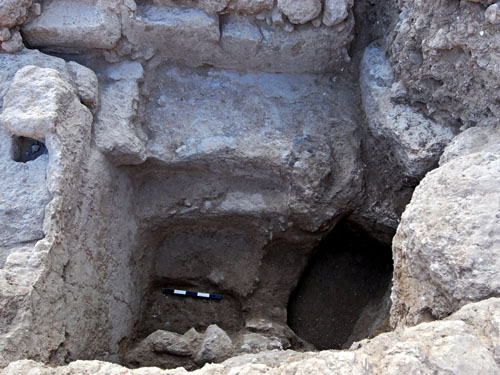
A report today from the Israel Antiquities Authority announces the discovery of a Second Temple Period ritual bath. This means the Herodian Temple that was standing at the time of the ministry of Jesus. Many Bible students think of the Herodian Temple as the Third Temple.

  1. Solomon’s Temple (built about 966 B.C.). Destroyed in 586 B.C. by the Babylonians.
  2. The post-Babylonian Exile temple built 520-516 B.C. This temple fell into decay and was rebuilt and vastly enlarged by Herod.
  3. Herod’s Temple (begun about 19/20 B.C. Destroyed in A.D. 70 by the Romans.

Archaeologist Pablo Betzer, excavation director on behalf of the Israel Antiquities Authority, said,

“This is the first time that any remains dating to the Second Temple period have been exposed in this region. We knew from the Talmud and from non-Jewish sources that on this ridge, as in most of the Judean Shephelah, there was an extensive Jewish community 2,000 years ago that existed until the destruction of the Temple in 70 CE. Yet despite the many surveys and excavations that have been carried out to date no remains from this period have been discovered so far”. According to Betzer the name of the Jewish settlement that the ritual bath belonged to is still unknown.

Second Temple Mikveh from Zorah. Photo by Assaf Peretz, courtesy IAA.

Second Temple Mikveh from Zorah. Photo by Assaf Peretz, courtesy IAA.

Zorah is know to Bible students as the area of Samson’s birth and activity (Judges 13-16). Manoah, Samson’s father, was a Danite from Zorah (Judges 13:2).

Questions about purification were common during the ministry of John and Jesus. This is the “Second Temple” period.

Now a discussion arose between some of John’s disciples and a Jew over purification.  (John 3:25 ESV)

The NET Bible uses the phrase “ceremonial washing” instead of “purification.”

The full press release may be read here.

HT: Bible Places Blog.

Monday Meandering — October 10

More about Paul’s Shipwreck on Malta. Gordon Franz reviews Robert Cornuke’s recent video on the claimed evidence for the shipwreck.  The review is available at the Associates for Biblical Research site here, or Gordon’s Life and Land blog here.

Gordon also exposes the photos purporting to show giant human skeletons from Greece here.

Shiloh. Leon Mauldin wrote about our recent visit to Shiloh here, here, here. The tabernacle was located at Shiloh for many years after ancient Israel came into the promised land. See Joshus 18; 1 Samuel 1-4, et al.

Recent excavations at the base of Tel Shiloh. Photo by Ferrell Jenkins.

Recent excavations at the base of Tel Shiloh. Photo by Ferrell Jenkins.

Jezreel Excavation. A well-trained team of archaeologists, headed by Norma Franklin and Jennie Ebeling, announces renewal of excavations at Jezreel. Details here.

The new website describes the importance of the location of Jezreel.

We are returning to Jezreel because it is an amazing site with a long history that reflects the rich cultural heritage of the area

Perched on the foothills of the Gilboa mountain range it commands an unparelled view over the valley below. The famous sentry site of Megiddo, Biblical Armageddon, lies 15 kms to the west and to the east the renowned city of Bet Shean (Scythopolis).

Reliability of the New Testament Manuscripts. Barry Creamer comments on the “debate between Bart Ehrman and Daniel Wallace on whether the text of the New Testament is trustworthy. Both are world class scholars in textual criticism.” Some interesting comments on the different approach taken by the two textual critics to the problem of no original manuscripts. Read here.

HT:  Bible Place Blog; Bible X.

Lecture on Khirbet Qeiyafa — the Elah Fortress

The Lynn Wood Archaeological Museum announces a lecture by Dr. Michael G. Hasel about Khirbet Qeiyafa, also known as the Elah Fortress.

On Wednesday, October 12, Dr. Michael G. Hasel, professor of Near Eastern Studies and Archaeology at Southern Adventist University, will be sharing  the latest archaeological discoveries from the biblical site of Khirbet Qeiyafa. Recent trends in archaeology have questioned the historicity of David and Solomon’s Kingdom. Since 2009, Southern Adventist University has been uncovering the remains of this city-fortress dating to the time of King David. The discovery of this biblical city is a powerful argument for the reliability of the biblical account. The lecture will be held at 7 p.m. in Lynn Wood Auditorium on the campus of Southern Adventist University, 4960 Industrial Drive, Collegedale, TN. The Lynn H. Wood Archaeological Museum Lecture Series is free and open to the public.

For more information check the Museum website here.

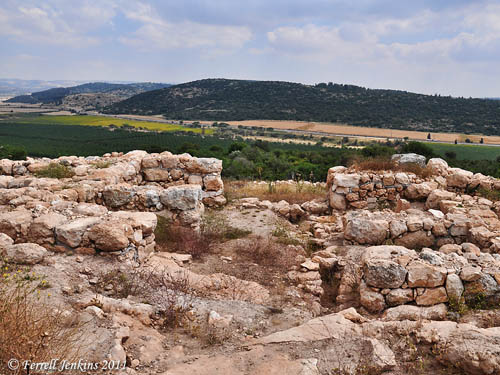
The photo below is one I made in September showing Khirbet Qeiyafa clearly visible on the hill above the Valley of Elah. A copy of the photo suitable for use in teaching is available by clicking on the image.

View of Khirbet Qeiyafa from across the Valley of Elah. Photo by Ferrell Jenkins.

View of Khirbet Qeiyafa from across the Valley of Elah. Photo by Ferrell Jenkins.

It was in the Valley of Elah where the conflict between David and Goliath took place (1 Samuel 17). The brook of Elah lies in the valley below the fortress.

The water system at Gezer

Water is necessary for life. Much has been learned about the provisions made for water in the cities of the biblical world. We know about the tunnels dug to bring water into the city at Hazor, Megiddo, Gibeon and Jerusalem, and about the well at Lachish.

For many years we have known about the water tunnel at Gezer. Now, as a result of the current Gezer Water System Expedition, new information is coming to light about the water system there. This project is a joint effort of New Orleans Baptist Theological Seminary and the Israel Nature and Parks Authority.

I appreciate this comment by Dan Warner, associate professor of Old Testament and Archaeology at NOBTS:

“The research at Gezer is important to Baptists because of our commitment to understand the Bible within its historical context,” Warner said. “Any information we can gain to give better insights into the cultures of the biblical world helps us interpret the Bible.

“Most think of the Canaanites as an old, rustic culture — not so,” Warner noted. “Digging the water system took great technical and hydraulic skill. This was a very advanced and sophisticated culture that had pronounced impact in biblical times.”

A news release from NOBTS says,

It is believed the Canaanites cut the massive tunnel around the time of Abraham using flint tools. Measuring nearly 13 feet wide by 24 feet high at the opening and stretching 150 feet into the ground at a 38 degree slope, the Gezer tunnel is the largest ancient water system ever unearthed.

Late in the last week of the 2011 dig, the NOBTS team found the natural cave at the end of the massive rock-hewn water system — the prime objective of this season’s dig. It is believed that the system’s original water source is located in or near the opening of the cave.

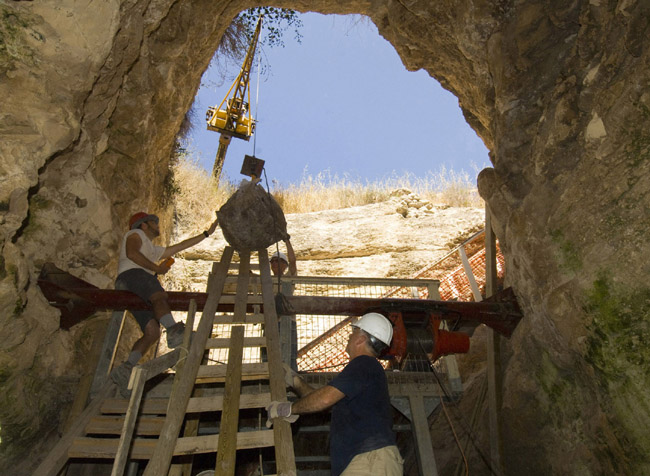
Two reports on the recent work may be read here. Here is one of the photos available with the reports.

Gezer Water System

Excavating the Gezer Water System. Photo by Art Beaulieu. Courtesy BP & NOBTS.

The photo below is an aerial shot that I made in December, 2009. This shows the massive Canaanite wall and the entrance to the water system to the right of center in the photo. The path goes down into the shaft that is now being excavated.

Aerial view of the Canaanite Wall and Water System at Gezer. Photo by Ferrell Jenkins.

Aerial view of the Canaanite Wall and Water System at Gezer. Photo by Ferrell Jenkins.

We included an aerial photo of Tel Gezer suitable for use in presentations here. From that same post we summarized the biblical information about Gezer.

  • The king of Gezer fought against Joshua and the Israelites during the conquest (Joshua 10:33; 12:12).
  • Gezer was allotted to Ephraim (Joshua 16:3).
  • Gezer became a city of the Levites (Joshua 21:21). It was designated as a city of refuge (1 Chronicles 6:67).
  • Israel failed to drive out the Canaanites who lived in Gezer (Joshua 16:10; Judges 1:29).
  • By the time of David the Philistine seem to be living at Gezer (2 Samuel 5:25; 1 Chronicles 14:16; 20:4).
  • Pharaoh, king of Egypt, captured Gezer, burned it, and gave it as a dowry to his daughter, Solomon’s wife (1 Kings 9:16).
  • Solomon (re)built the cities of Hazor, Megiddo, and Gezer (1 Kings 9:15-17).

The excavators are looking for volunteers for the 2012 season. This provides a good chance to do the kind of work you hire someone else to do at home. 🙂

Update: I failed to call attention to the web site of the Center for Archaeological Research at NOBTS here, and Can You Dig It? archaeology blog here. Under PHOTOS you will find a large gallery of photos and videos of the recent excavation.

HT: Joseph Lauer

A day in the West Bank

There was a time that it was easy to visit sites in the Palestinian West Bank. That is no longer true. Car rental companies will not permit their cars to be taken into the West Bank. We hired a driver and vehicle (4WD) to take us several places. I think we were fortunate to obtain the services of a tourist bus driver who happened to have a day free. Even for him going into the West Bank was not easy.

First it is necessary to choose the appropriate border crossing. Then instead of taking what formerly was the most direct route drivers must go in circles to avoid running into the fence (or wall). This is especially true near Jerusalem.

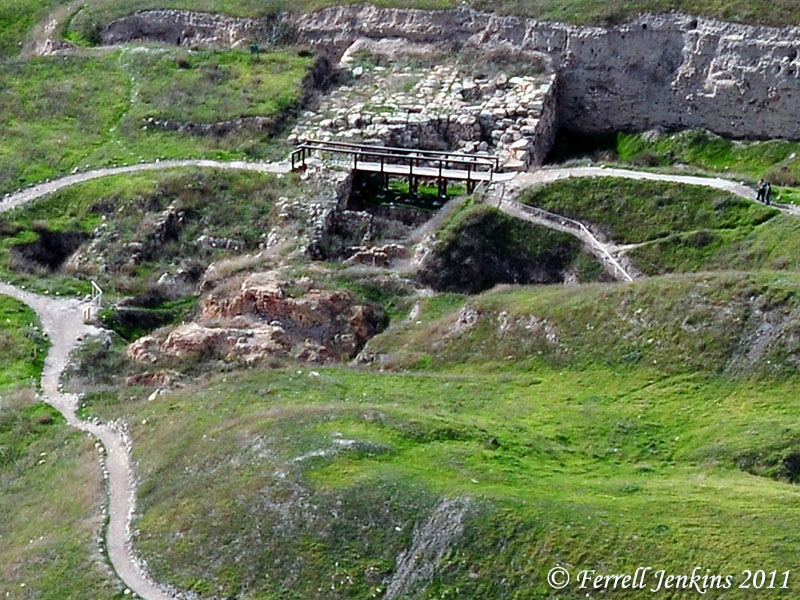
Our first stop was Gibeon (Joshua 9-10). The last time I was there to see the excavations by James Pritchard of the University of Pennsylvania I drove directly to the ruins. This time it was extremely difficult to reach the same ruins. We were successful in our efforts and got some good photos that we hope to share later.

We also stopped at Shiloh where the tabernacle was set up after the ancient Israelites entered Canaan  (Joshua 18:1). A team from the Israel Antiquities Authority was excavation in three different areas low on the tel in areas mostly from the Islamic and Byzantine period.

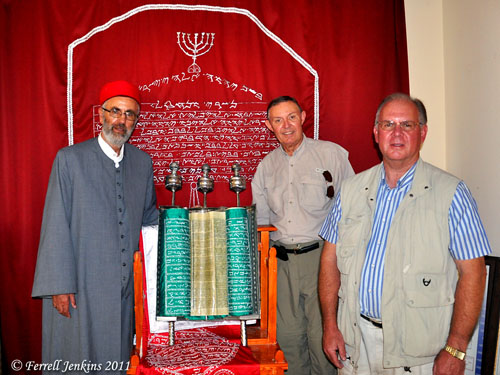
Next we went to Mount Gerizim to visit the Samaritans Museum. Husney W. Cohen, a priest and director of the Museum, was kind to show us around and explain the Samaritan viewpoint about several biblical events. Samaritans believe the temple was to be built on Mount Gerizim rather than Jerusalem. They think Abraham offered Isaac on the mountain. They accept only the first five books (the Pentateuch) of the Old Testament. In this photo you see Cohen, myself, and Leon Mauldin with the ancient scroll. This scrolls look to be much newer, or better preserved, than the old one I photographed many years ago (here).

wSamaritan Scroll at Mount Gerizim

Samaritan Scroll at Mount Gerizim. Husney W. Cohen, Ferrell Jenkins, Leon Mauldin.

I understood Husney W. Cohen to say that he was third in line to become the High Priest of the Samaritans.

We had hoped to visit the archaeological work on Mount Gerizim, but it was closed due to some construction.

We made a short stop at Jacob’s well (John 4). Then we visited the new Tel Balata Archaeological Park. Tel Balata is the site of biblical Shechem (Genesis 12:1). While in Nablus we also made a short stop at the traditional Tomb of Joseph (Joshua 24:32).

We left the central mountain rain through Wadi Farah (now called Wadi Tirza by the Israelis.   We were short on time and did not try to stop at Tirza (1 Kings 15:33). The springs that once flowed through the valley are now practically dry. I understand this is because the water is being piped away by Israel for use by the settlements.

We stopped at Jericho and made a visit to Tell es-Samarat (the site of Herod’s hippodrome) and Herod;s Palace (Matthew 2). New signs have been erected to point to these places, but the roads to them are terrible. The sites are in terrible condition and there are no explanatory signs.

In the future we hope to show some photo of some of these places.