Category Archives: Archaeology

Archaeologist pushes for a park at Carchemish

The ancient site of Carchemish (modern Karkamiş in Turkey) was identified by George Smith in 1876, and later excavated by the British Museum beginning in 1911. The various directors included Hogarth, Thompson, Wooley, and Lawrence. Many remains of Assyrian and Neo-Hittite periods were uncovered.

Carchemish is mentioned only a few times in the Bible, but it was one of the most significant cities in the ancient Bible world.

  • Isaiah made a reference to Carchemish (Isaiah 10:9). The city had been sacked by Sargon II in 717 B.C.
  • Pharaoh Necho of Egypt went up to Carchemish on the Euphrates to assist the Assyrians against the Babylonians in 609 B.C. (2 Chronicles 35:20; Jeremiah 46:2). King Josiah of Judah tried to stop him, but was killed.

One of the Babylonian Chronicles says that Nebuchadnezzar “crossed the river to go against the Egyptian army which lay in Carchemish.”

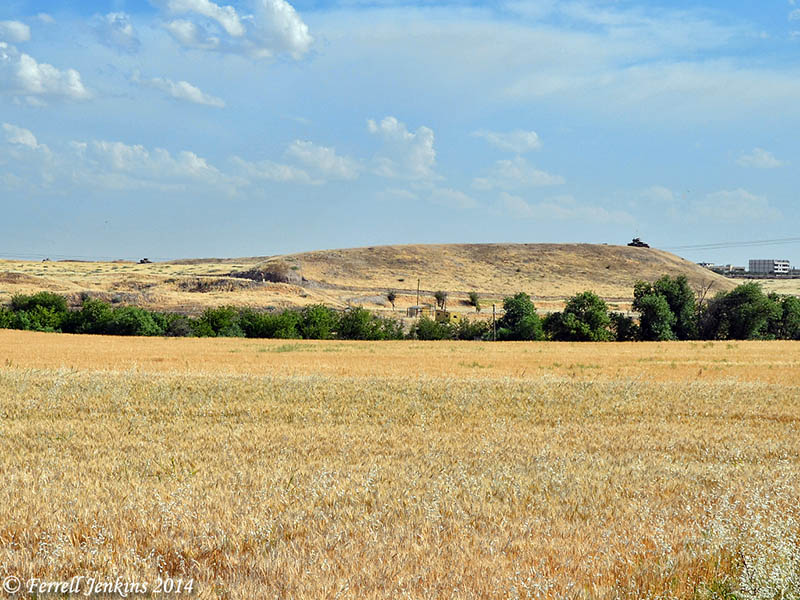
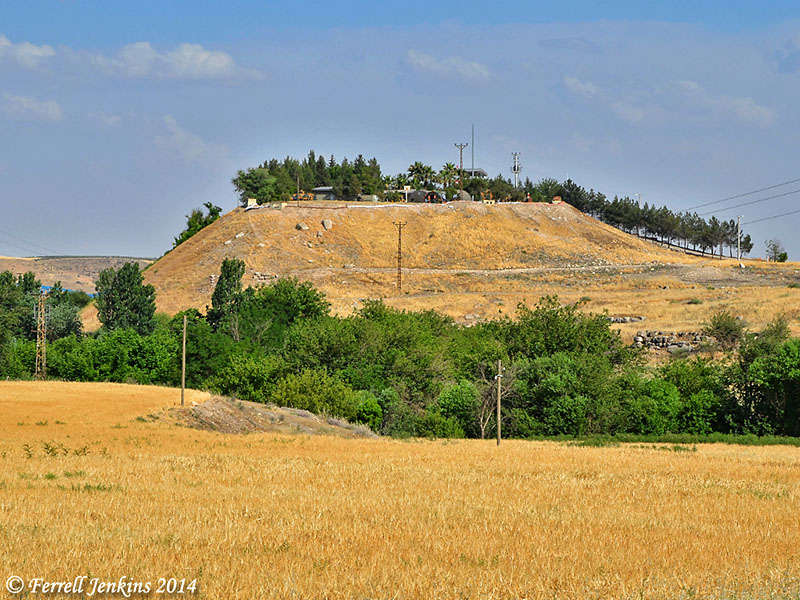
The tell (mound) at Carchemish consists of a smaller high mound and a larger lower mound. Hazor, in Israel, would be a similar site. The first photo shows the higher mound which is immediately north of the Turkish border with Syria. The Turkish military is making use of the tell. On the left side of the tell, above the trees you will see a blue metal structure. That is the bridge crossing the Euphrates River. Part of the ancient city is now within Syria. On the right side of the photo above the lower trees you will see portions of ancient walls.

Carchemish is now used by the Turkish military. Photo by Ferrell Jenkins.

Carchemish is now used by the Turkish military. Photo by Ferrell Jenkins.

Professor Nicola Marchetti of Bologna University in Italy has been heading a new excavation on the lower tell. Last year Marchetti announced plans to build a new archaeological park at Karkamiş. Monday he made a new call for the opening of the park and a museum to display artifacts from the site.

He said establishing an archaeology park in the ancient city would draw many tourists to the region.

The most important areas in the excavations are a lower palace and a lower city, which they had unearthed two years ago, and there were two temples in this area, said Marchetti, adding the most important stage of the excavations would be finished this year.

See the article in Hurriyet Daily News here. (HT: Bible Places Blog).

A few weeks ago we were able to get close to the ancient site, but was not able to visit the excavation. In the photo below you will see a military tank on top of the lower tell near the recent excavations. The high tell is immediately to the left.

Lower tell of Carchemish. Photo by Ferrell Jenkins.

Lower tell of Carchemish. Photo by Ferrell Jenkins.


Mark Wilson speaks to group in Antalya

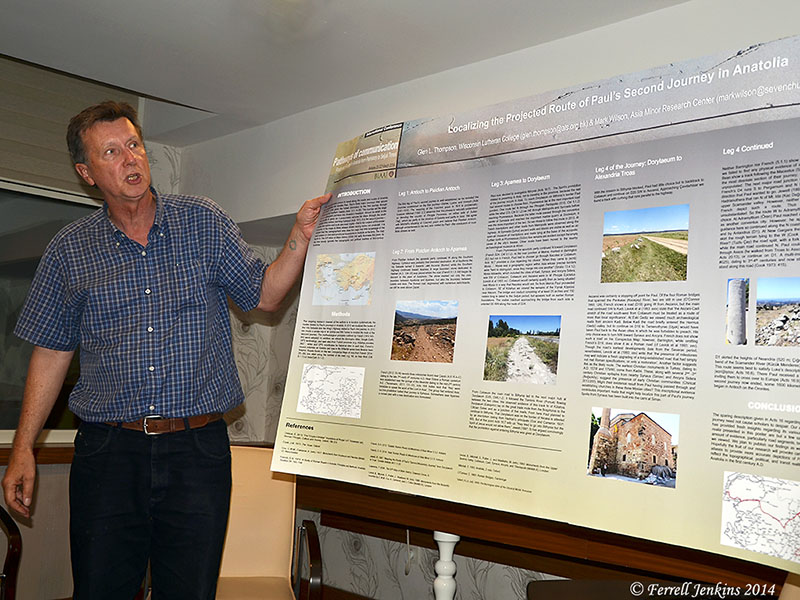
Dr. Mark Wilson shared a meal with us at the hotel one evening in Antalya, Turkey. After dinner Mark spoke to the group about his work in Turkey. He is the founder and director of the Asia Minor Research Center, and spends most of each year working and doing research in Turkey. He has updated several of the works of Sir William M. Ramsay, and written several helpful books on the book of Revelation. You will find much helpful material by Dr. Wilson on the Seven Church Network web site.

Our tour group heard a brief preview of the presentation Dr. Wilson plans for one of the upcoming annual professional biblical studies meetings in San Diego, California. He has been working on discovering the projected route of Paul’s Second Journey in Anatolia based on the biblical text, known roads, milestones, etc. from the first century. This was ideal for our group who had just completed a tour visiting all of the sites associated with Paul’s First Journey in Anatolia (modern Turkey).

Dr. Mark Wilson speaks about the route of Paul's second journey. Photo by Ferrell Jenkins.

Dr. Mark Wilson speaks about the route of Paul’s second journey in Anatolia to a tour group in Antalya, Turkey. Photo by Ferrell Jenkins.

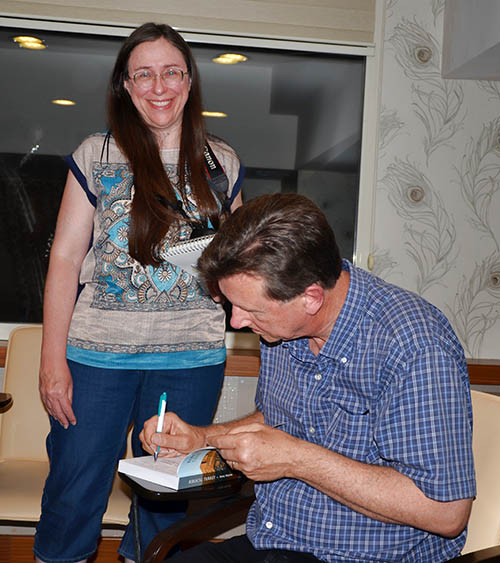
We were pleased to see Dr. Wilson’s book, Biblical Turkey: A Guide to Jewish and Christian Sites of Asia Minor, available in many of the museum books stores including the Istanbul Archaeological Museum. Many of our tour members who did not already have a copy of the book got one from Mark after the presentation. You may purchase a copy from Amazon by clicking on the title above.

Tour members were delighted to have their book autographed by the author.

Dr. Wilson autographs a copy of Biblical Turkey for Stacy. Photo by Ferrell Jenkins.

Dr. Wilson autographs a copy of Biblical Turkey for Stacy. Photo by Ferrell Jenkins.

JERUSALEM in IMAX

Friday morning my wife and I joined three Biblical Studies faculty from Florida College, and a handful of other people, in the MOSI IMAX giant screen theater in Tampa to see the National Geographic Entertainment presentation of JERUSALEM.

The original producers of this film have been promoting it for several years, as you can see from the video that we posted nearly three years ago here. The current production is about 45 minutes in length. The thing that really makes the difference is the IMAX giant screen presentation.

JERUSALEM features three young ladies representing the three religions claiming Jerusalem as the home of their origin: Judaism, Christianity, and Islam. The girls guide the viewers through the crowded, winding streets of the Old City to the various religious sites of the city. There are a few scenes in other parts of the country: Capernaum, Caesarea Maritima, Joppa, Masada, and the Dead Sea. The only scholar represented in the film is Dr. Jodi Magness. She provides informed commentary about the archaeology of Jerusalem, but it is limited. Views of the Givati garage excavation are shown, but no historical context is provided.

For my part, the hoards of people scurrying through Damascus Gate, or to the Church of the Holy Sepulchre, or to the Western Wall is overdone. The three young ladies who serve as guides almost come face to face in one scene, but admit that they still know very little about one another.

The best feature of the film (not shown at all in the video below), is taking ruins that remain and building reconstructions of the city in biblical times. One scene begins at the corner of the temple mount at Robinson’s Arch and builds into a model of the the biblical temple.

I don’t know if the film will be shown in Tampa, but it is showing in several cities. A full list, and other info about the film, is available here.

Jerusalem | Filmed in Imax 3D from JerusalemGiantScreen on Vimeo.

Having spent much time walking in the old city and viewing it from above, I knew where I was (in the film), but I am not sure that those who have little or no acquaintance with the city will find it anything but confusing.

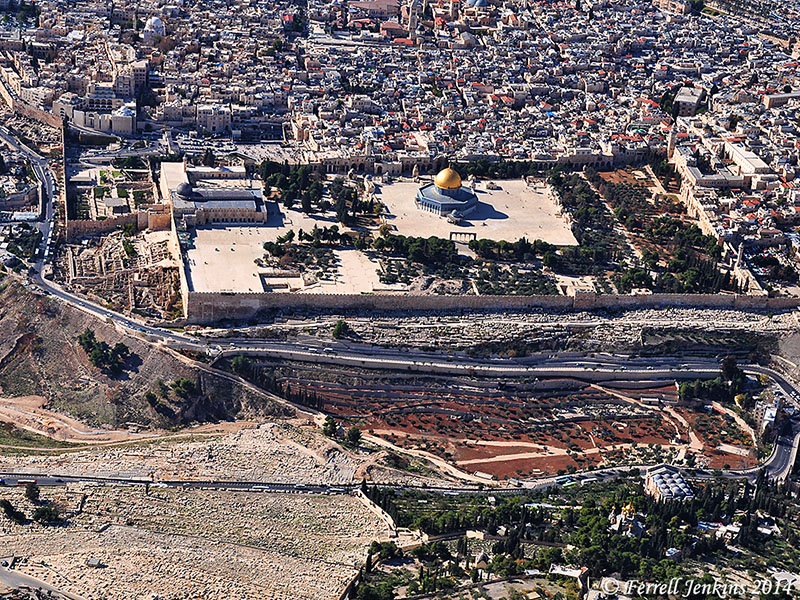
The aerial photo below was made from the east. It shows the western slopes of the Mount of Olives, the Kidron Valley, the Temple Mount, and a portion of the Old City buildings.

Aerial view of Jerusalem from the east. Photo by Ferrell Jenkins.

Aerial view of Jerusalem from the east. Photo by Ferrell Jenkins.


Choosing a guide; Losing a guide and friend

During my first two or three tours I remember guides asking if I had been “here” before. Actually I have had guides that made up answers to things they did not know, but I did not use them again. Finding and keeping a good guide became an important part of planning a good tour. In the comments to follow I will limit myself to Israel.

My first tour was a few weeks prior to the Six-Day War in 1967. The Old City of Jerusalem and the West Bank were still part of the Hashemite Kingdom of Jordan. We crossed from Jordan into Israel through the Mandelbaum Gate. Today the Grand Court and Olive Tree hotels stand nearby. After the war I continued to use Arab guides, all of whom would designate themselves as Christian (usually Lutheran or Greek Orthodox). My two favorite guides for many years were John and Anise. Both were knowledgeable in the events of Scripture and the places of these events. And both of them were good in handling a group. As these men reached the time of their retirement I had to scurry to locate other guides. One year all of the young Arab guides were called in for training by the Israelis. I had a Jewish young lady who had led only two tours prior to mine. I had to do a lot to help her with the group and the information.

In the mid-80s I began to listen in on other guides when visiting various sites. I looked for someone who was knowledgeable in the Bible and the history of the sites. I wanted someone whose English would be understandable to visitors from the United States. I would introduce myself to guides I though might be good with my groups, and we would exchange cards. I needed someone who knew the land and the book, and who was informed in archaeological matters.

In looking through old group photos I find two guides that begin to dominate. Eliemelech Ben Meir was my guide in 1994, but I see Yehuda Guy in some of the photos as late as 1998. I liked both men, and we worked together well I thought. They were both willing for me to make additional comments and explanations for the benefit of the group.

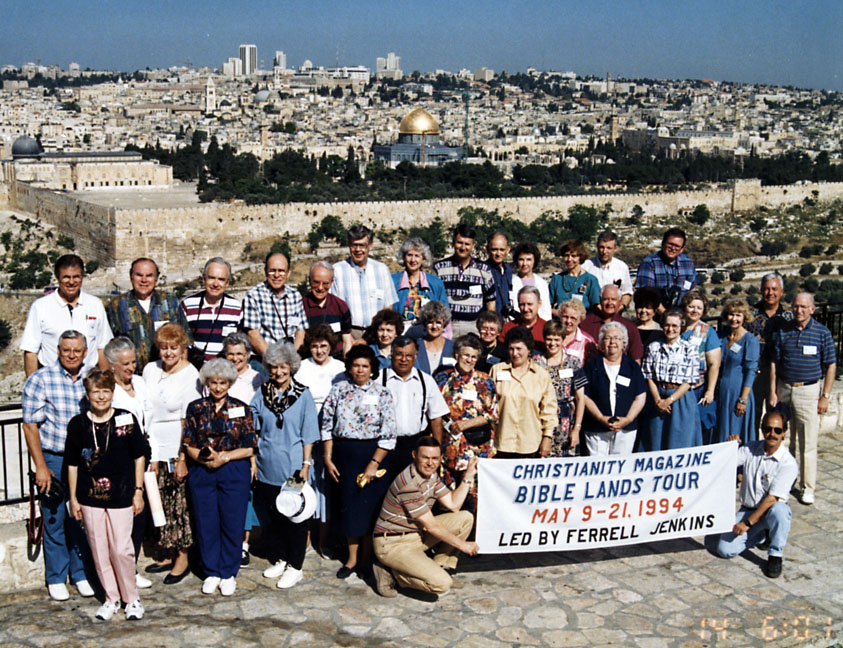
In looking through old group photos, the first photo I find with Elie Ben Meir is a tour twenty years ago in May, 1994. Elie is helping me hold the tour banner. I see that Yehuda continued to guide some groups for a few years. Some years I had two tours to Israel. Eventually it was also Elie guiding some tours. Elie told me that he was introduced to me by my Arab guide Anise whose health was failing.
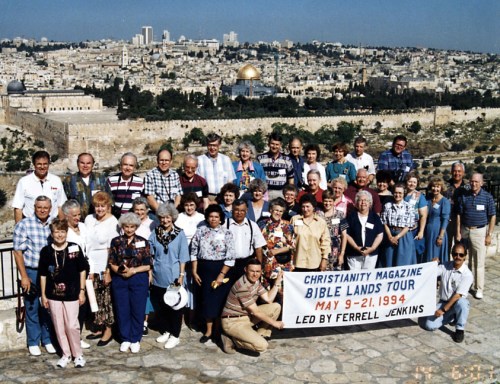
Ferrell Jenkins 1994 group with Elie Ben Meir.

1994 Group with Elie Ben Meir.

Over the past twenty year period Elie and I became good friends. In addition to the group tours I have made several personal study tours to Israel. Almost always I would be in touch with Elie. He brought his wife Maxine and the young daughters Adi and Danya to have dinner with the group in 2000. From year to year I would see them grow into beautiful young ladies. (I have a few digital photos made on a Sony camera that used a 3½ inch floppy drive, but the quality is too poor to use.)

Elie was not what we might call a “religious” Jew. He told me that on his first visit to Israel he stayed at a “religious kibbutz,” but by the time that stay ended he decided he would not be “religious.” Elie and Maxine wanted their girls to learn the Jewish customs, but bacon from the Armenian butcher would not be uncommon on a weekend morning. Some of the members of my groups would ask me how could Elie know the Bible so well and not be a Christian.

Elie’s family lived mostly in the Cleveland, Ohio, area. When he visited his mother or sister he would give me a call and talk a while. During the mid-2000s I told Elie about my mother who was suffering from Alzheimer’s Disease. Then the time came when Elie wanted to talk with me about a similar condition his mother was enduring. His trips to the USA became more frequent to assist his siblings in the care for her. I ferried items that Elie or his family needed from the USA to Israel − some special hair-care product for the girls or some beef jerky for the family. Even when I stayed over to visit sites I had not yet been to, Elie and one or both girls would come to the hotel and eat with me.

Elie enjoyed Bluegrass Music. Sometimes, as we drove away from the Tel Aviv airport at the beginning of a new tour he would ask, “Does anyone in the group play Bluegrass?” He kept his guitar in the storage area under the bus so he could pick a little in the evening at the hotel.

On Elie’s last trip to the USA he went to Cleveland to visit family. He left me a call on May 7, but I was already in Turkey by that time and did not receive the call until May 30. On the same day he sent me an Email with this heading and message.

Adi Meyerson, bass | Spring ’14 Ensemble & Recital Series | New School Jazz – New York City – The New School.
Hey Ferrell!
In case you happen to be in NY City!
Hope you and Elizabeth are well!
Sincerely,
Elie
http://events.newschool.edu/event/adi_meyerson_bass_spring_14_ensemble_recital_series_new_school_jazz#.U2rftO29Kc2

Elie was really on his way to NYC to hear his daughter perform. He had sent me other clippings about her.

By May 14 Barry Britnell was forwarding Emails that he received from Maxine because Elie was to be Barry’s guide in early June. She wrote,

There has been a tragedy and Elie had a serious stroke on Sunday night and is now in hospital in Cleveland in critical condition.

I was also receiving updates from Susan who was in touch with Elie’s sister Lynne in Cleveland. Elie had been having headaches for a few days when Lynne took him to the hospital. At some point he had a stroke. By May 18 the outlook did not seem good. Maxine sent Barry, John Barnett (I have not met John, but Elie always spoke highly of him), and me the following Email on May 24th.

So sorry to have to bring you the sad news that Elie passed away on Friday night 11:30pm. He died peacefully with all his siblings, daughters and myself by his side. Much love to all
Maxine

The complete obituary from the Cleveland Plain Dealer reads as follows:

MEYERSON ELIE MELECH BEN MEIR (MALCOLM MEYERSON), beloved husband of Maxine (nee Rabinowitz). Loving father of Adi and Danya. Dear brother of Jay (Jacquie) Meyerson, David (Honey) Meir-Levi, Lynne (Jacob) Meckler. Cherished son of Evelynne and the late Bernard Meyerson. Graveside services will be held Sunday, May 25 at 11:30 a.m. at the Mt. Sinai Cemetery, (SOM Center and White Rd.), Mayfield Village, OH. Family will receive friends at the residence of Jacquie and Aaron Meyerson,… SUNDAY FOLLOWING SERVICES UNTIL 8 P.M.

Elie had a number of qualities that were admirable. He was always ready to recommend the businesses of Moslems and Christians that he thought were honorable people. He warned his groups about those he thought were less than honorable. He always insisted on Fawzy (of Bethany) as the driver for my tours. Fawzy is an excellent driver whom I have known since the days of working with Anise. Elie knew woodworking. He spent time at that during those hard years of 2001-2005 when practically no tourists visited Israel. He did the electrical work for Yigael Shiloh in the City of David excavation. Elie had on his phone the personal numbers of acquaintances such as Sam Wolff (Gezer) and Eilat Mazar (City of David).

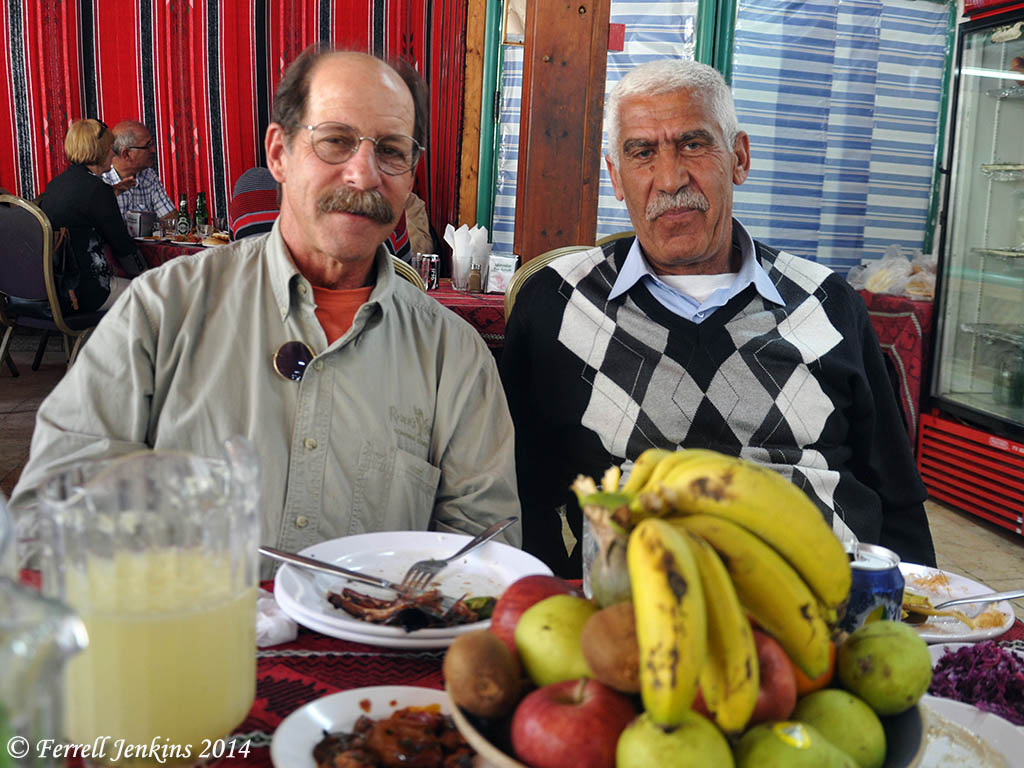
On my tour in 2013, Elie and Fawzy invited me to eat with them at Jericho. Here is the photo I made of them. You can see that Elie was a young man. I remember talking with him about his age and retirement, but I will not try to depend on my memory for that.
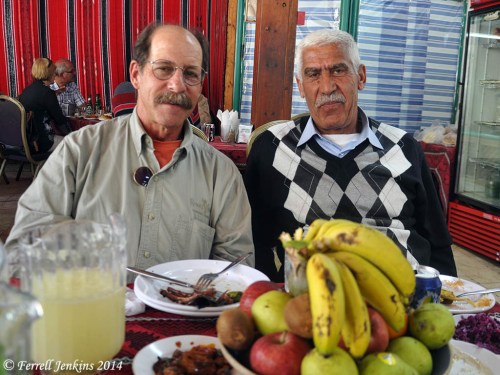
Elie and Fawzy in Jericho. Photo by Ferrell Jenkins.

Elie and Fawzy in Jericho. Photo by Ferrell Jenkins.

I extend my deepest sympathy to Maxine, Adi, and Danya, whom I have met, and to other family members whom I have not met. I think the hundreds of persons who have spent about 10 days listening to Elie help turn the Bible places from black and white to color, one of his favorite expressions, will share my sentiment.



The Zeugma Mosaic Museum

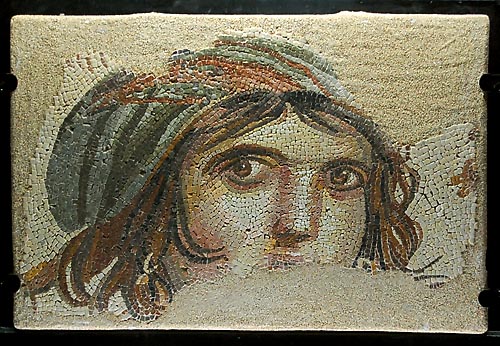
This morning we made a short visit to the Zeugma Mosaic Museum in Gaziantep. This museum contains many of the mosaics and some statues from the Roman city of Zeugma. Much of Zeugma has been covered by the waters of the Euphrates River due to one of the dams built by the Turkish government to provide hydro-electric power and water for irrigation for southeastern Turkey. Archaeologists worked diligently over a period of years to preserve as much of the material as possible. The small mosaic below has been called Gypsy Girl. When I first saw it in 2007 I thought it would rival the Mona Lisa. That was in the old museum. Today the small mosaic is  displayed in a dark room, perhaps to create more mystique. In my judgment it is not as attractive as before. My photo below was made in 2007.

The Gypsy Girl from Zeugma. Photo by Ferrell Jenkins..

The Gypsy Girl from Zeugma. Photo by Ferrell Jenkins.

Otherwise the display of the mosaics is beautifully done. Perhaps at another time I will be able to post some of those photos.

This afternoon we are utilizing our time in the Gaziantep airport. Our flight for the day was cancelled and we were not notified before coming to the airport. Such is travel.

Yesterday we had a few sprinkles, but this afternoon it is pouring rain at the Gaziantep airport.


Some Museums in Turkey

My Ancient Crossroads Tour of Biblical and Historical Turkey is compete. Yesterday most of the tour members returned home. A few had other plans of travel before returning.

There are some wonderful museums in Turkey, but many of them are undergoing restoration at this time.

We missed seeing the main section of the Museum of Anatolian Civilizations in Ankara due to restoration. A nice,  small section containing mostly classical materials was open, but the great collection of Hittite materials (our reason for going there) was closed. According to an article in the Harriyet Daily News it reopened last Friday.

The Archaeological Museum in Antakya (Antioch of Syria, Acts 11, 13) was almost bare. Only a few of the lesser quality mosaics were on the walls. A new museum will open soon. I had told the group that we would see some good Hittite materials there, but they had already been moved. Incidentally, the Church of St. Peter and the Simon Stylites Monastery were also closed for renovation.

We did better at the fabulous museum in Antalya (Attalia of Acts 14:25). The Roman period statuary from Perga in Pamphylia (Acts 13:13-14; 14:25) is housed there.

In Istanbul we were able to visit the Ancient Orient section of the Archaeological Museum. The museum containing material from the classical world was closed. An excellent selection of materials was housed in a small area of the Museum.  The third floor, where artifacts from Palestine are housed was closed. Our appeal for entry failed.  There is where some very famous pieces are housed − the Siloam Tunnel inscription, the Gezer Calendar, the Herodian Temple inscription forbidding gentiles from entering the Temple, et al.

The Ancient Orient building houses a large number of bulls, dragons, and oxen from the procession street of ancient Babylon. I think it is second only to the Pergamum Museum in Berlin. There are excellent Hittite materials, including the oldest treaty between nations. It is the treaty between the Hittites and Pharaoh Ramses of Egypt after the battle of Kadesh on the Orontes. There are several pieces from the Assyrians, and a clay cylinder from the time of Nebuchadnezzar.

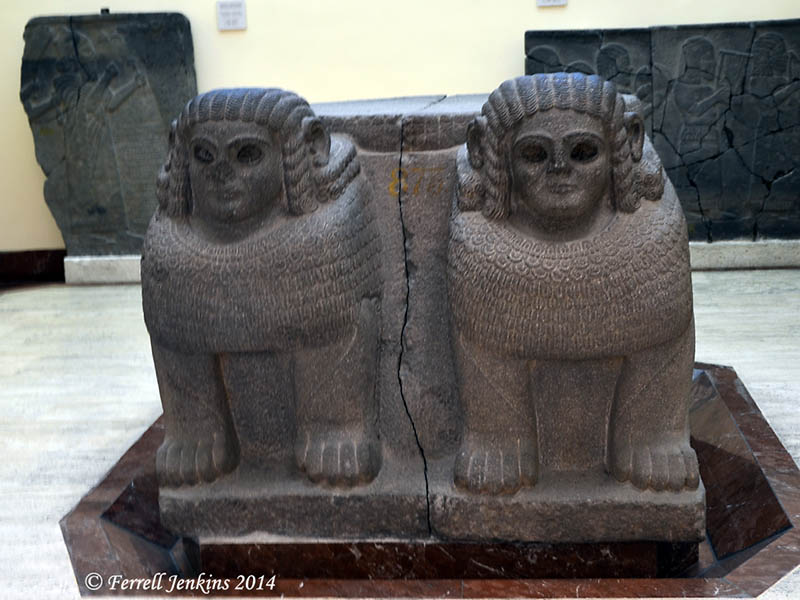
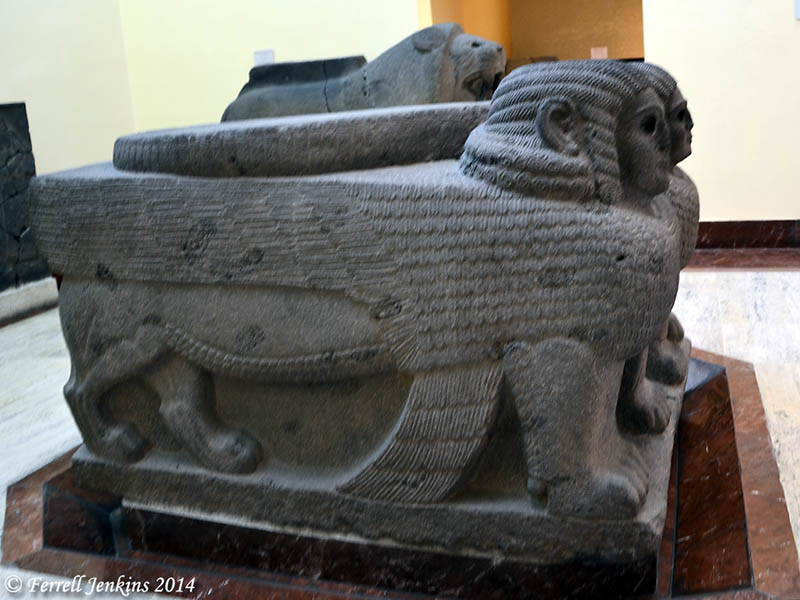
Here is a picture of one of the basalt Hittite column bases from Sinjerli. It is a double sphinx, dating to the 8th century B.C., that came from the entrance to Palace III.

Hittite Column Base from Sinjerli. Photo by Ferrell Jenkins.

Front view of Hittite column base from Sinjerli. Photo by Ferrell Jenkins.

Below is the side view of this column base. Note that the figure of a lion shows a human head and wings of a bird. This provides a good illustration for the apocalyptic imagery in Daniel, Ezekiel, Zechariah, and Revelation.

Side view of Hittite Column Base from Sinjerli. Photo by Ferrell Jenkins.

Side view of Hittite Column Base from Sinjerli. Photo by Ferrell Jenkins.

These are the Hittites with whom the ancient Israelites had dealings. Solomon imported horses and chariots from Egypt and Kue and exported them to the Hittites (1 Kings 10:29). See 2 Kings 7:6 for another reference to these people in the days of the prophet Elisha.

All things considered, maybe it didn’t turn out so bad after all.

Excavations at Derbe

The first excavations ever have begun at the ancient city of Derbe. Derbe was visited by the Apostle Paul and Barnabas on the first preaching journey (Acts 14:20-21). Paul returned with Silas on the second journey (Acts 16:1).

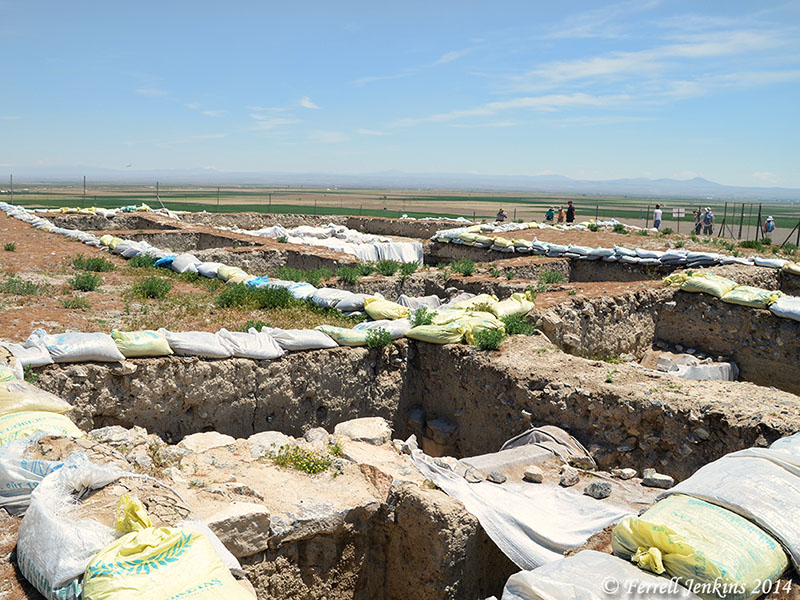
Today our tour group visited Kerti Hüyuk, the site widely believed to be ancient Derbe. Several squares were opened on the top of the mound in 2013.

Recent excavation at Derbe. Photo by Ferrell Jenkins, May 14, 2014.

Recent excavation at Derbe. Photo by Ferrell Jenkins, May 14, 2014.

The report in a Turkish newspaper quotes Associate Professor Mehmet Tekocak of Selçuk University:

So far the excavations have unearthed ancient wall remains. “There are brick and stone walls. We found graves and skeletons inside the walls. Anthropologic works will reveal the ages and genders of these skeletons and how they died. Works show us that this place received a lot of damage, and most architectural materials were removed for use in other places. This place was seen as a kind of stone quarry. We found the remains of a church-like structure, and we believe that we will find new structures as excavations continue. Even these remains alone show us that a Christian society lived in this tumulus,” Tekocak said.

There is no hint as to the age of the church-like structure.

See the report in Hurriyet Daily News here. We look forward to future reports from Derbe.

HT: HolyLandPhotos Blog.

Visualizing Isaiah 39: Hezekiah showed all his treasures

It seems to be a common human failing to reveal too much about ourselves, even to people we do not know very well. This is a mistake made by King Hezekiah when he was visited by Merodach-baladan, king of Babylon.

And Hezekiah had very great riches and honor, and he made for himself treasuries for silver, for gold, for precious stones, for spices, for shields, and for all kinds of costly vessels; storehouses also for the yield of grain, wine, and oil; and stalls for all kinds of cattle, and sheepfolds. He likewise provided cities for himself, and flocks and herds in abundance, for God had given him very great possessions. (2 Chronicles 32:27-29 ESV)

I would think that Hezekiah would have shown the Babylonian monarch his gold and silver treasures, but he may have shown him some of the storehouses where various significant goods were stored. We know that Lachish was a place for the storage of wheat and oil.

Three contiguous storehouse units to the right of the gate were excavated by archaeologists under the direction of Prof. Yohanan Aharoni at Beersheba. Aharoni says,

At Beer-sheba one found many storage vessels in every one of the two side chambers of each storehouse and also a Hebrew ostracon recording the shipment of quantities of a certain commodity (wine?) from two places near Beersheba, (El)tolad and (Beth-)Jamam (Joshua 15:26, 30; 19:4; 1 Chron. 4:29. (The Archaeology of the Land of Israel, p. 223)

These storehouses are dated to the 8th century B.C., the time of Isaiah and Hezekiah.

Storehouses at Beersheba. Photo by Ferrell Jenkins.

Storehouses at Beersheba. Photo by Ferrell Jenkins.

Seal from time of Sargon II found at Roman-era site

Haaretz, an Israeli newspaper, reports on the discovery of a seal dating to the time of Sargon II, king of Assyria (722-705 B.C.), at a Roman-period site in northern Israel. This is a rather unusual find to have been uncovered at the site of Omrit. The excavators at the site believe it to be the site of a temple dedicated to the Emperor Augustus.

The seal, the older of the two artifacts, was found behind the wall of the earliest shrine, within a layer of filler between an internal and external wall. Archaeologists are unaware of how the seal ended up at the site, as the temple was built roughly 700 years before [this should read after] the seal was created. The layer of filler also contained small glass tools and other objects which were apparently taken out of the temple during construction.

Prof. Ziona Grossmark of Tel-Hai Academic College in northern Israel conducted research on the seal, along with Baruch Brendl from the Israel Antiquities Authority. “The seal depicts a battle between a winged figure and a bull standing on its hind legs,” says Grossmark, adding that “comparative research allows us to date it to the time of Sargon II, an Assyrian king who ruled between 722 and 705 B.C.E. and completed the conquest of ancient Israel. The seal was apparently brought to Israel by one of his subjects. What happened to the seal after that remains a mystery, but ancient seals like this one are very rare − only a few of this nature have been found in remains from the Roman period, mostly in graves and temples.”

According to Grossmark, “the seal was a means of identifying its owners, similar to a modern ID card. Seals were in use in the Galilee from the third millennium B.C.E. until about the fifth century B.C.E. They were used mostly during the period during which clay tablets were used for writing, until the introduction of papyrus or leather scrolls. Some say that in later periods, seals were still significant, but they were not used for their original purposes.”

The seal discovered was perfectly preserved, and is still in the process of research and cataloguing. Grossmark says that for archaeologists and historians, it is one of the most beautiful seals ever found.

You may access the Haaretz article by Eli Ashkenazi here. The article does not include a photo of the seal, but you may be able to see the seal by using this link.

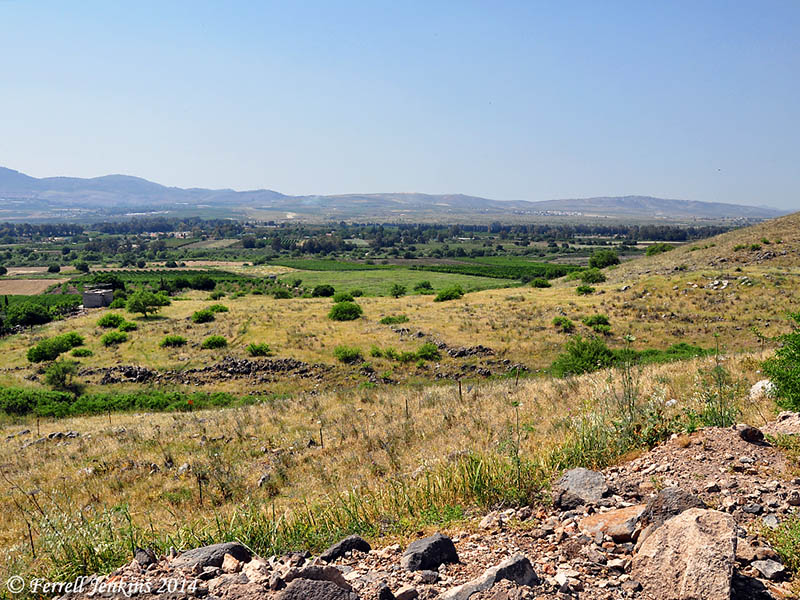
Our photo below was made from Omrit with a view NW of the northern Hula Valley. Omrit is located about 2½ miles southwest of Banias (Caesarea Philippi).

View NW from Omrit of the northern Hula Valley. Photo by Ferrell Jenkins.

View NW from Omrit of the northern Hula Valley. Photo by Ferrell Jenkins.

See our earlier discussions about Sargon II and Isaiah 20, here and here.

HT: Joseph Lauer

Visualizing Isaiah 38: a cake of figs for medication

King Hezekiah was at the point of death, but the LORD heard his prayer and extended his life by 15 years. There are several visual illustrations in this chapter. I have selected the one in verse 21.

Now Isaiah had said, “Let them take a cake of figs and apply it to the boil, that he may recover.” Hezekiah also had said, “What is the sign that I shall go up to the house of the LORD?” (Isaiah 38:21-22 ESV)

The IVP Bible Background Commentary: Old Testament offers this comment on the use of fig cakes at 2 Kings 20:7:

Fig cakes may have been used as condiments and for medicinal purposes at Ugarit. Both later rabbinical Jewish and classical sources (e.g., Pliny the Elder) shared the belief that dried figs had medicinal value. Poultices were sometimes used for diagnosis rather than for medication. A day or two after the poultice was applied, it would be checked for either the skin’s reaction to the poultice or the poultice’s reaction to the skin. One medical text from Emar prescribes the use of figs and raisins for such a process. They helped determine how the patient should be treated and whether or not he would recover.

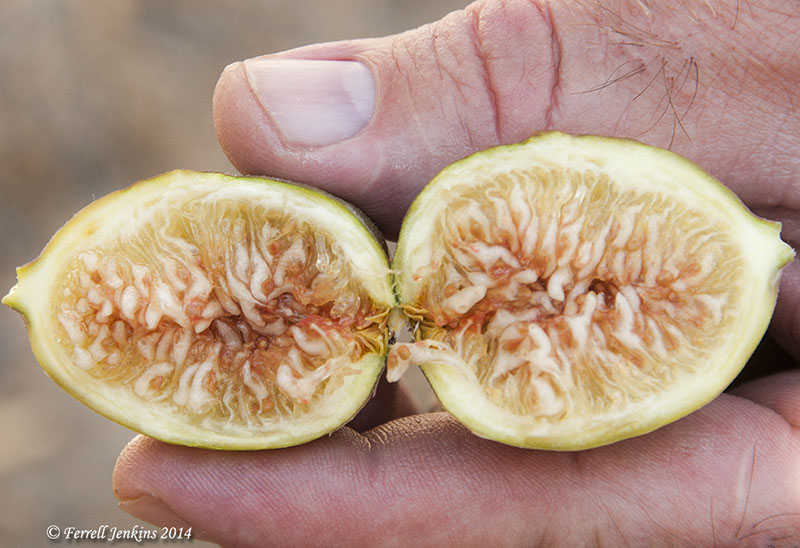
The photo below shows a freshly cut fig from Shechem.

A fresh fall fig from Shechem. Photo by Ferrell Jenkins.

A fresh fall fig from Shechem. Photo by Ferrell Jenkins.

The next photo shows dried figs from Jericho.

Dried figs from Jericho. Photo by Ferrell Jenkins.

Dried figs from Jericho. Photo by Ferrell Jenkins.