Author Archives: Ferrell Jenkins

Astronaut photo of Egypt, Israel and Jordan at night

The satellite photo below is one of the fabulous photos made by NASA astronauts from space. The emphasis in this photo is the Nile Delta at night. You are able to see the portion of Egypt where most of the people live. The Sinai, Israel and Jordan are also visible. To the north, the island of Cyprus and the south shore of Turkey can be seen.
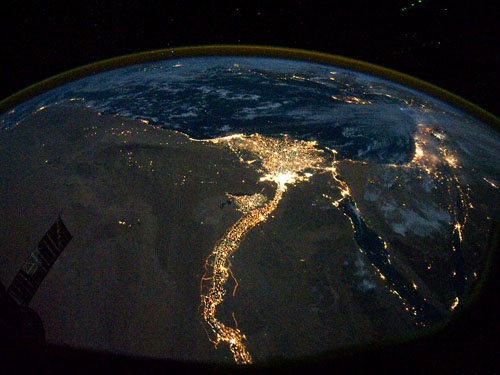
NASA Astronaut Photography of the Egypt and Israel by night.Astronaut photo of Egypt, Israel and Jordan at night.

NASA provides a helpful explanation of the photo.

One of the fascinating aspects of viewing Earth at night is how well the lights show the distribution of people. In this view of Egypt, we see a population almost completely concentrated along the Nile Valley, just a small percentage of the country’s land area.

The Nile River and its delta look like a brilliant, long-stemmed flower in this astronaut photograph of the southeastern Mediterranean Sea, as seen from the International Space Station. The Cairo metropolitan area forms a particularly bright base of the flower. The smaller cities and towns within the Nile Delta tend to be hard to see amidst the dense agricultural vegetation during the day. However, these settled areas and the connecting roads between them become clearly visible at night. Likewise, urbanized regions and infrastructure along the Nile River becomes apparent (see also The Great Bend of Nile, Day & Night.)

Another brightly lit region is visible along the eastern coastline of the Mediterranean—the Tel-Aviv metropolitan area in Israel (image right). To the east of Tel-Aviv lies Amman, Jordan. The two major water bodies that define the western and eastern coastlines of the Sinai Peninsula—the Gulf of Suez and the Gulf of Aqaba—are outlined by lights along their coastlines (image lower right). The city lights of Paphos, Limassol, Larnaca, and Nicosia are visible on the island of Cyprus (image top).

Scattered blue-grey clouds cover the Mediterranean Sea and the Sinai, while much of northeastern Africa is cloud-free. A thin yellow-brown band tracing the Earth’s curvature at image top is airglow, a faint band of light emission that results from the interaction of atmospheric atoms and molecules with solar radiation at approximately 100 kilometers (60 miles) altitude.

The image is used courtesy of the Image Science & Analysis Laboratory, NASA Johnson Space Center. You may access various images at their website here. An annotated photo is available there.
HT: Aantekeningen bij de Bijbel

Attending the Near East Archaeological Society

For the past few days I have been attending the annual meeting of the Near East Archaeological Society and the Evangelical Theological Society. NEAS is a small organization which meets in association with the ETS each year. This gives one the opportunity to attend meetings of either society. ETS has grown tremendously over the years that I have attended — first about 1976, I think. This year more than 2600 persons registered for the meeting. Even though I no longer teach, I like to attend these meetings in order to keep abreast of recent scholarship in areas in which I have special interest.

Among the lectures I heard at NEAS are the following:

Douglas Petrovich (University of Toronto) presented an impressive lecture on “More signs of societal upheaval in Egypt during the days of Joseph.”

Randall Price (Liberty University) was scheduled to make a presentation on Messiah in the Temple: A New 3-D Digital Computer Model of the Second Temple based on historical and archaeological data,” but his co-presenter was not able to make the trip from Germany. Dr. Price gave a presentation in refutation of the recent claims of a Chinese group who claimed they had found Noah’s ark on Mount Ararat.

Mark Wilson (Asia Minor Research Center) and Nadin Burkhardt (University of Frankfurt) spoke about the new excavation of the Priene synagogue (in Western Turkey).

Steven Ortiz (Southwestern Baptist Seminary) spoke about the most recent excavations at Gezer. Dr. Ortiz is one of the directors of the dig where much evidence from the 9th and 10th century B.C. is coming to light.

Eric Mitchell (Southwestern Seminary) told about the landscape archaeology associated with the current excavations at Gezer.

Bryant G. Wood (Associates for Biblical Research) presented the finds from the 2009 and 2010 seasons at Khirbet el-Maqatir. Wood thinks that this site is an excellent candidate to be identified with biblical Ai, rather than the generally accepted site at Et-Tell. Wood is director of this dig in the Palestinian West Bank.

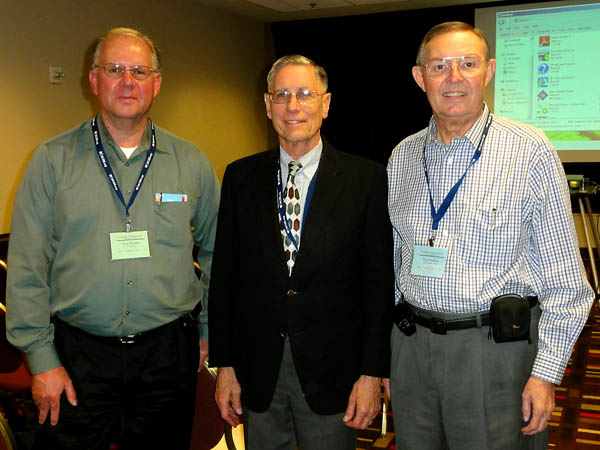
I asked Michael Luddeni, photographer for Bible and Spade and several excavation projects, to make a photo of Leon Mauldin and me with Dr. Bryant Wood.

Leon Mauldin, Dr. Bryant Wood, Ferrell Jenkins at NEAS annual meeting.

Leon Mauldin, Dr. Bryant Wood, Ferrell Jenkins at NEAS annual meeting.

Steven Collins (Trinity Southwestern University) made an excellent presentation on the rise and ruin of a bronze age city-state at Tall el-Hammam, Jordan. Collins is director of this dig.

James H. Charlesworth (Princeton Theological Seminary) was an invited speaker who gave a lecture on two Herodian pools north and south of the Jerusalem temple as they relate to the Gospel of John (chs. 5 and 9). These, of course, were the pools of Bethesda and Siloam. He argued that both pools were mikvaoths (ritual pools) at the time.

There were other good lectures at NEAS. Some of these scholars make similar presentation at the ASOR or SBL meetings.

Among the lectures I heard at ETS, I found these two to be extremely good:

British scholar N. T. Wright (St. Andrews University) spoke on “Justification yesterday, today and tomorrow.”

Eugene H. Merrill (Dallas Theological Seminary) gave the presidential address at the banquet on “Old Testament Scholarship and the man on the street: whence and whither?”

When I was still teaching I attended lectures dealing primarily with the subjects I was actively teaching. Now I attend anything that strikes my fancy. Because I frequently travel to the Middle East I enjoy keeping up with the archaeological excavations in those areas.

Ritmeyer’s Image Library now online

Dr. Leen Ritmeyer is well know for his archaeological drawings of the biblical era buildings, especially the temple. He now has much of his material online for immediate download. The Image Library is described this way:

The Image Library of Ritmeyer Archaeological Design contains authoritative reconstruction drawings and models which you will not find on any other website. The photos of ancient sites in the lands of the Bible have also been taken through the informed lens of an archaeological architect. A treasure-trove for teachers, pastors, lecturers and picture editors, it is the result of years of experience digging and researching in Israel and traveling in the surrounding countries.

The Image Library is arranged in different categories and is fully searchable. The different categories are designed to help you find the picture you are looking for easily. All preview illustrations are watermarked, but these won’t appear on the downloads.

For ease of use, each image comes with a descriptive note and, where applicable, full Scripture references. With the explosion of information coming from excavations, we hope that this will become an ever-expanding resource vital for all who wish to incorporate both beauty and authenticity into their portrayal of the Bible background.

Go here for additional information, and to browse the collection. The architectural drawings are $5 each, and the photographs are $3 each.

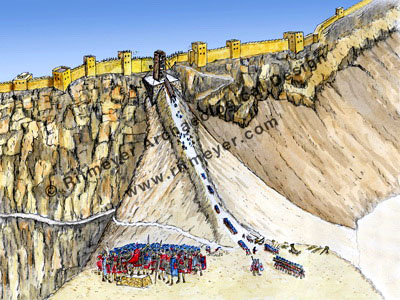
Here is a small sample of one of the drawings. This one shows the siege ramp built by the Romans at Masada in A.D. 72.

Roman siege ramp at Masada. Ritmeyer Image Library.

Roman siege ramp at Masada. Ritmeyer Image Library.

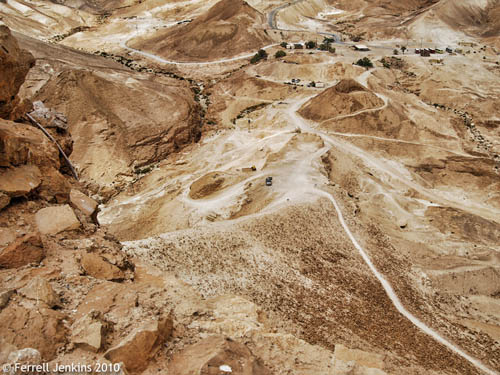
Here is one of my photos showing the siege ramp from above. The wall of Masada is visible in the left of the image.

The siege ramp at Masada. Photo by Ferrell Jenkins.
The Roman siege ramp at Masada from above. Photo by Ferrell Jenkins.

Certainly there is no excuse for presenting a dull, image deprived Bible class lesson or sermon.

Rachel’s tomb?

During the past few weeks there has been controversy over a site immediately on the outskirts of Bethlehem called Rachel’s Tomb. My thought through the years has been that it is at best one of the “traditional” sites that may or may not be the tomb of Rachel.

Some bloggers have presented varying views on the association of the site with Rachel, the mother of Joseph and Benjamin (Genesis 35:24). I am going to direct you to places where you can read to your satisfaction.

  • Todd Bolen says this can not be the tomb of Rachel if we follow the biblical account in Genesis 35:19-20; 48:7, 1 Samuel 10:2, et al.  Read here. He includes a nice color photo of the traditional tomb from the Feinberg collection (probably 1950s or 1960s), and documentation.
  • A response to Bolen by Benj Foreman. Read here.
  • Leen Ritmeyer’s response to Bolen. Read here.

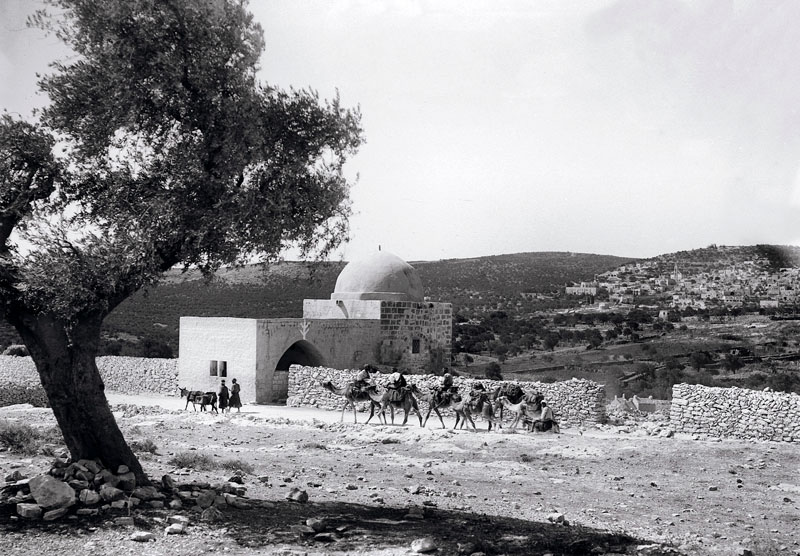
This old photo, which is dated sometime between 1898 and 1946,  is from The American Colony and Eric Matson Collection. Information on ordering is available at Life in the Holy Land.

Rachel's Tomb, American Colony and Eric Matson Collection.

Rachel's Tomb, American Colony and Eric Matson Collection.

Along with the set of historic views of the Holy Land, Todd Bolen has included quotations about the site from scholarly books that discuss the site. The following comment is from Edward Robinson and Eli Smith, Biblical Researches in Palestine, Mount Sinai and Petraea, 1841. The entire book is available at Google Books.

“Someways up the gently acclivity, which here rises towards the N.E. from Wady Ahmed, stands the Kubbet Rahil, or Rachel’s Tomb . . . This is merely an ordinary Muslim Wely, or tomb of a holy person; a small square building of stone with a dome, and within it a tomb in the ordinary Muhammedan form; the whole plastered over with mortar. Of course the building is not ancient; in the seventh century there was here only a pyramid of stones. It is now neglected, and falling to decay; through pilgrimages are sill made to it by the Jews” (Robinson and Smith, Biblical Researches in Palestine, Mount Sinai and Petraea, 1841: 1: 322).

Fascinating article on “Tyre and the Poets”

Joseph P. Duggan writes a fascinating article on “Tyre and the Poets” in The American Spectator. Notice a few excepts. I have added some of the pertinent Scripture references within the article in brackets.

For $50 a family can take a safe, radio-call taxi from the congested heart of Beirut to the uncluttered ancient waterfront of Tyre, a few miles north of the border with Israel. Lush banana plantations line the coastal route.…

The Western literary imagination is attracted to Tyre because it swirls amid the turbulent confluence of Biblical history and prophecy, Homeric and Virgilian epic, Ovidian mythology, and imperial extravagances of luxury and vindictive warfare. Tyre is the birthplace of real or fabulous personages including Cadmus, Europa, and Dido, the latter of whom colonized Carthage as others were to plant the Tyrian standard in Mediterranean ports as far west as Cádiz. The men who sailed with Columbus and colonized the Americas were descendants of long-ago colonists from Tyre.

With its expensive purple dye made from a local mollusk, the murex, Tyre was the center for the Versaces and Givenchys of the ancient world. Paris took Helen of Troy here on a shopping expedition to drape in sumptuous fabric the frame and face that launched a thousand ships.

King Hiram of Tyre was an ally and trading partner of Jerusalem’s King Solomon. Hiram sold Solomon the cedar timber for the great Temple. [1 Kings 9:11]

The Jerusalem-Tyre relationship was rocky then as now. The old Hebrew prophets inveighed against the wealthy city and its neighbor, Sidon, as hotbeds of heathenism and vice. Jezebel, a Tyrian princess (and Dido’s great-aunt) who married Israel’s King Ahab, came to an unhappy end. [Jezebel was the daughter of Ethbaal, king of the Sidonians. 1 Kings 16:31]

Egypt’s pharaohs many times made war against Tyre. Babylon under Nebuchadnezzar battered Tyre in the 6th century B.C. [Ezekiel 26:7; 29:18] Some 250 years later, Alexander the Great already had established effective mastery over the entire Levant when he demanded to offer sacrifice at Tyre to its principal god, Melqart. Alexander maintained that he himself was divine because, he said, he was a descendant of divine Herakles, of whom Melqart was only an avatar. The Tyrians didn’t cotton to that.

When diplomacy failed, Alexander mounted a costly siege whose success resulted in the slaughter of thousands of Tyrians, deportation into slavery for the survivors, and ruin of the splendid city. Modern historians say there was no strategic rationale for Alexander’s destruction of Tyre and its people. The impulse for the genocide was something like the rage of a deranged, spurned lover. Is “education” the answer to war and the world’s other problems? Consider that the Macedonian sociopath had for his personal tutor the serene and rational Stagirite who wrote the Nicomachean Ethics.

When Jesus walked up the short road from Galilee to Tyre, [Matthew 15:21] preaching to the people and driving a demon out of a local woman’s daughter, [Mark 7:26] he saw what Nebuchadnezzar and Alexander had done to the place, fulfilling the prophecies of, inter alia, Amos, Ezekiel [26-28], Zechariah and Jeremiah. He instructed his disciples to say to Galilean towns that rejected them and their preaching: “It shall be more tolerable for Tyre and Sidon at the judgment, than for thee.” [Matthew 11:21-22]

The entire article may be read here.

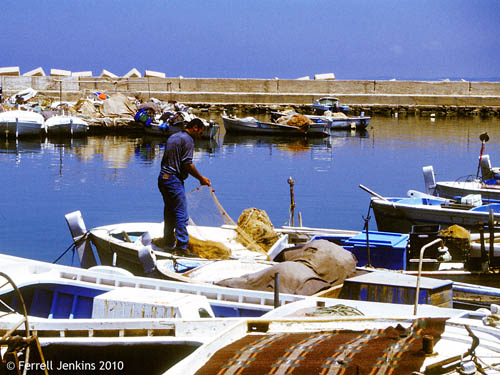
Our photo was made in the harbor of the island city of Tyre in 2002.

Fisherman working with nets at Tyre. Photo by Ferrell Jenkins.

Fisherman working with nets at Tyre. Photo by Ferrell Jenkins.

I will make you a bare rock. You shall be a place for the spreading of nets. You shall never be rebuilt, for I am the LORD; I have spoken, declares the Lord GOD. (Ezekiel 26:14 ESV)

HT: PaleoJudaica

Water in a dry and weary land

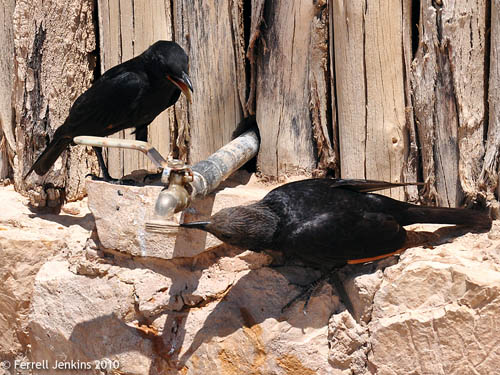
These Tristram’s Grackles, or Tristram’s Starlings, at Masada are trying to get a drop of water from one of the faucets supplying the tourists with lukewarm water during their visit to the site.

Tristram's Grackles at Madada. Photo by Ferrell Jenkins.

Tristram's Grackles at Madada. Photo by Ferrell Jenkins.

Henry B. Tristram wrote The Natural History of the Bible in 1868. In 1884 he wrote Fauna and Flora of Palestine.

A bird commonly seen at Masada, along the shore of the Dead Sea, is named for Tristram. The black bird has some distinctive orange feathers, as you can see in the bird on the right.

Psalm 63 is said to be “A Psalm of David, when he was in the wilderness of Judah.”

O God, you are my God; earnestly I seek you; my soul thirsts for you; my flesh faints for you, as in a dry and weary land where there is no water. (Psalm 63:1 ESV)

View east from the Herodium

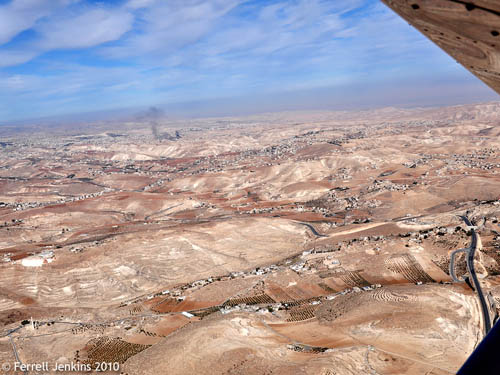
During the past few months we have had considerable interest in our aerial photos of Herodium. Today I will share a photo showing the area east of the Herodium. This area is part of the Wilderness of Judea.

Aerial view east from over the Herodium. Photo by Ferrell Jenkins.

Aerial view east from over the Herodium. Photo by Ferrell Jenkins.

John the Baptist preached in the wilderness of Judea (Matthew 3:3), and Jesus was tempted in the wilderness (Matthew 4:1). This activity was likely in a region to the north of the area shown in this photo.

Jesus spoke to the crowds about John this way:

What did you go out into the wilderness to see? A reed shaken by the wind? (Luke 7:24 ESV)

Bauer describes the wilderness (Greek eremos) of Judea this way:

Of the Judean wilderness, the stony, barren eastern declivity of the Judean mountains toward the Dead Sea and lower Jordan Valley. (BDAG)

The Hebrew word for this wilderness is midbar. Charles F. Pfeiffer said the wilderness of Judea,

is the region of rugged gorges and bad lands in the eastern part of Judah where the land slopes off toward the Jordan Valley. In ancient times this area was infested with wild animals. Except for a brief time during the spring rains the wilderness is arid. (Baker’s Bible Atlas, 201)

Recently I was in a class covering the section of Scripture dealing with the conflict between Saul and David (1 Samuel 23-25).

  • The wilderness of Maon in the Arabah to the south of Jeshimon (1 Samuel 23:24). Jeshimon is another word used to describe the wilderness.
  • The strongholds and wilderness of Engedi (1 Samuel 23:29; 24:1).
  • The stronghold (possibly the area we know as Masada) (1 Samuel 22:4; 25:2).24:22).
  • Ziph, Horesh, Carmel (1 Samuel 23:14-15;

Some of that activity took place within this view, and some took place further to the south. The terrain is much the same. I note that Rainey uses the phrase “steppe land” in several of these references (Sacred Bridge, 148).

Many people who read the Bible in English, without checking into the matter, think of the wilderness as being a place filled with wild growth and underbrush. Jesus’ question to the crowds indicates that no reeds are to be found in the wilderness. In this case a picture really is worth a thousand words.

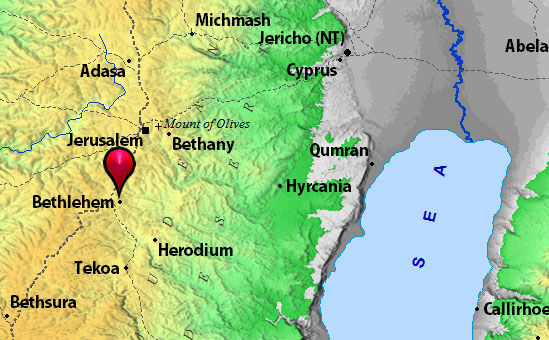
The map from BibleAtlas.org includes the region that we photographed.

Map to show area east of the Herodium. BibleMapper image from BibleAtlas.org.

Map to show area east of the Herodium. BibleMapper image from BibleAtlas.org.

Riblah — important in Old Testament history

Riblah served as a base of operation for the Egyptian Pharaoh Necho and the Babylonian King Nebuchadnezzar. The city is located on a broad plain about 50 miles south of Hamath (modern Hama in Syria), on the main road between Egypt and Mesopotamia. The Orontes River flows past the site on the west side. On a modern map you will locate Riblah in Syria immediately north of the border with Lebanon.

There is little more than a “country store” at the site today, but the name Riblah is preserved as Ribleh, Syria.

  • Pharaoh Necho imprisoned Jehoahaz, king of Judah, at Riblah. He later took him to Egypt where he died. The date was about 609 B.C. (2 Kings 23:31-34).
  • Zedekiah, puppet king of Judah, tried to escape capture by the Babylonians. He fled Jerusalem but was captured on the plains of Jericho and brought to Riblah. There Nebuchadnezzar passed sentence on him. His sons were slaughtered in his sight and he was bound with brass fetters and taken to Babylon. The date was 586 B.C. (2 Kings 25:5-7; see also Jeremiah 39:5-6; 52:9-10).
  • The officials of Zedekiah were taken to Riblah where they were put to death (2 Kings 25:19-21; see also Jeremiah 52:26-27).

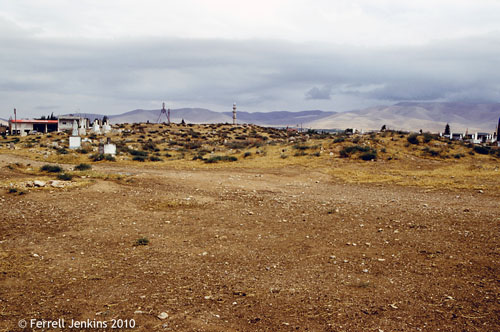
In 2002 a colleague and I spent several days visiting sites in Syria. Riblah was the most difficult to locate. Most folks, after seeing the site, would probably say, “What’s the big deal?”  Even though Riblah is mentioned only these few times in the Old Testament, it’s location makes it important in all movement between the south (Egypt and Israel) and Mesopotamia.

Riblah in the land of Hamath. Photo by Ferrell Jenkins.

Riblah in the land of Hamath. Photo by Ferrell Jenkins.

The slopes of this tell are now used as a cemetery. We know that this would make it difficult to negotiate rights to excavate.

This post was published March 2, 2009, but I had some slides scanned and am able to post a new photo of the tell of Riblah. A photo suitable for use in teaching is available by clicking on the image ago.

A look at copyright basics

The other day, on some source I look at, someone said something like this, “I don’t know anything about copyright.” Earlier this year I had a problem with a blogger who copied my articles and photos, even replacing my copyright notice with his own. Read here, if interested.

WordPress features some of their more successful blogs each day under the title “Freshly Pressed.” One of them caught my eye this morning. It has to do with misconceptions about copyright at it applies to blog posts.

I suggest that everyone who writes a blog, edits a bulletin, prepares presentations, wants to copy a handout, or posts info on a social network take a look at this article on Blogger Basics: Copyright by Deirdre Reid. She also explains Creative Commons.

Some think the solution to the copyright problem is just to label everything as “anonymous.” Not so.

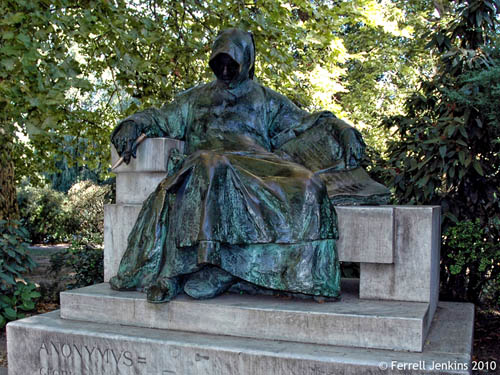
Statue of Anonymous in Budapest. Photo by Ferrell Jenkins.

In Budapest, Hungary, near the entrance of Vajdahunyad Castle, there stands a statue of Anonymous by Miklos Legeti. The statue commemorates a 12th or 13th century unknown chronicler of one of the several rulers named King Bela.

The apostles as gladiators

The apostle Paul compared the work of the apostles to that of gladiators in the arena. In writing to the Corinthians he says,

For I think that God has exhibited us apostles as last of all, like men sentenced to death, because we have become a spectacle to the world, to angels, and to men. (1 Corinthians 4:9 ESV)

As the last event of the day, the gladiator’s who were condemned to death were brought into the arena as a spectacle for the excited crowd. The word spectacle translates the Greek theatron, easy enough for everyone to understand the reference.

Leon Morris (Tyndale New Testament Commentary) calls attention to James Moffatt’s translation of this text.

The imagery is derived from the arena, as Moffatt’s rendering brings out, ‘God means us apostles to come in at the very end, like doomed gladiators in the arena!’

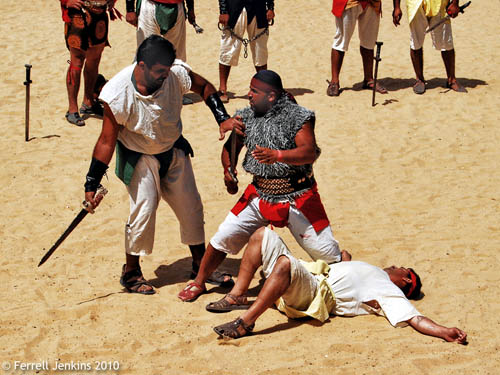
The photo below shows gladiators in the Roman hippodrome at the RACE (Roman Army and Chariot Experience)  show at Jerash, Jordan.

Gladiators in the Roman hippodrome at Jerash, Jordan. Photo by Ferrell Jenkins.

Gladiators in the Roman hippodrome at Jerash, Jordan. Photo by Ferrell Jenkins.

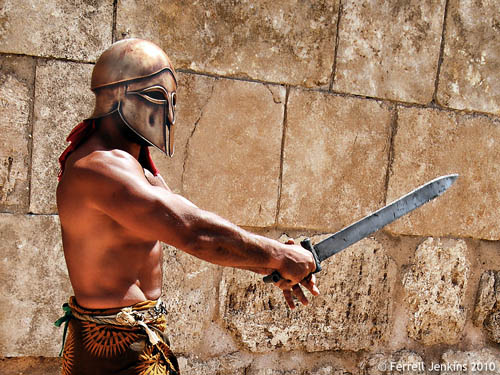
Here is a close up of one of the gladiators.

Gladiator in the RACE show, Jerash, Jordan. Photo by Ferrell Jenkins.

Gladiator in the RACE show, Jerash, Jordan. Photo by Ferrell Jenkins.

Both photos are available in a larger size suitable for use in teaching. Just click on the images.

David Padfield has several photos of gladiators here.