Yearly Archives: 2012

Jacob’s Well — from Jacob to Jesus

Jesus came to Sychar, a city of Samaria, near the piece of land Jacob had owned (John 4:5; Genesis 33:19). The territory was apportioned to the descendants of Joseph, and Joseph was buried there at Shechem (Joshua 24:32). It was a place of great historic importance.

We are not able to speak with certainty regarding the location of Sychar. Some scholars associate the site with Shechem; others think it should be identified with the village of Askar which is located a short distance north. The traditional Jacob’s Well is located at Shechem in the valley between Mount Gerizim and Mount Ebal. The modern town of Nablus now fills this valley.

André Parrot says,

“Of all the ‘holy places’ of Palestine, none has more reason to be considered authentic than Jacob’s well. Indeed, there is no reason why its authenticity should be questioned” (Land of Christ 65).

Parrot describes the water as “cool and pleasant-tasting…drawn from a depth of 128 feet.” I have drunk the water several times, but in the past couple of decades my guides have advised against it due to pollution in the area.

The Samaritan woman said, “the well is deep” (John 4:11). Parrot reports the well is 128 feet deep. Murphy-O’Connor says it is 22.5 meters deep (about 74 feet). McGarvey cites several measurements mentioned in 19th century writers and reminds us that the well became filled with stones cast in by travelers trying to hear how long it would take a stone to hit the bottom (Lands of the Bible 283). He reports that the well was often dry.

There are numerous springs in the area of Shechem. Jacob, as a late-comer to the region, might have found it necessary to dig a well to assure water for his family and cattle.

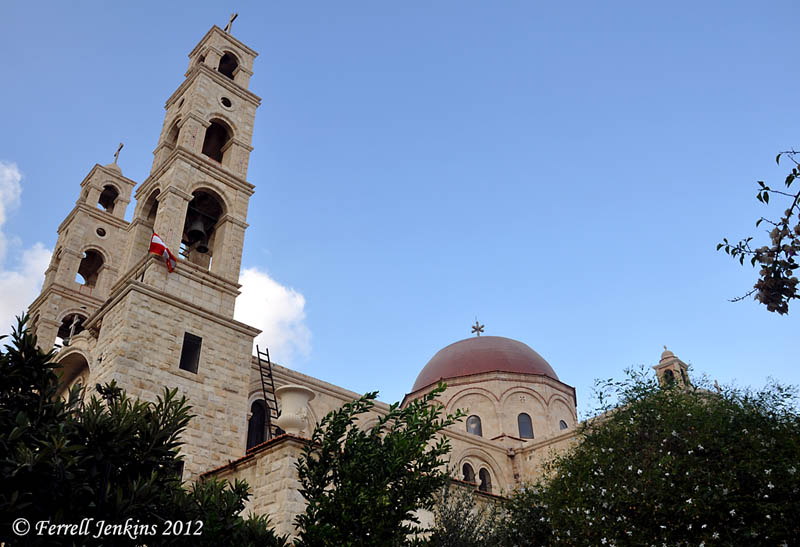
A church was erected over the well about A.D. 380. The Crusaders built another church on the site in the 12th century. The property came under the control of the Greek Orthodox church in 1860. By the end of the 19th century the Greeks began a new church, but construction was halted during World War I. The new building was completed in 2007. This photo shows the towers and dome of the church today.

New Greek Orthodox Church covering Jacob's Well. Photo by Ferrell Jenkins.

New Greek Orthodox Church covering Jacob’s Well. Photo by Ferrell Jenkins.

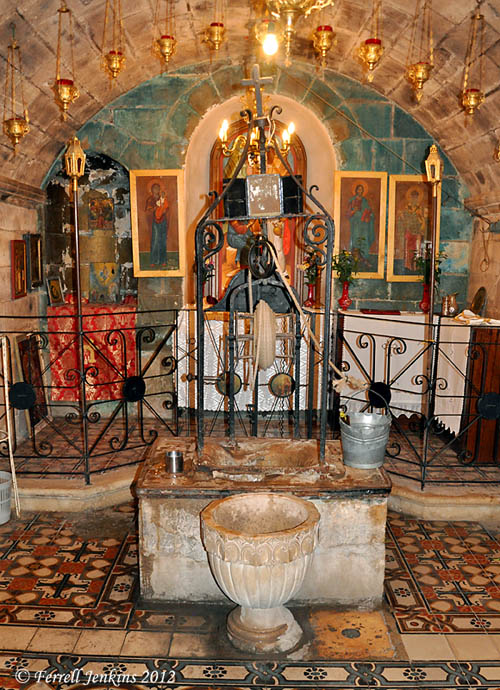
It has been difficult for groups to visit Jacob’s Well in recent years due to the situation in Nablus and the West Bank. Today we were able to visit the church and make photos.

Jacob's Well. Photo by Ferrell Jenkins.

Jacob’s Well. in a Greek Orthodox Setting. Photo by Ferrell Jenkins.

We had a nice day visiting Beth Shean, Spring of Harod (it was dry); Jezreel, Samaria, as well as Jacob’s Well.

Around the Sea of Galilee

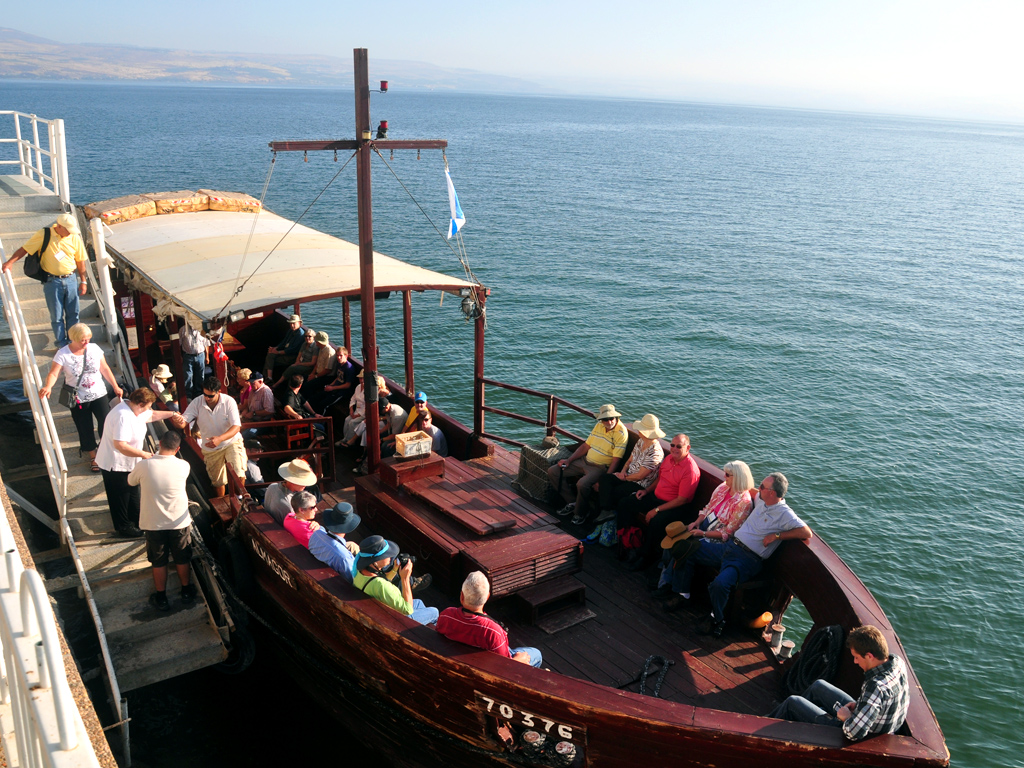
Our great little hotel in Tiberias, the Ron Beach, has its own boarding dock. I was delighted when I learned that the water level was high enough that this could be done. This morning we stepped out of our rooms and walked a few yards to boarded our boat for a ride on the Sea of Galilee.

We board our boat from the Ron Beach Hotel in Tiberias. Photo by Ferrell Jenkins.

We board our boat from the Ron Beach Hotel in Tiberias. Photo by Ferrell Jenkins.

After an orientation from the Sea, we visited major sites around the Sea of Galilee. These included the Roman Boat, Magdala (we actually entered the site, but were not allowed to make photos of the new excavations; it is not ready for tourist yet), Chorzain, Capernaum, the Mount of Beatitudes, the Cove of the Sower, Bethsaida/Geshur, Kursi, and a view of Hippos.

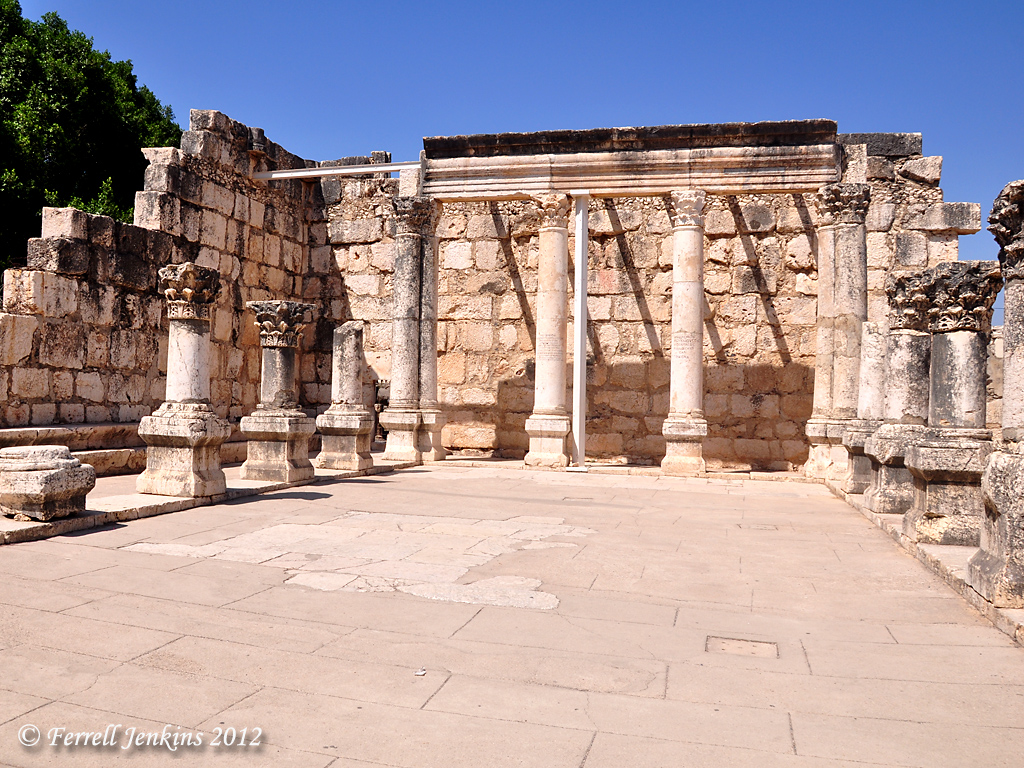
At Capernaum I waited with patience until I was able to get this photo of the interior of the 4th century (reconstructed) synagogue without a tourist in attendance. Not easy, I can tell you.

Interior of the Capernaum Synagogue. Photo by Ferrell Jenkins.

Interior of the Capernaum Synagogue. Photo by Ferrell Jenkins.

To my knowledge everyone in our group is well and enjoying this wonderful educational and spiritual experience.

Peter confesses Jesus to be “the Christ” at Caesarea Philippi

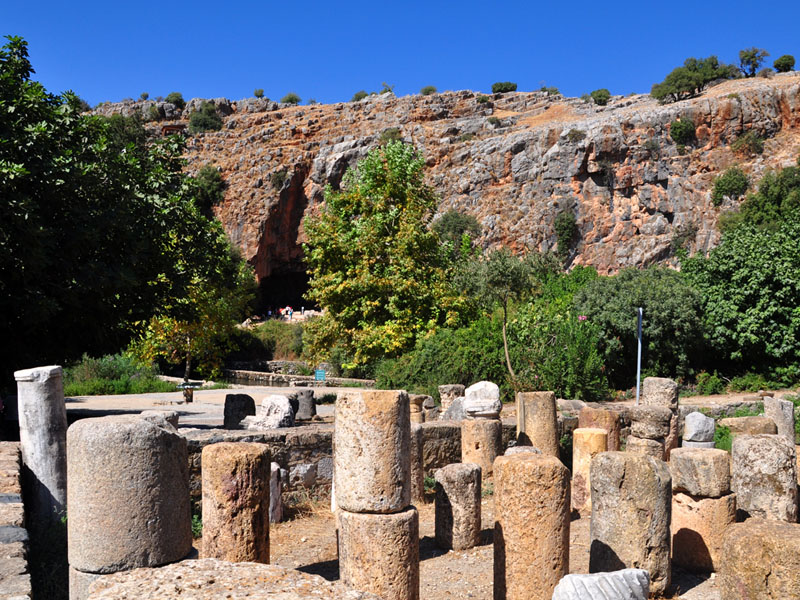
The major sites we visited today included Hazor, Dan, Caesarea Philippi, the Golan Heights, and the Jordan River. Here is a new photo I made at Caesarea Philippi. In the foreground there are broken columns discovered in the excavations at the site. The Banias (or Hermon) River, a major source of the Jordan River,  is hidden by the plants in this photo.

Caesarea Philippi. Photo by Ferrell Jenkins.

Caesarea Philippi. Photo by Ferrell Jenkins.

The Caesarea Philippi of the ministry of Jesus is also known as Banias (Matthew 16:13-19).

Caesarea Philippi is located on the eastern side of the Beka or Hula Valley.  The valley is called the Beka in Lebanon, and a little further south the Hula Valley. The elevation is about 1150 feet above sea level in the foothills of Mount Hermon.

Matthew uses the term district or region to describe the area Jesus visited with His disciples (Matthew 16:13). The King James Version coasts is misleading. Mark’s term is villages (Mark 8:27). It was not far from here that Jesus was confessed as the Christ by Peter.

Jesus went out, along with His disciples, to the villages of Caesarea Philippi; and on the way He questioned His disciples, saying to them, “Who do people say that I am?”  They told Him, saying, “John the Baptist; and others say Elijah; but others, one of the prophets.” And He continued by questioning them, “But who do you say that I am?” Peter answered and said to Him, “You are the Christ.” (Mark 8:27-29 NASB; also read Matthew’s account)

First Temple Public Water Reservoir Exposed in Jerusalem

We have enjoyed a good day visiting in Israel, but I want to share word of this amazing discovery announced today by the Israel Antiquities Authority.

— • —

A Public Water Reservoir Dating to the First Temple Period has been Exposed for the First Time next to the Western Wall

According to Eli Shukron, excavation director on behalf of the Israel Antiquities Authority, “It is now absolutely clear that the Jerusalem’s water consumption during the First Temple period was not solely based on the output of the Gihon Spring, but that it also relied on public reservoirs”

The find will be presented to the public today (Thursday) in the “City of David Studies” conference that will be held in Jerusalem

Massive reservoir discovered near Western Wall in Jerusalem.. Photo by IAA.

Massive reservoir discovered near Western Wall in Jerusalem.. Photo by IAA.

A large rock-hewn water reservoir dating to the First Temple period was discovered in the archaeological excavations that are being conducted in the Jerusalem Archaeological Garden at the foot of Robinson’s Arch. The excavations at the site are being carried out by the Israel Antiquities Authority, underwritten by the ʽIr David Foundation and in cooperation with the Nature and Parks Authority.

The impressive reservoir will be presented today (Thursday) together with other finds from this past year at the 13th annual conference on the “City of David Studies of Ancient Jerusalem” to be held in Jerusalem.

The excavation, during the course of which the reservoir was discovered, is part of an archaeological project whereby the entire drainage channel of Jerusalem dating to the Second Temple period is being exposed. The channel runs north along the City of David spur, from the Siloam Pool to a point beneath Robinson’s Arch. The route of the channel was fixed in the center of the main valley that extends from north to south the length of the ancient city, parallel to the Temple Mount. In his description of Jerusalem in the Second Temple period, Josephus refers to the valley by its Greek name “Tyropoeon”, which scholars believe means “Valley of the Cheese-makers”. Another interpretation identifies the valley with the “Valley of the Decision”, mentioned in the Book of Joel.

It became apparent while excavating the channel that during the construction of this enormous engineering enterprise its builders had to remove earlier structures that were situated along the route of the channel and “pass through” existing rock-hewn installations that were located along it. An extraordinary installation that was exposed in recent weeks is a large water reservoir treated with several layers of plaster, which probably dates to the First Temple period.

The reservoir has an approximate capacity of 250 cubic meters [66,043 U.S. gallons] and is therefore one of the largest water reservoirs from the First Temple period to be discovered so far in Jerusalem, and this was presumably a reservoir that was used by the general public.

According to Eli Shukron, the excavation director on behalf of the Israel Antiquities Authority, “While excavating beneath the floor of the drainage channel a small breach in the bedrock was revealed that led us to the large water reservoir. To the best of our knowledge this is the first time that a water reservoir of this kind has been exposed in an archaeological excavation. The exposure of the current reservoir, as well as smaller cisterns that were revealed along the Tyropoeon Valley, unequivocally indicates that Jerusalem’s water consumption in the First Temple period was not solely based on the output of the Gihon Spring water works, but also on more available water resources such as the one we have just discovered.

According to Dr. Tvika Tsuk, chief archaeologist of the Nature and Parks Authority and an expert on ancient water systems, “The large water reservoir that was exposed, with two other cisterns nearby, is similar in its general shape and in the kind of plaster to the light yellow plaster that characterized the First Temple period and resembles the ancient water system that was previously exposed at Bet Shemesh. In addition, we can see the hand prints of the plasters left behind when they were adding the finishing touches to the plaster walls, just like in the water reservoirs of Tel Be’er Sheva, Tel Arad and Tel Bet Shemesh, which also date to the First Temple period”. Dr. Tsuk says, “Presumably the large water reservoir, which is situated near the Temple Mount, was used for the everyday activities of the Temple Mount itself and also by the pilgrims who went up to the Temple and required water for bathing and drinking”.

The exposure of the impressive water reservoir that lies below Robinson’s Arch joins a series of finds that were uncovered during recent excavations in this region of the city, indicating the existence of a densely built-up quarter that extended across the area west of the Temple Mount and predating the expansion of the Temple Mount. It seems that with the expansion of the Temple Mount compound to the west and the construction of the public buildings and the streets around the Temple Mount at the end of the Second Temple period, the buildings from the First Temple period and early Second Temple period were dismantled in this region and all that remains of them is a series of rock-cut installations, among them the hewn water reservoir.

According to Dr. Yuval Baruch, archaeologist in charge of the Jerusalem Region of the Israel Antiquities Authority, “Upon completion of the excavations along the route of the drainage channel, the IAA will examine possibilities of incorporating the impressive water reservoir in the planned visitors’ path”.

Click here to download high resolution photographs of the reservoir.

HT: Joseph Lauer


Traveling in Israel

This afternoon we arrived in Israel. My first tour was in 1967, a few weeks before the Six-Day War when Jerusalem was in Jordan. The traditional site of the baptism of Jesus by John the Baptist was easily accessible.  That changed after the War, and we had no access to the River until Jordan opened a site thought to be the location of Bethany Beyond the Jordan (John 1:28). By 2006 we were able to visit the site.

Last year (2011) Israel opened access to the river, by special permission, on the west side. I understand the site is now open to anyone who wishes to visit.

Then Jesus came from Galilee to the Jordan to John, to be baptized by him.  John would have prevented him, saying, “I need to be baptized by you, and do you come to me?”  But Jesus answered him, “Let it be so now, for thus it is fitting for us to fulfill all righteousness.” Then he consented.  And when Jesus was baptized, immediately he went up from the water, and behold, the heavens were opened to him, and he saw the Spirit of God descending like a dove and coming to rest on him;  and behold, a voice from heaven said, “This is my beloved Son, with whom I am well pleased.” (Matthew 3:13-17 ESV)

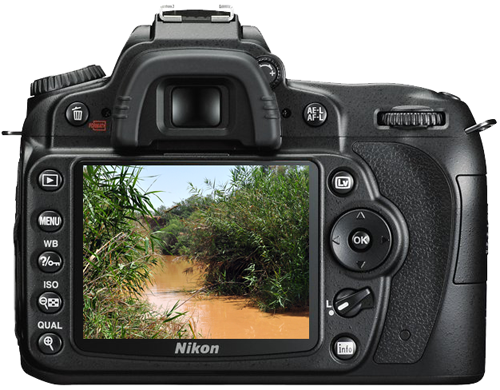
The River Jordan at the Israel-Jordan border north of the Dead Sea. Photo by Ferrell Jenkins.

Jordan River at the traditional site of the baptism of Jesus. Photo by Ferrell Jenkins.

This will be my eightieth foreign tour to direct in these past 46 years. Not all of these have been to Israel, but I’ve led tours to the land so central in the Biblical story almost annually except for those years when political conditions made it impossible. Occasionally there was a second tour the same year. I have made numerous personal study trips in addition to the tours I lead. I’m still learning, and still making efforts to see places I have not yet visited. Last year I spent about six weeks in the country.

Through this blog I have tried to share a little bit of information and a few of the photos I have accumulated. Over the next two or three weeks I hope to share a bit of the excitement of this tour.

Tell your friends about the blog.

At least three blogs are being written about the tour. You might enjoy them, especially if you know someone traveling with us.

Steven Braman — Braman’s Wanderings
http://bramanswanderings.wordpress.com

Barry Britnell — Exploring Bible Lands
http://exploringbiblelands.com

Trent and Rebekah Dutton
http://www.trentandrebekah.com

Our flight from New York was delayed due to bad weather in New York and connecting cities. We were too late to visit Joppa today. Trent and Rebekah Dutton arrived in Israel yesterday. I see they have already posted some information about Joppa.

Tonight all 39 tour members are settled on the Mediterranean coast at Netanya, Israel. Looking forward to a great day of learning tomorrow.

Historical Reliability of Acts

Apologetics 315 recently called attention to a PDF document by James Hickey on The Historical Reliability of Acts: Support from Extra-Biblical Primary Sources. I thought this document might be helpful, along with our photo illustrations, to those studying the Book of Acts.

https://i0.wp.com/3.bp.blogspot.com/-4sfuh5jjh8A/UD_H2fkFeII/AAAAAAAAJz4/a0OYCvz3zJk/s1600/historical-reliability-acts.jpg

You may download the document here, or from Apologetics 315 (above).

Logos Book of the Month — Psalms and Hymns of Isaac Watts

Pick up almost any book of hymns and you will note several songs by Isaac Watts (1674-1748), a native of Southhampton, England. The Dictionary of the Christian Church says,

Watts deservedly holds a very high place among English hymn-writers. His hymns reflect his strong and serene faith and did much to make hymn-singing a powerful devotional force, especially in Nonconformity… [especially nonconformity to the Church of England at the time, but used of nonconformity to any Established Church]

Logos is offering The Psalms and Hymns of Isaac Watts free to Logos users for the month of September. See details here.

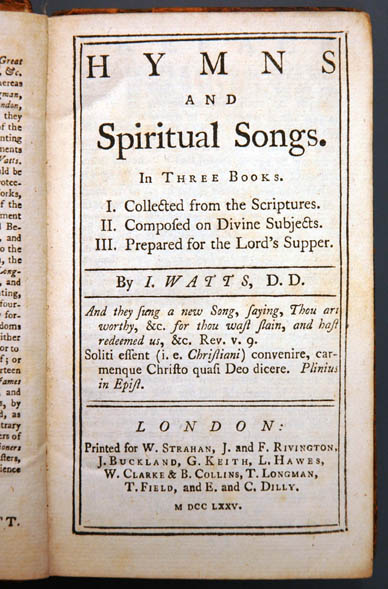
A 1775 edition of a book by Isaac Watts. U. of Otago.

I have Logos Bible Software 4 open now to a hymn based on Galatians 6:14. The title is “Crucifixion to the world by the cross of Christ.” We probably know this song by the first words, “When I survey the wondrous cross.”

Crucifixion to the world by the cross of Christ.
(Gal. 6:14)

 When I survey the wondrous cross
On which the Prince of glory died,
My richest gain I count but loss,
And pour contempt on all my pride.

Forbid it, Lord, that I should boast,
Save in the death of Christ my God!
All the vain things that charm me most,
I sacrifice them to his blood.

See from his head, his hands, his feet,
Sorrow and love flow mingled down!
Did e’er such love and sorrow meet,
Or thorns compose so rich a crown!

[His dying crimson, like a robe,
Spreads o’er his body on the tree:
Then am I dead to all the globe,
And all the globe is dead to me.]

Were the whole realm of nature mine,
That were a present far too small;
Love so amazing, so divine,
Demands my soul, my life, my all.

Watts, I. (1998). The Psalms and hymns of Isaac Watts. Oak Harbor, WA: Logos Research Systems, Inc.

Don’t expect modern shaped notes. And if you know nothing of the Meters that were used in Watts’ time, you may simply use the book for devotional readings.

Notice the vivid fourth stanza describing the dying Christ which is often left out of modern hymn books.

Acts 12 — Photo Illustrations

In presenting some photo illustrations for the book of Acts, I see that I skipped Acts 12.

“Herod the king” of Acts 12 is Herod Agrippa I who ruled as king of Judea (A.D. 37-44). He was the son of Aristobulus and grandson of Herod the Great. After the death of Agrippa, Roman procurators began to rule in Judea. Three of Agrippa’s children are mentioned later in Acts: Herod Agrippa II and Bernice (25:13), and Drusilla, who married Felix the procurator of Judea (24:24). The events recorded in Acts 12 took place shortly before the death of Herod in A.D. 44.

I invite your attention to a previous article about the death of Herod Agrippa I at Caesarea here.

In addition, I will provide a new aerial photo. On the left (north) you will see a portion of the amphitheater (hippodrome). At the end of the amphitheater is the partially reconstructed promontory palace of Herod the Great. On the right (south) is the theater which was built originally by Herod the Great.

Aerial view of Caesarea Maritima. From Left to Right: hippodrome, palace of Herod, theater.

Aerial view of Caesarea Maritima. From Left to Right: amphitheater (hippodrome), promontory palace of Herod the Great, theater. Photo by Ferrell Jenkins.

Could the “Herodian Mansion” have been the house of Annas the high priest?

Archaeological architect Leen Ritmeyer is interviewed by Justin Taylor about the “Palatial Mansion” or “Herodian Mansion” here. Ritmeyer takes the position that the Palatian Mansion, identified as the Wohl Museum, may be “the place of residence for Annas the high priest.”

Todd Bolen, at the Bible Places Blog, says,

While I appreciate the way that Ritmeyer makes these discoveries so accessible to the average Bible reader, I am less optimistic that this particular house is the very house where Jesus stood on trial and Peter denied the Lord. In favor of making this positive identification is the fact that this is the largest house known from this time period in Jerusalem. On the other hand, most of the land in the Old City has never been excavated. If there were 100 houses in Jerusalem in the first century, how likely is it that the only complete one excavated is the same one mentioned in the Bible?

A similar claim is made for the site known as Saint Peter in Gallicantu. Tour groups to Jerusalem often visit both sites. Maybe one of these places is the house of Annas and Caiaphas, and maybe not. Each may provide a good illustration of what happened when Jesus was brought before the high priest. I often say to my groups, “It may not have been right here, but it wasn’t far away.”

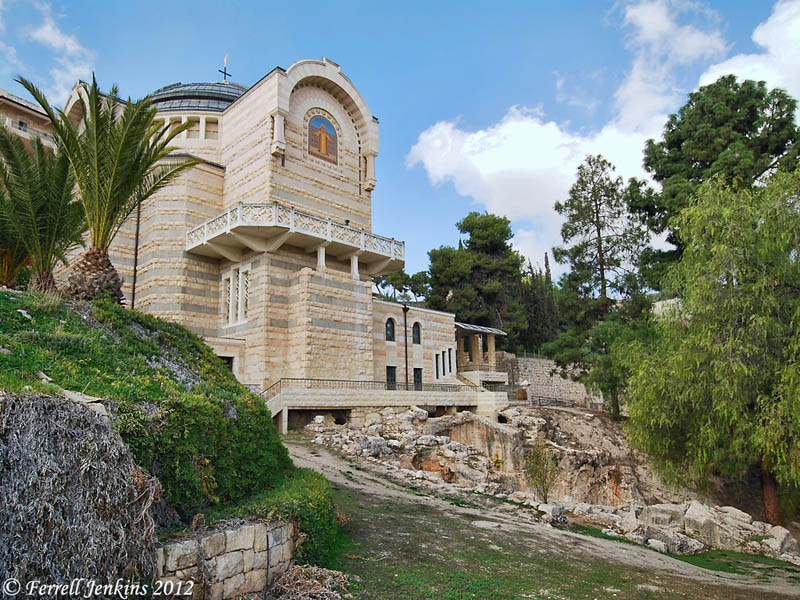
St. Peter in Galicantu, Jerusalem. Photo by Ferrell Jenkins.

St. Peter in Galicantu, Jerusalem. This exterior view shows the modern building covering the excavation that some suggest was the house of the high priest. Photo by Ferrell Jenkins.

In comments to the Ritmeyer interview, Shannon Brown shares an album of photos he made at the Wohl Museum a few years ago.

For the Biblical background of this discussion, see John 18:13-24; Matthew 26:57-68; Mark 14:53-65; and Luke 22:54-65.

Acts 13 — Photo Illustrations

How long would it take to provide photo illustrations for Acts 13? Here are some of the places and persons we might consider.

  • Syrian Antioch
  • Seleucia
  • Cyprus
  • Salamis, Cyprus
  • Paphos, Cyprus
  • Barnabas
  • Sergius Paulus
  • Perga in Pamphylia
  • Pisidian Antioch
  • Iconium

Not to mention the historical references in Paul’s sermon in the synagogue at Pisidian Antioch. (You can find posts about most, if not all, of the above list by using the Search box.)

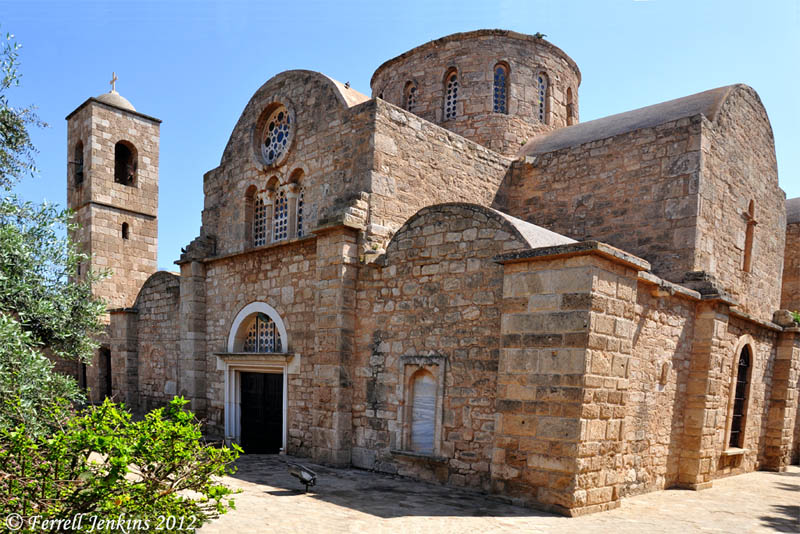
For today, I have chosen to call attention to Barnabas and his association with Cyprus. The first stop made by Barnabas, Saul, and John Mark on Cyprus was at the eastern port of Salamis. A few miles west of the harbor and ancient city we now have the Monastery and Church of St. Barnabas. Salamis, and this building, are now located in the Turkish Republic of Norther Cyprus. The folks in the south, the Republic of Cyprus, speak of the north as occupied territory. (I leave the politics of the issue for others.) The monastery and church, erected in A.D. 477, now houses an icon museum and a small archaeological museum.

Tradition has it that Barnabas was martyred by Jews on Cyprus, but we have no evidence to back up this assertion.

Church of St. Barnabas at Salamis, Cyprus.

Late 5th century church of St. Barnabas at Salamis, Cyprus. Photo by Ferrell Jenkins.

Acts 4:36 informs us that Joseph was also called Barnabas by the apostles. The name Barnabas means Son of Encouragement or Exhortation. He must have been an eloquent speaker, especially good at exhorting and encouraging others. He was generous with his property, a good man, full of the Holy Spirit and of faith (Acts 11:24).

Barnabas was of the tribe of Levi and a native of the island of Cyprus. He later introduced Saul of Tarsus (Paul) to the brethren in Jerusalem (Acts 9:26-27) and preached in Antioch (Acts 11:22-30). Barnabas, and his cousin John Mark (Colossians 4:10), joined Saul for the first preaching journey (Acts 13-14).

After a sharp disagreement between Barnabas and Paul, Barnabas took Mark with him to Cyprus (Acts 15:39). One wonders if Mark also was a native of Cyprus.