Monthly Archives: January 2009

Headed for Egypt

In a few hours we plan to be on a non-stop flight to Cairo. We have a good group of fellow-travelers who join us in exploring the ancient culture of Egypt.

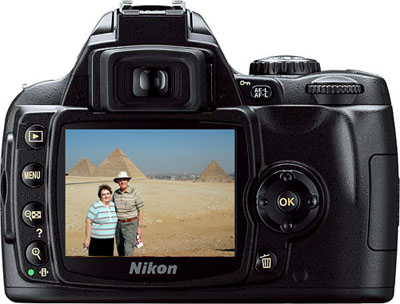
nikon-pyramids-t1

Our main purpose for tours like this is to better understand the culture in which so many Bible events took place. We will be joined by a competent Egyptian guide who is well versed in Egyptian history and also understands its relation to the Bible. My job will be to teach the biblical account on the spot. That is a little better than doing so back home with a photo! Not everyone can visit these places, and we are delighted to share a few of our experiences and understanding with you.

I consider these tours of the Bible lands, and this blog, an important part of my teaching ministry. Many of the men and women who travel with me do so in an effort to improve their teaching in the churches where they serve.

My last trip to Egypt was in 2005. I began using WordPress in 2007, and have not determined if we will be able to make proper contact with WordPress to publish our posts. As a backup I have set up an account on Blogger. After we have a day or two to get settled in Egypt, if you don’t see a new post here go to the Blogger site: fjtours.blogspot.com.

We have come to expect Jane to write a blog during our tours, but she and Olen are not able to be with us due to the recent heart surgery for Olen’s father. Jane tells us that Sharon will be writing. We encourage you to check her blog regularly at scenewithsharon.blogspot.com. She is a good photographer and I am sure you will find it of interest.

More illustrations of apocalyptic imagery

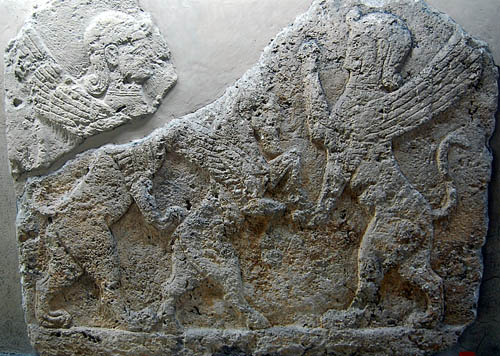
We mentioned in earlier posts on apocalyptic literature that composite images were common among the Assyrians, Babylonians, and Persians. This was also true of the Hittites who lived in the upper Euphrates area. The Anatolian Civilization Museum at Ankara contains many of the reliefs from Carchemish on the Euphrates. The one below shows two human-headed sphinx standing. There is also a winged horse standing between them. They appear to be dancing.

Human-headed sphinxs standing; winged horse standing. Photo by F. Jenkins.

Human-headed sphinx standing; winged horse standing. Photo by F. Jenkins.

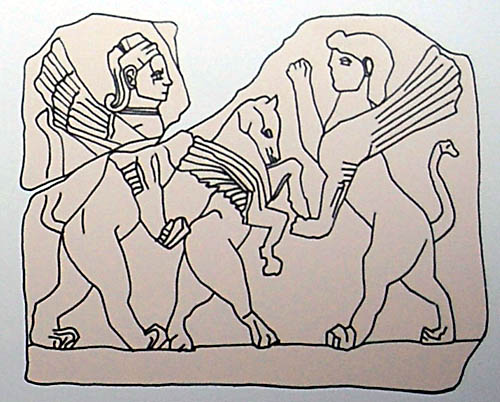
This drawing from the Museum may show the image more clearly. Notice the bird head on the tail of the sphinx on the right.

Drawing of the human-headed sphinx and standing horse.

Drawing of the human-headed sphinx and standing horse.

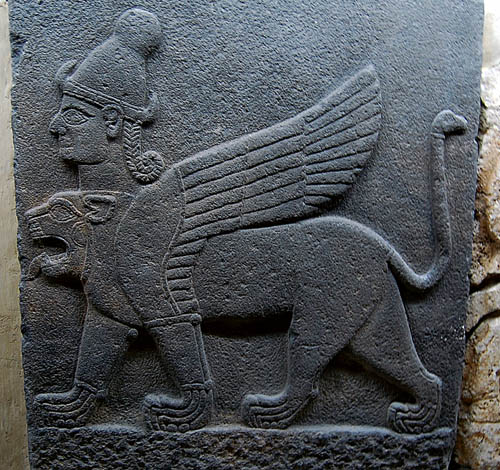
This one is of special interest. It shows a lion with wings and a human head.  The tail shows the head of a bird. There are four images in composite form. This basalt orthostat also comes from Carchemish.

Three-headed sphinx.

Three-headed sphinx.

Judeans who were taken captive to Babylon traveled in this region on their way to their place on the Chebar (Kebar) River in southern Mesopotamia. We know that Nebuchadnezzar made his headquarters at Riblah in the land of Hamath. Because this region was part of the Fertile Crescent we can be sure that the Judeans traveled in the area on their long trip from Judea to Babylon. See 2 Kings 25:6-7.

We are not saying that Ezekiel borrowed his composite creatures from the culture around him. We are saying that such was common and that it would not have been unusual or strange to Ezekiel or his hearers/readers.

Notice, again, Ezekiel’s description of the creatures he saw:

These are the living beings that I saw beneath the God of Israel by the river Chebar;  so I knew that they were cherubim.  Each one had four faces and each one four wings, and beneath their wings was the form of human hands.  As for the likeness of their faces, they were the same faces whose appearance I had seen by the river Chebar. Each one went straight ahead. (Ezekiel 10:20-22 NASB)

For the images in the book of Daniel we could show numerous composite creatures from Babylon.

Apocalyptic imagery is not strange

Visits to the great museums of the world provide many illustrations that help us understand the background of biblical images. This is especially true when we think of the apocalyptic imagery in Ezekiel, Daniel, Zechariah, and Revelation. The Greek name of the Book of Revelation is apocalypsis. In the opening sentence of the book we are told that it is an apocalypse.

In two previous posts we have called attention to the cherubim of the Bible. In this post I want to further this discussion and call attention to the multi-headed creatures that we encounter in apocalyptic literature. In the great throne scene of Revelation 4 we see four living creatures.

The first living creature was like a lion, the second creature like an ox, the third creature had a face like a man’s, and the fourth creature looked like an eagle flying. Each one of the four living creatures had six wings and was full of eyes all around and inside. They never rest day or night, saying: “Holy Holy Holy is the Lord God, the All-Powerful, Who was and who is, and who is still to come!” (Revelation 4:7-8 NET)

In Ezekiel we see figures representing four living beings with human form. Each living being had four faces and four wings. Each face was of a different creature.

Their faces had this appearance: Each of the four had the face of a man, with the face of a lion on the right, the face of an ox on the left and also the face of an eagle. (Ezekiel 1:10 NET)

One notes immediately that in early Christian art the Four Evangelists (or we might say, the four writers of the gospels) were likened to the same creatures.

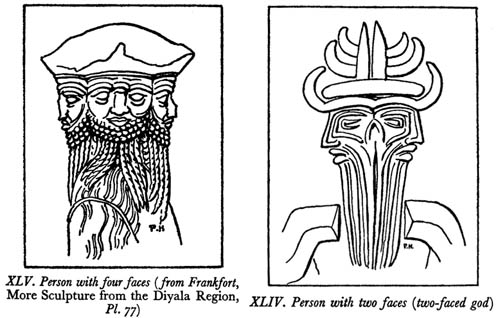
Andre Parrot, in Babylon and the Old Testament, calls attention to the imagery used in Ezekiel. He provides two drawings of images uncovered by the archaeological spade in Mesopotamia. One shows a two-faced image; the other a four-faced image.

Drawings from Parrot, Babylon and the Old Testament.

Drawings from Parrot, Babylon and the Old Testament.

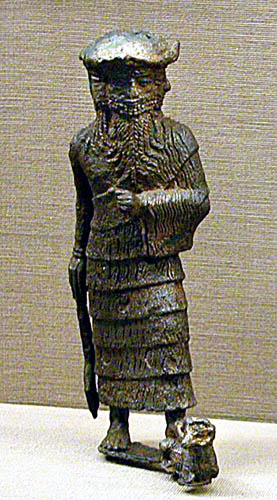
The location of the images is not given. The four-faced image seems to be an image that is now on display at the Oriental Institute of the University of Chicago. This is a museum you must not miss if you visit the Chicago area. Here is a nice photo made by David Padfield.

Four-faced image from Mesopotamia. Photo by David Padfield.

Four-faced image from Mesopotamia. Photo by David Padfield.

One notices immediately that these two-faced and four-faced images all have human heads. We need only turn to the sculpture of Assyria, Babylon, and Persia to find many composite creatures bearing features of four or more creatures. That will have to wait for another time.

In closing I must return to the title of this post. “Apocalyptic imagery is not strange.” That is, it was not strange to those to whom the apocalyptic books of the Bible are addressed. It may be strange to us at first glance, but that can easily change by investigating the culture in which these books were written and read.

More about the Cherubim

To the illustration from Byblos included with W. F. Albright’s article I would like to add a few photographic illustrations that might be helpful in understanding the concept of the Cherub as well as the general concept of composite beasts in the Apocalyptic books of Ezekiel, Daniel,  Zechariah, and Revelation.

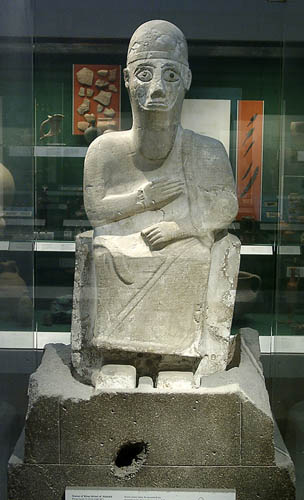
Throne of King Idrimi of Alalakh. Photo by Ferrell Jenkins.

Throne of King Idrimi of Alalakh. Photo by F. Jenkins.

The photo above shows the front of the Statue of King Idrimi of Alalakh, now displayed in the British Museum. An associated cuneiform inscription tells that this king, following a popular revolt, was forced into exile. He went first to Emar on the Euphrates, then to Canaan, where he joined other refugees from Syria and lived with the Hapiru. Seven years later he recaptured the district of Mukish and was acclaimed king of Alalakh.

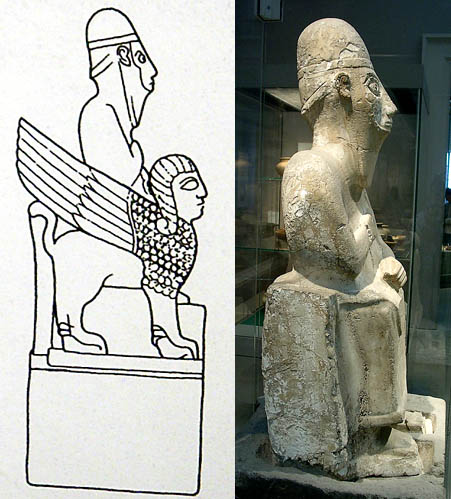
King Idrimi of Alalakh. Photo by F. Jenkins.

King Idrimi of Alalakh. Photo by F. Jenkins.

The drawing on the left (above) shows the suggested reconstruction of the throne of King Idrimi of Alalakh (1570-1500 BC) . Alalakh is located in North Syria, near the Orontes River. Due to political changes, Alalakh, Tell Atshana [Açana], is now in southern Turkey. See The New International Dictionary of Biblical Archaeology or The Biblical World for more information about the excavations at Alalakh.

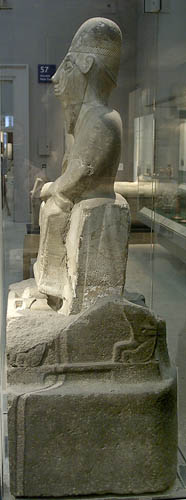
This photo on the right (above) shows the right side of the statue as it is displayed in the British Museum.

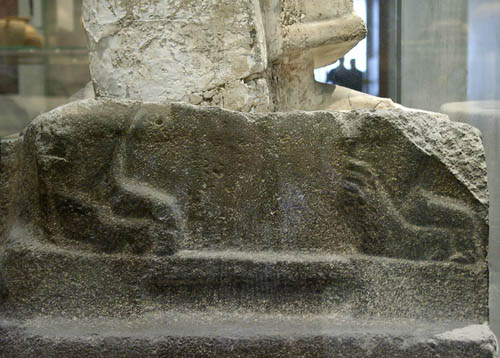
Right side base of throne of the King of Alalakh.

Right side base of throne of the King of Alalakh.

The photo above shows the base of the right side of the statue. The front and hind feet of the “creature” upon which the throne stands are clearly visible.

Left side of the throne.

Left side of the throne.

The photo to the right shows the left side of the throne. The front and hind legs of the animal can be seen.

Recall these references from the Bible describing the LORD as riding on a cherub.

And He rode on a cherub and flew; And He appeared on the wings of the wind. (2 Samuel 22:11)

He rode upon a cherub and flew; And He sped upon the wings of the wind. (Psalm 18:10)

These are the living beings that I saw beneath the God of Israel by the river Chebar; so I knew that they were cherubim. (Ezekiel 10:20; see entire chapter)

We are saying that images such as the one discussed here provide an idea of the imagery involved in the biblical description of the cherubim.

Perhaps later we will be able to include some photos of representations of the cherubim upon the ark of the covenant.

What Were the Cherubim?

What Were the Cherubim?
By W. F. Albright

Today we think of a cherub as a tiny winged boy, following the tradition of Renaissance artists. This conception was directly borrowed from pictures of Graeco-Roman “loves” or Erotes, familiar to us from the excavations of Pompeii. The actual appearance of the cherubim of the Old Testament was already forgotten before the time of Christ, and Josephus (first century A.D.) says that “no one can tell what they were like.”

Since the veil of the Tabernacle was decorated with embroidered cherubim, and the walls and the religious objects of Solomon’s temple lavishly adorned with them. we ought to be able to identify them in contemporary Syro-Palestinian art. The account of the Ark of the Covenant shows that only a creature with wings can be considered. If, therefore, we study all known representations of animals and hybrid creatures, partly animal, we find one which is much more common than any other winged creature, so much so that its identification with the cherub is certain: that is the winged sphinx or winged lion with human head. In Egypt the wingless sphinx and the griffin appear; in Babylonia and Assyria the winged bull with a human head prevails; but in Syria and Palestine it is the winged sphinx which is dominant in art and religious symbolism.

King Hiram of Byblus [Byblos] seated on his cherub-throne, tenth century B.C. Drawing by A. H. Detweiler.

The God of Israel was often designated as “He who sitteth (on) the cherubim” (I Sam. 4:4, etc.). The conception underlying this designation is well illustrated by representations of a king seated on a throne supported on each side by cherubim, which have been found at Byblus [Byblos], Hamath, and Megiddo, all dating between 1200 and 800 B.C. One shows King Hiram of Byblus (period of the Judges) seated upon his cherub throne. Pottery incense altars found at Taanach and Megiddo are archaeological parallels to the wheeled lavers (“bases”) of Solomon’s temple, which were decorated with lions and cherubs, according to I Kings 7:36.

The primary function of the cherub in Israelite religious symbolism is illustrated by two biblical passages. A very ancient hymn, found twice in the Bible, has the words, “And He rode upon a cherub and did fly” (I Sam. 22:11 [2 Sam. 22:11], Ps. 18:11 [English, Ps. 18:10]); the second is Ezek. 10:20. The conception of the deity as standing or as enthroned on an animal or hybrid creature was exceedingly common in the ancient Near East, but it was most common in Syria and Northern Mesopotamia between 2000 and 700 B.C. In Babylonia the figure of a deity is replaced in certain cases by a winged shrine and later by a thunderbolt. So in Israelite symbolism between 1300 and 900 B.C., the invisible Glory (Jehovah) was conceived as enthroned upon the golden cherubim or standing on a golden bull.

– – – – – – – – – –

This article was published in The Biblical Archaeologist, Feb., 1938, and is included in the Biblical Archaeologist Reader I: 95-97. A few corrections and notes have been added in brackets.

The drawing by A.H. Detweiler shows King Hiram of Byblus [Byblos] seated on his cherub-throne, tenth century B.C.

I plan to follow this article with some photographs to help illustrate the subject.

Ineffective teaching no longer excusable

Examples of the use of visuals in teaching are abundant in Scripture. Think of these.

God used visuals.

  • The rainbow (Genesis 9:12-18).
  • The stars He showed to Abraham (Genesis 15:5).
  • The burning bush through which he spoke to Moses (Exodus 3:3-4).

Ezekiel has been called the dramatic prophet because of his use of so many object lessons.

  • He made a sketch of Jerusalem on a brick to teach about the siege against Jerusalem by the Babylonians (Ezekiel 4:1-3).

Jesus used visuals in His teaching. There are too many illustrate to cite all of them. Think about these.

  • A little child (Matthew 18:3-6)
  • The birds of the air and the lilies of the field (Matthew 6:26-28).
  • A Roman coin (Matthew 22:15ff.).

Repeatedly on this page, and elsewhere, I have said that every church needs to have good maps and photographs available for use by the teachers. Specifically, I have recommended the Pictorial Library by Todd Bolen. On the Biblical Studies Info site, under Scholarly, I keep a list of excellent sources where one may find photographs suitable for use in teaching the Bible. Many of them are free of charge. Scroll down to Photos.

Today I want to call attention to maps for use in teaching. There are several good sites listed under Maps at the Biblical Studies Info page. David Barrett has made his Bible Mapper available free of charge. This marvelous program allows one to make his own maps. There is a learning curve, but the results are remarkable. The resultant map shows exactly what the teacher wants to emphasize in class.

The folks over at Biblos.com have posted many Bible Study Tools including visuals and a marvelous Bible Atlas. You get to it directly at BibleAtlas.org.  Hundreds of maps have been made using Bible Mapper, but they are specific to certain places. Let me illustrate.

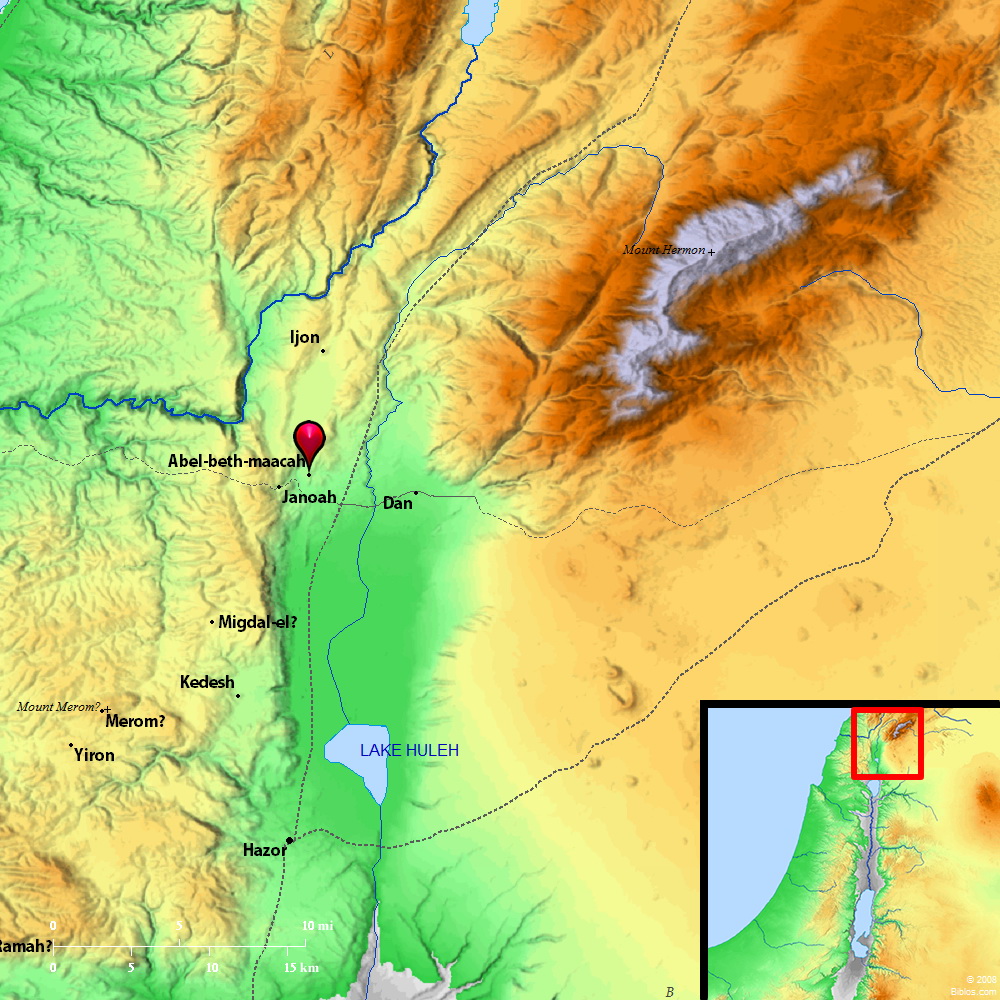
Recently I wrote here about an event at Abel-Beth-Maacah. If I were teaching on this subject I could use this map from BibleAtlas.org.

Map of Abel-beth-maacah. Courtesy of Biblos.com.

Map of Abel-beth-maacah. Courtesy of Biblos.com.

The original map is 1000 x 1000 (click on the map to see the original). It can be inserted into a PowerPoint presentation without any further work. There is plenty of space for the teacher to include some calls outs with additional information.

It is true that once you have inserted a map like this into your presentation it will take some additional study for you to be able to use it effectively. But your lesson will be much more interesting and you will more easily make your point.

Take advantage of these marvelous teaching aids. We extend our hearty thanks to the folks at BibleAtlas.org and all the others who labor and invite us to share in their labors. David Padfield frequently reminds us of the teaching of Jesus.

Freely you received, freely give. (Matthew 10:8 NAS)

A New Year’s poem by my favorite author

The New Leaf

He came to my desk with quivering lip —
The lesson was done.
“Dear Teacher. I want a new leaf he said,
“I have spoiled this one.”
I took the old leaf, stained and blotted
And gave him a new one, all unspotted,
And into his sad eyes smiled;
“Do better now, my child!”

I went to the Throne with a quivering soul —
The old year was gone.
“Dear Father, hast Thou a new leaf for me?”
“I have spoiled this one.”
He took the old leaf, stained and blotted
And into my sad heart smiled:
“Do better now, my child!”

This poem has been among my sermon notes for many years. It is one of those numerous good illustrations that have come down to us from Anonymous or Author Unknown.

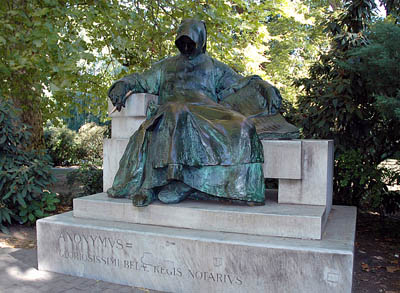
In Budapest, Hungary, near the entrance of Vajdahunyad Castle, there stands a statue of Anonymous by Miklos Legeti. The statue commemorates a 12th or 13th century unknown chronicler of one of the several rulers named King Bela.

Statue of Anonymous in Budapest. Photo by Ferrell Jenkins.

Statue of Anonymous in Budapest. Photo by Ferrell Jenkins.

The next time you quote him you will do so with knowledge of what he looked like.

Daily Bible Reading Program

Mark Roberts, of BibleClassMaterial.com, has been published a popular 5 Day Bible Reading Program for several years. The 2009 schedule has been completely revised to make it easier to complete and to arrange the reading more chronologically.

A single copy for personal use may be downloaded here. Churches wishing to duplicate larger quantities will need to buy a license.

Favorite photo of 2008?

Elizabeth and I were driving from lunch today when I asked her what she thought would be my favorite photo of 2008. That excludes the grandson, of course. After some discussion we both agreed that it was a difficult decision. She suggested the En Gedi waterfall. Good suggestion. We posted one of those photos here. I debated about posting a different view, but then decided to go with another choice.

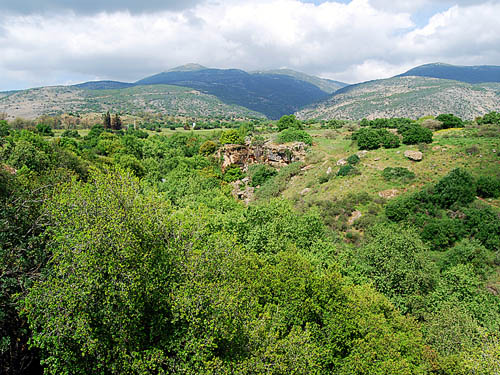
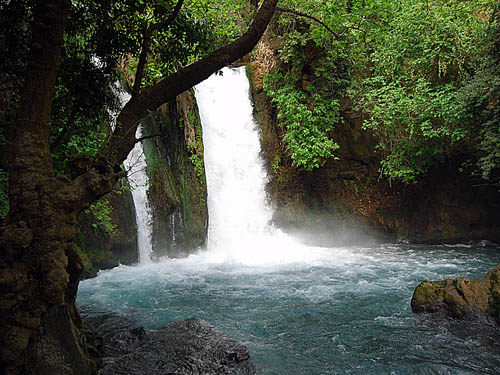
Early in the year I posted a 1984 photo of the Jordan River waterfall here. In April, while my group was eating lunch at Banias, the site of Caesarea Philippi, I broke away with David Padfield to visit the nearby Jordan Waterfall. The fall is also known as the Banias Waterfall. In order for this photo be understood it might be good if I showed you a photo of the surrounding terrain.

The photo below was made from above the waterfall. The waterfall is in the depression to the left of the rocky area; you are seeing the top of large trees. Caesarea Philippi is between the two closest hills. The Banias River begins as a spring there and soon cuts its way into the surrounding earth and rock. It is not really the Jordan until it joins with other sources, including the Dan River.

Vicinity of the Jordan River Waterfall. Photo by Ferrell Jenkins.

Vicinity of the Jordan River Waterfall. Photo by Ferrell Jenkins.

Once we make our way down into the depression among the trees we see the beautiful waterfall.

Jordan River Waterfall. Photo by Ferrell Jenkins.

Jordan River Waterfall. Photo by Ferrell Jenkins.

On my first trip in 1967 it was impossible to visit either the source of the river or the waterfall because it was within Syria. After Israel captured the territory, it became possible to make the visit.

Was this absolutely my favorite photo of 2008? Probably not. I was blessed to visit Israel (twice), Jordan, Turkey, Greece and the Greek islands. There were too many favorites to make a choice.

Matthew uses the term district or region to describe the area Jesus visited with His disciples (Matthew 16:13). The Kings James Version coasts is misleading. Mark’s term is villages (Mark 8:27). It was not far from here that Jesus was confessed as the Christ by Peter.

Jesus went out, along with His disciples, to the villages of Caesarea Philippi; and on the way He questioned His disciples, saying to them, “Who do people say that I am?”  They told Him, saying, “John the Baptist; and others say Elijah; but others, one of the prophets.” And He continued by questioning them, “But who do you say that I am?” Peter answered and said to Him, “You are the Christ.” (Mark 8:27-29 NASB; also read Matthew’s account)