Tag Archives: Syria

Acts 18 — Photo Illustrations: the Emperor Claudius

Claudius was the emperor of Rome from A.D. 41-54. This was a time when the message of Christ was spreading across the Roman Empire beginning from Jerusalem (Acts 1:8; 9:15). Much of the ministry of Paul took place during this period.

Claudius is mentioned twice in the Book of Acts.

  1. The great famine which affected the Empire during the time of Claudius prompted the disciples at Antioch to send relief to their brethren living in Judea (Acts 11:28-30). This is thought to have occurred about A.D. 46.
  2. The Emperor ordered all Jews to leave Rome. Because the Christians were considered by many as a sect of the Jews, Aquila and Priscilla left and went to Corinth where they met Paul (Acts 18:1-3). Paul was at Corinth for a period of 18 months between A.D. 51-53.
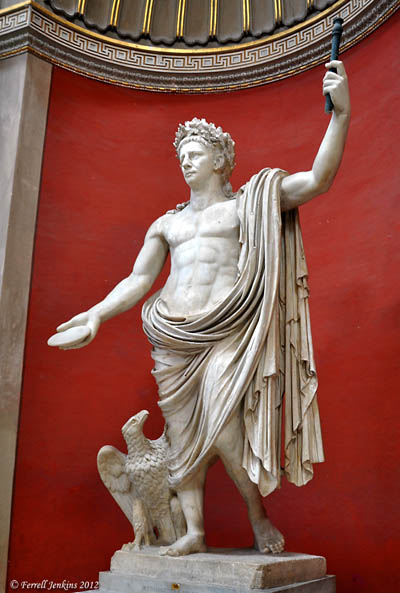
Emperor Claudius (37-54 A.D.). Vatican Museum. Photo by Ferrell Jenkins.

Emperor Claudius (41-54 A.D.), shown as Jupiter, wearing the civil crown of oak leaves and with the eagle at his feet. Found at Lanuvio, Italy, in 1865.Vatican Museum. Photo by Ferrell Jenkins.

The beautiful sculpture of Claudius is now displayed in the Vatican Museum.

Thomson’s “The Land and the Book” on Logos community pricing

William Thomson’s 3-volume set, The Land and the Book, is now on community pricing at Logos.

http://www.logos.com/product/26753/the-land-and-the-book

Thomson - The Land and the Book

The Land and the Book

This set of books was published by Harper & Brothers between 1880 and 1886.

Thomson spend many years living in Beirut and traveling throughout the region. This is one of the excellent books telling of travel in those days, and of the then-current understanding of the location of various sites.

I am delighted that this book is now on community pricing for $18. If enough people place a bid the price could be lower. Place your bid today.

HT: Brooks Cochran

Peter confesses Jesus to be “the Christ” at Caesarea Philippi

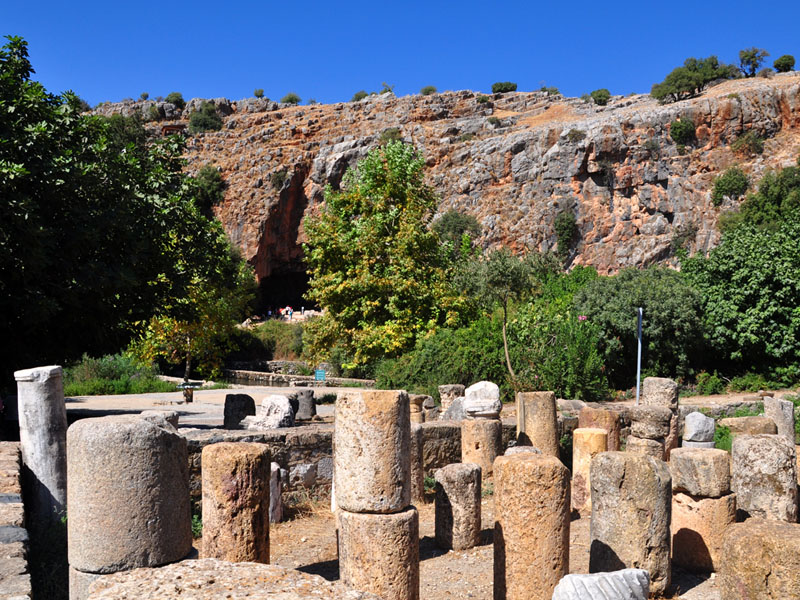
The major sites we visited today included Hazor, Dan, Caesarea Philippi, the Golan Heights, and the Jordan River. Here is a new photo I made at Caesarea Philippi. In the foreground there are broken columns discovered in the excavations at the site. The Banias (or Hermon) River, a major source of the Jordan River,  is hidden by the plants in this photo.

Caesarea Philippi. Photo by Ferrell Jenkins.

Caesarea Philippi. Photo by Ferrell Jenkins.

The Caesarea Philippi of the ministry of Jesus is also known as Banias (Matthew 16:13-19).

Caesarea Philippi is located on the eastern side of the Beka or Hula Valley.  The valley is called the Beka in Lebanon, and a little further south the Hula Valley. The elevation is about 1150 feet above sea level in the foothills of Mount Hermon.

Matthew uses the term district or region to describe the area Jesus visited with His disciples (Matthew 16:13). The King James Version coasts is misleading. Mark’s term is villages (Mark 8:27). It was not far from here that Jesus was confessed as the Christ by Peter.

Jesus went out, along with His disciples, to the villages of Caesarea Philippi; and on the way He questioned His disciples, saying to them, “Who do people say that I am?”  They told Him, saying, “John the Baptist; and others say Elijah; but others, one of the prophets.” And He continued by questioning them, “But who do you say that I am?” Peter answered and said to Him, “You are the Christ.” (Mark 8:27-29 NASB; also read Matthew’s account)

Acts 11 & 13 — Photo Illustrations

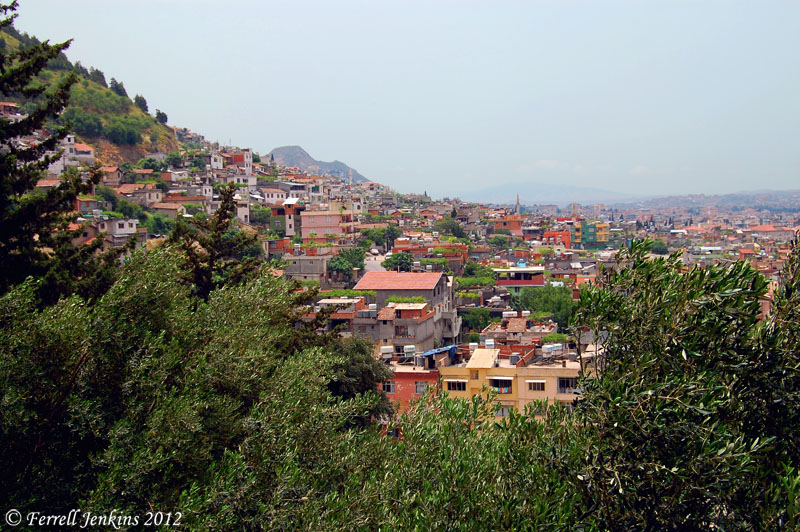
Antioch was founded on the Orontes River by Seleucus I Nicator in 300 B.C. The city is about 18 miles from the sea and is the most famous of 16 Antiochs built by Seleucus and named for his father Antiochus. Four of these cities are mentioned in the New Testament (Antioch of Syria, Pisidian Antioch, Seleucia, and Laodicea). Antioch continues today as Antakya, Turkey, with a population of more than 200,000.

Antakya, Turkey (biblical Antioch of Syria). View south from slopes of Mt. Silpius. Photo by Ferrell Jenkins.

Antakya, Turkey (biblical Antioch of Syria). View south from slopes of Mt. Silpius. Photo by Ferrell Jenkins.

The Romans came in 64 B.C. and put an end to Seleucid rule. Antioch became the capital of the new province of Syria. It became the third greatest city of the Roman empire after Rome and Alexandria. Some have estimated that in New Testament times the population of the city neared a half million. Even Herod the Great assisted Augustus and Tiberias in beautifying the city.

Seleucus I Nicator, King of Syria (358-280 B.C.). Louvre. Photo by Ferrell Jenkins.

Seleucus I Nicator, King of Syria (358-280 B.C.). Seleucus was the founder of Antioch. Displayed in the Louvre. Photo by Ferrell Jenkins.

After Jerusalem, Antioch was the second great center of Christianity in New Testament times. When the disciples were scattered from Jerusalem after the stoning of Stephen, some came to Antioch from Cyprus and Cyrene (area of modern Lybia) and preached to Greeks as well as Jews (Acts 11:19-21). Nicolas, a proselyte of Antioch, had been one of the seven chosen to serve in Jerusalem (Acts 6:5). When the church at Jerusalem, some 300 miles away, heard of the new work they sent Barnabas. When the work became too much for him he left for Tarsus to look for Saul. The two of them labored at Antioch for a whole year and the disciples of Christ were called Christians first at Antioch (Acts 11:22-26).

Acts 9 — Photo Illustrations

Damascus is first mentioned in the Bible at the time of Abraham (Gen. 14:15; 15:2-3). As the capital of Syria, the city had much contact with the kingdoms of Israel and Judah.

All of the New Testament references to Damascus are related to the conversion of Saul of Tarsus (Acts 9; 22; 26; 2 Cor. 11:32; Gal. 1:17). Saul had participated in the stoning of Stephen and was active in the persecution of the disciples of Christ in Jerusalem. He asked the high priest for authority to go to Damascus and seek out men and women who belonged to the Way and bring them bound to Jerusalem.

The Lord appeared to Saul as he approached Damascus and told him to go into the city where he would be told what he must do (Acts 9:6). Saul stayed at a house on the street called Straight. Ananias came to him and told him to arise and be baptized so that his sins might be washed away (Acts 22:16; 9:18). Saul stayed with the disciples for several days and immediately began to proclaim Jesus in the synagogues as the Son of God (9:20).

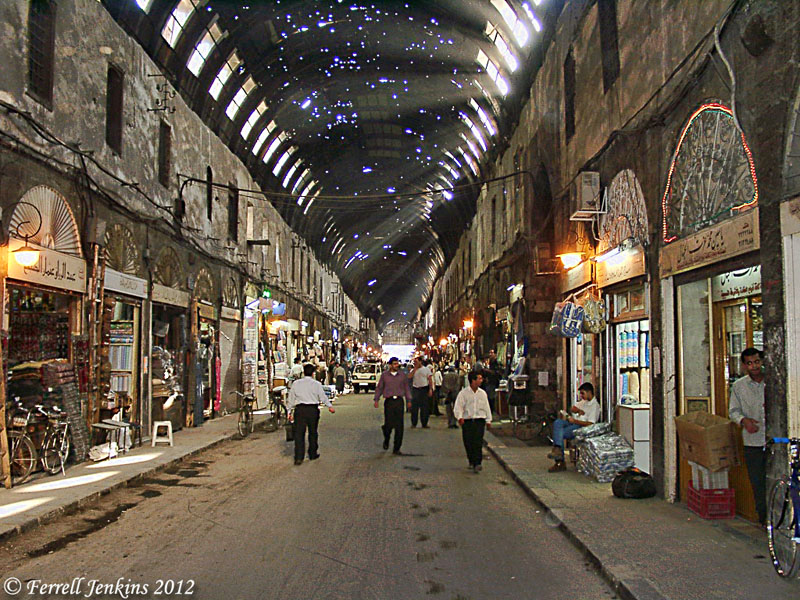
The photo below is one I made on Straight Street in 2002. This is not the main shopping street in the old city, but is historically significant.

The street called Straight in Damascus (the Via Recta). Photo by Ferrell Jenkins.

The street called Straight in Damascus (the Via Recta). Photo by Ferrell Jenkins.

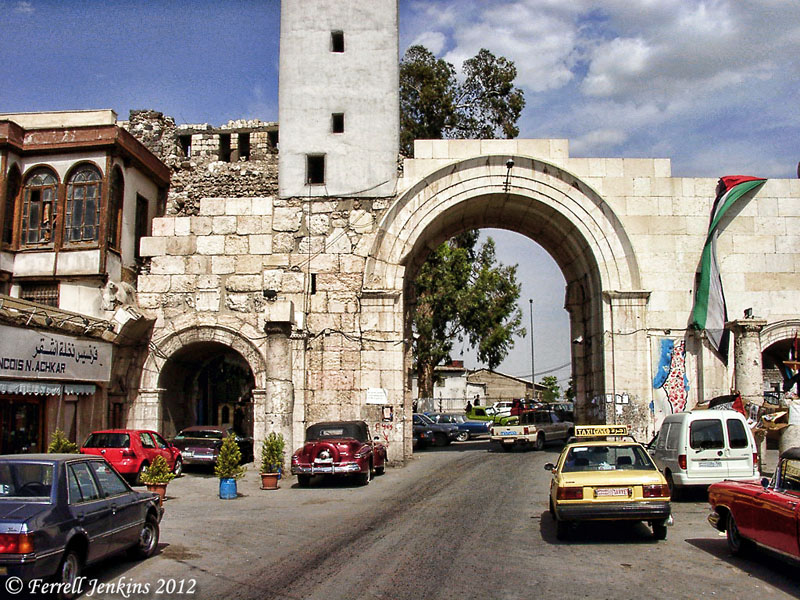
The street called Straight (Acts 9:11), the ancient Via Recta of the Roman city, now lies about 20 feet below the present street which runs the length of the old city, east to west. At the east end of the street a Roman gate has been elevated to the present level and partially restored.

Roman arch at the east end of Straight Street. Photo by Ferrell Jenkins.

Roman arch at the east end of Straight Street. Some of the stone work on the left of the central arch is original. The gate is now called Bab Sharki (Eastern Gate). Photo by Ferrell Jenkins.

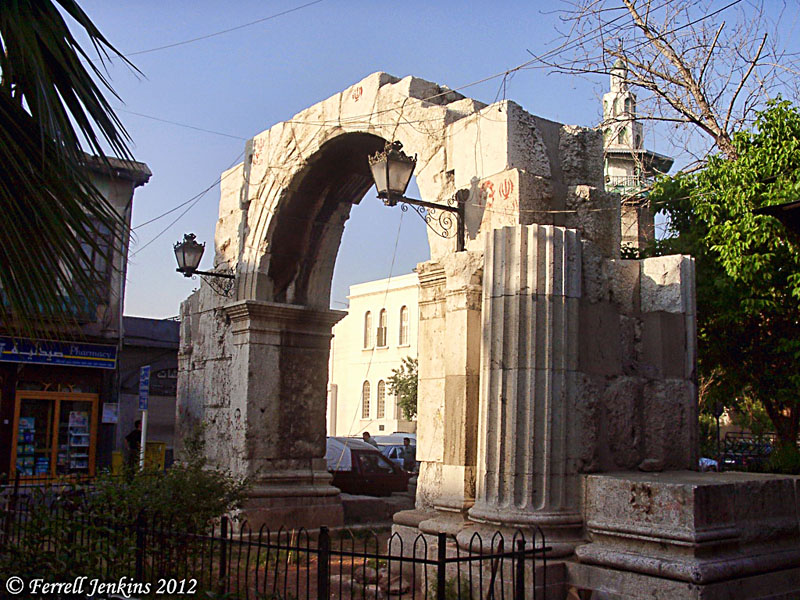
A small monumental arch, pictured below, can be seen near the middle of the Via Recta.

Roman Gate on Straight Street in Damascus. Photo by Ferrell Jenkins.

Roman Gate on Straight Street in Damascus. Photo by Ferrell Jenkins.

Note: This post is repeated, with editing, from Sept. 26, 2008 where it was entitled “Saul (Paul) in Damascus.” Another post on Damascus and Paul may be read here.

Millstones work better than concrete shoes

Jesus used the common millstone in one of his teaching illustrations.

And he said to his disciples, “Temptations to sin are sure to come, but woe to the one through whom they come!  It would be better for him if a millstone were hung around his neck and he were cast into the sea than that he should cause one of these little ones to sin. (Luke 17:1-2; cf. Matthew 18:6; Mark 9:42 ESV)

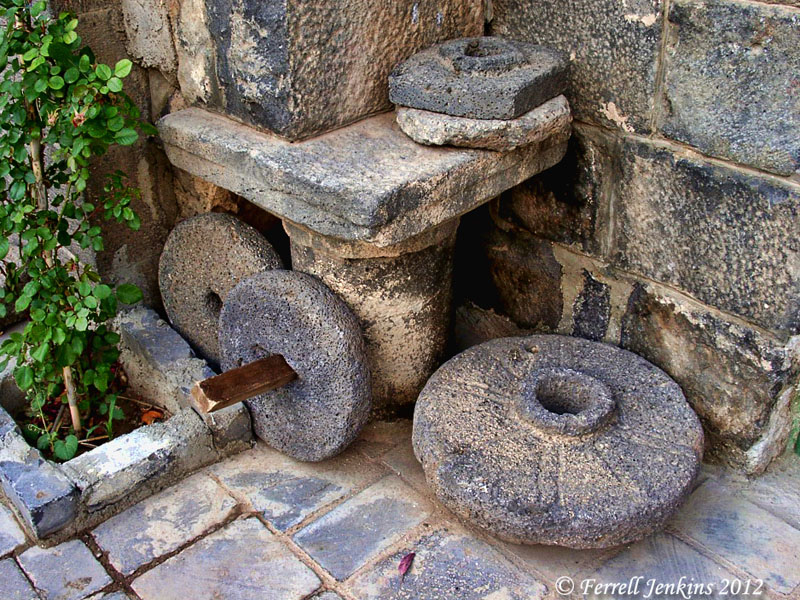
The photo below shows a collection of millstones at the Roman ruins of Bosra in southern Syria, a few miles north of the border with Jordan, in a region known as Hauran. The area has seen much volcanic action in the past. These dark millstones are made of basalt. The region is described by Ulrich Hübner this way.

Bozrah lies on one of the fruitful and water-rich plains of S Haurān at the important intersection of the N–S route, which leads from Damascus through the Transjordan to the Hejaz, with the E–W route, on which one could travel from the Mediterranean to Mesopotamia. (The Anchor Yale Bible Dictionary)

Mill stones at the Roman town of Bosra, Syria. Photo by Ferrell Jenkins.

Mill stones at the Roman town of Bosra, Syria. Photo by Ferrell Jenkins.

This Bosra is not to be confused with Bozrah in Edom (Genesis 36:33) or Bozrah in Moab (Jeremiah 48:21-24).

Millstones were significant in Bible times.

  • Used for grinding grain (even manna) (Numbers 11:8; Isaiah 47:2).
  • The work might be done by a slave girl (Exodus 11:5), or two women working together (Matthew 24:41).
  • Taking a person’s upper millstone as a pledge would deprive the person of his livelihood (Deuteronomy 24:6).
  • A woman at Shechem “threw an upper millstone on Abimelech’s head, crushing his skull” (Judges 9:53; 2 Samuel 11:21).
  • In the LORD’S challenge to Job, He describes Leviathan with a heart as hard as stone, “Even as hard as a lower millstone” (Job 41:24).
  • The sinking of a great millstone is used in the Apocalypse to describe the fall of Babylon (Revelation 18:21).

Evidence suggests Qarqur (Qarqar) continued when other civilizations saw a period of collapse

Archaeologists from the University of Arkansas “have found evidence for the continuity of civilization across a time period when civilizations throughout the Middle East and elsewhere were collapsing. Their work occurred at Tell Qarqur, an important archeological site in the Orontes River Valley in northwestern Syria.” (I typically use the Anglicized spelling Qarqar.)

“This new evidence shows the survival of a city through this tumultuous period about 4,000 to 4,200 years ago,” said Jesse Casana, associate professor of anthropology. “Our discovery offers a rare glimpse of what cultures were during this transitional time and challenges ideas about the reasons for the collapse in the first place.”

The end of the third millennium B.C. — roughly 2200 to 2000 B.C. — is often described as a dark age because this period experienced the collapse of many major states, including the Akkadian Empire in Mesopotamia, Old Kingdom Egypt and the Harappan culture of the Indus Valley. Major cities and small towns across the Middle East that had been occupied for centuries were suddenly abandoned, leaving a gap in the archaeological and historical record.

Read the full news release here. Several photos from the album may be seen at Live Science here.

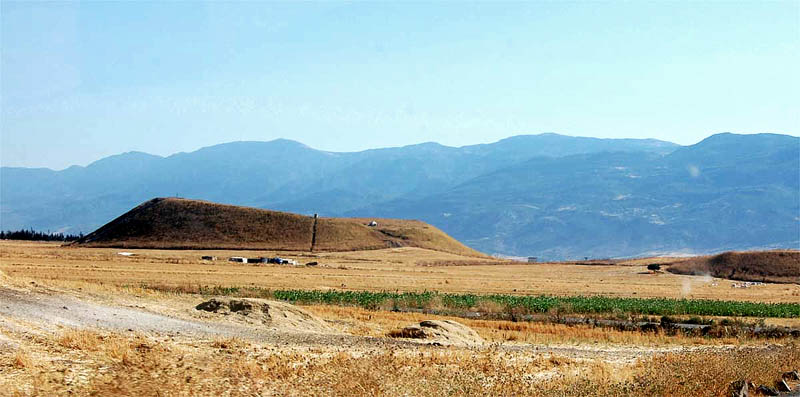
Matt McGowan, science and research communications officer at the University of Arkansas, has kindly granted permission for us to use this photo. It shows Tell Qarqur from the east. Qarqur is located in the Orontes River Valley in northwestern Syria.
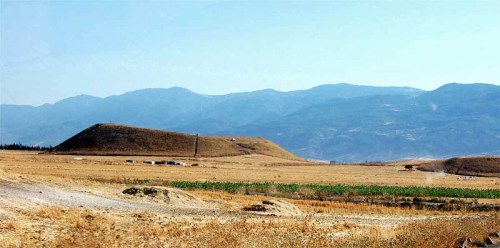
Qarqur from the east. Photo by Prof. Casana, courtesy University of Arkansas.

You will see an archaeological trench cut in the side of the tell. This allows the excavators to go down to bedrock and get a slice of every civilization that occupied the site.

Notice a portion of a second mound on the right of the image. I had the opportunity to visit the area in 2002 during early May. At that time the fields were wet and the tells were green.
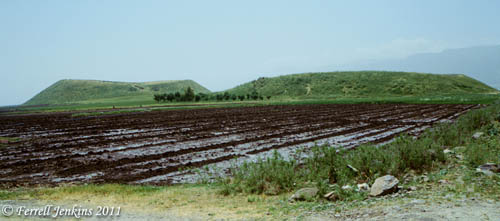
Tell Qarqar. Photo by Ferrell Jenkins, May, 2002.

Tell Qarqar. Photo by Ferrell Jenkins, May, 2002.

The Assyrian Empire ruled the ancient near east from the battle of Qarqar (853 B.C.) till the battle of Carchemish (605 B.C.) when they were defeated by the Babylonians. Nineveh had fallen seven years earlier. This was the time of the Divided Kingdom period in Israelite history, and Assyria had contact with a numerous biblical kings. Ahab, for example, fought against the Assyrians at Qarqar. Qarqar is north of Hammath (Hama). Both are on the Orontes River.

For a photo of the other side of the tell now being excavated, click here.

Finds from the excavation are said to be displayed in a museum at Hama. In light of the recent unrest in Syria, I suspect there won’t be many visitors there for a while.

HT: Joseph Lauer

Mount Hermon from the Damascus Road

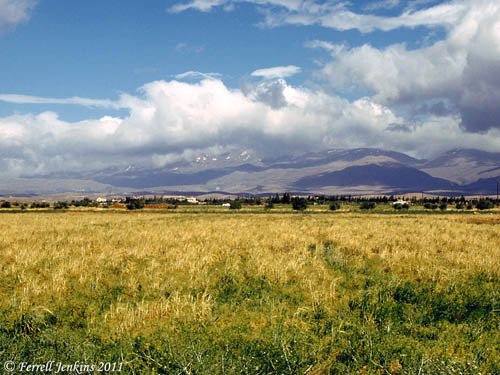
Mount Hermon is the southern end of the Anti-Lebanon mountain range. The mountain is about 20 miles long and has three peaks. At 9,232 feet above sea level it is the highest mountain of Canaan, or Roman Syria, named in the Bible. The mountain now is shared by the countries of Lebanon, Syria, and Israel. The photo below shows mount Hermon from the east, a few miles south of Damascus toward Quneitra. This is roughly the route of the famous Damascus Road taken by Paul as he went from Jerusalem to Damascus. This photo was made the middle of May, 2002. There was more snow on the west side of the mountain in Lebanon than you see here.

View of Mount Hermon from the East. Photo by Ferrell Jenkins 2002.

View of Mount Hermon from the East. Photo by Ferrell Jenkins 2002.

The first biblical reference to Mount Hermon is found in Moses’ account of the Israelite conquest of transjordan (Deuteronomy 3:8). He says that Israel took the land from the hand of two Amorite kings “from the valley of Arnon to Mount Hermon.” The Sidonians, of ancient Phoenicia, called the mountain Sirion, and the Amorites called it Senir (Deuteronomy 3:9). The half-tribe of Manasseh lived in the area of Bashan which is south of Mount Hermon (1 Chronicles 5:23). The Mountain of Bashan is probably a reference to Mount Hermon (Psalm 68:15). Hermon is mentioned in four references in the poetic books of the Old Testament (Psalm 42:6; 89:12; 133:3; Song of Solomon 4:8).

The heavens are yours; the earth also is yours; the world and all that is in it, you have founded them. The north and the south, you have created them; Tabor and Hermon joyously praise your name. (Psalm 89:11-12 ESV)

This post is a slightly revised post from 2009, but the photo is a new one digitized from a slide made in 2002.

Damascus is important in biblical history

Damascus is one of the oldest continuously inhabited cities mentioned in the Bible. It is mentioned no less than 60 times. Syria is mentioned a few times more.

Abraham went north of Damascus to rescue lot from the Mesopotamian kings (Genesis 14). He named (or considered?) Eliezer of Damascus as his heir (Genesis 15:2). I think it is most likely that Abraham, and the other patriarchs, traveled through Damascus on their way to the promised land.

The city continued to be important in biblical history during the time of the United and Divided Kingdoms of Israel and even to New Testament times (think conversion of Saul, Acts 9).

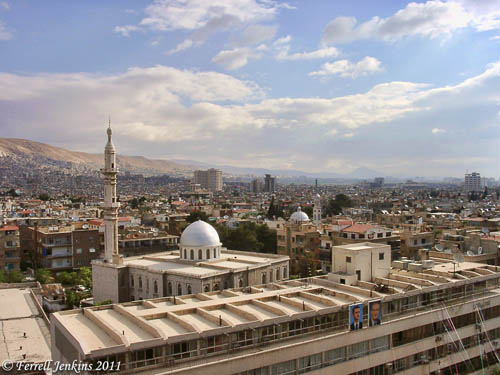
This photo was made from my hotel window in Damascus. The view is to the west (left side of photo) and north (right side of photo).  Damascus is built against the Anti-Lebanon mountains on the west. The desert on the east of the city stretches to the Euphrates River. Note two of the ever present photos of the young president Asad and his father on the building at the bottom of the photo.

Damascus. View west and north. Photo by Ferrell Jenkins.

Damascus. View west and north. Photo by Ferrell Jenkins 2002.

Mount Hermon is in the Anti-Lebanon range a few miles south of Damascus.

Hama, Syria = Hamath of the Bible

The city of Hama has been in the news quite a bit lately as the unrest of the citizens has been put down by the Syrian government. This is not something new to that city.

In 1982 Hama was the scene of the bloodiest episode of Syria’s modern history. (Footprint Syria & Lebanon Handbook 215).

At that time the protest was against the father of current president Bashar al-Asad. Estimates of the number killed range from 10,000 to 25,000.

Perhaps many Bible students read or see/hear the news about Syria today and fail to realize that this city is the site of an important city in the history of Israel. Hama is at the site of Biblical Hamath  (2 Kings 14:25; 2 Chronicles 8:4).

He [Jeroboam] restored the border of Israel from Lebo-hamath as far as the Sea of the Arabah, according to the word of the LORD, the God of Israel, which he spoke by his servant Jonah the son of Amittai, the prophet, who was from Gath-hepher. (2 Kings 14:25 ESV)

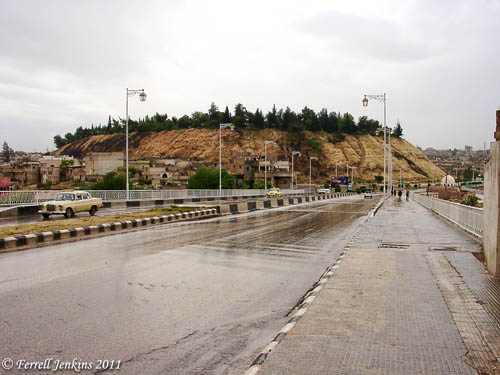
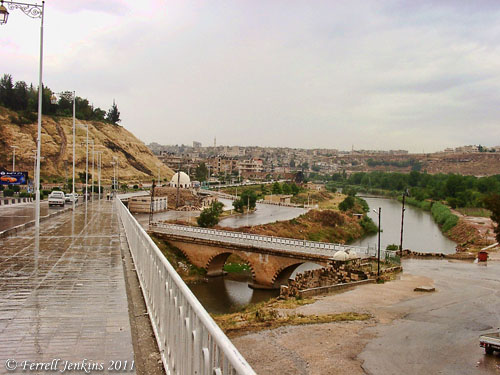
Our photo shows the tell or mound of Hamath situated on the left bank of the Orontes River as we approach from the north.

Citadel Mound of Hamath on the left bank of the Orontes River. Photo by Ferrell Jenkins.

Citadel Mound of Hamath on the left bank of the Orontes River. Photo by Ferrell Jenkins.

The work of Danish archaeologists at Hamath between 1931 and 1938 revealed occupation from the 6th millennium B.C. to the Middle Ages (Marie-Louise Buhl, Anchor Bible Dictionary). German archaeologists have been working in Hama recently, but I do not know whether it involves the tell.

The next photo shows a small portion of the tell with the Orontes River below. It was raining when we visited Hama in 2002.

Hamath on the Orontes. Photo by Ferrell Jenkins.

Hamath on the Orontes. Photo by Ferrell Jenkins.

King Toi of Hamath is mentioned twice in the Bible (2 Samuel 8:9-10; 1 Chronicles 18:9-10). One scholar recently equated biblical King Toi with a King Tatais whose name is known from inscriptions. See here.

Current news becomes much more interesting and meaningful once we know the history of a place.