Tag Archives: Photography

Archaeological project underway at Colossae

My first visit to Colossae was with two friends and teaching colleagues at Florida College. I was concluding a Bible Land tour in Rome. Melvin Curry and Phil Roberts agreed to meet me in Athens, Greece. I arrived in Athens after they had already turned in for the night, but early the next morning we took a short flight to the island of Samos, and from there we boarded a ferry to Turkey. We visited the area of the Seven churches addressed in the book of Revelation as well as other sites in the general area.

Colossae is not one of the Seven churches mentioned in the Apocalypse but it is a short distance from Laodicea. Our photo was made with a view of the tell or huyuk of ancient Colossae. We went near the site on a dirt road. The road to get to the mound is now paved.
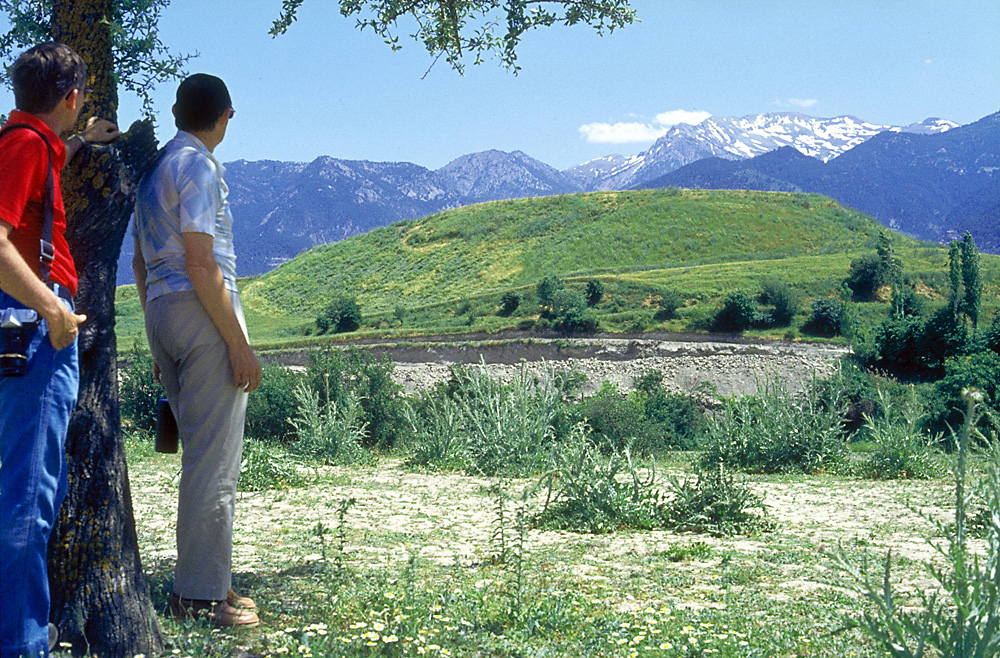
This photo shows Ferrell Jenkins and Melvin Curry gazing across  a small brook at the mound of ancient Colossae. Phil Roberts snapped the image.
I am in the blue shirt. Melvin Curry is standing behind me, and Phil Roberts snapped the photo.

Because of the Apostle Paul’s letter to the church many scholars hoped for an excavation. We all wanted to know more about the city that was home of the church we read about in Colossians. Timothy joins Paul in the address to the saints at Colossae.

The modern city known as Honaz stands in the shadow of Mount Cadmus. In this photo the town is hidden by the mound of Colossae.

Anarchaeological excavation of the site is now in progress under the direction of Dr. Barış Yener of nearby Pamukkale University. Good news.

Tell your friends about our blog and encourage them to sign up to receive each blog when it is posted. If the pictures we use are credited to the author you may use them freely in your teaching and preaching. Use for publications, etc. requires purchasing the right. Follow the link at the top of the page for details.

Conversions at Corinth in the mid first century A.D.

Subscribe to continue reading

Subscribe to get access to the rest of this post and other subscriber-only content.

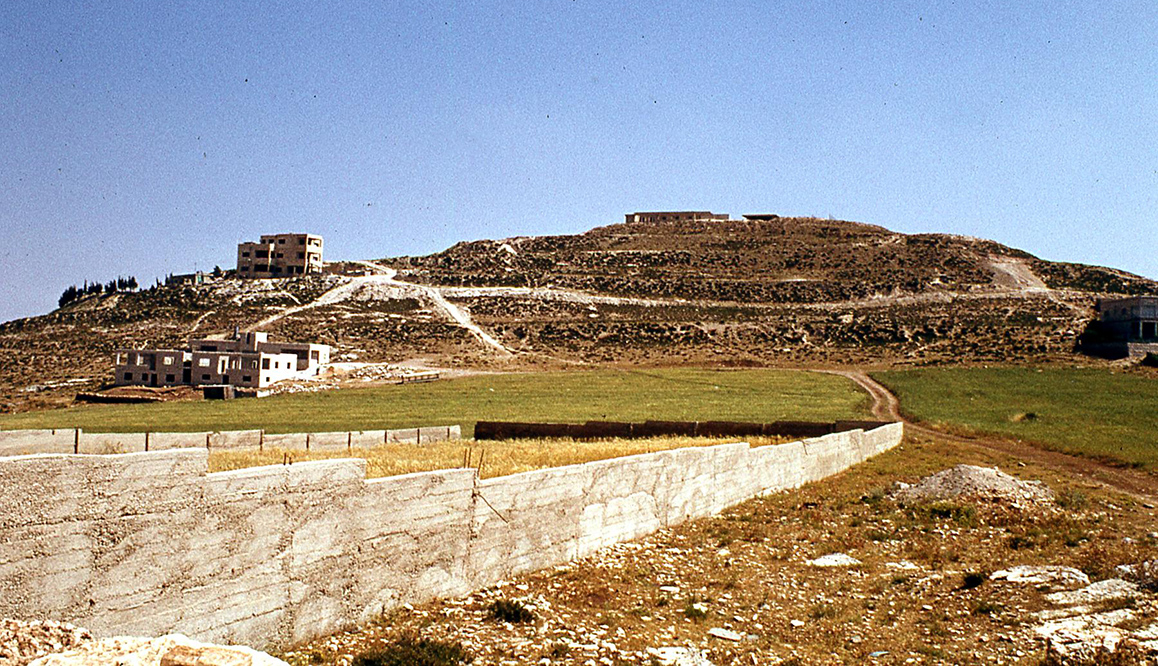
The Capitol of King Saul

Saul was the first king of Israel. He built his capitol north of Jerusalem in the territory of the tribe of Benjamin. The city is referred to in the Bible as Gibeah of Saul (1 Samuel 15:34). It is also called Gibeah of Benjamin (1 Samuel 14:16). Remnants of the small fortress from that time have been uncovered at the site. The flat-top building you see was being constructed by king Hussein of Jordan when Israel captured the area during the Six day war in 1967. Today the entire area around the tel is covered by residences and business buildings.

Photo (c) by Ferrell Jenkins about 1970 or 1971.

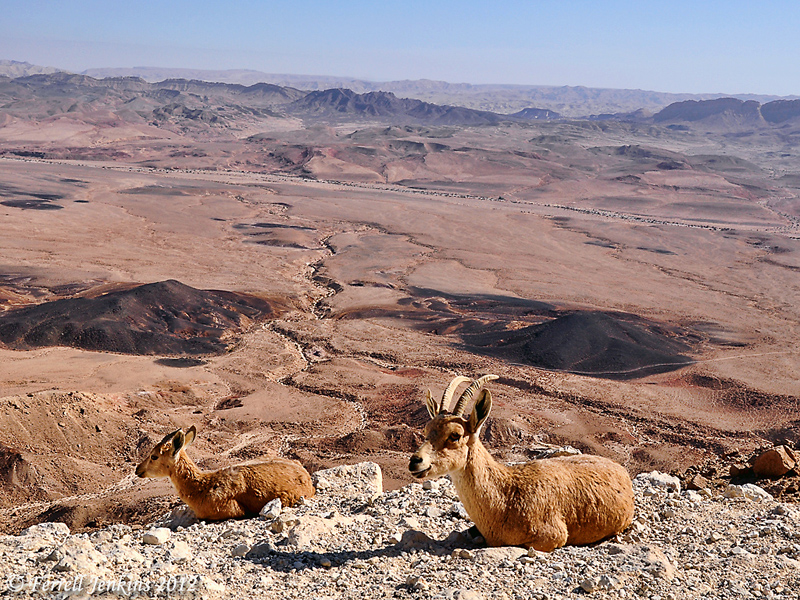
Wild Goats at Mitzpe Ramon

Ibex enjoy the view at Mitzpe Ramon, Israel, in the Wilderness of Zin. These two Ibex are lying on the edge of a steep cliff over a major highway below. Use the blog Search box to locate more photos of Ibex and additional information. Photo by Ferrell Jenkins.

Ibex enjoy the view at Mitzpe Ramon in the Wilderness of Zin. Photo by Ferrell Jenkins
https://wp.me/p1zOp-5yt

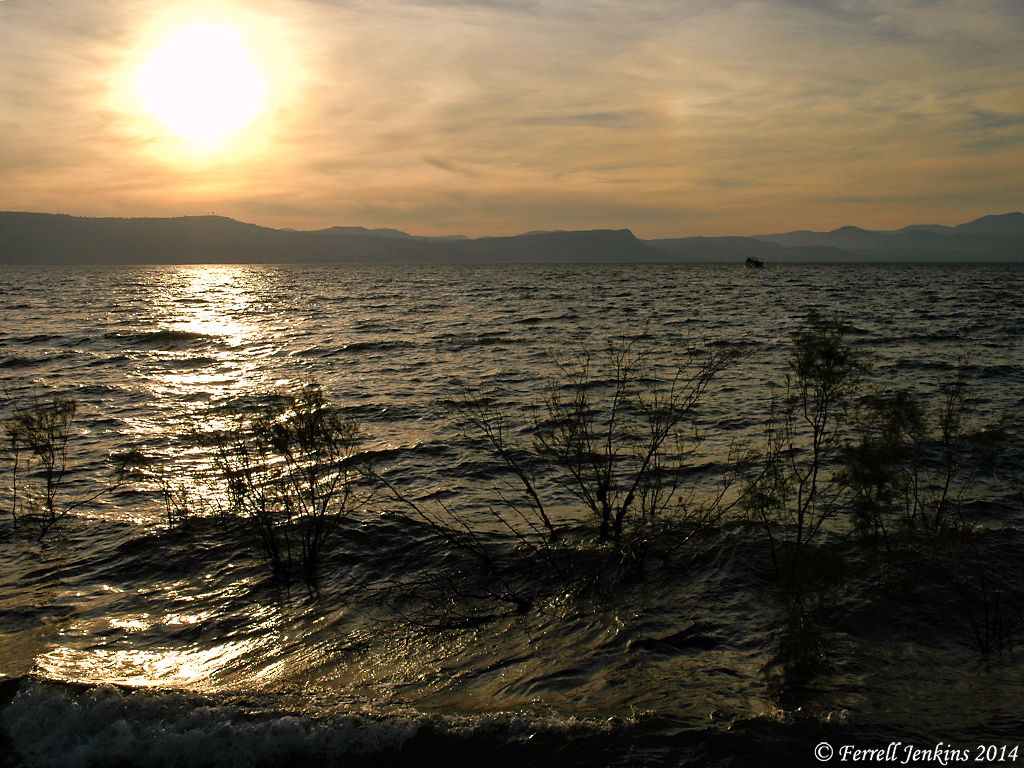
Choppy Water at Sunset: A View of the Sea of Galilee from the East

Many photos have been made of the sunrise on the Sea of Galilee. I certainly have made my share of them. On a rare occasion I have found my tour group or myself on the eastern shore of the Sea of Galilee at sunset. The photo below was made from En Gev. It illustrates several important things. The water looks choppy. This is more typical in the late afternoon than in the morning. The wind comes from the North East and causes turbulence on the water. That is what you see in this photo. Let me emphasize that this is NOT an AI generated picture..

The Sea of Galilee from the east at sunset. The water is choppy.
A view of the Sea of Galilee from the east at sunset. Photo by Ferrell Jenkins.

Something resembling this happened on the occasion when the disciples saw Jesus walking on the water. See Matthew 14, Luke 5 and John 6. Notice that a strong wind was blowing on the sea (John 6:18).

If you have traveled in this region of Israel you will recognize Mount Arbel and the Horns of Hattin in the distance on the western side of the Sea of Galilee (or Kinneret).

John baptized in the Jordan River

John, the son of Zachariah and Elizabeth, was born in a village west of Jerusalem. The Lord gave him a special responsibility as the one preparing the way for Jesus the Messiah. The Gospels record some of his early work. John appeared, baptizing in the wilderness and proclaiming a baptism of repentance for the forgiveness of sins. And all the country of Judea and all Jerusalem were going out to him and were being baptized by him in the river Jordan, confessing their sins.
(Mark 1:4-5 ESV)

John began to preach a baptism of repentance and many from Jerusalem and Judah came to him to be baptized.

Jesus came from Galilee to the Jordan River to be baptized by John (Matthew 3:13-17). His baptism was an exception to all the others John baptized. Jesus had no sin, but this was the occasion of the Father’s acknowledging him as his son.

A specific location is mentioned as “Bethany across the Jordan” (John 1:28). This location very near the traditional site that many have visited at Qasr el-Yahud near Jericho. Jordanian scholars claim that the baptism of Jesus took place on the eastern side of the Jordan River, a place they call Bethany beyond the Jordan. The photo below shows my long-time traveling friend, Leon Mauldin, very near this site.

Leon Mauldin on the banks of the River Jordan. Photo by Ferrell Jenkins.

When I was leading tours I often said to my group about some proposed site of a Biblical event, “If it was not here (pointing directly in front of me), it was here (spreading my arms wide). In Israel one is never far from a significant Biblical event.

Bringing in the Sheaves

The two main grain crops in Bible times were wheat and barley. Barley tended to be used mostly by the poor and for the feeding of the animals. It was planted and ripened about a month earlier than wheat.

Here is a list of the Biblical references to cutting the grain, binding it into sheaves so they could be brought into the barns.

The Psalmist said ” He who goes out weeping, bearing the seed for sowing, shall come home with shouts of joy, bringing his sheaves with him.” (Psalm126:6 ESV). And again, the Psalmist says, with which the reaper does not fill his hand nor the binder of sheaves his arms (Psalm 129:7 ESV)

Sheeves of grain bound to be gathered into the barn near ancient Samaria. The tell can be seen on top of the hill to the left of the photo. Photo by Ferrell Jenkins.
Grain that has been cut and bound so that it can be brought into the barn. The ancient hill of Samaria can be seen in the distance.

Moses’ View of the Promised Land

The past few days I have been looking through my photos of Mount Nebo in Jordan. My first visit to the site was in 1967 when the Old City of Jerusalem was in Jordan. Our group got up early on Tuesday May 2 and packed into some of the larger American cars for the ride to Mount Nebo and other sites in the area. For my first two tours the tour operator used cars to transport the group from place to place. We had 19 tour members on that first tour. The tour operator used Mercedes autos on the second tour. When we arrived at the site the tour members would gather to listen to the guide make his presentation.

I recall the guides for the early tours making comments about the view from Mount Nebo when they were younger. Several said they used to be able to see Mount Hermon from the site, before there was so much haze from pollution. I can recall a time or two that we might have had a fairly decent glimpse of Jericho.

Most times we could see only the wilderness of Judea on the west side of the Dead Sea. We might see a little bit of the northern end of the Dead Sea.

Because of the sin of Moses in failing to give credit to God for the water he provide in the wilderness Moses was not permitted to enter the promised land (Numbers 20:1-13).

Mount Nebo is the place from which Moses viewed the land that the LORD had promised to Abraham’s seed (Deuteronomy 34:1-8).

He could see the land but he was not permitting to lead the people across the Jordan into the land. This responsibility would fall to his successor Joshua.

The reconstructed Byzantine church built on Mount Nebo to commemorate the Biblical event.
The approach to Mount Nebo in the Biblical land of Moab

The building on Mount Nebo is a reconstructed Byzantine church built at the site to commemorate the event of Moses viewing the promised land before his death and burial in the vicinity.

The next photo show the typical view we have today when we look to the west from Mount Nebo.

Typical view from Mount Nebo to the West.
Typical View from Mount Nebo to the West.

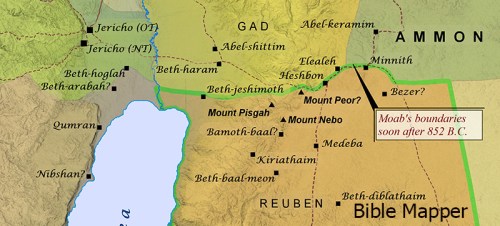
Here is a map showing Mount Nebo in the time of Moses.

Map showing the area near the Biblical site of Mount Nebo. Credit: BibleMpper.com.
The map is a portion of one of the outstanding maps available at BibleMapper.com. Highly recommended.

Centurions of the New Testament

Cornelius, a Roman centurion, was the first Gentile convert to the faith. He was stationed at Caesarea on the Mediterranean coast at the time when the apostle Peter was actively working in the spread of the Gospel.

A centurion in the Roman army normally had charge of 100 men (= to an Army captain). A regular cohort was one tenth of a legion and had a paper strength of 600 men. An auxiliary cohort was usually comprised of 1,000 men. Cornelius was of the Italian cohort. There is inscriptional evidence for the “Italian cohort” from Syria (See Bruce, 215).

When Paul set sail from Caesarea for Rome he was accompanied by a centurion of the Augustan cohort named Julius (Acts 27:1). All of the centurions mentioned in the New Testament make favorable impressions. This was not true of soldiers generally (Luke 3: 14). Note these examples:

  • The centurion at Capernaum (Matthew 8:5-13; Luke 7:2-10).
  • The centurion at the crucifixion of Jesus (Luke 23:47).

F. F. Bruce (The Book of Acts, NICNT) cites Polybius (History vi.24) saying,

“Centurions are required not to be bold and adventurous so much as good leaders, of steady and prudent mind not prone to take the offensive or start fighting wantonly, but able when overwhelmed and hard-pressed to stand fast and die at their post.”

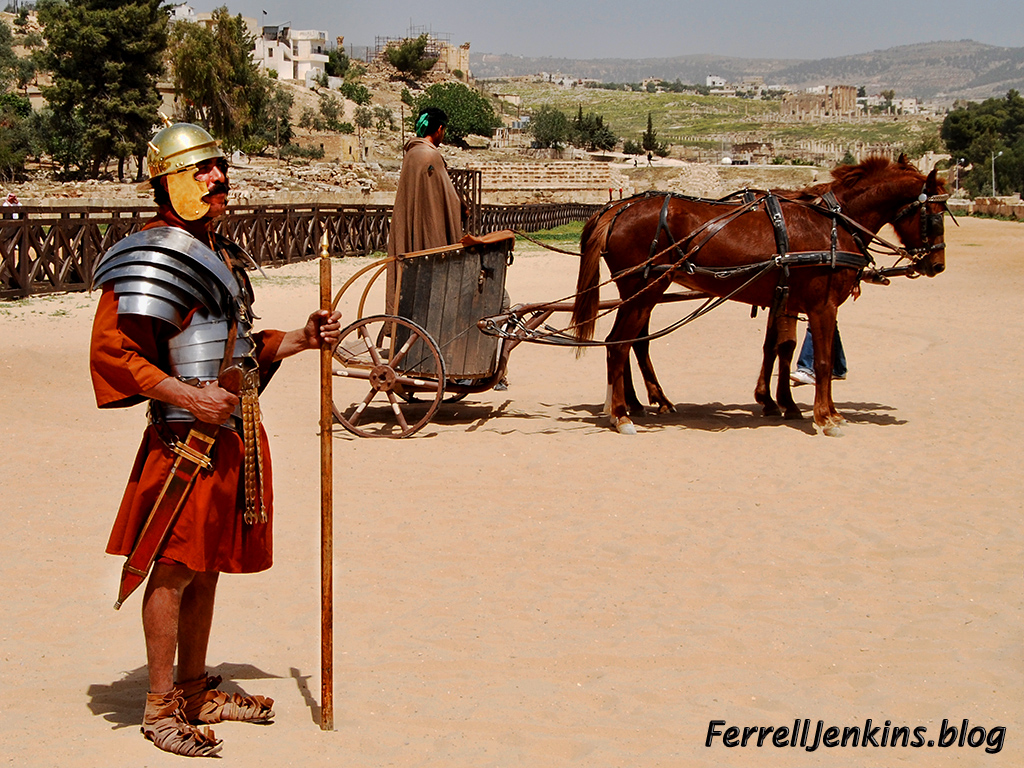
There is a wonderful performance in the early second century A.D. hippodrome at Jerash, Jordan. The RACE show (Roman Army Chariot Experience) shows actors dressed as Roman soldiers performing various activities of the early soldiers. Our photo shows a Roman centurion from that show.

Roman Centurion, with his chariot waiting,
in the RACE show at Jerash, Jordan.

Recent travel in Israel

Paulette and I enjoyed two weeks of travel in Israel the first part of May. It was her first opportunity to see and learn the land. I led tours to the Bible world almost annually from 1967 to 2016 and have made personal study trips to Israel or some other part of the Bible world with a friend every year except the first year of the recent pandemic. I wanted to show Paulette places that she had read about many times in her Bible study. Though she believes the Biblical accounts about the activities of Jesus and his disciples, as well as the judges, prophets and other writers of the Bible, I watched as the Biblical text came alive to her in a new way. We did not see as much as I had hoped but we were able to work out from Jerusalem and Tiberias on the Sea of Galilee and also enjoy a day along the Dead Sea.

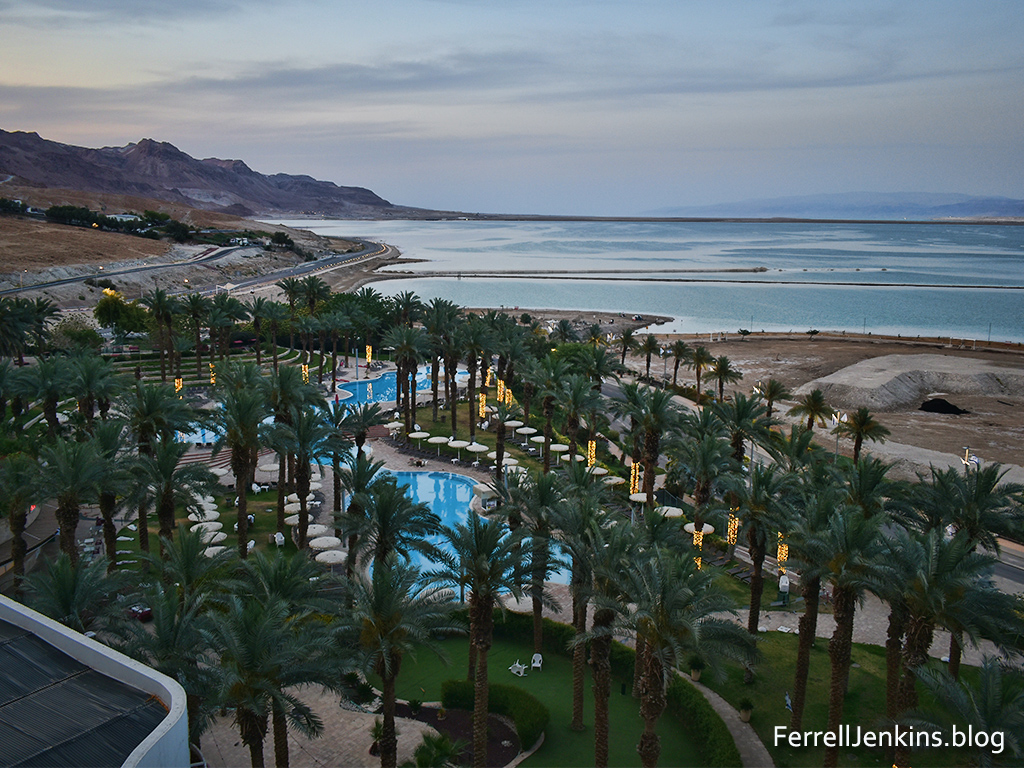
We drove the full length of the Dead Sea, south and north. Here are photos of some scenes that impressed us. The first one is a late afternoon view of the recreation area of the Dead Sea Resort and Spa at Ein Bokek at the southern end of the Dead Sea. The view is to the northeast. The water in this area is pumped from the deeper north. Otherwise it would be dry.

Southern end of the Dead Sea. Hotel recreation area.

Biblical references refer to the Dead Sea as the Sea of the Arabah and the Salt Sea (Deuteronomy 3:17; Joshua 3:16). The Greeks called it Lake Asphaltitis (Josephus, Jewish War IV.476-450).

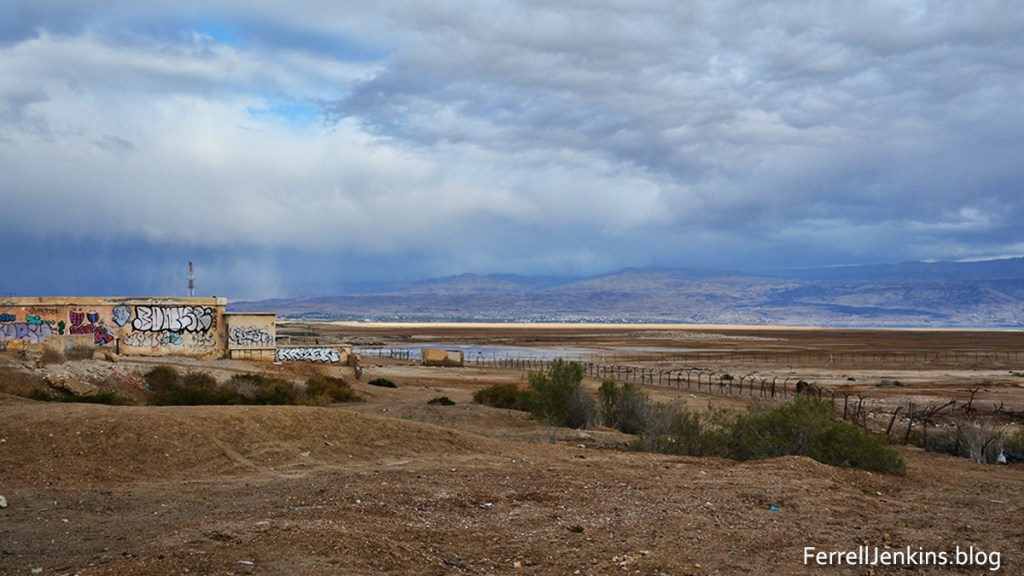
The next photo shows ruins of an old hotel or a building used by the military in the 1967 war. A hotel was there in 1967, my first trip. It was only a short walk to the water at that time, but today one can hardly see the water. We are aware that the level of the Dead Sea has continued to recede at about a meter (three feet) each year as less water flows into the Dead Sea from the north. Most of the water is pumped into reservoirs to provide water for the residents of Israel.

The north end of the Dead Sea. The view is from the Israel side toward the Transjordan plateau.

When I took my first class dealing with Bible geography in 1953 I learned that the Dead Sea was 1290 feet below sea level. Fairly recent reports give the surface level of the water as 1410 ft.

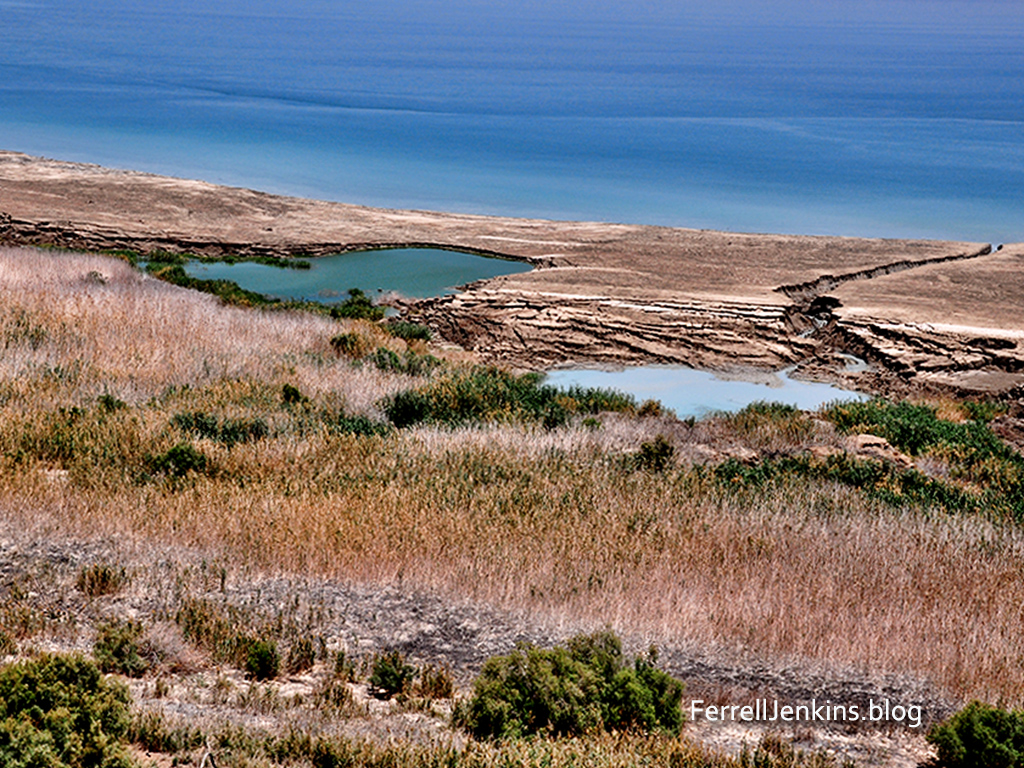
This photo below shows some of the sink holes that have recently developed on the west side of the Dead Sea near the northern end. A few years ago the water came almost to the highway.

We have written about the Dead Sea on several occasions. As always, we suggest that you use the Search box to seek information and photos for this and other Biblical places and topics.