Tag Archives: Ministry of Jesus

Rare hoard of coins from pre-AD 70 discovered near Jerusalem-Tel Aviv highway

The Israel Antiquities Authority announces today the discovery of a box containing 114 bronze coins dating to Year Four of the Great Revolt (Jewish Revolt against the Romans). The discovery was made several months ago during work on the new Highway 1 project (between Jerusalem and Tel Aviv).
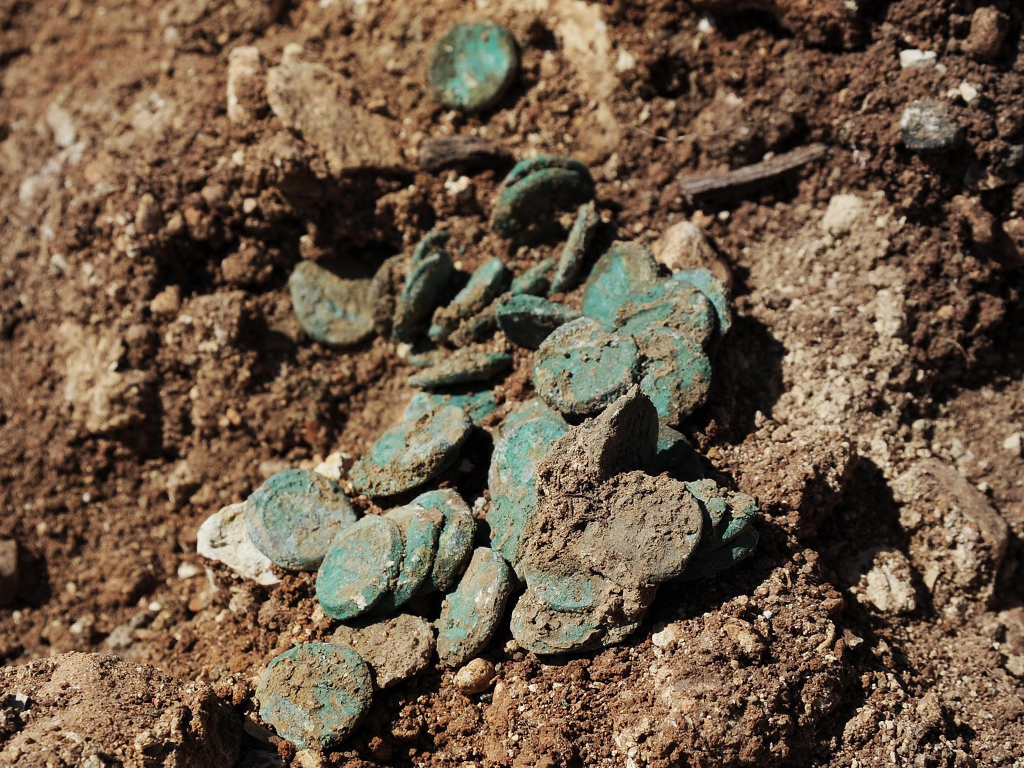
Coin hoard as it was found in the excavation. Photo Vladimir Nuhin, IAA.

Coin hoard as it was found in the excavation. Photo Vladimir Nühin, IAA.

According to Pablo Betzer and Eyal Marco, excavation directors on behalf of the Israel Antiquities Authority, “The hoard, which appears to have been buried several months prior to the fall of Jerusalem, provides us with a glimpse into the lives of Jews living on the outskirts of Jerusalem at the end of the rebellion. Evidently someone here feared the end was approaching and hid his property, perhaps in the hope of collecting it later when calm was restored to the region”. All of the coins are stamped on one side with a chalice and the Hebrew inscription “To the Redemption of Zion” and on the other side with a motif that includes a bundle of lulav between two etrogs. Around this is the Hebrew inscription “Year Four”, that is, the fourth year of the Great Revolt of the Jews against the Romans (69/70 CE).

The hoard was concealed in the corner of a room, perhaps inside a wall niche or buried in the floor. Two other rooms and a courtyard belonging to the same building were exposed during the course of the archaeological excavation. The structure was built in the first century BCE and was destroyed in 69 or 70 CE when the Romans were suppressing the Great Revolt.  Early in the second century CE part of the building was reinhabited for a brief period, which culminated in the destruction of the Jewish settlement in Judea as a result of the Bar Kokhba rebellion. This is attested to by three complete jars that were discovered embedded in the courtyard floor.

It seems that the residents of this village, like most of the Jewish villages in Judea, were active participants in both of the major uprisings against the Romans – the Great Revolt and the Bar Kokhba Revolt. As a result of their involvement the place was destroyed twice, and was not resettled.

The Israel Antiquities Authority and Netivei Israel Company are examining the possibility of preserving the village remains within the framework of the landscape development alongside the highway.
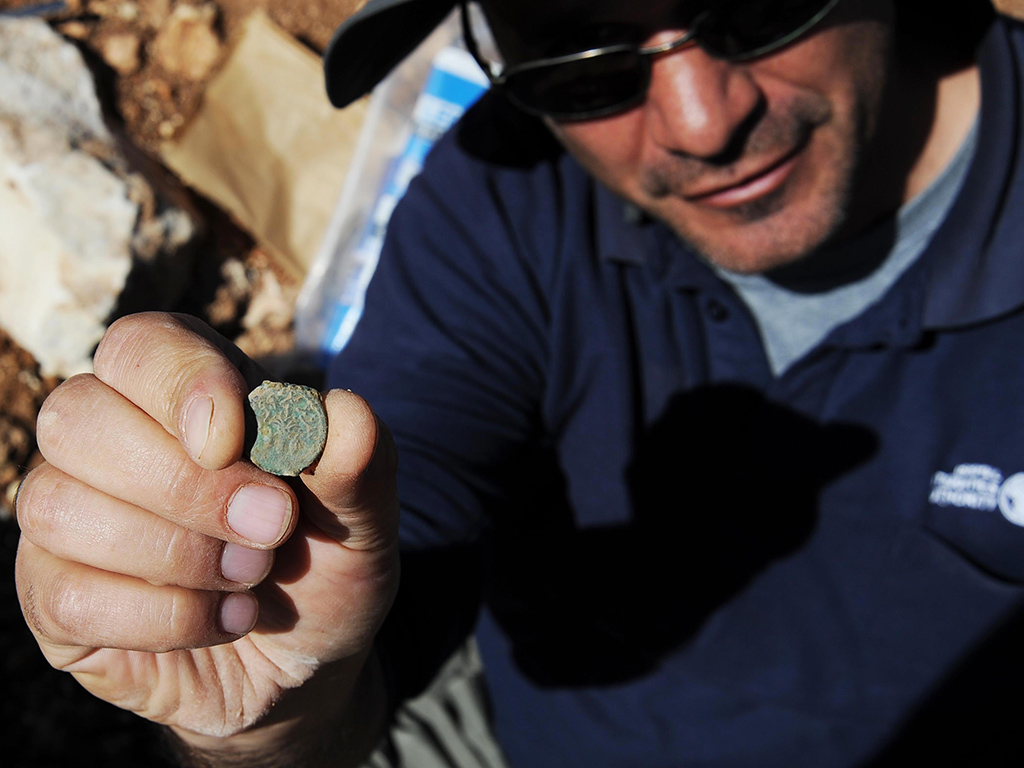
Pablo Betzer, IAA District Archaeologist for Judah, with a coin from Year Four of the Great Revolt. Photo Vladimir Nühin, IAA.

Pablo Betzer, IAA District Archaeologist for Judah, with a coin from Year Four of the Great Revolt. Photo Vladimir Nühin, IAA.

This discovery might remind Bible readers of the illustration used by Jesus.

The kingdom of heaven is like treasure hidden in a field, which a man found and covered up. Then in his joy he goes and sells all that he has and buys that field. (Matthew 13:44 ESV)

HT: Joseph Lauer

More artifacts of the Tenth Roman Legion

We had a good response to our recent posts, here and here, about the Roman Tenth Legion in Jerusalem.  I will post a few photos of other artifacts that are readily available for those who visit Israel.

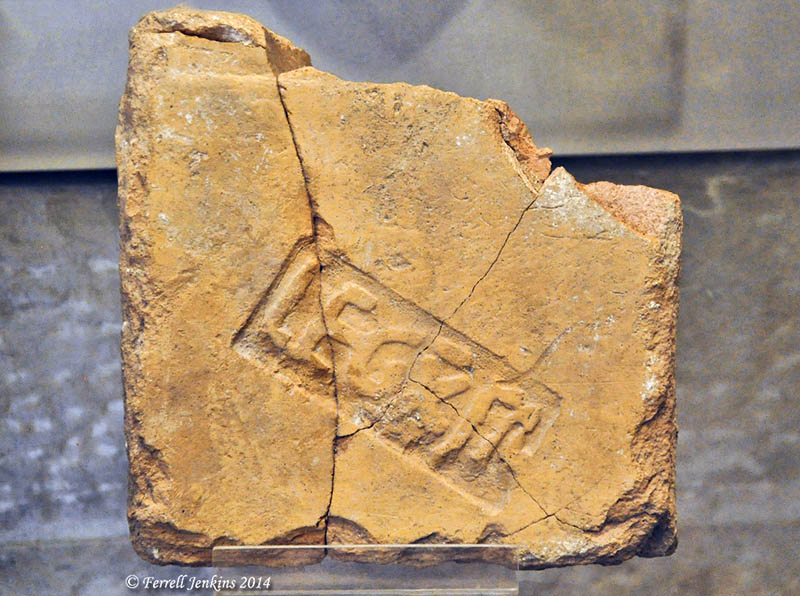
The first is an inscription of the eighth cohort of the Tenth Legion. According to the accompanying sign in the Israel Museum this limestone inscription comes from Jerusalem or Samaria and belongs to the first or second century A.D. The inscription reads “LEG X FRE COH IIX” and is decorated with dolphins and a wild boar, symbols of the legion.

Inscription of the Eighth cohort of the Tenth Legion. Israel Museum.

Inscription of the eighth cohort of the Tenth Legion. Photo by Ferrell Jenkins.

About halfway between Jerusalem and Bethlehem is the site of Ramat Rachel. It was first occupied in the 7th century B.C. Stratum III revealed evidence of a Roman villa dating to the 3rd and 4th centuries A.D. Some of the clay tiles from the villa are displayed in the hotel at the site.

Information about Ramat Rachel is available on the Archaeological Project website here.

Tile of the Tenth Legion from Ramat Rachel. Photo by Ferrell Jenkins.

Tile of the Tenth Legion from Ramat Rachel. Photo by Ferrell Jenkins.

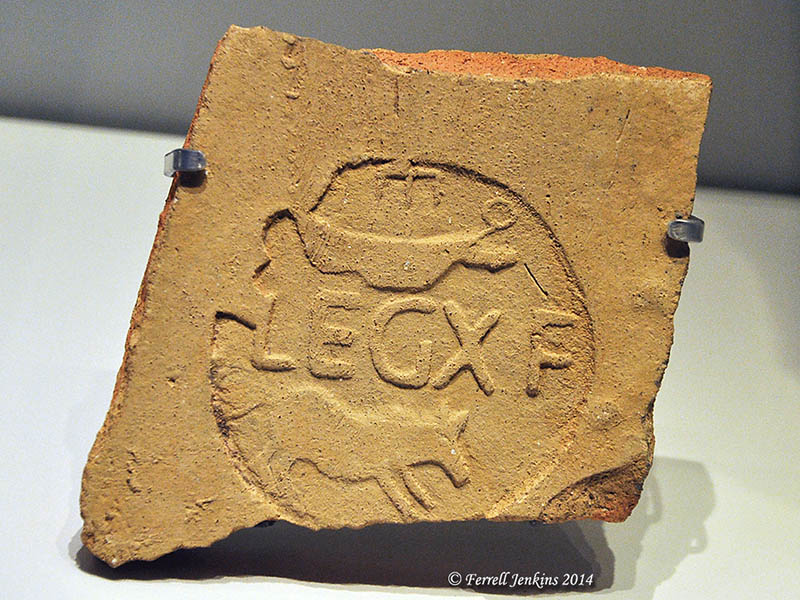
Finally, here is a tile fragment with a stamp of the Tenth Legion. The inscription reads “LG X F.” A wild boar and a battleship are the symbols on this one. The Israel Museum says this tile dates to the 1st-2nd century A.D.

Tenth Legion tile in the Israel Museum. Photo by Ferrell Jenkins.

Tenth Legion tile in the Israel Museum. Photo by Ferrell Jenkins.

The Roman period in the Holy Land is usually dated from about 63 B.C. to A.D. 323. This includes the entire period of Jesus, the early church, and the New Testament, but it also includes the time of the destruction of Jerusalem and the period when Jerusalem was rebuilt by the Emperor Hadrian and named Aelia Capitolina.

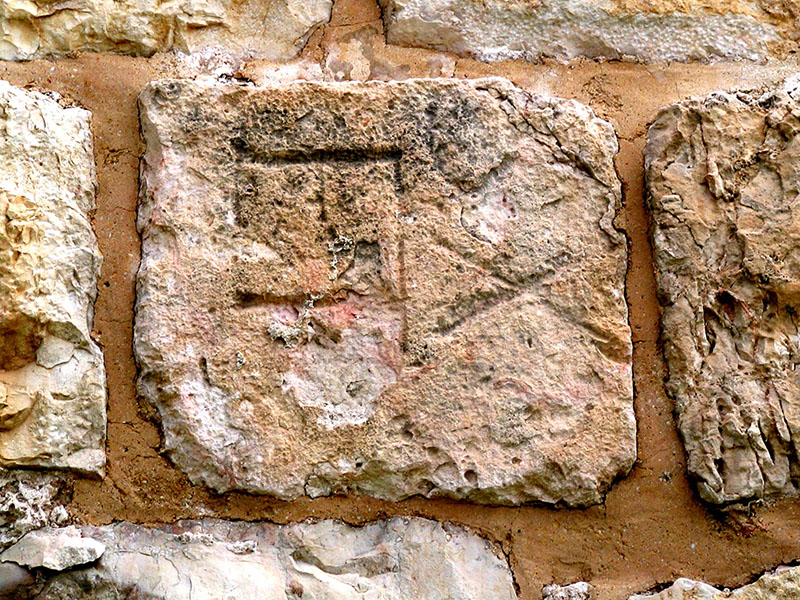
Added Note: See the helpful comments by Tom Powers below. Tom is licensed as a guide in Israel, but is no longer living there. Here is the photo he mentions in the comment about the reused stone in the wall of the Old City near Jaffa Gate.

Partial stone bearing inscription of the Tenth Legion reused in the wall of the Old City near Jaffa Gate. Photo by Tom Powers.

Partial stone bearing inscription of the Tenth Legion reused in the wall of the Old City near Jaffa Gate. Photo by Tom Powers.

The Tenth Roman Legion in Jerusalem

Students of the Bible are aware that the city of Jerusalem, including the Herodian temple, was destroyed by the Romans in A.D. 70. Vespasian commanded the Romans in the north of the country. When he learned of the death of Nero he began his return to Rome and left his son Titus in command of the military forces.

When Titus began to position his forces around the city of Jerusalem, he called the tenth legion from Jericho to come up to the Mount of Olives and take their position there.

and as these were now beginning to build, the tenth legion, who came through Jericho, was already come to the place, where a certain party of armed men had formerly lain, to guard that pass into the city, and had been taken before by Vespasian. These legions had orders to encamp at the distance of three quarters of a mile from Jerusalem, at the mount called the Mount of Olives, {c} which lies opposite the city on the east side, and is parted from it by a deep valley, interposed between them, which is named Kidron. (Josephus, Jewish Wars 5:69-70)

Jesus had prophesied about forty years earlier that the Holy City would be surrounded by armies.

But when you see Jerusalem surrounded by armies, then know that its desolation has come near. (Luke 21:20 ESV)

The word used for armies (stratopedon) is used in literature of the time to specify a legion or a camp (see BDAG and MM).

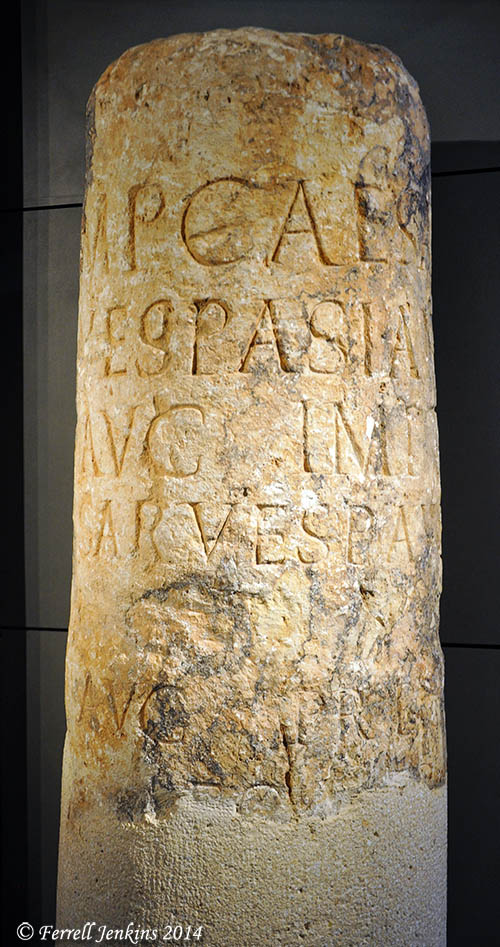
Archaeological discoveries have supplemented the writings of Josephus to provide evidence of the presence of the tenth legion in Jerusalem. In addition to the column near Jaffa Gate that we mentioned in the previous post, we here call attention to some other evidence that is readily available for anyone who wishes to see it. Here, I call attention to a Roman milestone.

Roman milestone found near the Temple Mount in Jerusalem mentions Vespasian, Titus, and the Tenth Legion. Displayed in Israel Museum. Photo by Ferrell Jenkins.

Roman milestone found near the Temple Mount in Jerusalem mentions Vespasian, Titus, and the Tenth Legion. Displayed in Israel Museum. Photo by Ferrell Jenkins.

The Israel Museum sign associated with the milestone reads,

Near the Temple Mount in Jerusalem, a milestone bearing a Latin inscription was discovered. The inscription mentions both the Roman emperor Vespasian and his son Titus, commander of the Roman army at the time of the suppression of the Great Revolt and had been deliberately effaced, seems to have mentioned the name of Flavius Silva, procurator of Judea and commander of the Tenth Legion, responsible for both the destruction of Jerusalem and the conquest of Masada. The inscription was carved by soldiers of the Tenth Legion.

I have a few more photos of artifacts mentioning the tenth legion that I hope to post soon.

Roman Roads and Milestones

A new website devoted to Roman Roads and Milestones in Judaea/Palaestina has recently come to our attention. This site is co-sponsored by the Kinneret College on the Sea of Galilee Department of Holy Land Studies and Tel Aviv University IMC-Israeli Milestone Committee. Most readers will know that Kinneret is the Hebrew name for the Sea of Galilee. The website includes articles by the late Israel Roll and others, as well as maps showing the location of the roads. Many of the articles are in Hebrew or another language other than English. The maps, however, should be useful to those who do not read Hebrew.

The English website is available here. (If it links to the Hebrew page look in the upper left hand corner and click on EN.)

Good Bible atlases include a map of the known roadways. See, for example, the following:

  • Rasmussen, Zondervan Atlas of the Bible. Rasmussen includes a map showing the Natural Routes/Roads, and a discussion of International Routes.
  • Beitzel, The New Moody Atlas of the Bible. Beitzel includes a map showing The Roads of Palestine and a discussion of the principles back of making decisions about the roads.
  • Schlegel, Satellite Bible Atlas. The second map in this atlas shows the Regions and Routes of the Land of Israel.

Our photo below shows remains of the Roman road that Jesus might have taken from near Nazareth to the Sea of Galilee. These roads are often in danger of destruction by careless builders and farmers.

The Roman Road near Golani Junction in Galilee. This road collected Diocaesarea (Zephoris) and Tiberias. Photo by Ferrell Jenkins.

The Roman Road near Golani Junction in Galilee. This road connected Diocaesarea (Zephoris) and Tiberias. Photo by Ferrell Jenkins.

Jesus taught His disciples about the attitude they should have toward the Roman authorities.

And if anyone forces you to go one mile, go with him two miles.(Matthew 5:41 ESV)

New Testament writers gave distances in their descriptions of travel from one city to another. Luke says that Emmaus was about seven miles from Jerusalem (Luke 24:13). John says that Bethany was about two miles from Jerusalem (John 11:18).

Milestones were common in Roman times and numerous ones have been found throughout the land of Israel. I understand that the milestone below is from the Jezreel Valley. It is one of many displayed on the grounds of the Beit-Sturman Museum near En Harod.

Roman Milestone from the Jezreel Valley. Photo by Ferrell Jenkins.

Roman Milestone from the Jezreel Valley. Photo by Ferrell Jenkins.

HT: Jack Sasson

Free book: Did Jesus Rise From the Dead?

William Lane Craig’s short book, Did Jesus Rise From the Dead?, is available free today in Kindle format.
The Empty Tomb

The Gospel of Mark provides a brief account of the events of the first day of the week after the crucifixion of Jesus. The women went to the tomb of Jesus to anoint his body. The approach of the Sabbath did not allow this on Friday.

1 When the Sabbath was past, Mary Magdalene, Mary the mother of James, and Salome bought spices, so that they might go and anoint him.
2 And very early on the first day of the week, when the sun had risen, they went to the tomb.

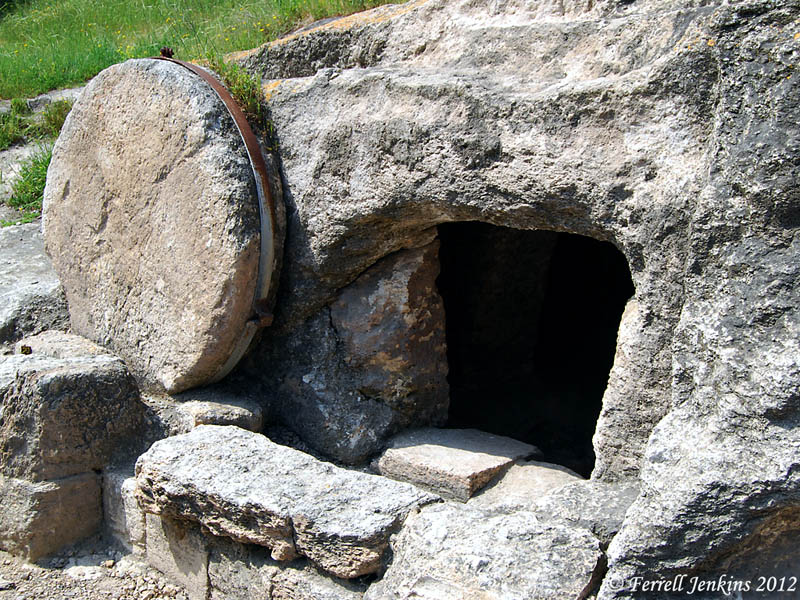
These grieving women were concerned about the removal of the large stone that had been rolled over the tomb opening and sealed by the Roman authorities. They were surprised when they discovered that the stone had already been removed.

3 And they were saying to one another, “Who will roll away the stone for us from the entrance of the tomb?”
4 And looking up, they saw that the stone had been rolled back–it was very large.

Perhaps they thought that some others, unknown to them, had come to provide the same service. They were alarmed to see the young man in a white robe.

5 And entering the tomb, they saw a young man sitting on the right side, dressed in a white robe, and they were alarmed.

The message was an unexpected one, but one that they were to share with his disciples and Peter and to tell them to update their appointment calendar to include a meeting with Jesus in Galilee.

6 And he said to them, “Do not be alarmed. You seek Jesus of Nazareth, who was crucified. He has risen; he is not here. See the place where they laid him.
7 But go, tell his disciples and Peter that he is going before you to Galilee. There you will see him, just as he told you.”
8 And they went out and fled from the tomb, for trembling and astonishment had seized them, and they said nothing to anyone, for they were afraid. (Mark 16:1-8 ESV)

The message that these women took with them was that the tomb was empty and that Jesus had risen from the grave. From this time forward He would be acknowledged by believers as Lord and Christ (Acts 2:36).

An empty Roman period tomb with a rolling stone. Photo by Ferrell Jenkins.

An empty Roman period tomb with a rolling stone. Photo by Ferrell Jenkins.

This is a rerun from April 8, 2012, but I think it is one that is still relevant.

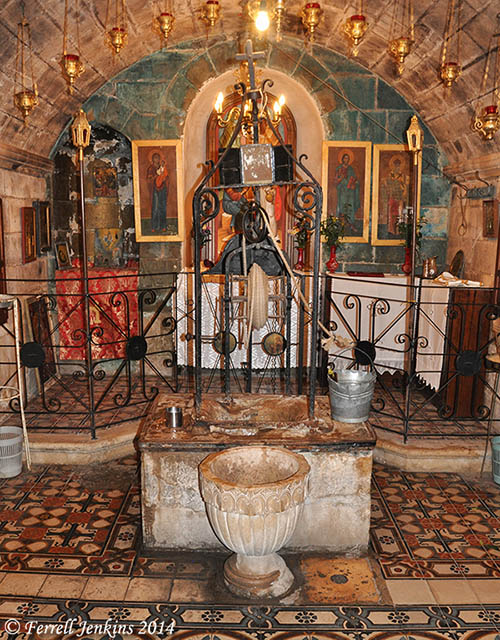
Visualizing Isaiah 12: wells of salvation

Isaiah describes the Messianic Age as one that will be characterized by many spiritual blessings. The pleasant waters of Shiloah had been rejected by God’s people, but in the time to come Judah would joyfully draw water from the wells of salvation.

With joy you will draw water from the wells of salvation. (Isaiah 12:3 ESV)

The term mayan (wells) is often used in the Old Testament of springs, fountains, wells, or pools of water.

We might think of a well like the one where Jesus stopped at Sychar in Samaria.

Jesus answered her, “If you knew the gift of God, and who it is that is saying to you, ‘Give me a drink,’ you would have asked him, and he would have given you living water.” The woman said to him, “Sir, you have nothing to draw water with, and the well is deep. Where do you get that living water? Are you greater than our father Jacob? He gave us the well and drank from it himself, as did his sons and his livestock.” Jesus said to her, “Everyone who drinks of this water will be thirsty again, but whoever drinks of the water that I will give him will never be thirsty again. The water that I will give him will become in him a spring of water welling up to eternal life.” The woman said to him, “Sir, give me this water, so that I will not be thirsty or have to come here to draw water.” (John 4:10-15 ESV)

Jacob's well in Samaria. Photo by Ferrell Jenkins.

Jacob’s well in Samaria. Photo by Ferrell Jenkins.

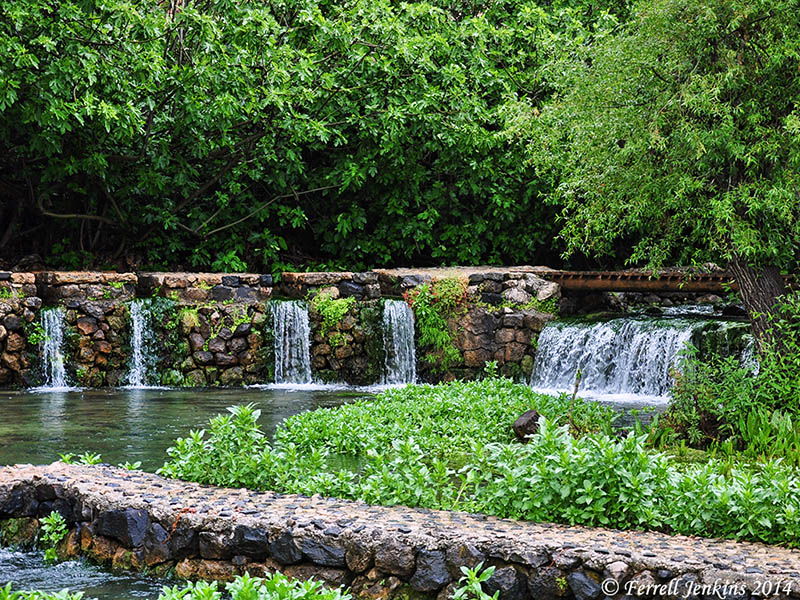
Or, we might think of a spring like the beautiful one at the source of the Banias River at Caesarea Philippi. This spring and river becomes a major source of the Jordan River.

The source of the Banias River, source of the River Jordan. Photo by Ferrell Jenkins.

The source of the Banias River. Photo by Ferrell Jenkins.


Photo of the year 2013 – Gethsemane

As we approached the end of the year 2013 I began to think of the wonderful places I visited and the photos I made. What photo stands out as the “photo of the year”? I have some unique photos, and I have other photos from places I have photographed many times. I won’t say that this is the best photo I made during the year, but it is one with great meaning to multitudes of Christians.

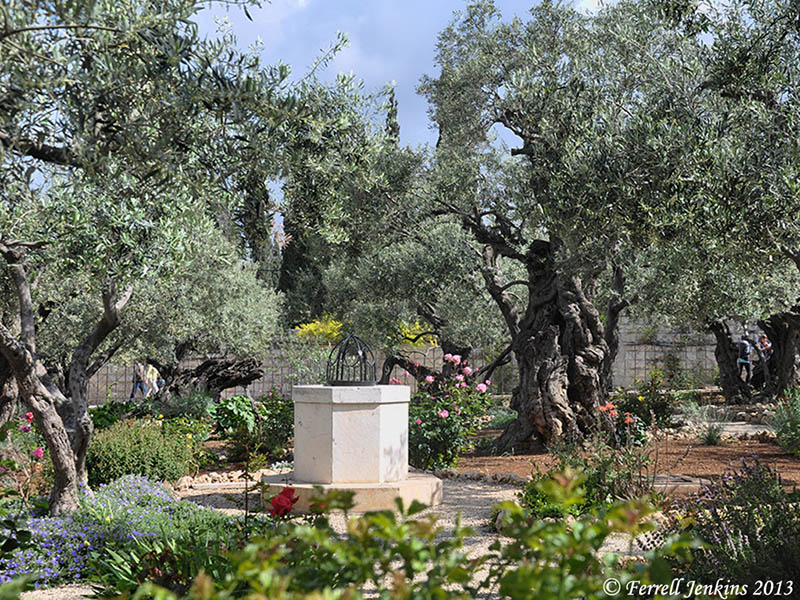
This photo that I wish to share with you is of the traditional Garden of Gethsemane. One thing is for sure. If the “place” mentioned in the New Testament is not here, it could not have been very far away.

Gethsemane is a place well known in the minds of Christians, for according to the Gospels it was there that Jesus prayed alone to the Father before his arrest and trial. The word Gethsemane means oil-press. It is the name of an olive orchard on the Mount of Olives. Not many olive trees remain on the mountain originally named for them. This photo was made in the modern Garden at the Church of All Nations.

As a gift to our faithful readers I want to share a hi-res image suitable for teaching and preaching presentations. Click here for the larger image.

A place called Gethsemane. Photo by Ferrell Jenkins, 2013.

Mark’s account of Jesus’ visit to Gethsemane begins this way:

And they went to a place called Gethsemane. And he said to his disciples, “Sit here while I pray.” And he took with him Peter and James and John, and began to be greatly distressed and troubled. And he said to them, “My soul is very sorrowful, even to death. Remain here and watch.” And going a little farther, he fell on the ground and prayed that, if it were possible, the hour might pass from him. (Mark 14:32-35 ESV)

Read the following verses for the complete story.

I visited several places in 2013 that I have not yet written about. Hopefully I will be able to get to some of these in the following months.

Roman period wine presses at Eretz Israel Museum

The Eretz Israel Museum, located on the campus of Tel Aviv University in Tel Aviv, is a wonderful, educational museum to visit. Many of the exhibits are outside, including an archaeological tel (Tel Qasile), and others are in several different small buildings.

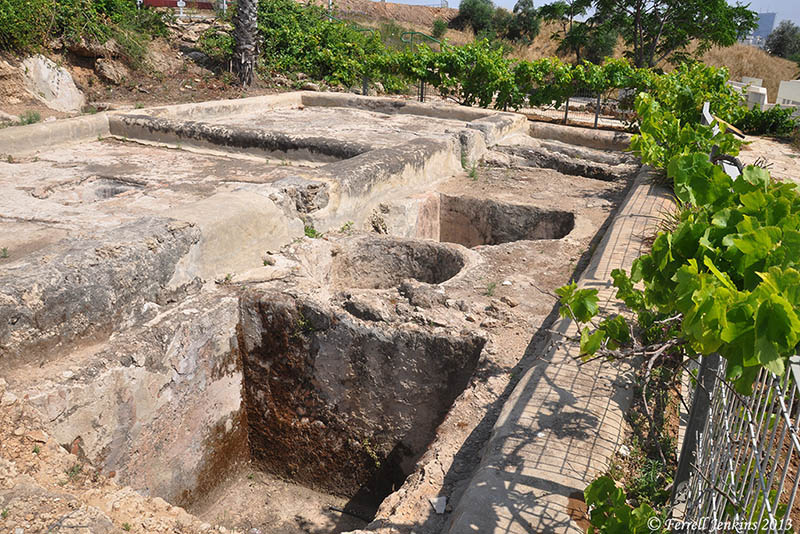
In the photo below we see two Roman period wine presses. (Common English versions use the spelling winepress.) The treading floors are on the left and the collecting vats are on the right.

Roman winepresses at Eretz Israel Museum, Tel Aviv. Photo by Ferrell Jenkins.

Roman wine presses at Eretz Israel Museum, Tel Aviv. Photo by Ferrell Jenkins.

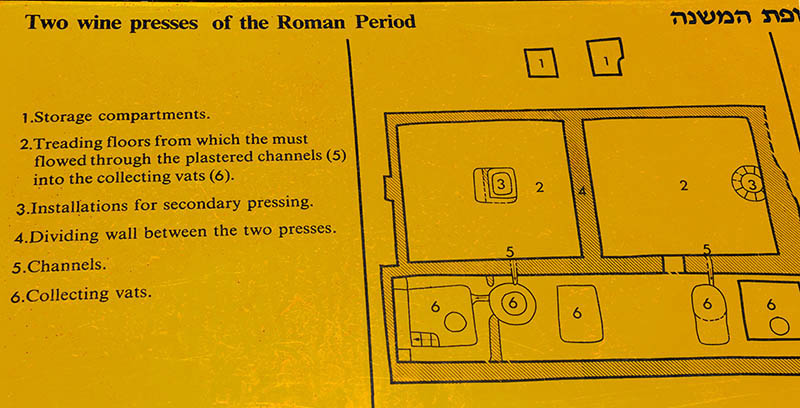
The sign below provides needed explanation for those who have not seen a wine press from the Roman period.

Explanation of Roman winepresses at Eretz Israel Museum, Tel Aviv. Photo by Ferrell Jenkins.

Explanation of the Roman wine presses at Eretz Israel Museum. Photo: Ferrell Jenkins.

One of the parables of Jesus illustrates how common such wine presses were in Biblical times.

“Hear another parable. There was a master of a house who planted a vineyard and put a fence around it and dug a winepress in it and built a tower and leased it to tenants, and went into another country. (Matthew 21:33 ESV)

See a photo of the Byzantine wine press at Avdat here. The Museum website may be visited here.

The Sea of Galilee and Mount Arbel from the NW

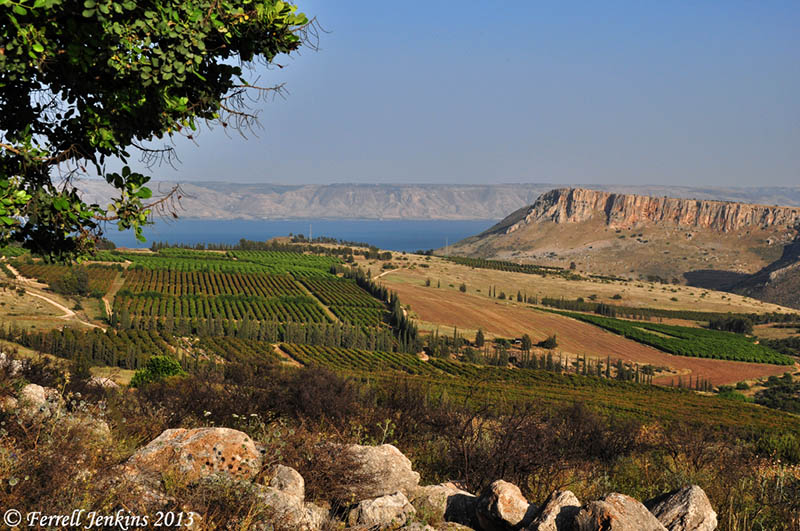
This photograph of the Sea of Galilee and Mount Arbel was made from highway 807.

Sea of Galilee and Mount Arbel from the NW. Photo by Ferrell Jenkins.

The Sea of Galilee and Mount Arbel from the NW. Photo by Ferrell Jenkins.

From this point we can see the east side of the Sea of Galilee. Today we know it as the Golan Heights. In Old Testament times it was known as Bashan (Joshua 21:27). Golan was one of the cities of Refuge located in the area. In New Testament times this was the area of the Decapolis (Mark 7:31), and probably the country of the Gadarenes (Matthew 8:28).

Below Mount Arbel runs the Via Maris, the main road leading from the Turan Valley to Capernaum. This road allowed travel and commerce between Capernaum, Magdala, and Tiberias with the cities of Nazareth, Cana, Sepphoris, and Jotapata.