Tag Archives: Ministry of Jesus

Jesus enters Jerusalem (The Lexham English Bible)

Last evening I downloaded The Lexham English Bible, which Logos is giving away to Logos Libronix users. Information here. The Lexham Bible is available free in several popular formats here. I decided to share this text about Jesus’ entry into Jerusalem in preparation for His death. Notes have been removed. The note are an important part of The Lexham Bible, but you may read those when you download your own copy.

And when they drew near to Jerusalem and came to Bethphage at the Mount of Olives, then Jesus sent two disciples, 2 saying to them, “Go into the village before you, and right away you will find a donkey tied and a colt with her. Untie them“bring them to me. 3 And if anyone says anything to you, you will say, ‘The Lord needs them,’ and he will send them at once.” 4 Now this took place so that what was spoken through the prophet would be fulfilled, saying,
5 “Say to the daughter of Zion,
‘Behold, your king is coming to you,
humble and mounted on a donkey,
and on a colt, the foal of a pack animal.’”
6 So the disciples went and did just as Jesus directed them, 7 and brought the donkey and the colt and put their cloaks on them, and he sat on them. 8 And a very large crowd spread their cloaks on the road, and others were cutting branches from the trees and spreading on the road. 9 And the crowds who went ahead of him and the ones who followed were shouting, saying,
“Hosanna to the Son of David!
Blessed is the one who comes in the name of the Lord!
Hosanna in the highest heaven!”
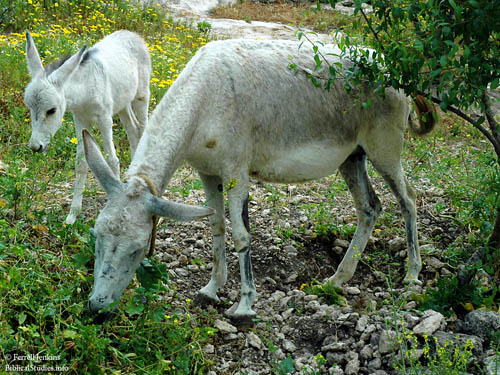
Donkey and Colt at Nazareth Village. Photo by Ferrell Jenkins.

Donkey and Colt at Nazareth Village. Photo by Ferrell Jenkins.

The late William Hendriksen makes these comments about this important event.

However, he also shows the crowds what kind of Messiah he is, namely, not the earthly Messiah of Israel’s dreams, the One who wages war against an earthly oppressor, but the One who came to promote and establish “the things that make for peace” (Luke 19:42), lasting peace: reconciliation between God and man, and between a man and his fellow man. Accordingly, Jesus enters Jerusalem mounted on a colt, the foal of an ass, an animal associated not with the rigors of war but with the pursuits of peace, for he is the Prince of Peace (Isa. 9:6).

But the people in general, their minds filled with earthly ideas concerning the Coming One, did not understand or appreciate this. In hailing him as the Messiah, the people were right; the Pharisees, chief priests, and scribes (Matt. 21:15, 16; Luke 19:39, 40) were wrong. But in expecting this Messiah to reveal himself as a political, earthly Messiah the Hosanna shouters were as wrong as were their leaders. Those who in every way rejected Jesus were committing a crime, but those who outwardly “accepted” and cheered him were also doing him a gross injustice, for they did not accept him for what he really was. Their tragic mistake was committed with dire results for themselves. (William Hendriksen, New Testament Commentary : Exposition of the Gospel According to Matthew, 760)
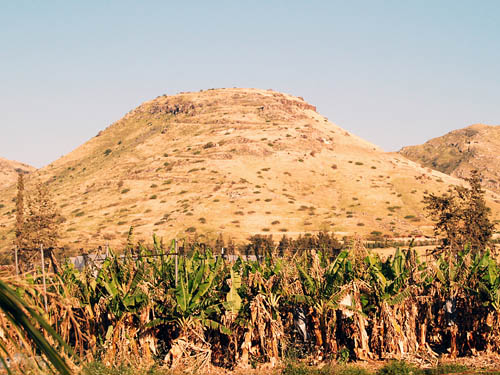
Hippos overlooks the Sea of Galilee

I think many Bible Land travelers pass En Gev on the eastern shore of the Sea of Galilee and never realize that the site of Hippos is visible about one and a half miles to the east. Perhaps that is because of the almost magnetic attraction of the Sea of Galilee.

The site of Hippos (Susita), east of the Sea of Galilee. Photo by Ferrell Jenkins.

The site of Hippos (Susita), east of the Sea of Galilee. Photo by Ferrell Jenkins.

Vassilios Tzaferis wrote about Hippos in Biblical Archaeology Review:

If you look at the site of Sussita/Hippos from an adjacent mountain, or, better yet, from the air, and follow the adjoining ridge, or saddle, to the east, the site looks like the head of a horse and the saddle, or ridge, looks like the long, outstretched neck of a horse. It is this configuration that gave the site its name for nearly a thousand years. The ancient Greeks, who apparently were the first to settle the site, must have been aware of this resemblance because they named the place Hippos (horse). When the Jews conquered the city, they translated the name to Sussita, “mare” in Aramaic. When the Arabs conquered it, they called it Qal’at el Husn, the “fortress of the horse.”

The summit of the mountain is a plateau of about 37 acres on which lie scattered the ruins of what was once a beautiful town overlooking the lake.

Our story begins—perhaps it will begin much earlier after the site is thoroughly excavated—about a century after Alexander the Great conquered and Hellenized much of the then-known world. After Alexander’s death in 331 B.C., his empire split in two—the Ptolemies in Egypt and the Seleucids in Syria shared this world. Over the centuries Palestine passed from one side to the other, occasionally winning its own independence. The first evidence we now have of organized habitation at Hippos indicates that it was founded by the Seleucids in the middle of the third century B.C., very probably as a frontier fortress against the threat of the Ptolemaic kingdom to the south. The settlement was located on a most strategic point, on the western approach to Gaulanitis (today’s Golan Heights). The site’s natural fortification and defense allowed it to serve equally as a fortress stronghold and as an effective frontier post, controlling any movement to the east, both in time of war and peace. In about 200 B.C., the boundaries of the Seleucid kingdom were pushed down to southern Palestine, so Hippos lost much of its strategic significance but it retained its importance as an urban cultural center, with a social and political organization in accord with the principles of a Greek polis.

When the town was formally recognized as an official constitutional polis, it was renamed Antiocha, in honor of the head of the Seleucid kingdom, Antiochus the Great (III), although the old name Hippos was also officially used.

Hippos had a port on the Sea of Galilee “to serve the commercial and navigational needs” of the city.

The progress of the city as a Hellenistic center was interrupted for a period of about 20 years during the first half of the first century B.C. Sometime between 83 and 80 B.C., the Judean king Alexander Jannaeus, who then ruled an independent fiefdom, conquered Hippos. According to the first-century A.D. historian Flavius Josephus (Antiquities of the Jews 14.75), Jannaeus forced Hippos’ heathen inhabitants to be circumcised and to accept Judaism. In 64 B.C., however, the Roman army entered the scene. The Roman general Pompey took the city from the Jews; it was then included in the League of the Ten Cities, the Decapolis, created by Pompey in the northern Jordan Valley and adjacent Transjordan. Each city in the Decapolis had jurisdiction over an extensive area. As a member of the Decapolis, Hippos enjoyed internal autonomy and could even mint its own coins. The population of Hippos welcomed Pompey with open arms.

About 35 years later, Hippos again became part of a Jewish realm. In 30 B.C. the Roman emperor Augustus gave Hippos to Herod the Great, who ruled it until his death 26 years later, in 4 B.C. After Herod’s death, Hippos was assigned by the Romans to the province of Syria.

During the First Jewish Revolt against Rome (66–70 A.D.), the Jews attacked Hippos and its Greek inhabitants, who retaliated by killing or imprisoning the Jews residing there. (Biblical Archaeology Review 16:05, Sep/Oct 1990).

Riesner says that Hippos “must be” the city of the Decapolis presupposed in Mark 5:1-20 (the account of casting demons into swine; Dictionary of Jesus and the Gospels 40). It might be. Hippos is the closest of the cities of the Decapolis to the area of Jesus’ ministry which was centered in Capernaum. It would make sense that Gentiles in this area might be growing pigs.

And he [the healed demon-possessed man]went away and began to proclaim in the Decapolis how much Jesus had done for him, and everyone marveled. (Mark 5:20 ESV)

And great crowds followed him [Jesus] from Galilee and the Decapolis, and from Jerusalem and Judea, and from beyond the Jordan. (Matthew 4:25 ESV)

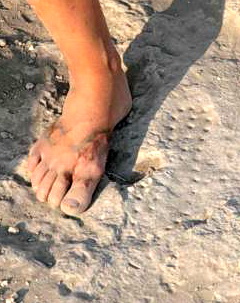
During excavations at Hippos in 2007, a sandal print identified as that of a Roman soldier was uncovered:

Sandal print from Hippos.

Roman sandal print from Hippos. Photo: University of Haifa.

Archaeologists have discovered a footprint made by the sandal of a Roman soldier in a wall surrounding the Hellenistic-Roman city of Hippos (Sussita), east of the Sea of Galilee.

The footprint was discovered during this eighth season of excavation, led by Prof. Arthur Segal from the Zinman Institute of Archaeology at the University of Haifa in conjunction with archaeologists from the Polish Academy of Sciences and Concordia University in St. Paul, Minnesota.

This rare footprint, which is complete and well preserved, hints at who built the walls, how and when,” said Michael Eisenberg of the Zinman Institute at the University of Haifa.

The print, made by a hobnailed sandal called caliga, the sandal worn by Roman soldiers, is one of the only finds of this type. The discovery of the print in the cement led archaeologists to presume that legionnaires participated in construction of the walls.

The full article may be read in Science Daily here.

Witherington and Crossan on the Message of Jesus

Last week I attended The Greer-Heard Point-Counterpoint Forum in New Orleans. The forum is briefly described by Paul F. South, NOBTS Communications:

Two of the world’s best-known religious scholars will dialog at New Orleans Baptist Theological Seminary on a question that has sparked debate for some 2,000 years: What did Jesus really teach?

John Dominic Crossan and Ben Witherington III will be the featured speakers at the  2010 Greer-Heard  Point-Counterpoint  Forum, Feb. 26 and 27 at Leavell Chapel.

The event marks the seminary’s sixth Greer-Heard Point-Counterpoint Forum. The Forum is designed to provide a venue in which a respected evangelical scholar and a respected non-evangelical scholar discuss critical issues in religion, science, philosophy, or culture.

Audio CDs, MP3, or DVDs are available for all of the previous forums at a reasonable rate. Go here and click on STORE. The most recent forum (The Message of Jesus) is not on the list, but it is available. I think you can find a contact link somewhere on the page.

In addition to Witherington and Crossan, the other speakers were Darrell Bock, Craig Evans, Amy Jill Levine, and Stephen J. Patterson. Perhaps you recognize these names as representing both liberal and conservative perspectives on Jesus.

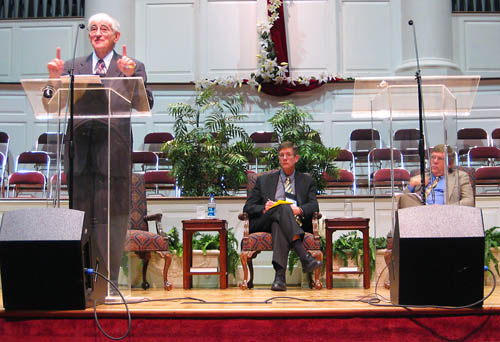
Crossan speaks while Witherington (R) waits his turn. Photo by Ferrell Jenkins.

Crossan (L) speaks while Witherington (R) waits his turn. Photo by Ferrell Jenkins.

He does not say so, but I think Ben Witherington III has posted his paper on his Bible and Culture blog here. It is a little difficult to read. Copy the document and save it in your word processor and it will be easier to read.

All of the speakers are distinguished scholars who have spent a great deal of their academic life writing on the general theme of Jesus Studies.

The land of Gennesaret

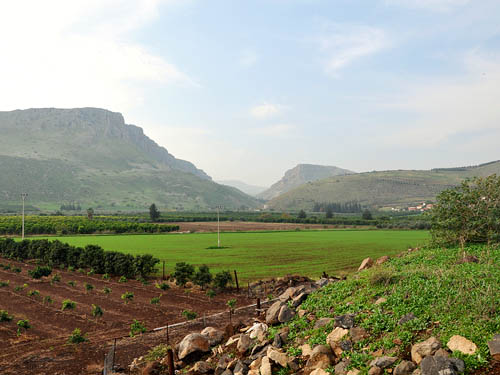
The Sea of Galilee is called the “lake Gennesaret” by Luke (Luke 5:1). The area on the northwest corner of the Sea of Galilee is called the “land at Gennesaret.” In the view below we see the land of Gennesaret and the Via Maris. The route here leads to the Beit Netofa Valley and the sites of (Khirbet) Cana, Sepphoris, Nazareth, and Yodfat (Jotapata). Yodfat was fortified by Josephus during the Jewish revolt against Rome. Josephus, commander of the Jewish rebels, surrendered to the Roman Emperor Vespasian at Yodfat.

The land of Gennesaret and the Via Maris. Photo by Ferrell Jenkins.

The land of Gennesaret and the Via Maris. Photo by Ferrell Jenkins.

Many of the miracles of Jesus were performed in this area.

When they had crossed over, they came to land at Gennesaret. And when the men of that place recognized Him, they sent word into all that surrounding district and brought to Him all who were sick; and they implored Him that they might just touch the fringe of His cloak; and as many as touched it were cured. (Matthew 14:34-36 NAU)

More on the Magdala Excavation Project

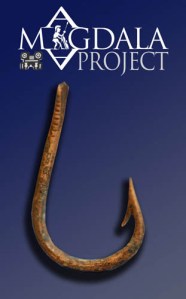
Fishhook from the 2008 Magdala Project dig.

Fish-hook from the 2008 Magdala Project dig.

The Magdala Project blog is giving some info on the current excavations at the site of Magdala on the west short of the Sea of Galilee. Reports include information on the first century synagogue, a 2006 preliminary report, and ship iconography as portrayed on mosaics of the first to third centuries AD.

Several nice photos are included on the blog including one of a fish-hook discovered  from the 2008 Magdala Project dig, and a stone anchor from the 2007 season.

The article by K. C. Hanson on “The Galilean Fishing Economy and the Jesus Tradition” is extremely helpful for those seeking to understand the role of the disciples of Jesus who were fishermen.

The photo of the fish-hook  provides a nice illustration of a text from Matthew 17:24-27.

When they came to Capernaum, the collectors of the two-drachma tax went up to Peter and said, “Does your teacher not pay the tax?” He said, “Yes.” And when he came into the house, Jesus spoke to him first, saying, “What do you think, Simon? From whom do kings of the earth take toll or tax? From their sons or from others?” And when he said, “From others,” Jesus said to him, “Then the sons are free. However, not to give offense to them, go to the sea and cast a hook and take the first fish that comes up, and when you open its mouth you will find a shekel. Take that and give it to them for me and for yourself.” (Matthew 17:24-27 ESV)

We have mentioned Magdala several times. Check here, and use the Search box for other references.

HT: Bible Places Blog

Mount Hermon is a source of water

The land captured by Joshua and the Israelites included “Baal Gad in the valley of Lebanon at the foot of Mount Hermon” (Joshua 11:17). Today we call this valley to the east of Mount Hermon the Beka Valley. Some have suggested that Baal Gad might be the site later known as Paneas (now Banias), and later Caesarea Philippi. Dan is another important biblical town located at the foothills of Mount Hermon.

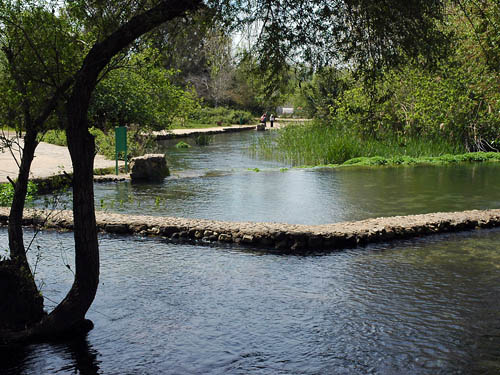
Source of the Jordan River at Caesarea Philippi. Photo by Ferrell Jenkins.

Source of the Jordan River at Caesarea Philippi. Photo by Ferrell Jenkins.

Brethren dwelling together in unity is said to be “like the dew of Hermon Coming down upon the mountains of Zion” (Psalm 133:3). Mount Hermon receives an annual average of about 60 inches of precipitation. In the winter the mountain is usually fully covered with snow.

The proximity of Mount Hermon to Caesarea Philippi, where Jesus was confessed to be the Christ, and where he promised to build the church, causes many scholars to suggest it as the “high mountain” of the transfiguration (Matthew 16:13 – 17:1-9).

The Sea of Galilee

A boat ride on the Sea of Galilee is one of the highlights of a trip to Israel for most Christian tourists. They enjoy seeing the lake and recognizing the places they have read about so much in their Bible study: Tiberias, Magdala, the Mount of Beatitudes, Capernaum. They reflect on the accounts of Jesus walking on the water and stilling the tempest, etc.

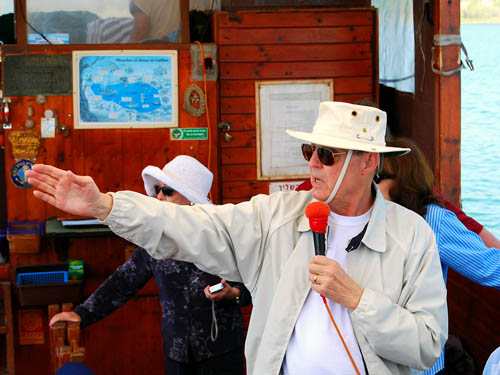
My wife had someone shooting photos while I was pointing out sites of interest along the shores of Galilee. I think I was pointing out the possible location of the account of the swine rushing down the steep bank into the sea (Matthew 8:28 – 9:1).

Ferrell Jenkins pointing out sites of interest on the shore of Galilee.

Ferrell Jenkins pointing out sites of interest along the shore of Galilee.

Luke calls the Sea of Galilee a lake (Luke 5:1-2; 8:22-23,33).

Now Jesus was standing by the Lake of Gennesaret, and the crowd was pressing around him to hear the word of God. (Luke 5:1 NET)

Jesus spoke in the treasury of the Temple

The events of John 8 take place in the Temple precinct in Jerusalem. At this time He claims to be the light of the world (John 8:12). Notice verse 20.

These words he spoke in the treasury, as he taught in the temple; but no one arrested him, because his hour had not yet come. (John 8:20 ESV)

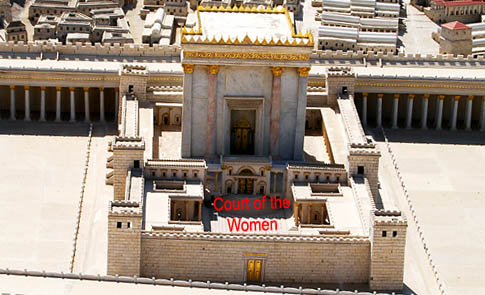
This photo of the Second Temple Model shows the area of the Court of the Woman where the “treasury” or offering boxes were located.

Second Temple Model showing the Court of the Women. Photo by F. Jenkins.

Second Temple Model showing the Court of the Women. Photo by F. Jenkins.

Alfred Edersheim includes the following information about the Court of the Women with an explanation of the 13 offering boxes found there. The info follows without indentation.

——

The Court of the Women obtained its name, not from its appropriation to the exclusive use of women, but because they were not allowed to proceed farther, except for sacrificial purposes. Indeed, this was probably the common place for worship, the females occupying, according to Jewish tradition, only a raised gallery along three sides of the court. This court covered a space upwards of 200 feet square. All around ran a simple colonnade, and within it, against the wall, the thirteen chests, or ‘trumpets,’ for charitable contributions were placed. These thirteen chests were narrow at the mouth and wide at the bottom, shaped like trumpets, whence their name.

Their specific objects were carefully marked on them. Nine were for the receipt of what was legally due by worshippers; the other four for strictly voluntary gifts. Trumpets I and II were appropriated to the half-shekel Temple-tribute of the current and of the past year. Into Trumpet III those women who had to bring turtledoves for a burnt- and a sin-offering dropped their equivalent in money, which was daily taken out and a corresponding number of turtledoves offered. This not only saved the labour of so many separate sacrifices, but spared the modesty of those who might not wish to have the occasion or the circumstances of their offering to be publicly known. Into this trumpet Mary the mother of Jesus must have dropped the value of her offering (Luke 2:22, 24) when the aged Simeon took the infant Saviour ‘in his arms, and blessed God.’ Trumpet IV similarly received the value of the offerings of young pigeons. In Trumpet V contributions for the wood used in the Temple; in Trumpet VI for the incense, and in Trumpet VII for the golden vessels for the ministry were deposited. If a man had put aside a certain sum for a sin-offering, and any money was left over after its purchase, it was cast into Trumpet VIII. Similarly, Trumpets IX, X, XI, XII, and XIII were destined for what was left over from trespass-offerings, offerings of birds, the offering of the Nazarite, of the cleansed leper, and voluntary offerings. In all probability this space where the thirteen Trumpets were placed was the ‘treasury,’ where Jesus taught on that memorable Feast of Tabernacles (John 7 and 8; see specially 8:20). We can also understand how, from the peculiar and known destination of each of these thirteen ‘trumpets,’ the Lord could distinguish the contributions of the rich who cast in ‘of their abundance’ from that of the poor widow who of her ‘penury’ had given ‘all the living’ that she had (Mark 12:41; Luke 21:1).

But there was also a special treasury-chamber, into which at certain times they carried the contents of the thirteen chests; and, besides, what was called ‘a chamber of the silent,’ where devout persons secretly deposited money, afterwards secretly employed for educating children of the pious poor.

It is probably in ironical allusion to the form and name of these treasure-chests that the Lord, making use of the word ‘trumpet,’ describes the conduct of those who, in their almsgiving, sought glory from men as ‘sounding a trumpet’ before them (Matthew 6:2)—that is, carrying before them, as it were, in full display one of these trumpet-shaped alms-boxes (literally called in the Talmud, ‘trumpets’), and, as it were, sounding it.

Alfred Edersheim, The Temple: Its Ministry and Services as They Were at the Time of Jesus Christ, electronic ed. (Garland, TX: Galaxie Software, 2000).

The shepherd and his sheep

Scenes typical of biblical times are common Jordan, Turkey, and portions of the West Bank of Palestine today. There are some differences, of course.

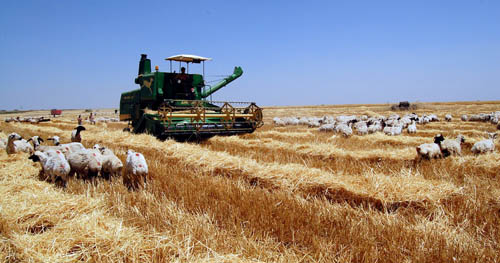
We were traveling between Diyarbakir and Sanliurfa, Turkey, in early June. Several farmers were harvesting their grain using modern combines.

Harvesting grain in Eastern Turkey. Photo by Ferrell Jenkins.

Harvesting grain in Eastern Turkey. Photo by Ferrell Jenkins.

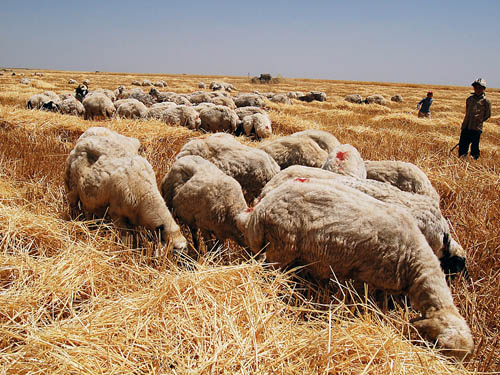
As quickly as the combine passed by, the shepherds brought in the sheep to feed.

The sheep/shepherd analogy was used by Jesus to describe His relationship to His disciples.

I am the good shepherd. The good shepherd lays down his life for the sheep. (John 10:11 ESV)

When Paul spoke to the elders of the Ephesian church he instructed them “to shepherd the church of God” (Acts 20:28 NAS). I note that the ESV uses the term care instead of shepherd to translate the Greek poimaino. That certainly conveys the right idea.

Shepherds care for their sheep in Eastern Turkey. Photo by Ferrell Jenkins.

Shepherds care for their sheep in Eastern Turkey. Photo by Ferrell Jenkins.

Peter instructed elders to “shepherd the flock of God among you” (1 Peter 5:2). The NET Bible says, “Give a shepherd’s care to God’s flock among you.” Lest these men who have been appointed to this work be elevated in their own importance, Peter added,

And do not lord it over those entrusted to you, but be examples to the flock. (1 Peter 5:3 NET)

not domineering over those in your charge, but being examples to the flock. (1 Peter 5:3 ESV)

J. B. Phillips, in his translation of this text, used a vivid phrase to illustrate the overreaching of some elders:

You should aim not at being “little tin gods” but as examples of Christian living in the eyes of the flock committed to your charge. And then, when the chief shepherd reveals himself, you will receive that crown of glory which cannot fade.

Longest underground Roman aqueduct

A recent article in Spiegel Online reports on the discovery of “The Ancient World’s Longest Underground Aqueduct.”

Roman engineers chipped an aqueduct through more than 100 kilometers of stone to connect water to cities in the ancient province of Syria. The monumental effort took more than a century, says the German researcher who discovered it.

When the Romans weren’t busy conquering their enemies, they loved to waste massive quantities of water, which gurgled and bubbled throughout their cities. The engineers of the empire invented standardized lead pipes, aqueducts as high as fortresses, and water mains with 15 bars (217 pounds per square inch) of pressure.

In the capital alone there were thousands of fountains, drinking troughs and thermal baths. Rich senators refreshed themselves in private pools and decorated their gardens with cooling grottos. The result was a record daily consumption of over 500 liters of water per capita (Germans today use around 125 liters).

However, when the Roman legions marched into the barren region of Palestine, shortly before the birth of Christ, they had to forgo the usual splashing about, at least temporarily. It was simply too dry.

The article by Matthias Schulz says,

This colossal waterworks project supplied the great cities of the ‘Decapolis’ – a league originally consisting of 10 ancient communities — with spring water. The aqueduct ended in Gadara, a city with a population of approximately 50,000. According to the Bible, this is where Jesus exorcized demons and chased them into a herd of pigs.

The full story may be read here. There are some nice photos and diagrams.

The identification of the “country of the Gadarenes” (Matthew 8:28-34), and the “country of the Gerasenes” (Mark 5:1; Luke 8:26-39), and the exact place where the swine rushed down the steep cliff into the Sea, is a difficult one.  And I don’t have the time to work on it today.

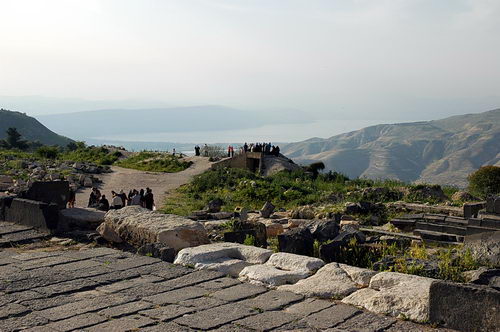
View of Sea of Galilee from Umm Queis. Photo by Ferrell Jenkins.

View of Sea of Galilee from Umm Queis. Photo by Ferrell Jenkins.

We know that Gadara had a port on the Sea of Galilee, and that Roman coins of the city portrayed ships.

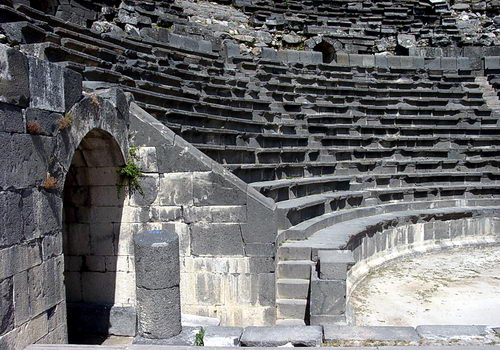
Here is a photo of the Roman theater of Umm Queis. The earliest buildings of this city are made of basalt, the volcanic rock common in the area.

The basalt theater at Umm Queis. Photo by Ferrell Jenkins.

The basalt theater at Umm Queis. Photo by Ferrell Jenkins.

HT: Joe Lauer