If we consider the Gospel of John a sort of “Day Planner” for Jesus, we have nearly complete activity recorded for two weeks of the earthly ministry of Jesus. The first is in John 1:19—2:11 where activity for six of the seven days is recorded. I think the omitted day is the sabbath.
The next nearly complete week is the last week, leading up to the resurrection. John gives more attention to the last week than any other Gospel. Even here we have activities for only six of eight days. This section begins in John 12:1 and continues into John 20. Here is the way I have reconstructed it. Where John does not record the activity I have omitted the scripture reference.
Sunday — The King enters Jerusalem — 12:12-19
Monday — Cleansing the Temple —
Tuesday — Visit of the Greeks — 12:20-36
Tuesday — Jewish rejection — 12:37-50
Wednesday — No events recorded in the Gospels
Thursday Evening — Passover Meal, including Washing Disciples Feet (only in John) — 13:1-38
Thur. Eve — Farewell discourses — 14—16
Thur. Eve — Prayer — 17
Thur. Eve — Annas (only in John) — 18:12-14
Thur. Eve — Caiaphas — 18:24-28
Friday — Pilate — 18:28—19:16
Friday — Crucifixion — 19:16-42
Sabbath —
First Day — Resurrection — 20
It should be noted that the appearance before Annas and Caiaphas were the Jewish (Religious) trials. The appearance before Pilate [and Herod Antipas] were the Roman (Civil) trials.
John does not record the pronouncement of woes on the religious leaders, the institution of the Lord’s Supper, and the account of the agony in the Garden of Gethsemane.
With this sparse attention given to two weeks, no wonder John says,
Now there are also many other things that Jesus did. Were every one of them to be written, I suppose that the world itself could not contain the books that would be written. (John 21:25 ESV)
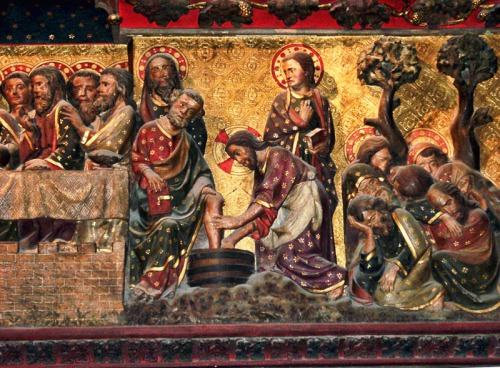
There is a medieval wood carving of the last week of Jesus in Notre Dame (Paris). In this photo you see the representation of the last supper, the washing of the disciples’ feet, and the agony in Gethsemane. (Sorry, this was made more than a decade ago and I don’t have a hi-res photo.) I do not know if this was destroyed in the fire.
Wood carving of Last Week of Jesus in Notre Dame. I do not know if this was destroyed in the fire. Photo by Ferrell Jenkins.
A reader of the previous post (Click to read: https://wp.me/p1zOp-5FC ) wonders how we know Jerusalem was not destroyed later than A.D. 70.
It is a good question. The New Testament, including the records of the life and ministry of Christ, is rooted in history. Notice how Luke, a gentile physician, emphasizes the historicity of the work of John the Baptist and the beginning of the baptism and ministry of Jesus.
Luke 3:1 In the fifteenth year of the reign of Tiberius Caesar, Pontius Pilate being governor of Judea, and Herod being tetrarch of Galilee, and his brother Philip tetrarch of the region of Ituraea and Trachonitis, and Lysanias tetrarch of Abilene, 2 during the high priesthood of Annas and Caiaphas, the word of God came to John the son of Zechariah in the wilderness. 3 And he went into all the region around the Jordan, proclaiming a baptism of repentance for the forgiveness of sins. (Lk. 3:1-3 ESV)
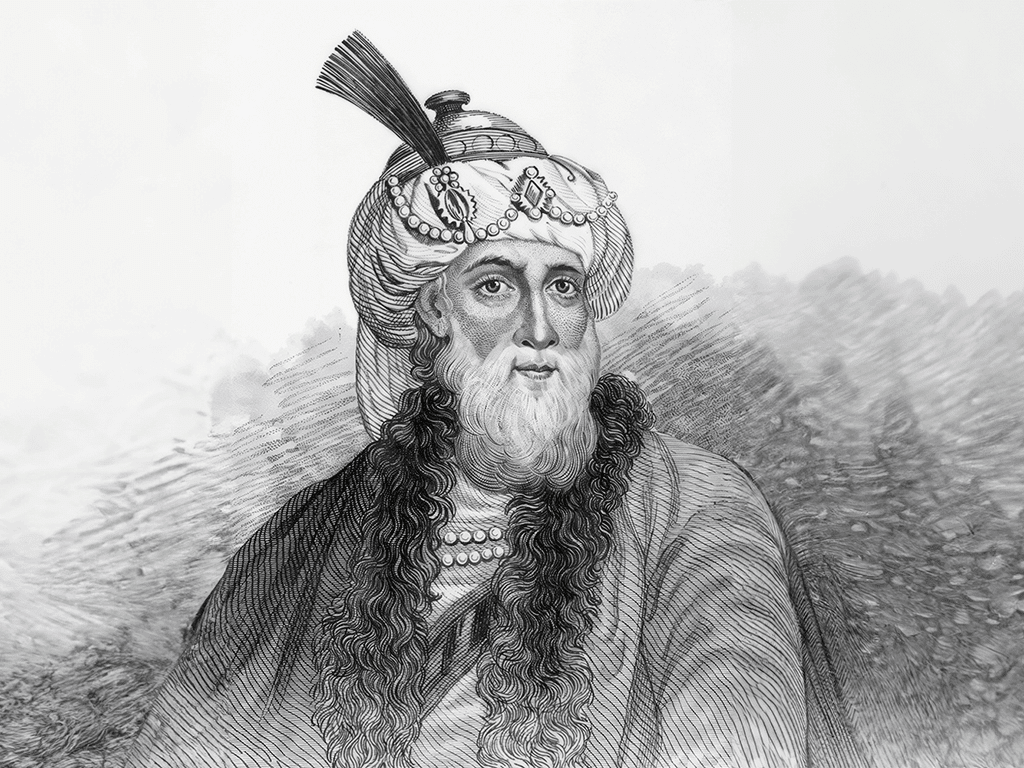
We don’t know what Josephus looked like, but older English versions of his works sometimes included a line drawing. David Padfield, at Padfield.com, had one of those old drawings enhanced by AI and shared the drawing with me. I suggest you visit Padfield.com for more good material.
Josephus, the Jewish historian, who was contemporaneous with these events, and an eye witness of many of them, tells us much about the movement of the Romans as they came near the city of Jerusalem. Vespasian had been leading the plans to attack Jerusalem. When he learned of the death of Emperor Nero (A.D. 68) he returned to Rome to become emperor. His son Titus became the leader of the effort. Josephus, a native of Yodfat, now in north western Israel, was an eye witness to many of the events of the Roman invasion of the country. Not only did he write the History of the Jews, but also the Wars of the Jews. He provides specific information about the movement of the Romans as they approached the city of Jerusalem. As the army began to be seen in plain view, Josephus records the events.
JOE Wars of the Jews 2:528: He then pitched his camp upon the elevation called Scopus [or watch tower], which was about a mile from the city; yet did not he assault them in three days’ time, out of expectation that those within might perhaps yield a little; and in the meantime he sent out a great many of his soldiers into neighboring villages, to seize their grain; and on the fourth day, which was the thirtieth of the month Hyperbereteus, [Tisri], when he had put his army in array, he brought it into the city. (Wars 2:528) This might be a reference to the temple which was in the city.
Accordingly, this place, on the north quarter of the city, and joining thereto, was a plain, and very properly named Scopus [the prospect]; 68 and was no more than a mile from the city And here it was that Titus ordered a camp to be fortified for two legions that were to be together; but ordered another camp to be fortified, six hundred yards behind them, for the fifth legion; for he thought that, by marching in the night, they might be tired, and might deserve to be covered from the enemy, and with less fear might fortify themselves; (Wars 5:67-68)
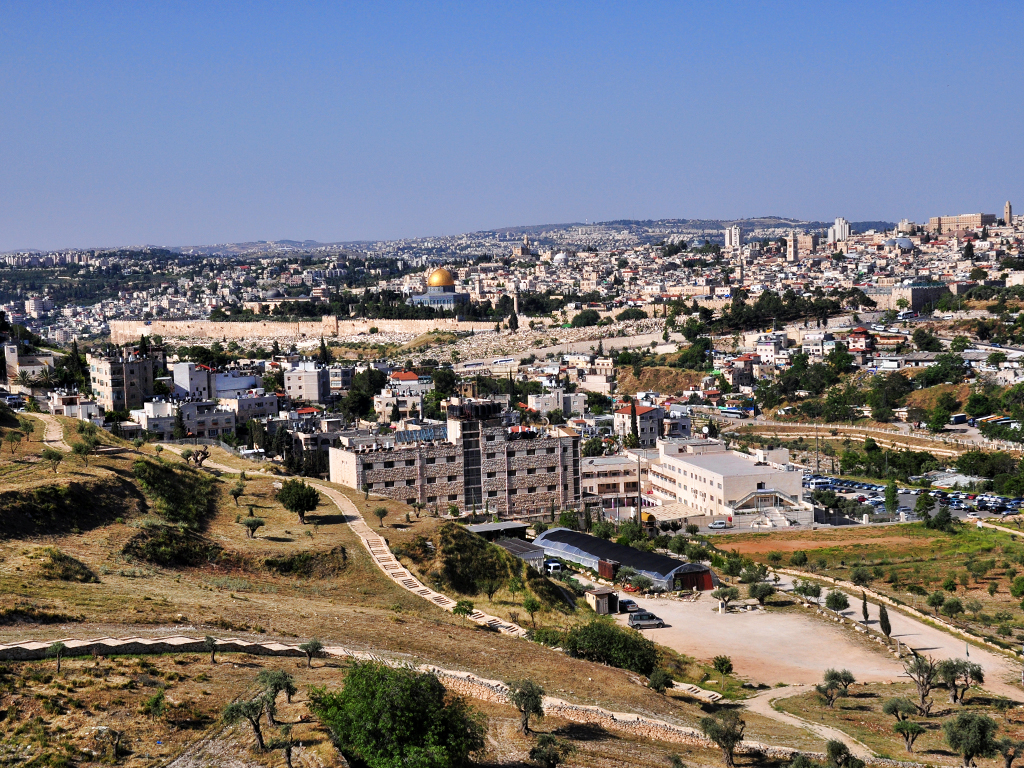
The photo below shows a view of the Old City of Jerusalem made from the slope of Mount Scopus. Notice the Dome of the Rock, the gold domed building with the sun shining on it. It is located approximately where Herod’s temple was stood from its completion until the destruction in A.D. 70. If you click on the image it should enlarge to allow you to see everything better.
(c)FerrelllJenkins2013______________
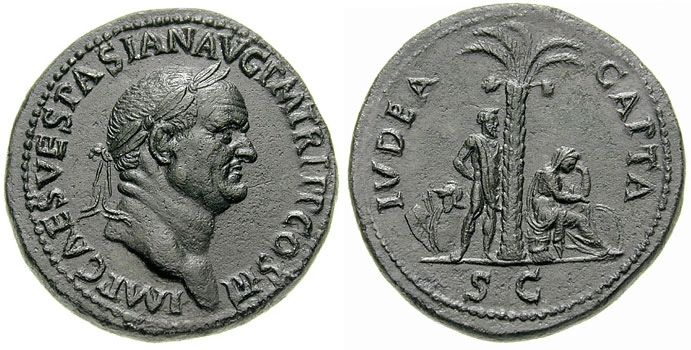
The images below show an example of the coins minted by Vespasian and Titus to commemorate the capture of Judea. The obverse [heads] shows a laureate head of image of Caesar Vespasian. The reverse[tails ] had the wording Judea Capta and shows a mourning Jewess under a palm tree. David Hendin, Guide to Biblical Coins, Fifth Edition, shows a variety of this coin minted by different emperors at various places.
Merrill C. Tenney, New Testament Times, includes a chart of the various Roman and Herodian rulers in connection with the events in Judea. Good Bible dictionaries and Encyclopedias will also provide this type of information.
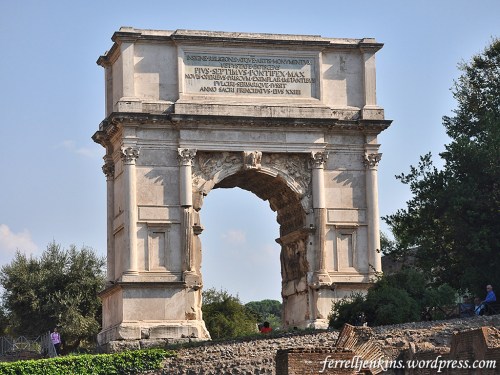
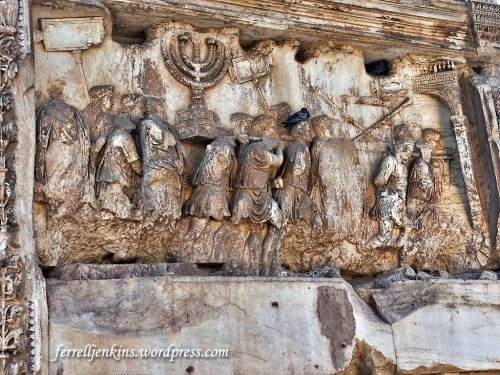
During A.D. 68 and 69 three men, Galba, Otho, and Vitellius, ruled. Vespasian was Emperor of Rome A.D. 69-79. Titus was emperor 79-81. The Arch of Titus on one end of the Roman forum commemorates this event. Carvings on the inside of the arch show the Roman soldiers taking away the ark of the covenant and the table of showbread from the Jerusalem temple.
The Arch of Titus in the Roman Forum commemorates the Roman victory of the Jews in A.D. 70. Photo by Ferrell Jenkins.Arch of Titus relief showing Roman soldiers carrying the items taken from the Temple in Jerusalem in A.D. 70. Photo by Ferrell Jenkins.
Jews now celebrate a holiday called Tisha B’Av [The 9th of the Jewish month of Av] (roughly our August). Tjhis day commemorates the destruction of the first temple which was built by Solomon was destroyed by the Babylonians in 586 B.C., and the destruction of the temple built by Herod the Great was destroyed by the Romans on Tisha B’av in A.D. 70.
Jerusalem was destroyed in A.D. 70, or as the Jews would say 70 C.E..
With former students and other acquaintances attending the Florida College Homecoming and Bible lectureship this week, I thought it would be wise to make a list of my available books that you will be able to purchase from the Florida College Bookstore. while you are on campus.
Ask one of the workers where the books are located when you visit the store.
Better Things (Workbook on Hebrews)
Studies in the Book of Revelation
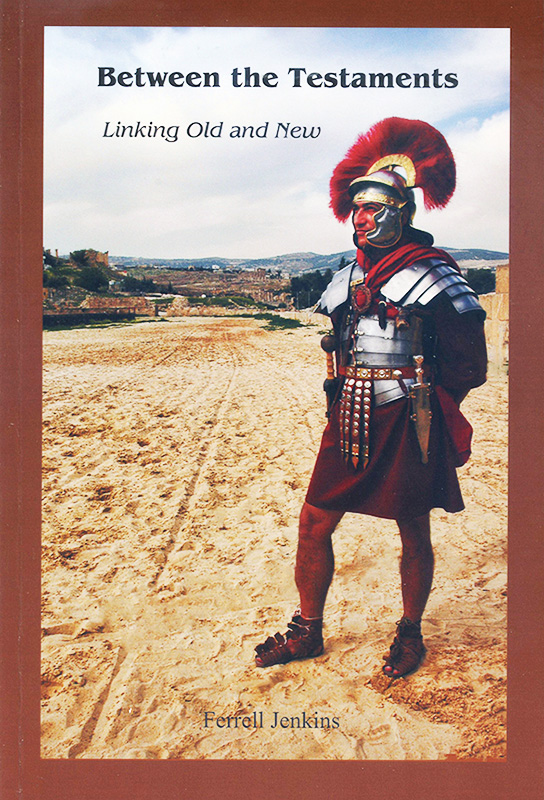
Between the Testaments (Linking Old and New)
The Early Church
The Finger of God (A Study of the Holy Spirit)
The Middle East Conflict and the Bible
Biblical Authority
God’s Eternal Purpose (Workbook on Ephesians)
The Old Testament in the Book of Revelation (new edition in preparation. Follow FerrellJenkins.blog for the announcement and for photographs you may use in your preaching and teaching.
Every time I think of working on tax preparation I think about this episode from the ministry of Jesus:
24 When they came to Capernaum, the collectors of the two-drachma tax went up to Peter and said, “Does your teacher not pay the tax?” 25 He said, “Yes.” And when he came into the house, Jesus spoke to him first, saying, “What do you think, Simon? From whom do kings of the earth take toll or tax? From their sons or from others?” 26 And when he said, “From others,” Jesus said to him, “Then the sons are free. 27 However, not to give offense to them, go to the sea and cast a hook and take the first fish that comes up, and when you open its mouth you will find a shekel. Take that and give it to them for me and for yourself.” (Matthew 17:24-27 ESV).
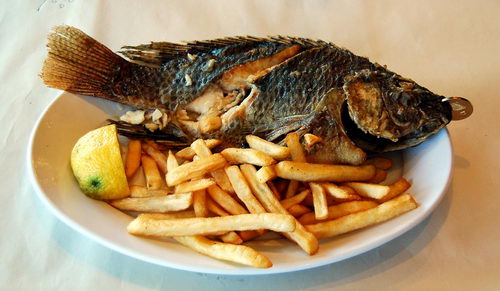
Fishing is still important on the Sea of Galilee. Tour groups to Israel usually have at at least one meal of the famous St. Peter’s Fish when we are in the Galilee.
Mendel Nun spent more than 50 years fishing the Sea of Galilee. He became an expert in the history of fishing on the Sea. His article, “Cast Your Net Upon the Waters: Fish and fishermen in Jesus’ Time” (Biblical Archaeology Review, 19:06), includes information on this episode. Because this is a lengthy quotation I will leave it full width for easier reading.
— • —
The musht is the only large fish in the lake that moves in shoals, which of course is a key to the identification of the fish in the story in Luke, although not the only one.
The flat shape of the musht makes it especially suitable for frying. The skeleton consists of an easily detachable backbone and relatively few small bones, and thus it is easy to eat. It has long been known as St. Peter’s fish. Recently, it has even been exported under this name. But, alas, the name is a misnomer.
Presumably the fish got its name because of an incident recorded in the Gospel of Matthew (Matthew 17:24–27). In this episode, the tax collectors come to Capernaum to collect the half-shekel Temple tax that each Jew was required to pay annually. Jesus tells Peter, “Go to the sea and cast a hook, and take the first fish that comes up, and when you open its mouth you will find a shekel; take that and give it to them for me and yourself.”
The musht was probably given the name St. Peter’s fish because of this miracle. However, this cannot have been the fish Peter caught with a hook and line. The reason is simple: Musht feeds on plankton and is not attracted by other food. It is therefore caught with nets, and not with hook and line. The fishermen on the lake have, since time immemorial, used a hook baited with sardine to fish for barbels, which are predators and bottom feeders. Peter almost surely caught a barbel. There can be only one explanation for the confusing change of name. It was good for tourism! The Sea of Galilee has always attracted pilgrims; musht (today raised mostly in ponds) is part of the unique local cuisine. It is delicious, especially when freshly fried. In ancient times, just as today, the fishing boats delivered their catch to the eating places on shore. Indeed, the proverbial metaphor for speed in the Talmud is “as from the sea into the frying pan.” This expression was part of daily speech in Tiberias and clearly refers to musht and not barbels; the latter are best when boiled.
The first Christians were local people and were therefore familiar with the various fish. They of course knew that the fish Peter caught could only have been a barbel and not a musht. However, as pilgrims began to come from distant regions, it no doubt seemed good for business to give the name “St. Peter’s fish” to the musht being served by the early lakeside eating houses. The most popular and easily prepared fish acquired the most marketable name! But even if Peter did not catch a musht, he deserves to have his name associated with the best fish in the lake.
Returning to the miracle of the fish caught in Luke (5:1–7), additional clues that the fish were musht are the kind of net referred to and the place and the time of the event. Several kinds of nets were used in the Sea of Galilee. The most important were the seine, the cast net and the trammel net.
— • —
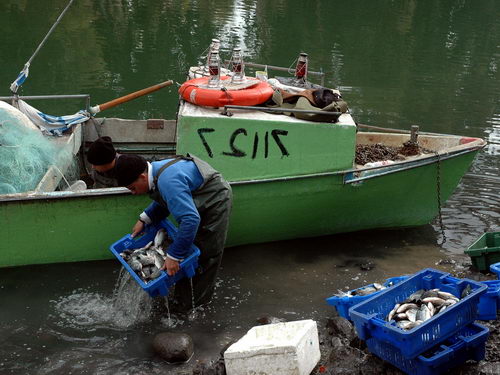
For some time the most searched for article on this blog has been Fish of the Sea of Galilee. If you have not read the article and enjoy the photos I urge you to do so now.
Here is one of the photos from that post.
A fisherman unloading his catch early in the morning at a dock at Tiberias, Israel.
Use this shortlink to go to the article with more information about the fish of the Sea of Galilee: https://wp.me/p1zOp-42k
If you use our SEARCH box and insert the word fish you will locate many articles about fish and fishing on the Sea. If you search for Mendel Nun you will find several more helpful articles about fishing and the harbors of the Sea of Galilee.
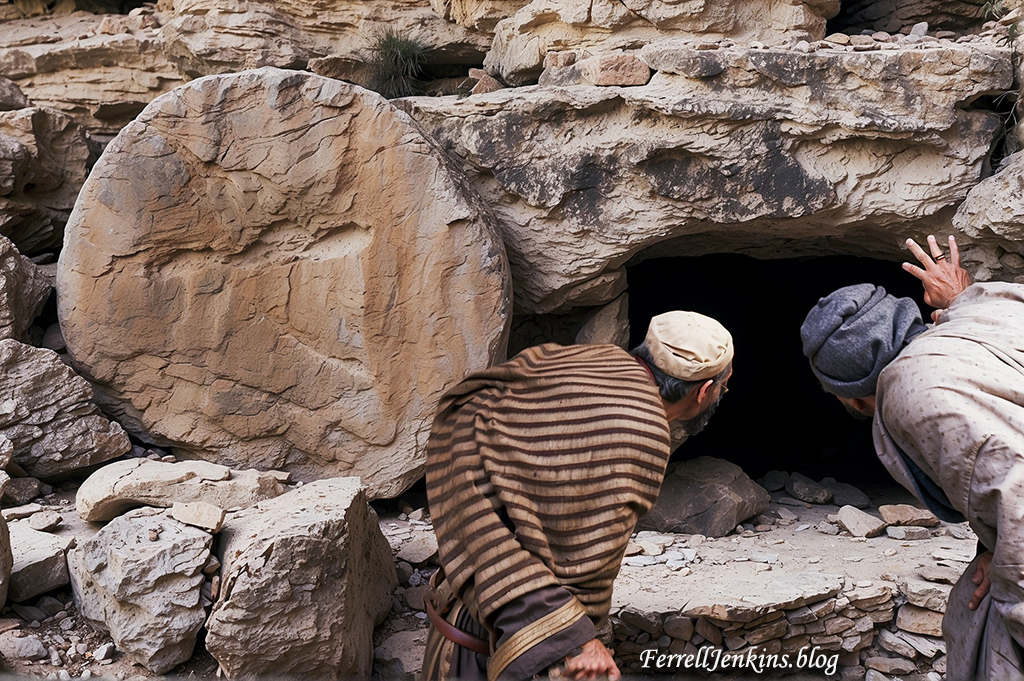
A Roman period tomb cut from stone, using a rolling stone to cover the opening.
The following text is taken from the Gospel of John, chapter 20.
Now on the first day of the week Mary Magdalene came to the tomb early, while it was still dark, and saw that the stone had been taken away from the tomb. So she ran and went to Simon Peter and the other disciple, the one whom Jesus loved, and said to them, “They have taken the Lord out of the tomb, and we do not know where they have laid him.” So Peter went out with the other disciple, and they were going toward the tomb. Both of them were running together, but the other disciple outran Peter and reached the tomb first. And stooping to look in, he saw the linen cloths lying there, but he did not go in. Then Simon Peter came, following him, and went into the tomb. He saw the linen cloths lying there and the face cloth, which had been on Jesus’ head, not lying with the linen cloths but folded up in a place by itself. Then the other disciple, who had reached the tomb first, also went in, and he saw and believed; for as ye they did not understand the Scripture, that he must rise from the dead. Then the disciples went back to their homes. (Jn. 20:1-10 ESV)
Imagine the emotions of the disciples of Jesus, both women and men, when they were told that the tomb that had been so carefully secured on Friday was found empty on the first day of the week, with only the grave clothes and the cloth that covered the head still in the tomb.
[The second photo showing the disciples of Jesus at the open tomb was made in Leonardo AI. David Padfield assisted me in this project.
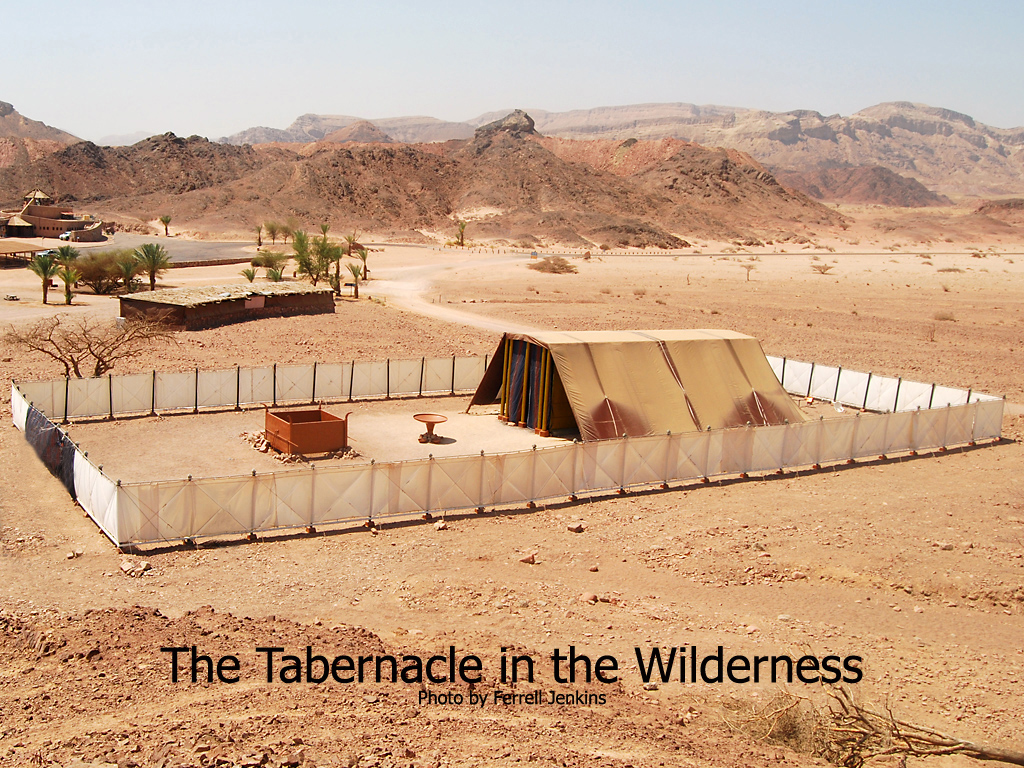
In the gospels one may find several references or allusions to events of the wilderness wandering. This indicates the significance of the event and suggests that it should be studied carefully by Christians as well as Jews.
“The Word became flesh and dwelt [tented, tabernacled] among us…” (Jn. 1:14). The Lord made His presence known to the Israelites in the “tent of meeting” (the tabernacle; Ex. 29:45-46).
The Law was given through Moses [in the wilderness] (Jn. 1:17).
The serpent in the wilderness (Jn. 3:14ff.; cf. 8:28; 12:32).
The manna (Jn. 6:31ff.; notice the “grumbling” over the bread, vs. 41).
The water (Jn. 7:37-38).
Jesus was tempted in the wilderness by the devil. (Mt. 4:1-11).
Jesus fasted for 40 days and 40 nights (cf. Israel’s 40 years).
Jesus was tempted but did not succumb.
In response to the temptations of the devil Jesus quoted from the book of Deuteronomy (Mt. 4:4;
Dt. 8:3; Mt. 4:7; Dt. 6:16; Mt. 4:10; Dt. 6:13).
Stephen made several references to the events of the wilderness in his sermon (Acts
7:30-44).
Paul calls attention to the exodus and events of the wilderness wandering (Acts 13:18; Gal. 4:21-31). Notice his use of the phrase, “Remove the wicked man from among yourselves” (1 Cor. 5:13; cf. Dt. 13:5, the false prophet; 17:7, the one who served other gods; 17:12, one who acts presumptuously; 21:21, the rebellious son; 22:21, a girl not found a virgin).
Israel was baptized, ate spiritual food and drank spiritual drink, but practiced idolatry and immorality and fell (1 Cor. 10:1-13). Compare the situation at Corinth: Christians who had been baptized, ate and drank the Lord’s supper, were tempted by the idolatry (meat sacrificed to idols) and immorality of their city.
The Writer of Hebrews speaks of events of the wilderness wandering.
The events at Mount Sinai (Heb. 12:18-29). The word spoken through angels (2:2; cf. Gal. 3:19).
The unfaithfulness of Israel in the wilderness (Heb. 3–4).
In the book of Revelation.
“See…that you make all things according to the pattern which was shown you on the mountain” (Heb. 8:5; Ex. 25:40, the building of the tabernacle).
The woman who gave birth to the man child fled into the wilderness where she was nourished (Rev. 12:6). This symbol makes the wilderness a place of protection and nourishing. The figure seems to be based on the experience of the nation of Israel and of Elijah (1 Kings 19:1-18) as they were cared for by the Lord.
Some of the trumpets of chapters 8-10 are drawn from the plagues of Egypt. The one like a son of man came on a white cloud (cf. Isa. 19:1, judgment of Egypt) and judged the enemy (Rev. 14:14-20). The saints sing the song of Moses and the Lamb beside the sea (Rev. 15; cf. Ex. 14:31; 15:1-19).
Bethlehem and the Birth of Jesus. Our total number of posts has now grown to more than 1700 and this makes it difficult to locate a post you may need. This index is prepared to assist you in your study of the birth of Jesus in ancient Bethlehem. Most, if not all, of the posts include at least one photo illustrating the lesson.
Jerome in Bethlehem. Jerome lived in Bethlehem for nearly 40 years. He translated ancient Hebrew and Greek manuscripts of the Bible into what we call the Latin Vulgate.
Bethlehem and Shrines. Discussion of the origin and value of shrines related to the birth of Jesus.
The Truth About Christmas. A more detailed discussion of the historical aspects of the birth of Jesus and the origin of Christmas celebrations. PDF
Other places near Bethlehem. Most of the links below are related to Herod the Great and the fortress he built near Bethlehem. I see that I have normally used the spelling Herodium, but sometime Herodion.
The Pools of Solomon. These pools, south of Bethlehem, supplied water to Jerusalem in New Testament times.
Historical Connections to Modern Christmas Celebrations. These post are post-biblical, historical references to customs associated with Christmas.
Myra, home of Saint Nicholas. Myra, in present-day Turkey, is the home of a Greek Orthodox bishop known as Nicholas. Several legends arose around Nicholas who was noted for giving gifts to the poor and raising the dead.
Jesus told the disciples that after His resurrection He would go ahead of them to Galilee (Matthew 26:32). His third appearance to the disciples was on the shore of the Sea of Tiberias (Galilee/Gennesaret).
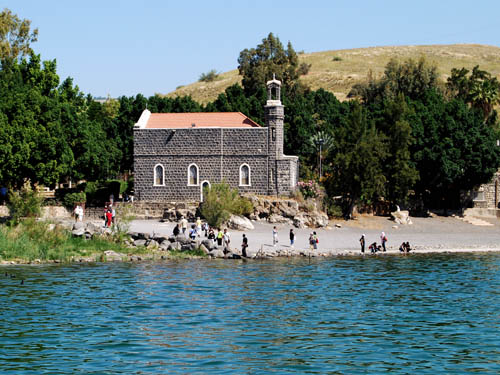
Tradition locates the place of His meeting with the disciples at (or near) Tabgha on the northwest shore of the Sea of Tiberias. The events are recorded in John 21. The disciples had fished during the night and caught nothing. At day break Jesus invited them to “Come and have breakfast.”
The small church, made of the local basalt stone, is called the Church of the Primacy of Peter. Roman Catholics believe Christ promised and conferred the primacy of jurisdiction over the entire church on the Apostle Peter at this time and place (John 21:14-17). Need I say that many do not agree with this interpretation?
The traditional site where Jesus prepared breakfast for the disciples. The building covers what Catholics call the Mensa Christi (the Table of Christ). Photo by Ferrell Jenkins.
Observe in the photo that the shoreline is far from the building. This is because the water level has been extremely low in the past few years. Remnants of a small harbor can be seen beside the building. Mendel Nun, in his well-known article about the 15 man-made harbors around the Sea of Galilee, writes about Tabgha:
In the winter, fishermen from Capernaum worked at Tabgha, where several warm mineral springs attracted musht, popularly called St. Peter’s Fish. (The name Tabgha is a corruption of the Greek for “Seven Springs.”) Today the remains of this small harbor’s breakwater can be seen when the water level is low. Christian tradition ascribes the meeting place of Jesus with his disciples to a prominent rock at the warm springs. From a fisherman’s viewpoint, this is the correct choice. This is the area where musht schools formerly concentrated in the winter and spring. Here Jesus met his disciples for the first—and also the last—time (Luke 5:1–7; John 21:1–8). On this rock, now known as the rock of the primacy of Peter, stands a small modern Franciscan chapel, the Church of the Primacy of Peter. It was built on the foundations of earlier churches, the oldest of which dates from the first half of the fourth century. The altar is built around a stone outcropping known to pilgrims as the Lord’s Table (Mensa Domini), on which Jesus served the disciples after the miraculous draught of fishes (John 21:13). (Nun, Mendel. “Ports of Galilee.” Biblical Archaeology Review. July/August 1999).
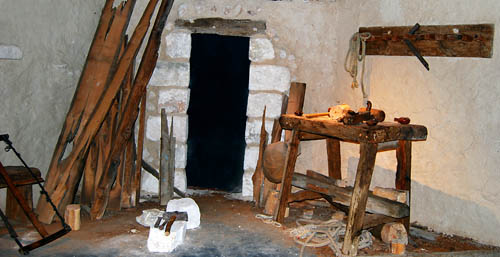
Jesus is called a carpenter in Mark 6:3. In Matthew’s account He is called the carpenter’s son. The study note in the NET Bible suggests that this was probably a derogatory term. Those who used the term thought of Him as “a common laborer like themselves.”
Lane says the term carpenter (Greek tekton) “commonly designates a worker in any hard material: wood, metal or stone, and so comes to mean a builder.”
Louw-Nida says,
There is every reason to believe that in biblical times one who was regarded as a tekton would be skilled in the use of wood and stone and possibly even metal.
A carpenter’s shop is exhibited at Nazareth Village. It is correct in showing tools for stone cutting as well as wood working.
Carpenter shop at Nazareth Village. Photo by Ferrell Jenkins.
The first disciples called by Jesus were fishermen. In the previous post we indicated the significance of fishing on the Sea of Galilee. The best time to see fishermen on the Sea is early in the morning. The photo below was made early one morning where the Jordan River exits from the Sea of Galilee. These fishermen have been fishing with nets and have brought in a nice catch.
Fishermen on the Sea of Galilee bringing in the catch. Photo by Ferrell Jenkins.
This reminds us of the call Jesus gave to the disciples one day in ancient Galilee.
Now as Jesus was walking by the Sea of Galilee, He saw two brothers, Simon who was called Peter, and Andrew his brother, casting a net into the sea; for they were fishermen. And He said to them, “Follow Me, and I will make you fishers of men. Immediately they left their nets and followed Him.” (Matthew 4:18-20 NAS)





 Ferrell's Travel Blog

You must be logged in to post a comment.