Tag Archives: Jerusalem

More on the Vandalization of the Protestant Cemetery in Jerusalem

This is a brief follow-up on our report here of the vandalization of the Protestant Cemetery. Trent Dutton, “Our man in Jerusalem”, reports that once AP released a story about the vandalism, several Middle East and American news outlets have come to the cemetery for photographs, and have re-posted the story.

Fox News: http://www.foxnews.com/world/2013/10/09/vandals-damage-graves-in-jerusalem-in-latest-attack-against-christians/?intcmp=latestnews

Washington Times: http://www.washingtontimes.com/news/2013/oct/9/jerusalem-grave-vandals-set-christians-edge/

Ma’an News (Jordanian) discusses this in the context of the general problem faced by some Arabs: http://www.maannews.net/eng/ViewDetails.aspx?ID=634823

YouTube: http://www.youtube.com/watch?v=4GY6D02dksI

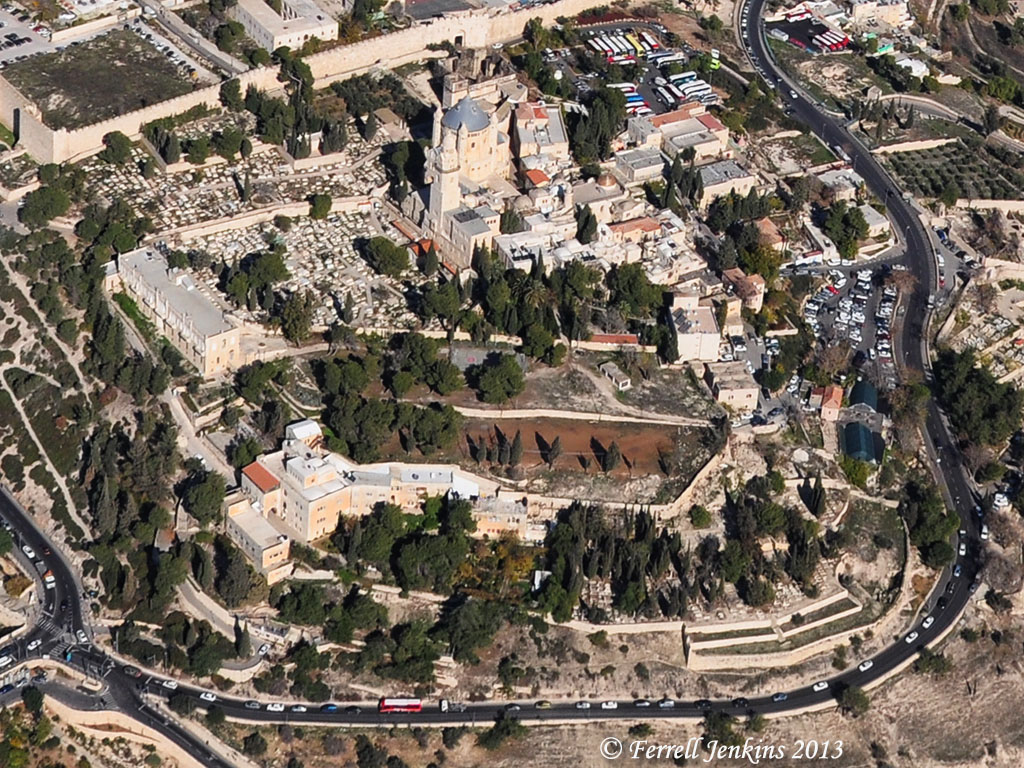
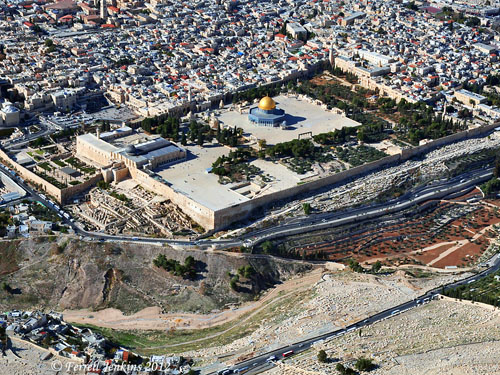
The aerial photo below shows the Church of the Dormitian, the Catholic, Armenian, and Greek cemeteries in the upper left portion. Along the bottom of the photo, overlooking the road along the south of the Old City where it joins with the Hebron Road, is the Jerusalem University College. The Protestant Cemetery can be seen among the trees just above our copyright notice. Click on the photo for a larger image.

Aerial photo of the Protestant Cemetery. Photo by Ferrell Jenkins.

Aerial photo of the Protestant Cemetery. Photo by Ferrell Jenkins.

You can probably see that it would be rather easy for one to enter the cemetery from the road below.

HT: Trent Dutton

Crusader period hospital building in Jerusalem

The Israel Antiquities Authority announced yesterday that a building from the Crusader period (1099–1291 A.D.) has been excavated. The building is in an area of the Christian Quarter of Jerusalem known as the Muristan (“a corruption of the Persian word for hospital”). Our first photo shows part of the Muristan near the old structure. You can see the tower of the Lutheran Church of the Redeemer. This is near the Church of the Holy Sepulcher.

The Muristan in the Christian Quarter of the Old City of Jerusalem. The tower of the Lutheran Church of the Redeemer is visible. Photo by Ferrell Jenkins.

The Muristan in the Christian Quarter of the Old City of Jerusalem. The tower of the Lutheran Church of the Redeemer is visible. Photo by Ferrell Jenkins.

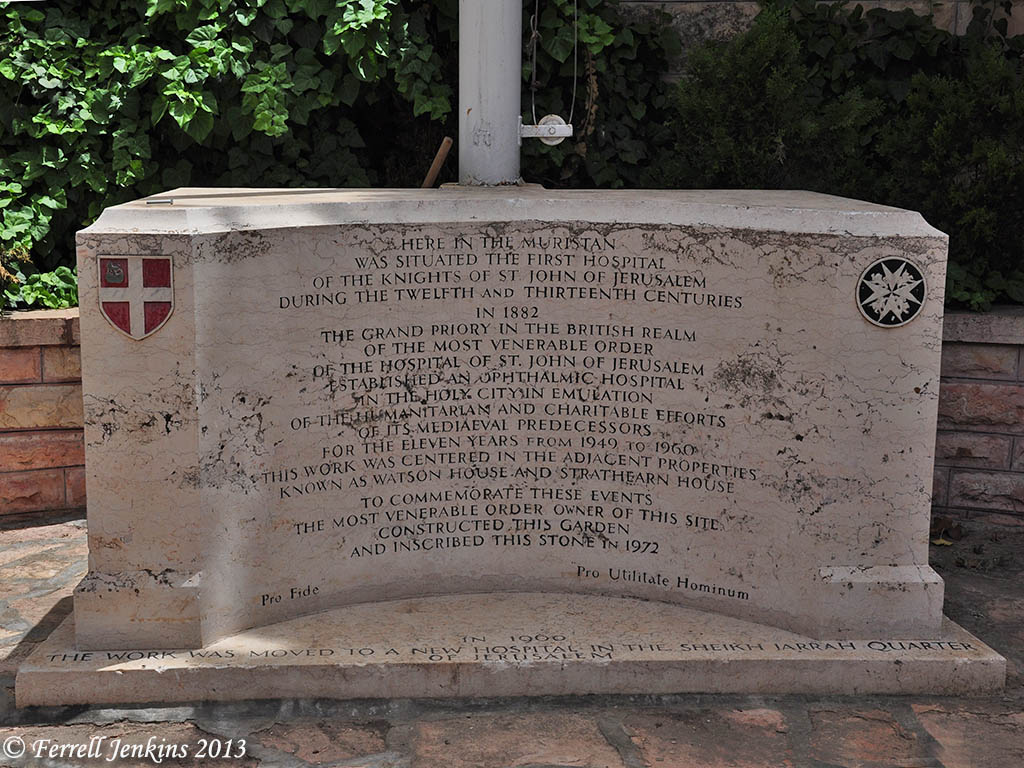
Between the Lutheran Church and the Armenian Quarter on Muristan Street stands a monument identifying the area where the hospital of St. John of Jerusalem was established. Click on the image if you wish to read the inscription.
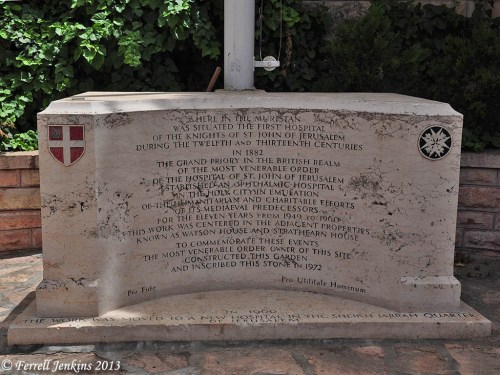
Marker identifying the location of the hospital built by the "Order of St. John of the Hospital in Jerusalem." Photo by Ferrell Jenkins.

Marker identifying the location of the hospital built by the “Order of St. John of the Hospital in Jerusalem.” Photo by Ferrell Jenkins.

The Press Release contains several bits of historical information that may be of interest to readers. Here is the full Press Release.

— ♦ —

The Israel Antiquities Authority conducted an excavation in the impressive Crusader building, which is similar in appearance to the Knights Halls in Akko and stands 6 meters high, prior to the construction of a restaurant by the Grand Bazaar Company

Part of an enormous structure dating to the Crusader period (1099–1291 CE), which was a busy hospital,  has currently been revealed to the public following excavations and research by the Israel Antiquities Authority there in cooperation with the Grand Bazaar Company of East Jerusalem. The building, owned by the Waqf, is situated in the heart of the Christian Quarter in the Old City of Jerusalem, in a region known as “Muristan” (a corruption of the Persian word for hospital), near David Street, the main road in the Old City.

Until a decade or so ago the building served as a bustling and crowded fruit and vegetable market. Since then it stood there desolate. In the wake of the Grand Bazaar Company’s intention to renovate the market as a restaurant, the Israel Antiquities Authority conducted archaeological soundings there.

The structure, only a small part of which was exposed in the excavation, seems to extend across an area of fifteen dunams! Its construction is characterized by massive pillars and ribbed vaults and it stands more than six meters high. The image we have is that of a great hall composed of pillars, rooms and smaller halls.
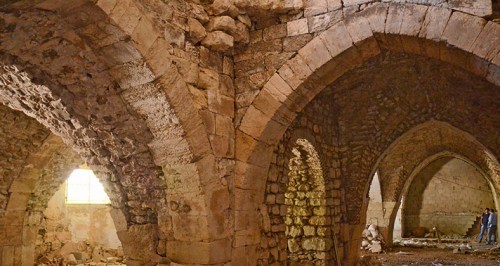
Ruins of the Crusader hospital built by the Order of St. John of the Hospital in Jerusalem. Yoli Shwartz, courtesy of the Israel Antiquities Authority.

Ruins of the Crusader hospital built by the Order of St. John of the Hospital in Jerusalem. Photo by Yoli Shwartz, courtesy of the Israel Antiquities Authority.

According to Renee Forestany and Amit Re’em, the excavation directors on behalf of the Israel Antiquities Authority, “We’ve learned about the hospital from contemporary historical documents, most of which are written in Latin.  These mention a sophisticated hospital that is as large and as organized as a modern hospital. The hospital was established and constructed by a Christian military order named the “Order of St. John of the Hospital in Jerusalem” and known by its Latin name the Hospitallers (from the word hospital). These righteous warriors took an oath to care for and watch over pilgrims, and when necessary they joined the ranks of the fighters as an elite unit.

The hospital was comprised of different wings and departments according to the nature of the illness and the condition of the patient – similar to a modern hospital. In an emergency situation the hospital could accept as many as 2,000 patients. The Hospitallers treated sick men and women of different religions. There is information about Crusaders who ensured their Jewish patients received kosher food. All that notwithstanding, they were completely ignorant in all aspects of medicine and sanitation: an eyewitness of the period reports that a Crusader doctor amputated the leg of a warrior just because he had a small infected wound – needless to say the patient died. The Muslim Arab population was instrumental in assisting the Crusaders in establishing the hospital and teaching them medicine. Arab culture has always held the medical profession in high regard and Arab physicians were famous far and wide.

In addition to the medical departments, the hospital also functioned as an orphanage where abandoned newborns were brought. Mothers who did not want their offspring would come there with covered heads and hand over their infants. In many instances when twins were born, one of them was given to the orphanage. The orphans were treated with great devotion and when they reached adulthood they served in the military order.

We can learn about the size of the hospital from contemporary documents. One of the documents recounts an incident about a staff member who was irresponsible in the performance of his work in the hospital. That person was marched alongside the building awhile, and the rest of the staff, with whips in hand, formed a line behind him and beat him. This spectacle was witnessed by all of the patients.

The Ayyubid ruler Saladin lived near the hospital following the defeat of the Crusaders, and he also renovated and maintained the structure. He permitted ten Crusader monks to continue to reside there and serve the population of Jerusalem.

The building collapsed in an earthquake that struck in 1457 CE and was buried beneath its ruins, which is how it remained until the Ottoman period. In the Middle Ages parts of the structure were used as a stable and the bones of horses and camels were found in excavations, alongside an enormous amount of metal that was used in shoeing the animals.

According to Monser Shwieki, the project manager, “The magnificent building will be integrated in a restaurant slated to be constructed there, and its patrons will be impressed by the enchanting atmosphere of the Middle Ages that prevails there”. According to Shwieki, “The place will be open to the public later this year”.

Click here to download high resolution pictures . Photograph credit: Yoli Shwartz, courtesy of the Israel Antiquities Authority.

HT: Joseph I. Lauer

Tenth century B.C. inscription found in Jerusalem

Hebrew University announces another significant archaeological discovery today. The entire press release is below.

 —• —

Jerusalem, July 10, 2013 — Working near the Temple Mount in Jerusalem, Hebrew University of Jerusalem archaeologist Dr. Eilat Mazar has unearthed the earliest alphabetical written text ever uncovered in the city.

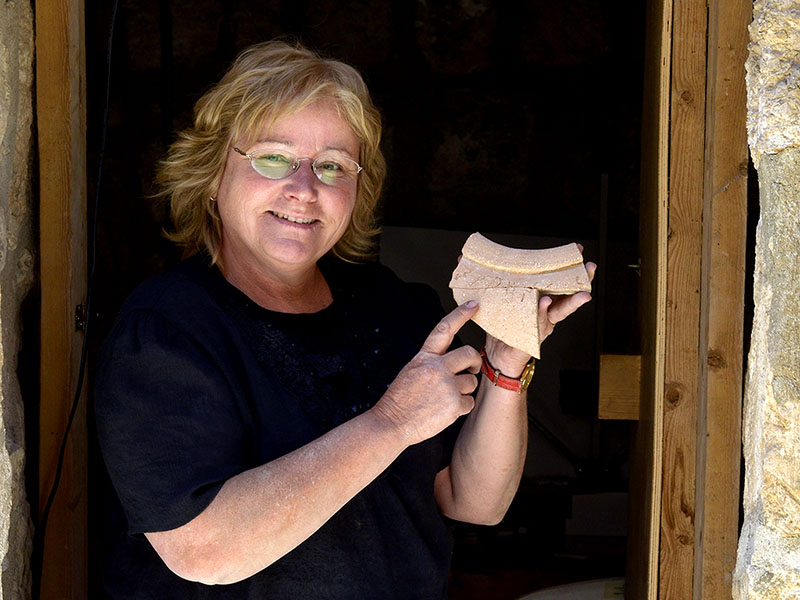
Dr. Eilat Mazar with Canaanite inscription.

Hebrew University of Jerusalem archaeologist Dr. Eilat Mazar displays a jar fragment unearthed near Jerusalem’s Temple Mount bearing an inscription in the Canaanite language. Dated to the tenth century BCE, it is the earliest alphabetical written text ever uncovered in the city. (Photo courtesy of Dr. Eilat Mazar; photographed by Oria Tadmor.)

The inscription is engraved on a large pithos, a neckless ceramic jar found with six others at the Ophel excavation site. According to Dr. Mazar, the inscription, in the Canaanite language, is the only one of its kind discovered in Jerusalem and an important addition to the city’s history.

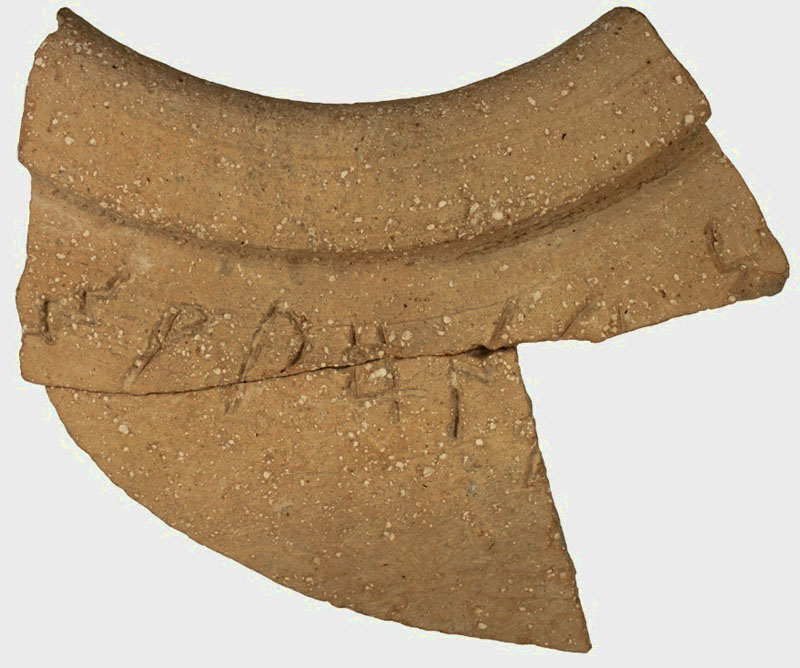
Canaanite inscription excavated by Dr. Eilat Mazar.

This jar fragment bearing an inscription in the Canaanite language was unearthed near Jerusalem’s Temple Mount by Hebrew University archaeologist Dr. Eilat Mazar. Dated to the tenth century BCE, it is the earliest alphabetical written text ever uncovered in the city. (Photo courtesy of Dr. Eilat Mazar; photographed by Noga Cohen-Aloro.)

Dated to the tenth century BCE, the artifact predates by two hundred and fifty years the earliest known Hebrew inscription from Jerusalem, which is from the period of King Hezekiah at the end of the eighth century BCE.

A third-generation archaeologist working at the Hebrew University’s Institute of Archaeology, Dr. Mazar directs archaeological excavations on the summit of the City of David and at the southern wall of the Temple Mount.

The discovery will be announced in a paper by Dr. Mazar, Prof. Shmuel Ahituv of Ben-Gurion University of the Negev, and Dr. David Ben-Shlomo of the Hebrew University, following their extensive research on the artifact. Prof. Ahituv studied the inscription and Dr. Ben-Shlomo studied the composition of the ceramic materials. The paper, “An Inscribed Pithos From the Ophel,” appears in the Israel Exploration Journal 63/1 (2013).

The inscription was engraved near the edge of the jar before it was fired, and only a fragment of it has been found, along with fragments of six large jars of the same type. The fragments were used to stabilize the earth fill under the second floor of the building they were discovered in, which dates to the Early Iron IIA period (10th century BCE).  An analysis of the jars’ clay composition indicates that they are all of a similar make, and probably originate in the central hill country near Jerusalem.

According to Prof. Ahituv, the inscription is not complete and probably wound around the jar’s shoulder, while the remaining portion is just the end of the inscription and one letter from the beginning. The inscription is engraved in a proto-Canaanite / early Canaanite script of the eleventh-to-tenth centuries BCE, which pre-dates the Israelite rule and the prevalence of Hebrew script.

Reading from left to right, the text contains a combination of letters approximately 2.5 cm tall, which translate to m, q, p, h, n, (possibly) l, and n. Since this combination of letters has no meaning in known west-Semitic languages, the inscription’s meaning is unknown.

The archaeologists suspect the inscription specifies the jar’s contents or the name of its owner. Because the inscription is not in Hebrew, it is likely to have been written by one of the non-Israeli residents of Jerusalem, perhaps Jebusites, who were part of the city population in the time of Kings David and Solomon.

Excavations at the site are conducted in collaboration with the Israel Antiquities Authority, the Israel Nature and Parks Authority, and the East Jerusalem Development Company. The site is in the national park surrounding the walls of Jerusalem’s Old City, near the southern wall of the Temple Mount compound. The Israel Antiquities Authority maintains the excavation site as a national park open to the public.

The excavations are made possible through a generous donation by Daniel Mintz and Meredith Berkman of New York. Participants in the dig include Israeli students and workers, along with students or alumni of Herbert W. Armstrong College sent to Jerusalem from Edmond, Oklahoma to participate in the excavation.

HT: Joseph I. Lauer

Roman road found in Jerusalem

A section of the Roman road that led from Joppa to Jerusalem has been found in the Beit Hanina community northeast of the Old City of Jerusalem. This road came to light during preparation for the installation of a drainage pipe.

The road is about 25 feet wide and is said to date back about 1800 years.

Roman road excavated in the Beit Hanina community. Photo: Assaf Peretz, courtesy of the Israel Antiquities Authority.

Roman road excavated in the Beit Hanina community. Photo: Assaf Peretz, courtesy of the Israel Antiquities Authority.

The IAA press release, available here, gives attention the course of the road from Joppa (Yafo) and Jerusalem.

The road section discovered in the IAA excavations in Beit Hanina is part of the imperial network of roads that led to Jerusalem from the coastal plain. We know about these roads from both historical sources and archaeological excavations. Two main arteries led from Yafo to Jerusalem during the Roman period. One is the road that passes through Bet Horon and the other runs via Shaar HaGai. This particular segment belongs to the Bet Horon road. The road began in Yafo and passed through Lod where it split it two different directions: one to Shaar HaGai and the other by way of Modiin along the route of what is today Highway 443 to Bet Horon. From there the road continued eastward as far as Bir Nabala and turned south to Kefar Shmuel where it merged with the highlands road that led to the Old City of Jerusalem.

The Times of Israel includes a map here showing the location of the uncovered section of road.

HT: Joseph Lauer

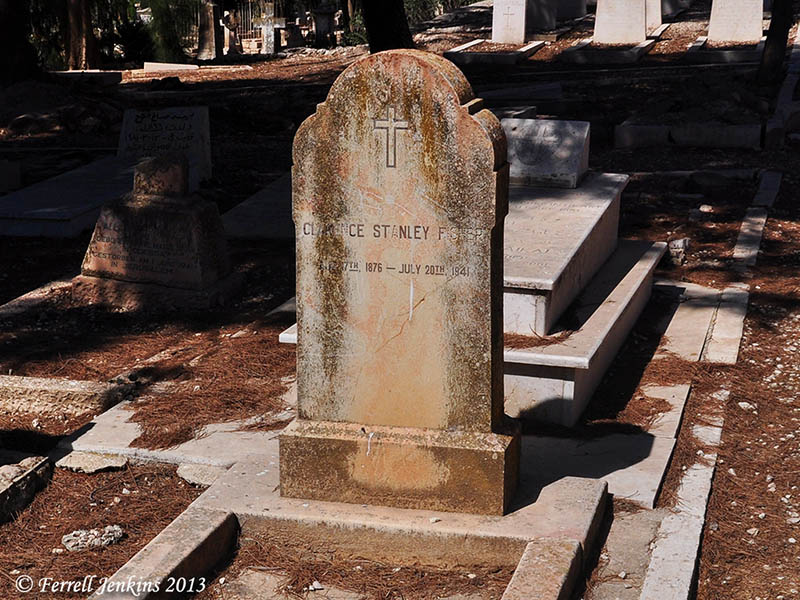
Clarence Stanley Fisher — Armageddon

Clarence Stanley Fisher was trained as an architect at the University of Pennsylvania in his hometown of Philadelphia. He became involved in archaeology at Nippur, Iraq (the region of ancient Sumer). Later he worked with George Andrew Reisner at Giza, Egypt, and then at Samaria from 1908 to 1910. This expedition, sponsored by Harvard, was the first American excavation in Palestine. After a short time back at Giza, he excavated at Beth Shan (Beit She’an), a dig sponsored by the University of Pennsylvania.

Fisher received an invitation from the University of Chicago to work at Megiddo, a work funded by the Rockefeller family. This excavation continued from 1933 to 1939, but fisher stopped working at the site after two years because of bad health.

The Megiddo excavations were recounted by Fisher under the title The Excavation of Armageddon, a work published by the University of Chicago Press with a foreword written by James Henry Breasted. This work is available at Google Books.

From 1936 to the time of his unexpected death in 1941, Fisher served as Professor of Archaeology at the American Schools of Oriental Research in Jerusalem (now the Albright Institute).

Fisher is buried at the Protestant Cemetery on Mount Zion in Jerusalem.

Grave marker for Clarence Stanley Fisher. Photo by Ferrell Jenkins.

Grave marker for Clarence Stanley Fisher. Photo by Ferrell Jenkins.

The brief information I have included here is summarized from a brief article by Milton C. Fisher in Bible and Spade 6:2 (Spring 1993). I get the impression that Milton is not related to Clarence. Milton Fisher cites two comments about C. S. Fisher that I wish to quote here.

W. F. Albright described Fisher as “an archaeological genius of no mean quality.”

Nelson Glueck wrote the following at the time of his death:

“The company of his friends misses him sorely. The host of those who loved him for his goodness of heart and humility of spirit will cherish the memory of this gentle man, whose last pilgrimage was to Nazareth, and whose final resting place is in Jerusalem.”

I find it fascinating to see so many well-known names associated with Fisher when Americans and American institutions were actively working in the Middle East.

Conrad Schick — architect, explorer, model builder

Conrad Schick was born in Switzerland and first came to Jerusalem with a group of men who planned to teach the local young people vocational trades. This group soon disintegrated, and Schick eventually married Friederike Dubler, a German missionary.

Schick became well known as an architect and city planner. He also became involved with some of the late 19th century explorers. He surveyed significant parts of the Old City, and built models of the temple mount and other structures in Jerusalem to use in teaching.

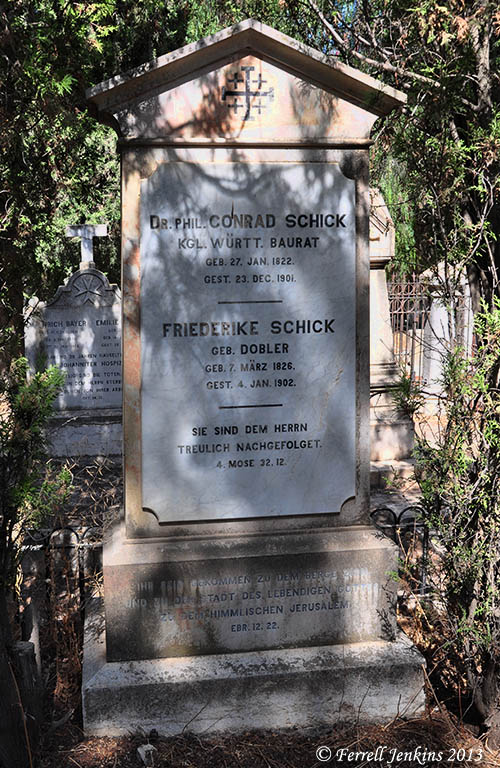
Schick and his wife are buried in the Protestant Cemetery on Mount Zion.

Grave marker for Conrad and Frederike Schick. Photo by Ferrell Jenkins.

Grave marker for Conrad and Frederike Schick. Photo by Ferrell Jenkins.

Epitaphs are often fascinating. This grave stone includes two Scriptures in German.

… for they have wholly followed the LORD (Numbers 32:12)

But you have come to Mount Zion and to the city of the living God, the heavenly Jerusalem … (Hebrews 12:22)

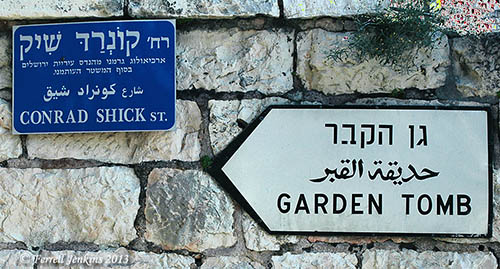
The short lane leading from Nablus Road to the Garden Tomb is named for Conrad Shick [Schick].

Conrad Schick Street leads to the Garden Tomb. Photo by Ferrell Jenkins.

Conrad Shick Street leads to the Garden Tomb. Photo by Ferrell Jenkins.

Tom Powers has prepared an article about Conrad Schick, and I have made use of it in this post. The entire paper is fascinating. See here.

There is also a page devoted to Schick here.

Special Note: If you have any interest in the American Colony, and other people buried in this cemetery, please take a look at the comments by Tom Powers (Outremer) following the two earlier posts about the Spaffords.

David — the sweet psalmist of Israel

As a young man, David played the harp (lyre, Hebrew kinnor) for King Saul.

So it came about whenever the evil spirit from God came to Saul, David would take the harp and play it with his hand; and Saul would be refreshed and be well, and the evil spirit would depart from him. (1 Samuel16:23 NAU)

Later, David is called the “sweet psalmist of Israel.” We have many examples in the collections of Psalms.

Now these are the last words of David. David the son of Jesse declares, The man who was raised on high declares, The anointed of the God of Jacob, And the sweet psalmist of Israel, (2 Samuel 23:1 NAU)

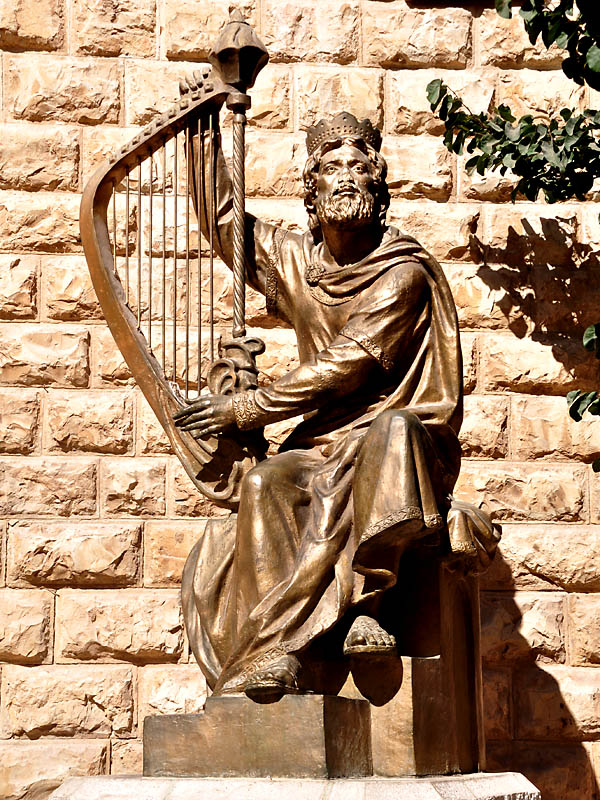
On traditional Mount Zion, near the traditional Tomb of David there is a statue of King David playing the harp (lyre).

Statue of King David on Mount Zion, Jerusalem. Photo by Ferrell Jenkins.

Statue of King David on Mount Zion, Jerusalem. Photo by Ferrell Jenkins.

Our time in the Bible World has come to an end once more. It has been a profitable trip. I still learn something each time I come to this part of the world. Looking forward to next year in Jerusalem.

Our numbers have been extremely good during the past three weeks. I hope that you will continue to check the blog from time to time. Why not subscribe and receive a notification each time we post something new?

Acts 2 — Photo Illustrations

Acts 2 is one of those highly significant chapters of the Bible. It is a pivotal point, or as the late James D. Bales called it in one of his books, “The Hub of the Bible.” The reason is because so many Old Testament prophecies looked forward to their fulfillment in the events of Acts 2 (e.g., Isaiah 2, Joel 2, Daniel 2), and because many New Testament texts look back to the beginning of the gospel in that chapter (e.g., Ephesians 2). In fact, Peter refers to the events of Pentecost as “the beginning” (Acts 11:15).

The prophet Isaiah said,

Now it will come about that In the last days The mountain of the house of the LORD Will be established as the chief of the mountains, And will be raised above the hills; And all the nations will stream to it. And many peoples will come and say, “Come, let us go up to the mountain of the LORD, To the house of the God of Jacob; That He may teach us concerning His ways And that we may walk in His paths.” For the law will go forth from Zion And the word of the LORD from Jerusalem. (Isaiah 2:2-3 NAU)

From the beginning of His ministry, Jesus spoke of the establishment of the kingdom during the lifetime of some of those who heard him (Mark 1:14-15; 9:1).

Our aerial photo shows the enclosed Islamic sanctuary area that is commonly called the Haram es-Sherif. Benjamin Mazar says that this area is about 40 acres. He points out that Josephus and the Mishna give smaller dimensions, and says that they apparently refer to “the Soreg or sacred enclosure” (The Mountain of the Lord, 119-120). Other writers say the area is 36 acres in size. Certainly large enough for the crowds who came to Jerusalem for festivals such as the Passover and Pentecost.

Solomon’s temple stood on Mount Moriah (2 Chronicles 3:1). Centuries later Herod the Great built the large platform and enclosure walls. Stones from that wall can still be seen in many places around this vast enclosure. The picture shows the southern wall and the eastern wall (the long one). The Kidron Valley and a portion of the slope of the Mount of Olives is visible in the bottom of the photo.

Aerial view of the temple precinct from the time of Herod the Great. Today the area is occupied by Moslem shrines, Al Aksa Mosque and the Mosque of Omar (Dome of the Rock). Photo by Ferrell Jenkins.

Aerial view of the temple precinct from the time of Herod the Great. Today the area is occupied by Moslem shrines, Al Aksa Mosque and the Mosque of Omar (Dome of the Rock). Photo by Ferrell Jenkins.

Click on the photo for an image suitable for use in teaching.

The New Testament (Greek) makes a distinction between the entire temple precinct, courts and all (Greek, hieron), and the sanctuary where only the priests were allowed (Greek, naos). John 2:14-15 uses hieron. John 2:19-21 uses naos.

Hieron is the term used in Acts 2:46. The new converts met in the temple precinct. They most likely assembled in one of the large porticoes built around the inside of the enclosure wall (cf. Acts 3:11; 5:12).

Day by day continuing with one mind in the temple, and breaking bread from house to house, they were taking their meals together with gladness and sincerity of heart,  praising God and having favor with all the people. And the Lord was adding to their number day by day those who were being saved. (Acts 2:46-47 NAU)

It also was within this precinct that the large crowd of devout Jews “from every nation under heaven” assembled on Pentecost. Here, Peter preached the gospel of the death, burial, and resurrection of Jesus for the first time.

Alexander the Great and the Book of Daniel

Josephus, the late first century Jewish historian, records the visit of Alexander the Great to the city of Jerusalem in the 4th century B.C. He recounts how Alexander “went up into the temple” and “offered sacrifice to God.” He says that the Book of Daniel was shown to Alexander. Alexander assumed, as have many commentators since that time, that Daniel was prophesying of Alexander.

Bust of Alexander in the Istanbul Archaeological Museum. Photo by Ferrell Jenkins.

Bust of Alexander in the Istanbul Archaeological Museum. Photo by Ferrell Jenkins.

Here is a portion of the account from the Antiquities of the Jews. Notice especially section 337.

336 And when he had said this to Parmenion, and had given the high priest his right hand, the priests ran along by him, and he came into the city. And when he went up into the temple, he offered sacrifice to God, according to the high priest’s direction, and magnificently treated both the high priest and the priests.
337 And when the Book of Daniel was showed to him {a} wherein Daniel declared that one of the Greeks should destroy the empire of the Persians, he supposed that himself was the person intended; and as he was then glad, he dismissed the multitude for the present; but the next day he called them to him, and bade them ask what favours they pleased of him;
338 whereupon the high priest desired that they might enjoy the laws of their forefathers, and might pay no tribute on the seventh year. He granted all they desired; and when they entreated him that he would permit the Jews in Babylon and Media to enjoy their own laws also, he willingly promised to do hereafter what they desired:  (Ant 11:336-338)

Read Daniel 8 for more details of the conflict between Alexander, who is compared to a male goat, and the Persian king who is likened to a ram.

As I was considering, behold, a male goat came from the west across the face of the whole earth, without touching the ground. And the goat had a conspicuous horn between his eyes. (Daniel 8:5 ESV)

“Gibeon, for the king” bulla discovered

The Temple Mount Sifting Project, Jerusalem, announced yesterday the discovery of a clay bulla bearing the name of the biblical city of Gibeon. The name of Gibeon (GB’N) occurs with LMLK (for the king).

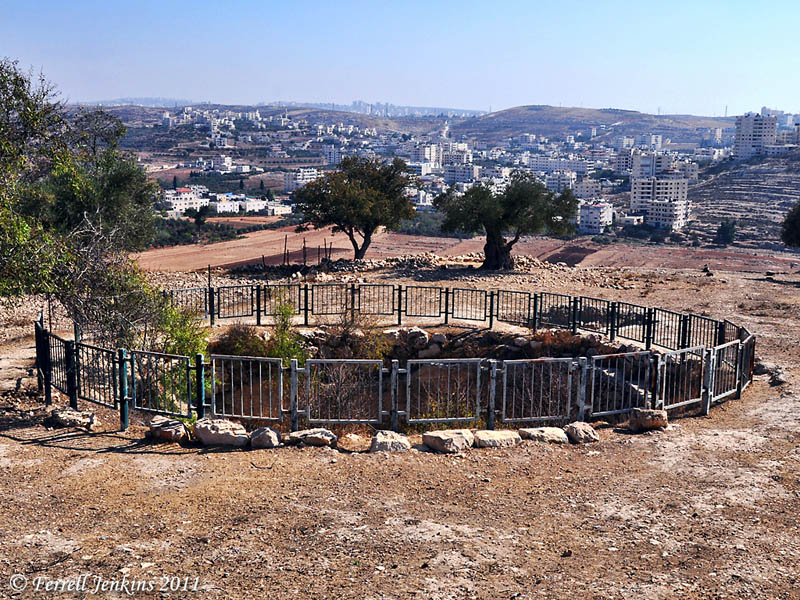
The Pool of Gibeon. Photo by Ferrell Jenkins in 2011.

The Pool of Gibeon at El-Jib. Photo by Ferrell Jenkins in 2011.

Gabriel Barkay summarizes his report of this discovery.

A small fragment of a clay bulla was discovered in the wet sifting carried out at Tzurim Valley National Park, the site of the Temple Mount Sifting Project. The bulla carries an Ancient Hebrew inscription: “[g]b’n/lmlk“, i.e. “Gibeon, for the King”. The bulla originates from the eastern slope of the Temple Mount, descending into the Kidron Valley. The bulla belongs to a group of bullae which were called by N. Avigad “Fiscal Bullae”.

Presently we know more than 50 bullae of this type. They comprise two groups, one with names of cities in the kingdom of Judah, and the other with names of royal officials. All the fiscal bullae known until now come from the antiquities market, and our bulla is the first one to come from a controlled archaeological project. This bulla enables us to fully illuminate and discuss the entire phenomenon of the fiscal bullae.

Barkay says the known bullae,

include names of 19 different cities of Judah, and dates of the reign of one of the Judean kings, usually in hieratic numerals, as well as the particle lmlk, “for the king”.

He says,

The fiscal bullae represent a taxation system from the different Judean cities, based on yearly taxes, which probably replaced the previous one, reflected in the royal Judean jars and their seal impressions, from the time of King Hezekiah.

The discovery of the fiscal bulla with the name of Gibeon from the slope of the Temple Mount, authenticates all the other fiscal bullae, and enables us to study a variety of subjects connected to the history of Judah in the 7th century BCE.

Two brief reports on the Project may be read here.

Name of Gibeon is not new. This is not the first time the name of Gibeon has been discovered from the past. During the excavations conducted by James Pritchard for the Museum of the University of Pennsylvania and the Church Divinity School of the Pacific between 1956 and 1962, over 25 inscription were found with the name Gibeon. In fact, this is how Pritchard first knew with certainy that the Arab town El Jib was to be identified as Gibeon.

Some of the inscribed jar handles discovered by Pritchard’s excavation at El Jib are displayed at the University of Pennsylvania Archaeological Museum in Philadelphia.

Gibeon is an important town in Biblical history. The first Biblical reference is in Joshua 9.

Recently I have been scanning a few slides I made at Gibeon in 1970 and 1976. Hopefully I will be able to provide some comparison photos for you to see the vast difference between then and now.

The Temple Mount Sifting Project began after it was discovered that the Moslems in control of the Temple Mount, where the Dome of the Rock is located, were dumping debris from work they were doing on the Temple Mount. This project has been underway for more than two years. A temporary building has been erected in Tzurim Valley National Park for the sifting project.

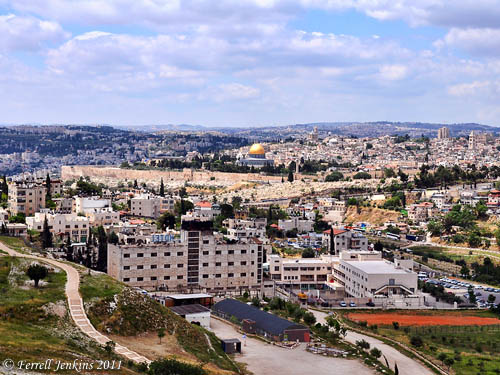
The photo below was made from Mount Scopus. Here we see the temporary building of the Temple Mount Sifting Project in the foreground. The slope of the Mount of Olives is on the left (east). The Kidron Valley begins to the right of the buildings in the center of the photo and continues south under the eastern wall of the Old City of Jerusalem which you can see clearly in this photo. Click on the photo for a larger image.

Jerusalem from Mount Scopus. The Temple Mount Sifting Project building is in the foreground. Photo by Ferrell Jenkins.

Jerusalem from Mount Scopus. The Temple Mount Sifting Project building is in the foreground. Photo by Ferrell Jenkins.

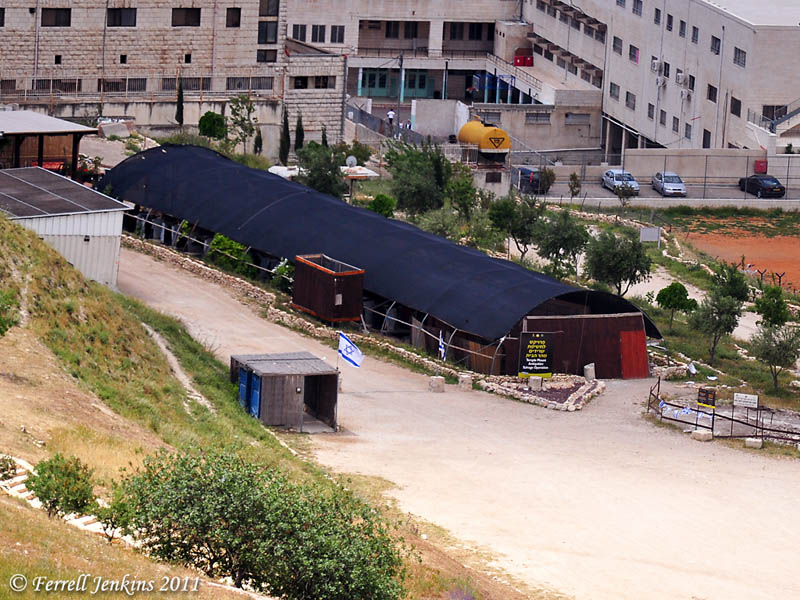
The next photo is a closeup of the building used by The Temple Mount Sifting Project. Some wonderful pieces have been discovered from the first temple period, as well as other periods, as a result of the work done here.

View from Mount Scopus of the Temple Mount Sifting Project building. Photo by Ferrell Jenkins.

View from Mount Scopus of The Temple Mount Sifting Project building. Photo by Ferrell Jenkins.

Gordon Franz has an interesting article by Stephanie Hernandez about participation in the TMSP on his Life and Land site here.

Perhaps in the days to come we will be favored with a photo of the new bulla with the name of Gibeon on it. In the mean time, see how many times you can find the word Gibeon or Gibeonite/s in the Bible.