Tag Archives: Apostle Peter

Traveling in Turkey

“Turkey? Why would you want to go to Turkey?” That is a question I have been asked a number of times over the years since my first visit in 1968. My response usually goes something like this. If you are interested in Bible history, Turkey is very important both for the Old Testament and the New Testament. Of course, the land was not called Turkey at the time of the Bible, but had various names depending on the historical period and the geographical region.

Think of the Old Testament history.

  • It is possible that the Garden of Eden was located somewhere in the mountains of eastern Turkey near the source of the Tigris and Euphrates Rivers (Genesis 2:10-14).
  • For sure, Noah’s Ark came to rest on the mountains of Ararat (ancient Urartu) (Genesis 8:4).
  • Haran, and the region known as Padan-aram in Mesopotamia, became the ancestral home of Abraham and his family before he went to the land of Canaan (Genesis 28:2; et al.).
  • Bible kings were involved in battles with world powers at the town of Carchemish (Jeremiah 46:2).
  • The Hittites lived in central and eastern Turkey (1 Kings 10:28-29; 2 Kings 7:6). Kue designates Cilicia in Turkey.
  • Both the Assyrians and Babylonians, enemies of Israel, were active in this region (Isaiah 10:9; Jeremiah 46:1-2).
  • The Euphrates and the Tigris, great rivers of Turkey, were important in Bible times (Isaiah 27:12; Genesis 2:14; Daniel 10:4). The Euphrates is often designated simply as the River (Isaiah 11:16).

Think of New Testament history.

  • Paul was a native of Tarsus in Cilicia (Acts 21:39). Timothy was a native of Lystra (Acts 16:1).
  • From Acts 11 onward throughout the New Testament, most of the events take place in Roman Asia Minor.
  • The town we know as Antioch in (the Roman province of) Syria is now located in the Hatay province of Turkey (Acts 11; Galatians 2:11).
  • Paul, Barnabas, and John Mark sailed from Seleucia to begin the first missionary journey (Acts 13:4).
  • With the exception of Salamis and Paphos in Cyprus, all of the places associated with the first journey are in Turkey (Acts 13-14).
  • Many of the towns visited on the second and third journey are in Turkey (Acts 15-16).
  • Paul made stops at the coastal town of Myra on the voyage to Rome (Acts 27:5).
  • Paul’s letters to the Galatians, Ephesians, Colossians, and Philemon were address to churches or persons in Asia Minor.
  • Peter’s two letters were addressed to Christians in Pontus, Galatia, Cappadocia, Asia, and Bithynia, now in Turkey (1 Peter 1:1; 2 Peter 3:1). Peter also visited Antioch in Syria (Galatians 2:11).
  • The apostle John spent some of his latter years in Ephesus, and addressed the book of Revelation to seven churches in Asia (Revelation 1:4, 11).
Hot air balloons are moved by the wind over the lunar-like landscape of Cappadocia while the pilots control their altitude. Photo by Ferrell Jenkins.

Hot air balloons are moved by the wind over the lunar-like landscape of Cappadocia while the pilots control their altitude. Photo by Ferrell Jenkins.

Post New Testament church history.

  • The Book of Revelation describes events that would affect the saints of Asia (Revelation 1:4). The information we have about the Roman Emperors and the temples erected to their honor throughout Turkey fit perfectly with what we read in Revelation.
  • The Ecumenical Councils met in the place we now call Turkey in the following cities: Nicaea, Constantinople, Ephesus, Chalcedon.
  • Some of the better known early church fathers are associated with places in Turkey.

Good enough reasons to visit Turkey, I’d say.

Note: This is intended only as a suggestive list; not a complete one.
 

Temple Mount, Pools, Jericho, Jordan River

Today was a great day for travel in and around Jerusalem. We started the day by visiting the Temple Mount. This is a place filled with Bible history relating to Abraham, David, Solomon, Jesus, and Peter (as well as all of the apostle). It is a place destroyed by the Babylonians (586 B.C.) and the Romans (A.D. 70).

The site has been under Islamic control since the 7th century.

We visited the Pools of Bethesda (John 5) and the Pool of Siloam (John 9).

Yesterday, by the time we visited Masada, Qumran, and Jericho, it was too late to visit the baptismal site on the Jordan River, a site known as Qasr el-Yahud. This site on the Israel side is across from the Jordanian site identified as Bethany beyond the Jordan (John 1:28).

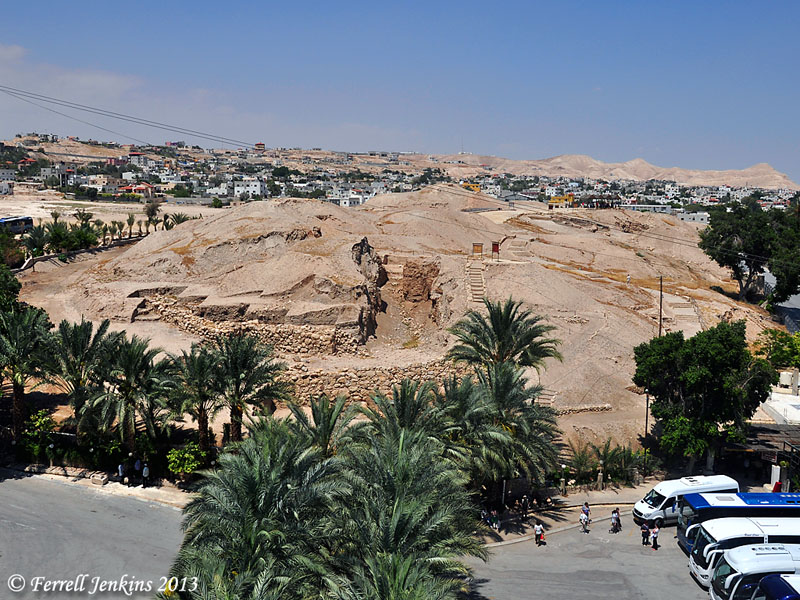
We stopped in Jericho for lunch at the Temptations Restaurant. The restaurant is located on the south end of Tell es-Sultan, identified with Biblical Jericho (Joshua 3-6).

The restaurant has lots of parking space for tour buses and good food. That’s a good combination in the tourist industry. As I was leaving I noticed a sign with the wording “View of Jericho”, and thought I should check it out. It took a climb of 11 flights of stairs to reach the roof. It was worth it for the view which was exceptionally good in all directions.

The view to the north is of Tel es-Sultan. See below. You may notice some wires (cables) across the photo. These are for the cable car that goes up to the traditional Mount of Temptation (Matthew 4).

Jericho (Tell es-Sultan) from the south. Photo by Ferrell Jenkins.

Jericho (Tell es-Sultan) from the south. Photo by Ferrell Jenkins.

Afterwards we visited the Jordan River. On the way back to Jerusalem we stopped by the St. George Monastery in the wilderness of Judea. The monastery building appear to hang on the side of a cliff overlooking the Wadi Qilt. Quite a sight.

We stopped at the Inn of the Good Samaritan (Luke 10:25-37) which now houses many mosaic floors from Jewish synagogues, Samaritan Synagogues, and Byzantine Churches, as well as a few other interesting artifacts.

It was a great day.

Hidden treasure

The discovery of hidden treasure is fairly common in and near ancient sites. Individuals may not have a bank account, but they keep the funds they have stored in what they consider a safe place.

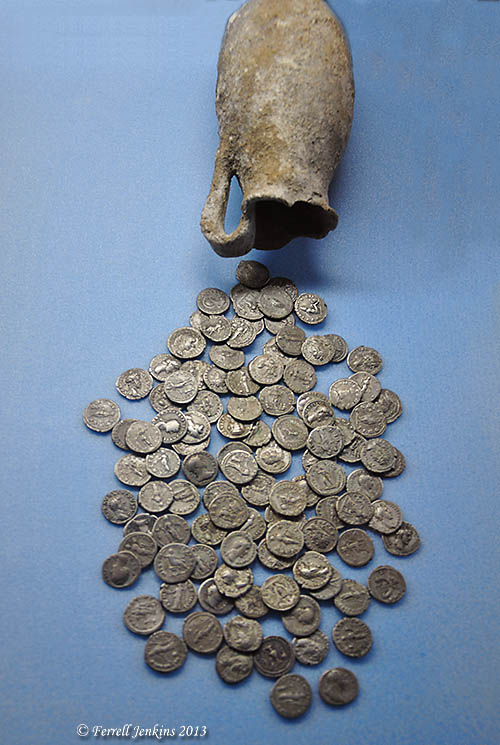
The photo below shows a clay jar with a hoard of silver coins displayed in the Samsun (Turkey) Archaeological Museum. These coins date from the Roman Imperial Period (69-79 A.D. and 238/244 A.D.). The earliest coins are not far removed from the time of the delivery of Peter’s Epistles to saints in Pontus and other Roman provinces (1 Peter 1:1). For more information about the delivery of Peter’s Epistles, see here.

For more information about the museum, check here and here.

Hoard of Roman coins displayed in Samsun Archaeological Museum. Photo by Ferrell Jenkins.

Roman coins displayed in Samsun Archaeological Museum. Photo by Ferrell Jenkins.

Photos such as this remind us of several Biblical passages. For today, consider Paul’s instruction to Timothy regarding what he was to teach those who set their hope on the uncertainty of riches.

 17 As for the rich in this present age, charge them not to be haughty, nor to set their hopes on the uncertainty of riches, but on God, who richly provides us with everything to enjoy.
18 They are to do good, to be rich in good works, to be generous and ready to share,
19 thus storing up treasure for themselves as a good foundation for the future, so that they may take hold of that which is truly life. (1 Timothy 6:17-19 ESV)

Speaking at Florida College Annual Lectures

Tuesday morning at 10 a.m. I am scheduled to present an illustrated lecture on Biblical Coastal Towns of Turkey in Puckett Auditorium at the Florida College Annual Lectures. Normally in these sessions, in which I have participated in for many years, I present material on lesser-visited places that are important to Bible study.

There are several important coastal towns in Turkey that are mentioned in the Bible, mostly in connection with the journeys of Paul. These include Troas, Assos, Ephesus, Miletus, Patara, Myra, Attalia, Perga, and Seleucia. I have chosen to discuss two Black Sea cities (Sinope and Samsun) that are related to the discussion of the route of delivery of the Epistles of Peter, and to two cities on the Mediterranean Sea (Patara and Myra). I was able to visit all of these cities during the past year.

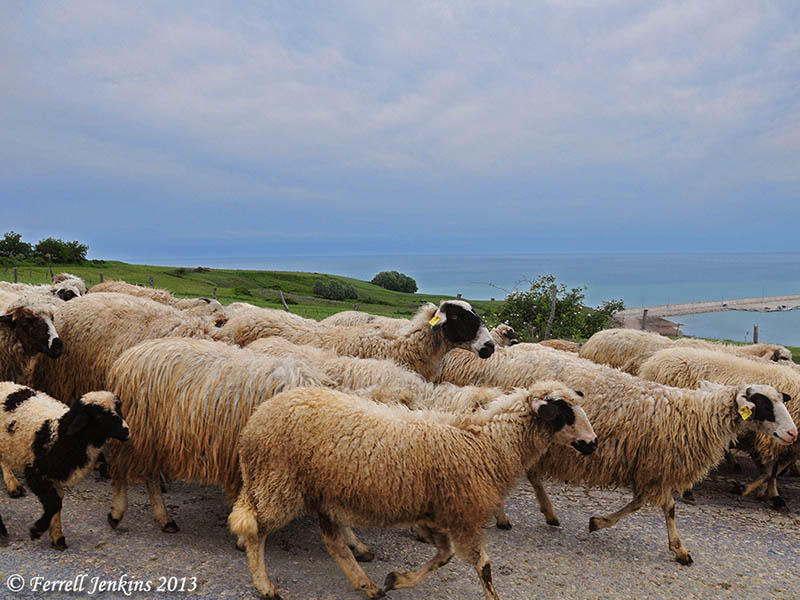
The photo below was made a few miles east of Sinope along the Black Sea (ancient Euxine). The territory is mountainous and the road is often far enough inland that the sea is not visible. Here the road runs along the sea, but still considerably above it. To the south, the mountains are much higher.

Sheep on the road east of Sinope, above the Black Sea. Photo by Ferrell Jenkins.

Sheep on the road east of Sinope, above the Black Sea. Photo by Ferrell Jenkins.

Acts 10 — Photo Illustrations

Joppa (Yafo, Jaffa) is about 35 miles northwest of Jerusalem on the coast of the Mediterranean Sea. Yafo is on the south side of Tel Aviv.

Joppa has a history dating back to the 15th century B.C. when it is mentioned in the town lists of Pharaoh Thutmose III.

In this post I will limit my comments to some of the significant events of the Book of Acts related to Joppa.

  • Tabitha (Dorcas) lived in Joppa. When she died the disciples sent for Peter who was a Lydda. He came to Joppa and raised Dorcas (Acts 9:36-42). (Acts 10:6).
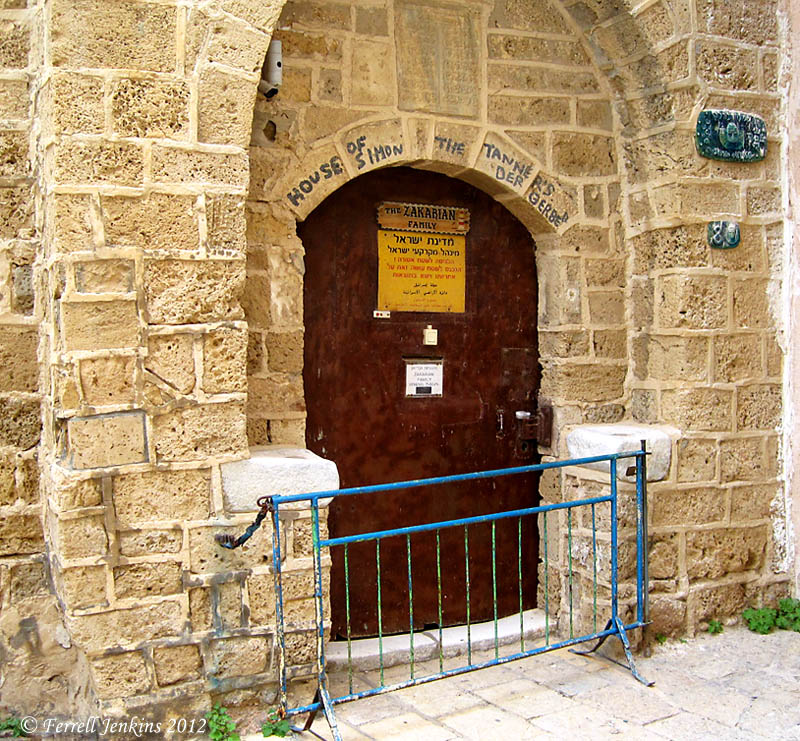
  • Peter stayed many days in Joppa with Simon the tanner (Acts 9:43). His house was by the sea (Acts 10:6). A house near the port is shown as the house of Simon, but there is no way to know this with certainty.
  • Peter received the housetop vision and learned that he was to go to Caesarea to preach the gospel to the Gentiles at the house of the Roman centurion Cornelius (Acts 10:23).

On one of the narrow streets of Joppa is a fairly modern house identified as the House of Simon the Tanner. Directly behind the house stands the lighthouse standing watch over the harbor. We take claims like this one with a grain of salt. But I often tell members of my tour groups, “It may not have been here, but it was not far from here.”

The traditional house of Simon the Tanner at Joppa. Photo by Ferrell Jenkins.

The traditional house of Simon the Tanner at Joppa. Photo by Ferrell Jenkins.

At least some houses during Bible times were build with a flat roof which could serve some practical uses. In the case of Peter it provided a good place to pray and to fall into a trance.

Could there be an “Internet Use Disorder”?

A headline in today’s New York Times caught my attention. It says, “Silicon Valley Says Step Away From the Device.” The article by Matt Richtel begins,

Stuart Crabb, a director in the executive offices of Facebook, naturally likes to extol the extraordinary benefits of computers and smartphones. But like a growing number of technology leaders, he offers a warning: log off once in a while, and put them down.

In a place where technology is seen as an all-powerful answer, it is increasingly being seen as too powerful, even addictive.

A leader from each of the giants in this field is quoted. Facebook, Twitter,  Zynga (FarmVille), Google (YouTube).

This is a worthwhile article which you may read in full here.

A few weeks back, Dr. Rod Decker commented on an article by Kevin Bauder. If this subject intrigues you, you might enjoy reading what they have said. Click here for Decker, and here for Bauder.

Self-control is a fruit of the Spirit (Galatians 5:23). Note Peter’s admonition in his reminder epistle to Christians.

Now for this very reason also, applying all diligence, in your faith supply moral excellence, and in your moral excellence, knowledge, and in your knowledge, self-control, and in your self-control, perseverance, and in your perseverance, godliness, and in your godliness, brotherly kindness, and in your brotherly kindness, love. (2 Peter 1:5-7 NAU)

Meanwhile, be sure to check back here tomorrow. 🙂

Acts 3 — Photo Illustrations

We begin today with a photo of the Second Temple Model of Jerusalem. This is the time of Jesus and the early days of the church. The wonderful model is now displayed on the grounds of the Israel Museum. Our view of the model shows pre-70 A.D. Jerusalem from the southwest (assuming we were photographing the city; not the modern setting of the model).

To the right of the photo is the dome of the Shrine of the Book. In the distance between the trees you will see Israel’s Knesset building.

Model of the city of Jerusalem in the time of Jesus. Photo by Ferrell Jenkins.

Model of the city of Jerusalem in the time of Jesus. Photo by Ferrell Jenkins.

Acts 3 begins with the account of Peter and John going up to the temple.

Now Peter and John were going up to the temple at the ninth hour, the hour of prayer. (Acts 3:1 NAU)

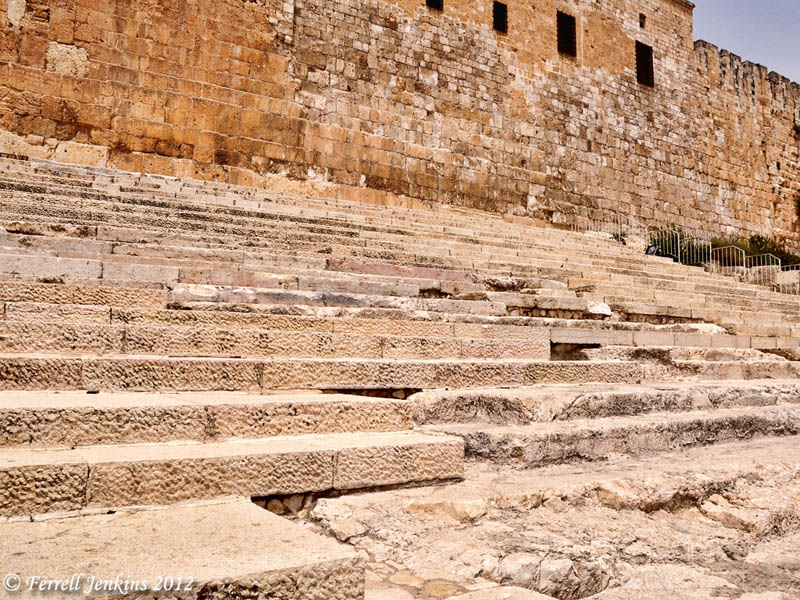
Following 1967 an excavation of area around the southern wall of the temple enclosure was conducted by Prof. Benjamin Mazar. Mazar describes the monumental stairway that was uncovered.

In the course of our excavations in the area facing the Western Hulda Gate, we uncovered a gigantic stairway which led from the Lower City (Ophel) to the gates. It is two hundred and fifteen feet wide; the foundation steps were cut into the natural bedrock on the slopes of the Temple Mount. The stairs were constructed of wide, trimmed and smoothed stone paving blocks, fitted together snugly. The stairway comprised thirty steps set alternately in wide and narrow rows. (The Mountain of the Lord, 143).

The Monumental Stairway led to the Double Gate which led into the temple precinct. We can safely say that Jesus and His disciples used these steps to enter the temple precinct.

Monumental Stairway leading to the temple. Photo by Ferrell Jenkins.

Monumental Stairway leading to the temple. Photo by Ferrell Jenkins.

Dr. Leen Ritmeyer, author of The Quest, calls attention to the virtual model of the Temple Mount in the time of Jesus. The brief video is helpful in understanding the area. Click here.

Perhaps another day we can discuss the Beautiful Gate (Acts 3:2, 10).

Roman artifacts in the Samsun Archaeology Museum

Our main interest in visiting the Black Sea coastal cities of Samsun and Sinop is because they are part of the ancient Roman province of Pontus. Somewhere in Pontus, probably Amisos (now Samsun), was the beginning point for the messenger who carried Peter’s first epistle to the elect of the diaspora residing in Pontus, Galatia, Cappadocia, Asia, and Bithynia (1 Peter 1:1).

The Archaeology Museum in Samsun has only a few items from the first century Roman period on display, but they are significant.

A marble head of Augustus is displayed prominently. Augustus was the Roman Emperor from 30 B.C. to A.D. 14. He is mentioned only once in the New Testament, but his influence in the eastern part of the Empire is evident in many way. The apostles traveled along roads built in the days of Augustus.

Luke records that the decree for a census to be taken of all the inhabited earth went out from Augustus.

Now in those days a decree went out from Caesar Augustus, that a census be taken of all the inhabited earth. (Luke 2:1 NAU)

This accounts for Mary and Joseph traveling from Nazareth to Bethlehem at the time of the birth of Jesus.

Roman Emperor Augustus. Displayed in Samsun Archaeology Museum. Photo by Ferrell Jenkins.

Augustus. Displayed in Samsun Archaeology Museum. Photo by Ferrell Jenkins.

I was surprised at the many references to Augustus on this blog. Just put the word Augustus in the search box to locate posts that mention him.

There is a first century image is that of a young athlete in the museum. He is full height, with arms missing.

Young Roman athlete in Samsun Archaeology Museum. Photo by Ferrell Jenkins.

Young Roman athlete in Samsun Archaeology Museum. Photo by Ferrell Jenkins.

The Apostle Paul used several illustrations from athletics. He told the young preacher Timothy that discipline and self control were necessary in his work as a preacher.

Every athlete exercises self-control in all things. They do it to receive a perishable wreath, but we an imperishable. So I do not run aimlessly; I do not box as one beating the air.  But I discipline my body and keep it under control, lest after preaching to others I myself should be disqualified. (1 Corinthians 9:25-27 ESV)

Visiting the Black Sea coast of Turkey

One might ask why a person interested in the Bible world would want to visit the Black Sea coast of Turkey. A few weeks ago, while there, I gave some of the reasons here. A summary before proceeding might be advisable. My visit was limited to a region of about 100+ miles from about 20 miles east of Samsun to Sinop.

Both Samsun and Sinop are located in the the region known as the Roman province of Pontus in Asia Minor. By New Testament times the provinces of Bythinia and Pontus were combined and governed as a single province.

Roman Provinces of Asia Minor in New Testament Times. BibleAtlas.org.

Roman Provinces of Asia Minor in New Testament Times. BibleAtlas.org.

There were 13 cities in the province of Pontus (Wilson, Biblical Turkey, 332).

The New Testament mentions Pontus only three times. The first reference is in Acts 2. Note the association with Peter.

  • Jews from Pontus were visiting Jerusalem during Pentecost when the gospel was first announced by Peter (Acts 2:5,9). It is likely that some of these men became obedient to the gospel before returning home.

Beside Peter’s address to Christians in Pontus in his first epistle, the only person named in association with Pontus is Aquila.

  • A Jew by the name of Aquila was a native of Pontus. He had gone to Rome, but was commanded to leave Rome under the decree of the Emperor Claudius (A.D. 41-54). Reaching Corinth, he and his wife Priscilla, met the apostle Paul (Acts 18:2). We are not told whether Priscilla was from Pontus, Rome, or some other place.
  • When Paul left Corinth, Aquila and Pricilla went with him to Ephesus and remained there. When they heard the eloquent Alexandrian preacher Apollos who knew only John’s baptism, they privately taught him the “the way of God more accurately” (Acts 18:18, 26). I think the inference is that they encouraged Apollos to go to Corinth.
  • Paul mentions Aquila and Priscila (Prisca) in his letter to the Corinthians which was written from Ephesus (1 Corinthians 16:19).
  • During Paul’s third journey, when he wrote to the saints at Rome from Greece (Corinth) during the reign of the Emperor Nero (A.D. 54-68), he sends greetings to Prisca and Aquila (Romans 16:3). This means that by this time they found it safe to reside in Rome.
  • In his final letter from Rome, Paul tells Timothy to “Greet Prisca and Aquila” (2 Timothy 4:19).

We have evidence that the name Aquila was known in Pontus. In the 1909 Dictionary of the Bible (ed. James Hastings), A. Souter says,

an inscription has recently been found referring to one Aquila at Sinope, one of the principal cities of the Roman province Pontus.

Do not make the mistake of thinking this is a reference to the husband of Priscilla. It simply means that the name was known in the region.

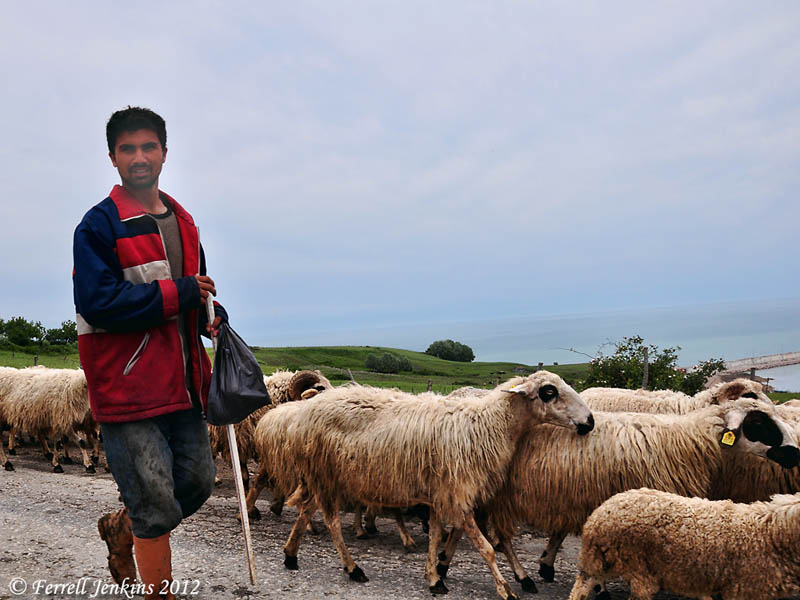
Our photo today was made on a dreary, rainy day near Sinop. Notice that the highway is high in the mountains overlooking the Black Sea. At several points there is no coastal road. This is an important fact that we will speak more about in a future post.

A shepherd overlooking the Black Sea near Sinop, Turkey. Photo by Ferrell Jenkins.

A shepherd overlooking the Black Sea near Sinop, Turkey. Photo by Ferrell Jenkins.

Black Sea coastal town of Sinop

We drove the 100 miles from Samsun to Sinop today. The distance on the road map is deceptive. about one half of the distance is in serious mountain territory. The drive took three hours each way. We had a 6:15 p.m. flight from Samsun to Istanbul, so our time was limited. The drive was educational and helped us to understand some things we had only read about before.

I don’t have the time to explain the reasons for going to this town, except to say that it is in the region of the ancient Roman province of Pontus (1 Peter 1:1).

Later I hope to show you some photos and explain the importance of the town to the study of Peter’s epistles.

Homeward bound tomorrow after a great (nearly) four weeks in Turkey, Greece, and Cyprus.