Earthquake shakes Eastern Turkey — the Land of Ararat

Early Sunday morning we learned that a 7.2 magnitude earthquake hit eastern Turkey around Lake Van. Today this region is occupied mostly by Kurds, but in biblical times it was known as the land of Urartia or Ararat. The region was the area where Noah’s ark is said to have rested after the flood.

and in the seventh month, on the seventeenth day of the month, the ark came to rest on the mountains of Ararat. (Genesis 8:4 ESV)

After the sons of Assyrian king Sennacherib killed him at Nineveh, they escaped to the land of Ararat (2 Kings 19:37; Isaiah 37:38).

The kingdom of Ararat was called to participate in the overthrow of Babylon (Jeremiah 51:27).

Several times we have written about earthquakes in the Bible, and specifically earthquakes in the eastern portion of Turkey. See here and here. We wrote about the planning done by local people for earthquakes here.

Below is another photo made in June, 2007, on the road from Van to Batman. The wooden beams you see in the wall are placed there to help absorb the shock from earthquakes.

Preparing for earthquakes in Eastern Turkey between Van and Batman. Photo by Ferrell Jenkins 2007.

Preparing for earthquakes in Eastern Turkey. Photo by Ferrell Jenkins 2007.

The only photos of yesterday’s earthquake damage that I have seen has been from the cities where the buildings are made of concrete. I wonder how well these country folk have fared in this earthquake.
Making your enemies your footstool

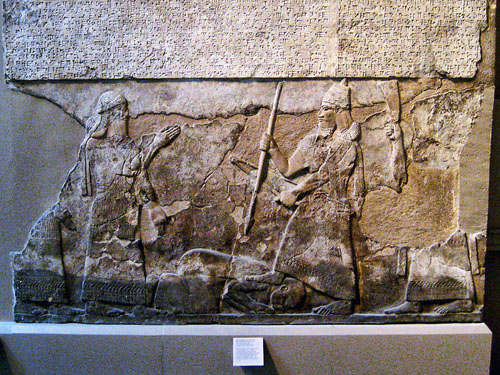
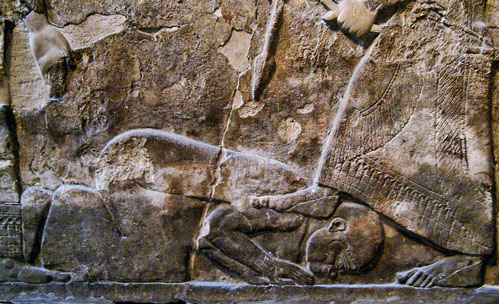
A common motif found in Ancient Near East reliefs shows a monarch placing his foot on his enemy. One illustration of this is the large relief showing the Assyrian King Tiglath-Pileser III (reigned 745-727 B.C.) with his foot on the neck of an enemy. Tiglath-Pileser III is known as Pul in the Bible.

Pul king of Assyria invaded the land, and Menahem paid him a thousand talents of silver to gain his support and to solidify his control of the kingdom. (2 Kings 15:19 NET)

So the God of Israel stirred up King Pul of Assyria (that is, King Tiglath-pileser of Assyria), and he carried away the Reubenites, Gadites, and half-tribe of Manasseh and took them to Halah, Habor, Hara, and the river of Gozan, where they remain to this very day. (1 Chronicles 5:26 NET)

The Assyrian relief below is displayed in the British Museum.

Tiglath-Pileser III Subjugates an Enemy. British Museum. Photo by Ferrell Jenkins.

Tiglath-Pileser III Subjugates an Enemy. British Museum. Photo by Ferrell Jenkins.

Here is a closeup of what we are seeking to illustrate.

Tiglath-Pileser III Puts His Foot on Neck of Enemy. British Museum. Photo by Ferrell Jenkins.

Tiglath-Pileser III Puts His Foot on the Neck of an Enemy. BM. Photo by Ferrell Jenkins.

Several biblical passages come to mind in this connection.

When they brought the kings out to Joshua, he summoned all the men of Israel and said to the commanders of the troops who accompanied him, “Come here and put your feet on the necks of these kings.” So they came up and put their feet on their necks. (Joshua 10:24 NET)

Here is the LORD’s proclamation to my lord: “Sit down at my right hand until I make your enemies your footstool!” (Psalm 110:1 NET)

Peter quotes Psalm 110:1 to show that Jesus is now seated on the throne of David at the right hand of God (Acts 2:35).

And Paul says,

For he must reign until he has put all his enemies under his feet. (1 Corinthians 15:25 NET)

The last enemy is death (1 Corinthians 15:26).

Not much remains at Capernaum

Capernaum, on the northern shore of the Sea of Galilee, played a significant role in the ministry of Jesus. The town became the Galilean center for the ministry of Jesus.

And leaving Nazareth he went and lived in Capernaum by the sea, in the territory of Zebulun and Naphtali, (Matthew 4:13 ESV)

The aerial photo below was made on approach to Capernaum from the east. The site most visited by tourists may be seen left of the center of the photo. You may recognize the new church and the ruins of the synagogue. This property is owned by the Franciscans. To the right you will see the Greek Orthodox Church and the property they own. Evidence of some excavations may be seen.

There is not much remaining of ancient Capernaum. This is not surprising in light of the pronouncement of Jesus.

And you, Capernaum, will you be exalted to heaven? You will be brought down to Hades. For if the mighty works done in you had been done in Sodom, it would have remained until this day. (Matthew 11:23 ESV)

Aerial View of Capernaum. Photo by Ferrell Jenkins.

Aerial View of Capernaum. Photo by Ferrell Jenkins.

Ritual bath discovered at biblical Zorah

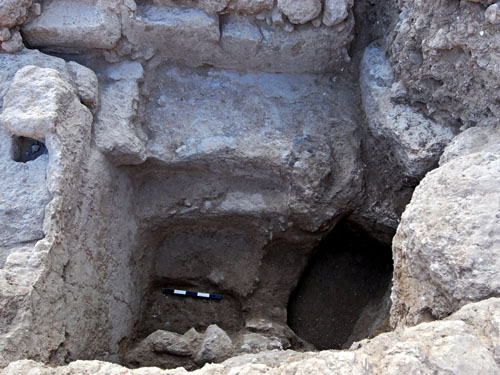
A report today from the Israel Antiquities Authority announces the discovery of a Second Temple Period ritual bath. This means the Herodian Temple that was standing at the time of the ministry of Jesus. Many Bible students think of the Herodian Temple as the Third Temple.

  1. Solomon’s Temple (built about 966 B.C.). Destroyed in 586 B.C. by the Babylonians.
  2. The post-Babylonian Exile temple built 520-516 B.C. This temple fell into decay and was rebuilt and vastly enlarged by Herod.
  3. Herod’s Temple (begun about 19/20 B.C. Destroyed in A.D. 70 by the Romans.

Archaeologist Pablo Betzer, excavation director on behalf of the Israel Antiquities Authority, said,

“This is the first time that any remains dating to the Second Temple period have been exposed in this region. We knew from the Talmud and from non-Jewish sources that on this ridge, as in most of the Judean Shephelah, there was an extensive Jewish community 2,000 years ago that existed until the destruction of the Temple in 70 CE. Yet despite the many surveys and excavations that have been carried out to date no remains from this period have been discovered so far”. According to Betzer the name of the Jewish settlement that the ritual bath belonged to is still unknown.

Second Temple Mikveh from Zorah. Photo by Assaf Peretz, courtesy IAA.

Second Temple Mikveh from Zorah. Photo by Assaf Peretz, courtesy IAA.

Zorah is know to Bible students as the area of Samson’s birth and activity (Judges 13-16). Manoah, Samson’s father, was a Danite from Zorah (Judges 13:2).

Questions about purification were common during the ministry of John and Jesus. This is the “Second Temple” period.

Now a discussion arose between some of John’s disciples and a Jew over purification.  (John 3:25 ESV)

The NET Bible uses the phrase “ceremonial washing” instead of “purification.”

The full press release may be read here.

HT: Bible Places Blog.

Monday Meandering — October 10

More about Paul’s Shipwreck on Malta. Gordon Franz reviews Robert Cornuke’s recent video on the claimed evidence for the shipwreck.  The review is available at the Associates for Biblical Research site here, or Gordon’s Life and Land blog here.

Gordon also exposes the photos purporting to show giant human skeletons from Greece here.

Shiloh. Leon Mauldin wrote about our recent visit to Shiloh here, here, here. The tabernacle was located at Shiloh for many years after ancient Israel came into the promised land. See Joshus 18; 1 Samuel 1-4, et al.

Recent excavations at the base of Tel Shiloh. Photo by Ferrell Jenkins.

Recent excavations at the base of Tel Shiloh. Photo by Ferrell Jenkins.

Jezreel Excavation. A well-trained team of archaeologists, headed by Norma Franklin and Jennie Ebeling, announces renewal of excavations at Jezreel. Details here.

The new website describes the importance of the location of Jezreel.

We are returning to Jezreel because it is an amazing site with a long history that reflects the rich cultural heritage of the area

Perched on the foothills of the Gilboa mountain range it commands an unparelled view over the valley below. The famous sentry site of Megiddo, Biblical Armageddon, lies 15 kms to the west and to the east the renowned city of Bet Shean (Scythopolis).

Reliability of the New Testament Manuscripts. Barry Creamer comments on the “debate between Bart Ehrman and Daniel Wallace on whether the text of the New Testament is trustworthy. Both are world class scholars in textual criticism.” Some interesting comments on the different approach taken by the two textual critics to the problem of no original manuscripts. Read here.

HT:  Bible Place Blog; Bible X.

Lecture on Khirbet Qeiyafa — the Elah Fortress

The Lynn Wood Archaeological Museum announces a lecture by Dr. Michael G. Hasel about Khirbet Qeiyafa, also known as the Elah Fortress.

On Wednesday, October 12, Dr. Michael G. Hasel, professor of Near Eastern Studies and Archaeology at Southern Adventist University, will be sharing  the latest archaeological discoveries from the biblical site of Khirbet Qeiyafa. Recent trends in archaeology have questioned the historicity of David and Solomon’s Kingdom. Since 2009, Southern Adventist University has been uncovering the remains of this city-fortress dating to the time of King David. The discovery of this biblical city is a powerful argument for the reliability of the biblical account. The lecture will be held at 7 p.m. in Lynn Wood Auditorium on the campus of Southern Adventist University, 4960 Industrial Drive, Collegedale, TN. The Lynn H. Wood Archaeological Museum Lecture Series is free and open to the public.

For more information check the Museum website here.

The photo below is one I made in September showing Khirbet Qeiyafa clearly visible on the hill above the Valley of Elah. A copy of the photo suitable for use in teaching is available by clicking on the image.

View of Khirbet Qeiyafa from across the Valley of Elah. Photo by Ferrell Jenkins.

View of Khirbet Qeiyafa from across the Valley of Elah. Photo by Ferrell Jenkins.

It was in the Valley of Elah where the conflict between David and Goliath took place (1 Samuel 17). The brook of Elah lies in the valley below the fortress.

The location of Mount Sinai

Horeb is probably the range of mountains (cf. Exodus 17:6), and Sinai the peak. The terms are used interchangeably in several passages (cf. Acts 7:30,38 with Exodus 3:1ff.). Several sites have been suggested for Mount Sinai. Here are the major ones.

1. Some have suggested the Land of Midian because of what appears to be volcanic action (Exodus 19:18). It is argued that there has been no volcanic activity in the Sinai Peninsula, but that there has been in Midian. The Bible says, “the Lord descended upon it in fire.” This was miraculous activity.

2. Mt. Serbal at Wadi Feiran. There is no plain large enough for the encampment of Israel. This tradition goes back to Eusebius (4th century A.D.).

3. The traditional site is a peak known as Jebel Musa (Mount Moses). The elevation is 7,519 feet. The plain of el-Raha (Arabic for the Rest) at the foot of Jebel Musa has enough water for an encampment of considerable duration. G. Ernest Wright says, “we are left with the traditional location of Mt. Sinai as still the most probable” (20th Century Encyclopedia of Religious Knowledge, 1033). Grollenberg comments more from emotion than from reason:

“A visit to the traditional Mount Sinai suffices to dispel all these doubts. The huge granite formations are an awe-inspiring spectacle. The atmosphere, the light and the colours, the incredible stillness, all conspire to make the scene an unforgettable setting for the meeting of God with man” (Atlas of the Bible, 48).

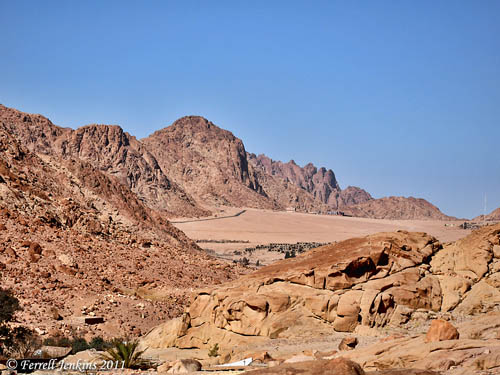
The photo below was made above Saint Catherine’s Monastery with a view toward el-Raha, the Rest.

View of el-Raha, the Rest, at Jebel Musa. Photo by Ferrell Jenkins.

View of el-Raha, the Rest, at Jebel Musa. Photo by Ferrell Jenkins.

4. Some scholars have suggested sites much further north in the Sinai peninsula.

There is no way to know for certain the location of Mount Sinai, but the traditional site fits well with much of the biblical evidence. Rasmussen says the “meeting of Moses and Aaron at the ‘mountain of God’ could well have been this spot (Exod. 4:27)” (Zondervan Atlas of the Bible Revised Edition. 105).

Click on the photo for an image suitable for use in teaching presentations.

Four sorts of men (and women)

Recently while browsing through my folders on the book of Proverbs I ran across an article with a quotation about four sorts of men. I see that the quotation is attributed to different sources, but it is usually called an Arabian proverb.

There are four sorts of men:

  • He who knows not and knows not he knows not: he is a fool — shun him.
  • He who knows not and knows he knows not: he is simple — teach him.
  • He who knows and knows not he knows: he is asleep — wake him.
  • He who knows and knows he knows: he is wise — follow him.

There are several penetrating statements about the wise man in the book of Proverbs. Here are a few of the references.

A wise man will hear and increase in learning, And a man of understanding will acquire wise counsel, (Proverbs 1:5 NAU)

Do not reprove a scoffer, or he will hate you, Reprove a wise man and he will love you. (Proverbs 9:8 NAU)

Give instruction to a wise man and he will be still wiser, Teach a righteous man and he will increase his learning. (Proverbs 9:9 NAU)

Do you see a man wise in his own eyes? There is more hope for a fool than for him. (Proverbs 26:12 NAU)

Bible Land Food display to teach children

During a recent series of lessons on Daily Life in Bible Times I presented some material on the foods of Bible times. I emphasized that the foods ancient Israel had were those suitable to the terrain in which they lived — predominantly the mountains. One of the major biblical references about the foods is Deuteronomy 8:7-9.

 For the LORD your God is bringing you into a good land, a land of brooks of water, of fountains and springs, flowing forth in valleys and hills; a land of wheat and barley, of vines and fig trees and pomegranates, a land of olive oil and honey; a land where you will eat food without scarcity, in which you will not lack anything; a land whose stones are iron, and out of whose hills you can dig copper.  (Deuteronomy 8:7-9 NAU)

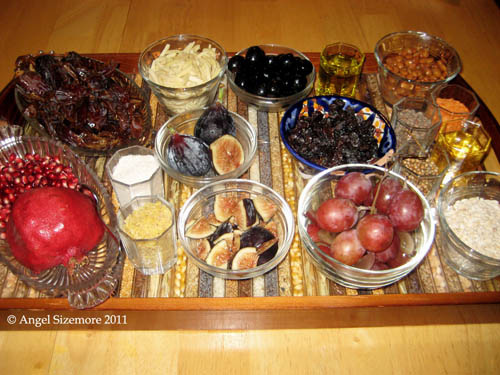
Later I learned that one of the ladies had prepared a Bible Land Food display to show the children during their Bible classes. I requested that Angel Sizemore allow me to use this material here. Here is her brief account.

— • —

After the September weekend lectures you presented at Centreville (Virginia) church of Christ, I had an idea for my class.  (I am teaching the 3rd & 4th graders this quarter). I thought that many of them may not have known what some of the food items you mentioned looked or tasted like. My family already eats most all of the items you mentioned, so I already had them in my kitchen. I had samples of several things cut up so they could taste them.

I showed the food to my own class first; then went over to the 5th & 6th grade class to show them; and finally to the little ones in the 1st & 2nd grade class. It was a HUGE hit with the children of all ages! I have heard from several of their parents that their kids really enjoyed it, and a couple of them had to scour the produce sections looking for their kid’s new favorite foods (like dates and pomegranates!).

Anyway, thank you for helping me to learn so much, and for inspiring me to teach more about it to our own little ones.

Bible Land Foods display by A. Sizemore. Ferrell's Travel Blog.

Bible Land Foods display by A. Sizemore.

Angel provided a list of the foods on the tray. (Click on the photo for a larger image.)

Foods included:
  • Dates — some whole and some cut up so they could taste it
  • Almonds — slivered
  • Black olives
  • Olive oil
  • Lentils — some dry brown and red lentils, and cooked brown lentils to taste
  • Coriander seed — threw that in because of the description of manna
  • Honey
  • Barley
  • Red grapes — some cut up so they could eat them
  • Raisins
  • Figs — some whole and some cut up so they could taste it
  • Cracked wheat [we also spoke of barley]
  • Whole wheat flour
  • Pomegranate — half of a fruit intact, some seeds so they could taste it
  • Cheese — not pictured but added to display — made with mix of goat/sheep milks
The kids enjoyed tasting everything, even stuff I didn’t intend for them to eat (like the raw lentils and olive oil)!
— • —
Note: Most of these foods have been discussed on the Travel Blog. Just use the search box to locate the posts. I have found that the search works best if you use only a single word. Try fig instead of figs. Try wheat instead of cracked. You will find coriander though I did not mention it in the lesson in Virginia.
Thanks to Angel for allowing us to share this wonderful teaching aid with our readers.

Enduring Word Exhibit at the Museum of Biblical History

The Museum of Biblical History in Collierville, Tennessee, announces the Enduring Word Exhibit In Celebration of the King James Bible’s 400th anniversary.

Would you like to know more about Johannes Gutenberg and his famous printed Bible? Gutenberg was the first European to use movable type printing, in around 1439, and the global inventor of the printing press. If you go to the museum named after him in his hometown, Mainz, Germany, you can learn a lot about him. Instead, why not come to the Museum of Biblical History in Collierville, Tennessee, during our “Enduring Word” exhibit, open October 1 through 9, Sundays 1-5 PM, Monday-Saturday 10 AM-7 PM.

In addition to the Bible exhibit, a special feature of the exhibit is the operation of a full-scale working model of Gutenberg’s press.

By special arrangement Dr. Rusty Maisel will operate his full-scale, working model of Gutenberg’s press during this exhibit, in celebration of the King James Bible’s 400th year. He will print page facsimiles from Gutenberg’s famous Latin Bible of 1456 and from the first edition of the King James Bible of 1611. He will also exhibit his collection of ancient biblical manuscripts and early printed Bibles in our main museum gallery. Maisel, an international authority on the history of the Bible, can be with us for nine days only. Don’t miss this wonderful learning opportunity.

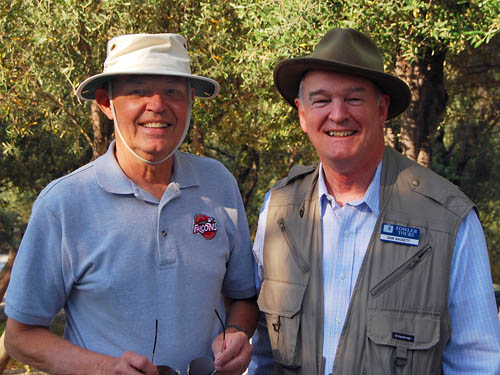
Ferrell Jenkins & Don Bassett at the Acropolis in Athens.

Ferrell Jenkins & Don Bassett at the Acropolis.

Details about the Museum of Biblical History, including this special exhibit, may be found on the Museum website here. Collierville is located a few miles southeast of Memphis, Tennessee.

Don Bassett is Chairman of the Museum of Biblical History. Don is a long time friend. Our tours crossed paths at the Acropolis in Athens, Greece a few years ago.