Category Archives: Turkey

A visit to Harran – home of Abraham

This morning we flew from Istanbul to Gaziantep in eastern Turkey, picked up our rental car and headed east to Zugma. This is a Roman period town that has been mostly flooded as a result of a dam built on the Euphrates River.

We continued east to Sanliurfa, and then south to Harran (some English Bible versions use Haran). Harran is located in biblical Padan-Aram (Genesis 25:29, et al.). Abraham and his family lived in the area (Genesis 11:21). The city has a long history which I will not go into now.

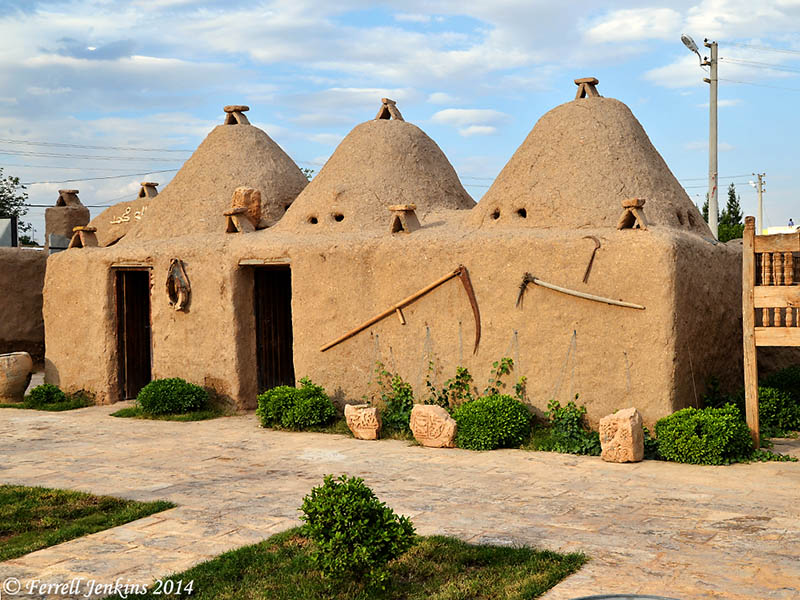
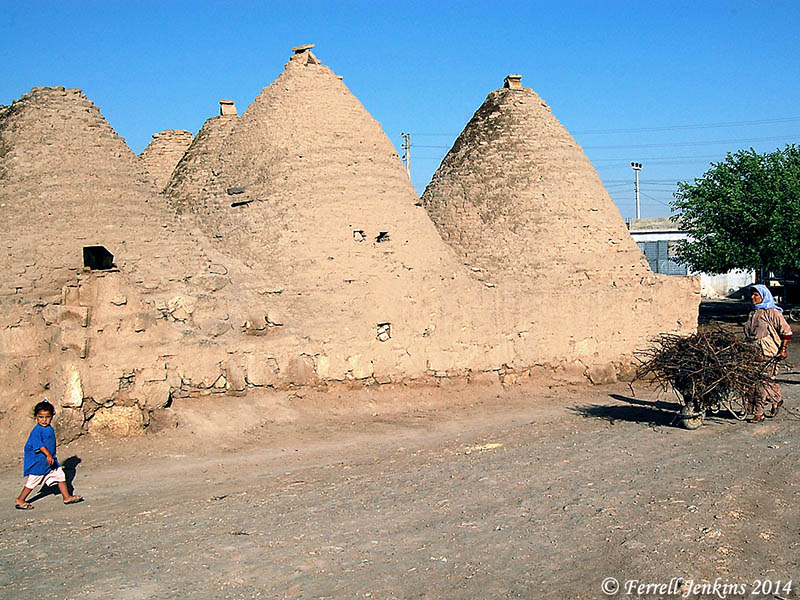
For the past two hundred years the people who live here have built mud brick conical, beehive-shaped houses. I have also seen some of these houses in northern Syria.

At the present time very few people still live in the beehive-shaped houses. For touristic and educational purposes some of the houses have been reconstructed to show how people used them for dwellings.

If you have seen the houses at Haran over the past few decades, you may think that these in my photo look entirely too good.

Having been here twice before, I must admit that I was a bit letdown when I saw the condition of the town today. On the north side of town a large number of new houses have been built. Some apartment buildings now stand on the west side. One young man told us that very few of the residents keep sheep. Most, he said, are involved in raising cotton on the plains about Harran.

Beehive-shaped houses at Harran. Photo by Ferrell Jenkins.

Beehive-shaped houses at Harran. Photo by Ferrell Jenkins.


A visit to Nicaea in Bithynia.

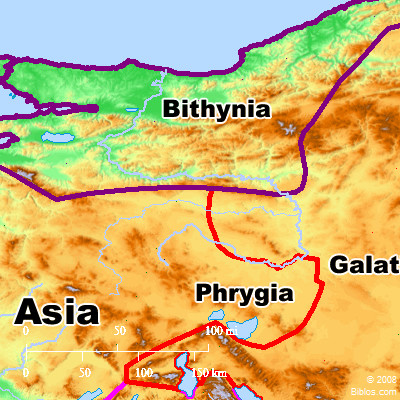
Today  my friend Leon and I made a 10 hour trip from Istanbul to Iznik, Turkey. Iznik is the name of ancient Nicaea (Nicea) in Bithynia. This is a region of Asia Minor into which Paul was not allowed by the Spirit to travel. Instead, he was directed to go down to Troas where he received the call to come over into Macedonia.

And when they had come up to Mysia, they attempted to go into Bithynia, but the Spirit of Jesus did not allow them. So, passing by Mysia, they went down to Troas. (Acts 16:7-8 ESV

Bithynia is across from Istanbul on the south side of the Sea of Marmara. It is a beautiful mountainous region with valleys filled with olive trees and fruit orchards.

The Epistles of Peter are addressed to saints living in Bithynia, but no specific towns are mentioned (1 Peter 1:1; 2 Peter 3:1).

The Roman province of Bithynia. BibleAtlas.org.

The Roman province of Bithynia. BibleAtlas.org.

The modern town of Iznik utilizes the layout of ancient Nicaea. Nicaea was the site of the first and seventh of the ecumenical councils held between 325 and 787 A.D. Hopefully I will be able to write more about these councils and their importance in the history of Christianity at a later time.

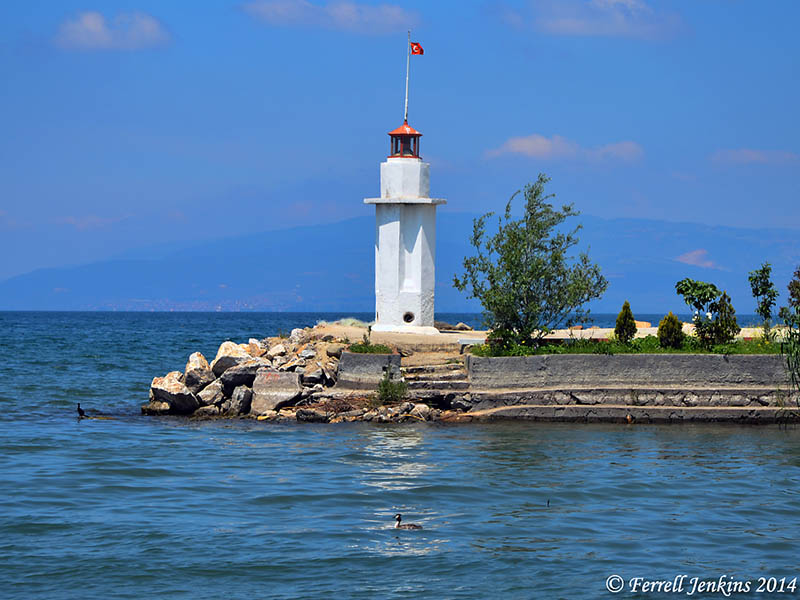
For today I wanted to share a photo I made of a little lighthouse in the fresh water Lake Iznik.

Lighthouse in Lake Iznik. Photo by Ferrell Jenkins.

Lighthouse in Lake Iznik. Photo by Ferrell Jenkins.

Some Museums in Turkey

My Ancient Crossroads Tour of Biblical and Historical Turkey is compete. Yesterday most of the tour members returned home. A few had other plans of travel before returning.

There are some wonderful museums in Turkey, but many of them are undergoing restoration at this time.

We missed seeing the main section of the Museum of Anatolian Civilizations in Ankara due to restoration. A nice,  small section containing mostly classical materials was open, but the great collection of Hittite materials (our reason for going there) was closed. According to an article in the Harriyet Daily News it reopened last Friday.

The Archaeological Museum in Antakya (Antioch of Syria, Acts 11, 13) was almost bare. Only a few of the lesser quality mosaics were on the walls. A new museum will open soon. I had told the group that we would see some good Hittite materials there, but they had already been moved. Incidentally, the Church of St. Peter and the Simon Stylites Monastery were also closed for renovation.

We did better at the fabulous museum in Antalya (Attalia of Acts 14:25). The Roman period statuary from Perga in Pamphylia (Acts 13:13-14; 14:25) is housed there.

In Istanbul we were able to visit the Ancient Orient section of the Archaeological Museum. The museum containing material from the classical world was closed. An excellent selection of materials was housed in a small area of the Museum.  The third floor, where artifacts from Palestine are housed was closed. Our appeal for entry failed.  There is where some very famous pieces are housed − the Siloam Tunnel inscription, the Gezer Calendar, the Herodian Temple inscription forbidding gentiles from entering the Temple, et al.

The Ancient Orient building houses a large number of bulls, dragons, and oxen from the procession street of ancient Babylon. I think it is second only to the Pergamum Museum in Berlin. There are excellent Hittite materials, including the oldest treaty between nations. It is the treaty between the Hittites and Pharaoh Ramses of Egypt after the battle of Kadesh on the Orontes. There are several pieces from the Assyrians, and a clay cylinder from the time of Nebuchadnezzar.

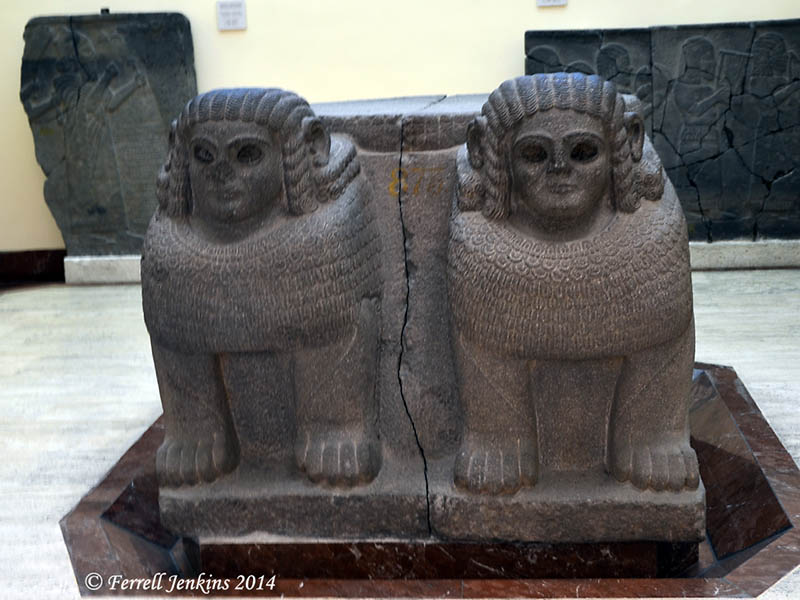
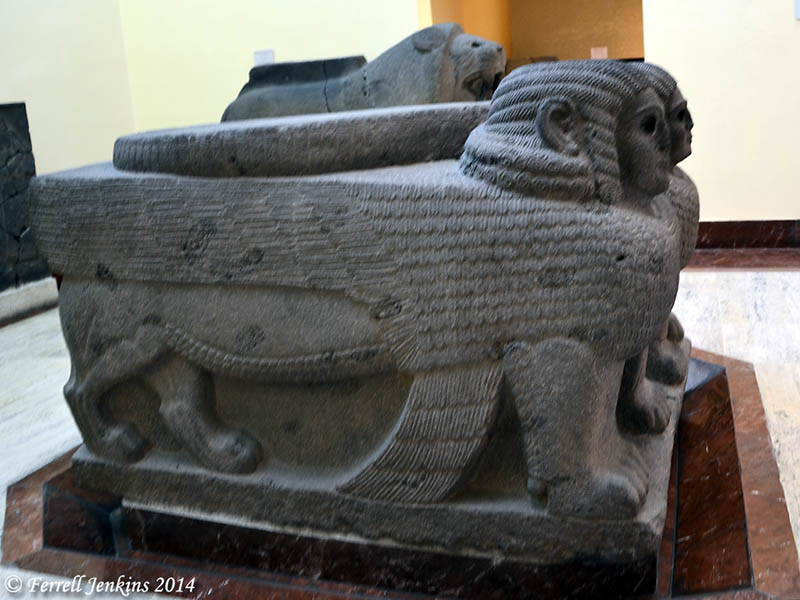
Here is a picture of one of the basalt Hittite column bases from Sinjerli. It is a double sphinx, dating to the 8th century B.C., that came from the entrance to Palace III.

Hittite Column Base from Sinjerli. Photo by Ferrell Jenkins.

Front view of Hittite column base from Sinjerli. Photo by Ferrell Jenkins.

Below is the side view of this column base. Note that the figure of a lion shows a human head and wings of a bird. This provides a good illustration for the apocalyptic imagery in Daniel, Ezekiel, Zechariah, and Revelation.

Side view of Hittite Column Base from Sinjerli. Photo by Ferrell Jenkins.

Side view of Hittite Column Base from Sinjerli. Photo by Ferrell Jenkins.

These are the Hittites with whom the ancient Israelites had dealings. Solomon imported horses and chariots from Egypt and Kue and exported them to the Hittites (1 Kings 10:29). See 2 Kings 7:6 for another reference to these people in the days of the prophet Elisha.

All things considered, maybe it didn’t turn out so bad after all.

Excavations at Derbe

The first excavations ever have begun at the ancient city of Derbe. Derbe was visited by the Apostle Paul and Barnabas on the first preaching journey (Acts 14:20-21). Paul returned with Silas on the second journey (Acts 16:1).

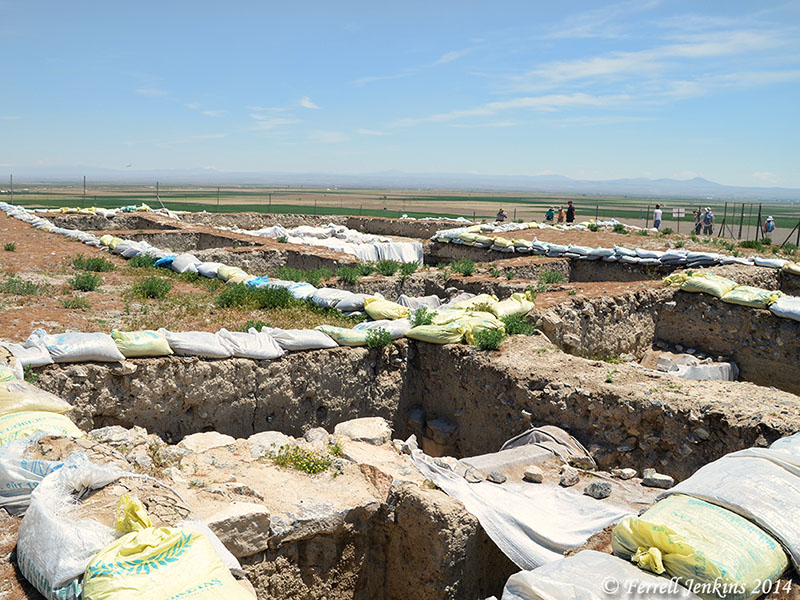
Today our tour group visited Kerti Hüyuk, the site widely believed to be ancient Derbe. Several squares were opened on the top of the mound in 2013.

Recent excavation at Derbe. Photo by Ferrell Jenkins, May 14, 2014.

Recent excavation at Derbe. Photo by Ferrell Jenkins, May 14, 2014.

The report in a Turkish newspaper quotes Associate Professor Mehmet Tekocak of Selçuk University:

So far the excavations have unearthed ancient wall remains. “There are brick and stone walls. We found graves and skeletons inside the walls. Anthropologic works will reveal the ages and genders of these skeletons and how they died. Works show us that this place received a lot of damage, and most architectural materials were removed for use in other places. This place was seen as a kind of stone quarry. We found the remains of a church-like structure, and we believe that we will find new structures as excavations continue. Even these remains alone show us that a Christian society lived in this tumulus,” Tekocak said.

There is no hint as to the age of the church-like structure.

See the report in Hurriyet Daily News here. We look forward to future reports from Derbe.

HT: HolyLandPhotos Blog.

Traveling in Turkey

Tuesday afternoon our group arrived in Ankara, capital of the Republic of Turkey. Wednesday traveled about three hours of Ankara to Bogazkale, the capital of the ancient Hittite (Hatti) kingdom.

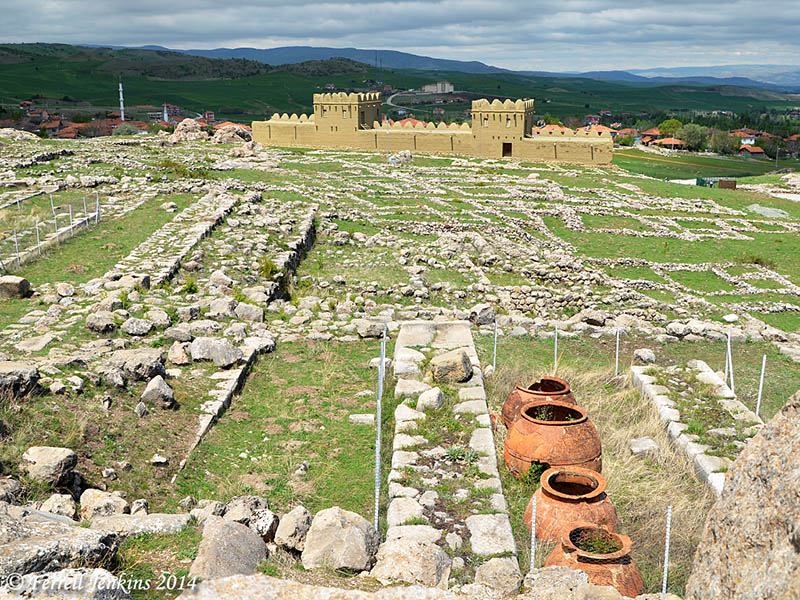
The photo below shows ruins of what is designated Temple 1 in the Lower City of ancient capital. The walls seen here are the only reconstructed walls from the ancient city. The ruins belong to the most sacred building of the city. The jars in the foreground are samples of many that were found. They were used to hold cuneiform tablets, and grain, wine, and oil used in the temple services.

Temple area and reconstructed walls at Bogazkale. Photo by Ferrell Jenkins.

Temple area and reconstructed walls at Bogazkale. Photo by Ferrell Jenkins.

I don’t seem to be finding the time to blog, but several of our travelers are doing so. You may find what they write more interesting because they tend to write about things as they see them through fresh eyes that have not been here before. All of them have traveled with me before, and I think most of them have visited Western Turkey on a previous tour.

Alexander’s Adventurehttp://jimmyanddarlene.wordpress.com/
This is the blog of Jimmy and Darlene Alexander. What an appropriate title for a tour in Turkey. Jimmy and Darlene are new to blogging, but they have traveled a lot, and Darlene has recently learned how to use an iPad Mini, photo editor, etc., and doing a good job of it.

Braman’s Wanderinghttp://bramanswanderings.wordpress.com/
Steven Braman is literally a world traveler in his work. He blogs on a wide variety of things.

The other side of the worldhttp://stacyjobe.blogspot.com/
Stacy Jobe blogged during our Steps of Paul and John tour in 2012. She has updated her blog for this tour. Stacy is a multi-talented young lady who finds something interesting in whatever she sees.

Scene With Sharon http://scenewithsharon.blogspot.com/
 According to the NASA website, Sharon Cobb “is the lead scientist developing an important facility for studying materials in the International Space Station.” She loves traveling on earth, too. Sharon blogged from Egypt during our 2009 tour.

Turkey is a wonderful place to visit for those interested in ancient and biblical history. Enjoy the country through the eyes of these people are traveling with me on this journey.


Regarding the Visualizing Isaiah series

The response to the Visualizing Isaiah series has been good by my estimation. Numerous readers have written that they enjoyed/profited by the series. Several bloggers have linked to the series and a few have re-blogged almost all of them to their readers.

This was an ambitious project. First, there was the responsibility to understand Isaiah well enough to make appropriate comments. Second, the selection of good photos was quite a task. I often looked through photos from various Bible sites and/or several museums with Ancient Near Eastern collections to locate what I thought was the right image. Some chapters offered numerous possibilities; others were a bit more difficult.

Hopefully I will be able to continue the series later. At this time I must take a break because I will be traveling in the Bible world most of May. I do plan to post something most days to indicate where I am traveling.

I trust that the Isaiah series has illustrated how you can enhance your study and teaching with visuals. You may say, “but I haven’t been to all of those places.” But you can search this blog for illustrations. Some time back we provided illustrations for the entire book of Acts. You can go to your Pictorial Library of Bible Lands collection and find the photos you need. Or, search the Bible Places Blog, or the Holy Land Photos’ Blog, or the vast collection at Holy Land Photos, or David Padfield’s collection here.

For my next series, I plan to select a shorter book such as Philemon or Jude.

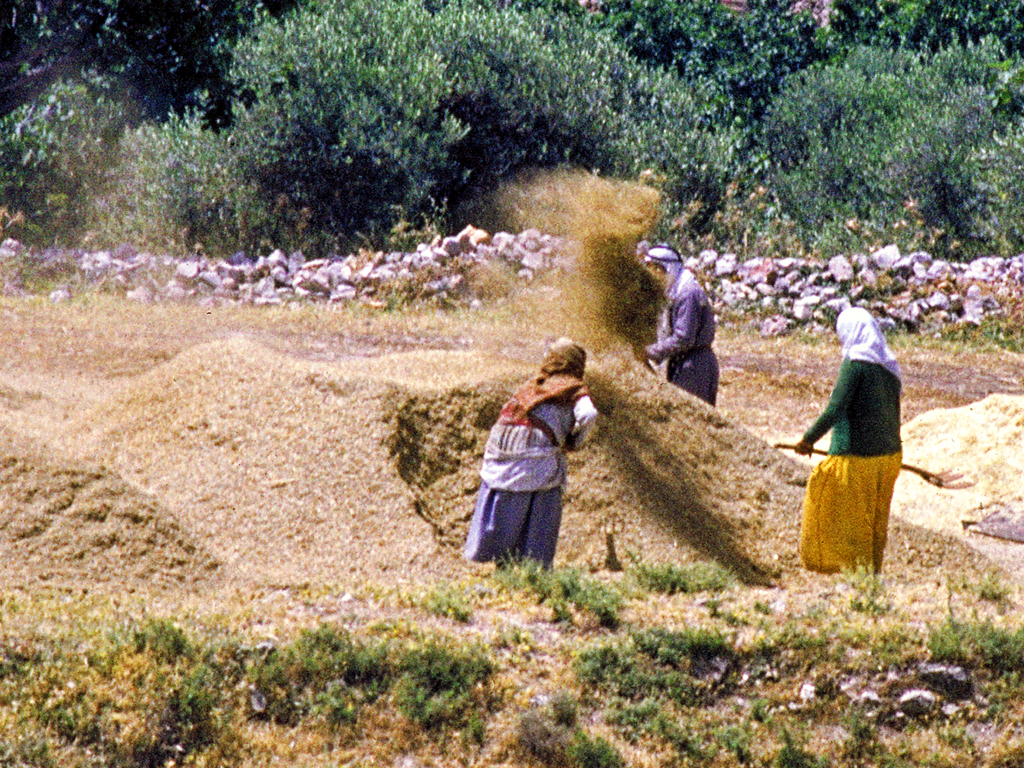
Just in case some of you are looking ahead to Isaiah 41, I will include an image to help with verses 15-16.

Behold, I make of you a threshing sledge, new, sharp, and having teeth; you shall thresh the mountains and crush them, and you shall make the hills like chaff; you shall winnow them, and the wind shall carry them away, and the tempest shall scatter them. And you shall rejoice in the LORD; in the Holy One of Israel you shall glory.  (Isaiah 41:15-16 ESV)

Winnowing at Shechem. Photo by Ferrell Jenkins.

Winnowing at Shechem. Photo by Ferrell Jenkins.

Visualizing Isaiah 37: Sennacherib’s assassins escape to the land of Ararat

After the LORD struck down 185,000 of the Assyrians who were camped outside Jerusalem, Sennacherib returned home and lived at Nineveh. In the final verse of this chapter we are told that his sons killed him and fled to the land of Ararat.

Then Sennacherib king of Assyria departed and returned home and lived at Nineveh. And as he was worshiping in the house of Nisroch his god, Adrammelech and Sharezer, his sons, struck him down with the sword. And after they escaped into the land of Ararat, Esarhaddon his son reigned in his place. (Isaiah 37:37-38 ESV; see also 2 Kings 19:37)

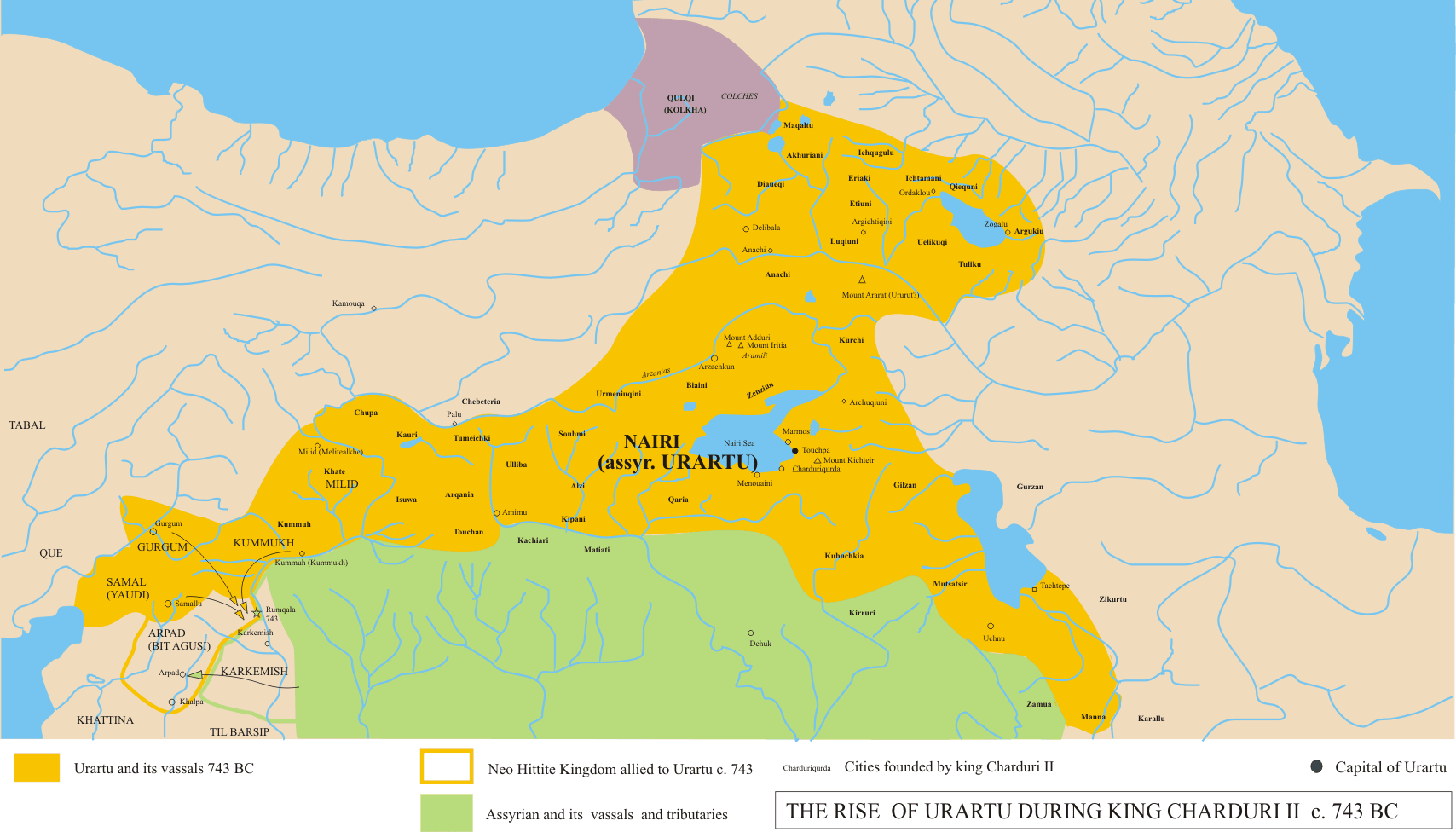
The Biblical land of Ararat (Urartu) is located in modern eastern Turkey. We might think of the land of Urartu being centered in Lake Van. From Nineveh to Van is an air distance of about 150 miles. The map below is from the Wikipedia entry on the Urartu-Assyria War. Click the map to enlarge. Lake Van is 5737 feet above sea level.

Wikimedia Commons.

Map of the Urartu-Assyrian war in 743 B.C. Wikimedia Commons.

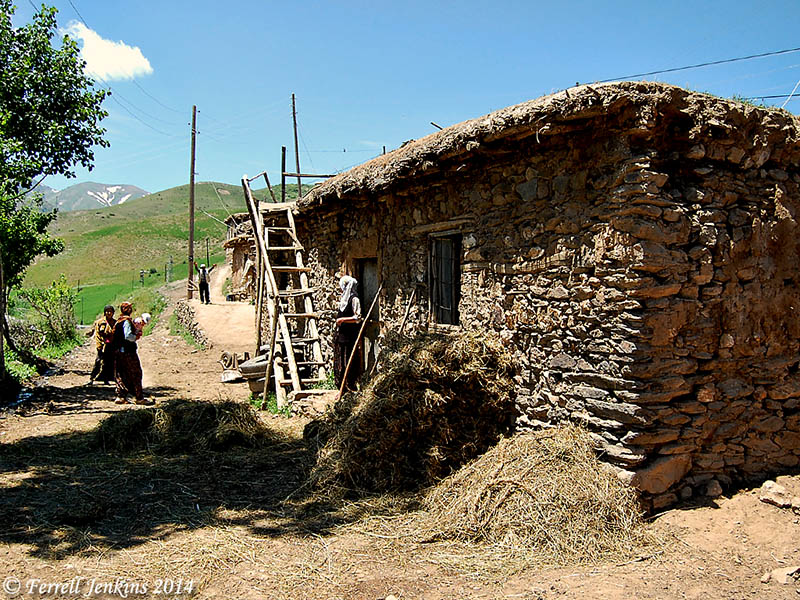
The entirety of the land of Urartu is mountainous. Our photo below shows the region between Van and Batman in Turkey. Note the snow-covered slopes in the distance.

A house in Turkey between Van and Batman. In ancient times the area was known as Urartu (Biblical Ararat). Photo by Ferrell Jenkins.

A house in Turkey between Van and Batman. In ancient times the area was known as Urartu (Biblical Ararat). Photo by Ferrell Jenkins.

Use our search box to look for more entries dealing with Urartu. Remember that the ark built by Noah came to rest on the “mountains of Ararat” (Genesis 8:4).

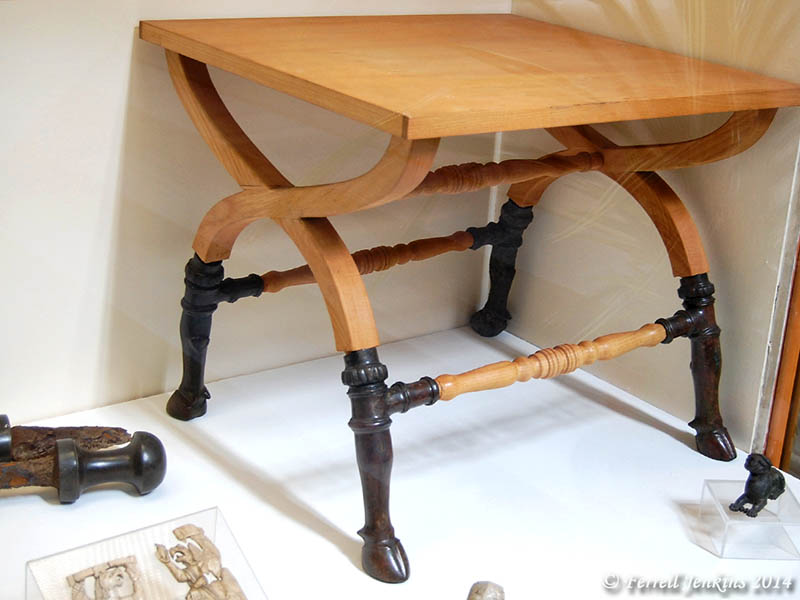
The photo below was taken in the Anatolian Civilizations Museum in Ankara, Turkey. It shows (the metal legs of) some Urartian furniture. In the left bottom corner you should see some of the ivory pieces that decorated walls and furniture.

Urartian furniture displayed in the Anatolian Civilization Museum. Photo by Ferrell Jenkins.

Urartian furniture displayed in the Anatolian Civilization Museum. Photo: F. Jenkins.


Visualizing Isaiah 29: a book that is sealed

Sealed documents were common in Bible times. Isaiah had already used this figure in chapter 8:16. Here the same illustration is used to show that because of Israel’s blindness of heart, no one was able (or willing) to accept and understand the will of God (see 6:9-10).

And the vision of all this has become to you like the words of a book that is sealed. When men give it to one who can read, saying, “Read this,” he says, “I cannot, for it is sealed.” And when they give the book to one who cannot read, saying, “Read this,” he says, “I cannot read.”(Isaish 29:11-12 ESV)

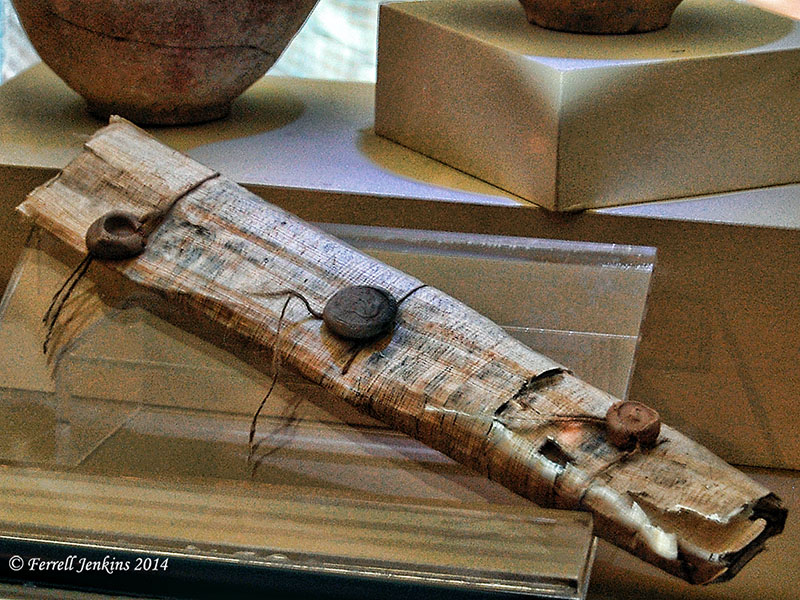
The photo below was taken in the archaeological museum in Gaziantep, Turkey. It shows a rolled up document with three strings held by clay seals. It appears that the document is modern with three ancient seals, but it illustrates what Isaiah is writing about.

The illiterate man says, “I cannot read.” The man who is literate says, “I cannot, for it is sealed.” The illiterate man does not try to find someone who can read, and the literate man does not find someone with authority to break the seal. Blindness, darkness, and spiritual insensitivity prevent either man from finding out what is in the document. No wonder Jesus cited Isaiah’s statement to explain why he used parables (Matthew 13:13-15).

A sealed document displayed in the Gaziantep Museum. Photo by Ferrell Jenkins.

A sealed document displayed in the Gaziantep Museum. Photo by Ferrell Jenkins.

The IVP Bible Background Commentary: Old Testament (Walton, Matthews & Chavalas) has this explanatory note about sealed documents in Bible times.

Official documents were written on scrolls of papyrus or vellum and then, when stored or dispatched by messenger, were rolled up and sealed with string and an affixed seal (see 1 Kings 21:8; Jer 32:10–11). The seal, either a ring or signet, was impressed into either wax or a lump of clay known as a bulla (Job 38:14). Archaeologists have found many of these clay bullae with the names of Israelite officials.

I am aware of one ancient document with as many as seven seals. It is the Wadi ed-Daliyeh Aramaic papyrus document dating to the 4th century B.C. The seals are currently displayed in the Israel Museum, Jerusalem. This document provides an illustration for Revelation 5 and 6.

Visualizing Isaiah 27: women make a fire of dry boughs

The judgment upon Israel will become severe before the redemption comes. Here is one illustration of the bad conditions.

For the fortified city is solitary, a habitation deserted and forsaken, like the wilderness; there the calf grazes; there it lies down and strips its branches. When its boughs are dry, they are broken; women come and make a fire of them. For this is a people without discernment; therefore he who made them will not have compassion on them; he who formed them will show them no favor. (Isaiah 27:10-11 ESV)

Our photos were made at Haran, the home of Abraham and his family before they departed for the promised land (Genesis 11:31 – 12:5). Haran is a few miles north of the Syrian border in Southeastern Turkey. The beehive mud houses have been in use here for several hundred years. The first photo shows a woman bringing in dry branches to her house to use for building fires.

Woman carrying dry boughs at Haran. Photo by Ferrell Jenkins.

Woman carrying dry boughs at Haran. Photo by Ferrell Jenkins.

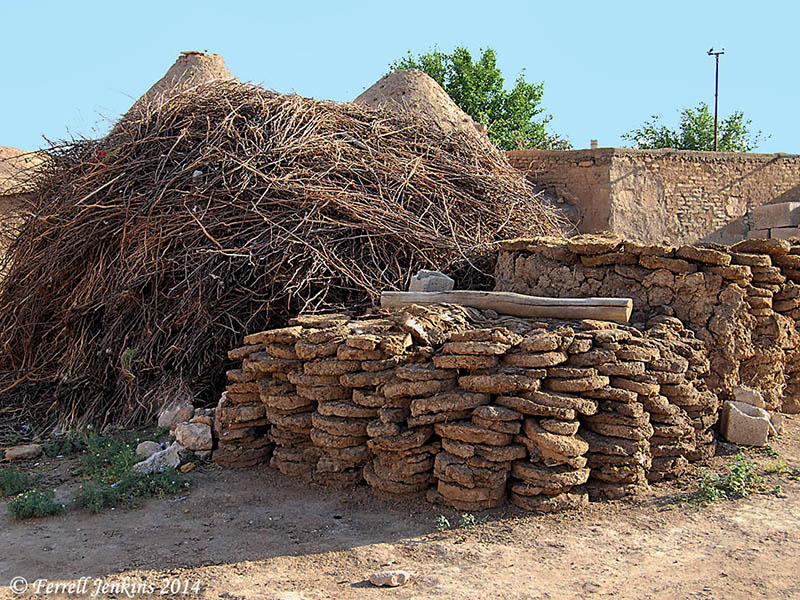
And the photo here shows a large supply of dried boughs and a large stack of dung cakes which will be used to make fires for cooking and heating.

Dry boughs gathered for fire at Haran. Photo by Ferrell Jenkins.

Dry boughs gathered for fire at Haran. Photo by Ferrell Jenkins.


Reading the Blogs # 3

Michael J. Kruger (canon fodder) has written a review of each episode of the History Channel’s Bible Secrets Revealed. He says the series has reminded him of two critical truths:

1. Our popular culture is prone to distort and misrepresent the teachings of the Bible. I was struck again by how sensationalistic and misleading popular-level programming can actually be when it comes to the Bible.  Although this series had some good moments, as a whole I was disappointed to see the History Channel offer the standard Da Vinci Code-style approach to the Bible.

2. The church must be equipped to respond to these sorts of critiques.  Given the high-profile nature of the History Channel (and similar style programming), the average person we are trying to reach is going to be exposed to this type of material.  And we need to be ready to offer some answers if we expect non-Christians to give the biblical message a hearing.

The six reviews cover a wide variety of topics of interest to many people.

  1. Lost in Transmission
  2. The Promised Land
  3. The Forbidden Scriptures
  4. The Real Jesus
  5. Mysterious Prophecies
  6. Sex and the Scriptures

Begin here on canon fodder for links to each of the reviews.

Kruger is President and Professor of New Testament at Reformed Theological
Seminary, Charlotte. You will find much useful material on this blog.

HT: Brooks Cochran

Çatalhöyük. Polish archaeologists have discovered containers of barley, said to be 8,200 years old from the Neolithic period, at Çatalhöyük in Turkey.

The largest so far known in the Middle East amount of grain of the Neolithic period in a perfect state of preservation has been discovered by Polish archaeologists in Çatalhöyük, a famous archaeological site in Turkey. Çatalhöyük is one of the largest urban centers of first farmers and one of the most famous archaeological sites in the world.

Read the report, with photo, here.

Preserving Tal Al Umayri in Jordan. Many archaeological sites are in danger of destruction. Tal Al Umayri, south of Amman, Jordan, is going to become an archaeological park. The site is on private property. Now the owners have agreed to give the land for the project. Details here.

New Museum in Petra, Jordan. The report here says,

According  to the Petra National Trust, it was visited by around 450,000 people in  2013, though this was a significant drop from 2010’s record number of 975,000 visitors. Officials hope the new museum will encourage tourists to spend more time in the ancient city. It will present the history of Petra and the Nabataeans, as well as house antiquities, but it is unclear what this means for the site’s two existing museums: the Petra Nabataean Museum, opened in 1994, and the Petra Archaeological Museum, opened in 1963.

HT: Steven Braman
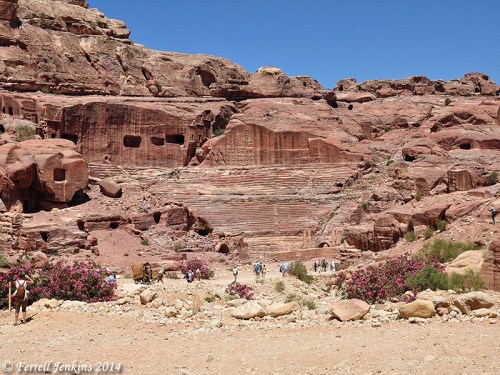
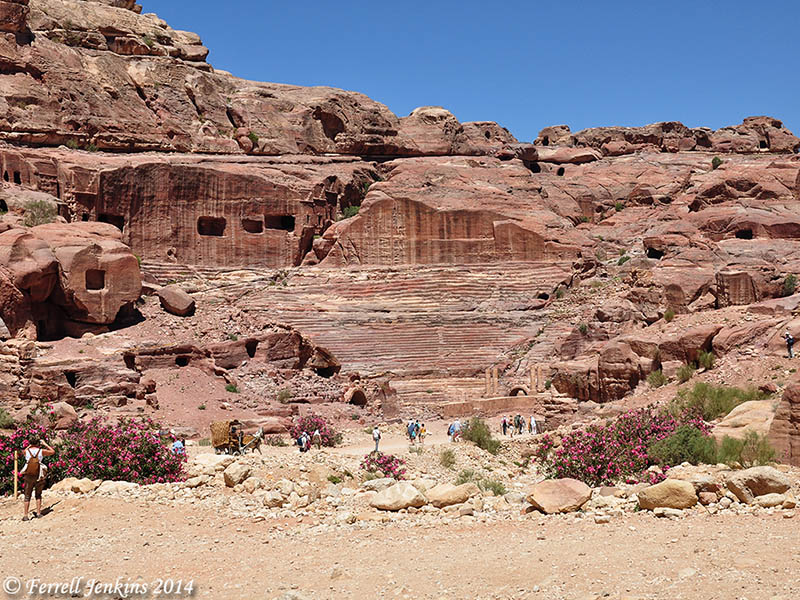
The Roman Theater at Petra. Photo by Ferrell Jenkins.

The Roman Theater at Petra. Photo by Ferrell Jenkins.

Old Testament Bibliography by Ray Clendenen. Here is the info from Charles Savelle at Bible X.

You can access Ray Clendenen’s recently revised 385-page Old Testament bibliography here. Note: you have to have an account with academia.edu to access it but if you don’t already have an account,signing up is free.

A Dictionary of the Bible. This five-volume set is now on Community Pricing at Logos. A bid of $15.00 will secure a set in Logos digital format. Information is here.
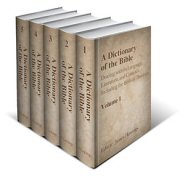
A Dictionary of the Bible, James Hastings.

A Dictionary of the Bible, James Hastings. The work will be in digital format for use with Logos Bible Software.

It is true that this is an old work first published between 1893 and 1905, but it contains some excellent material. The five volumes contain 4,718 page. The projected price of $15 is less than you might pay for a paperback with one good idea in it.

I have owned the hardback set for many years and am anxious to include these volumes in my Logos 5. Logos needs some more orders to produce this set of books. Let’s pull together. Once the work is published in digital format the price will be $99.95.