Category Archives: Turkey

Acts 13 — Photo Illustrations # 2

During the trip to Israel I got a little behind in the photo illustrations for the chapters of Acts.

When we come to Acts 13 and 14, there are so many places to consider that it could take weeks to cover them all in detail. In fact, if you use the search box you will see that we have posts on most of the places mentioned in these chapters.

It seems that Paul and Barnabas did not stop to preach in Perga on the outgoing portion of the first journey. The text says, almost casually, that “going on from Perga, they arrived at Pisidian Antioch” (Acts 13:14).

Here we have one of the longer sermons of the book of Acts — Paul’s sermon in the Jewish synagogue. While it appears that we have a vibrant Jewish community in Pisidian Antioch, we also find a receptive Gentile audience. When the Jews rejected the message of the risen Christ, Paul and Barnabas said,

“we are turning to the Gentiles.” (Acts 13:46 ESV)

Pisidian Antioch was a city of numerous idol temples. There was a sanctuary or temple dedicated to the Emperor Augustus (30 B.C. – A.D. 14) built by Tiberias (A.D. 14-37).
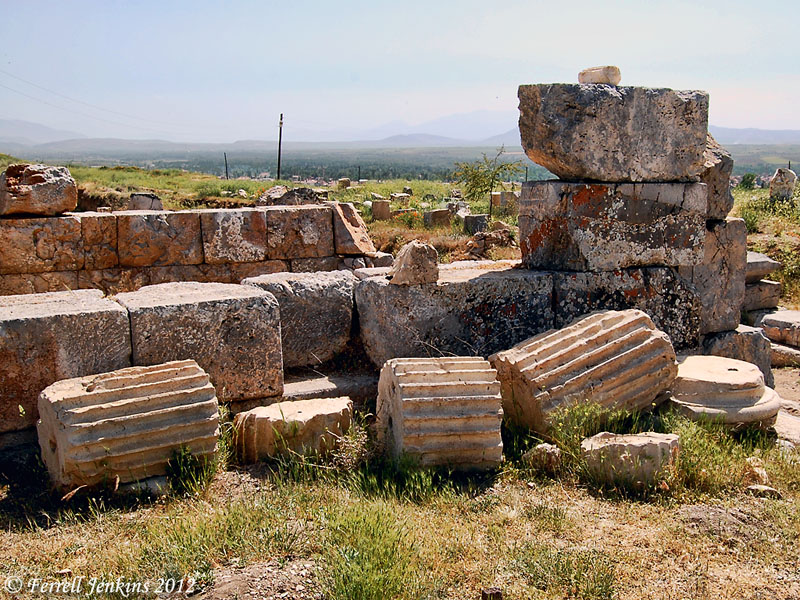
Ruins of the Augustus Imperial Sanctuary at Pisidian Antioch. Photo by Ferrell Jenkins.

Ruins of the Augustus Imperial Sanctuary at Pisidian Antioch. Photo by Ferrell Jenkins.

The foundation of the sanctuary is cut from the solid bedrock.
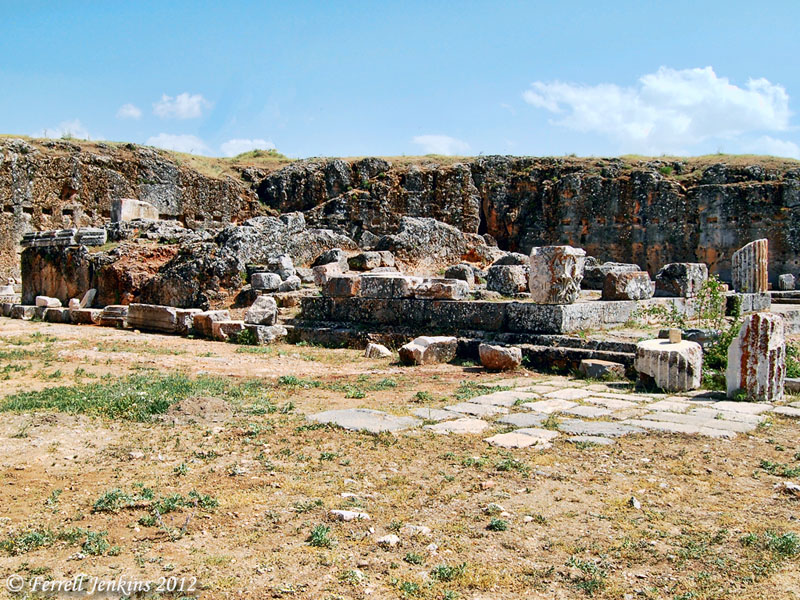
The Augustus Imperial Sanctuary at Pisidian Antioch. Photo by Ferrell Jenkins.

The Augustus Imperial Sanctuary at Pisidian Antioch. Photo by Ferrell Jenkins.

Peter Walker describes the temple,

Beyond the propylon was a large, semicircular courtyard, surrounded by colonnades, the eastern part of which was cut out from the hill-side’s rock. And standing in the centre, towards the back, was the sanctuary of Augustus’ temple. Though quite small – some 15 by 30 feet (4.5 x 9 m) – it was set on a high foundation of natural rock and approached by a further twelve steps. Antioch’s residents were expressing in impressive fashion their gratitude to the emperor for their city’s increased prestige under his rule. However, for Paul it demonstrated the daunting challenge ahead. What room would there be for his own message, focused on a rival world-ruler, in a city where this imperial cult was evidently growing at such a pace? (In the Steps of Paul, 87,89).

Maps. In your study of Acts you might enjoy the use of the Digital Map of the Roman Empire available here. This map, based on the Barrington Atlas, includes the road system. Because the maps show the terrain, you can get some concept of the difficulties encountered by Paul and his companions as they traveled from place to place.

Thanks to Dr. Rasmussen for the lead to this map.

A new Archaeology Museum in Turkey

Turkey is a marvel of historical sites, and many of them have their own archaeological museum. A new museum has opened in Aydin, due east of Kusadasi (near Ephesus). Here is a description of the museum and its contents.

Aydın Provincial Culture and Tourism Director Nuri Aktakka said around 3,000 historical artifacts are on display in the 2,500-square-meter museum. “Most of the artifacts were discovered at the Tralleis, Magnesia, Alinda, Nysa, Alabanda and Ortasia historical sites in Turkey. We hope to increase the number of artifacts in the museum in the future. We have many historical sites in Aydın, and excavations are under way to discover more artifacts,” he said.

Aktaka also said 11,000 archeological and 45,000 numismatic and 4,000 ethnographic artifacts are currently registered at the museum and they will be on display by turns.

Read the full news article here. The name that first caught my attention is Nysa (also Nyssa). Back in 2006 my friend Leon Mauldin and I were driving from Kusadasi to the Hierapolis area. I think I am correct in saying that neither of us knew anything about Nysa, but when we saw the usual brown sign that marks archaeological sites we decided to take the short detour to visit Nysa. It was a pleasant stop.

Nysa (Nyssa), Turkey, archaeological excavation. Photo by Ferrell Jenkins.

Nysa (Nyssa), Turkey, archaeological excavation. Photo by Ferrell Jenkins.

Nysa is also known as Nysa Ad Maeandrum, and became famous as an educational center. The Meander River flows past the city only a few miles south. The city was the home of the ancient geographer Strabo (63 B.C. – A.D. 25).

Another museum to visit.

HT: Jack Sasson

Acts 11 & 13 — Photo Illustrations

Antioch was founded on the Orontes River by Seleucus I Nicator in 300 B.C. The city is about 18 miles from the sea and is the most famous of 16 Antiochs built by Seleucus and named for his father Antiochus. Four of these cities are mentioned in the New Testament (Antioch of Syria, Pisidian Antioch, Seleucia, and Laodicea). Antioch continues today as Antakya, Turkey, with a population of more than 200,000.

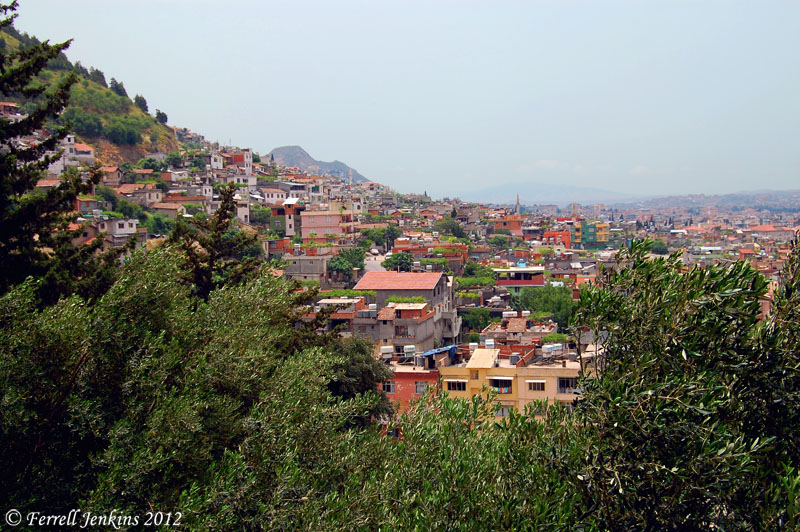
Antakya, Turkey (biblical Antioch of Syria). View south from slopes of Mt. Silpius. Photo by Ferrell Jenkins.

Antakya, Turkey (biblical Antioch of Syria). View south from slopes of Mt. Silpius. Photo by Ferrell Jenkins.

The Romans came in 64 B.C. and put an end to Seleucid rule. Antioch became the capital of the new province of Syria. It became the third greatest city of the Roman empire after Rome and Alexandria. Some have estimated that in New Testament times the population of the city neared a half million. Even Herod the Great assisted Augustus and Tiberias in beautifying the city.

Seleucus I Nicator, King of Syria (358-280 B.C.). Louvre. Photo by Ferrell Jenkins.

Seleucus I Nicator, King of Syria (358-280 B.C.). Seleucus was the founder of Antioch. Displayed in the Louvre. Photo by Ferrell Jenkins.

After Jerusalem, Antioch was the second great center of Christianity in New Testament times. When the disciples were scattered from Jerusalem after the stoning of Stephen, some came to Antioch from Cyprus and Cyrene (area of modern Lybia) and preached to Greeks as well as Jews (Acts 11:19-21). Nicolas, a proselyte of Antioch, had been one of the seven chosen to serve in Jerusalem (Acts 6:5). When the church at Jerusalem, some 300 miles away, heard of the new work they sent Barnabas. When the work became too much for him he left for Tarsus to look for Saul. The two of them labored at Antioch for a whole year and the disciples of Christ were called Christians first at Antioch (Acts 11:22-26).

Acts 9 & 11 — Photo Illustrations: Tarsus in Cilicia – home of Saul (Paul)

Tarsus in Cilicia was Paul’s native home, described as “no insignificant city” (Acts 9:11; 21:39; 22:3). The city had been important historically. Located near the Mediterranean on the River Cydnus, about 30 miles from the famous Cilician Gates, it was a fortified city and trade center as early as 2000 B.C. It had been captured by the Assyrian kings, Shalmaneser III (833 B.C.) and Sennacherib (698 B.C.), and had seen the likes of Alexander the Great and Cleopatra.

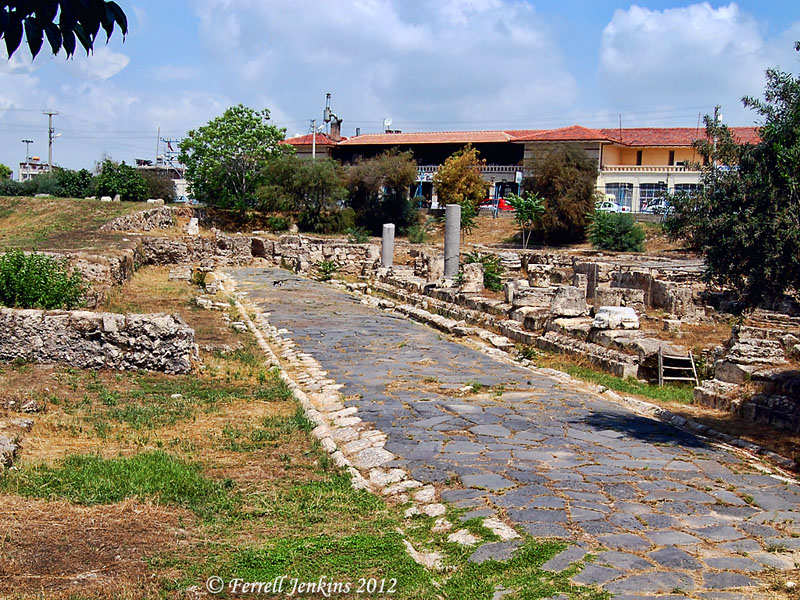
Roman Road at Tarsus in Cilicia. Photo by Ferrell Jenkins.

Roman Road at Tarsus in Cilicia. Photo by Ferrell Jenkins.

Tarsus was important commercially. Ancient writers mention the linen woven here from flax which grew in the fertile plain. A material called cilicium was woven from goat’s hair and used to make coverings which would protect against cold and wet. The city was also culturally important. Strabo describes the people as being avid in the pursuit of culture. Tarsus was a university town and noted as the home of several well-known philosophers, especially of the Stoic school. Barclay says:

“If a man was destined to be a missionary to the world at large, there was no better place in all the east for him to grow to manhood than in Tarsus” (The Mind of Paul, 25-26).

After Hellenistic Jews in Jerusalem sought to put Saul to death, the brethren sent him off to Tarsus.

And he was talking and arguing with the Hellenistic Jews; but they were attempting to put him to death. But when the brethren learned of it, they brought him down to Caesarea and sent him away to Tarsus. (Acts 9:29-30 NAU)

When Barnabas was overwhelmed in the work at Antioch, he went to Tarsus to look for Saul. Saul came to Antioch with Barnabas and they taught a large number of people (Acts 11:25-26).

Another PLBL Giveaway

Todd Bolen, over at the Bible Places Blog, is giving away another five volumes of the Pictorial Library of the Bible Lands. Any five you choose. The entry period ends Friday. Check details here.

Memory

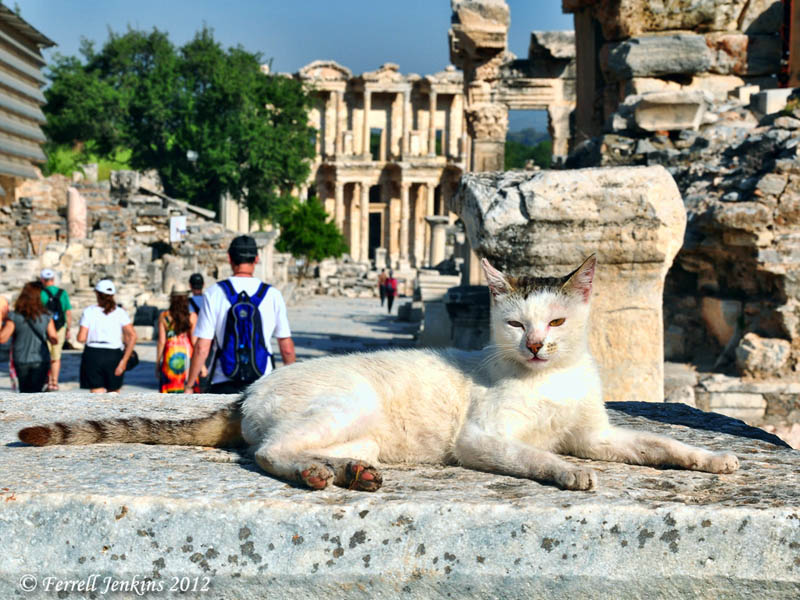
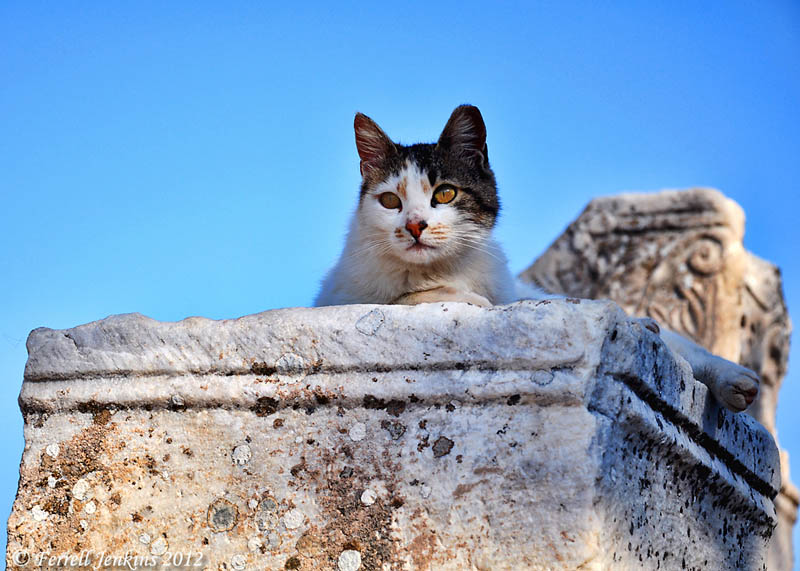
Several “Friends” on Facebook enjoy posting photos of cats. I would like to share a couple of pictures of the cats that hang out at Ephesus.

One of the Cats at Ephesus. Photo by Ferrell Jenkins.

One of the Cats at Ephesus. Photo by Ferrell Jenkins.

One of the Cats at Ephesus. Photo by Ferrell Jenkins.

One of the Cats at Ephesus. Photo by Ferrell Jenkins.

A neat place to hang out. Lots of memories here.

Roman artifacts in the Samsun Archaeology Museum

Our main interest in visiting the Black Sea coastal cities of Samsun and Sinop is because they are part of the ancient Roman province of Pontus. Somewhere in Pontus, probably Amisos (now Samsun), was the beginning point for the messenger who carried Peter’s first epistle to the elect of the diaspora residing in Pontus, Galatia, Cappadocia, Asia, and Bithynia (1 Peter 1:1).

The Archaeology Museum in Samsun has only a few items from the first century Roman period on display, but they are significant.

A marble head of Augustus is displayed prominently. Augustus was the Roman Emperor from 30 B.C. to A.D. 14. He is mentioned only once in the New Testament, but his influence in the eastern part of the Empire is evident in many way. The apostles traveled along roads built in the days of Augustus.

Luke records that the decree for a census to be taken of all the inhabited earth went out from Augustus.

Now in those days a decree went out from Caesar Augustus, that a census be taken of all the inhabited earth. (Luke 2:1 NAU)

This accounts for Mary and Joseph traveling from Nazareth to Bethlehem at the time of the birth of Jesus.

Roman Emperor Augustus. Displayed in Samsun Archaeology Museum. Photo by Ferrell Jenkins.

Augustus. Displayed in Samsun Archaeology Museum. Photo by Ferrell Jenkins.

I was surprised at the many references to Augustus on this blog. Just put the word Augustus in the search box to locate posts that mention him.

There is a first century image is that of a young athlete in the museum. He is full height, with arms missing.

Young Roman athlete in Samsun Archaeology Museum. Photo by Ferrell Jenkins.

Young Roman athlete in Samsun Archaeology Museum. Photo by Ferrell Jenkins.

The Apostle Paul used several illustrations from athletics. He told the young preacher Timothy that discipline and self control were necessary in his work as a preacher.

Every athlete exercises self-control in all things. They do it to receive a perishable wreath, but we an imperishable. So I do not run aimlessly; I do not box as one beating the air.  But I discipline my body and keep it under control, lest after preaching to others I myself should be disqualified. (1 Corinthians 9:25-27 ESV)

The Samsun Archaeological Museum

Hidden in Plain Sight. While driving around Samsun we saw a brown sign pointing to the Archaeology Museum, but we were not able to locate the building. We knew it was there because Mark Wilson mentions it in Biblical Turkey (340), as do some other guide books. I mentioned earlier that very few people in this region speak English. There was one girl at the hotel who could speak English. We met one young man in a local store who had been living in New York who spoke English, and a lady from the Netherlands. We always get by, and the locals are almost always helpful.

When we inquired about the Archaeology Museum we were always directed to the Gazi Museum. That is a museum devoted to the early history of Mustafa Kemal Atatürk, the founder of the Republic of Turkey. We enjoyed visiting that museum, but it still was not what we were looking for. After much effort, we finally found a policeman who pointed us in the right direction. Then, while we were standing on the street corner with an inquiring look, a Moslem lady asked if she could help us. She was from the Netherlands. She went in a store to inquire. They pointed us back to the Gazi Museum. When we indicated that was not the museum, we were finally pointed directly across the main street, beyond a little park, to the Archaeology Museum. By this time one of the local men indicated we should follow him. Success, at last.

The museum is small, but contains artifacts ranging from the Chalcolithic Period (as early as 4300 B.C.) to the Roman Period.

Excavation at Ikiztepe. Ikiztepe is a site located about 4 miles northwest of Bafra (see our discussion of the Halys River in yesterday’s post). In recent excavations, evidence of “cultures of the Chalcolithic Age, the Bronze Age and the Transition Age (Before Hittites) have been determined” (Museum brochure).

An article in Hurriyet Daily News says that discoveries at Ikiztepe range from the Chalcolithic Age to the Hellenistic period.

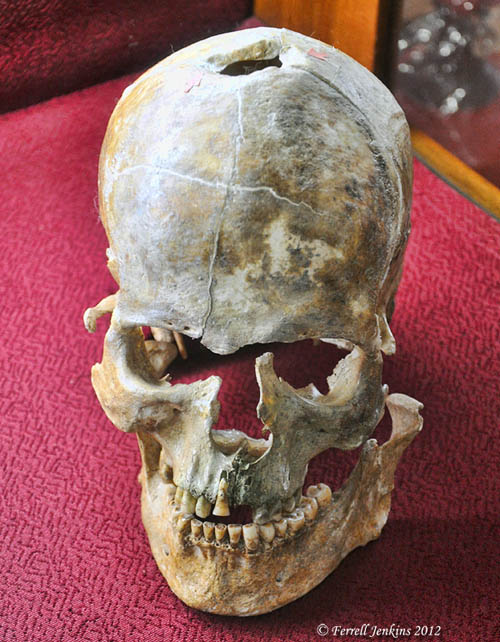
The most interesting findings unearthed during the excavations are skulls, which underwent surgical operation. In the graveyard on the highest hill in the ancient site, dating back to 2300-2100 BC, eight out of the 690 skeletons had skulls with traces of surgical operation. These skulls have archaeological importance since they are the only ones unearthed in Anatolia. They also show that people who lived there did not have the characteristics of Mediterranean people but of southern Russians and Bulgarians.

Read the full article here.

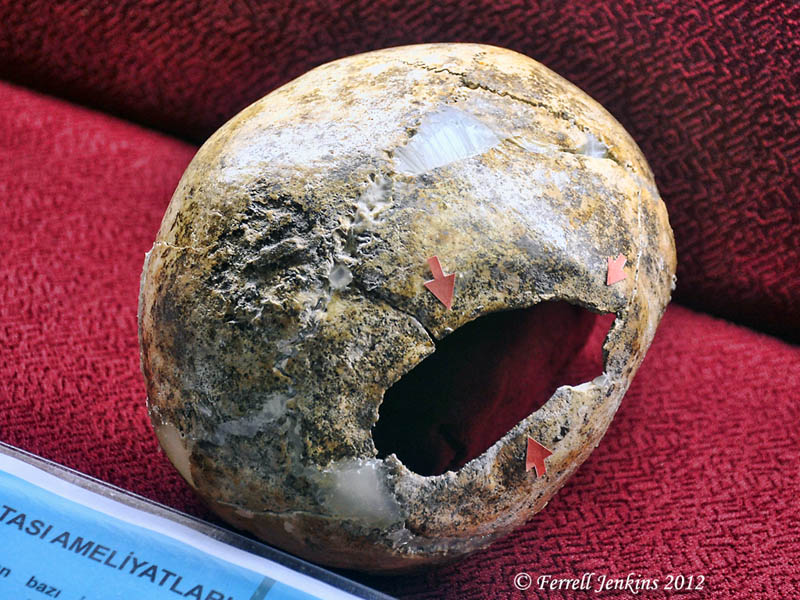
Ancient brain surgery that cut a hole in the skull to relieve pressure is referred to as trepanation. A few of the skulls found at Ikiztepe are displayed in the museum. They are said to belong to Bronze Age III. I think that would be in the neighborhood of 1600 B.C. Here are two of the photos I made that show the hole drilled in the skull.

Example of Trepanation, Bronze Age III, Ikiztepe. Samsun Archaeological Museum. Photo by Ferrell Jenkins.

Example of Trepanation, Bronze Age III, Ikiztepe. Samsun Archaeological Museum. Photo by Ferrell Jenkins.

The surgery in the case below required a much larger hole.

Example of Trepanation, Bronze Age III, Ikiztepe. Samsun Archaeological Museum. Photo by Ferrell Jenkins.

Example of Trepanation, Bronze Age III, Ikiztepe. Samsun Archaeological Museum. Photo by Ferrell Jenkins.

There is no indication whether the surgery was successful, or what happened to the surgeon if it failed.

Joe Zias, in an article in Mikhmanim (Spring 1999), says there have been 29 skulls showing trepanation (trephination) discovered in Israel. He says the survival rate based on “inflammatory or bone remodeling” indicate a 77 percent survival rate in these cases. You may read his entire article about this and other medical issues in ancient Israel here.

In a future post I plan to show you a few of the Roman period ruins, the time of Peter’s epistles (1 Peter 1:1).

The Halys (Kizilirmak) River

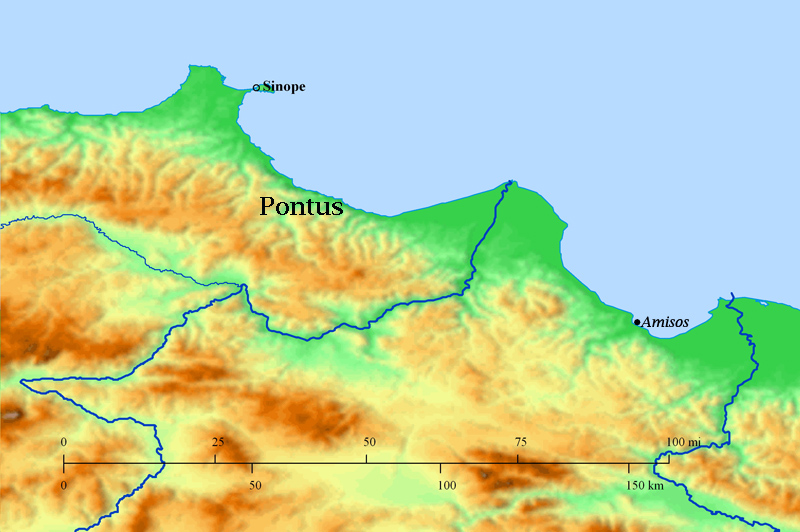
The Kizilirmak (Kizil Irmak) River was known as the Halys River in ancient times. The river flows past the Turkish town of Bafra into the Black Sea. Notice the Halys between Sinope and Amisos on the map below. It is about 35 to 40 miles west of Amisos. The river to the east of Amisos is the Iris.

Map of Pontus showing Sinop and Amisos.

Map of Pontus showing Sinope and Amisos. The Kizilirmak (Halys) River is located between the two towns, but closer to Amisos.

Pfeiffer and Vos describe the importance of the Halys.

The most important river of the peninsula [Asia Minor] is the Kizil Irmak (ancient Halys), 600 miles long, which originates in eastern Asia Minor and flows in a great bend to the southwest and finally into the Black Sea through what was Pontus. Unfortunately its gorge is often too narrow to permit it to be an important means of communication into the interior. (The Wycliffe Historical Geography of Bible Lands, 316).

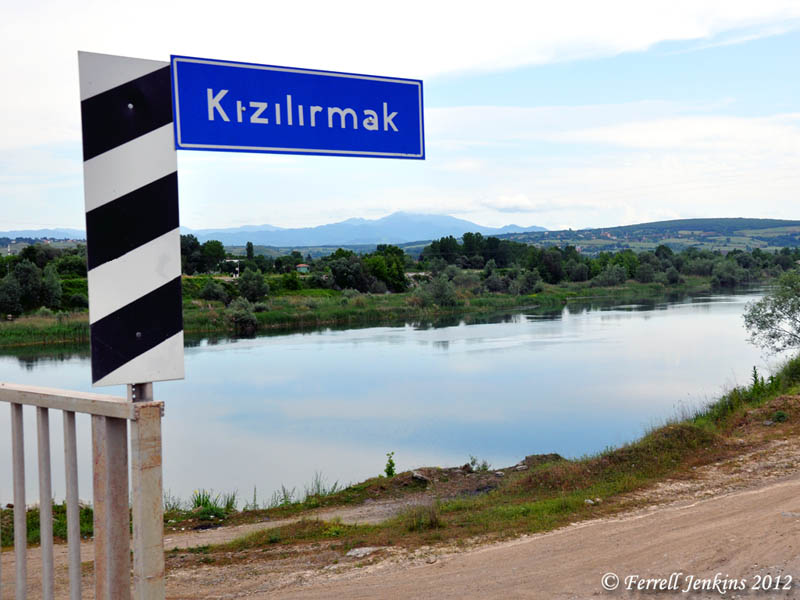
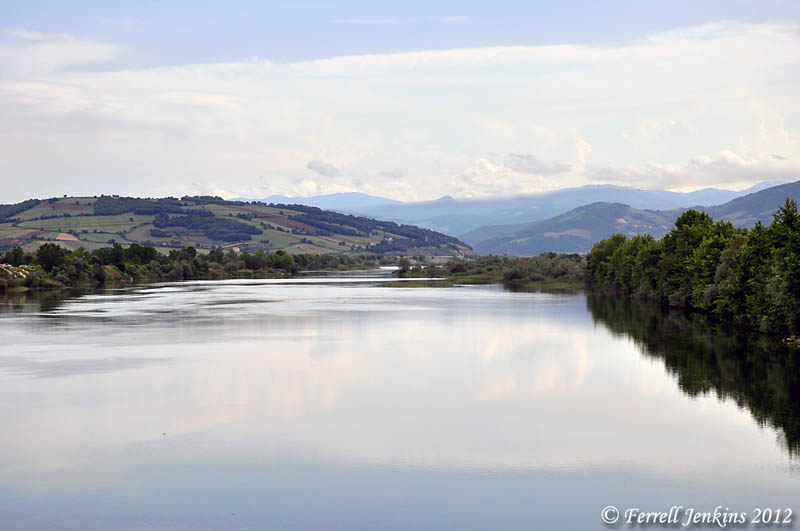
The photos below show the river flowing from the mountains on the south side of Pontus. These photos were made about 10 miles from the Black Sea, which is to the north. This is one of the widest areas of what was once the Roman province of Pontus.

Kizilirmak (Halys) River flowing to the Black Sea. Photo by Ferrell Jenkins.

C. J. Hemer wrote of the importance of the rivers of Pontus. He also calls attention to the fact that the “narrow coastal margin was separated from the interior by mountains.”

The chief rivers besides the Halys were the Iris, Lycus, and Thermodon. The fertile land of their valleys and of the narrow coastal margin was separated from the interior by mountains, once heavily forested, which have always impeded communication with the plateau. Important products included fruit, corn, olives, and timber. (The International Standard Bible Encyclopedia, Revised (3:903).

Kizilirmak (Halys) River flowing to the Black Sea. Photo by Ferrell Jenkins.

Kizilirmak (Halys) River flowing to the Black Sea. Photo by Ferrell Jenkins.

The ancient Hittite Empire comes to mind when I think of the Halys River, as Pfeiffer and Vos have pointed out. We say that the Hittites lived within the bend of the Halys River. A portion of Cappadocia (1 Peter 1:1) is also within that same bend.

Seeing the Halys, which I had seen before near the Hittite capital, was a pleasant surprise.

A funny thing happened on the way to Samsun

Pardon the delay, but I have had a couple of grandson days since the last post. Not much else gets done.

In the last post I spoke of the mountainous road east of Sinop, and of the rare opportunity to pull off the two lane highway. The first time we found a place to safely pull off the road we stopped to make some photos. I walked a few yards away from the car to find a clearing for a photo.

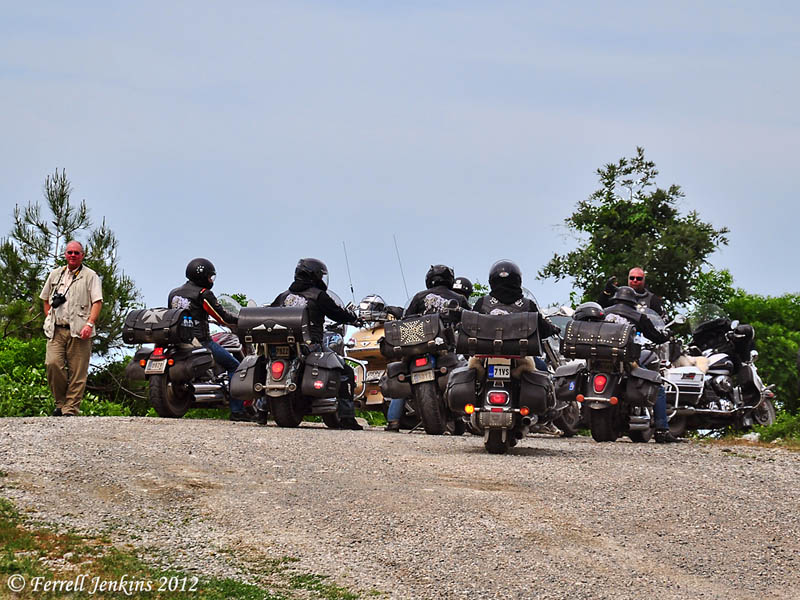
After a minute or two we heard a roaring sound. My first thought was that there might be a military air base in the vicinity. The sound came from jets taking off, I thought. To my surprise I saw a group of motorcyclists coming around the bend. One of the riders in the front of the group had a helmet with horns. Further back was another rider with the same kind of helmet. I didn’t know if these guys were a rogue motorcycle club or a bunch of “Wild Hogs.”

When the entire group of about 15 cyclists pulled in around our car which was up the hill a short distance from where I was, I thought of the old joke about the tourist group that got lost in cannibal territory. The cannibal leader told the group, “You take the bus and leave the driver for us.” I was able to snap a photo of Leon making a fast get away from the group. But the car is totally hidden from view by the cyclists.

Group of cyclists on the mountanious road east of Sinop. Photo by Ferrell Jenkins.

Cyclists on the mountainous road east of Sinop. Photo by Ferrell Jenkins.

After conferring, Leon and I decided we should get to the car while there was opportunity. As we approached the cycles I noticed that most of the tags, and some of the leather jackets, bore the designation Estonia. When we spoke in English, several of the riders tried to communicate. The best English speaker in the group was from Russia. He told us that they were riding around the Black Sea.

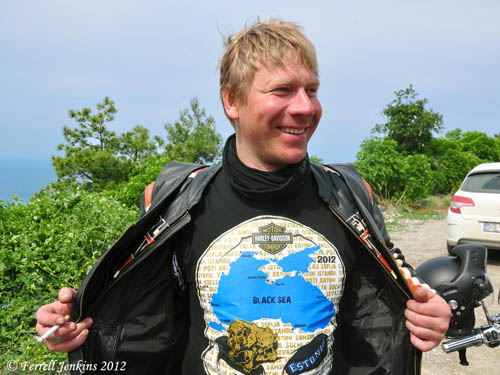
An Estonian proudly showed me his shirt with a screen print showing the Black Sea and the names of the major places they were visiting. I think his smile tells how our encounter turned out. The Black Sea is slightly visible far below us.

Cyclist from Estonia making a circuit of the Black Sea. Photo by Ferrell Jenkins.

Cyclist from Estonia making a circuit of the Black Sea. Photo by Ferrell Jenkins.

Uneasiness past, we said good-bye and went on our way to Samsun. It was a nice experience; the sort that we often encounter in foreign travel.