Category Archives: Turkey

Acts 27 — Photo Illustrations — Myra in Lycia

Myra was a town of Lycia about 85 miles west of Antalya, Turkey (biblical Attalia, Acts 14:25). The town is located about two miles inland from the Mediterranean, but has a port at nearby Andriake. When Paul was being escorted by a Roman centurion from Caesarea Maritima to Rome, the ship sailed along the coast of Cilicia and Pamphylia, and landed at Myra in Lycia (Acts 27:5). There they found an Alexandrian ship sailing for Italy. This was one of the many grain ships that used Andriake as a port (Acts 27:38).

We do not know whether Paul was able to see any of Myra. There are several interesting things that could have been seen.

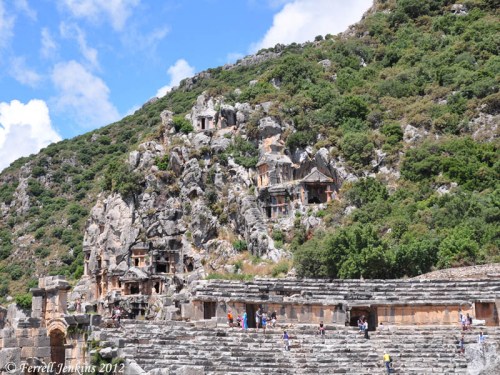
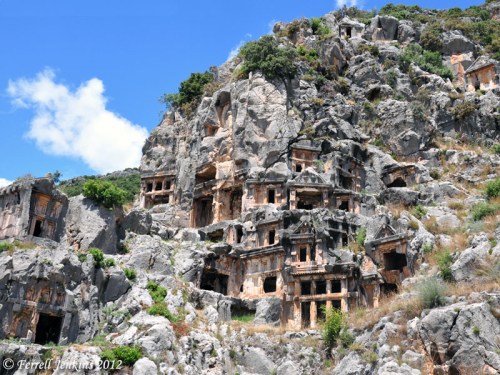
Here is a photo of the house-type tombs in the rock cliffs at Myra dating from the 4th century B.C.

Fourth century B.C. house-type rock tombs at Myra. Photo by Ferrell Jenkins.

Fourth century B.C. house-type rock tombs at Myra. Photo by Ferrell Jenkins.

The next photo shows the top seats of the 2nd century B.C. theater with the tombs in the background. The theater seated about 10,000 spectators.

Rock tombs of Myra with Theater in the foreground. Photo by Ferrell Jenkins.

Rock Tombs of Myra with Theater in the foreground. Photo by Ferrell Jenkins.

Our last photo shows the harbor at Andriake, and walls of granaries built in the time of the Roman Emperor Hadrian (A.D. 117-138).  This was an ideal place to find a grain ship headed for Rome, even before Hardian built the granaries.

Anriake, the harbor of Myra, Photo by Ferrell Jenkins

Anriake, the harbor of Myra, Photo by Ferrell Jenkins

Turkey wants British Museum to return sculptures from the Mausoleum of Halicarnassus

According to an article in The Guardian (here), the town of Bodrum in Southwest Turkey wants the British Museum to return several priceless sculptures once associated with the Mausoleum of Halicarnassus in the 4th century B.C.

Human rights legislation that has overturned the convictions of terrorists and rapists could now rob the British Museum of sculptures created for one of the seven wonders of the ancient world.

A Turkish challenge in the European court of human rights will be a test case for the repatriation of art from one nation to another, a potential disaster for the world’s museums.

Halicarnassus is where Mausolus built a gigantic tomb in honor of himself. Leon Mauldin and I visited the site earlier in the year. You may read about our visit (with photos) here. It became known as one of the Seven Wonders of the Ancient World.

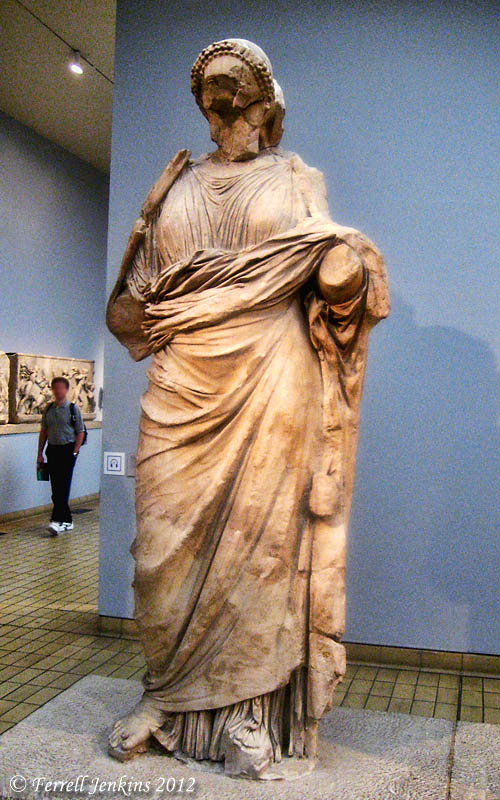
Two of the sculptures that the town of Bodrum wants returned are through to be of Mausolus and Artemisia, his wife. Here is a photo of the marble statue thought to be Mausolus.

Statue of Mausolus in British Museum. Photo by Ferrell Jenkins.

Statue of Mausolus in British Museum. Photo by Ferrell Jenkins.

The next statue is usually identified as Artemisia, wife of Mausolus.

Statues from the Mausoleum of Maussollos - Marble, About 350 B.C

Statue from Halicarnassus, usually identified as Artemisia, the wife of Mausolos. Photo by Ferrell Jenkins.

Another reason to visit the British Museum soon, or Turkey later.

HT: Jack Sasson

The Annual Meetings # 1

Each year in November professional meetings pertaining to the field of biblical studies are held in a major U.S. city. The largest meeting is the SBL/AAR meeting. That is the Society of Biblical Literature and the American Academy of Religion. Together these organizations attract maybe eight thousand persons who are involved in teaching and researching in the fields of Biblical Studies and Religious Studies.

ASOR, the American Schools of Oriental Research, meets separately a few days ahead of the other meeting. This organization attracts those who are teaching and active in the field of Near Eastern archaeology.

The Evangelical Theological Society (ETS) currently meets at the same time as ASOR. I think in some recent years as many as 2000 members attend ETS. This organization attracts scholars who are admittedly conservative in their approach toward the Scriptures. Most of them teach in seminaries or religious schools.

Some international scholars attend each of these meetings.

From time to time I have someone ask me why I attend. I will suggest a couple of reasons based on the current ETS meeting, and these reasons will be true of both meetings.

Books, Books, Books. I do not buy as many books as I once did, but I still like to see what is being published. The ETS book exhibit has grown from a few tables several years back to a large exhibit hall this year. Many of the major religious publishers offer deep discounts to the members. They know that these teachers may use their books, or at least recommend them, in their classes. Only members with the proper ID are allowed in the exhibit hall.

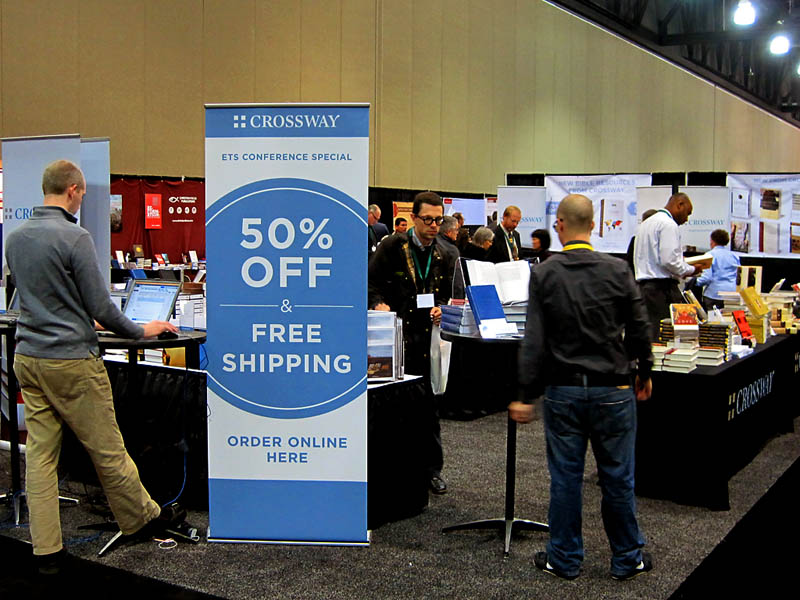
The Crossway display. Crossway is the publisher of the ESV bible.

The Crossway display. Crossway is the publisher of the ESV bible.

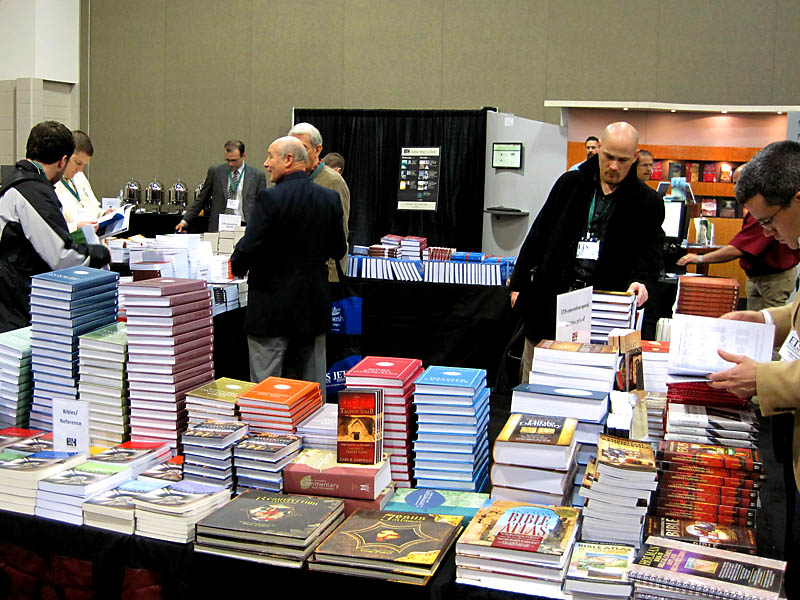
The books on display are mainly the current publications along with a few of the previous best sellers.

A portion of the B&H display.

A small portion of the B&H display.

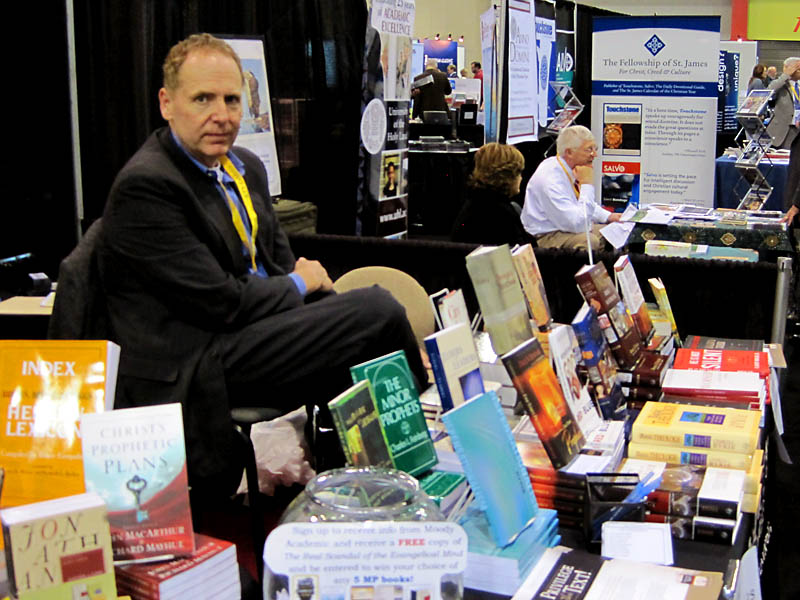
Friends. Another reason I attend the meetings to to see old friends and make new ones. Jack is now a freelance representative. This week he was working for Moody Press.

Promoting Moody Press books at the ETS meeting.

Promoting Moody Press books at the ETS meeting.

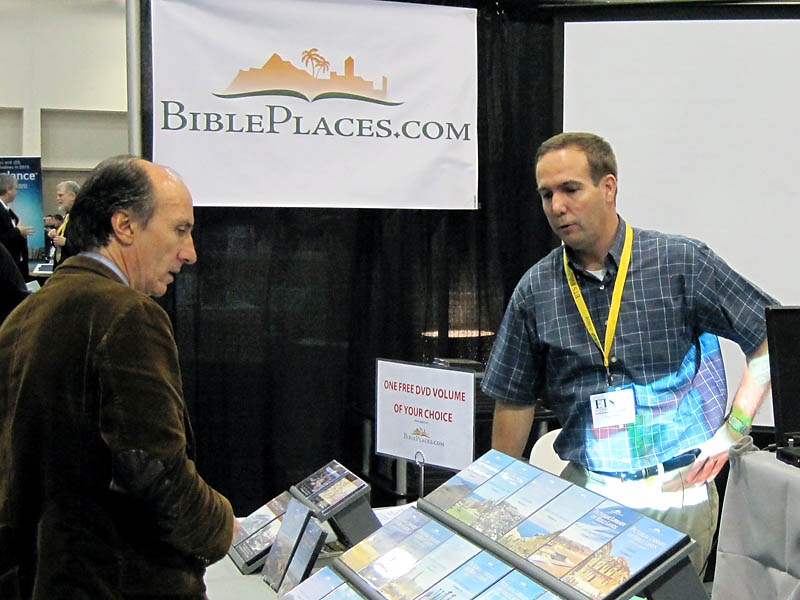
For the first time, Todd Bolen had a display of his Pictorial Library of the Bible Lands. We have written about this series here.

Todd Bolen, Bible Places.com, talks with a customer.

Todd Bolen (right), Bible Places.com, talks with a customer.

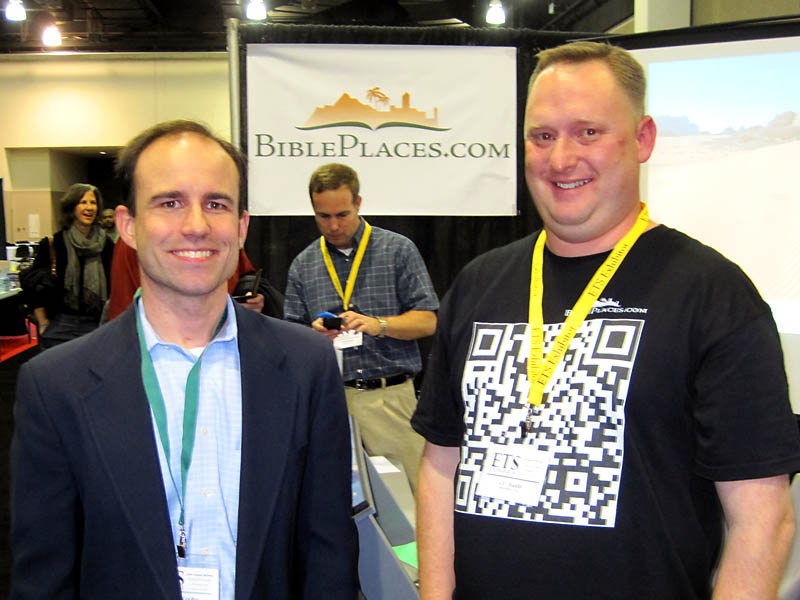
A. D. Riddle made new maps for the revised PLBL. He was helping at the booth. A customer is on the right. Bolen is in the background. This was my first time to meet A. D., he has been helpful to me several times via correspondence.

A.D. Riddle, who supplied new maps for the revised series.

A.D. Riddle (right), who supplied new maps for the revised series, takes a break from talking with an ETS member about the PLBL series.

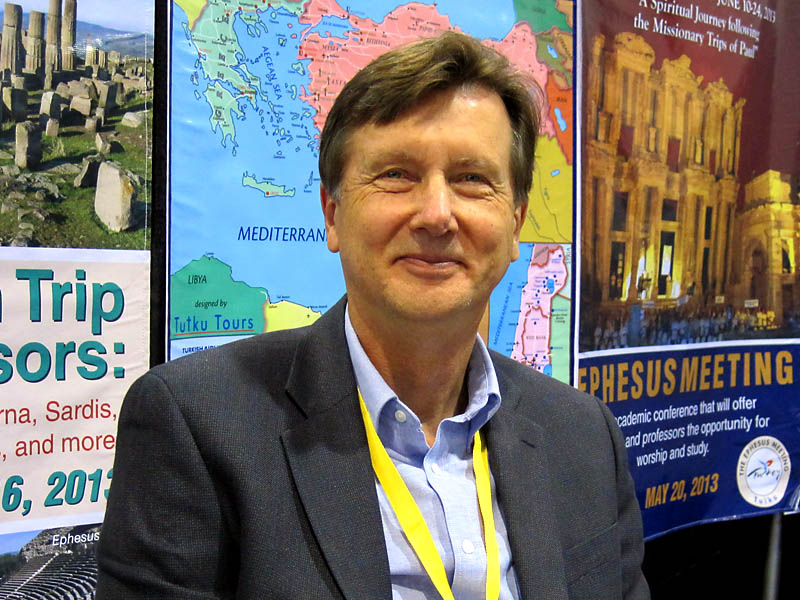
I ran across Mark Wilson, author of Biblical Turkey: A Guide to the Jewish and Christian Sites of Asia Minor. Mark lives in Turkey part of each year, and has spoken to one of my groups. Everyone who plans a trip to Turkey, or who just wants to know more about the Biblical places in Turkey, should have this book.

Mark Wilson mans the Tutku Travel booth.

Mark Wilson mans the Tutku Travel booth.

Other friends I saw included Steve Wolfgang, former students Rusty Taylor and Randy Murphy.

In another post I will mention some of the papers I heard.

Portions of Bond 007 Skyfall filmed in Turkey

An article at MI6 (here) about the Istanbul premier of Skyfall mentions Turkish sites used in the film.

Turkey has felt a noticeable increase in tourist enquiries. “Skyfall” showcases the famous rooftops and the Grand Bazaar of Istanbul, as well as the more rural and rugged landscapes of southern Turkey as the film’s second unit shot extensively in Adana.

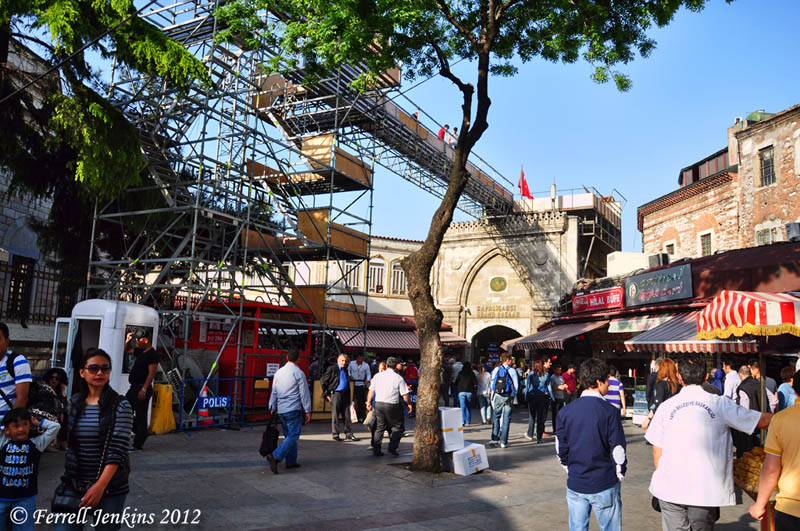
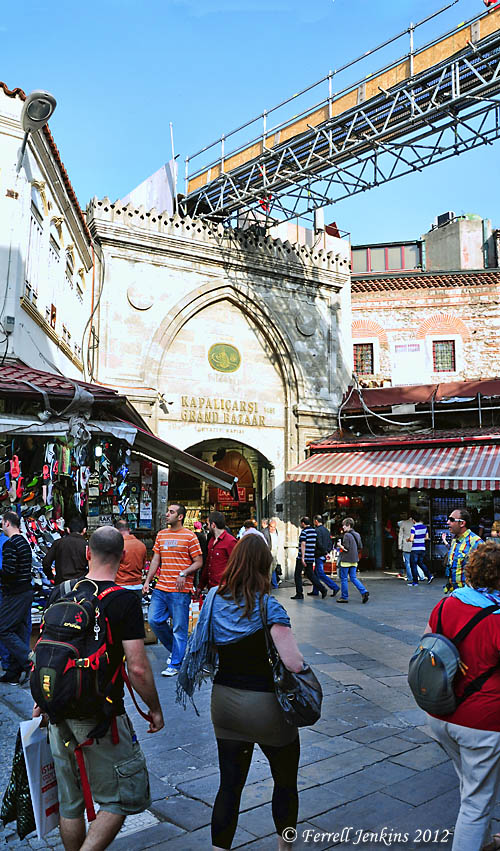
Almost every group that visits Turkey makes a stop in Istanbul. On our recent Steps of Paul and John Tour we also made a brief visit to the Grand Bazaar. At one entry to the Bazaar the scaffolding was in place for the filming of some of the scenes in the new Bond 007 Skyfall movie.

Istanbul Grand Bazaar set for the Bond 007 Skyfall movie. Photo by Ferrell Jenkins.

Istanbul Grand Bazaar set for the Bond 007 Skyfall movie. Photo by Ferrell Jenkins.

One of the reasons many people have enjoyed the Bond movies is for the opportunity to see many beautiful and exotic places that served as settings.

Skyfall scaffolding above the Grand Bazaar in Istanbul. Photo by Ferrell Jenkins.

Adana is located about 30 miles east of Tarsus, the native home of the Apostle Paul in the region of Cilicia.

But Paul said, “I am a Jew of Tarsus in Cilicia, a citizen of no insignificant city; and I beg you, allow me to speak to the people.” (Acts 21:39 NAU)

Acts 21 # 2 — Photo Illustrations – Tyre

Luke records the journey from Patara to Tyre in these words:

 2 and having found a ship crossing over to Phoenicia, we went aboard and set sail.  3 When we came in sight of Cyprus, leaving it on the left, we kept sailing to Syria and landed at Tyre; for there the ship was to unload its cargo.  4 After looking up the disciples, we stayed there seven days; and they kept telling Paul through the Spirit not to set foot in Jerusalem.  5 When our days there were ended, we left and started on our journey, while they all, with wives and children, escorted us until we were out of the city. After kneeling down on the beach and praying, we said farewell to one another.  6 Then we went on board the ship, and they returned home again.  7 When we had finished the voyage from Tyre, we arrived at Ptolemais, and after greeting the brethren, we stayed with them for a day.  (Acts 21:2-7 NAU)

Tyre was well known to the Old Testament writers, especially the prophet Ezekiel. In Ezekiel 26-28 you will find a proclamation against Tyre, a prophetic lamentation over the fall of the city, and a proclamation against the king of Tyre.

The ministry of Jesus took Him to the district of Tyre and Sidon (Matthew 15:21).

The disciples, with wives and children, escorted Paul and his companions out of the city. The group kneeled and prayed on the beach before saying farewell to one another.

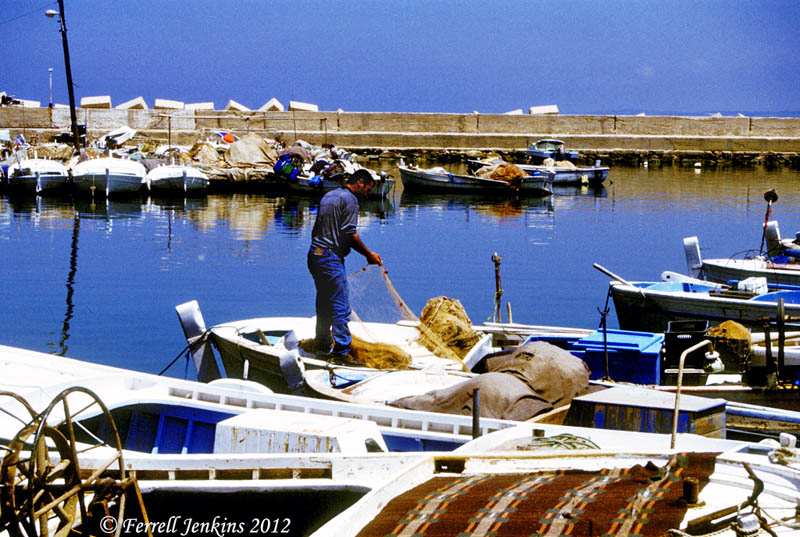
Tyre was once an important Phoenician city, but is now a small town known as Sur in Lebanon. It has a small fishing port that you see in the photograph below.

A fisherman works with his nets in the small harbor of Tyre. Photo by Ferrell Jenkins.

A fisherman works with his nets in the small harbor of Tyre. Photo by Ferrell Jenkins.

Acts 21 — Photo Illustrations – Patara

Patara is mentioned only once in the New Testament. When Paul and his companions sailed from Miletus on their way to Syria (Caesarea), they made stops at Cos, Rhodes, and Patara in the Roman province of Lycia in Asia Minor (Acts 27:5).

And when we had parted from them and set sail, we came by a straight course to Cos, and the next day to Rhodes, and from there to Patara. And having found a ship crossing to Phoenicia, we went aboard and set sail.  (Acts 21:1-2 ESV)

Patara is known as Gelemis (in Turkey) today, but the sign on the main highway from Fethiye to Kas points to the ancient site of Patara.

Wilson says,

Patara served as a way station for sea travelers, and Paul changed ships here to Phoenicia at the end of his third journey in AD 57 (Acts 21:1). (Biblical Turkey, 91).

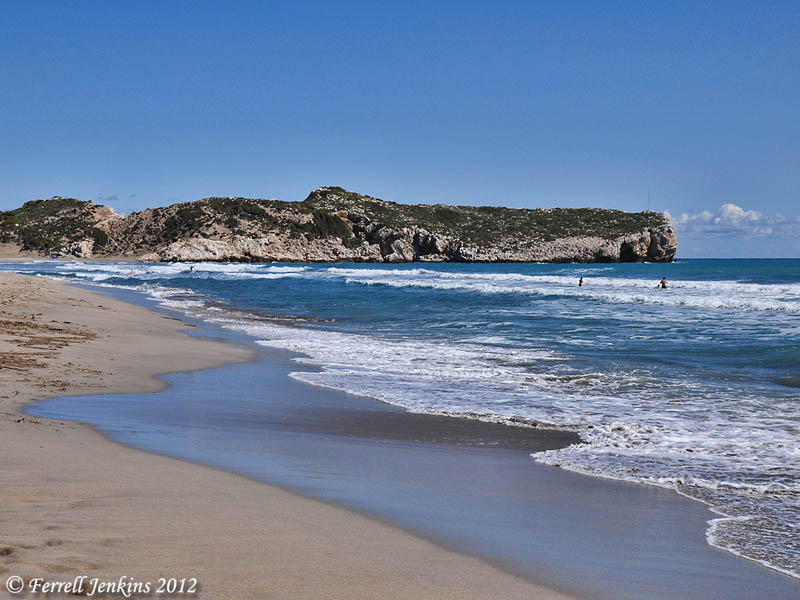
The beach at Patara is a popular leisure place for locals as well as visitors to the area. For this photo we drove the narrow road from the main highway through the ruins of the city to the water.

Beach on the Mediterranean Sea at Patara, Turkey. Photo by Ferrell Jenkins.

Beach on the Mediterranean Sea at Patara, Turkey. Photo by Ferrell Jenkins.

Patara already had a long history before Paul stopped there. Tradition has it that it was founded by Patarus, a son of Apollo. Persians used the port during the Persian Wars. The city later came under the control of Alexander the Great, the Ptolemies, and the Seleucids in succession before being given freedom by the Romans in 167 B.C. In 43 B.C. the city became part of the province of Lycia (Biblical Turkey, 90-91).

Our next photo shows the site of the silted up harbor of Patara. In the distance you will see a narrow sliver of blue between the trees and the sky. That is the Mediterranean Sea. Entrance to the harbor from the Sea is blocked. Ruins of granaries built in the days of Hadrian (A.D. 117-138) are visible on the west side of the harbor. Click on the photo for a larger image.

Silted up harbor at Patara. The Mediterranean Sea is visible on the horizon. Photo by Ferrell Jenkins.

Silted up harbor. The Mediterranean is visible on the horizon. Photo by Ferrell Jenkins.

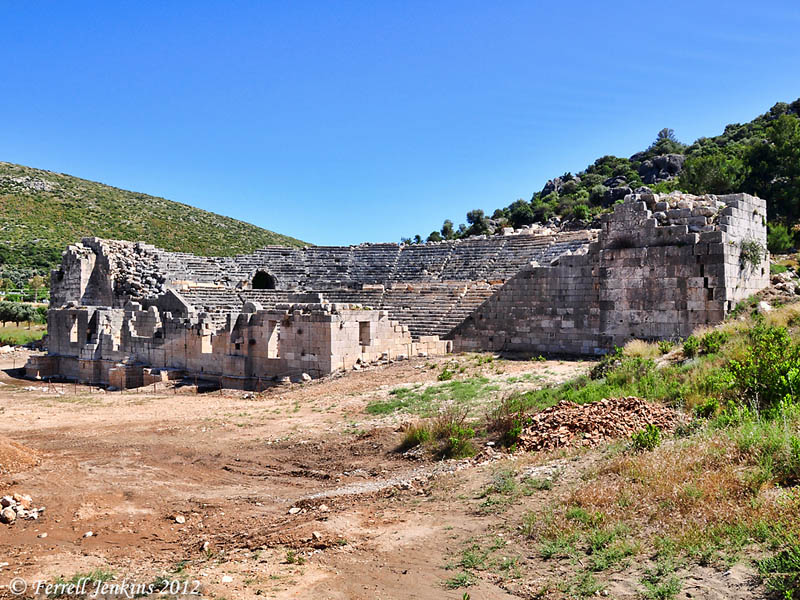
Our last photo shows the theater which was built in the Hellenistic period, but was rebuilt in the time of the Roman Emperor Tiberias (A.D. 14-37). It seated more than 6,000 people.

Theater at Patara. Photo by Ferrell Jenkins.

Theater at Patara. Photo by Ferrell Jenkins.

Use the search box for posts about some of the other places mentioned in Acts 21: Rhodes, Cyprus, Tyre, Ptolemais, and Caesarea.

Acts 20–21 — Paul’s Travel Itinerary with Photo Illustrations

The precision and chronological exactitude with which this journey is recounted is amazing. F. F. Bruce says,

The description of this critical journey of Paul and his disciples to Jerusalem is given in considerable detail; some have compared the detailed description in the Third Gospel of Jesus’ critical journey to Jerusalem with His disciples. But the kind of details is different; the chronological exactitude of this second “we” narrative of acts is due mainly to the fact that Luke was one of the party and kept a log-book. (The Book of Acts in the NICNT, 407).

Acts 20:6    —    Paul left Philippi “after the days of Unleavened Bread”(Passover). He was hurrying to be in Jerusalem “on the day of Pentecost” (20:16). This would be 50 days after Passover. He had been in Ephesus on Pentecost one year earlier (1 Cor. 16:8).
Acts 20:6    —    Paul came to Troas within 5 days. Tarried 7 days. A “door” had been opened for Paul at Troas less than a year earlier, but he was not able to enter it (2 Cor. 2:12).
Acts 20:7    —    On the first day of week — gathered together with the disciples to break bread.
Acts 20:11    —    Monday (or ? Sunday) — Paul departed. This depends on whether they followed the Jewish practice of sundown beginning the new day, or the Roman practice of mid-night to mid-night.
Acts 20:13-14    —    Assos. Paul’s companions went by boat from Troas to Assos. Paul traveled overland.
Acts 20:14    —    Mitylene (on the island of Lesbos).
Acts 20:15    —    Following day — opposite Chios.
Acts 20:15    —    Next day — Samos.

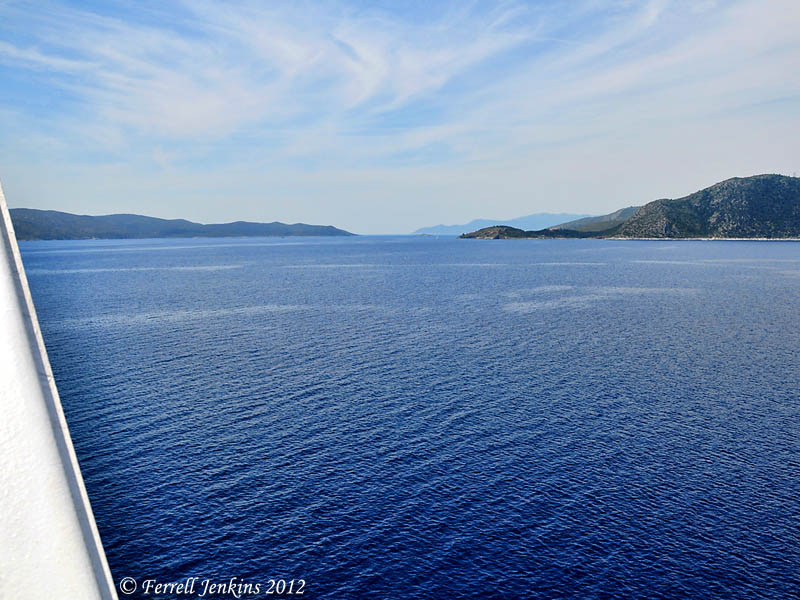
The photo below was made from a ship after it passed from north to south through the narrow strait between Samos (on the left) and the Turkish coast (on the right).  The ancient site of Trogyllium is located on the small peninsula extending into the Aegean Sea.
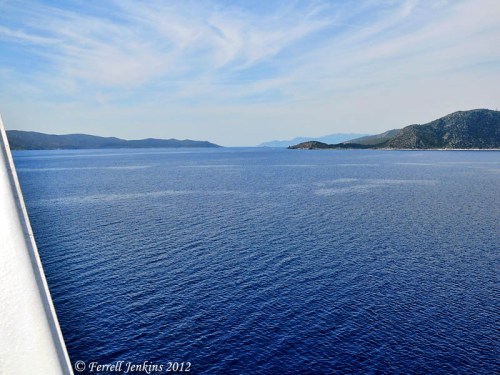
Samos-Turkey Strait. View North. Photo by Ferrell Jenkins.

View north of the Samos-Turkey Strait. Photo by Ferrell Jenkins.

Acts 20:15    —    Tarried at Trogyllium. (Appears in Western and Byzantine texts and in the KJV and NKJV.) The omission of the name in most manuscripts is explained by Bruce M. Metzger:

“Chiefly because of superior external attestation, a majority of the Committee preferred the shorter text” (A Textual Commentary on the Greek New Testament, 478).

Ramsay points out that the information is,

“in itself highly probable, for the promontory of Trogyllian or Trogylia projects far out between Samos and Miletus, and the little coasting vessel would naturally touch there, perhaps becalmed, or for some other reason” (The Church in the Roman Empire, 155).

Acts 20:15    —    The day following — Miletus.

This photo shows some standing water in the Lion Harbor of Miletus.
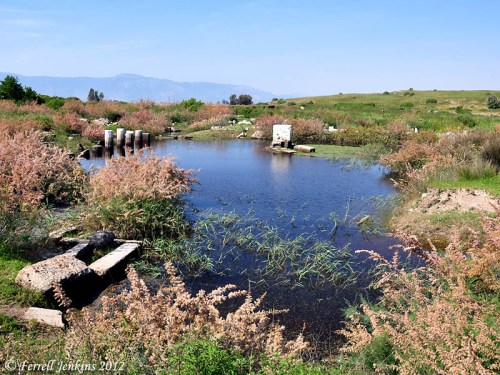
Ruins of the Lion Harbor at Miletus. Photo by Ferrell Jenkins.

Ruins of the Lion Harbor at Miletus. Photo by Ferrell Jenkins.

Acts 20:16    —    Paul had decided to sail past Ephesus — to be in Jerusalem on Pentecost (fifty days after leaving Philippi).

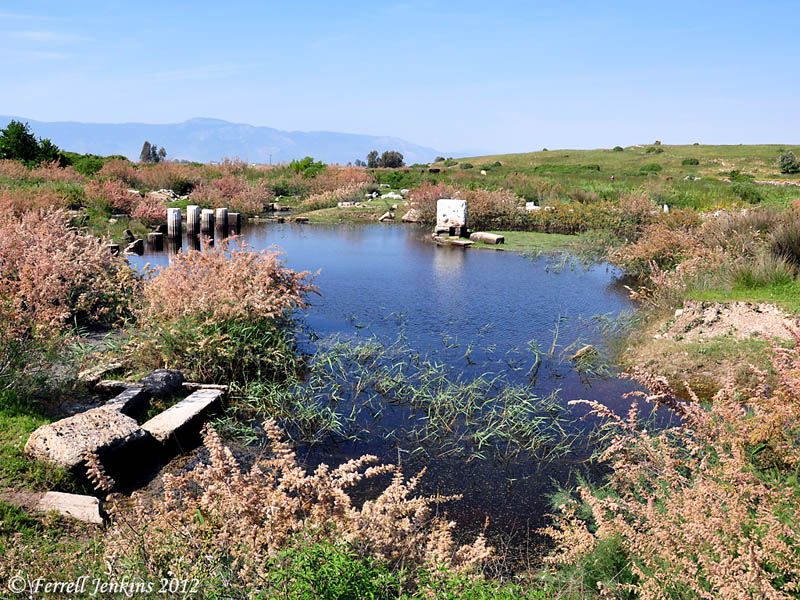
From Miletus Paul sent for the Ephesian elders. Consider the distance. How long would it take the courier to go to them and for them to come to him at Miletus? The distance was 63 miles by land or 38 if they went across the gulf of Latmos. This gulf is now silted up, leaving only a small inland lake.

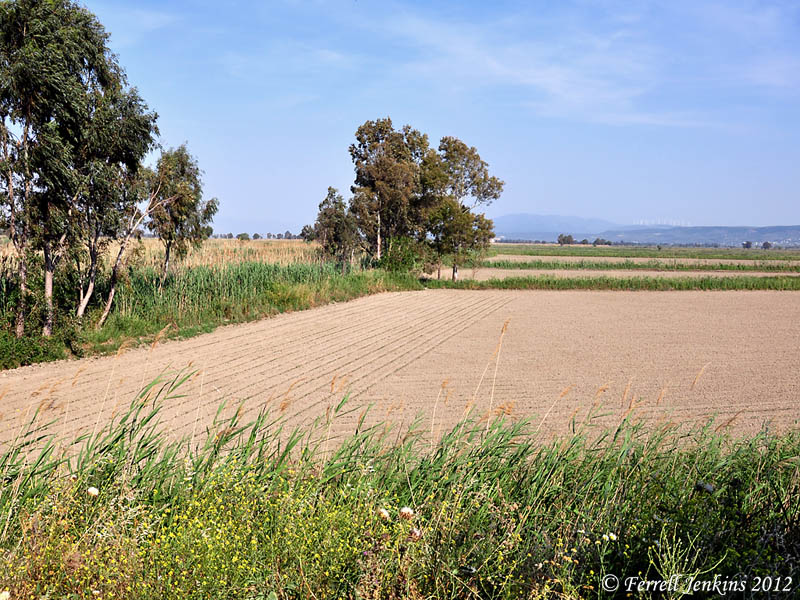
The photo shows the site of the Gulf of Latmos which is now silted up. Turkish farmers grow rice in the area. The Meander River flows to the left of this photograph.
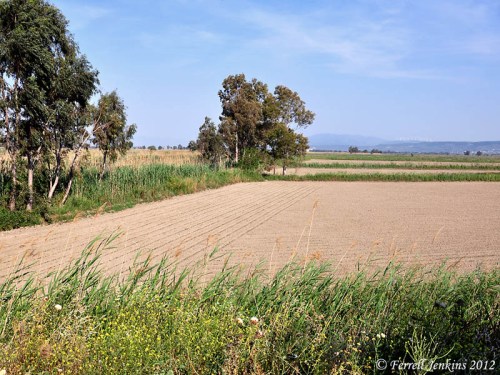
Site of Lake Latmos, now silted up, within two miles of Miletus. Photo by Ferrell Jenkins.

Site of the Gulf of Latmos, now silted up, within 2 miles of Miletus. Photo: F. Jenkins.

Acts 21:1    —    Set sail on a straight course to Cos.

  •  Next day to Rhodes. Tradition identifies this stop at St. Paul’s Bay at Lindos.
  • Patara.
  • Patara to Tyre. According to Chrysostom this trip took five days (Homily XLV.2; cf. Bruce, The Book of Acts in NICNT  421). They were always at the mercy of the wind. When they came within sight of Cyprus they sailed past to the south of the island as they headed to Syria (21:3).

Acts 21:4    —    Tyre — Paul tarried 7 days (note 20:6-7).
Acts 21:7    —    Ptolemais [modern Acre in Israel] — stayed one day.
Acts 21:8    —    Caesarea. They arrived the next day. The text does not say whether they went by boat or land. At Caesarea they stayed with Philip for “many days” (21:10).

Acts 21:15-17    —    Up to Jerusalem of Judea (cf. 21:10).

Acts 21:18    —    The following day Paul and the others visited James and the elders.

If our study of the Book or Acts, or any book of the Bible, is only a cursory one without attention to details, we miss much of what was intended for us.

Note: Use the Search Box to locate posts about Philippi, Assos and Mitylene, Ephesus, Miletus, Rhodes, Tyre, Ptolemais, and Caesarea.

Acts 19 — Photo Illustrations

Ephesus is one of the most excavated sites from the Biblical world. Teams of Austrian archaeologists have worked at the site since 1895.

Items of interest at Ephesus include the single standing column of the Temple of Diana (Artemis), the harbor which is now silted up, the great theater which seated nearly 25,000 (Acts 19:29), the Marble street, the Library of Celsus, the Agora, the Temple of Hadrian, the Temple of Domitian (or the Flavian Emperors), and much more.

The first instance of believers baptized into Christ at Ephesus is recorded in Acts 19. Many changes took place in the church between the time when Paul spent nearly three years in the city, and the time when John lived there. There are two letters in the New Testament addressed to the church at Ephesus. The first is the letter of Paul to the Ephesians. The other is the letter included in the book of Revelation (Revelation 2:1-7).

Yamauchi comments on the size of Ephesus in the first century:

“In the New Testament era it was probably the fourth greatest city in the world (after Rome, Alexandria, and Antioch) with a population of about 250,000” (Archaeology of New Testament Cities, 79).

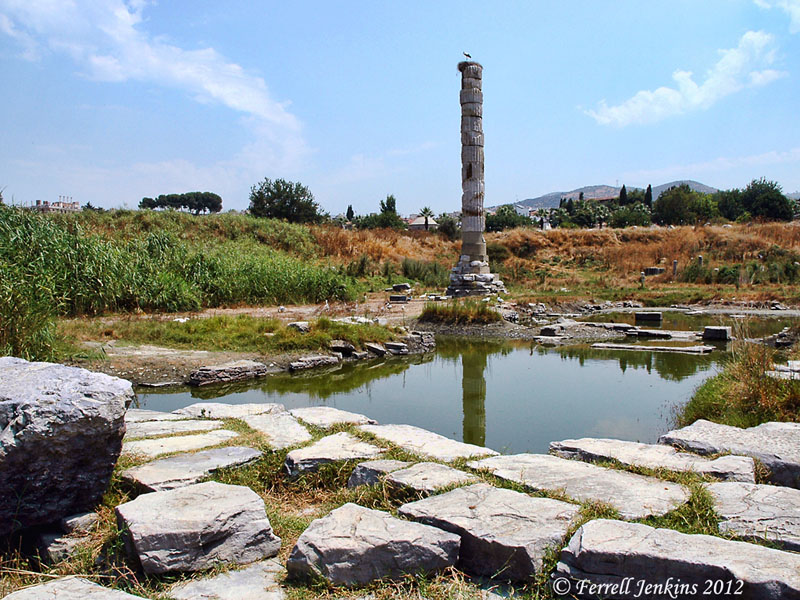
The photo below shows the site of the Temple of Artemis (Diana). Notice the stork standing on top of the sole standing column. Click on the photo for a larger image.

The site of the Artemis temple at Ephesus. Photo by Ferrell Jenkins.

The site of the Temple of Artemis at Ephesus. Photo by Ferrell Jenkins.

The ruins of the famous temple were discovered in 1869 by J. T. Wood, an English engineer.  Pausanias, the second century A.D. geographer, said the “temple of Diana surpassed every structure raised by human hands.” The temple was four times as large as the Parthenon. The platform of the temple was 239 feet wide by 418 feet long. The temple itself was 180 feet wide by 377 feet long, and the roof was supported by more than 100 sixty-foot columns. The temple served as a bank and a place of asylum for criminals. The earliest stage of the temple was built about 600 B.C. The Hellenistic temple which Paul and John saw was destroyed in A.D. 262.

“From the Land of Black Tents”

In his book The Apostle: A Life of Paul, noted biographer John Pollock begins his book with information about Paul’s background at Tarsus. He calls the first chapter, “From the Land of Black Tents.”

His father most likely was a master tentmaker, whose craftsmen worked in leather and in cilicium, a cloth woven from the hair of the large long-haired black goats that grazed (as they still do) on the slopes of the Taurus. The black tents of Tarsus were used by caravans, nomads, and armies all over Asia Minor and Syria.

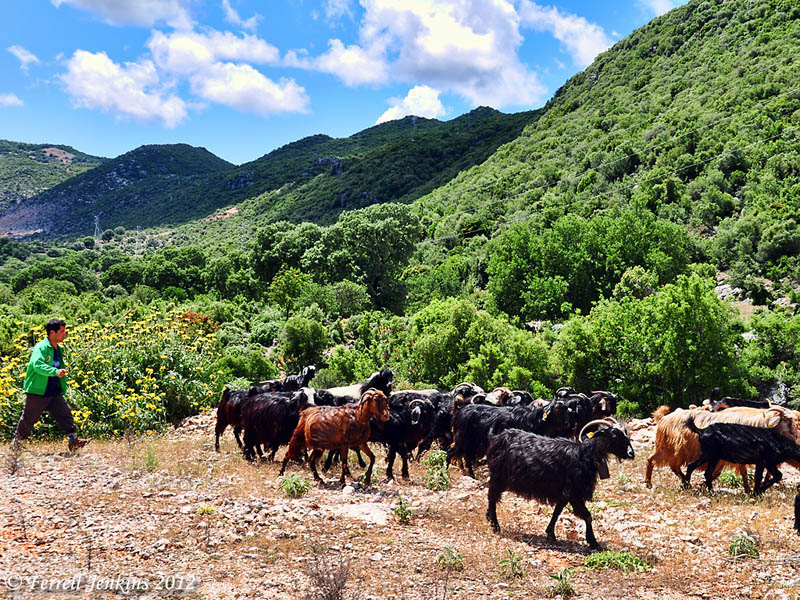
We still see these herds of long-haired black goats in many parts of Turkey. The photo below was made east of Myra near the Mediterranean coast of Turkey.

Goats with long black hair, east of Myra, Turkey. Photo by Ferrell Jenkins.

Goats with long black hair east of Myra, Turkey. Photo by Ferrell Jenkins.

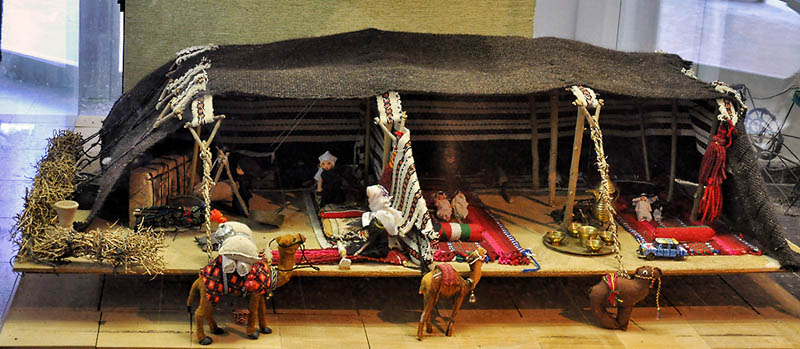
The Museum for Beduin Culture at Kibbutz Halav in the Negev of Israel displays a small model of a beduin (bedouin) tent. This museum intends to preserve the memory of the original bedouin life that is quickly being replaced by a permanent life and housing.

Bedouin Tent Model displayed at the Museum for Beduin Culture. Photo by Ferrell Jenkins.

Tent Model displayed at the Museum for Beduin Culture. Photo by Ferrell Jenkins.

Paul said,

But Paul said, “I am a Jew of Tarsus in Cilicia, a citizen of no insignificant city; and I beg you, allow me to speak to the people.” (Acts 21:39 NAU)

Acts 14 — Photo Illustrations

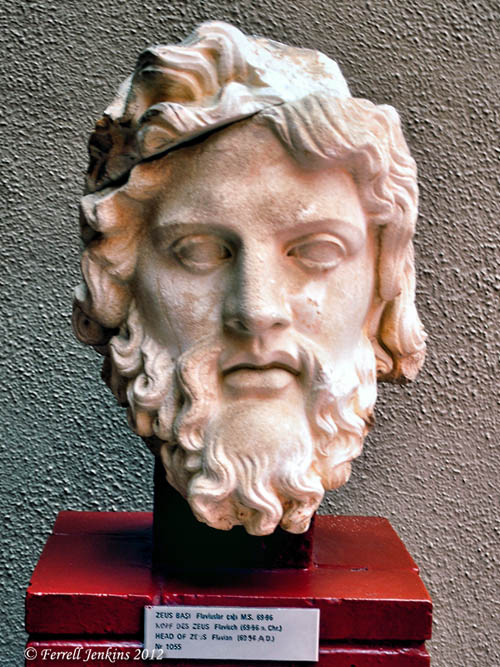
G. Walter Hansen comments on the religious life of Galatia and the importance of Zeus and Hermes to the people who lived there.

Zeus was the most widely worshipped god in Galatia; temples to Zeus were ubiquitous. Zeus was often linked with other gods. In the territory of Lystra there are carvings and inscriptions which show Zeus accompanied by Hermes. An inscription found near Lake Sugla is a dedication to Zeus of a sundial and a statue of Hermes. The names of the dedicators are Lycaonian. A stone altar near Lystra is dedicated to “the Hearer of Prayer [presumably Zeus] and Hermes.” A relief near Lystra depicts Hermes with the eagle of Zeus. In Lystra a stone carving shows Hermes with two other gods, G and Zeus. (Gill and Gempf, The Book of Acts in its First Century Setting, Vol. 2: Graeco-Roman Setting, 393)

This evidence, says Hansen, provides the setting for the events of Paul and Barnabas at Lystra. Luke describes the reaction of the Lystrans when they saw Paul heal a lame man.

When the crowds saw what Paul had done, they raised their voice, saying in the Lycaonian language, “The gods have become like men and have come down to us.”  And they began calling Barnabas, Zeus, and Paul, Hermes, because he was the chief speaker.  The priest of Zeus, whose temple was just outside the city, brought oxen and garlands to the gates, and wanted to offer sacrifice with the crowds.  (Acts 14:11-13 NAU)

Bruce reminds us that “Zeus was the chief god in the Greek pantheon; Hermes, the son of Zeus by Maia, was the herald of the gods” (The Book of the Acts, NICNT, 292).

Our photo of Zeus is of a bust displayed in the archaeological museum at Ephesus.
Image

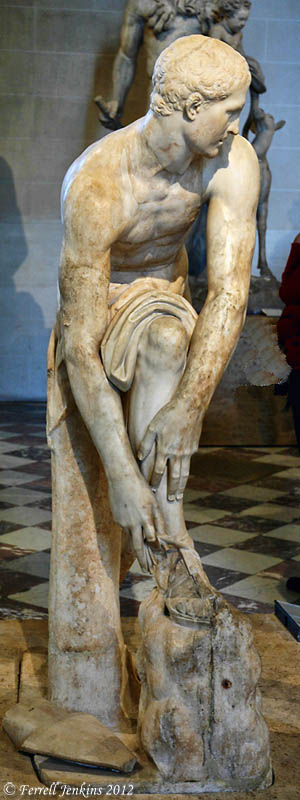
Paul was called Hermes because he was the chief speaker. Hermes was the messenger of the gods. How appropriate that our word hermeneutics, coming from the name Hermes, is used to describe the important work of interpreting the Scriptures. I have heard some speakers make fun of the word and then proceed to say that a certain phrase in the Scripture means … ! The photo below shows Hermes tying on his sandal in preparation for delivering a message. Some may recognize Hermes as the Latin Mercury, who is used as the symbol for the floral industry.

Image

The King James Version used the Latin terms Jupiter and Mercurius in Acts 14:12. Bruce says this is “due to an old and foolish fashion of replacing Greek proper names by their Latin equivalents in English translations from the Greek.”

This post is reprinted from December 1, 2011, with improved photos.