Category Archives: Travel

The Pools of Solomon

It is a fact that numerous structures in Israel are incorrectly identified. Earlier travelers may have asked where this or that biblical event took place. There was always someone willing to show them what they wanted to see. Some items that come to mind include the Tower of David and Solomon’s Stables in Jerusalem, Ahab’s Palace at Jezreel, and Solomon’s Pools southwest of Bethlehem.

In the earliest days of my tours we were able to visit Solomon’s Pools as we traveled between Bethlehem and Hebron. In more recent years the Pools have been in the Palestinian Authority’s West Bank. This means going to Bethlehem and then making arrangement to visit the pools.

Solomon, who ruled about 970–931 B.C., is said to have developed vineyards, gardens, and pools.

I made great works. I built houses and planted vineyards for myself. I made myself gardens and parks, and planted in them all kinds of fruit trees. I made myself pools from which to water the forest of growing trees. (Ecclesiastes 2:4-6 ESV)

These pools do not belong to the time of Solomon. It may be legendary, but Josephus says that Solomon used to ride upon a chariot to a place called Etham (Etam). This area is described as “very pleasant in its fine gardens, and abounding in rivulets of water; he used to go there in the morning sitting high in his chariot” (Antiquities 8:186).

One of the earliest projects conducted by Amihai Mazar, in 1968, was a survey of the 70 kilometers of aqueducts. He wanted to see how accurate Conrad Schick has been in his 19th century surveys.

Several springs feed into the “pools of Solomon” from the south through two aqueducts. From the western pool a high level aqueduct carried water to the Upper City of Jerusalem. From the easternmost pool a low level aqueduct carried water to the Temple Mount.

One of the earliest projects conducted by Amihai Mazar, now Professor Emeritus at Hebrew University, in 1968 was a survey of 70 kilometers of aqueducts. He wanted to see how accurate Conrad Schick had been in his surveys in the 19th century. He says the pools,

must date to the Hasmonean period, perhaps to Alexander Jannaeus [126 B.C.–76 B.C.]. We don’t have any written sources, and there is no objective archaeological data for dating them. But we base our assumption on the fact that in the Mishnah the aqueducts are referred to and are very important for ritual purposes on the Temple Mount. (BAR, 10:3, May/June 1984).

Mazar’s study of “The Aqueducts of Jerusalem” is published in Jerusalem Revealed: Archaeology in the Holy City 1968–1974. 79-84.

Our first photo shows the highest of the pools which I am calling the western pool.
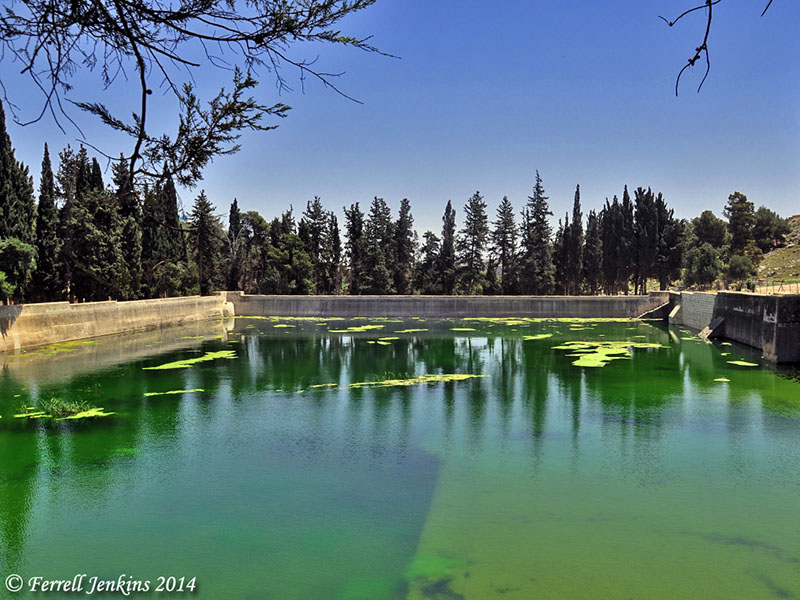
The western most pool. View east. Photo by Ferrell Jenkins.

The western pool. View east. Photo by Ferrell Jenkins.

The middle pool is shown here with a view to the northwest. You can see the higher hills in the break between the trees.
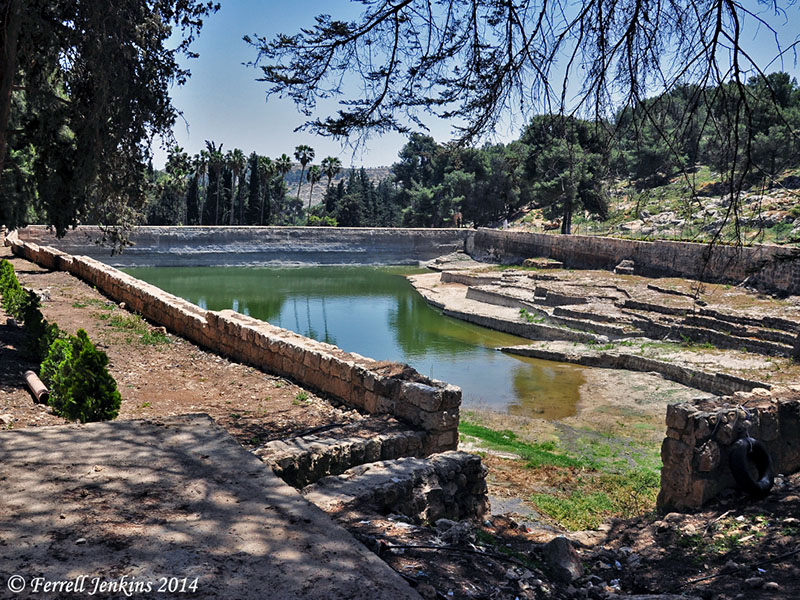
The middle pool. View west. Photo by Ferrell Jenkins.

The middle pool. View northwest. Photo by Ferrell Jenkins.

The third pool (eastern) is shown below with a view toward the west.

The eastern pool. View west. Photo by Ferrell Jenkins.

The eastern pool. View west. Photo by Ferrell Jenkins.

A recent study of “Jerusalem’s Ancient Aqueduct System” by Tom Powers is available for download at his website here. This article can be helpful for those who wish to know more about the subject.

Jerome Murphy-O’Connor has a few pages devoted to Solomon’s Pools, including the aqueduct system, in The Holy Land (483-486).

Within the past few weeks there has been some information, and some unfounded speculation, about a water system found at ‘Ain Joweizeh. Todd Bolen describes the location of the site:

The site is located 5.5 miles (9 km) southwest of the Old City of  Jerusalem, 3.5 miles (5.5 km) northwest of Bethlehem, and just down the slope to the west of Har Gilo.

Bolen has a good summary of what we know about this water system (“Royal Water System Excavated in Judean Hills”) in a recent post here.

BAR’s Bible History Daily includes photos of the Proto-Aeolic Capital associated with the recently discovered tunnel here.
Visualizing Isaiah: a booth in a vineyard

Because the events of the Bible took place in the Ancient Near East, we expect it to use illustrations from that world. Many of these cultural practices are different from those we know, but others are similar.

The prophet Isaiah describes what will happen to Jerusalem as a result of their sin.

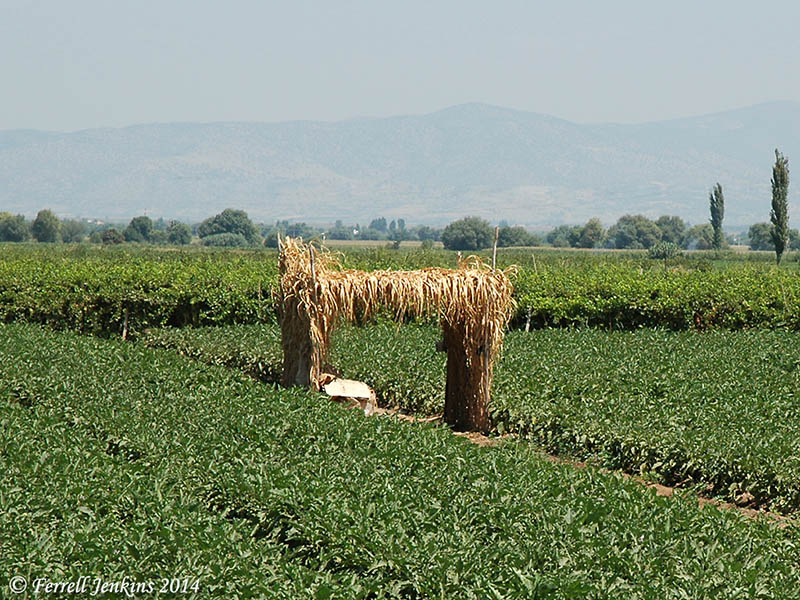
And the daughter of Zion is left like a booth in a vineyard, like a lodge in a cucumber field, like a besieged city. (Isaiah 1:8 ESV)

Almost everyone has seen a fruit or vegetable booth along a highway during the picking season. Months later we may see that same booth in disrepair. In Biblical times, watchtowers and temporary booths were set up in fields to provide a moment of shade for the workers.

Our photo today was made a few miles east of Sardis (Revelation 3:1) in modern Turkey. It is near a vineyard and set amidst another crop. One can easily image it still standing in disarray when the winter rains come.

A booth in the field, east of Sardis. Photo by Ferrell Jenkins.

A temporary booth in the field, east of Sardis. Photo by Ferrell Jenkins.

The Judeans of the 8th century B.C. could easily visualize what Isaiah was describing, and those who were living when the city was destroyed by the Babylonians would see it as a fact.

Jeremiah’s lament over the city after 586 B.C. illustrates the point:

How lonely sits the city that was full of people! How like a widow has she become, she who was great among the nations! She who was a princess among the provinces has become a slave. (Lamentations 1:1 ESV)

Ancient sunken treasure returned to Israel Antiquities Authority

It really happened. A lady in Poriya Illit, a village a short distance from the western shore of the southern tip of the Sea of Galilee, called the Israel Antiquities Authority. She told them that a now-deceased family member had “fished” some treasures from the Mediterranean. It was packed in her basement, but she wanted it to be in a museum so her grandchildren would be able to see it in due time. The information below comes from an article by Roz Wolberger in The Jerusalem Post Online Edition here.

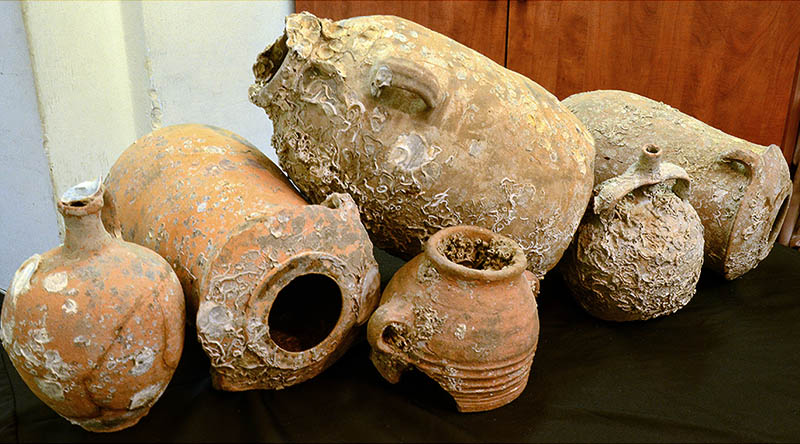
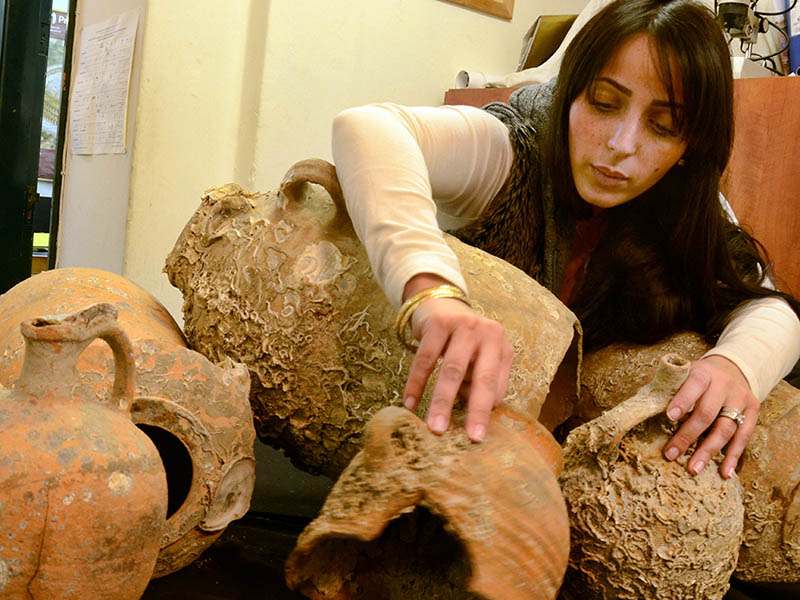
Soon after the phone call, two archaeologists from the IAA arrived at Lester’s Galilee home and were amazed to see the extent of the treasure: wrapped in cloth and stacked in boxes were a large number of whole pottery vessels, clearly very ancient and rare. The surface of the vases were encrusted with sea shells and other ocean sediments, including the occasional fossil. Most of the pieces were fully intact, and the rest were in large fragments, neatly wrapped in fabric.

The cache of artifacts came from a wide variety of periods.

An especially beautiful vase with a tall frame and high handles was immediately recognized as being from the time of the Biblical period, about 3000 years ago. Another remarkable piece was reported to be from the Roman period, some 2000 years ago, and yet another round urn was dated to the Byzantine period, about 1500 years ago

Sunken treasure from the Mediterranean. Photo: Israel Antiquities Authority

Sunken treasure from the Mediterranean. Photo: Israel Antiquities Authority

I think the vase with “a tall frame and high handles” is the second from the right in both photos. My guess is that the lady in the photo above is with the IAA.

Sunken treasure from the Mediterranean. Photo: Israel Antiquities Authority

Sunken treasure from the Mediterranean. Photo: Israel Antiquities Authority

HT: Joseph Lauer

Church History book available for Kindle

Do you have a good book on Church History? I have observed that many church members are generally ignorant of church history. A few months ago I learned that two books by Zondervan were to be available in Kindle format for $3.99 each. The second volume in the series was available, but there was some delay in getting the first volume online. Volume two is available today for $3.99. For how long I do not know.

51YVjpXge3L

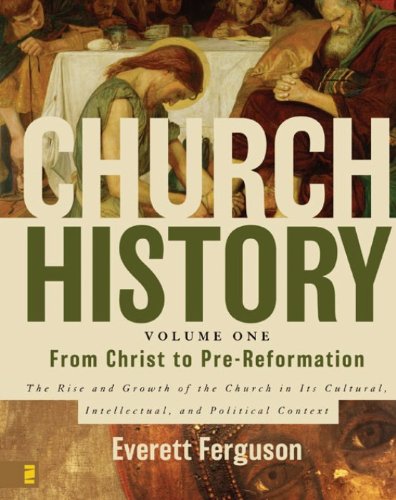
Everett Ferguson’s Church History ,Volume One: From Christ to Pre-Reformation: The Rise and Growth of the Church in Its Cultural, Intellectual, and Political Context: 1, is currently available for the Kindle for $3.99. The regular price for the Kindle edition is $44.99. This book begins with the historical setting for the coming of Christ and the establishment of the church. It ends at about 1300 A.D.
Ferguson is widely respected as a scholar in early church history. With a Ph.D. from Harvard, he is professor emeritus of Bible and distinguished scholar-in-residence at Abilene Christian University. He is author of several books on early Christianity.

An eBook like this could be helpful for travelers visiting the Bible lands. In Turkey, for example, one sees the development of the Church Councils. In Italy there is the rise of the papacy and Catholicism. The Crusades involved numerous countries, including Israel. Sections on monasticism and the rise of Islam can be helpful as well. Ferguson also covers the “Dark Ages” and sets the stage for the earliest Reformation efforts.

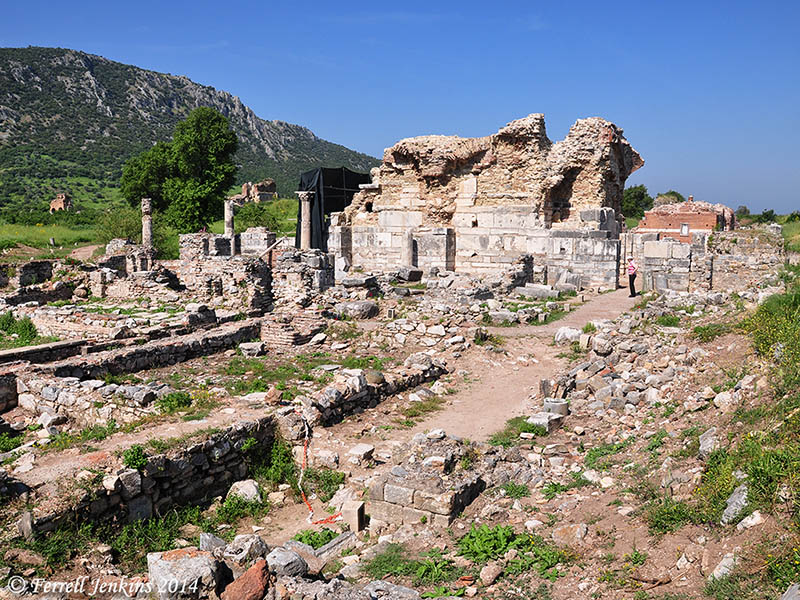
Our photo shows ruins of The Church of Mary, also called the Church Council Church, at Ephesus. In A.D. 431 the Council of Ephesus was conducted here.

Church Council Church at Ephesus. Photo by Ferrell Jenkins.

Church of Mary (Church Council Church) at Ephesus. Photo by Ferrell Jenkins.

HT: Brooks Cochran

Children in the Marketplaces

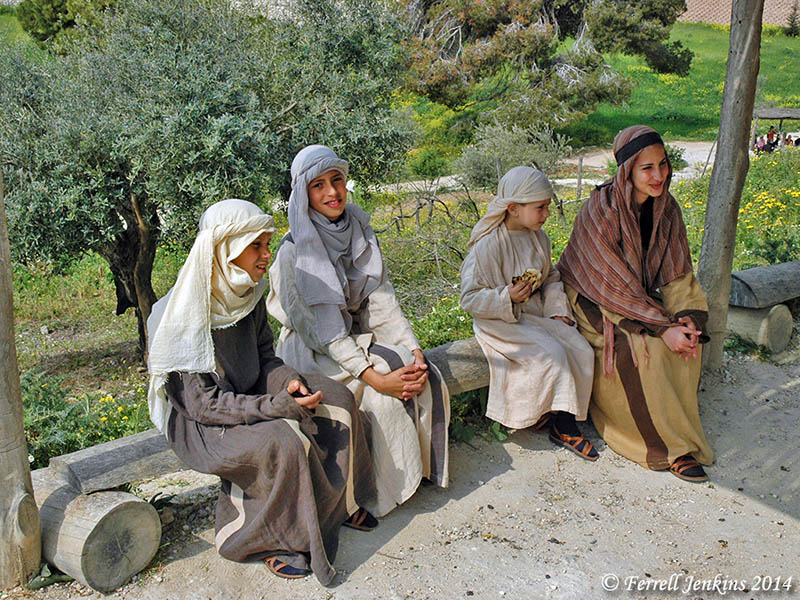
To those dissatisfied with both Jesus and John the Baptist, Jesus used a simple illustration that must have happened many times in each city of ancient Israel.

“But to what shall I compare this generation? It is like children sitting in the marketplaces and calling to their playmates, “‘We played the flute for you, and you did not dance; we sang a dirge, and you did not mourn.’ For John came neither eating nor drinking, and they say, ‘He has a demon.’ The Son of Man came eating and drinking, and they say, ‘Look at him! A glutton and a drunkard, a friend of tax collectors and sinners!’ Yet wisdom is justified by her deeds.” (Matthew 11:16-19 ESV; see also Luke 7:31-34) Some English versions use market places).

Keener, in The IVP Bible Background Commentary: New Testament, explains:

Spoiled children who pretend to have weddings and funerals (one later game was called “bury the grasshopper”) stand for Jesus’ and John’s dissatisfied opponents; dissatisfied with other children who will not play either game, they are sad no matter what. The term for “mourn” here is “beat the breast,” a standard mourning custom in Jewish Palestine. Custom mandated that bystanders join in any bridal or funeral processions.

This photograph made at Nazareth Village helps to illustrate the Biblical text.

Children at Nazareth Village. Photo by Ferrell Jenkins.

Children at Nazareth Village. Photo by Ferrell Jenkins.

Archaeological Conferences in Houston

The Dunham Bible Museum at Houston Baptist University will host an Archaeological Conference devoted to Khirbet el-Maqatir, proposed site for Biblical Ai, Saturday, February 8, 2014. Speakers include Dr. Bryant Wood, Dr. Eugene Merrill, Dr. Scott Stripling, and Dr. Leen Ritmeyer.

Information about the conference and registration details may be found here.

From January 21 – December 19, 2014, the Dunham Bible Museum will display a special exhibit, Khirbet el-Maqatir – History of a Biblical Site. This is in cooperation with the Associates for Biblical Research. Details here.

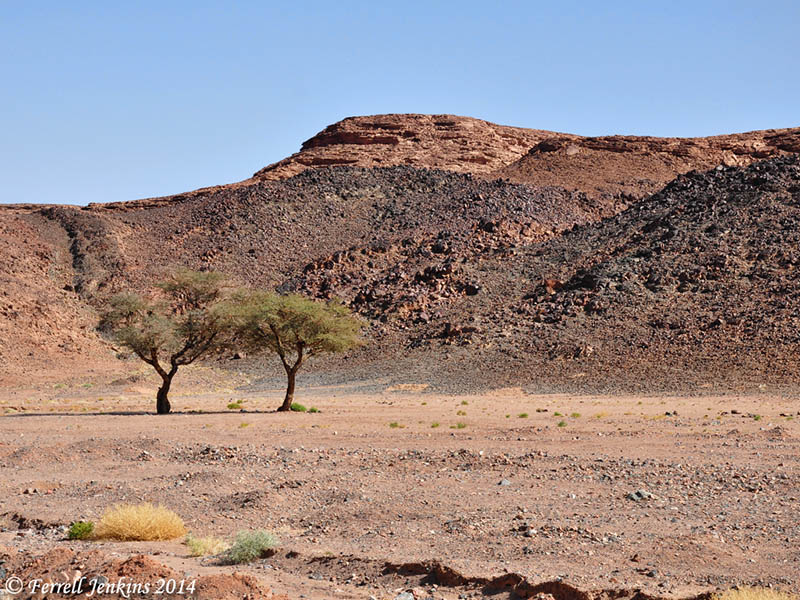
A scene in the eastern Sinai wilderness. Photo by Ferrell Jenkins.

A scene in the eastern Sinai wilderness. Photo by Ferrell Jenkins.

The Lanier Theological Library announces a lecture by James Hoffmeier and Stephen Moshier dealing with the exodus and the location of Mount Sinai. The titles for the January 18th lecture are,

  • Moses Did Not Sleep Here!
  • A Critical Look at Some Sensational Exodus and Mt. Sinai Theories

Registration information is here. (HT: Bible Places Blog).

The lectures by Hoffmeier and Moshier are the climax of a two day Consultation on the Historicity and Authenticity of the Exodus and Wilderness Traditions in a Post Modern Age. Details here.

Speakers include Richard Hess, Steven Ortiz, Alan Millard, Richard Averbeck, Lawson Youngers, Jr., and others.

Hiking Abraham’s footsteps

The full title of this Haaretz article is “Hiking in Abraham’s footsteps, from Turkey to the Holy Land.” Sounds incredible at the moment. To hike this complete trail from Haran (Genesis 12:4) to Beersheba (Genesis 21:31) (not to mention the trip to Egypt) requires travel in Turkey, Syria, Jordan, Israel, and the Palestinian Authority (West Bank).

Among the leaders back of the concept is David Landis and his wife Anna Dintaman, developers of the Jesus Trail from Nazareth to the Sea of Galilee. Their book, Hiking the Jesus Trail and Other Biblical Walks in the Galilee, is worthwhile even for those who do not plan to walk the trail.
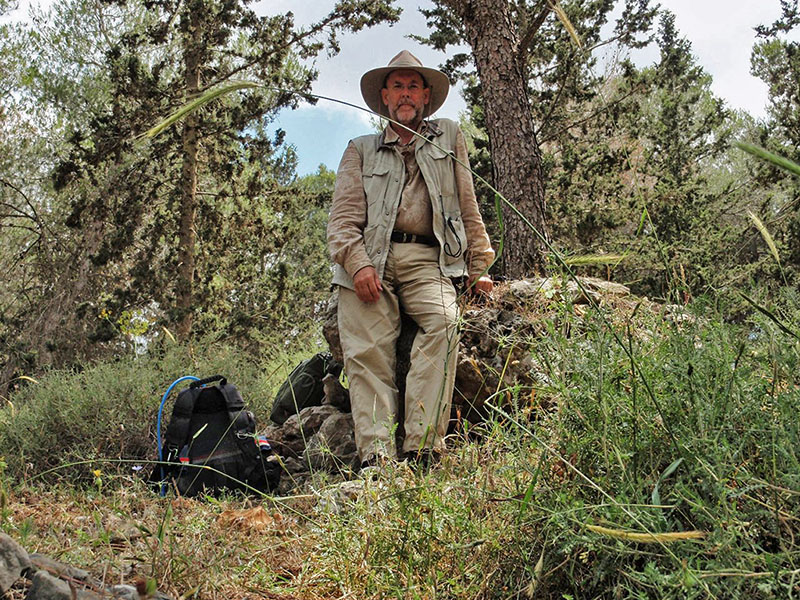
Larry Haverstock walked the Jesus Trail in 2011. I see that Larry’s posts about the experience is still available on his blog. See the 3rd Journey. You will find some fascinating stories along with beautiful photos you may never see from a bus or car.

Larry Haverstock in the Zippori Forest north of Nazareth.

Larry Haverstock in the Zippori Forest north of Nazareth.

The link to the Haaretz article may be accessed here. In order to read the full article you must register for free access to 10 articles a month.

Don’t expect to walk the Abraham Path from Haran (in Turkey) to Beersheva [Beersheba], but you might be able to walk small portions of the trail everywhere except the part going through Syria.

There are many hiking trails in Israel, but most of these avoid contact with the Palestinian Authority. The new plan seeks to involve the local people in the development of facilities useful to hikers.

If you like hiking, or if you appreciate the geography of the Bible lands you will probably enjoy the article. Abraham Path has a nice web site with maps and photos here.

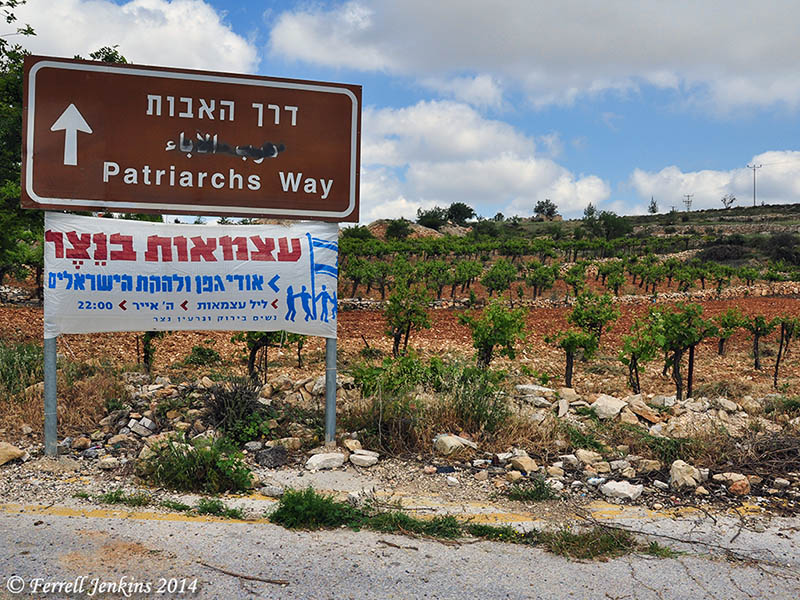
I don’t know what, if any, relationship there is between the Abraham  Path and the Patriarchs Way, a trail that is said to run from Beersheba to Nazareth. The defacing of the sign to eradicate the Arabic indicates one of the problems either trail might face. One often sees this sort of thing on signs pointing to Christian sites.

Sign pointing to Patriarchs Way off Hebron Road (Hwy. 60) south of Bethlehem . Photo by Ferrell Jenkins.

Sign pointing to Patriarchs Way off Hebron Road (Hwy. 60) south of Bethlehem . Photo by Ferrell Jenkins.

Walk the Land : A Journey on Foot through Israel, by Judith Galblum Pex, is a fascinating account of a couple who walked the Israel Trail from Eilat to Dan.
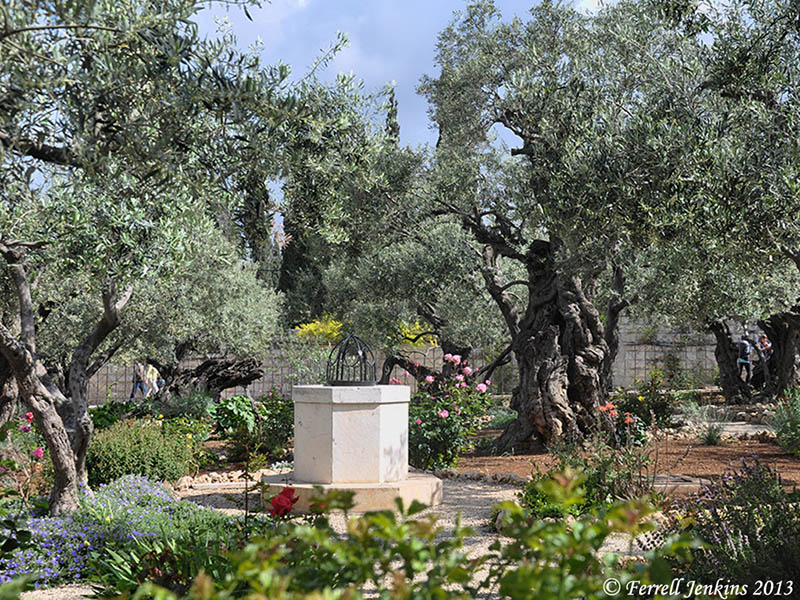
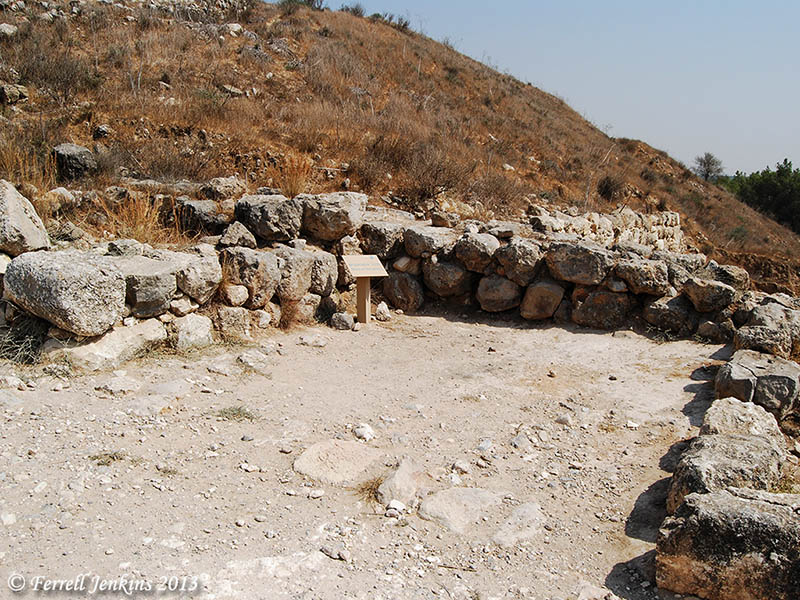
Photo of the year 2013 – Gethsemane

As we approached the end of the year 2013 I began to think of the wonderful places I visited and the photos I made. What photo stands out as the “photo of the year”? I have some unique photos, and I have other photos from places I have photographed many times. I won’t say that this is the best photo I made during the year, but it is one with great meaning to multitudes of Christians.

This photo that I wish to share with you is of the traditional Garden of Gethsemane. One thing is for sure. If the “place” mentioned in the New Testament is not here, it could not have been very far away.

Gethsemane is a place well known in the minds of Christians, for according to the Gospels it was there that Jesus prayed alone to the Father before his arrest and trial. The word Gethsemane means oil-press. It is the name of an olive orchard on the Mount of Olives. Not many olive trees remain on the mountain originally named for them. This photo was made in the modern Garden at the Church of All Nations.

As a gift to our faithful readers I want to share a hi-res image suitable for teaching and preaching presentations. Click here for the larger image.

A place called Gethsemane. Photo by Ferrell Jenkins, 2013.

Mark’s account of Jesus’ visit to Gethsemane begins this way:

And they went to a place called Gethsemane. And he said to his disciples, “Sit here while I pray.” And he took with him Peter and James and John, and began to be greatly distressed and troubled. And he said to them, “My soul is very sorrowful, even to death. Remain here and watch.” And going a little farther, he fell on the ground and prayed that, if it were possible, the hour might pass from him. (Mark 14:32-35 ESV)

Read the following verses for the complete story.

I visited several places in 2013 that I have not yet written about. Hopefully I will be able to get to some of these in the following months.

The Lachish letters (ostraca)

The first major archaeological excavation at Tell ed-Duweir (= Tel Lachish) was called the Wellcome-Marston Archaeological Research Expedition, directed by James Leslie Starkey. During that expedition, in 1935 eighteen pieces of broken pottery with writing were found in a room outside the city gate. Three more pieces were found in 1938. J. A. Thompson explains the importance of the letters:

They represent correspondence between the military commander of Lachish, a certain Yoash, and outpost commanders, in the days when Nebuchadnezzar was closing in on Jerusalem. Most of these letters are poorly preserved, but six of them give useful information about the time. (The New International Dictionary of Biblical Archaeology)

The room outside the gate where the "letters" were found. Photo by Ferrell Jenkins.

The room outside the gate where the “letters” were found. Photo by Ferrell Jenkins.

Jerusalem was destroyed by the Babylonians in 586 B.C. These letters were written shortly before that time and were in the room at the time of the destruction of Lachish. Take a look at the biblical evidence. The prophet Jeremiah describes a time when only the Judean cities of Lachish and Azekah were left.

when the army of the king of Babylon was fighting against Jerusalem and against all the cities of Judah that were left, Lachish and Azekah, for these were the only fortified cities of Judah that remained. (Jeremiah 34:7 ESV)

Lachish Letter #4 indicates that only Lachish was left at the time of writing.

“And let (my lord) know that we are watching for *[fire] signals of Lachish, according to all the indications which my lord hath given, for we cannot see Azekah” (Pritchard, The Ancient Near East).

Letter #3 mentions a prophet.

And as for the letter of Tobiah, servant of the king, which came to Shallum son of Jaddua through the prophet, saying, ‘Beware!, thy servant hath sent it to my lord. (Pritchard, The Ancient Near East)

D. Winton Thomas says that this is “the first occurrence in non-Biblical texts of the common Hebrew word for prophet (nabi).”

One of the Lachish letters displayed in the British Museum.

Lachish Ostracon II displayed in the British Museum. The word “Yahweh” [yhwh] is used as the first word (on right) of line 2 in this letter.

The prophet Jeremiah may not be the prophet mentioned in Letter #3, but he was a prophet in Judah at the same time, and he wrote about the same situation. Notice Jeremiah 34:6-7 again.

Then Jeremiah the prophet spoke all these words to Zedekiah king of Judah, in Jerusalem, when the army of the king of Babylon was fighting against Jerusalem and against all the cities of Judah that were left, Lachish and Azekah, for these were the only fortified cities of Judah that remained. (Jeremiah 34:6-7 ESV)

This example provides wonderful corroborating evidence for the historical trustworthiness of the writing of Jeremiah.

Visiting the shepherd’s fields near Bethlehem

After the birth of Jesus in Bethlehem, Luke records that an announcement of His birth was made to shepherds in the field at night.

And in the same region there were shepherds out in the field, keeping watch over their flock by night. And an angel of the Lord appeared to them, and the glory of the Lord shone around them, and they were filled with great fear. And the angel said to them, “Fear not, for behold, I bring you good news of great joy that will be for all the people. For unto you is born this day in the city of David a Savior, who is Christ the Lord. (Luke 2:8-11 ESV)

There was enough distance that the shepherds said, “Let us go over to Bethlehem and see this thing that has happened, which the Lord has made known to us.” (Luke 2:15 ESV)

We do not know the exact time of the birth of Jesus. We have a reasonable degree of certitude about the place of His birth, but places such as the field of the shepherds are not certain. As a result, traditions have risen about the place. Here I will mention three places that one can visit a short distance east of Bethlehem, near the wilderness of Judea. This area is known as Beit Sahour.

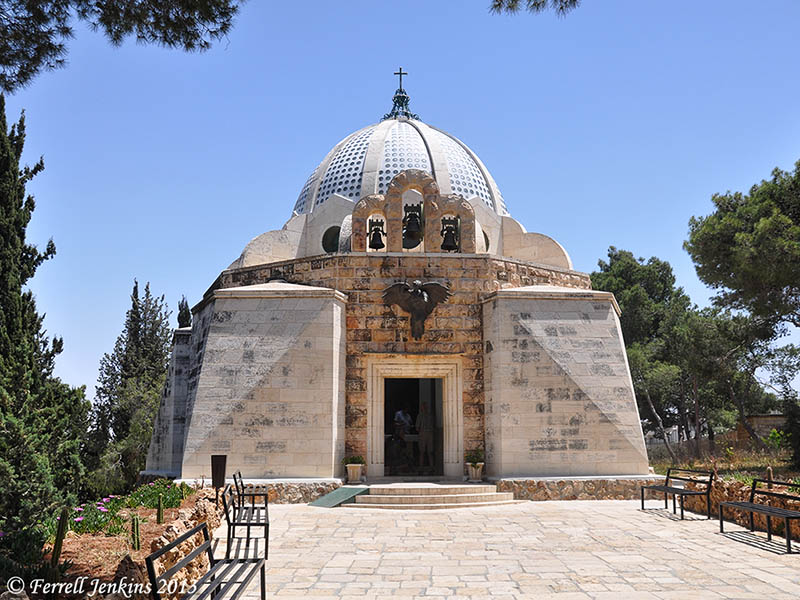
The first place is the Shepherd’s Field of the Franciscan Custody of the Holy Land (a Roman Catholic site). The photo shows the modern church built over a cave.

The Shepherd's Field of the Franciscan Custody of the Holy Land. Photo by Ferrell Jenkins.

The Shepherd’s Field of the Franciscan Custody of the Holy Land. Photo: F. Jenkins,

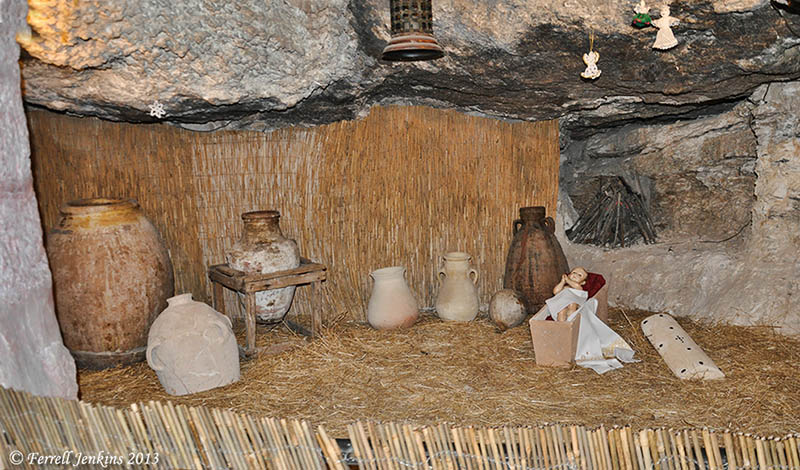
Under the church there is a large cave. These caves are not uncommon in the central mountain range. A display illustrating the birth of Jesus can be seen in the cave. One little note of interest. It is often pointed out that the manger of Luke 2:7 might be a feeding trough cut from stone. In this display the baby is placed in an ossuary! Notice the lid to the right.

Display in cave at Shepherd's Field. Photo by Ferrell Jenkins.

Display in cave at Shepherd’s Field. Photo by Ferrell Jenkins.

Outside one sees fields and olive groves.

Shepherd's fields at Beit Sahour. Photo by Ferrell Jenkins

Shepherd’s fields at Beit Sahour. Photo by Ferrell Jenkins.

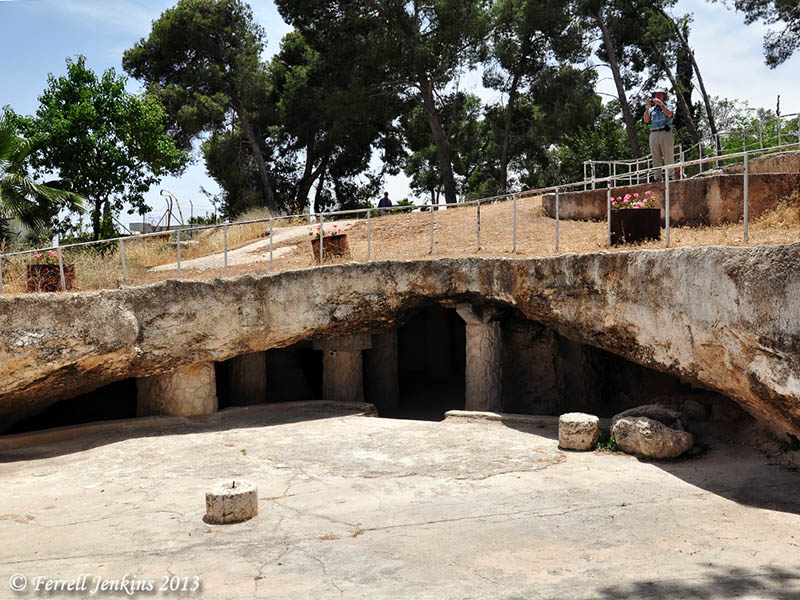
Not far away is the Shepherd’s Field of the YMCA. Some call it the Protestant Shepherd’s Field. There is a large cave on the property overlooking the fields of the region.

Caves at YMCA Shepherd's Field. Photo by Ferrell Jenkins.

Caves at YMCA Shepherd’s Field. Photo by Ferrell Jenkins.

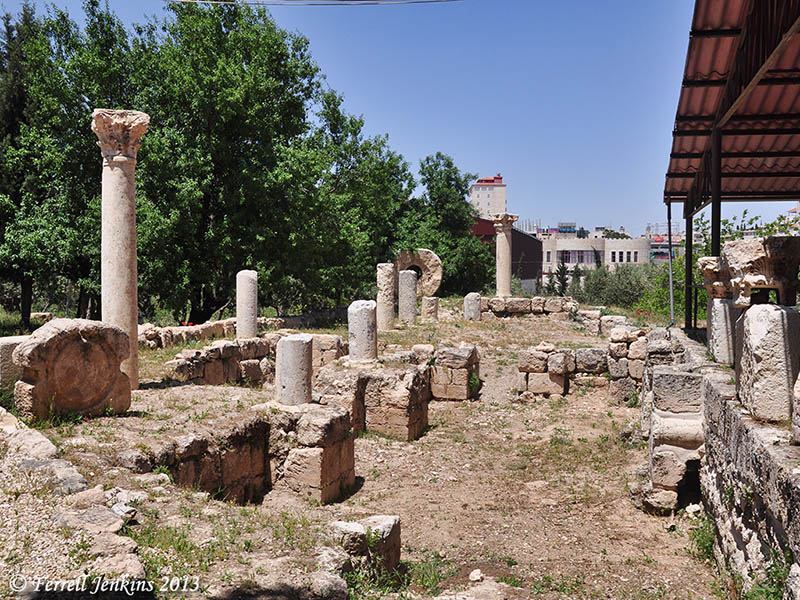
The Greek Orthodox site features ruins of a Byzantine church dating from the 5-7th centuries.

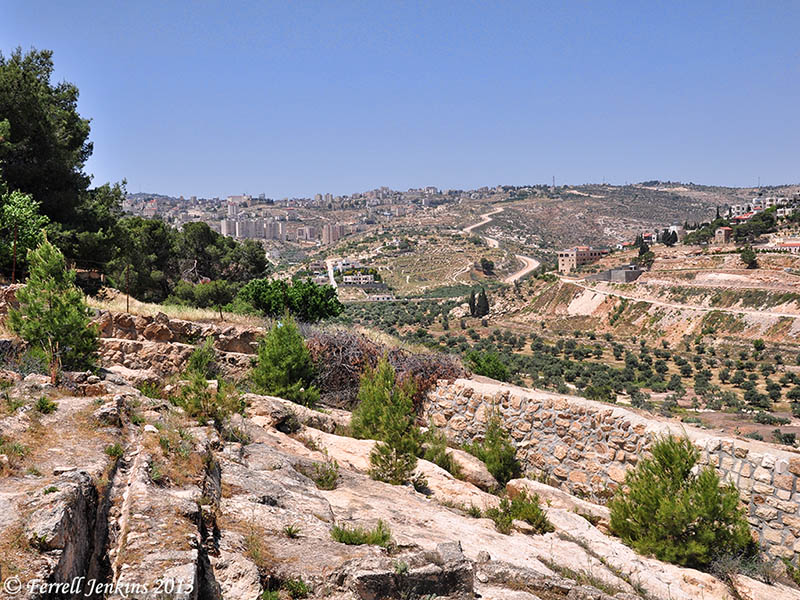
Byzantine church ruins at the Greek Orthodox site of the Shepherd's field. Photo by Ferrell Jenkins.

Byzantine church ruins at the Greek Orthodox site. Photo by Ferrell Jenkins.

Carl Rasmussen wrote about the “3 Christmases in Bethlehem” here, and Mark Ziese wrote about the Milk Grotto here. We have written about the Church of the Nativity several times, including here.