Category Archives: Travel

A visit to the Siegfried H. Horn Museum

Andrews University in Berrien Springs, Michigan, has long been associated with archaeological work, especially in Jordan. This work is carried out under the name of the Institute of Archaeology.

The interesting history of the Siegfried H. Horn Museum may be read here. The name of Siegfried H. Horn is well known to anyone who had read about biblical archaeology in modern times.

Last week I was at Valparaiso, Indiana, presenting a series of lessons on Bible History and Archaeology. I had long wanted to visit the Horn Archaeological Museum. When we learned that we were slightly more than an hour away, Mark Russell, Steve Wolfgang and I made the trip one morning. The Museum is hopeful of moving into a new facility as soon as the project can be funded. At this time the small museum is open only on Saturday afternoon, but they will open by appointment, as they did for us.

The Siegfried H. Horn Archaeological Museum houses over 8,500 artifacts, but only a small portion of those are on display. There are replicas of a few famous artifacts such as the Black Obelisk of Shalmannessar II and the Moabite Stone

There are significant original pieces from most areas of the Bible world with Mesopotamia and Transjordan being featured. There is a mummified Ibis from Egypt. The Egyptian god Thoth was portrayed with the head of an Ibis. I never see representations of these gods without thinking of Paul’s description of the Roman world prior to the coming of Christ.

Claiming to be wise, they became fools, and exchanged the glory of the immortal God for images resembling mortal man and birds and animals and creeping things. (Romans 1:22-23 ESV)
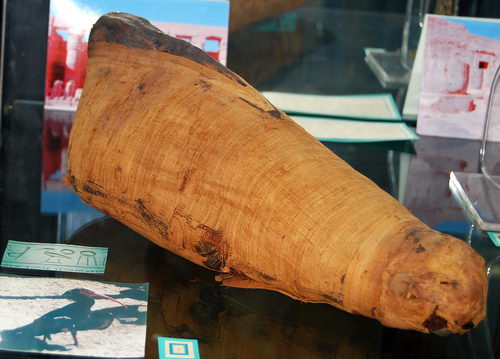
Mummfied Ibis from Egypt. Photo by Ferrell Jenkins.

Mummified Ibis from Egypt. Photo by Ferrell Jenkins.

In the main exhibit hall there is a life-size Bedouin tent. This makes a good background for explaining patriarchal life.
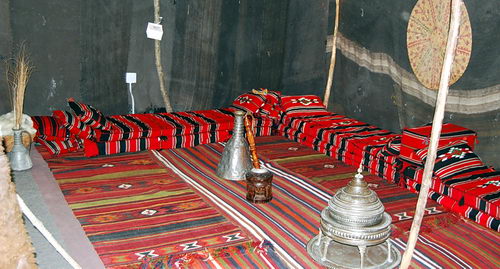
Authentic Bedouin Tent at Horn Museum. Photo by Ferrell Jenkins.

Authentic Bedouin Tent at Horn Museum. Photo by Ferrell Jenkins.

By faith Abraham obeyed when he was called to go out to a place that he was to receive as an inheritance. And he went out, not knowing where he was going. By faith he went to live in the land of promise, as in a foreign land, living in tents with Isaac and Jacob, heirs with him of the same promise. For he was looking forward to the city that has foundations, whose designer and builder is God. (Hebrews 11:8-10 ESV)

Two other things should be mentioned. There are some wonderful models. One that impressed me was of the Roman rolling-stone tomb at Heshbon. The murals covering biblical and modern church history are impressive.

I recommend that anyone traveling in the vicinity of Berrien Springs, or those living within driving distance, take advantage of this opportunity to visit. Bible class teachers would do well to become familiar with this Museum and arrange for their students to see it.

Our thanks to Jody Washburn, an Administrative Assistant at the Institute of Archaeology, for her help in making our visit pleasant.
Bronze Age gate at Dan opened

Ha’aretz announces the opening of the Bronze Age gate at Dan after restoration.

The Nature and National Parks Protection Authority yesterday opened “Abraham’s Gate” at Tel Dan in the north, for visits by the public.

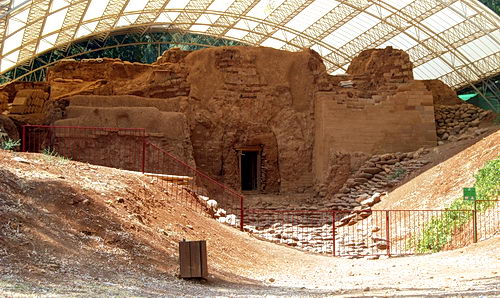
The ancient structure from the Canaanite period of the Bronze Age is made of mud and is thought to have been built around 1750 B.C.E. The authority named the archaeological site for Abraham, the first patriarch of the Jewish people, indicating that it dates from the period of Abraham.

The gate was uncovered in 1979 but more recently underwent restoration. It is composed of three arches and constructed of sun-dried mud brick on a foundation of large basalt stones. The gate, which in ancient times stood seven meters tall, has been restored to its original height. It features two towers and a horizontal structure linking them below the arches, the oldest arches ever found in the Land of Israel.

Read the full article here.

This photo shows the condition of the gate August 31, 2008. I don’t know what has been done to “open” the gate to the public.

Bronze age gate at Dan. Photo by Ferrell Jenkins.

Bronze age gate at Dan. Photo by Ferrell Jenkins.

This gate was dubbed “Abraham’s Gate” in the Ha’aretz headline. We have no way of knowing that Abraham saw this gate, but he might have. The Bible records that when the kings of the east took Lot captive, Abraham pursued them as far as Dan (Genesis 14:14).

HT: Joseph I. Lauer

Mount Hor

The Scripture records that Aaron was buried on Mount Hor (Numbers 20:25-29). We wrote about this here. A few interesting questions have been left in a comment. I am away from home for the week and do not have access to all the materials I might check, but here is a brief response.

1. How long would it take to walk unaided up Mt. Hor? Are there clearly marked-out historical trails?

Hikers make the trek. My recollection is that one should allow between a half and a full day for the trip up and down. A guide book such as Lonely Planet would surely answer this question. Perhaps some reader has made the climb and will tell us.

2. Do you know anything about the history of the Muslim shrine at the summit? I’m sure there have been quite a bit of academic research into this over the years, but I’m hoping for a simple answer about how reliable is this tradition about the exact location of Mt. Hor?

Not really. There are many “traditional” places identified by Jews, Christian, and Muslims, but a large number of them are without any historical foundation. Todd Bolen has this comment, along with a nice photo, at Bible Places.

In Bedouin tradition, Jebel Haroun is Mt. Hor where Moses’ brother Aaron was buried.  Most scholars reject this, locating Mt. Hor near Kadesh-barnea to the west.

I trust this will be helpful.

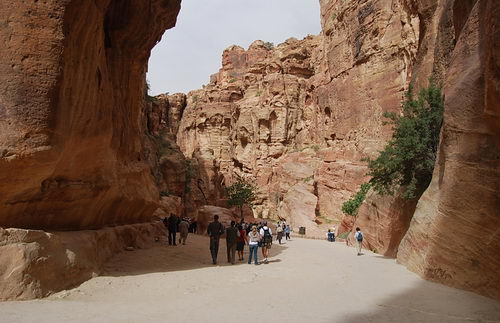
Here is a photo of the beginning of the Siq at Petra. Almost everyone likes to show the photos of the narrow part. It is beautiful, even from the beginning.

The beginning of the Siq at Petra. Photo by Ferrell Jenkins.

The beginning of the Siq at Petra. Photo by Ferrell Jenkins.

Ireland and St. Patrick

Thoughts turn toward the Emerald Isle on St. Patrick’s Day, especially for those with Irish roots. The truth about St. Patrick is shrouded in Irish mist. He is said to have brought Christianity to Ireland, perhaps in the latter part of the fifth century.

I do not celebrate St. Patrick’s day, but for whatever good he may have done I am thankful. I thought this would be a good opportunity to share a photo from Ireland with you.

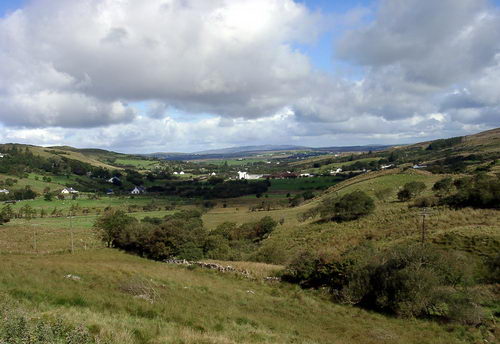
Ireland is a beautiful place to visit. The photo below of Finn Valley was made near Donegal Bay. The area is noted for beautiful hills, a magnificent coastline, majestic mountains, deep glens, and shimmering lakes.

Ireland's Finn Valley. Photo by Ferrell Jenkins.

Ireland's Finn Valley. Photo by Ferrell Jenkins.

One branch of my family came from County Wicklow on the south eastern side of the island.

Pigeons

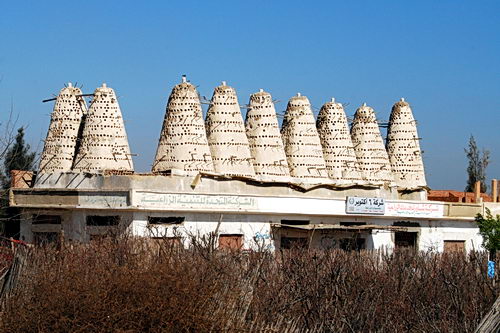
While traveling in Egypt we noticed pigeon roosts several places, but especially in the eastern Delta region (the biblical land of Goshen). The photo below was made along the desert road between Cairo and Alexandria.

Pigeons may serve many purposes: food, eggs, making fertilizer, message carriers, etc. Our guide explained that many people thought of the pigeon as an aphrodisiac.

Pigeon roosts near Alexandria, Egypt. Photo by Ferrell Jenkins.

Pigeon roosts near Alexandria, Egypt. Photo by Ferrell Jenkins.

Every reference to pigeons in the Bible is related to sacrifices. Most of the references are in Leviticus (1:14; 5:7, 11; 12:6, 8; 14:22, 30; 15:14, 29). Note two other references:

  • When the LORD made the land covenant with Abram at Shechem, He asked Abram to bring “a three year old heifer, and a three year old female goat, and a three year old ram, and a turtledove, and a young pigeon” (Genesis 15:9). The Hebrew word here is different. Fox, in The Five Books of Moses, uses the term fledgling.
  • Mary’s offering of purification in Jerusalem was “a pair of turtledoves or two young pigeons” (Luke 2:24).

Reminders of Patriarchal Life

The Bible paints a clear picture of the life of the patriarchs, especially Abraham, Isaac, and Jacob. Just type the words tent and tents in your computer Bible search engine. Here are a few things said about the biblical patriarchs. (You need to remove the hits referring to the “tent of meeting” or tabernacle.)

  • Lot and Abraham had flocks and herds and tents (Genesis 13:5).
  • Numerous references mention moving the tent (see Genesis 13:18).
  • Jacob was a peaceful man, living in tents (Genesis 25:27).
  • Even as late as the time of David many were living in tents (2 Samuel 18:17).

The writer of Hebrews describes the faith of Abraham this way:

By faith he lived as a foreigner in the promised land as though it were a foreign country, living in tents with Isaac and Jacob, who were fellow heirs of the same promise. (Hebrews 11:9)

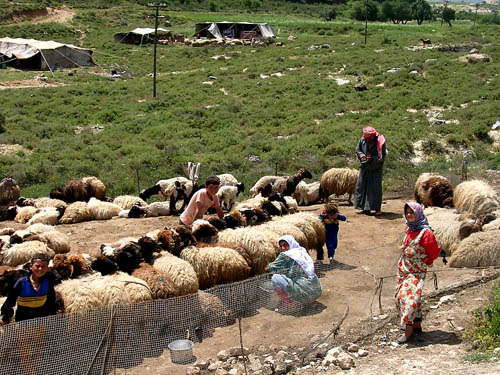
One of the values of travel to the lands of the Bible is to see many customs reminiscent of Bible times. In 2002 I spent nearly a week in Syria with a colleague visiting biblical and historical sites. North of Latakia, almost to the border with Turkey, we saw a settlement of what appeared to be at least three families living in tents. One man was clearly the “patriarch” of the group. Several women were busy working. One was milking the sheep. The tents were spread out over about an acre or more of land.

Shepherd settlement in northeastern Syria. Photo by Ferrell Jenkins.

Shepherd settlement in northeastern Syria. Photo by Ferrell Jenkins.

I think one could envision Abraham and his family in much the same way.

Riblah in the land of Hamath

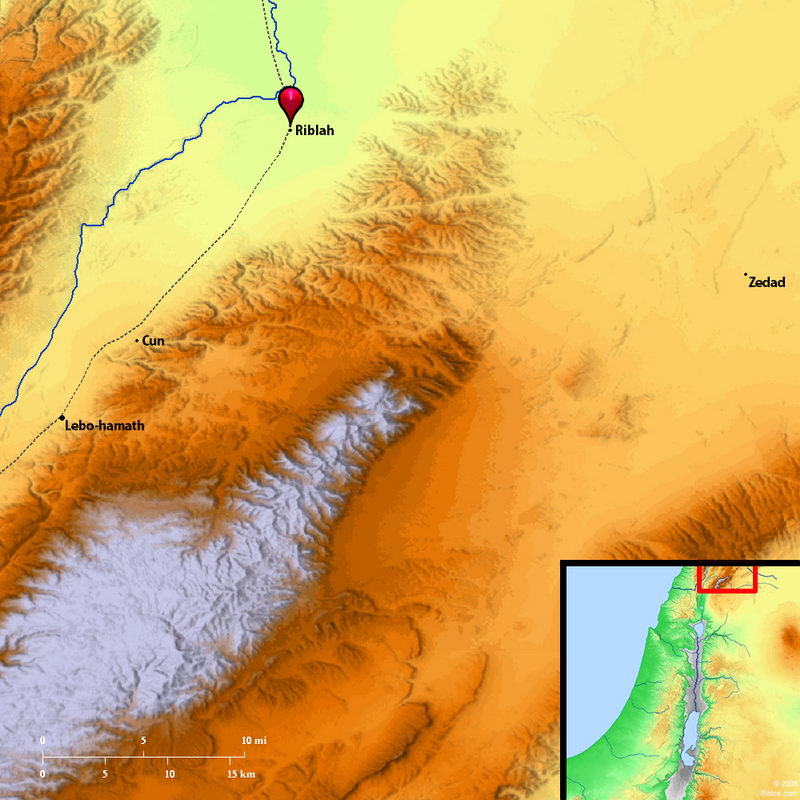
Riblah served as a base of operation for the Egyptian Pharaoh Necho and the Babylonian King Nebuchadnezzar. The city is located on a broad plain about 20 miles south of Hamath (modern Hama in Syria), on the main road between Egypt and Mesopotamia. The Orontes River flows past the site on the west side. On a modern map you will locate Riblah in Syria immediately north of the border with Lebanon.

There is little more than a “country store” at the site today, but the name Riblah is preserved as Ribleh, Syria.

Riblah in the land of Hamath. Courtesy BibleAtlas.org.

Riblah in the land of Hamath. Courtesy BibleAtlas.org.

  • Pharaoh Necho imprisoned Jehoahaz, king of Judah, at Riblah. He later took him to Egypt where he died. The date was about 609 B.C. (2 Kings 23:31-34).
  • Zedekiah, puppet king of Judah, tried to escape capture by the Babylonians. He fled Jerusalem but was captured on the plains of Jericho and brought to Riblah. There Nebuchadnezzar passed sentence on him. His sons were slaughtered in his sight and he was bound with brass fetters and taken to Babylon. The date was 586 B.C. (2 Kings 25:5-7; see also Jeremiah 39:5-6; 52:9-10).
  • The officials of Zedekiah were taken to Riblah where they were put to death (2 Kings 25:19-21; see also Jeremiah 52:26-27).

In 2002 a colleague and I spent several days visiting sites in Syria. Riblah was the most difficult to locate. Most folks, after seeing the site, would probably say, “What’s the big deal?”  Even though Riblah is mentioned only these few times in the Old Testament, it’s location makes it important in all movement between the south (Egypt and Israel) and Mesopotamia.

Riblah in the land of Hamath. Photo by Ferrell Jenkins.

Riblah in the land of Hamath. Photo by Ferrell Jenkins.

The slopes of this tell are now used as a cemetery. We know that this would make it difficult to negotiate rights to excavate.

Rainbow over the Dead Sea

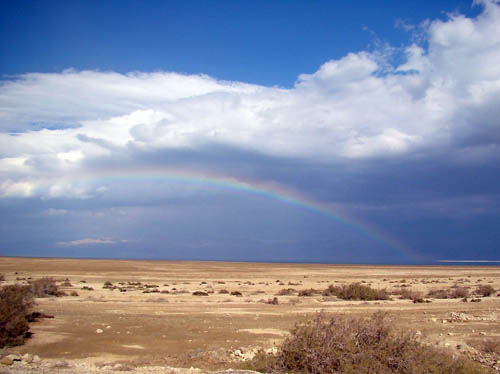
My friend Leon Mauldin is in Israel. He sent me a nice photo in which he captured a rainbow over the Dead Sea. I publish it here with his permission. This view looks east toward the Transjordan tableland. You can’t see the mountains because of the heavy clouds. To the far right of the photo you will see a glimmer of light on the surface of the Dead Sea.

Rainbow over the Dead Sea. Photo by Leon Mauldin.

Rainbow over the Dead Sea. Photo by Leon Mauldin.

The land in the foreground of the photo was covered by the water of the Dead Sea just forty years ago. With less water flowing into the Dead Sea the level has been declining over the past few decades.

The name Dead Sea is not used in the Bible. Rather, this body of water is called the Sea of the Arabah, the Salt Sea, or the Eastern Sea. The Bible describes the territory of the Transjordan tribes, Reuben and Gad, this way:

The Arabah and the Jordan River were also a border, from the sea of Chinnereth to the sea of the Arabah (that is, the Salt Sea), beneath the watershed of Pisgah to the east. (Deuteronomy 3:17).

Josepus called this body of water Lake Asphaltitis.

Refreshing Snow

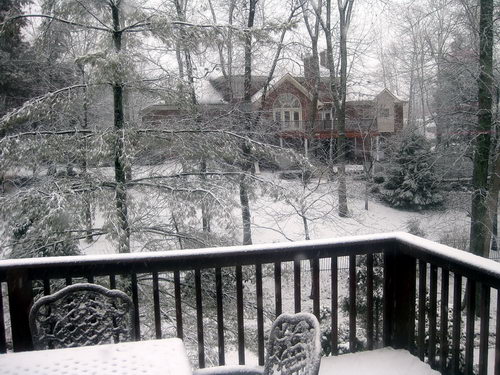
This afternoon when I arrived at the airport in Louisville, Kentucky, snow was beginning to fall. By the time I reached my destination on the eastern outskirts of the city with friends Boyd and Linda the snow was covering the ground.

Snow in Louisville. Photo by Ferrell Jenkins.

Snow in Louisville. Photo by Ferrell Jenkins.

It is certainly something I would not have seen in Florida.

Snow has a refreshing quality. The Wise Man said,

Like the cold of snow in the time of harvest Is a faithful messenger to those who send him, For he refreshes the soul of his masters. (Proverbs 25:13 NAS)


The traveler of Hierapolis

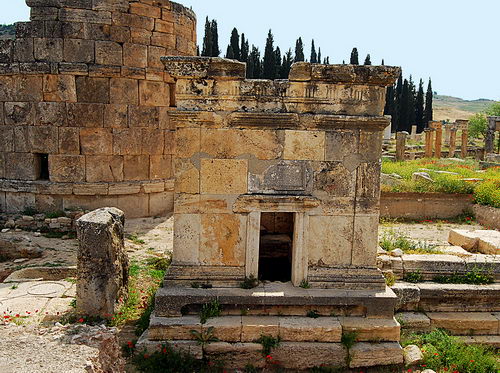
The tomb of a merchant named Flavius Zeuxis at Hierapolis is often called the “Traveler’s Tomb.” The marble inscription above the entrance states that he circumnavigated the southern cape of Peloponnesus 72 times on his way to Italy. It has been estimated that this would have amounted to about 150,000 miles.

The tomb of Flavius Zeuxis at Hierapolis. Photo by Ferrell Jenkins.

The tomb of Flavius Zeuxis at Hierapolis. Photo by Ferrell Jenkins.

This gentleman was roughly contemporary with the Apostle Paul, but he traveled more miles than Paul.

Paul spoke of the dangers associated with his many journeys.

I have been on journeys many times, in dangers from rivers, in dangers from robbers, in dangers from my own countrymen, in dangers from Gentiles, in dangers in the city, in dangers in the wilderness, in dangers at sea, in dangers from false brothers (2 Corinthians 11:26)