Category Archives: Travel

“Our IAA which art in Israel”

Tourist confesses to taking a stone from an Israel Antiquities Excavation 12 years ago.

Twelve years after a stone disappeared from an Israel Antiquities Authority Excavation south of the Temple Mount, a tourist from New York confessed: “I Took It. My Conscience Bothers Me and I Am Asking for Forgiveness” The stone, which weighs 21 kilo, was returned to Jerusalem this week.

Here is part of the account released by the IAA in Jerusalem.

In 1997, a twenty one kilogram fragment of a marble column disappeared from one of the excavations the Israel Antiquities Authority was conducting south of the Temple Mount.

Several weeks ago, the IAA received an unexpected e-mail from a clergyman in the state of New York: “I am requesting forgiveness for a member of my congregation”, he writes. “The fellow confessed to me that twelve years ago he took a stone from Jerusalem and his conscience has bothered him ever since. I wish to return the stone to Israel and hope that you will forgive the man for his transgression”.
A letter from the fellow was attached to the heavy stone fragment, which arrived in Jerusalem in a wooden crate that was specially constructed for the flight back to Israel. “I came to Israel on an organized trip. As a student of archaeology, I was very excited when we visited an excavation south of the Temple Mount. I asked how I can purchase a stone from the excavation because I wanted a souvenir with which to pray for Jerusalem and was told it was not possible. On the last day of the trip our Israeli tour guide approached me and took the stone fragment from inside his coat. ‘Take it’, he said. ‘It’s a present from me’. I asked him how he obtained the stone and he replied, ‘It’s okay; don’t worry’. I was very happy and took the stone with me on my flight back to New York. Only later did I realize that he probably took the stone from the excavation without permission. For the past twelve years since then, rather than remind me of the prayer for Jerusalem, I am reminded of the mistake I made when I removed the stone from its proper place in Israel. I am asking for your forgiveness”.

Shay Bar Tura displays the package and the returned stone. Photo by IAA.
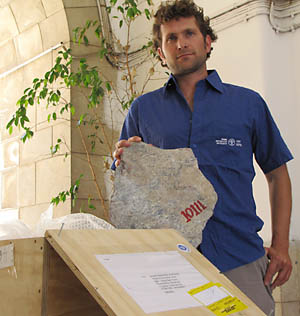
Shay Bar Tura displays the package and the returned stone. Photo by IAA.

Shay Bar Tura, Deputy Director of the Unit for the Prevention of Antiquities Robbery in the IAA, stated,

It should be emphasized that any activity conducted at an antiquity site requires permission from the IAA. Taking archaeological artifacts from antiquities sites constitutes a severe criminal offense which is punishable by law with imprisonment”.

Who was the tour guide?

HT: Joe Lauer
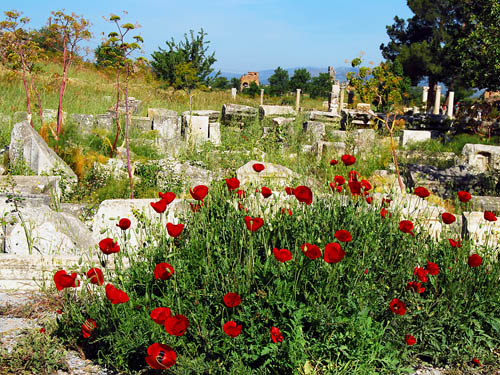
Paul in Ephesus

Paul taught in the school of Tyrannus during his stay in Ephesus. We need not think that Paul was assigned as an Associate Professor, or Lecturer. He may have simply used a rented facility or hall for his teaching.

But when some were becoming hardened and disobedient, speaking evil of the Way before the people, he withdrew from them and took away the disciples, reasoning daily in the school of Tyrannus. (Acts 19:9)

When we visit Ephesus today we see nothing but ruins and a few partially reconstructed buildings. We wonder about all of the things that happened to Paul, Apollos, Aquila, Priscilla, and Timothy in these places. Meditate on these things as you enjoy today’s photo.

Flowers blooming among the ruins at Ephesus. Photo by Ferrell Jenkins.

Flowers blooming among the ruins at Ephesus. Photo by Ferrell Jenkins.

Memorial Day 2009

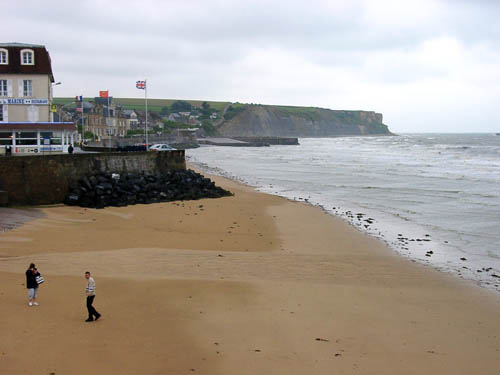
Memorial Day (Monday) honors all the men and women who have died in military service in the defense of our country. There were 1,465 USA deaths in the Battle of Normandy. In addition, 2,700 UK soldiers and 500 Canadian soldiers died. It is estimated that between 4,000 and 9,000 German soldiers died.D-Day, June 6, 1944, is a very important day in American history. Here is one of the photos I made of “Omaha” Beach on a rainy day in 2002. This is where many American soldiers landed.

"Omaha" Beach in Normandy. Photo by Ferrell Jenkins.

"Omaha" Beach in Normandy. Photo by Ferrell Jenkins.

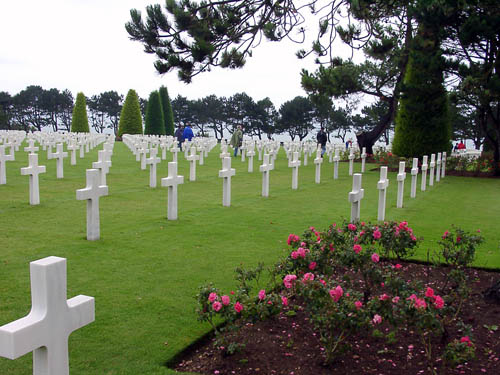
A visit to this area and especially to the American cemetery helps us realize what a great debt we owe to those who gave their lives while fighting for freedom. A few years ago, prior to his death, I visited regularly with a veteran of World War II who was at Normandy. I enjoyed hearing him talk about the war, and asking him questions. I was always encouraged when I left his home.

The American Cemetery at Omaha Beach in Normandy. Photo by F. Jenkins.

The American Cemetery at Omaha Beach in Normandy. Photo by F. Jenkins.

We should not apologize for what happened here. We must never rewrite this history!

The Aladdin Lamp gave light to all in the house

The New Dictionary of Cultural Literacy, provides this information about the Aladdin Lamp:

The subject of a story in the Arabian Nights. The young boy Aladdin acquires a magic lamp that, when rubbed, brings forth a genie, who grants Aladdin’s wishes to win the hand of the sultan’s daughter and to build a palace. The magician who first gave Aladdin the lamp steals it back, but Aladdin regains the lamp, and he and the sultan’s daughter live happily ever after.

The lamp that Americans of the 1930s and 1940s came to know as the Aladdin Lamp was already in use in Germany during the early part of the 20th century. The flat wick kerosene lamp was common in the rural south when I was a youngster, but the Aladdin Lamp provided much more light because the flame heated a frameless mantle that hung over the flame. We had one Aladdin Lamp which we kept in the “big room” where both my parents and I slept until during my earliest grammar school years. This was literally our “living room.”

All of my evening school work was done in the light of the bright Aladdin Lamp. I thought that was the brightest light I had ever seen at night, and it was.

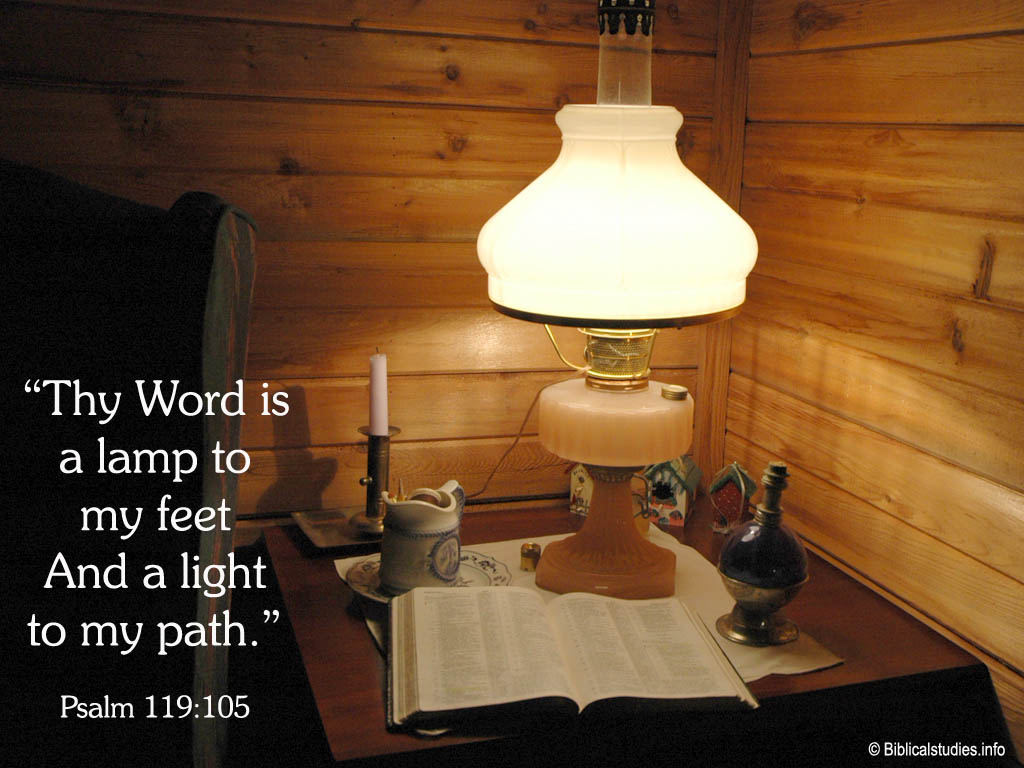
A few years ago, during a speaking engagement, I stayed with a fine family in Cullman, Alabama. They had the largest collection of Aladdin Lamps I have seen. Many of them have been refitted with electric fittings to make them usable today, like the one in our photo. I asked if he knew how much “wattage” one of the original lamps provided. He told me that it was about 60 watts.

The Aladdin Lamp provided light for all in the house. Photo by Ferrell Jenkins.

The Aladdin Lamp provided light for all in the house. Photo by Ferrell Jenkins.

Lamps like this provide us with a reminder of the wonderful illustration used by Jesus.

Again Jesus spoke to them, saying, “I am the light of the world. Whoever follows me will not walk in darkness, but will have the light of life.” (John 8:12 ESV)

And, we recall the illumination and guidance provided by the LORD and His word.

Your word is a lamp to my feet And a light to my path. (Psalm 119:105 NAS)

This photo has been prepared in a size large enough to be used in PowerPoint presentations by my preaching/teaching friends. Just click on the image for a larger one.

Sir William M. Ramsay – New Testament Scholar

As a student Ramsay had been influenced by Baur and the Tubingen School and doubted the historical trustworthiness of the New Testament. His studies in Asia Minor caused him to study the book of Acts, which he accepted as a document of the second half of the second century. He tells in The Bearing of Recent Discovery on the Trustworthiness of the New Testament how he came to change his mind about this. In a study of Acts 14, Ramsay saw that Luke listed Lystra and Derbe as cities of Lycaonia, but did not include Iconium (Acts 14:6). He thought this had been deliberately invented by Luke because he was under a false impression. Check maps you have in your Bible and various Bible Atlases. You will probably see that some of them still have this incorrect. The SN (Study Note) in the NET Bible contains this note:

Iconium was a city in Lycaonia about 90 mi (145 km) east southeast of Pisidian Antioch. It was the easternmost city of Phrygia.

This comment relies on the older classical location of Iconium, but it was not this way during the Roman Imperial period.

In The Bearing of Recent Discovery…, Ramsay says that the purpose of his book, St. Paul the Traveler and the Roman Citizen, is to show:

“that Luke is a historian of the first rank; not merely are his statements of fact trustworthy; he is possessed of the true historical sense; he fixes his mind on the idea and plan that rules in the evolution of history, and proportions the scale of his treatment to the importance of each incident. He seizes the important and critical events and shows their true nature at greater length, while he touches lightly or omits entirely as much that was valueless for his purpose. In short, this author should be placed along with the very greatest of historians” (222).

The people of Lystra spoke the Lycaonian language (14:11). They called Barnabas, Zeus, and Paul, Hermes (14:12). Inscriptions have been found that identify these particular gods with Lycaonia.

F. F. Bruce mentions his debt to the writings of Sir William Ramsay, and frequently calls attention to Ramsay’s works. Colin Hemer’s works on Acts and Revelation build on the work of Ramsay.

Dr. Mark W. Wilson, of Seven Churches Network has edited and updated at least four of Ramsay’s works: The Letters to the Seven Churches (Hendrickson), St. Paul the Traveler and Roman Citizen (Kregel), and Historical Commentary on First Corinthians (Kregel). This makes these older works much more valuable.

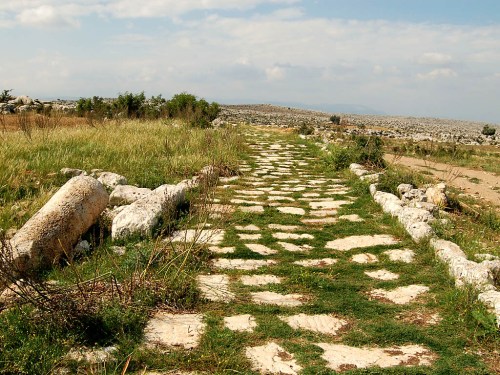
Our photo below shows a portion of a Roman road a few miles north of Tarsus, home of Saul of Tarsus. I think this is the route that would have been taken by Paul and Silas to connect them to the Cilician Gates and the Anatolian plateau. See Acts 15:41 – Acts 16:2.

Roman Road north of Tarsus. Note the fallen milestone. Photo by Ferrell Jenkins.

Roman Road north of Tarsus. Note the fallen milestone. Photo by Ferrell Jenkins.

Sir William M. Ramsay

William M. Ramsay (1851-1939), a native of Scotland, studied classics at the University of Aberdeen. In 1880 he won a traveling studentship to study in Asia Minor. For several decades he was able “to study the geography and archaeology of Roman proconsular Asia, Phyrgia, Lycaonia, Cappadocia, and Galatia” (Gasque, Sir William M. Ramsay Archaeologist and New Testament Scholar, 15; I am indebted to this work for much information about Ramsay). He was knighted in 1906.

Gasque’s book has recently been made available here by Rob Bradshaw of Biblical Studies.org.uk in either PDF or Scribd. Grab it while it is available. Rob is providing a wonderful service in making works like this available.

Some of Ramsay’s more significant writings include The Historical Geography of Asia Minor, The Cities and Bishoprics of Phrygia, St. Paul the Traveller and the Roman Citizen, The Bearing of Recent Discovery on the Trustworthiness of the New Testament, The Letters to the Seven Churches, and A Historical Commentary on St. Paul’s Epistles to the Galatians. He wrote many articles for the 9th edition of Encyclopedia Britannica and for the five-volume Dictionary of the Bible by Hastings, including “Roads and Travel in the New Testament.”

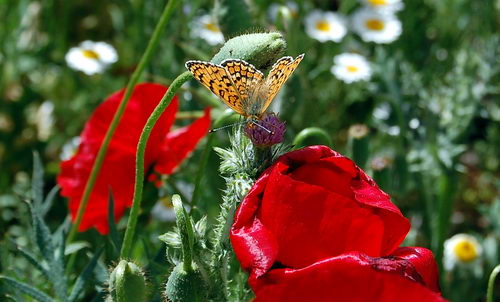
This photo of a butterfly among wild flowers was made west of Konya, Turkey. Konya was biblical Iconium (Acts 13:51 – Acts 14).

Spring wild flowers growing west of Konya, Turkey. Photo by Ferrell Jenkins.

Spring wild flowers growing west of Konya, Turkey. Photo by Ferrell Jenkins.

In the next post we will explain more about the significance of Ramsay to New Testament studies.

Colonial archaeologists and the Ishtar Gate

Recently we called attention to an article in The New York Times about Babylon. Writer Steven Lee Myers says,

Colonial archaeologists packed off its treasures to Europe a century ago.

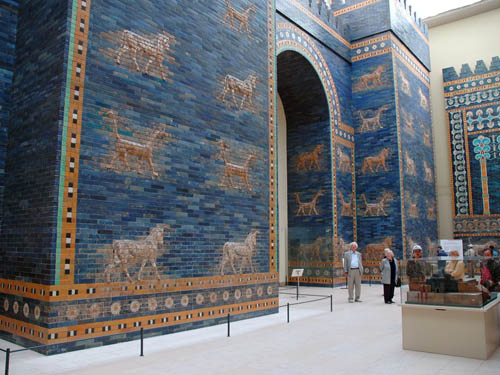
This statement seemed significant enough to be repeated under the photo of the miniaturized Ishtar Gate at the site. My immediate reaction to the statement is, “Well, aren’t we glad!” Anyone who has visited the Pergamum Museum in Berlin has seen the reconstructed Ishtar Gate. It looks like this.

Ishtar Gate in the Pergamum Museum of Berlin. Photo by Ferrell Jenkins.

Ishtar Gate in the Pergamum Museum of Berlin. Photo by Ferrell Jenkins.

Now, it’s not that the German archaeologists, under the direction of Robert Koldewey, “packed off” what you see here. All of these lions, bulls, and dragons were excavated from the mound of ancient Babylon between 1899 and 1912. Eventually they were taken to Berlin in 1926. Even under the Communist government of East Germany this gate was preserved. I saw it a few times before the Berlin Wall came down. Anyone able to travel to Berlin may see the Ishtar Gate as well as the reconstructed Procession Street. Can one say as much for the ruins of Babylon and the museum in Baghdad?

Babylon was once the greatest city of the world when the Neo-Babylonian Empire reigned supreme in the Ancient Near East (626-539 B.C.). The prophet Daniel was active in Babylon from 605 B.C. until after the fall of the city to the Persians (Daniel).  I can not imagine that he failed to see this gate.

Nebuchadnezzar was a megalomaniac. His pride is evident in the statement recorded by the prophet Daniel.

The king uttered these words: “Is this not the great Babylon that I have built for a royal residence by my own mighty strength and for my majestic honor?” (Daniel 4:30 NET Bible)

Babylon ruins reopen to tourists

The New York Times recently carried an article about the reopening of Babylon to tourists. Most of the attention is given to locals getting a chance to see Saddam Husein’s former palace built to overlook the ruins of the ancient city. Some of the photos are nice. (HT: Todd Bolen, BiblePlaces Blog)

Here is an article I published in Biblical Insights several years back.

– – – – – –

The site of Babylon is located about 55 miles southwest of Baghdad near Hillah in Iraq. The city was located on the River Euphrates, but is now a few miles east of the river on one of the canals. The rivers of Mesopotamia have frequently changed their course.

The earliest ancient name for Babylon, given in the table of nations, was Babel (Gen. 10:10). Babylon was ruled by Hammurabi, best known for his law code, in the 18th century B.C.

The city reached its peak during the Neo-Babylonian empire (626-539 B.C.). The Bible refers to Babylon as “the beauty of kingdoms, the glory of the Chaldeans’ pride” (Isaiah 13:19).

The greatest king of the Neo-Babylonian empire was Nebuchadnezzar (605-562 B.C.). There is abundant evidence of the activities of his reign. The best collections of artifacts are to be found in the British Museum in London and the Museum of the Near East (part of the Pergamon Museum) in Berlin. In Berlin one may see the reconstructed Procession Street, the Ishtar Gate, and the decorated facade of the Throne Room of Nebuchadnezzar from Babylon.

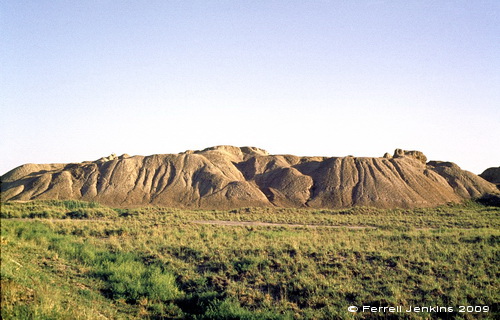
The photo below shows my first view of the site of ancient Babylon in 1970. Jeremiah 51:37 provides a wonderful caption: “And Babylon will become a heap of ruins.”

My first view of Babylon in 1970. Photo by Ferrell Jenkins.

My first view of Babylon in 1970. Photo by Ferrell Jenkins.

The kingdom of Judea had much contact with the Babylonians. Daniel was in the first group of Judean royal youths taken into Babylonian exile in 605 B.C., and was educated in the literature and language of Babylon (Daniel 1:1-6). Jerusalem fell to Nebuchadnezzar’s army March 15/16, 597 B.C. At that time Jehoiachin and 10,000 captives were taken as prisoners to Babylon (2 Kings 24:8-16). The prophet Ezekiel was among that group of captives. His prophetic call came in the fifth year of his exile by the river Chebar, a tributary of the Euphrates (Ezekiel 1:1-3).

The Judean captives remained in Babylon until the time of the Medes and Persians (Jeremiah 25:11-12). Cyrus, according to a clay cylinder now in the British Museum, allowed captives to return to their home land, build their temples and serve their own gods. This is in harmony with the biblical account in 2 Chronicles 36 and Ezra 1.

Excavations were conducted at Babylon by German archaeologists between 1899 and 1917. Discoveries included the main palace of Nebuchadnezzar, the procession street, some temples, and the Ishtar gate. The most fabulous of the items to be found have been reconstructed in the Museum of the Near East in Berlin. I have been able to visit Babylon only once in 1970.

Robert Jackson – Gospel Preacher

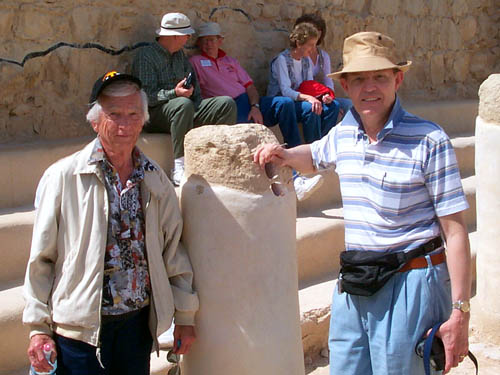
Word has come today of the passing of Robert Jackson, long-time minister of the gospel. I have many fond memories of time spent with Robert. He strengthened and encouraged me in one very difficult time in gospel work. I was especially pleased when he was able to join one of my tours in 2000. Phil Cavender made this photo in the synagogue at Masada.

Robert Jackson and Ferrell Jenkins at Masada in 2000.

Robert Jackson and Ferrell Jenkins at Masada in 2000.

Our deepest condolences go to Robert’s family. May the Lord raise up others like him!

He had to pass through Samaria

The Gospel of John informs us that Jesus had to pass through Samaria (4:4). The most direct travel route between Judea and Galilee was through Samaria. Josephus says, “it was the custom of the Galileans, when they came to the holy city at the festivals, to take their journeys through the country of the Samaritans….” (Ant. XX.118). He also informs us that the trip took three days (Life of Flavius Josephus 1.269). This route ran along the central mountain range, sometimes called the water-parting route.

Carson says geography determined that Jesus had to go through Samaria, but some scholars believe the term had indicates necessity. The following conversation with the woman of Samaria and the visit with the people of Sychar may explain why He had to go through Samaria.

We know that Jesus and His disciples encountered problems when traveling through Samaria (Luke 9:51-56). When Jesus sent out the twelve He told them not to enter any city of the Samaritans (Matthew 10:5).

The Jews, on their way from Galilee to Judea, could travel through Transjordan (Perea). It seems that Jesus took this route when He traveled through Jericho up to Jerusalem (Luke 19).

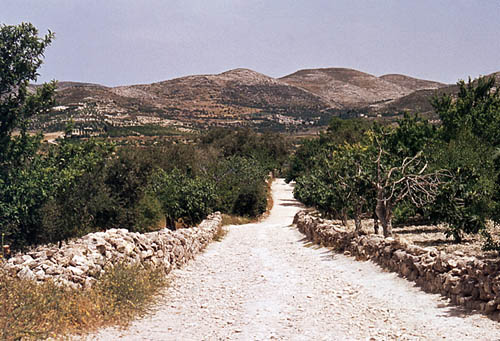
This photo was made in 1981 from the hill of Samaria with a view of the surrounding “mountains of Samaria” (Amos 3:9). One can easily imagine Jesus and His disciples traveling paths such as this.

samaria_path_mountains_1981-t