Category Archives: Travel

Traveling ancient roads together

Fifty six years ago today I married a wonderful young lady who has been by my side all this time. She wasn’t always able to travel with me, especially when our children were young, but she has shared many trips with me. She often comments about how important it is for couples to travel when they are young. That, of course, is the most difficult time for those with children. We still enjoy the memories we made on our first trip to Rome, Athens/Corinth, Egypt, Lebanon, Damascus, Jordan, and Israel in 1967.

How can you stay together for fifty six years? We made a commitment to each other and to God when we exchanged our vows. That’s it.

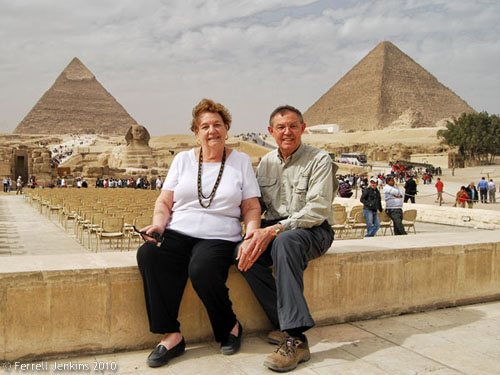
Ferrell and Elizabeth Jenkins at the Giza Pyramids.

Ferrell and Elizabeth Jenkins at the Giza Pyramids in 2009.

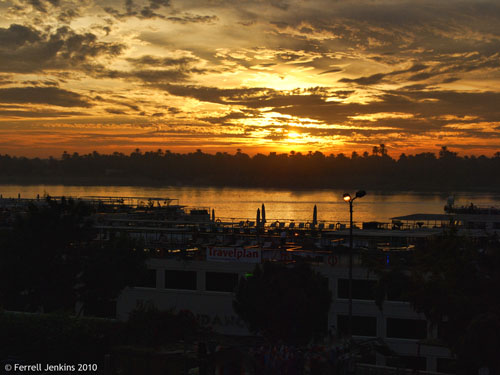
Sunset on the Nile

Our photo today was made from the temple at Kom Ombo overlooking the Nile River. The temple here was built by the Ptolemies in the 4th century B.C.

Sunset on the Nile at Kom Ombo. Photo by Ferrell Jenkins.

Sunset on the Nile at Kom Ombo. Photo by Ferrell Jenkins.

The biblical prophets warned that ancient Egypt would come to an end. By the time of the Ptolemies, successors to Alexander the Great, the power of the ancient empire was slowly slipping away.

This is what the Lord God says: I will destroy the idols and put an end to the false gods in Memphis. There will no longer be a prince from the land of Egypt. So I will instill fear in that land. (Ezekiel 30:13 CSB)

Sharks at Sharm el-Sheikh in the Sinai

Even our local TV news is reporting on the shark attacks at Sharm el-Sheikh in Egypt. Sharm el-Sheikh is located  on the tip of the Sinai Peninsula. The Huffington Post includes numerous links for those who have an interest in this subject here.

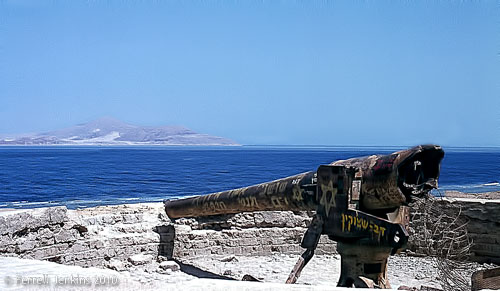
I have been in the Sinai peninsula several time, but have visited Sharm el-Sheikh only once in 1973. At that time the Sinai was under Israeli control. The site played an important role in the June War of 1967. The United Arab Republic closed the Straits of Tiran to Israeli shipping and blockaded all ships headed for Eilat. This narrow waterway and one of the Egyptian guns is seen in the old photo I made. Today Israel and Egypt share diplomatic relations and the Sinai is under Egyptian control. Sharm el-Sheikh is one of Egypt’s most popular resorts.

Egyptian gun taken by Israel at the Straits of Tiran in 1967. Photo by Ferrell Jenkins.

Egyptian gun taken by Israel at the Straits of Tiran in 1967. Photo by Ferrell Jenkins.

The Sinai is significant in biblical history because the traditional location of Mount Sinai is located there, equated with Jebel Musa.

The glory of the LORD settled on Mount Sinai, and the cloud covered it for six days. On the seventh day He called to Moses from the cloud. (Exodus 24:16 CSB)

Scholars are not in agreement on the location of Mount Sinai. In the beautiful revised edition of the Zondervan Atlas of the Bible, geographer Carl G. Rasmussen says,

… there are at least twelve different candidates for Mount Sinai: five in the southern part of the peninsula, four in the north, one in the center, one in Midian (Saudia Arabia), and another in Edom (southern Transjordan). — page 103

The pinnacle of the temple

A friend asks about the pinnacle of the temple.

Can you tell me where to find a diagram that shows the “pinnacle of the temple?” It looks as if the consensus is that it was Solomon’s porch. Anyone jumping off would land in the Kidron Valley.

In my reading the most common view is that the southeast corner of the Temple Mount is the place mentioned in Mark and Luke as  the pinnacle of the temple.

William Barclay says,

In the third temptation Jesus in imagination saw himself on the pinnacle of the Temple where Solomon’s Porch and the Royal Porch met. (The Gospel of Luke, in The Daily Study Bible Series, 44)

Benjamin Mazar, The Mountain of the Lord, shows a photo of the southeast corner of the wall with the comment that this “is known as the ‘pinnacle of the Temple’ (Mark 11:11; Luke 4:9),” page 149.

William Hendriksen says,

The present temptation, then, takes place in Jerusalem, to which the devil has led Jesus. Satan has set the Savior on the very pinnacle (literally wing) of the outer wall of the entire temple complex. The exact spot is not given. It may have been the roof-edge of Herod’s royal portico, overhanging the Kedron Valley, and looking down some four hundred fifty feet, a “dizzy height,” as Josephus points out (Antiq. XV.412). This spot was located southeast of the temple court, perhaps at or near the place from which, according to tradition, James, the Lord’s brother, was hurled down. See the very interesting account in Eusebius, EcclHist;, II.xxiii. ( New Testament Commentary : Exposition of the Gospel According to Luke, 237)

Here is the comment by Josephus,

… and this cloister deserves to be mentioned better than any other under the sun; for while the valley was very deep, and its bottom could not be seen, if you looked from above into the depth, this further vastly high elevation of the cloister stood upon that height, insomuch, that if anyone looked down from the top of the battlements, or down both those heights, he would be giddy, while his sight could not reach to such an immense depth. (Ant. 15:412)

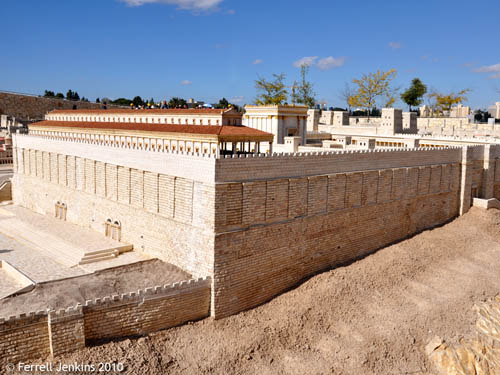
The photo below shows the southeast corner of the temple enclosure built by Herod the Great in the Second Temple model now displayed on the grounds of the Israel Museum.

Second Temple Model, Jerusalem. Photo by Ferrell Jenkins.

Second Temple Model view from the southeast. Photo by Ferrell Jenkins.

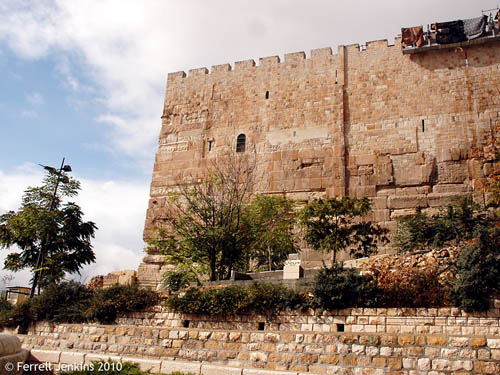
In the photo below we see the southeast corner from the east. The stone work includes a conglomerate ranging from later Moslem (at the top) to Herodian (at the bottom). At the present time one certainly would not fall into the Kidron Valley if he jumped from the top of the wall. I do not know what it might have been in the time of Jesus. I think a jump from the present wall to the land below would be deadly enough.

Southeast corner of Temple Mount enclosure. Photo by Ferrell Jenkins.

Southeast corner of Temple Mount enclosure. Photo by Ferrell Jenkins.

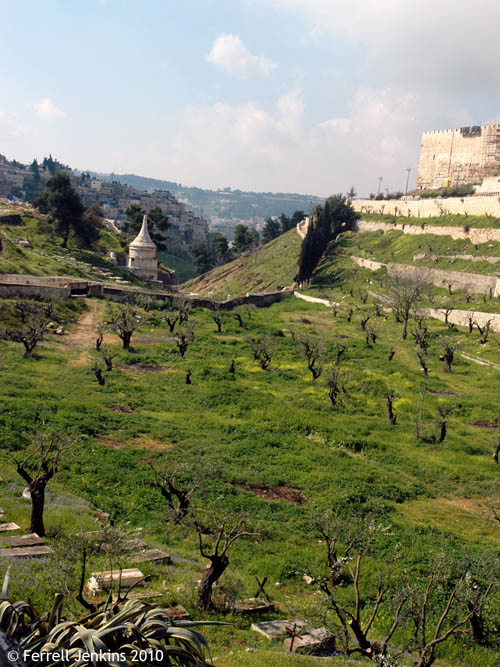
Here is a view of the Kidron Valley looking south. The “pinnacle of the temple” is visible in the upper right of the photo. The valley drops off rapidly near the point where you see the tomb on the left (Absalom’s Pillar).

Kidron Valley looking South. Photo by Ferrell Jenkins.

Kidron Valley looking South. Note wall in upper right. Photo by Ferrell Jenkins.

In a post to follow I will mention another view.

My friend asked where to find a diagram of the pinnacle of the temple. One might check the Image Library at Ritmeyer Archaeological Design here.

The photos above might be all one needs to illustrate the point. I have posted these in sizes large enough for use in teaching presentations.

Uriah’s trip from Jerusalem to Rabbah

Last evening I was looking at the biblical account of David’s battles against the Ammonites (2 Samuel 10-11).

In the spring of the year, at the time when kings normally conduct wars, David sent out Joab with his officers and the entire Israelite army. They defeated the Ammonites and besieged Rabbah. But David stayed behind in Jerusalem. (2 Samuel 11:1 NET)

You probably know the rest of the story. David is attracted to Bathsheba, commits adultery, learns Bathsheba is pregnant, calls Uriah home in hope that he will spend the night with Bathsheba. Uriah acted in the true warrior way by not enjoying the benefits of the marriage bed while his companions were camping in the open field. David sent Uriah back to the battle with a letter to Joab to put Uriah in the forefront of the battle.

Have you thought about the journey made by Uriah and the other Israelite soldiers as they traveled from Jerusalem to Rabbah and back? You know where Jerusalem is located. It is situated on the eastern side of the water parting ridge of Israel at an elevation of about 2400 feet above sea level. Numerous times we have discussed the journey from Jerusalem to the Jordan Valley. See here and here.

The distance from Jerusalem to the Dead Sea is not more than 20 miles. The elevation drops from about 2600 feet at the Mount of Olives to (currently) about 1384 feet below sea level at the surface of the Dead Sea. The point of crossing at the Jordan River would be a little higher. From there one must go up into the Transjordan Tableland to reach Rabbah. The general elevation of the Transjordan Tableland is about 3000 feet above sea level. Amman is about 2500 feet above sea level. That makes this a difficult route of travel.

Rabbah (Rabbath), the capital of ancient Ammon, is the site we now know as Amman, capital of Jordan. During the Hellenistic period the city was renamed Philadelphia.

The total distance from Jerusalem to Rabbah is about 40 miles as the crow flies. Men rarely travel like crows. The distance by road is longer and more difficult.

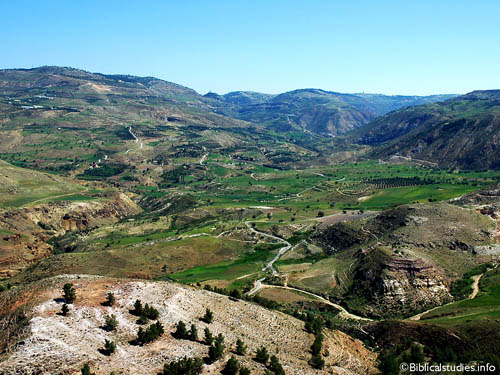
The photo I wish to share today was made in early April. It was made along a road a little east of the Jordan Valley and the Plains of Moab. From here you can see the terrain David’s men, including Joab and Uriah, had to travel on their way from Jerusalem to Rabbah. Modern Amman is located in the mountains we see on the horizon.

View looking east toward Amman. Photo by Ferrell Jenkins.

View looking east toward Amman. Photo by Ferrell Jenkins.

Learning routes of travel is one of the most important values in visiting the Bible lands. I hope this photo will help you with your study of the biblical account.

Half a millionaire!

Compared with many websites and blogs, reaching the 500,000 hits level, as we did a few minutes ago, is not much. However, for a blog by an obscure writer dealing with the narrow topic of the Bible lands this might be impressive.

During our first month online (May, 2007) we averaged about 81 hits a day. The blog was intended to provide an opportunity for friends of those traveling with me on a tour of Anatolian Turkey and the area of Paul’s first journey to keep in touch. I think there was no thought of continuing the blog on a regular basis.

When we discovered that there was continuing interest in the photographs and bits of information we provided, we continued to write. The growth of readership was gradual. This month we are averaging about 885 hits a day. At the annual professional meetings of the NEAS, ETS, and SBL several people who saw my name badge mentioned reading the blog.

We always have in mind those who preach and teach the Bible as we prepare our material.

Thank you for your interest in this material and for your kind words of encouragement from time to time. I must confess that some days I give thought to discontinuing the blog. Except for the evidence that some of the readers are finding this material helpful I probably would.

I am grateful to others who have called attention to my blog through their links and honorable mentions. Every time Todd Bolen mentions my posts at Bible Places Blog I note an uptick in hits. I continue to be thankful for WordPress and the platform provided to anyone who wishes to post their thoughts/materials on the Internet.

Just had a thought. What if I had a dollar for each hit? It was just a thought.

For this special occasion I wanted to share a nice photo of the site of Paneas /Banias/Caesarea Philippi. This photo shows the site of the Pan shrine at the foot of the vast rock which is part of the the foothills of Mount Hermon. A spring flows from beneath the rock to form the Banias River which in turn joins other branches to form the Jordan River. Click on the photo to get an image suitable for use in sermon and class presentation.
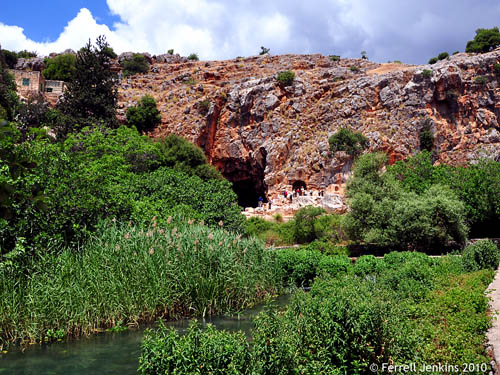
The site of Paneas was Caesarea Philippi in the time of Jesus. Photo by Ferrell Jenkins.

The site of Paneas was Caesarea Philippi in the time of Jesus. Photo by Ferrell Jenkins.

Here is the Bible text that goes with the photo.

13 Now when Jesus came into the district of Caesarea Philippi, He was asking His disciples, “Who do people say that the Son of Man is?”
14 And they said, “Some say John the Baptist; and others, Elijah; but still others, Jeremiah, or one of the prophets.”
15 He said to them, “But who do you say that I am?”
16 Simon Peter answered, “You are the Christ, the Son of the living God.”
17 And Jesus said to him, “Blessed are you, Simon Barjona, because flesh and blood did not reveal this to you, but My Father who is in heaven.
18 “I also say to you that you are Peter, and upon this rock I will build My church; and the gates of Hades will not overpower it.
19 “I will give you the keys of the kingdom of heaven; and whatever you bind on earth shall have been bound in heaven, and whatever you loose on earth shall have been loosed in heaven.” (Matthew 16:13-19 NAU)

Fascinating article on “Tyre and the Poets”

Joseph P. Duggan writes a fascinating article on “Tyre and the Poets” in The American Spectator. Notice a few excepts. I have added some of the pertinent Scripture references within the article in brackets.

For $50 a family can take a safe, radio-call taxi from the congested heart of Beirut to the uncluttered ancient waterfront of Tyre, a few miles north of the border with Israel. Lush banana plantations line the coastal route.…

The Western literary imagination is attracted to Tyre because it swirls amid the turbulent confluence of Biblical history and prophecy, Homeric and Virgilian epic, Ovidian mythology, and imperial extravagances of luxury and vindictive warfare. Tyre is the birthplace of real or fabulous personages including Cadmus, Europa, and Dido, the latter of whom colonized Carthage as others were to plant the Tyrian standard in Mediterranean ports as far west as Cádiz. The men who sailed with Columbus and colonized the Americas were descendants of long-ago colonists from Tyre.

With its expensive purple dye made from a local mollusk, the murex, Tyre was the center for the Versaces and Givenchys of the ancient world. Paris took Helen of Troy here on a shopping expedition to drape in sumptuous fabric the frame and face that launched a thousand ships.

King Hiram of Tyre was an ally and trading partner of Jerusalem’s King Solomon. Hiram sold Solomon the cedar timber for the great Temple. [1 Kings 9:11]

The Jerusalem-Tyre relationship was rocky then as now. The old Hebrew prophets inveighed against the wealthy city and its neighbor, Sidon, as hotbeds of heathenism and vice. Jezebel, a Tyrian princess (and Dido’s great-aunt) who married Israel’s King Ahab, came to an unhappy end. [Jezebel was the daughter of Ethbaal, king of the Sidonians. 1 Kings 16:31]

Egypt’s pharaohs many times made war against Tyre. Babylon under Nebuchadnezzar battered Tyre in the 6th century B.C. [Ezekiel 26:7; 29:18] Some 250 years later, Alexander the Great already had established effective mastery over the entire Levant when he demanded to offer sacrifice at Tyre to its principal god, Melqart. Alexander maintained that he himself was divine because, he said, he was a descendant of divine Herakles, of whom Melqart was only an avatar. The Tyrians didn’t cotton to that.

When diplomacy failed, Alexander mounted a costly siege whose success resulted in the slaughter of thousands of Tyrians, deportation into slavery for the survivors, and ruin of the splendid city. Modern historians say there was no strategic rationale for Alexander’s destruction of Tyre and its people. The impulse for the genocide was something like the rage of a deranged, spurned lover. Is “education” the answer to war and the world’s other problems? Consider that the Macedonian sociopath had for his personal tutor the serene and rational Stagirite who wrote the Nicomachean Ethics.

When Jesus walked up the short road from Galilee to Tyre, [Matthew 15:21] preaching to the people and driving a demon out of a local woman’s daughter, [Mark 7:26] he saw what Nebuchadnezzar and Alexander had done to the place, fulfilling the prophecies of, inter alia, Amos, Ezekiel [26-28], Zechariah and Jeremiah. He instructed his disciples to say to Galilean towns that rejected them and their preaching: “It shall be more tolerable for Tyre and Sidon at the judgment, than for thee.” [Matthew 11:21-22]

The entire article may be read here.

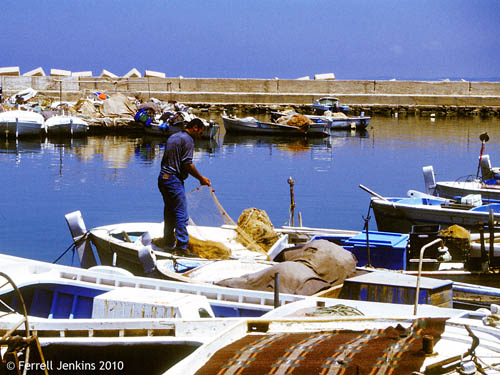
Our photo was made in the harbor of the island city of Tyre in 2002.

Fisherman working with nets at Tyre. Photo by Ferrell Jenkins.

Fisherman working with nets at Tyre. Photo by Ferrell Jenkins.

I will make you a bare rock. You shall be a place for the spreading of nets. You shall never be rebuilt, for I am the LORD; I have spoken, declares the Lord GOD. (Ezekiel 26:14 ESV)

HT: PaleoJudaica

Riblah — important in Old Testament history

Riblah served as a base of operation for the Egyptian Pharaoh Necho and the Babylonian King Nebuchadnezzar. The city is located on a broad plain about 50 miles south of Hamath (modern Hama in Syria), on the main road between Egypt and Mesopotamia. The Orontes River flows past the site on the west side. On a modern map you will locate Riblah in Syria immediately north of the border with Lebanon.

There is little more than a “country store” at the site today, but the name Riblah is preserved as Ribleh, Syria.

  • Pharaoh Necho imprisoned Jehoahaz, king of Judah, at Riblah. He later took him to Egypt where he died. The date was about 609 B.C. (2 Kings 23:31-34).
  • Zedekiah, puppet king of Judah, tried to escape capture by the Babylonians. He fled Jerusalem but was captured on the plains of Jericho and brought to Riblah. There Nebuchadnezzar passed sentence on him. His sons were slaughtered in his sight and he was bound with brass fetters and taken to Babylon. The date was 586 B.C. (2 Kings 25:5-7; see also Jeremiah 39:5-6; 52:9-10).
  • The officials of Zedekiah were taken to Riblah where they were put to death (2 Kings 25:19-21; see also Jeremiah 52:26-27).

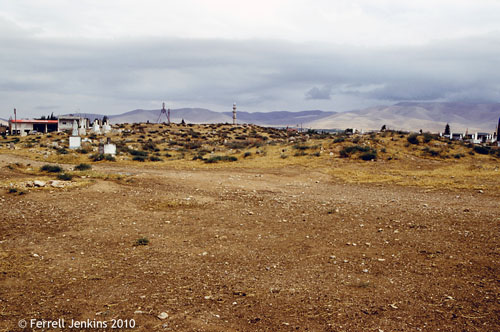
In 2002 a colleague and I spent several days visiting sites in Syria. Riblah was the most difficult to locate. Most folks, after seeing the site, would probably say, “What’s the big deal?”  Even though Riblah is mentioned only these few times in the Old Testament, it’s location makes it important in all movement between the south (Egypt and Israel) and Mesopotamia.

Riblah in the land of Hamath. Photo by Ferrell Jenkins.

Riblah in the land of Hamath. Photo by Ferrell Jenkins.

The slopes of this tell are now used as a cemetery. We know that this would make it difficult to negotiate rights to excavate.

This post was published March 2, 2009, but I had some slides scanned and am able to post a new photo of the tell of Riblah. A photo suitable for use in teaching is available by clicking on the image ago.

The apostles as gladiators

The apostle Paul compared the work of the apostles to that of gladiators in the arena. In writing to the Corinthians he says,

For I think that God has exhibited us apostles as last of all, like men sentenced to death, because we have become a spectacle to the world, to angels, and to men. (1 Corinthians 4:9 ESV)

As the last event of the day, the gladiator’s who were condemned to death were brought into the arena as a spectacle for the excited crowd. The word spectacle translates the Greek theatron, easy enough for everyone to understand the reference.

Leon Morris (Tyndale New Testament Commentary) calls attention to James Moffatt’s translation of this text.

The imagery is derived from the arena, as Moffatt’s rendering brings out, ‘God means us apostles to come in at the very end, like doomed gladiators in the arena!’

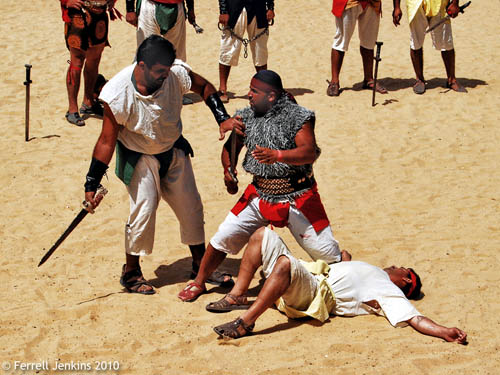
The photo below shows gladiators in the Roman hippodrome at the RACE (Roman Army and Chariot Experience)  show at Jerash, Jordan.

Gladiators in the Roman hippodrome at Jerash, Jordan. Photo by Ferrell Jenkins.

Gladiators in the Roman hippodrome at Jerash, Jordan. Photo by Ferrell Jenkins.

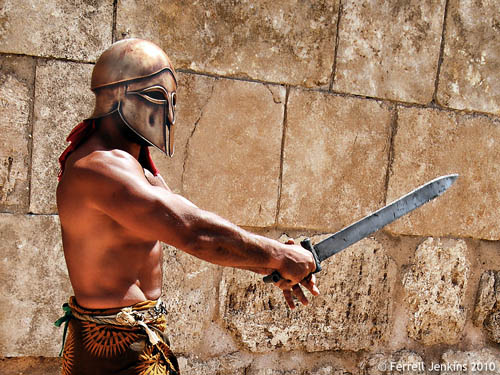
Here is a close up of one of the gladiators.

Gladiator in the RACE show, Jerash, Jordan. Photo by Ferrell Jenkins.

Gladiator in the RACE show, Jerash, Jordan. Photo by Ferrell Jenkins.

Both photos are available in a larger size suitable for use in teaching. Just click on the images.

David Padfield has several photos of gladiators here.

“Lands of the Bible” 2011 calendar

Lands of the Bible 2011 CalendarEveryone who has visited Israel, or those who wish they had, enjoy seeing good pictures of the lands of the Bible. Orange Circle Studio, a leading calendar publisher, produced a beautiful calendar for 2011 using the photographs of Todd Bolen.

A friend sent me a copy of the calendar as a gift. I enjoyed it as soon as I browsed through it, and expect to enjoy it for the next 14 months. I thought some of our readers who appreciate good photos of the Bible land would enjoy the calendar. Todd has a few of the calendars available at a discount price (postpaid). For more information go to the Bible Places Blog, or directly to the order page here.