
The judgment upon Edom is mentioned prominently in chapter 34 (verses 5, 6, 9; cf. the city of Bozrah, v. 6).
The most prominent place today within the ancient territory of Edom is Petra. Most people visit Petra to see the sculpted structures of the Nabateans. But the Nabateans came much later. The area was originally settled by the descendants of Esau, the brother of Jacob (Israel).
Our first photo, showing the desolate nature of the area, was made from a higher spot where several tourist hotels are located. To the right of center you will be able to see the parking lot and some of the buildings associated with the operation of the national park of Petra.
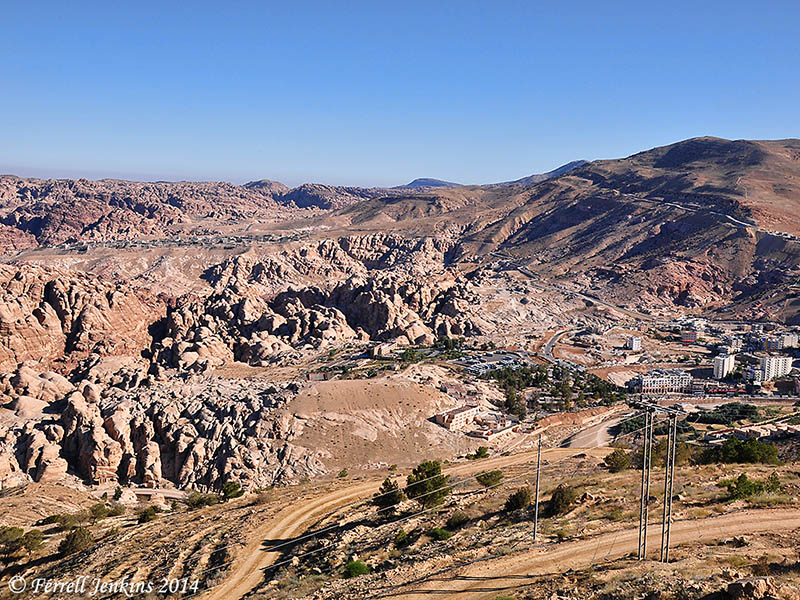
Petra is located within this ancient territory of Edom. Photo by Ferrell Jenkins.
Our next photo was made inside Petra, but our attention is drawn to the large, high, steep-sided, flattop mountain named Umm el-Biyarah. From this vantage the ancient Edomites felt impregnable.
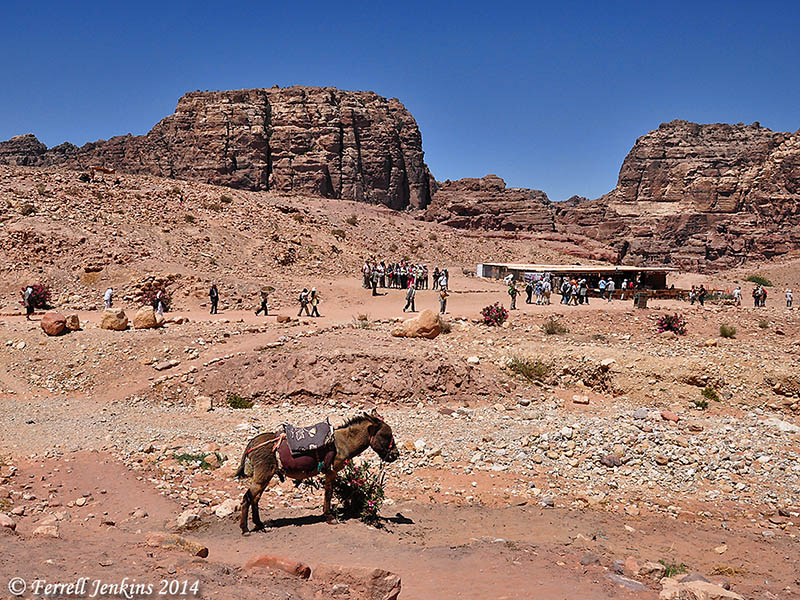
Umm el-Biyarah, the ancient stronghold of Esau. Photo by Ferrell Jenkins.
For those who wish to see a more comprehensive discussion about Edom, I call your attention to the succinct discussion by J. Alec Motyer in the Tyndale Old Testament Commentaries.
Edom is presented as a case in point. Even though Esau himself had no capacity for sustained animosity (Gen. 33:4–16), it was with him that relations with Jacob were soured (Gen. 27:41) and by the time of Numbers 20:14–21 hostility had become an established pattern. Saul made war on Edom (1 Sam. 14:47). David became the only king to subdue and annex Edom (2 Sam. 8:14; cf. 1 Kgs 11:15–16). Edom rebelled against Solomon (1 Kgs 11:1–17, 23–25) and was still rebelling a century later (2 Kgs 8:20). Fifty years further on, there was still fighting (2 Kgs 14:7, 10), and at the fall of Jerusalem the bitter hostility of Edom became notorious (Ps. 137:7; Obad. 10–14). Consequently Amos’ accusation (1:11) of perpetual hatred is well founded. Jeremiah 49:7–22 shows that, even prior to Edom’s behaviour at Jerusalem’s fall, the idea of judgment on Edom was part of the prophetic worldview. Obadiah saw Edom as both a place and a symbol: meriting judgment in its own right but also picturing the judgment which would mark the Day of the Lord. He was not innovating: in Psalms 60:8; 83:6, Edom had already a symbolic place in the theme of hostility to Zion. Two factors make Edom specially fit to stand as a motif for the whole world in the final judgment: first, its ceaseless hostility to the Lord’s people, and secondly the fact that it was only to David that it ever really succumbed. Thus Ezekiel, foreseeing the coming David (34:23), moves immediately to the conquest of Edom (35:1–15). Isaiah stands in this same tradition by following his forecast of the King (ch. 33) with the rout of Edom in the final judgment (cf. 11:14; 63:1–6). Recollecting 29:22 and the establishing of the family of Jacob, the overthrow of Edom/Esau makes the End the exact fulfilment of the beginning (Gen. 25:23). The purposes of God according to election stand.



 Ferrell's Travel Blog
Good reading for the weekend
Noah
There has been much discussion in the past few weeks about the Noah movie. In last Saturday’s roundup, Todd Bolen called attention to the blog of Dr. Brian Mattson. In a post entitled “Sympathy for the Devil” Mattson comments about the movie. He reminds us of the following important point: The Bible is not the text for this movie. Several writers, and speakers, have pointed out that about the only things in common between the Noah movie and the Noah/Flood story of the Bible are a man named Noah, an ark, and water.
Mattson claims and documents the philosophical background of the director of the movie in Gnosticism and Kabbalah. I am certain that many people will see the movie and have no awareness of that, just as many ready Paul’s epistle to the Colossians, and John’s epistles without understanding how they are responding to early Gnostic doctrines.
Here is the link to Mattson’s articles:
The Wife of Jesus, again.
It is almost Easter, so we can expect a rerun on various strange views about Jesus. I first called attention to this speculation about the wife of Jesus back in September, 2012, here. Todd Bolen recently commented on the same material that is now getting new attention. Here, he provides links to the article in the New York Times, and the Harvard Theological Review article by Dr. Karen King (available for download). The Times of Israel article is available here.
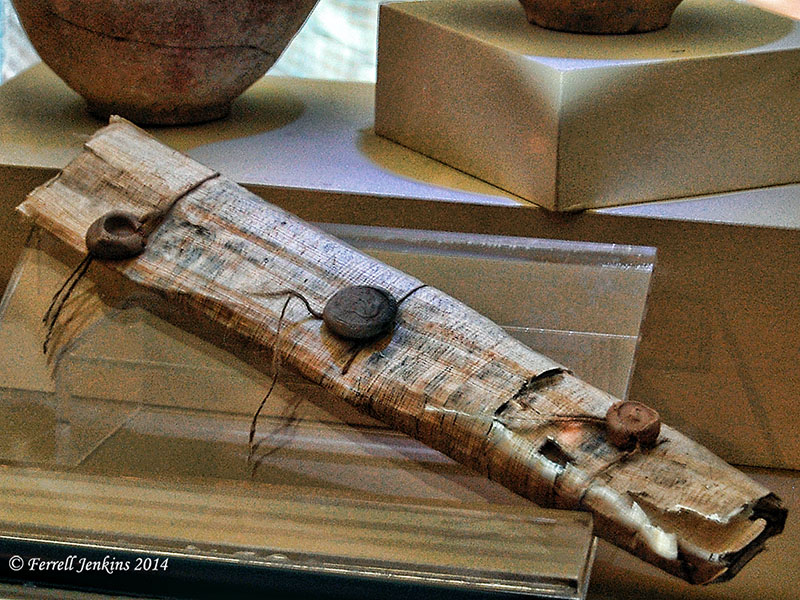
The GJW (Gospel of Jesus Wife) papyrus fragment possibly claiming that Jesus had a wife. Photo: Harvard University, Dr. Karen L. King.
Bolen summarizes the pertinent material, showing that the document tells us nothing about 1st century events:
Larry Hurtado has written three posts about the papyrus document. Begin here and then scroll back for the other two.
Wild Boar at Caesarea Philippi
Carl Rasmussen’s recent Israel student group encountered a herd of about 15 wild boar at Caesarea Philippi. He provides some nice photos to back up his claim, and discusses the various Biblical references about swine. Access the HolyLandPhotos’ Blog here.
Using Google Books
Rob Bradshaw is making many books and journals available in PDF format. I check his BiblicalStudies.org.uk site regularly for materials that might be helpful in my study. Recently he called attention to a short video by Tim Bulkeley on how to access Bible commentaries without a library. The helpful, brief video is here.
2 Comments
Posted in Bible Lands, Bible Study, Biblical Studies, blog, Books, Culture, Israel, New Testament, Old Testament, Photography, Travel
Tagged Commentaries, Noah, Todd Bolen, Wife of Jesus